Infant Kitten Care: Feeding and Warmth Guide
By Dr. Zubair Khalid, DVM, MS, PhD ·
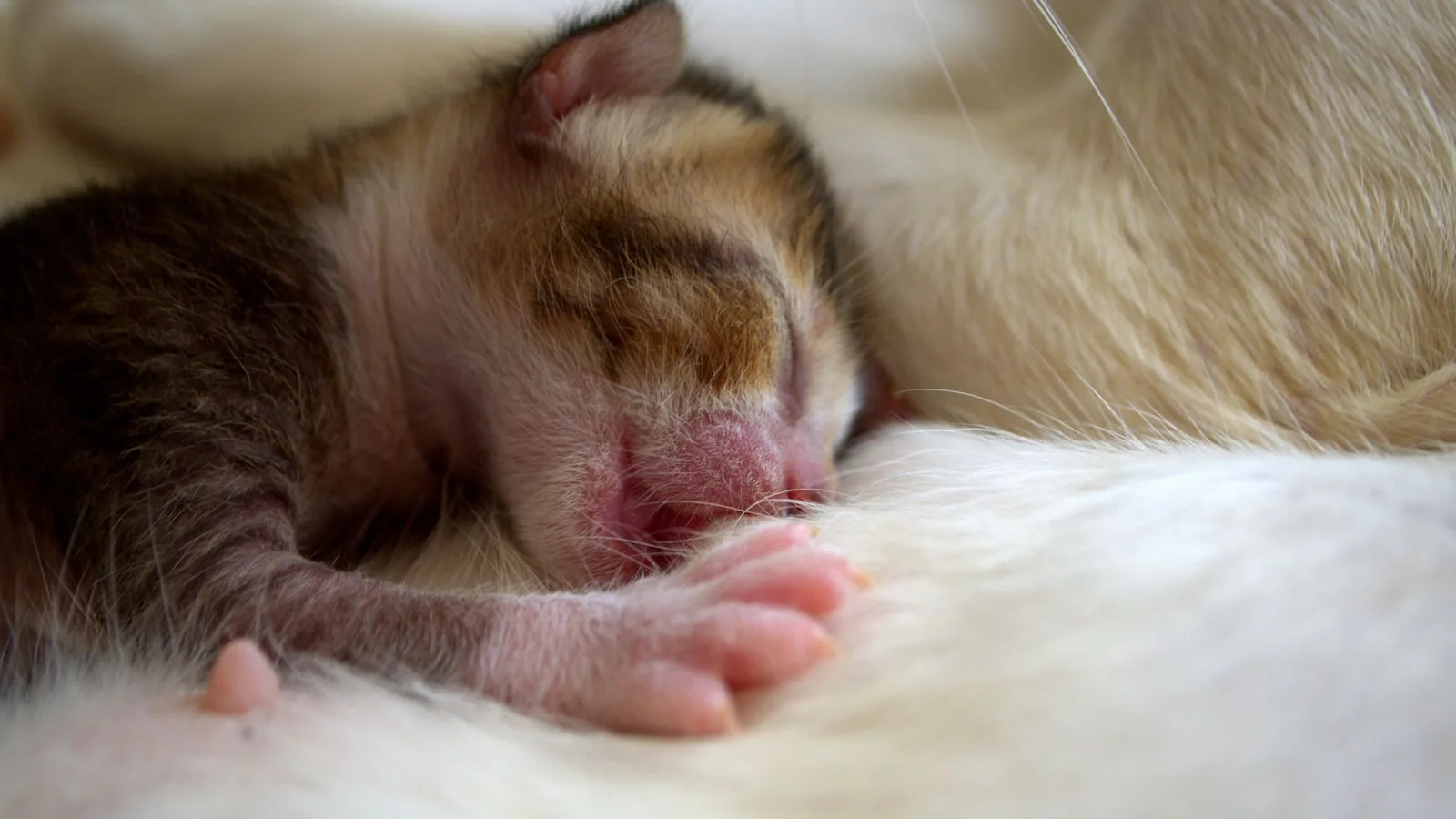
Caring for an infant kitten, from birth to roughly four weeks of age, is one of the most demanding jobs in animal care. The kitten cannot regulate its own body heat, cannot feed itself, and depends entirely on its mother or on human caregivers. The two most urgent priorities are warmth and feeding. A cold kitten cannot digest food properly, and a kitten fed with poor technique can inhale formula into its lungs [1][2]. This guide explains why the first weeks are so fragile, how to provide safe warmth, how to feed an infant kitten correctly, and when a veterinarian is needed. Every kitten is different, so this article is a starting point, not a substitute for veterinary care.
At a Glance: Infant Kitten Care Checklist
| Step | Action | Why it matters |
|---|---|---|
| 1 | Set up a draft-free nest with a heat source covering only part of the floor | Newborns cannot regulate body heat, and hypothermia is common in sick kittens [3][4] |
| 2 | Let the kitten nurse within the first 24 hours if the queen is available | Colostrum supports the immune system [2] |
| 3 | Feed a commercial kitten milk replacer with careful technique | Replacers match queen's milk, and good technique reduces aspiration risk [1][2] |
| 4 | Weigh the kitten daily and track activity and reflexes | Low birth weight and reduced vitality are linked to higher mortality [5][6] |
| 5 | Call a veterinarian for any kitten that is cold, inactive, or not gaining weight | Sick neonates need supportive care quickly [3] |
Supplies you will need: a warm, draft-free nest with a heat source, a commercial kitten milk replacer, bottles and nipples designed for kittens, a digital scale for daily weights, and a notebook or chart to record feedings, weights, and observations [7][1][2][6].
Why the First Weeks Are Critical
The period from birth to weaning is brief, but it is one of the most intensive phases of a cat's life [8]. During this time, the kitten adapts to life outside the uterus and prepares for the relative independence of the post-weaning period [8]. Lawler described five transitional zones that define this journey: organogenesis, parturition, the neonatal period of roughly the first 2 weeks, the maturation phase from about day 21 to 28, and weaning itself [8]. Each zone has its own risks and its own care requirements.
Neonatal kittens are not small adult cats [7]. Their anatomy and physiology differ from adults in ways that change how physical examination findings should be interpreted [7]. Heart rate, respiratory rate, temperature, reflexes, and laboratory values all have neonatal reference ranges that differ from adult values [7][5]. A veterinarian who is familiar with neonatal medicine can perform a systematic assessment and recognize the subtle signs of illness that an owner might miss [7]. The queen's health also matters. A thorough evaluation of the litter and the mother is part of any neonatal assessment [7].
The mortality data show why vigilance matters. In a study of 294 Domestic Shorthair kittens, birth weight was closely related to survivability [6]. Slightly more than half of the nonsurviving kittens lost at 0 to 3 days of life were stillborn [6]. Abnormal gross anatomy was not a major factor in neonatal death, which means that most losses were related to birth weight, vigor, and care [6]. Mortality was lowest at the fifth parity and in litters of five kittens [6]. Litters of one kitten had high mortality [6]. Smaller queens tended to deliver fewer kittens per litter, but their kittens had better viability [6]. Overweight queens experienced increased mortality of kittens [6]. Low birth weight kittens survived less often than normal birth weight kittens, even within the same litter [6].
The practical takeaway is that the first three days are the highest-risk window and that birth weight is one of the most useful predictors of survival [6]. Daily weighing is not optional for an orphaned or hand-fed litter.
Warmth First: Helping Infant Kittens Stay Warm
Why Newborn Kittens Lose Heat Quickly
A newborn kitten cannot control its body temperature the way an adult cat does. It relies on the queen's body heat and on the warmth of the nest. When the queen is absent, or when the kitten is too weak to snuggle close, body temperature falls quickly.
Hypothermia is a consistent finding in sick kittens. Fading kittens are often hypothermic [3]. A reported case of a malnourished kitten described mild hypothermia along with a low body condition score [4]. The pattern is clear: when a kitten is unwell, temperature drops, and a dropping temperature makes the kitten more unwell.
Setting Up a Warm Nest
The goal of warming is to prevent chilling without overheating. A heat source that covers only part of the nest allows the kitten to move away if it becomes too warm. The nest should be draft-free and large enough for the kitten to choose its own comfortable spot.
Temperature is one of the clinical parameters used to assess newborn vitality [5]. Owners can do a simpler version at home: check the kitten's body temperature, weigh it daily, and watch its activity level. Check the nest several times a day. A kitten that is too warm will move away from the heat source and may seem restless. A kitten that is too cold will pile onto its littermates or cry. The queen, if present, will usually adjust her position to keep the kittens warm, but an orphaned kitten depends on the caregiver to make these adjustments.
Recognizing Hypothermia
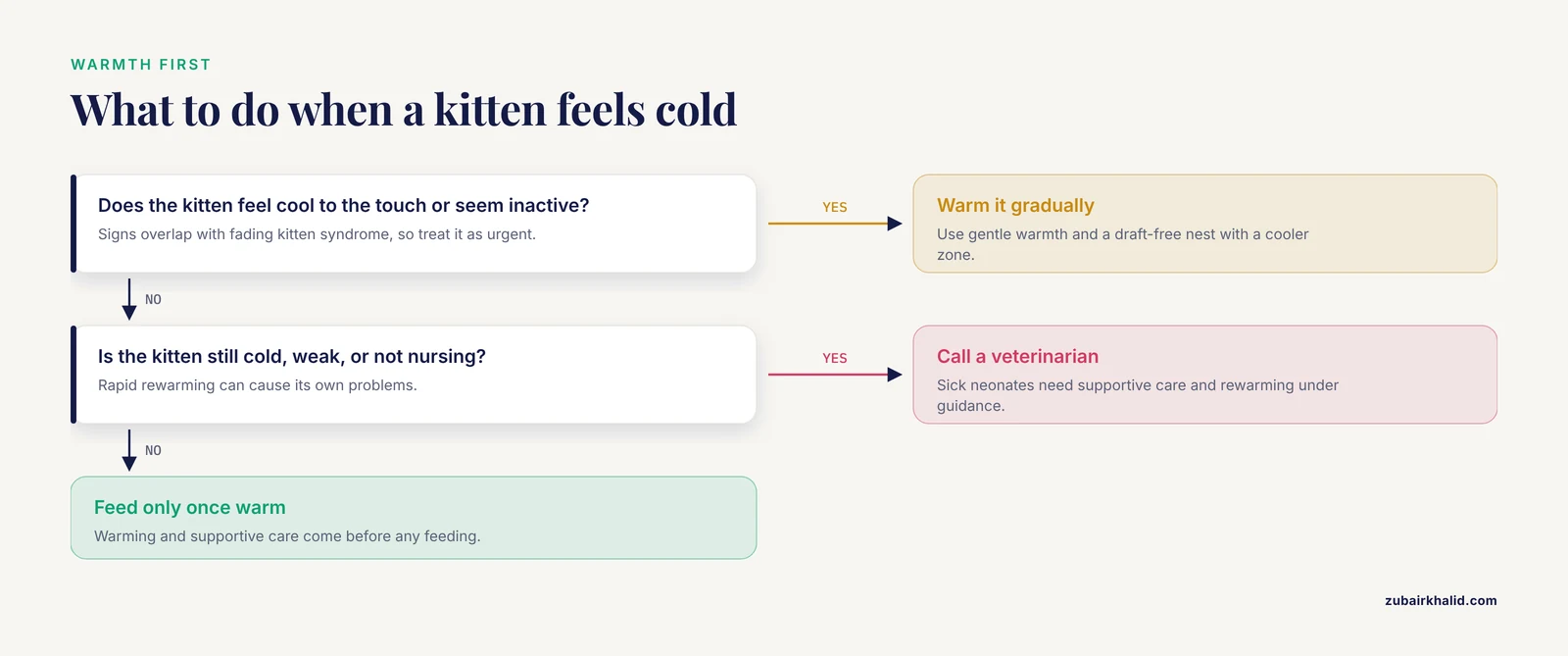
A kitten that feels cool to the touch, is inactive, or is not nursing may be hypothermic [3]. The signs of hypothermia overlap with the signs of fading kitten syndrome [3]. Because most neonatal diseases look alike, a specific cause cannot usually be determined from clinical signs alone [3]. A detailed physical examination by a veterinarian is needed to identify the underlying problem [3].
Rewarming should be gradual. A kitten that is already sick should be rewarmed under veterinary guidance, because rapid rewarming can cause its own problems [3].
Feeding Infant Kittens Safely
Colostrum: The First 24 Hours
Colostrum is the first milk secreted by the queen, and it is most critical during the first 24 hours, when immunoglobulin absorption is highest [2]. Colostrum supports the immune system and is essential for neonatal kitten health [2]. Kittens absorb protective factors from colostrum during this narrow window, and no milk replacer can fully replace them.
Kittens born by dystocia or cesarean section are at higher risk for death and may be too weak to nurse effectively [2][5]. These kittens need help to latch on, and they need colostrum within the first day of life [2]. If the queen is healthy and willing, allow the kitten to nurse as soon as possible after birth [2].
Choosing a Milk Replacer
When the queen is unavailable, cannot produce milk, or rejects the kitten, a commercial kitten milk replacer is the appropriate choice. These products are specifically formulated to replicate queen's milk [2]. They are designed to match the protein, fat, carbohydrate, vitamin, and mineral profile that a kitten needs.
Other products are not safe substitutes. In one reported case, a two-month-old kitten developed progressive abdominal distension, hair loss, swelling of the distal forelimbs, and poor body condition after uncontrolled feeding with nutritionally inadequate wet food [4]. Testing revealed macrocytic anemia, leukocytosis, mild hypoalbuminemia, elevated liver enzyme activity, and reduced calcium and phosphate concentrations [4]. The kitten also had mild hypothermia and a low body condition score [4]. The case is a reminder that the quality of the diet matters as much as the quantity.
Bottle Feeding Technique
Bottle feeding a neonatal kitten requires meticulous attention to technique, timing, and physiologic considerations [2]. The most serious risk is aspiration, in which formula enters the airways instead of the stomach. Aspiration can lead to aspiration pneumonia [1].
In a research setting, infant rhesus macaques fed with kitten bottles or syringes had a relatively high risk of aspiration pneumonia [1]. The same anatomical risk applies to kittens. The researchers developed a refined feeding device that eliminated aspiration pneumonia in their infants, and they concluded that careful technique and appropriate equipment make feeding safer [1].
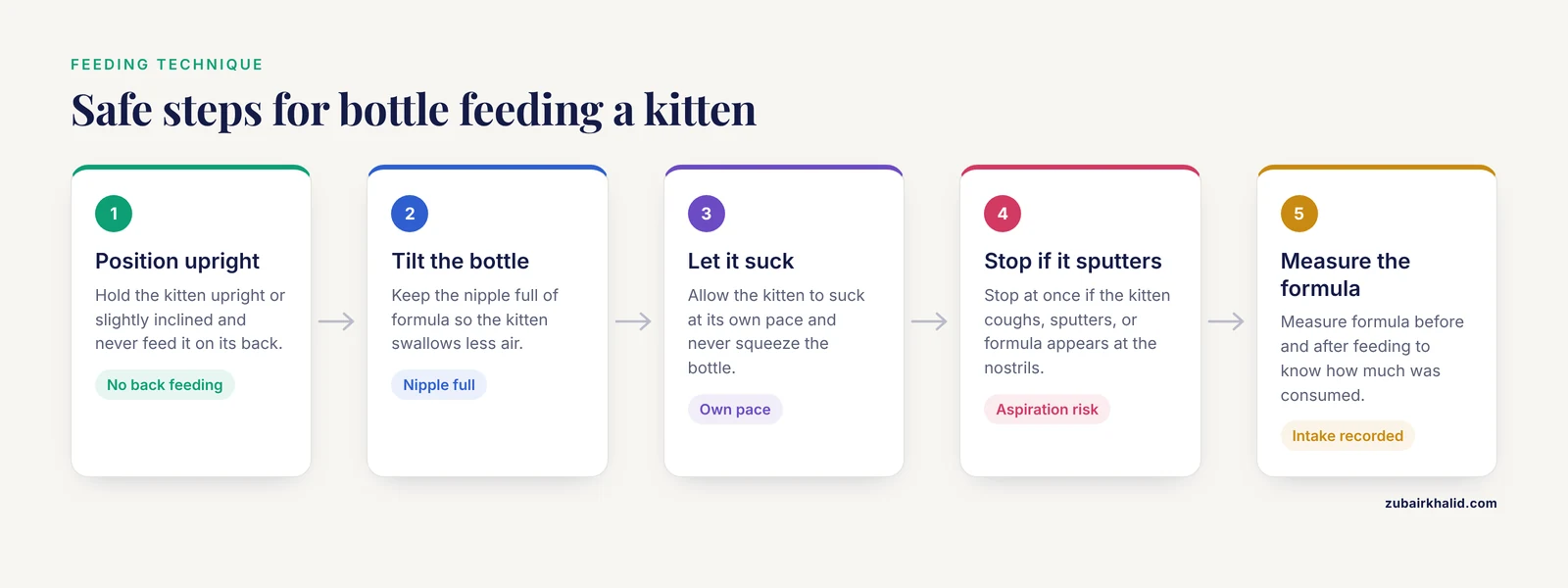
Practical points for safe bottle feeding:
- Hold the kitten in a natural, upright or slightly inclined position. Never feed on the back.
- Tilt the bottle so the nipple remains full of formula, which reduces the amount of air the kitten swallows.
- Let the kitten suck at its own pace. Do not squeeze the bottle to force formula.
- Stop immediately if the kitten coughs, sputters, or formula appears at the nostrils.
- Measure the formula before and after feeding so you know exactly how much the kitten consumed [1].
After feeding, place the kitten back in the warm nest and monitor it briefly. A kitten that coughs or sputters after feeding needs veterinary attention [1].
Feeding Schedule and Amounts
The exact schedule and volume depend on the kitten's age, weight, health, and growth rate. A veterinarian should set the initial plan. Infant kittens need frequent, small meals because their digestive systems are immature and their energy needs are high [2]. The interval between feedings should be short enough to prevent hunger, dehydration, and low blood sugar, but the precise timing should come from a veterinary professional.
One challenge with bottle feeding is knowing how much formula the kitten actually consumed [1]. Weighing the kitten daily, and measuring formula before and after each feeding, gives the caregiver objective data [1]. A kitten that is not consuming enough will fail to gain weight, and that is an early warning sign [6].
As the kitten grows, the schedule changes. The maturation phase, from about day 21 to 28, is when the kitten begins transitioning toward solid food [8]. A veterinarian can help you adjust the feeding plan during this transition.
Weight Gain and Growth Checks
Birth weight is closely related to survival [6]. Low birth weight kittens survive less often than normal birth weight kittens, even within the same litter [6]. Weigh the kitten at the same time each day, on the same scale, and record the number. A kitten that fails to gain weight, or that loses weight, needs veterinary attention promptly [7][6].
Weight is also part of the clinical assessment of newborn vitality [5]. Kittens with better Apgar scores at birth tend to have better weights and vital signs [5].
Recognizing Problems in Infant Kittens
Vitality Scoring at Birth
The APGAR score, which stands for Appearance, Pulse, Grimace, Activity, and Respiration, is a birth assessment method used to identify at-risk newborns [2][5]. It was originally developed for human babies and has been adapted for kittens. The score is calculated at birth and repeated at intervals to track recovery [5].
In one study, 32 neonates were evaluated, with 19 born normally and 13 delivered by emergency cesarean section [5]. The cesarean group had significantly lower Apgar scores, lower oxygen saturation, higher blood glucose, reduced reflexes, and lower respiratory rates at birth and at 10 and 60 minutes after birth [5]. The mortality rate in the study was 15.6% (5 of 32 kittens) [5]. Early mortality, from 0 to 2 days of age, accounted for 80% of the deaths [5].
The message for caregivers is straightforward: kittens born by emergency cesarean section are more fragile and need closer monitoring [2][5]. If your kitten was born by cesarean, expect to provide extra support with warmth, nursing, and colostrum intake, and have a veterinarian examine the kitten early [2][5].
Fading Kitten Syndrome
Fading kitten syndrome is a term used when one or more kittens in a litter are born appearing healthy but gradually become inactive, sick, and die [3]. Typically, faders are kittens that die during the first two weeks of life [3]. The causes are many and include infectious, toxic, traumatic, metabolic, and genetic diseases [3].
Regardless of the underlying cause, the approach to a sick neonate is similar [3]. Supportive care is the first priority, followed by a detailed physical examination [3]. Once the cause is identified, the treatment protocol can be adjusted [3]. Most perinatal and neonatal diseases present similarly, and a specific cause cannot usually be determined from clinical signs alone [3].
Owners should monitor the litter constantly and look for the most subtle signs of illness [7]. A kitten that is not gaining weight, is less active than its littermates, or is not nursing as vigorously as before deserves attention [7][6]. Early recognition gives the veterinarian the best chance to intervene [7].
Challenges in Examining a Sick Kitten
Neonatal kittens have distinct physiological differences from adults, and some procedures are more difficult to perform in neonates, such as blood collection [3]. Some diagnostic tests are harder to interpret, such as radiography [3]. These challenges are why a sick newborn should be managed by a veterinary team with experience in neonatology [7][3].
Common Mistakes in Infant Kitten Care
- Feeding a kitten on its back or forcing formula, which increases the risk of aspiration [1][2]
- Using a product that is not a commercial kitten milk replacer [2]
- Failing to weigh the kitten daily
- Assuming a quiet, inactive kitten is just sleeping [3]
- Delaying veterinary care for a kitten that is cold, weak, or not nursing [7][3]
- Trying to feed a kitten that is still cold, since warming and supportive care come first in a sick neonate [3]
- Heating the entire nest uniformly without giving the kitten a cooler zone
- Ignoring the queen, because the health of the mother affects the health of the litter [7]
Limitations and When to Contact a Veterinarian
This article is educational and is not a substitute for veterinary diagnosis or treatment. Individual cases vary, and a kitten that seems fine can decline quickly [7]. Contact a veterinarian immediately if an infant kitten:
- Feels cold to the touch or has a low temperature
- Is inactive, lethargic, or unresponsive
- Is not nursing or is not gaining weight
- Coughs, sputters, or has formula coming from the nose during feeding [1]
- Was born by cesarean section and seems weaker than expected [5]
- Has diarrhea, vomiting, or a swollen belly
- Is from a litter where another kitten has already died [3]
Neonatal kittens have distinct physiological differences from adults, and some procedures are more difficult in neonates [3]. An experienced veterinary team should manage any sick newborn [7][3]. If the queen is present, she should be examined too, because her health affects the health of the litter [7][6].
Formula Preparation, Storage, and Bottle Hygiene
Use a commercial kitten milk replacer and follow the manufacturer's mixing ratio exactly [2]. Mix with clean drinking water in a clean container. Measure the water first, then add powder with a level scoop. Do not pack the powder or estimate by eye; a mix that is too thick or too watery can cause digestive upset. Stir or swirl until no dry clumps remain. Prepare only what you need for the next feedings, because a large batch sits longer and has more chance to become contaminated.
Warming Without Hotspots
Warm refrigerated formula gently by setting the bottle in a cup of warm water. Shake or swirl, then test a drop on your inner wrist. Do not microwave formula. Microwave heating is uneven and can leave hot pockets that burn a kitten's mouth even when the bottle feels cool to the touch. Never feed formula straight from the refrigerator.
Storage and Discarding
| Situation | Safe action |
|---|---|
| - | - |
| Mixed formula not yet fed | Cover, label with the mixing time, and refrigerate promptly |
| Formula left in the bottle after a feed | Discard |
| Bottle warmed but refused | Discard |
| Bottle and nipple after use | Wash, rinse, sanitize, and air dry |
Do not reuse formula that has been warmed and then returned to the refrigerator. If a batch has been out at room temperature for a long period, throw it away. When in doubt, mix fresh.
Bottle and Nipple Hygiene
Wash bottles, nipples, and mixing utensils after every feeding with hot soapy water and a bottle brush. Rinse thoroughly, then sanitize by boiling or by the method recommended for the bottle. Air dry on a clean towel. Clean the nipple and bottle neck carefully, since milk residue collects there. Replace nipples that are cracked, stretched, or soft. Wash your hands before preparing formula and before feeding. Dirty equipment can introduce bacteria that cause diarrhea, poor feeding, or digestive upset. A kitten with diarrhea, vomiting, or a swollen abdomen needs veterinary advice.
Stimulating Elimination and Maintaining Kitten Hygiene
Neonatal kittens do not eliminate without stimulation during the first few weeks of life. In normal circumstances, the queen licks each kitten's perineal area after feeding, and this gentle stimulation triggers urination and defecation [2]. An orphaned kitten needs the caregiver to perform this task after every feeding until about three weeks of age, when elimination becomes voluntary.
How to Stimulate Elimination
After each feeding, hold the kitten in a warm towel and gently stroke the perineal area, the region between the genitals and the anus, with a warm, damp cotton ball or soft cloth. Use light pressure and a circular or back-and-forth motion. Most kittens urinate within seconds and pass stool within a minute. Continue until the kitten stops producing urine or stool, then stop. Stimulation should be repeated after every feeding, day and night.
What Normal Urine and Stool Look Like
Normal urine is pale yellow, clear, and nearly odorless. Normal stool is soft but formed, yellowish-brown or tan, and passed one to four times daily. The exact frequency varies with age and formula, so the pattern that matters is the one that is consistent for that kitten.
Keeping the Rear End Clean and Dry
After stimulation, wipe the perineum with a clean, damp cloth and pat it dry. Urine and feces left on the skin cause scalding, redness, and infection. Change the bedding whenever it becomes damp or soiled. Do not use baby wipes or harsh soaps; warm water on a soft cloth is sufficient. A thin layer of a pet-safe barrier ointment can protect skin that is already irritated, but ask a veterinarian before applying any product.
When to Contact a Veterinarian
Contact a veterinarian if a kitten has not passed stool for more than 48 hours, strains without producing stool, or passes hard, dry pellets. Diarrhea is also a concern because it dehydrates kittens quickly; watery, foul-smelling, or frequent stools warrant veterinary advice. Redness, swelling, discharge, or raw skin around the perineum, and blood in the urine or stool, also require attention. A kitten that cries when stimulated may have a urinary tract problem or skin irritation. Do not give laxatives, enemas, or any medication without veterinary instruction.
Supporting the Queen and Recognizing Maternal Problems
The queen’s health directly affects the survival of the litter. A lactating queen has high energy and nutrient demands, and she needs a complete, energy-dense diet formulated for growth or lactation [2]. Fresh water must be available at all times, because milk production requires substantial fluid intake. Feed the queen in a quiet place away from the nest so she can eat without leaving the kittens unprotected for long.
Provide a quiet, low-stress nesting area. The queen needs privacy, soft bedding, and a stable location where she is not disturbed by noise, other pets, or frequent handling. Stress can disrupt maternal behavior and reduce milk letdown. If the queen is anxious, she may move the kittens, stop grooming them, or spend less time in the nest.
Monitor the queen daily for signs of illness. Mastitis is an infection of the mammary glands. Affected glands are swollen, hot, painful, and often firm. The queen may have a fever, refuse to eat, or resist nursing. Metritis is an infection of the uterus after birth. Signs include lethargy, fever, decreased appetite, and a foul-smelling or discolored vaginal discharge. Both conditions require prompt veterinary treatment, and the kittens may need temporary supplementation while the queen is being treated.
Poor milk supply can be hard to detect at first. Kittens that are not getting enough milk cry frequently, fail to gain weight, and may have sunken bellies. Weighing kittens daily is the most reliable way to catch this early. A queen with poor milk production may also be dehydrated, underfed, or ill. Rejection or neglect is another concern. A queen that leaves the nest for long periods, hisses at the kittens, or refuses to groom them may be stressed, ill, or simply inexperienced. Some queens reject a single weak kitten while caring for the rest of the litter.
Orphaned kittens, or kittens from a large litter where the queen cannot keep up, need supplementation. The decision to supplement should be made with veterinary guidance, because the goal is to support the queen’s care rather than replace it unless necessary. Any kitten that is not gaining weight despite nursing needs evaluation [6].
Urgent veterinary care is needed if the queen shows signs of mastitis or metritis, if she is neglecting the entire litter, or if any kitten is cold, inactive, or failing to gain weight. The queen should be examined alongside the litter, because her health affects the health of the kittens [7].
Weaning Readiness and Transition to Solid Food
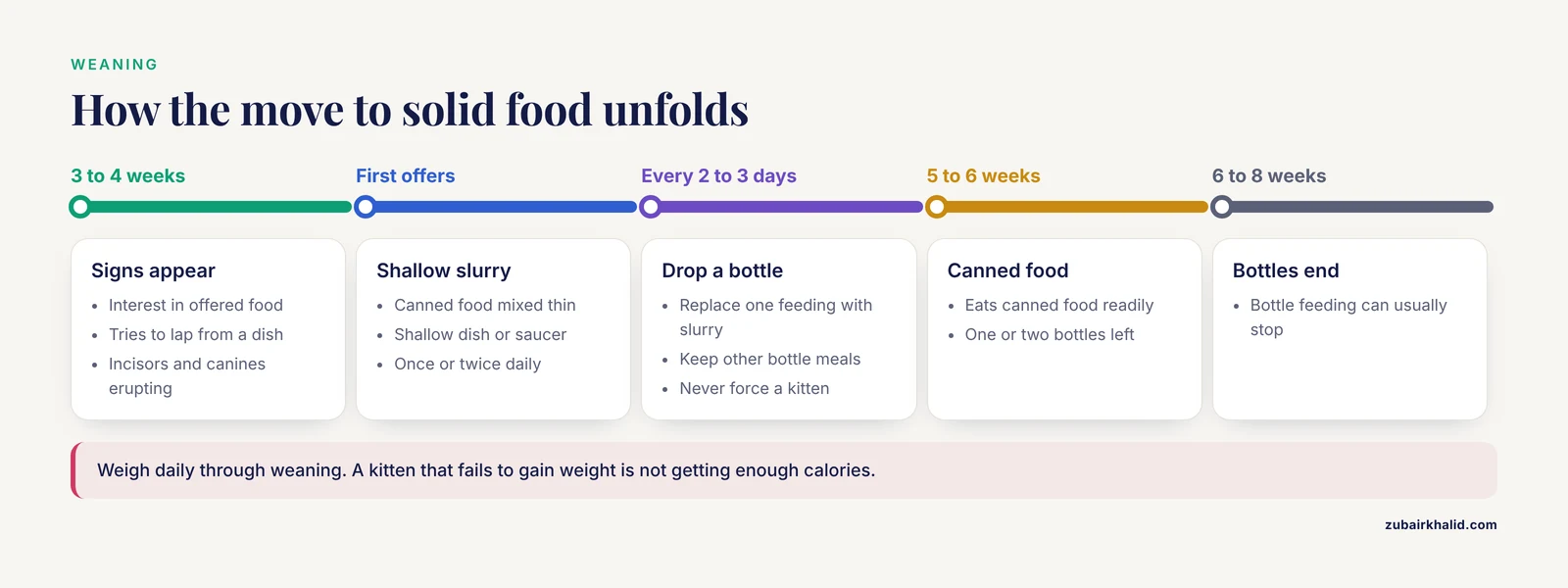
Weaning is a gradual process, not a single event. It typically begins around three to four weeks of age.
Signs of Readiness
A kitten is ready to begin weaning when it shows interest in food offered by the queen or caregiver, attempts to lap from a dish, can sit upright and chew, and has incisors and canine teeth erupting. These signs usually appear between three and four weeks of age. Premature or ill kittens may be slower and should be weaned later.
Offering the First Slurry
The first solid food should be a slurry, not dry kibble. Mix a high-quality canned kitten food with kitten milk replacer or warm water until it has the consistency of thin oatmeal. Offer it in a shallow dish or saucer; a deep bowl can cause the kitten to inhale food or water.
Let the kitten lick a small amount from your finger, then guide its nose toward the dish. Keep the slurry shallow. Offer it once or twice daily at first, while continuing bottle feeding for the remaining meals. Do not force a kitten that is not interested.
Reducing Bottle Feedings
As the kitten eats more slurry, reduce bottle feedings gradually. A typical pattern is to replace one bottle feeding every two to three days with a slurry meal. By five to six weeks, most kittens eat canned food readily and need only one or two bottle feedings per day. By six to eight weeks, bottle feeding can usually stop.
Monitoring Weight and Stool
Continue weighing the kitten daily throughout weaning. Weight should increase steadily, even as milk intake decreases. A kitten that fails to gain weight during weaning is not consuming enough calories and may need to return to more bottle feedings.
Stool should remain formed and brown. Diarrhea during weaning may mean the food was changed too quickly, the kitten is eating too much, or the kitten has an infection. Any persistent change in stool warrants a veterinary visit.
When to Involve a Veterinarian
Contact a veterinarian if a kitten shows no interest in food by four to five weeks of age, loses weight or fails to gain weight during the transition, coughs or sputters when eating slurry, or develops diarrhea, vomiting, or a swollen belly after solid food is introduced. A veterinarian can assess weight, stool, and overall health and adjust the weaning plan if needed [7][2].
Related Guides
- 6-Week-Old Kitten Care: Needs, Milestones, and Feeding: Continues care into the 6-week stage with milestones and feeding
- 8-Week-Old Kitten Care: Feeding, Vaccines, and Play: Covers 8-week feeding, vaccines, and play for the next phase
- Found a Stray Kitten? Step-by-Step Care Guide: Step-by-step help for caregivers who found a stray kitten
- Found a Sick Kitten? Rescue, Care, and Vet Steps: Guidance for sick kittens and when to seek veterinary care
- Kitten Care by Age: 1 Week to 3 Months Explained: Explains kitten care from 1 week to 3 months
- Pregnant Cat Care: Nutrition, Gestation, and Kitten Delivery: Queen health and delivery context for newborn kitten care
- Kitten Teething: How to Help and Care for New Teeth: Teething care for when incisors and canine teeth emerge
- How to Care for a Dying Kitten: Comfort and Support: Comfort and support guidance for critically ill or dying kittens
Frequently Asked Questions
How often should I feed an infant kitten?
Infant kittens need frequent, small meals because their digestive systems are immature and their energy needs are high [2]. The exact interval depends on the kitten's age, weight, and health, so ask your veterinarian to set a schedule [2].
What should I feed an orphaned infant kitten?
Use a commercial kitten milk replacer formulated to replicate queen's milk [2]. Do not use cow's milk or other products not designed for kittens, because nutritionally inadequate food can cause malnutrition and illness [4].
How do I know if an infant kitten is too cold?
A kitten that feels cool to the touch, is inactive, or is not nursing may be hypothermic [3][4]. Temperature is one of the parameters used to assess newborn vitality [5]. If you suspect hypothermia, provide gentle warmth and contact a veterinarian [3].
What is fading kitten syndrome?
Fading kitten syndrome is a condition in which kittens are born appearing healthy but gradually become inactive, sick, and die, usually within the first two weeks of life [3]. Causes include infectious, toxic, traumatic, metabolic, and genetic diseases [3].
How much should a newborn kitten weigh?
Birth weight varies by breed and litter, and it is closely tied to survival [6]. Low birth weight kittens survive less often than normal birth weight kittens, even within the same litter [6]. Your veterinarian should track your kitten's weight regularly [7][6].
Can I feed an infant kitten cow's milk?
Commercial kitten milk replacers are specifically formulated to replicate queen's milk [2]. Cow's milk is not formulated for kittens, and feeding nutritionally inadequate products can contribute to malnutrition [4]. Use a kitten milk replacer instead [2].
How is an infant kitten's health assessed at birth?
Veterinarians use the APGAR score (Appearance, Pulse, Grimace, Activity, Respiration) to identify at-risk newborns [2][5]. Kittens born by emergency cesarean section tend to have lower APGAR scores and lower vitality than kittens born normally [5].
When should I contact a veterinarian for an infant kitten?
Contact a veterinarian if a kitten is cold, inactive, not nursing, not gaining weight, coughing during feeding, or from a litter where another kitten has died [7][1][3][6]. Sick neonates need supportive care quickly [3].
Sources
- A refined technique for feeding newborn rhesus macaques (Macaca mulatta).
- Feline Neonatal Care.
- Fading kitten syndrome: Factors predisposing to 'faders' and treatment options.
- Multifactorial Ascites in a Kitten with Chronic Malnutrition
- Topics in the routine assessment of newborn kitten vitality: Apgar score, reflexes and complementary assessments.
- Morbidity and mortality in neonatal kittens.
- Neonatal Clinical Assessment of the Puppy and Kitten: How to Identify Newborns at Risk?
- Neonatal and pediatric care of the puppy and kitten.