Protists: Characteristics, Types and Examples
By Dr. Zubair Khalid, DVM, MS, PhD ·
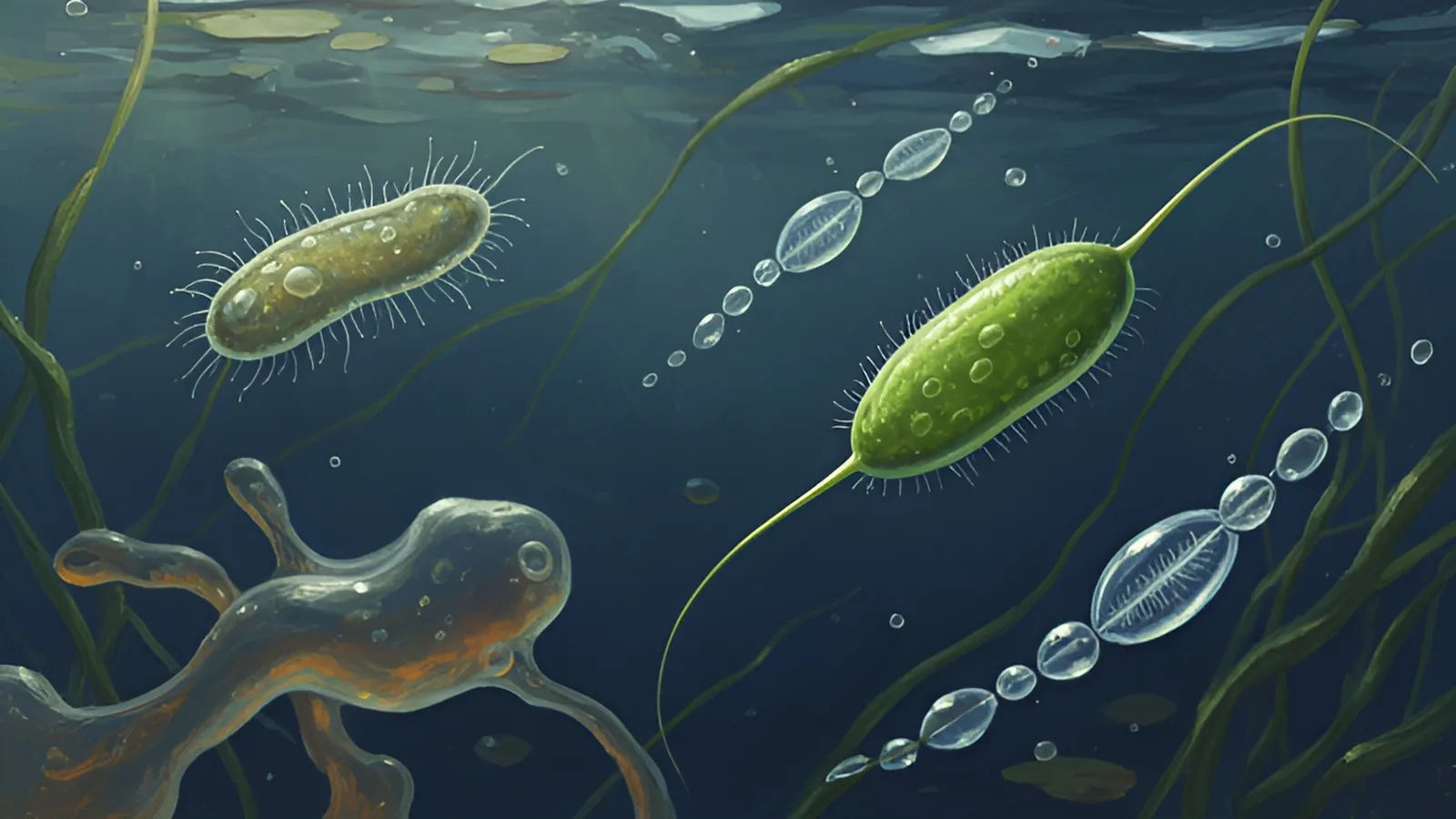
A protist is any eukaryotic organism that is not an animal, a land plant, or a fungus (Protist). The name covers a paraphyletic group spanning the entire eukaryote tree of life, and animals, land plants, and fungi all evolved from within it. Protist cells contain a nucleus and other complex membrane-bound structures (Protist | Definition, Characteristics, Reproduction ...).
Most protists are single-celled and microscopic, appearing as amoebae, ciliates, thick-walled microalgae, and flagellates (Protist). Single cells range from less than a micrometer to three meters, and many species are multinucleated (2.4.1: Introduction to Protists/02%3A_Biodiversity_(Organismal_Groups)/2.04%3A_Protists/2.4.01%3A_Introduction_to_Protists)). Several lineages made the transition to multicellularity, from colonies with alternating cell types to giant slime molds and seaweeds with differentiated tissues. Over 100,000 living species have been described, and the number still undescribed is unknown (2.4.1: Introduction to Protists/02%3A_Biodiversity_(Organismal_Groups)/2.04%3A_Protists/2.4.01%3A_Introduction_to_Protists)).
Key Points
- Protists are defined by exclusion: eukaryotic organisms that are not animals, land plants, or fungi. They were formerly placed in Kingdom Protista (Protist; 2.4.1: Introduction to Protists/02%3A_Biodiversity_(Organismal_Groups)/2.04%3A_Protists/2.4.01%3A_Introduction_to_Protists)).
- Their cells are eukaryotic, with a nucleus and other complex internal structures (Protist | Definition, Characteristics, Reproduction ...).
- They do not form a natural group. Sources describe protists as paraphyletic (Protist) or polyphyletic (2.4.1: Introduction to Protists/02%3A_Biodiversity_(Organismal_Groups)/2.04%3A_Protists/2.4.01%3A_Introduction_to_Protists)), because the subgroups do not share an ancestor exclusive of plants, fungi, and animals (2.4.1: Introduction to Protists/02%3A_Biodiversity_(Organismal_Groups)/2.04%3A_Protists/2.4.01%3A_Introduction_to_Protists)).
- Most are microscopic and single-celled, live mainly in aquatic environments, and include amoebae, ciliates, thick-walled microalgae, and flagellates (Protist; Protist).
- Single protist cells range from less than a micrometer to three meters in length, and many species have multiple nuclei, sometimes of different sizes with distinct roles (2.4.1: Introduction to Protists/02%3A_Biodiversity_(Organismal_Groups)/2.04%3A_Protists/2.4.01%3A_Introduction_to_Protists)).
- Multicellular forms exist, including brown algae (Phaeophyta), colonies that behave partly as free-living cells and partly as one organism, and giant multinucleate slime molds (Protist; 2.4.1: Introduction to Protists/02%3A_Biodiversity_(Organismal_Groups)/2.04%3A_Protists/2.4.01%3A_Introduction_to_Protists)).
At a Glance
| Feature | Summary | |
|---|---|---|
| Definition | Eukaryotic organisms that are not animals, land plants, or fungi (Protist) | |
| Cell type | Eukaryotic, with a nucleus and membrane-bound organelles | |
| Size | Mostly microscopic, though some seaweeds grow very large | |
| Main groups | Protozoa, algae, slime molds, water molds (2.4.1: Introduction to Protists/02%3A_Biodiversity_(Organismal_Groups)/2.04%3A_Protists/2.4.01%3A_Introduction_to_Protists)) | |
| Nutrition | Photosynthetic, heterotrophic, or a mix of both ([Protist | Definition, Characteristics, Reproduction ...](https://www.britannica.com/science/protist)) |
| Habitats | Fresh water, oceans, soil, and inside other organisms |
Protists form a loose collection of eukaryotic organisms, not a single natural group, so the term is useful for teaching but does not describe shared ancestry (Protist). The group covers free-living photosynthesizers, predators, and parasites that live in water, soil, and the bodies of other organisms (Protist; Protist | Definition, Characteristics, Reproduction ...).
What Are Protists?
A Definition by Exclusion
A protist is any eukaryotic organism that is not an animal, a land plant, or a fungus (Protist). The definition is negative: it states what a protist is not. The single trait shared by all protists is the eukaryotic cell, with a true nucleus and membrane-bound organelles. Almost everything else, from shape to diet to how the cell divides, varies between groups.
Because the group is defined by exclusion, protists do not form a natural group or clade. They are a paraphyletic collection that spans the entire eukaryote tree of life, and land plants, animals, and fungi evolved from within that tree (Protist). Some protist lineages sit closer to animals and fungi on the tree than they do to other protists (2.4.1: Introduction to Protists/02%3A_Biodiversity_(Organismal_Groups)/2.04%3A_Protists/2.4.01%3A_Introduction_to_Protists)).
Protist Is a Convenience Term
The word protist is a general description used in teaching and in general writing. It does not correspond to a formal kingdom in modern classification (Protist). Molecular data place protists across several major eukaryotic lineages, so no single kingdom can hold them without also holding plants, animals, and fungi. The term survives because it is short and useful, not because it marks a branch on the tree.
Size and Body Forms
Most protists are single-celled and microscopic (Protist). Several transitions to multicellularity occurred within the group, producing colonies with alternating cell types, giant slime molds, and seaweeds with differentiated tissues. Individual protist cells range from less than a micrometer to three meters in length (2.4.1: Introduction to Protists/02%3A_Biodiversity_(Organismal_Groups)/2.04%3A_Protists/2.4.01%3A_Introduction_to_Protists)). Many protist cells are multinucleated, and in some species the nuclei differ in size and carry out distinct jobs in the cell (2.4.1: Introduction to Protists/02%3A_Biodiversity_(Organismal_Groups)/2.04%3A_Protists/2.4.01%3A_Introduction_to_Protists)).
Where Protists Live
Protists occupy fresh water, oceans, and soil (Protist). Many live as commensals or parasites inside other organisms, and these relationships are often species-specific, so host diversity supports protist diversity (2.4.1: Introduction to Protists/02%3A_Biodiversity_(Organismal_Groups)/2.04%3A_Protists/2.4.01%3A_Introduction_to_Protists)). Some protists are used as food (Protist). Free-living forms drift in plankton, glide over wet films on soil particles and rocks, and grow attached to surfaces in streams and coastal waters.
How Many Are There?
More than 100,000 living species have been described, and the number of undescribed species is unknown (2.4.1: Introduction to Protists/02%3A_Biodiversity_(Organismal_Groups)/2.04%3A_Protists/2.4.01%3A_Introduction_to_Protists)). Because many live inside other organisms and are specific to their hosts, the true total is likely to track the diversity of those hosts (2.4.1: Introduction to Protists/02%3A_Biodiversity_(Organismal_Groups)/2.04%3A_Protists/2.4.01%3A_Introduction_to_Protists)).
Key Characteristics of Protists
No single trait list fits every protist, because the group is defined by exclusion (Protist). The features below describe the range found across protist lineages.
Cell Structure
Protist cells are eukaryotic. They contain a nucleus, mitochondria, and other membrane-bound organelles (Protist). Protist cells are among the most elaborate of all cells (2.4.1: Introduction to Protists/02%3A_Biodiversity_(Organismal_Groups)/2.04%3A_Protists/2.4.01%3A_Introduction_to_Protists)). Some species have many nuclei in one cell, and those nuclei can differ in size and function (2.4.1: Introduction to Protists/02%3A_Biodiversity_(Organismal_Groups)/2.04%3A_Protists/2.4.01%3A_Introduction_to_Protists)). Photosynthetic protists carry plastids, and in several lineages those plastids trace back to red algae.
Size and Body Plans
Most protists are microscopic, though a few seaweeds grow to many meters (Protist). Body plans include single cells, colonies that behave partly as a group of free-living cells and partly as one organism, true multicellular forms such as brown algae, and enormous multinucleate single cells (2.4.1: Introduction to Protists/02%3A_Biodiversity_(Organismal_Groups)/2.04%3A_Protists/2.4.01%3A_Introduction_to_Protists)).
Nutrition
Nutrition ranges from photosynthesis to heterotrophy to a mix of both (Protist | Definition, Characteristics, Reproduction ...). Heterotrophic protists feed by engulfing bacteria, other protists, or organic particles, and some are predators or parasites of larger organisms. Some protists are used as food (Protist).
Movement
Movement varies by group: flagella, cilia, pseudopods, or no movement at all (Protist | Definition, Characteristics, Reproduction ...). A flagellum is a long whip-like structure that pulls or pushes the cell through water. Cilia are shorter and beat in coordinated waves. Pseudopods are extensions of cytoplasm used for crawling and for engulfing food. Parasitic and spore-forming protists may have no motile stage at all.
Reproduction
Reproduction is mostly asexual, with sexual cycles in some groups (Protist | Definition, Characteristics, Reproduction ...). Asexual division produces genetically identical cells quickly, which suits life in temporary ponds and other short-lived habitats. Sexual cycles appear in some lineages and can involve fusion of gametes or exchange of genetic material between cells.
Coverings and Skeletons
Some protists have cell walls, shells, or silica tests, and others have none (Protist). Silica tests occur in diatoms, and calcium carbonate shells occur in foraminifera. Cells without coverings, such as amoebae, change shape freely as they move and feed.
| Trait | Range across protists | |
|---|---|---|
| Cell type | Eukaryotic, with nucleus and organelles (Protist) | |
| Size | Less than 1 micrometer to 3 meters (2.4.1: Introduction to Protists/02%3A_Biodiversity_(Organismal_Groups)/2.04%3A_Protists/2.4.01%3A_Introduction_to_Protists)) | |
| Body form | Single cell, colony, multicellular, multinucleate (2.4.1: Introduction to Protists/02%3A_Biodiversity_(Organismal_Groups)/2.04%3A_Protists/2.4.01%3A_Introduction_to_Protists)) | |
| Nutrition | Photosynthesis, heterotrophy, or both ([Protist | Definition, Characteristics, Reproduction ...](https://www.britannica.com/science/protist)) |
| Movement | Flagella, cilia, pseudopods, or none | |
| Covering | Cell wall, shell, silica test, or none | |
| Reproduction | Mostly asexual; sexual cycles in some groups |
How Protists Are Classified
From One Kingdom to Many Lineages
Older textbooks placed all protists in a single kingdom, Protista (2.4.1: Introduction to Protists/02%3A_Biodiversity_(Organismal_Groups)/2.04%3A_Protists/2.4.01%3A_Introduction_to_Protists)). That arrangement grouped organisms by what they were not: not animals, not plants, not fungi. Genetic and molecular data later showed that protists come from many distinct evolutionary lineages, some closer to fungi and animals than to plants or to each other (2.4.1: Introduction to Protists/02%3A_Biodiversity_(Organismal_Groups)/2.04%3A_Protists/2.4.01%3A_Introduction_to_Protists)). Protists are therefore polyphyletic: the groups do not share a common ancestor that is not also shared with plants, fungi, and animals (2.4.1: Introduction to Protists/02%3A_Biodiversity_(Organismal_Groups)/2.04%3A_Protists/2.4.01%3A_Introduction_to_Protists)). Modern schemes split protists across several major eukaryotic lineages (Protist).
The Four Teaching Groups
Classroom and textbook treatments usually sort protists into four broad groups based on lifestyle (2.4.1: Introduction to Protists/02%3A_Biodiversity_(Organismal_Groups)/2.04%3A_Protists/2.4.01%3A_Introduction_to_Protists)).
| Group | Common label | Typical lifestyle | Examples |
|---|---|---|---|
| Protozoa | Animal-like | Heterotrophic, often motile, free-living or parasitic | Amoebae, ciliates |
| Algae | Plant-like | Photosynthetic, mostly aquatic | Diatoms, kelp |
| Slime molds | Fungus-like | Decomposers that engulf bacteria | Plasmodial slime molds |
| Water molds | Fungus-like | Filamentous decomposers or parasites | Water molds on fish and plants |
Why the Labels Mislead
These labels describe lifestyle, not evolutionary relatedness (Protist). Slime molds share a more recent evolutionary history with fungi and animals, while red and green algae are more closely related to land plants than they are to brown algae (2.4.1: Introduction to Protists/02%3A_Biodiversity_(Organismal_Groups)/2.04%3A_Protists/2.4.01%3A_Introduction_to_Protists)). Red and green algae are genuine relatives of land plants, but brown algae are not, despite a similar plant-like appearance and growth form (2.4.1: Introduction to Protists/02%3A_Biodiversity_(Organismal_Groups)/2.04%3A_Protists/2.4.01%3A_Introduction_to_Protists)). A label such as "plant-like" describes how an organism makes a living, not who its ancestors were.
What Modern Trees Show
Major subdivisions of the eukaryote tree include Amoebozoa, Obazoa (which contains animals and fungi), Discoba, Metamonada, and Diaphoretickes, which contains Archaeplastida (including land plants), SAR, and other groups (Protist). Animals, fungi, and land plants are excluded from the protists by definition. Any scheme that treats protists as one group is a practical shortcut for teaching, not a statement about ancestry.
Main Types of Protists
"Protist" is a working label, not a branch on the tree of life. The term covers every eukaryote that is not an animal, land plant, or fungus, so the organisms placed here do not share one common ancestor that excludes those other groups (2.4.1: Introduction to Protists/02%3A_Biodiversity_(Organismal_Groups)/2.04%3A_Protists/2.4.01%3A_Introduction_to_Protists)). More than 100,000 living species have been described, and the number still undescribed is unknown (2.4.1: Introduction to Protists/02%3A_Biodiversity_(Organismal_Groups)/2.04%3A_Protists/2.4.01%3A_Introduction_to_Protists)). Because the group is defined by exclusion, biologists sort protists by practical features: how they feed, how they move, and what their cells look like.
Protozoa
Protozoa are heterotrophic and motile, and many are predatory or parasitic (2.4.1: Introduction to Protists/02%3A_Biodiversity_(Organismal_Groups)/2.04%3A_Protists/2.4.01%3A_Introduction_to_Protists)). They live in ponds, in soil water films, and inside larger organisms. An amoeba hunting bacteria in a ditch and a parasite absorbing nutrients in a host gut can fall under the same loose label, because protozoa describe a way of life more than a lineage. Many of these organisms live as commensals or parasites inside other species, and those relationships are often species-specific (2.4.1: Introduction to Protists/02%3A_Biodiversity_(Organismal_Groups)/2.04%3A_Protists/2.4.01%3A_Introduction_to_Protists)).
Algae
Algae are photosynthetic protists, and the group includes diatoms, dinoflagellates, and kelps (Protist). Size varies enormously. A diatom is a single cell inside a silica shell, while a kelp can form a seaweed with differentiated tissues. Photosynthesis in these cells supports food webs in oceans, lakes, and soils. Some algae float freely in the water column, and others attach to rocks, shells, or plants.
Slime molds
Slime molds are amoeboid cells that gather and form fruiting bodies (Protist). Some live as separate cells that stream together when food runs short, and others grow as enormous multinucleate single cells that look like blobs of slime (2.4.1: Introduction to Protists/02%3A_Biodiversity_(Organismal_Groups)/2.04%3A_Protists/2.4.01%3A_Introduction_to_Protists)). The gathered mass can reorganize into a stalked fruiting body that releases spores, which is how these organisms reach new sites.
Water molds
Water molds are filamentous decomposers with cellulose in their walls (Protist). They grow as branching threads through dead plant material, insect remains, and other organic matter in water and damp soil. The cellulose in their walls separates them from true fungi, which build walls mainly from chitin. Some water molds also grow on living plants and animals and draw nutrients from them.
Euglenids and other mixotrophs
Some groups, such as euglenids, both photosynthesize and feed (Protist | Definition, Characteristics, Reproduction ...). These organisms carry chloroplasts and can also take in bacteria or dissolved nutrients when light is scarce. Mixotrophy appears in several unrelated protist groups, which fits the general pattern that similar feeding habits evolved many times.
| Group | Nutrition | Movement | Examples | |
|---|---|---|---|---|
| Protozoa | Heterotrophic, often predatory or parasitic (2.4.1: Introduction to Protists/02%3A_Biodiversity_(Organismal_Groups)/2.04%3A_Protists/2.4.01%3A_Introduction_to_Protists)) | Flagella, cilia, or pseudopods | Amoebas, ciliates, flagellates | |
| Algae | Photosynthetic (Protist) | Flagella, gliding, or drifting | Diatoms, dinoflagellates, kelps | |
| Slime molds | Heterotrophic, feeding on bacteria and detritus | Amoeboid crawling | Cellular and plasmodial slime molds | |
| Water molds | Decomposers, some parasitic | Filamentous growth | Oomycetes | |
| Euglenids | Mixotrophic ([Protist | Definition, Characteristics, Reproduction ...](https://www.britannica.com/science/protist)) | Flagella | Euglena and relatives |
How Protists Feed
Feeding is one of the clearest ways to sort protists. Some build their own food, some capture and swallow other cells, some absorb nutrients from a host, and some do more than one of these depending on conditions.
Photosynthesis
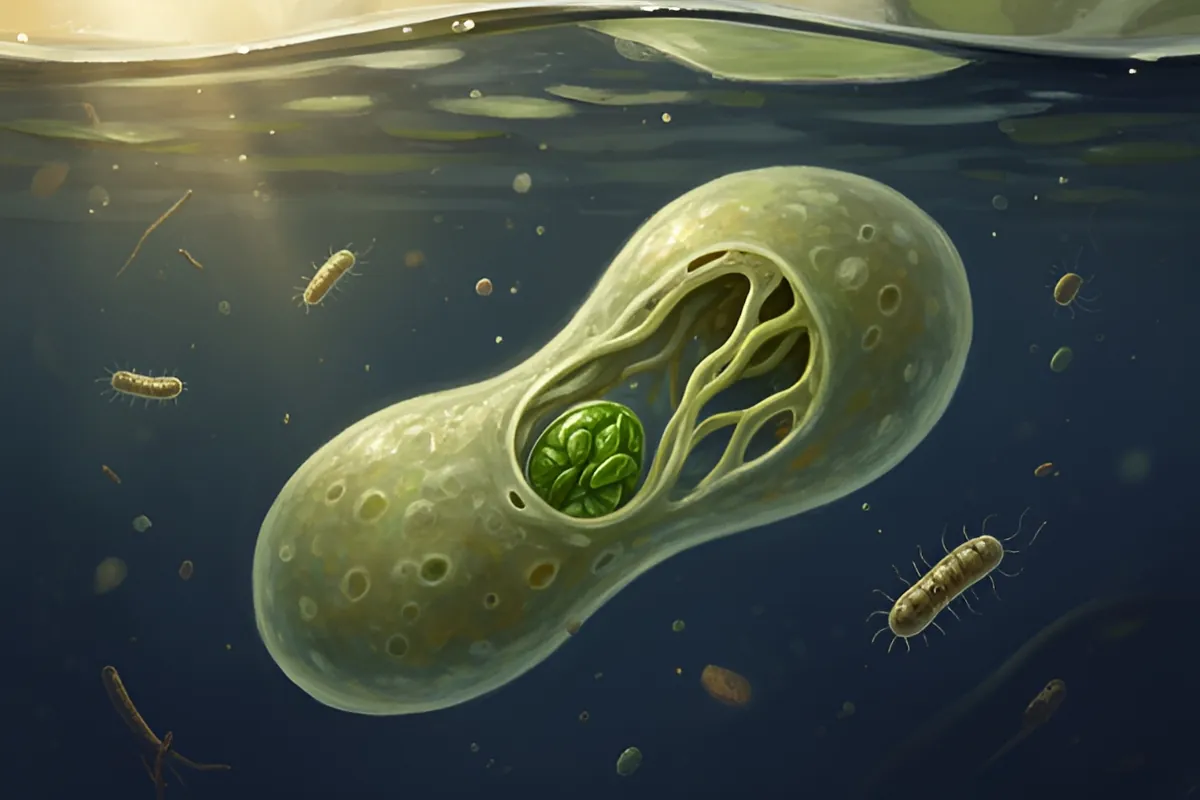
Photosynthetic protists make food with chloroplasts and sunlight (Protist | Definition, Characteristics, Reproduction ...). The chloroplast sits in the cytoplasm, captures light energy, and uses carbon dioxide and water to build sugars. Some of these chloroplasts trace back to red algae that were taken inside a host cell and retained (Protist). Photosynthetic protists form the base of many aquatic food webs, and the oxygen they release enters the water and the atmosphere.
Eating other cells
Heterotrophic protists eat bacteria, algae, or other protists (Protist). In a drop of pond water, this feeding looks like a slow chase. A ciliate swims toward a cluster of bacteria, an amoeba creeps over a smaller cell, or a flagellate follows chemical trails released by its prey.
Phagocytosis in amoebas
Amoebas engulf food by phagocytosis, forming a food vacuole (Protist | Definition, Characteristics, Reproduction ...). The sequence is consistent:
- The cell contacts a bacterium or another particle.
- Pseudopods flow around the particle, and the membrane seals behind it.
- The particle sits inside a food vacuole (Protist | Definition, Characteristics, Reproduction ...).
- Enzymes enter the vacuole and digest the contents.
- Useful molecules cross into the cytoplasm, and undigested material is expelled.
Feeding with cilia
Paramecia sweep food into a mouth-like groove using cilia (Protist | Definition, Characteristics, Reproduction ...). The beating cilia create a current that carries bacteria and small particles toward the groove, where they are packaged into vacuoles and digested. This is filter feeding at the scale of a single cell.
Parasitic feeding
Parasitic protists absorb nutrients directly from a host (Protist). Many live as commensals or parasites inside other organisms, and these relationships are often species-specific (2.4.1: Introduction to Protists/02%3A_Biodiversity_(Organismal_Groups)/2.04%3A_Protists/2.4.01%3A_Introduction_to_Protists)). Some parasitic species have lost the structures their free-living relatives use to capture prey.
Mixotrophy
Mixotrophs switch between photosynthesis and eating other cells (Protist | Definition, Characteristics, Reproduction ...). A mixotroph may photosynthesize in bright surface water and then capture bacteria when light or dissolved nutrients run low. The ability to switch provides a second source of carbon and nutrients when one route fails.
| Feeding mode | Mechanism | Examples | |
|---|---|---|---|
| Photosynthesis | Chloroplasts capture light energy ([Protist | Definition, Characteristics, Reproduction ...](https://www.britannica.com/science/protist)) | Diatoms, dinoflagellates, kelps (Protist) |
| Phagocytosis | Cell engulfs prey into a food vacuole | Amoebas | |
| Ciliary filter feeding | Cilia drive particles into a groove | Paramecium | |
| Parasitic absorption | Nutrients taken from host tissues | Parasitic protozoa | |
| Mixotrophy | Switch between photosynthesis and prey capture | Euglenids |
How Protists Move
Movement structures are among the most useful features for identifying protists under a microscope. Three main structures do the work: flagella, cilia, and pseudopods. Some species do not move at all.
Flagella
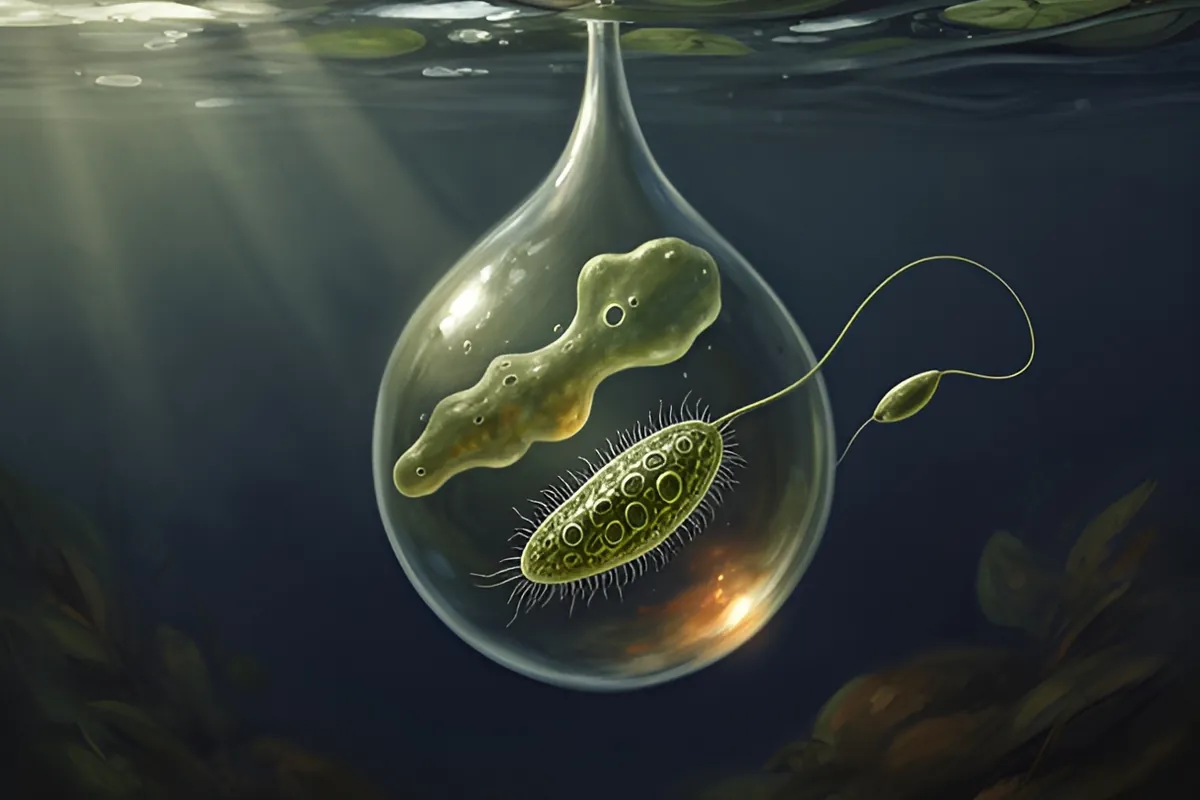
Flagella are long whip-like tails that pull or push the cell (Protist | Definition, Characteristics, Reproduction ...). A cell may carry one flagellum or many, depending on the species. The beat travels along the length of the structure in a wave, which drives the cell forward or draws it through the water. Many free-swimming protozoa and algae rely on this motion.
Cilia
Cilia are short hairs that beat in coordinated waves (Protist | Definition, Characteristics, Reproduction ...). They cover the cell surface in rows, and the waves travel along the body in a pattern that pushes the cell forward and turns it slightly. In Paramecium, the same cilia that drive swimming also sweep food toward the oral groove.
Pseudopods
Pseudopods are temporary bulges of cytoplasm used to crawl (Protist | Definition, Characteristics, Reproduction ...). An amoeba extends a pseudopod by pushing cytoplasm into the leading edge, anchors the tip, and pulls the rest of the cell forward. The same structure captures prey, so feeding and movement share one mechanism.
Gliding, drifting, and anchored cells
Some protists glide, drift, or stay anchored and do not move (Protist). Diatoms on wet surfaces can glide along a secreted track, while planktonic species drift with currents. Attached algae and parasites hold position and depend on water movement or host movement to bring what they need.
Why movement matters
Movement helps protists find food, light, and mates (Protist | Definition, Characteristics, Reproduction ...). A photosynthetic cell swims toward light, a predator follows chemical trails from prey, and free-swimming gametes meet and fuse. For species that cannot move, currents and hosts do the transporting.
| Structure | Shape | Type of motion | Example | |
|---|---|---|---|---|
| Flagellum | Long, whip-like | Wave-like beat that pulls or pushes ([Protist | Definition, Characteristics, Reproduction ...](https://www.britannica.com/science/protist)) | Euglenids, dinoflagellates |
| Cilium | Short hair | Coordinated waves | Paramecium | |
| Pseudopod | Temporary bulge | Crawling flow of cytoplasm | Amoeba |
How Protists Reproduce
Protists reproduce in several ways, and many species use more than one route during a single life cycle. Asexual division is the most common, sexual reproduction appears in many algae and some protozoa, and resting stages carry cells through hard conditions.
Asexual reproduction
Most protists reproduce asexually by binary fission or budding (Protist | Definition, Characteristics, Reproduction ...). In binary fission, the cell duplicates its nucleus and other organelles, then splits into two daughter cells of roughly equal size. In budding, a smaller daughter forms on the parent and separates. Because the offspring come from one parent, they carry the same genetic material apart from new mutations.
Multiple fission
Multiple fission makes many daughter cells at once in some species (Protist | Definition, Characteristics, Reproduction ...). The nucleus divides repeatedly inside one parent cell before the cytoplasm splits, so a single cell can release a large number of offspring in one event. This pattern appears in several parasitic and free-living species.
Sexual reproduction
Sexual reproduction occurs in many algae and some protozoa (Protist | Definition, Characteristics, Reproduction ...). Two cells or two gametes fuse, and the resulting cell carries genetic material from both parents. In many algae, the life cycle alternates between a stage that produces gametes and a stage that produces spores.
Cysts and resting stages
Some protists form resistant cysts to survive harsh conditions (Protist). A cyst is a rounded cell with a thickened wall that resists drying, freezing, and chemical stress. When conditions improve, the cell emerges and resumes feeding. Cysts can also be carried to new sites by water, air, or animals.
Life cycles
Life cycles often alternate between different cell forms (Protist | Definition, Characteristics, Reproduction ...). A single species may have a swimming stage, a feeding stage, and a resting stage, and some parasites add stages in different hosts. The form that appears depends on temperature, light, nutrients, and the internal environment of a host.
| Mode | What happens | Notes | |
|---|---|---|---|
| Binary fission | Parent divides into two cells ([Protist | Definition, Characteristics, Reproduction ...](https://www.britannica.com/science/protist)) | Most common route |
| Budding | Smaller daughter forms on the parent | Seen in several groups | |
| Multiple fission | Many daughters released at once | One parent, many offspring | |
| Sexual reproduction | Gametes fuse | Common in algae | |
| Cyst formation | Thick-walled dormant cell (Protist) | Survives drying and freezing |
Protists in Ecosystems and Human Life
Protists live in nearly every environment that holds water, and their activities reach far beyond ponds and oceans. They supply oxygen, feed fisheries, cause serious diseases, and support digestion in animals that eat wood or grass.
Oxygen and the Base of Food Webs
Photosynthetic protists release oxygen and anchor aquatic food webs (Protist). In the open ocean, diatoms and other algae drive much of primary production. These cells use sunlight, carbon dioxide, and dissolved nutrients to build organic matter. Small grazers such as copepods and krill eat them, and those grazers are eaten in turn by fish, seabirds, and whales. Remove the protist layer and the food web above it collapses. Freshwater systems work the same way: green algae, diatoms, and flagellated algae form the base of pond and lake food chains, and their blooms and die-offs shape water quality through the seasons.
Protists That Cause Disease
Some protists cause disease, including malaria and sleeping sickness (Protist). Malaria results from infection with Plasmodium species, which reach people through mosquito bites. Sleeping sickness, also called African trypanosomiasis, is caused by trypanosomes transmitted by tsetse flies. Other protist pathogens reach people through contaminated water or food, and some infect livestock, fish, and crops. Control depends on vector management, clean water, and drugs that target the parasite itself.
Harmful Algal Blooms
Harmful algal blooms can poison fish, shellfish, and people (Protist). Certain dinoflagellates and other algae produce toxins that accumulate in filter-feeding shellfish. People who eat contaminated shellfish can become ill, and fish kills during blooms damage aquaculture and wild stocks. Blooms often follow nutrient enrichment from fertilizer runoff, warm water, and calm conditions. Monitoring programs test shellfish and close harvest areas when toxin levels rise.
Digestion and Symbiosis
Protists help digest wood and plant matter in termites and ruminants (Protist). Termite guts hold flagellated protists that break down cellulose, and the rumen of cattle, sheep, and goats contains a dense community of ciliates and other microbes that ferment plant fiber. Reef-building corals also depend on photosynthetic protists living inside their tissues, which supply sugars in exchange for shelter and nutrients. These partnerships let animals exploit food sources they could not digest alone.
Research, Food, and Industry
They are used in research, food production, and industry (Protist). Laboratory work relies on protists such as Tetrahymena, Chlamydomonas, and Dictyostelium to study cell biology, genetics, and development. Red and brown algae supply agar, carrageenan, and alginates used in foods, cosmetics, and laboratory media. Diatom shells serve as fine filters and mild abrasives, and algal biomass is grown for pigments, oils, and animal feed. Because protist cells grow quickly and are easy to culture, they remain standard tools in both teaching labs and commercial production.
Examples of Protists
The organisms below cover the main lifestyles found among protists: free-living grazers, photosynthetic algae, and parasites. Each entry lists the group, where it lives, and the feature that makes it easy to recognize.
| Organism | Group | Typical habitat | Distinguishing feature |
|---|---|---|---|
| Amoeba proteus | Amoebozoan | Freshwater ponds and streams | Moves with pseudopods (Protist) |
| Paramecium | Ciliate | Freshwater, often stagnant | Slipper-shaped, covered in fine cilia |
| Euglena | Flagellate mixotroph | Freshwater, sunlit shallows | Chloroplasts and an eyespot |
| Plasmodium | Apicomplexan | Human blood and mosquito tissues | Causes malaria in humans |
| Diatoms | Stramenopile algae | Oceans and lakes | Silica shells |
| Giant kelp | Brown alga | Cold coastal seas | Large multicellular body |
Amoeba proteus
Amoeba proteus is a freshwater amoeba that moves with pseudopods (Protist). The cell pushes cytoplasm into a blunt extension, anchors it, and pulls the rest of the body forward. The same pseudopods wrap around bacteria and detritus, which are taken into the cell by phagocytosis and digested in food vacuoles.
Paramecium
Paramecium is a slipper-shaped ciliate covered in fine cilia (Protist). The cilia beat in coordinated waves that drive the cell through water and sweep food particles into a groove on one side. Contractile vacuoles collect excess water and expel it, which keeps the cell from swelling in dilute freshwater.
Euglena
Euglena is a flagellated mixotroph with chloroplasts and an eyespot (Protist). In bright light it photosynthesizes; in darkness it absorbs dissolved nutrients. The eyespot shields part of a light-sensitive patch, so the cell can steer toward or away from light as it swims with its flagellum.
Plasmodium
Plasmodium is the parasite that causes malaria in humans (Protist). Its life cycle alternates between a mosquito vector and a vertebrate host. Inside the human body, the parasite invades liver cells and then red blood cells, where it multiplies and eventually bursts the cells, producing the fever cycles typical of the disease.
Diatoms
Diatoms are silica-shelled algae common in oceans and lakes (Protist). Each cell builds a two-part shell of hydrated silica with pores and ridges. The shells persist after the cell dies and settle into sediment, where their shapes are used to reconstruct past water conditions.
Giant kelp
Giant kelp is a large multicellular brown alga (Protist). It grows in cold coastal water, attaching to rock with a holdfast and rising toward the surface on long stipes with flat blades. Dense kelp forests shelter fish, sea otters, and invertebrates.
Common Misconceptions About Protists
The word "protist" describes a category defined by exclusion, which makes it easy to misread. The table below pairs common claims with what the biology actually shows.
| Myth | What the evidence shows | |
|---|---|---|
| All protists are single-celled | Giant kelp is multicellular (Protist) | |
| Protists form one kingdom | They span many lineages | |
| All protists cause disease | Most are harmless | |
| Protists are always microscopic | Some seaweeds are huge | |
| Protozoa and protists are the same | Protozoa is a subset (2.4.1: Introduction to Protists/02%3A_Biodiversity_(Organismal_Groups)/2.04%3A_Protists/2.4.01%3A_Introduction_to_Protists)) | |
| Protists are simple | Many show complex behavior ([Protist | Definition, Characteristics, Reproduction ...](https://www.britannica.com/science/protist)) |
Myth: All protists are single-celled
Most described protists are unicellular, but multicellularity has evolved several times within the group. Giant kelp is multicellular (Protist), and brown algae show differentiated tissues with distinct functions. Slime molds and some algae also form colonies or large multinucleate masses that behave in some ways like a single organism.
Myth: Protists form one kingdom
Protists span many lineages (Protist). Kingdom Protista was a historical convenience that grouped everything eukaryotic and non-animal, non-plant, non-fungal. Molecular data show these organisms branch across the whole eukaryote tree, with some closer to animals and fungi and others closer to land plants (2.4.1: Introduction to Protists/02%3A_Biodiversity_(Organismal_Groups)/2.04%3A_Protists/2.4.01%3A_Introduction_to_Protists)). Depending on how the excluded groups are treated, the category is described as paraphyletic or polyphyletic (2.4.1: Introduction to Protists/02%3A_Biodiversity_(Organismal_Groups)/2.04%3A_Protists/2.4.01%3A_Introduction_to_Protists)).
Myth: All protists cause disease
Most are harmless (Protist). Free-living photosynthetic and grazing forms dominate in soil, fresh water, and the sea, where they feed other organisms and cycle nutrients. Only a minority are pathogens, and even those usually infect specific hosts.
Myth: Protists are always microscopic
Some seaweeds are huge (Protist). Giant kelp forms underwater forests many meters tall, and single protist cells can also reach sizes visible without a microscope. The microscopic impression comes from the many small flagellates and ciliates seen in pond water.
Myth: Protozoa and protists are the same
Protozoa is a subset (2.4.1: Introduction to Protists/02%3A_Biodiversity_(Organismal_Groups)/2.04%3A_Protists/2.4.01%3A_Introduction_to_Protists)). The term refers to animal-like, mostly heterotrophic protists such as amoebae and ciliates. Protists also include algae, which photosynthesize, and fungus-like forms such as water molds and slime molds.
Myth: Protists are simple
Many show complex behavior (Protist | Definition, Characteristics, Reproduction ...). Ciliates coordinate thousands of cilia to swim and capture food, amoebae hunt bacteria and change shape as they move, and slime molds aggregate into moving masses that search for food before forming spores.
Related Guides
- Annelid Phylum: Characteristics and Examples
- Chordata Phylum: Key Characteristics and Classes
- Characteristics of Life: The 8 Traits of Living Things
- Eukaryotic Cells: Structure, Organelles and Examples
- Prokaryotic vs Eukaryotic Cells: Key Differences With Diagram
- Kingdom Definition Biology
- Classification Biology
- Giardia lamblia: Protozoan Biology and Life Cycle
- Toxoplasma gondii in Cats: Life Cycle, Zoonotic Risk, and Management
- Entamoeba histolytica: Life Cycle and Amoebiasis
- Plasmodium gallinaceum Avian Malaria in Poultry: Mosquito Transmission and Clinical Management
- Chitin: Structure, Function and Where It Is Found
Frequently Asked Questions
What are protists?
Protists are eukaryotic organisms that are not animals, land plants, or fungi. The term is a general description, not a formal taxonomic group, and protists do not share a single common ancestor. They form a paraphyletic group that spans the eukaryote tree of life, from which land plants, animals, and fungi evolved (Protist). Most are single-celled, though some form colonies, giant multinucleate cells, or multicellular seaweeds with differentiated tissues (Protist; 2.4.1: Introduction to Protists/02%3A_Biodiversity_(Organismal_Groups)/2.04%3A_Protists/2.4.01%3A_Introduction_to_Protists)). Over 100,000 living species have been described, and many more likely remain unknown (2.4.1: Introduction to Protists/02%3A_Biodiversity_(Organismal_Groups)/2.04%3A_Protists/2.4.01%3A_Introduction_to_Protists)).
Are protists prokaryotic or eukaryotic?
Protists are eukaryotic. Their cells contain a nucleus and other membrane-bound structures, which separates them from bacteria and archaea, the prokaryotes (Protist | Definition, Characteristics, Reproduction ...). Being eukaryotic is the only trait that unites protists, and it is not exclusive to them, since animals, plants, and fungi are also eukaryotic (2.4.1: Introduction to Protists/02%3A_Biodiversity_(Organismal_Groups)/2.04%3A_Protists/2.4.01%3A_Introduction_to_Protists)). Beyond that shared cell plan, protist cells vary enormously in size, shape, and internal organization. Some are among the most elaborate cells known, with multiple nuclei of different sizes that carry out distinct roles (2.4.1: Introduction to Protists/02%3A_Biodiversity_(Organismal_Groups)/2.04%3A_Protists/2.4.01%3A_Introduction_to_Protists)).
What are three examples of protists?
Three well-known examples are amoebae, ciliates such as Paramecium, and dinoflagellates (Protist). Other familiar protists include red algae, kelp, golden algae, slime molds, and metamonads. These organisms show how broad the group is: amoebae move by extending pseudopods, ciliates swim using rows of hair-like cilia, and dinoflagellates use two flagella. Red algae and kelp are large photosynthetic seaweeds, while slime molds resemble fungi in appearance but are unrelated to them (Protist; 2.4.1: Introduction to Protists/02%3A_Biodiversity_(Organismal_Groups)/2.04%3A_Protists/2.4.01%3A_Introduction_to_Protists)).
How do protists reproduce?
Protist reproduction varies widely because the group includes many unrelated lineages. Asexual reproduction is common and typically involves mitosis followed by cell division, producing genetically identical offspring. Many protists also reproduce sexually, with gametes fusing to form a zygote, and some alternate between asexual and sexual phases during their life cycle. In parasitic species, complex life cycles may include several hosts and different reproductive stages. Because protists are defined by what they are not, no single mode of reproduction applies to all of them (Protist; 2.4.1: Introduction to Protists/02%3A_Biodiversity_(Organismal_Groups)/2.04%3A_Protists/2.4.01%3A_Introduction_to_Protists)).
Are all protists harmful to humans?
No. Most protists are harmless and many are beneficial. Photosynthetic protists such as diatoms and dinoflagellates produce oxygen and form the base of aquatic food webs, and some are used as food or in industry (Protist). A minority cause disease in humans. Examples include Plasmodium species that cause malaria, Giardia, Entamoeba, and Trypanosoma. Some dinoflagellates produce toxins that accumulate in shellfish and can harm people who eat them. Many protists also live as harmless commensals inside other organisms, including animals (2.4.1: Introduction to Protists/02%3A_Biodiversity_(Organismal_Groups)/2.04%3A_Protists/2.4.01%3A_Introduction_to_Protists)).
What is the difference between protozoa and protists?
Protozoa is an informal term for the animal-like protists: mostly single-celled, heterotrophic organisms that move actively and feed on bacteria, other protists, or organic particles. Protist is the broader term, covering all eukaryotes that are not animals, land plants, or fungi, including algae, slime molds, and fungus-like forms (Protist; 2.4.1: Introduction to Protists/02%3A_Biodiversity_(Organismal_Groups)/2.04%3A_Protists/2.4.01%3A_Introduction_to_Protists)). Every protozoan is a protist, but most protists are not protozoa. Because protozoa do not form a single evolutionary lineage either, the word describes a lifestyle and appearance more than a natural group.
References and Further Reading
- Protist, en.wikipedia.org
- Protist | Definition, Characteristics, Reproduction ..., britannica.com
- 2.4.1: Introduction to Protists/02%3A_Biodiversity_(Organismal_Groups)/2.04%3A_Protists/2.4.01%3A_Introduction_to_Protists), bio.libretexts.org
- Protist, sciencedirect.com