Characteristics of Life: The 8 Traits of Living Things
By Dr. Zubair Khalid, DVM, MS, PhD ·
Life is an interactive process occurring in entropy-producing, adaptive, and informative organic systems [1]. The eight characteristics of life are the shared traits that distinguish living things from nonliving matter: cellular organization, metabolism, homeostasis, response to stimuli, growth and development, reproduction, genetic information, and adaptation through evolution.
Biologists have debated the definition of life for centuries, and no single definition has reached universal consensus [1]. The 8 characteristics provide a practical framework. They let students, researchers, and clinicians classify a specimen as living or nonliving, understand what makes a cell healthy or diseased, and reason about boundary cases such as viruses, dormant seeds, and artificially engineered organisms [1][2]. In molecular biology, these traits are not abstract. Each one maps to specific molecules and mechanisms: membranes and cytoskeletons for cellular organization, ATP and enzymes for metabolism, receptor proteins for stimulus response, DNA for genetic information, and mutation and selection for evolution. Understanding the 8 traits is the first step in understanding how life works at the molecular level.
What Are the Characteristics of Life in Biology?
In 2023, Gómez-Márquez proposed that any definition of life should start by establishing which characteristics are common to all living systems: organic nature, entropy production, self-organization, a reworkable pre-program, capacity to interact and adapt, reproduction, and evolution [1]. He noted that reproduction and evolution are not essential for an individual to be alive, since a sterile organism or a non-reproducing cell can still be fully alive [1]. In a separate reflection, he defined life as a process that takes place in highly organized organic structures and is characterized by being preprogrammed, interactive, adaptive, and evolutionary [2]. He also distinguished between life as the process and living beings as the system in which that process takes place [2].
The 8 characteristics taught in standard biology courses combine these ideas into a checklist. Each trait is necessary, and together they describe what it means to be alive. The table below gives characteristics of life examples for each trait, along with the molecular basis and a typical laboratory test.
| Trait | What it means | Molecular basis | Example |
|---|---|---|---|
| 1. Cellular organization | Made of one or more cells | Plasma membrane, cytoplasm, organelles, cytoskeleton | A bacterial cell; a human neuron |
| 2. Metabolism and energy processing | Acquires and transforms energy and matter | Enzymes, ATP, photosynthesis, respiration | A plant using sunlight to fix CO2 [3] |
| 3. Homeostasis | Maintains a stable internal environment | Ion channels, pumps, hormones, feedback loops | Human body temperature near 37°C |
| 4. Response to stimuli | Detects and reacts to environmental changes | Receptors, signal transduction pathways | Chemotaxis in bacteria |
| 5. Growth and development | Increases in size and complexity over time | Cell division, differentiation, gene expression | A fertilized egg developing into an embryo |
| 6. Reproduction | Produces new individuals | DNA replication, mitosis, meiosis | A hen laying fertile eggs [4] |
| 7. Genetic information | Stores and transmits hereditary instructions | DNA, RNA, the genetic code | BMP15 gene expression in ovarian follicles [4] |
| 8. Adaptation and evolution | Populations change over generations | Mutation, natural selection, genetic drift | Adaptive signaling in cancer cells [5] |
Cellular Organization and Order
All living things are made of cells. This is the cell theory, one of the cornerstones of biology. A cell is the smallest unit that can carry out all the processes of life. Some organisms, such as bacteria, are unicellular. Others, such as humans and oak trees, are multicellular, with trillions of cells organized into tissues and organs.
At the molecular level, cellular organization depends on a plasma membrane that separates the inside of the cell from the outside. The plasma membrane is a phospholipid bilayer studded with proteins that control the movement of molecules in and out. The cytoplasm is a crowded gel of water, salts, and macromolecules where most chemical reactions occur. Eukaryotic cells, which include the cells of animals, plants, and fungi, also contain membrane-bound organelles. The nucleus houses the genome. Mitochondria produce ATP through oxidative phosphorylation. The endoplasmic reticulum and Golgi apparatus synthesize and sort proteins. A dynamic network of filaments called the cytoskeleton gives the cell its shape and enables movement.
This internal order is not static. It is maintained by continuous energy input. Gómez-Márquez describes living systems as self-organizing [1]. They build and repair their own structures using instructions encoded in their genomes. A cell can replace damaged proteins, repair DNA, and rebuild membranes. A crystal or a machine cannot do this.
Order is also visible at the level of whole organisms. A chicken embryo develops from a single fertilized cell into a complex animal with distinct organs, a process that requires precisely regulated gene expression [4]. In the ovaries of laying hens, follicles develop in a structured sequence, and the histological organization of the theca and granulosa cell layers differs between high-performing and low-performing birds [4]. High-performing hens have relatively thinner and loosely arranged theca and granulosa layers in large white follicles, while low-performing hens show thicker and denser cellular structures [4]. This kind of structural order is a hallmark of life.
Nonliving things can also be ordered. Crystals have regular structure, and machines have organized parts. But crystals do not maintain their order by consuming energy, and machines do not repair themselves. The self-organizing, energy-driven order of cells is unique to life [1].
Metabolism and Energy Processing
Living things require energy to maintain order, grow, and reproduce. Metabolism is the sum of all chemical reactions in an organism. It has two branches. Catabolism breaks down molecules to release energy. Anabolism uses energy to build larger molecules from smaller ones.
The ultimate source of energy for most life on Earth is sunlight. Photosynthesis converts light energy into chemical energy, producing sugars and oxygen from carbon dioxide and water. Photosynthesis is the primary source of energy and matter for nearly all life on Earth [3]. Synthetic biology efforts to improve photosynthesis focus on optimizing the enzyme Rubisco, installing carbon-concentrating mechanisms, and engineering photorespiratory bypasses, all of which aim to make energy capture more efficient [3]. Rubisco catalyzes the first major step of carbon fixation, but it is slow and often reacts with oxygen instead of carbon dioxide. Researchers are also attempting to install C4 photosynthetic features into C3 crops and to manipulate sugar transport to coordinate source-sink relations [3].
Organisms that cannot photosynthesize obtain energy by consuming other organisms or organic matter. Cellular respiration breaks down glucose to produce ATP, the molecule that stores and transfers energy in cells. ATP, or adenosine triphosphate, has three phosphate groups. Hydrolysis of ATP to ADP and inorganic phosphate releases energy that drives other reactions.
Some organisms live without oxygen. Fermentation allows microbes to extract energy from sugars in the absence of oxygen. In natto fermentation, bacteria transform flaxseed proteins into free amino acids, increasing the total free amino acid content from 1.52 to 79.56 g/kg, particularly glutamic and aspartic acids [6]. The fermentation also produces hundreds of volatile organic compounds, with 368 differential compounds identified out of 1017 total detected [6]. This is metabolism in action: the conversion of raw materials into new molecules, with energy flowing through the system.
Life is an entropy-producing process [1]. Entropy is a measure of disorder. Living systems create internal order by exporting disorder to their surroundings as heat and waste. This is why a living organism is not a closed system. It constantly exchanges energy and matter with its environment. Without this exchange, order collapses and the organism dies.
Homeostasis
Homeostasis is the maintenance of a stable internal environment despite changes in the external world. It is one of the most dynamic traits of life. Cells and organisms constantly sense their internal state and adjust their activity to keep conditions within a narrow range.
Temperature, pH, water balance, and solute concentrations are all regulated. In mammals, body temperature is kept near 37°C by shivering, sweating, and changes in blood flow. In cells, ion channels and pumps maintain the membrane potential and control calcium, sodium, and potassium levels. Glucose homeostasis depends on hormones such as insulin and glucagon, which signal the liver and muscles to store or release sugar.
At the molecular level, homeostasis relies on negative feedback loops. A sensor detects a deviation from the set point. A control center compares the value to the set point. An effector corrects the deviation. For example, when blood glucose rises, the pancreas releases insulin, which promotes glucose uptake by cells, bringing glucose back to normal. When glucose falls, glucagon signals the liver to release stored glucose.
Homeostasis is related to the entropy-producing nature of life [1]. Maintaining order requires constant work. A living cell is like a whirlpool. It maintains its structure only by continuously dissipating energy. When energy input stops, the system moves toward equilibrium, which for a cell means death.
Response to Stimuli
Living things detect and respond to changes in their environment. This trait is called sensitivity or irritability. It is essential for finding food, avoiding danger, and coordinating internal processes.
The molecular basis of stimulus response is signal transduction. A receptor protein on the cell surface or inside the cell detects a specific stimulus, such as a chemical, a photon of light, or a change in temperature. The receptor then triggers a cascade of intracellular signals, often involving phosphorylation events, that ultimately change cell behavior. Many receptors are receptor tyrosine kinases, which add phosphate groups to specific proteins when activated. Others are G protein-coupled receptors, which activate downstream effectors through a G protein intermediate.
Bacteria perform chemotaxis, moving toward attractants and away from repellents. Plants grow toward light, a response called phototropism. Animals have complex nervous systems that detect stimuli and coordinate rapid responses. Even single cells respond. Immune cells migrate toward sites of infection, and cancer cells respond to signals from their microenvironment.
The capacity to interact and adapt is one of the characteristics common to all living systems [1]. Gómez-Márquez includes interaction and adaptation as core features of his definition of life [2]. In pancreatic ductal adenocarcinoma, tumor cells adapt to chemotherapy by remodeling their signaling pathways, showing reduced immune activity and increased cellular plasticity [5]. This is a striking example of a living system responding to a hostile environment, in this case with consequences that are clinically significant.
Response to stimuli is often tested in the classroom with simple experiments. Students might observe how a plant bends toward a window, how a paramecium changes direction when it hits an obstacle, or how a hand pulls away from a hot surface. In the laboratory, researchers measure stimulus response using calcium imaging, electrophysiology, or gene expression assays.
Growth and Development
Living things grow and develop. Growth is an increase in size or number of cells. Development is the process by which an organism changes form and function over its lifetime, from a single cell to a mature adult.
Growth occurs through cell division and cell expansion. In multicellular organisms, development involves cell differentiation, in which cells with the same genome become specialized for different functions. A human begins as a fertilized egg and develops into an organism with more than 200 cell types, including neurons, muscle cells, and red blood cells. This process is controlled by gene regulatory networks that turn genes on and off in precise spatial and temporal patterns.
Development is not limited to embryos. Many organisms continue to grow throughout their lives. Trees add new rings each year, and chickens continue to produce follicles and eggs during their reproductive years. The histological organization of the oviduct magnum in hens changes with egg shape. Hens producing ball-shaped eggs show more developed mucosal folds and glandular structures, while hens producing elongated eggs exhibit relatively loose tissue [4]. These structural differences reflect ongoing development and maintenance of reproductive tissues.
Growth and development require both genetic information and energy. The genome provides the blueprint, and metabolism provides the building blocks. A "reworkable pre-program" is how Gómez-Márquez describes the genome [1]. It is a program that can be read, modified, and reorganized during development and evolution.
Reproduction and Genetic Information
Reproduction is the production of new individuals. It can be asexual, as in binary fission in bacteria, or sexual, as in animals and plants. The molecular basis of reproduction is DNA replication, followed by cell division. In sexual reproduction, meiosis produces gametes with half the chromosome number, and fertilization restores the full set.
Genetic information is the trait that makes reproduction meaningful. DNA stores the instructions for building and operating an organism. The sequence of nucleotides in DNA encodes genes, and genes are expressed through transcription to RNA and translation to protein. This flow of information, the central dogma of molecular biology, is universal among living things.
Gómez-Márquez calls the genetic program "reworkable". Mutations alter DNA sequences, creating new variants. Gene expression can be regulated, so different cells use different parts of the program. In Huaixiang chickens, the expression of BMP15 increases with laying performance, and BMP15 expression is significantly positively correlated with laying rate [4]. This shows how a specific gene contributes to a complex trait like egg production.
Reproduction is often listed as a characteristic of life, but it is not required for an individual to be alive [1]. A mule is sterile, yet it is clearly alive. A worker bee cannot reproduce, but it is alive. Gómez-Márquez explicitly states that reproduction and evolution are not essential for life [1]. They are essential for the continuation of life across generations, but an individual organism can be alive without reproducing.
This distinction matters in medicine and agriculture. A cancer cell can divide indefinitely, but a neuron in the adult brain typically cannot. Both are alive. The capacity for reproduction is a property of the species and of certain cell types, not a requirement for every living individual.
Adaptation and Evolution
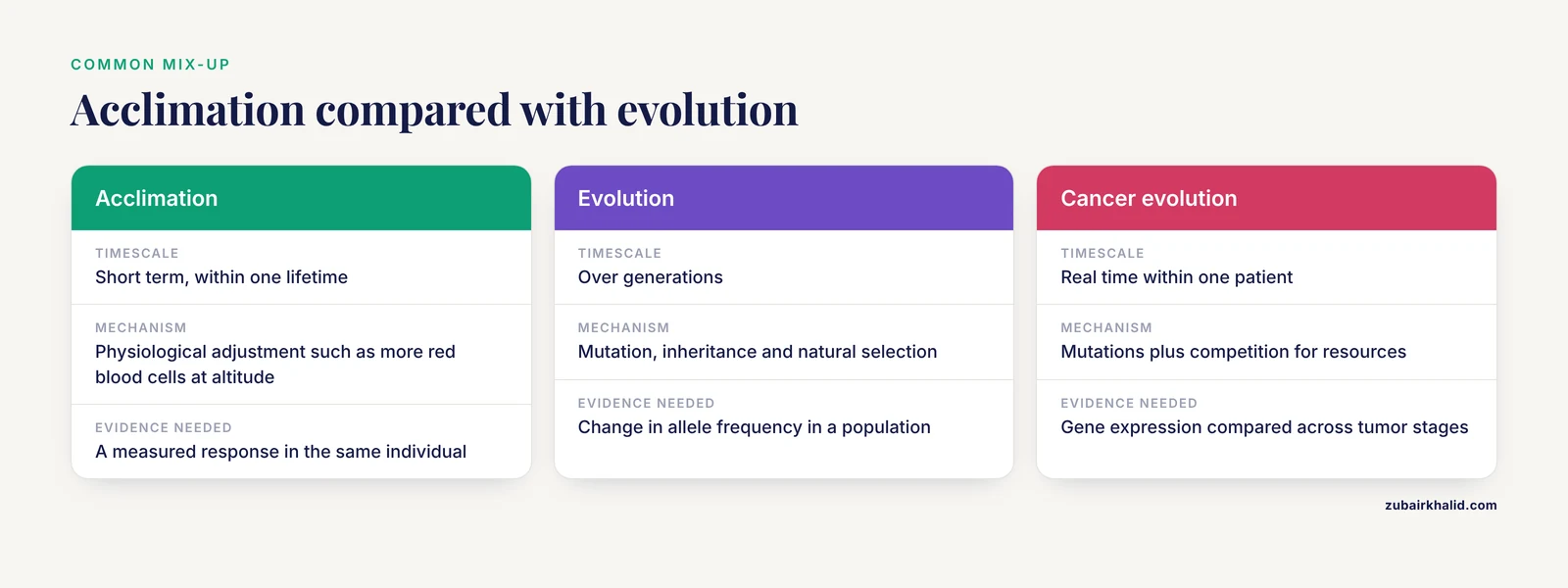
Adaptation and evolution are the traits that allow life to persist over long timescales. Adaptation can mean two things. At the individual level, it means acclimation, a short-term adjustment to environmental change. At the population level, it means evolutionary adaptation, a change in the frequency of genetic variants over generations due to natural selection.
Evolution requires variation, inheritance, and selection. Mutations create new alleles, which are alternative versions of a gene. Sexual reproduction shuffles alleles into new combinations. Individuals with traits that improve survival and reproduction leave more offspring, and their alleles become more common. Over time, populations become better matched to their environments.
The capacity to interact and adapt is one of the characteristics common to all living systems [1]. Gómez-Márquez defines life as a process that is preprogrammed, interactive, adaptive, and evolutionary [2]. He argues that if life exists elsewhere in the universe, it would be very similar to life on Earth, because the laws of physics and the composition of matter are universal [2].
Evolution is also observed within the body. Cancer is a disease of somatic evolution. Tumor cells accumulate mutations, compete for resources, and adapt to treatments. In pancreatic ductal adenocarcinoma, advanced-stage tumors show increased proliferation and cellular plasticity, and chemotherapy-treated tumors exhibit adaptive changes in signaling alongside reduced immune activity [5]. This is evolution happening in real time, at the cellular level, within a single patient.
The distinction between individual adaptation and population evolution is a common source of confusion. A person who develops a tan after sun exposure has acclimated, not evolved. Evolution requires a change in allele frequency in a population over generations. Both processes are forms of adaptation, but they operate on different timescales and involve different mechanisms.
How the Characteristics of Life Are Tested and Observed
In the classroom, the 8 characteristics of life are often taught with a characteristics of life worksheet or quiz. Students are given a list of objects, such as a rock, a bacterium, a virus, a seed, and a robot, and asked to classify each one as living or nonliving using the 8 traits. Many instructors distribute a characteristics of life pdf with the same exercise. This activity reveals the boundary cases, such as seeds, which are dormant but can resume life when conditions are right [1].
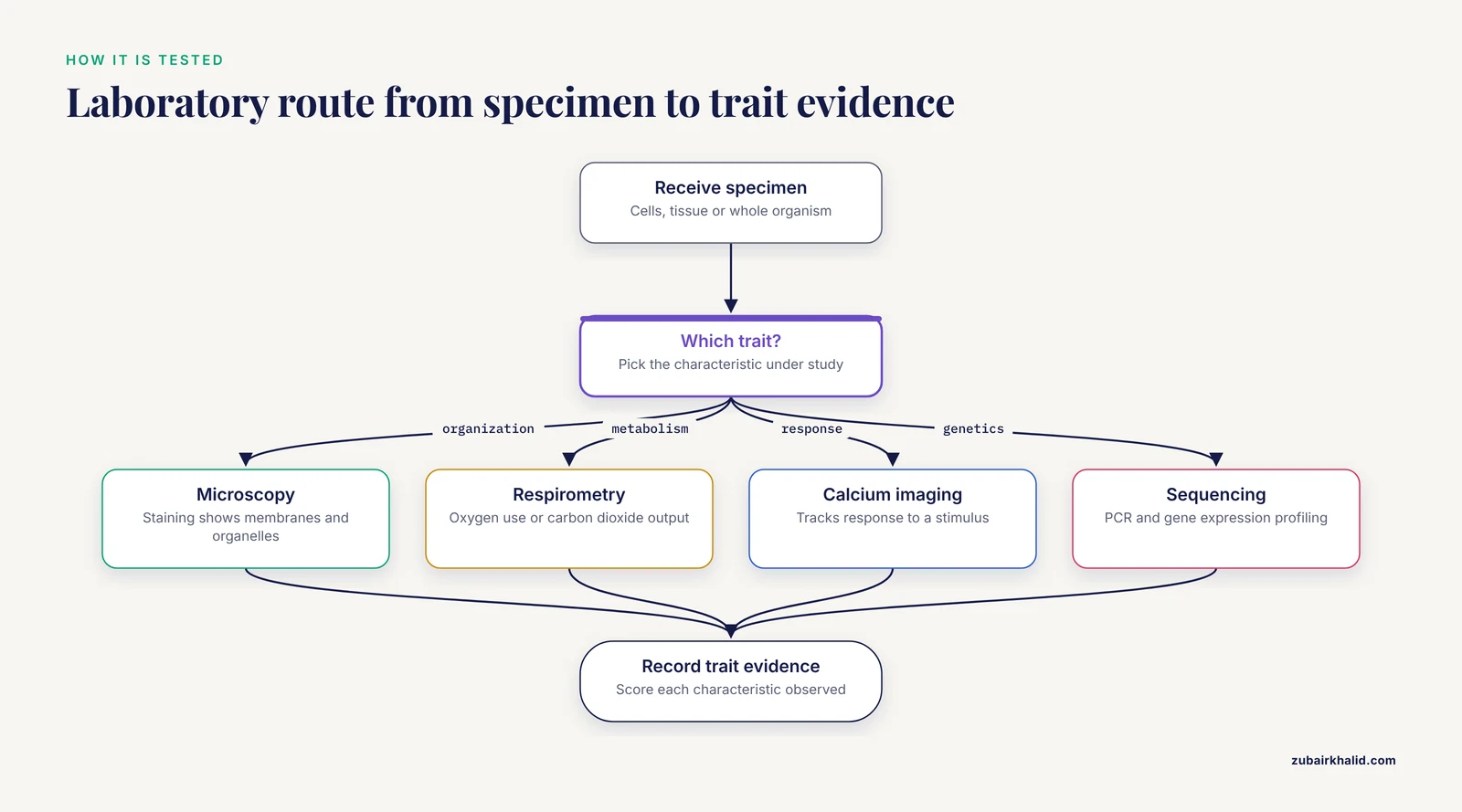
In the laboratory, each trait can be tested directly.
Cellular organization is observed with light and electron microscopy. Staining techniques reveal membranes, nuclei, and organelles. Immunofluorescence can localize specific proteins within a cell.
Metabolism is measured with respirometry, which detects oxygen consumption or carbon dioxide production. Enzyme assays measure the activity of specific metabolic pathways. In fermentation studies, researchers use gas chromatography-mass spectrometry to identify volatile organic compounds produced by microbes [6].
Homeostasis is tested by challenging an organism or cell and measuring its response. Blood glucose tests, pH measurements, and ion concentration assays all report on homeostatic regulation.
Response to stimuli is measured with behavioral assays, calcium imaging, or electrophysiology. Researchers might expose cells to a chemical gradient and track their movement.
Growth is measured with growth curves, cell counts, or biomass measurements. Development is studied with lineage tracing and gene expression analysis.
Reproduction is observed directly. In chickens, laying performance is quantified by counting eggs over a defined period, and follicular morphology is examined histologically [4].
Genetic information is analyzed with DNA sequencing, PCR, and gene expression profiling. Single-cell RNA sequencing, for example, reveals which genes are active in individual cells of a tumor [5].
Adaptation and evolution are tested with long-term experiments, comparative genomics, and studies of natural populations. In cancer, researchers compare gene expression across tumor stages to identify adaptive changes [5].
Comparative and Clinical Relevance
The 8 characteristics of life are not just an academic exercise. They have real consequences for medicine, agriculture, and biotechnology.
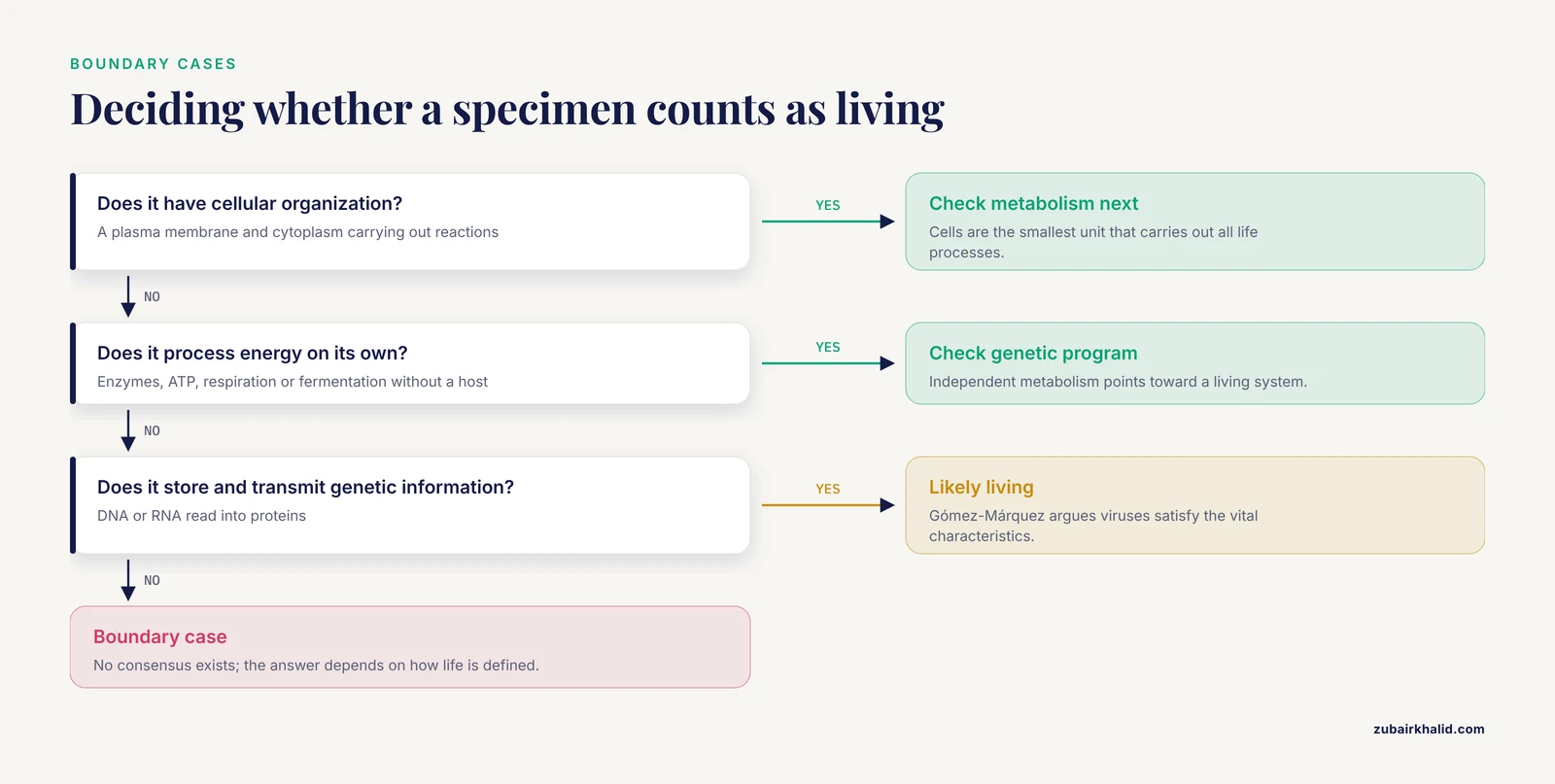
Viruses are the most famous boundary case. They have genetic information and can reproduce, but only inside host cells. They do not carry out metabolism on their own. Whether viruses are alive is a matter of debate. Gómez-Márquez argues in favor of considering viruses as living beings, because they satisfy all the vital characteristics common to living things and because of their role in the evolution of species [2]. Other biologists disagree, pointing to the absence of independent metabolism.
Dormant seeds and ultracold cells are another boundary case. They are alive, but they show almost no metabolic activity. Gómez-Márquez describes them as temporarily lifeless living systems [1]. They can resume full activity when conditions improve. This shows that the characteristics of life are not always expressed at full intensity.
The definition of life also matters for artificial life and synthetic biology. If scientists build a cell from scratch, or engineer a photosynthetic pathway into a new organism, how should we classify it? Synthetic biology already aims to improve photosynthesis by optimizing Rubisco, installing carbon-concentrating mechanisms, and engineering photorespiratory bypasses [3]. These efforts blur the line between natural and artificial life.
In medicine, the characteristics of life help explain disease. Cancer cells are alive by every criterion, but their growth, metabolism, and adaptation are dysregulated. They consume nutrients, evade signals that would normally stop division, and evolve resistance to therapy [5]. A veterinarian assessing a sick pet relies on the same traits, checking whether the animal responds to stimuli, maintains body temperature, and recovers from illness. Understanding the molecular traits of life, such as the genetic program and adaptive signaling, is essential for developing treatments.
In agriculture, the traits of life are used to improve crops and livestock. The study of BMP15 expression in hens, for example, connects a specific gene to egg production, which could inform breeding programs [4].
Common Mistakes and Limitations
Students and even working biologists make several recurring mistakes when applying the 8 characteristics of life.
First, they treat the traits as a strict checklist in which every trait must be present at all times. In reality, individual organisms can lack one or more traits. A sterile mule does not reproduce. A dormant seed does not grow. A virus does not metabolize. Gómez-Márquez explicitly excludes reproduction and evolution from the essential features of an individual life [1]. The traits describe the general behavior of living systems, not a set of requirements that every organism must meet at every moment.
Second, students confuse individual adaptation with evolution. Acclimation, such as producing more red blood cells at high altitude, is a physiological response. Evolution is a change in allele frequency in a population over generations. Both are forms of adaptation, but they require different evidence.
Third, students assume that all living things need oxygen. Many microbes are anaerobes, and fermentation supports life in oxygen-free environments. Energy processing does not require oxygen.
Fourth, students think that viruses are clearly alive or clearly dead. The scientific community has not reached consensus [1]. The question depends on how life is defined, and reasonable biologists hold different views [2].
Fifth, students confuse "characteristics of life" with "quality of life." The phrase "quality of life" appears in medicine and social science, where it refers to well-being, independence, and contentment in human populations. This is a different concept entirely and should not be mixed into a biology lesson on the traits of living things.
Finally, the 8 characteristics have limitations as a definition. They are descriptive, not predictive. They tell us what life does, but they do not fully explain what life is. Gómez-Márquez notes that no definition of life has reached consensus [1]. The characteristics approach is a useful framework, but it is not a complete theory.
Quick Review
- Life is an interactive process in entropy-producing, adaptive, and informative organic systems [1].
- The 8 characteristics are cellular organization, metabolism, homeostasis, response to stimuli, growth and development, reproduction, genetic information, and adaptation through evolution.
- Reproduction and evolution are essential for the continuation of life, but not for an individual to be alive [1].
- The genome is a reworkable pre-program: it stores information, is read during development, and can be altered by mutation [1].
- Living systems create internal order by exporting entropy to the environment [1].
- Viruses, dormant seeds, and ultracold cells are boundary cases that test any definition of life [1][2].
- Cancer is a real-world example of adaptive evolution at the cellular level [5].
Related Guides
- Annelid Phylum: Characteristics and Examples: Examples of multicellular organism traits and classification
- Chordata Phylum: Key Characteristics and Classes: Key animal phylum traits for comparing organism characteristics
- Bantam Breed Chickens: Care and Characteristics: Chicken breed care linked to hen examples
- Hypothesis Development Worksheet: A Fillable PDF for Planning Your Next Study: Worksheet for planning biology studies and classroom exercises
- Campylobacter jejuni in Poultry: Zoonotic Risks, Food Safety, and Thermophilic Characteristics: Poultry zoonoses relevant to chicken and veterinary readers
- Highland Cattle Farming: Breed Characteristics and Management: Cattle breed management for agriculture and livestock context
Frequently Asked Questions
What are the 8 characteristics of life?
The 8 characteristics of life are cellular organization, metabolism and energy processing, homeostasis, response to stimuli, growth and development, reproduction, genetic information, and adaptation through evolution. Together they describe what distinguishes living things from nonliving matter.
Why is reproduction not required for an individual to be alive?
Reproduction is required for the continuation of a species, but not for the life of an individual. A sterile mule or a non-dividing neuron is fully alive. Gómez-Márquez explicitly states that reproduction and evolution are not essential for life [1].
Are viruses living things?
There is no consensus. Viruses have genetic information and can reproduce inside host cells, but they do not carry out independent metabolism. Gómez-Márquez argues that viruses should be considered living beings because they satisfy the vital characteristics common to all living things [2]. Other biologists disagree.
What is the difference between adaptation and evolution?
Adaptation at the individual level is acclimation, a short-term physiological adjustment. Evolution is a change in allele frequency in a population over generations. Both are forms of adaptation, but they operate on different timescales. Cancer is an example of somatic evolution within the body.
How do scientists test whether something is alive?
Scientists test for the 8 characteristics directly. Microscopy reveals cellular organization. Respirometry and enzyme assays measure metabolism. Behavioral assays and calcium imaging measure stimulus response. Growth curves measure growth. DNA sequencing and gene expression profiling reveal genetic information. Long-term experiments test evolution.
Can a single cell be considered alive?
Yes. A single bacterial cell is alive. It has cellular organization, carries out metabolism, maintains homeostasis, responds to stimuli, grows, reproduces, and contains genetic information. Even individual cells in a multicellular organism, such as a neuron or a cancer cell, are alive by these criteria.
Sources
- Reflections upon a new definition of life.
- What is life?
- Synthetic biology for improving photosynthesis.
- Histological characteristics and expression of BMP15 and ZDHHC2 in relation to laying performance and egg shape traits in Huaixiang chickens.
- Pancreatic Ductal Adenocarcinoma Progression Is Associated With Reduced Stromal Organization and Adaptive Tumor Signaling at Single-Cell Resolution.
- Flaxseed kernel as an alternative substrate for novel natto fermentation: metabolic characteristics and flavor formation mechanism.