pH Calculator
By Dr. Zubair Khalid, DVM, MS, PhD ·
A pH calculator converts a concentration and an acid dissociation constant into a number on the pH scale. That sounds narrow, but the number you get depends entirely on which formula you chose. A strong acid, a weak acid, a buffer, and a salt of a weak acid each need a different equation, and using the wrong one produces an answer that looks precise and is wrong by whole pH units.
By the end of this guide you will be able to look at a solution, decide which of five calculation routes applies, run the arithmetic yourself, and judge whether the result is trustworthy or whether the simple model has broken down. You need three things on hand: the analytical concentration in moles per liter, the Ka or pKa for any species that is not fully dissociated, and a calculator with a base-10 logarithm. Python 3 with only its standard library, or any spreadsheet program, is enough. No packages are required.
What the Number Means Before You Compute It
pH is defined as the negative base-10 logarithm of the hydrogen ion activity, not the concentration.
pH = -log10(aH+)
Activity is concentration multiplied by an activity coefficient that depends on how crowded the solution is with other ions. In dilute solutions below about 0.01 M, the activity coefficient is close to 1 and activity is close to concentration. In seawater, in cell culture medium, or in a 0.5 M salt solution, the two diverge and a calculator that ignores activity will drift from a calibrated electrode reading.
A pH calculator is therefore a model, and every model has assumptions. The good ones state them: ideal solution, 25 °C, one dominant equilibrium, no precipitation, no complexation. Read those assumptions before you trust a number.
Brønsted acids and the Lewis contrast
The calculations in this guide treat acids as proton donors and bases as proton acceptors, the Brønsted-Lowry definition. It is the framework that produces pH values because it tracks the hydrogen ion directly.
A separate framework, Lewis acid-base theory, tracks electron pairs instead of protons. A Lewis acid accepts an electron pair and a Lewis base donates one. This bookkeeping does not produce a pH number, but it explains why surfaces and catalysts bind particular ions. Materials chemists use Lewis acid and Lewis base sites, such as boron and nitrogen centers, to selectively adsorb iodine species in a battery host [1], and they use paired hard and soft Lewis base sites to promote desolvation of hydrated zinc ions at a carbon electrode [2]. If you are reading a paper about adsorption and see "Lewis acid," do not expect to plug it into a pH equation.
The temperature problem
Water autoionizes, and the equilibrium constant Kw changes with temperature. At 25 °C, Kw is 1.0 × 10^-14 so pKw is 14.00. At 0 °C, pKw is about 14.94. At 50 °C, pKw is about 13.26. Neutral pH is pKw divided by 2, which means neutral water is pH 7.00 at 25 °C but pH 6.63 at 50 °C. A solution at pH 6.6 at 50 °C is neutral, not acidic. Any pH calculator online that hardcodes 14 for the strong base formula will be off by a similar amount at elevated temperature.
Choosing the Right Formula
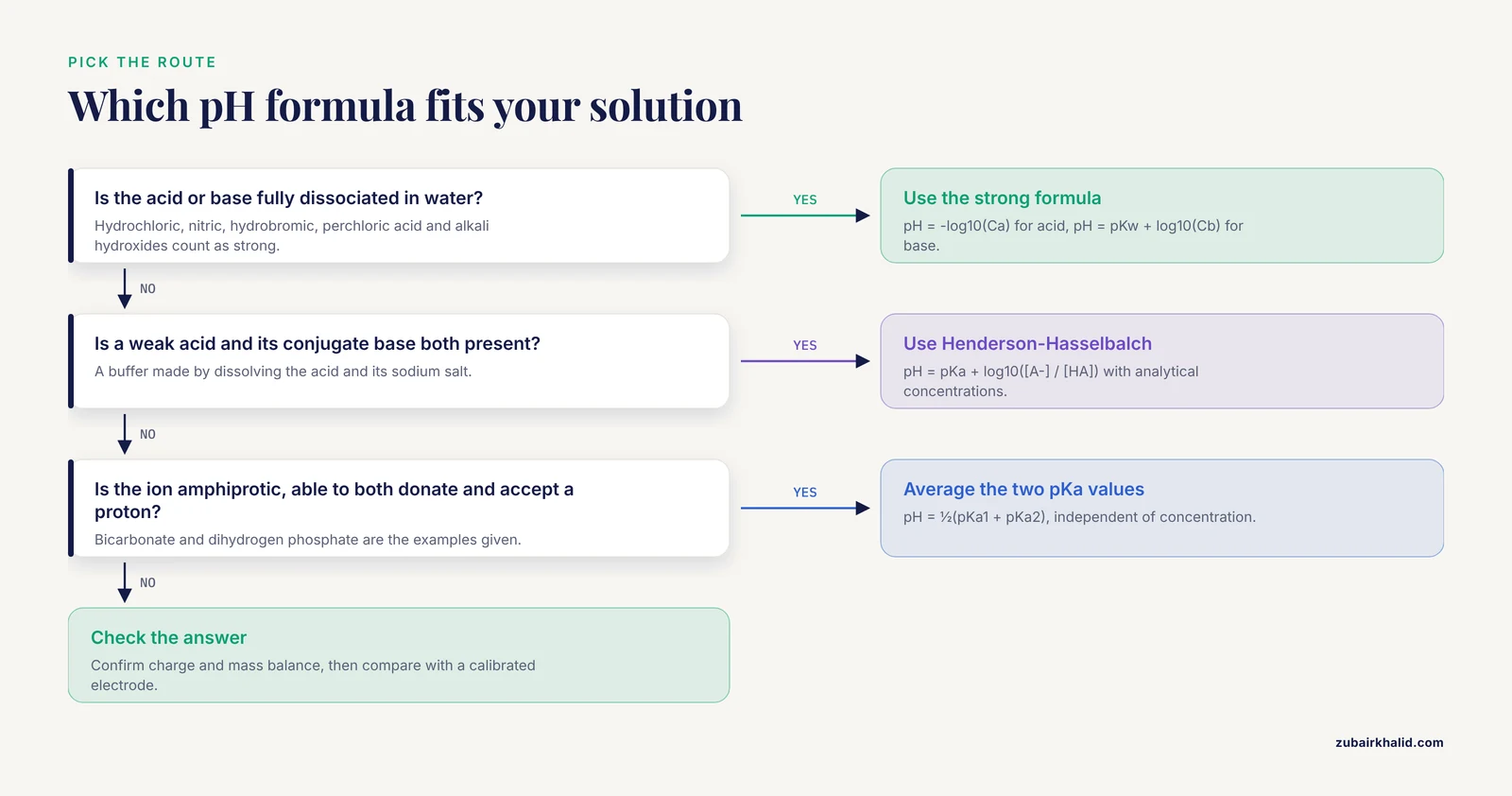
The decision comes down to two questions. Is the acid or base fully dissociated in water, and is there a second species present that resists pH change?
| System | What you know | Formula | Key assumption |
|---|---|---|---|
| Strong acid | Concentration Ca | pH = -log10(Ca) | Complete dissociation |
| Strong base | Concentration Cb | pH = pKw + log10(Cb) | Complete dissociation |
| Weak acid | Ca and Ka | Solve x² + Ka·x - Ka·Ca = 0 | One equilibrium, ideal solution |
| Weak base | Cb and Kb | Solve x² + Kb·x - Kb·Cb = 0, then pH = pKw - pOH | One equilibrium |
| Buffer | Ca, Cb, Ka | pH = pKa + log10(Cb / Ca) | Both forms present, ratio near 1 |
| Salt of weak acid | Ca and Ka | pH = 7 + ½(pKa + log10 Ca) | Hydrolysis only |
The salt row is the shortcut form. The full treatment is a weak base calculation using Kb = Kw / Ka.
Walkthrough 1: Strong Acid and Strong Base
Hydrochloric acid, nitric acid, hydrobromic acid, perchloric acid, and the alkali hydroxides are treated as fully dissociated in water at the concentrations usually encountered in a teaching lab.
- Convert the mass to moles, then divide by the volume in liters. A 0.0100 M solution means 0.0100 mol per liter, not 0.0100 mol per 100 mL.
- Confirm the acid is monoprotic. Sulfuric acid is not, and its second dissociation matters above about 0.01 M.
- Apply the formula. For the base, compute pOH first, then subtract from pKw.
import math

KW = 1.0e-14
PKW = 14.00   # at 25 C

def ph_strong_acid(ca):
    return -math.log10(ca)

def ph_strong_base(cb):
    return PKW + math.log10(cb)

print(f"{ph_strong_acid(0.0100):.3f}")
print(f"{ph_strong_base(0.0100):.3f}")
Expected output:
2.000
12.000
Check the second line against intuition. A 0.0100 M sodium hydroxide solution has pOH 2.000 and pH 12.000 at 25 °C. If your calculator returns 2.000 for the base as well, it has applied the acid formula to a base.
For a mixture of a strong acid and a strong base, subtract the smaller amount of moles from the larger, then divide by the total volume before taking the logarithm. A solution made from 25.0 mL of 0.100 M HCl plus 20.0 mL of 0.100 M NaOH has 0.00250 mol of acid and 0.00200 mol of base in 0.0450 L, leaving 0.00050 mol of acid at a concentration of 0.0111 M and a pH of 1.954.
Walkthrough 2: Weak Acid with the Quadratic
Acetic acid, formic acid, benzoic acid, hydrofluoric acid, and ammonium ion are not fully dissociated. You need the equilibrium expression.
HA ⇌ H+ + A- with Ka = [H+][A-] / [HA]
Set up an ICE table with x as the concentration that dissociates.
| Species | Initial | Change | Equilibrium |
|---|---|---|---|
| HA | Ca | -x | Ca - x |
| H+ | ~0 | +x | x |
| A- | 0 | +x | x |
Substituting gives x² / (Ca - x) = Ka, which rearranges to x² + Ka·x - Ka·Ca = 0. Solve with the quadratic formula and take the positive root.
- Write down Ca and Ka in mol/L and in the correct units. Convert pKa to Ka with Ka = 10^(-pKa).
- Decide whether the shortcut x ≈ √(Ka·Ca) is allowed. Compute x, divide by Ca, and if the result is below 5 percent the shortcut is fine. Above 5 percent, use the quadratic.
- Compute pH = -log10(x).
- Verify with a charge balance. The positive charge from H+ should equal the negative charge from A- plus OH-.
def ph_weak_acid(ca, ka):
    disc = ka * ka + 4.0 * ka * ca
    h = (-ka + math.sqrt(disc)) / 2.0
    return -math.log10(h)

def ph_shortcut(ca, ka):
    return -math.log10(math.sqrt(ka * ca))

ca, ka = 0.100, 1.8e-5
print(f"quadratic  {ph_weak_acid(ca, ka):.3f}")
print(f"shortcut   {ph_shortcut(ca, ka):.3f}")
print(f"percent dissociated {100 * math.sqrt(ka * ca) / ca:.2f}")
Expected output:
quadratic  2.876
shortcut   2.872
percent dissociated 1.34
With 1.34 percent dissociation, the shortcut is acceptable and the two answers differ by 0.004 pH units. Now run the same comparison on 0.0100 M citric acid with Ka1 = 7.4 × 10^-4. The shortcut gives pH 2.57. The quadratic gives pH 2.62, and the fraction dissociated is 23.8 percent, well past the 5 percent threshold. The gap is real, and only the quadratic answer is defensible.
Walkthrough 3: Buffers and the Henderson-Hasselbalch Equation
A buffer is a mixture of a weak acid and its conjugate base. The ratio of the two concentrations sets the pH, and the total sets the capacity.
pH = pKa + log10([A-] / [HA])
- Identify the weak acid and its conjugate base, and find the pKa of the acid form.
- Use the analytical concentrations of the two forms, not the equilibrium ones. For a buffer made by dissolving the acid and its sodium salt, these are the amounts you weighed out.
- Check that the ratio is between about 0.1 and 10. Outside that window the mixture is a poor buffer and the Henderson-Hasselbalch equation loses accuracy.
- Check that the buffer concentration is well above the Ka value. A buffer prepared at 1 mM with a pKa of 4 is too dilute to control pH.
def ph_buffer(ca, cb, ka):
    return -math.log10(ka) + math.log10(cb / ca)

print(f"{ph_buffer(0.100, 0.100, 1.8e-5):.3f}")   # equal parts
print(f"{ph_buffer(0.100, 0.050, 1.8e-5):.3f}")   # half as much base
Expected output:
4.745
4.444
The first value equals the pKa of acetic acid, 4.745. The second is 0.301 pH units lower because the log10 of 0.5 is -0.301. That 0.301 figure is worth remembering: halving the base-to-acid ratio shifts any buffer by about 0.3 units.
Buffers are where a pH calculator from molarity most often fails in practice. Real buffered systems resist change but they do not resist it perfectly, and the resistance runs out. In a dissolution study using a biorelevant bicarbonate buffer at an initial pH of 6.5 with a buffer capacity of 4.4 mM/pH, the bulk pH dropped below 6.0 for naproxen and below 5.0 for valsartan after four hours as the free acid drugs dissolved and consumed buffer [3]. The initial pH alone would have predicted far higher solubility than the experiment delivered. Buffer capacity, not just starting pH, controls what happens.
Buffers also appear as reaction media in synthetic chemistry. One study converted nitric oxide to nitrogen gas using an iron porphyrin in an acidic aqueous solution near pH 3 with glycine as the buffer component, and the reaction produced nitrogen bubbles within minutes at room temperature [4]. The pH and the buffer identity are part of the reaction design, not an afterthought.
Walkthrough 4: Weak Bases and Salts
For ammonia or an amine with base constant Kb, the math mirrors the weak acid case.
B + H2O ⇌ BH+ + OH- with Kb = [BH+][OH-] / [B]
- Solve the quadratic for [OH-].
- Convert to pOH = -log10([OH-]).
- Convert to pH with pH = pKw - pOH.
A salt of a weak acid, such as sodium acetate, makes the solution basic. The acetate ion is the conjugate base of acetic acid, so its Kb is Kw divided by Ka.
def ph_weak_base(cb, kb):
    disc = kb * kb + 4.0 * kb * cb
    oh = (-kb + math.sqrt(disc)) / 2.0
    return PKW + math.log10(oh)

ka_acetic = 1.8e-5
kb_acetate = KW / ka_acetic

print(f"0.10 M ammonia, Kb 1.8e-5  {ph_weak_base(0.100, 1.8e-5):.3f}")
print(f"0.10 M sodium acetate      {ph_weak_base(0.100, kb_acetate):.3f}")
Expected output:
0.10 M ammonia, Kb 1.8e-5  11.124
0.10 M sodium acetate      8.872
Both answers are basic, as expected. If your spreadsheet returns 5.128 for sodium acetate, you computed pOH and forgot to subtract from pKw.
Walkthrough 5: Polyprotic Acids and Zwitterions
Citric acid has three carboxylic acid groups with pKa values of 3.13, 4.76, and 6.40. Citric acid appears as a standard food-simulating liquid in materials testing, where it stands in for acidic foods [5]. For a 0.0100 M solution the first dissociation dominates, and the calculation above gives pH 2.62. The second dissociation contributes about 0.7 percent of the total hydrogen ion at that pH, which is why the single-equilibrium answer is close but not exact.
A general rule helps. Compare the pH you computed to each successive pKa. If the pH is more than about one unit below pKa2, the second dissociation is negligible. If it is within one unit, you need to solve the full system or use a numerical solver.
Polyprotic and multi-site molecules also break the assumption that charge and protonation move together. Zwitterionic species carry positive and negative charges at the same time and a net charge of zero. Zwitterionic tetrazole N-oxides, including a 5-amino-1-methyl tetrazole 4-N-oxide, have been synthesized along with their nitrate and perchlorate salts [6]. A calculator that assigns a single protonation state per molecule will mishandle such a compound. Real speciation needs each ionizable group treated separately with its own pKa.
Charge state matters beyond acid-base arithmetic. A cationic dye such as methylene blue forms an ion pair with the perfluorooctanoate anion in a quartz crystal microbalance sensor, and that pairing depends on the acid being in its anionic form [7]. The pH of the sample is part of the assay design because it decides which form is present.
pH Calculator From Molarity: Where the Shortcut Breaks
Concentration alone gives an exact pH only for a fully dissociated strong acid or base in pure water. Four situations break the shortcut.
The acid is weak. A 0.1 M solution of a weak acid with pKa 4 has a pH near 2.5, not 1.0. The difference is two orders of magnitude in hydrogen ion concentration.
The solution is buffered. The pH is set by the ratio of conjugate forms, not the total molarity. You can double the concentration of a buffer and the pH barely moves.
The solvent has its own background. Pure water in contact with air absorbs carbon dioxide and settles near pH 5.6, not 7.0. A dilute acid or base below about 10^-6 M cannot be calculated from concentration alone because the water background dominates.
The concentration is high. Above roughly 0.1 M, activity coefficients deviate from 1 and the calculated pH runs low compared with a measured value. In 1 M acid the error can exceed 0.2 units.
Parameters That Move the Answer
Temperature
Ka and Kw are both temperature dependent. If you measure pH at 37 °C for a biological sample, state the temperature. A glass electrode calibrated at 25 °C and used at 37 °C will read slightly differently, and the neutral point has shifted.
Ionic strength
Add a background salt and the activity coefficients fall. The measured pH drifts even when the acid concentration is unchanged. If you work in physiological saline or in a medium with high magnesium and calcium, use a calibration buffer matched to the sample matrix.
Dissolved gases and volatility
Carbon dioxide lowers the pH of any open alkaline solution. Ammonia and volatile amines raise it and also escape, so a calculated pH for a dilute ammonia solution can shift as the solution sits on the bench.
Concentration units
Molarity is moles of solute per liter of solution. Molality is moles per kilogram of solvent. For dilute aqueous work the two are nearly equal, but at high concentration the difference matters. Always convert mass and volume to molarity first.
Hydration and complexation
Metal ions hydrolyze. A solution of ferric chloride is acidic not because of free HCl but because the hydrated iron ion releases protons. No simple formula covers this. Use measured values or a speciation program.
Common Mistakes and Limitations
Using the strong acid formula on a weak acid. The result is low by one to three pH units. Fix it by checking the pKa first. If the pKa is above zero, the acid is probably weak enough to need the equilibrium treatment.
Forgetting to convert pKa to Ka. The quadratic needs Ka. If you pass pKa directly, the quadratic still runs but returns a wrong pH, because the formula needs Ka (10^-pKa), not pKa. Convert with ka = 10 ** -pka before calling.
Passing a zero or negative concentration. math.log10(0.0) raises ValueError: math domain error. A negative concentration through the quadratic gives a negative discriminant and the same error. Validate inputs with a check such as if ca <= 0: raise ValueError("concentration must be positive").
Dividing by zero in a buffer ratio. If the acid concentration is zero, math.log10(cb / ca) raises ZeroDivisionError: float division by zero. A buffer with no acid form is not a buffer. Guard the function.
Excel returns #NUM! or #DIV/0!. #NUM! in a logarithm cell almost always means the argument is zero or negative. #DIV/0! in a buffer row means the acid concentration cell is empty rather than small.
Mixing units. Millimoles per liter and moles per liter differ by a factor of 1000, which is 3 pH units. Label every cell.
Assuming pH 7 is neutral at every temperature. It is neutral only at 25 °C.
Ignoring the second dissociation of sulfuric acid. Above about 0.01 M, the second proton contributes measurably. Treat it as a two-step system.
Reporting too many digits. A pH reported as 4.7453 implies an accuracy the inputs do not have. Two decimals is usually the honest limit for a calculated value.
Treating a calculated pH as a measurement. Calculations assume ideal behavior. A calibrated electrode measures the real thing. When the two disagree by more than 0.1 units, trust the electrode and look for a missing equilibrium.
Checking the Result
Charge balance. Sum the positive charges and the negative charges. They must be equal. For a weak acid, [H+] should equal [A-] plus [OH-]. If the balance fails by more than a few percent, the model is missing a species.
Mass balance. The sum of all forms of the acid should equal the analytical concentration. If [HA] plus [A-] does not equal Ca, something is wrong in the algebra.
Limiting cases. At very low concentration, a weak acid approaches pure water and the pH approaches 7 minus a small amount. If your answer goes below 7 by a large margin at 10^-7 M, the calculation has ignored the water background.
Monotonicity. Diluting an acid by a factor of 10 should raise the pH by about 1 unit for a strong acid and about 0.5 units for a weak acid. If a tenfold dilution changes the answer by 3 units, check for a unit conversion error.
Cross-check with a second route. Compare the quadratic result to the shortcut. If they differ by more than 0.1 units, the 5 percent rule has failed and the quadratic is the one to keep.
Compare to a measurement. Calibrate a glass electrode with fresh pH 4.01, 7.00, and 10.01 buffers and measure the sample at the same temperature as the calibration. Record both the calculated and measured values.
Very Dilute Acids: When Water Itself Supplies the H⁺
The formula pH = -log10(C) assumes every hydrogen ion in the solution came from the acid. That assumption fails when C is so small that water's own dissociation contributes a comparable amount. Pure water at 25 °C has [H+] = 1.0 × 10^-7 M. A solution of 1.0 × 10^-8 M HCl cannot be acidic at pH 8; the acid adds protons, but the water equilibrium shifts and still supplies about 10^-7 M H+. The simple logarithm ignores this background and breaks down below roughly 10^-6 M. The error grows as C decreases because the acid's own protons become a minority. At 10^-8 M, the acid contributes only about 10 percent of the total hydrogen ion.
For a strong monoprotic acid at concentration C, the exact treatment includes both sources of protons. The charge balance is
[H+] = [OH-] + C
because each acid molecule contributes one A- and each water molecule contributes one OH-. This assumes no other ions are present, the same ideal-solution assumption used elsewhere in this guide. Using Kw = [H+][OH-], substitute [OH-] = Kw/[H+] to get
[H+] = Kw/[H+] + C
Multiply through by [H+] and rearrange:
[H+]^2 - C[H+] - Kw = 0
The positive root is
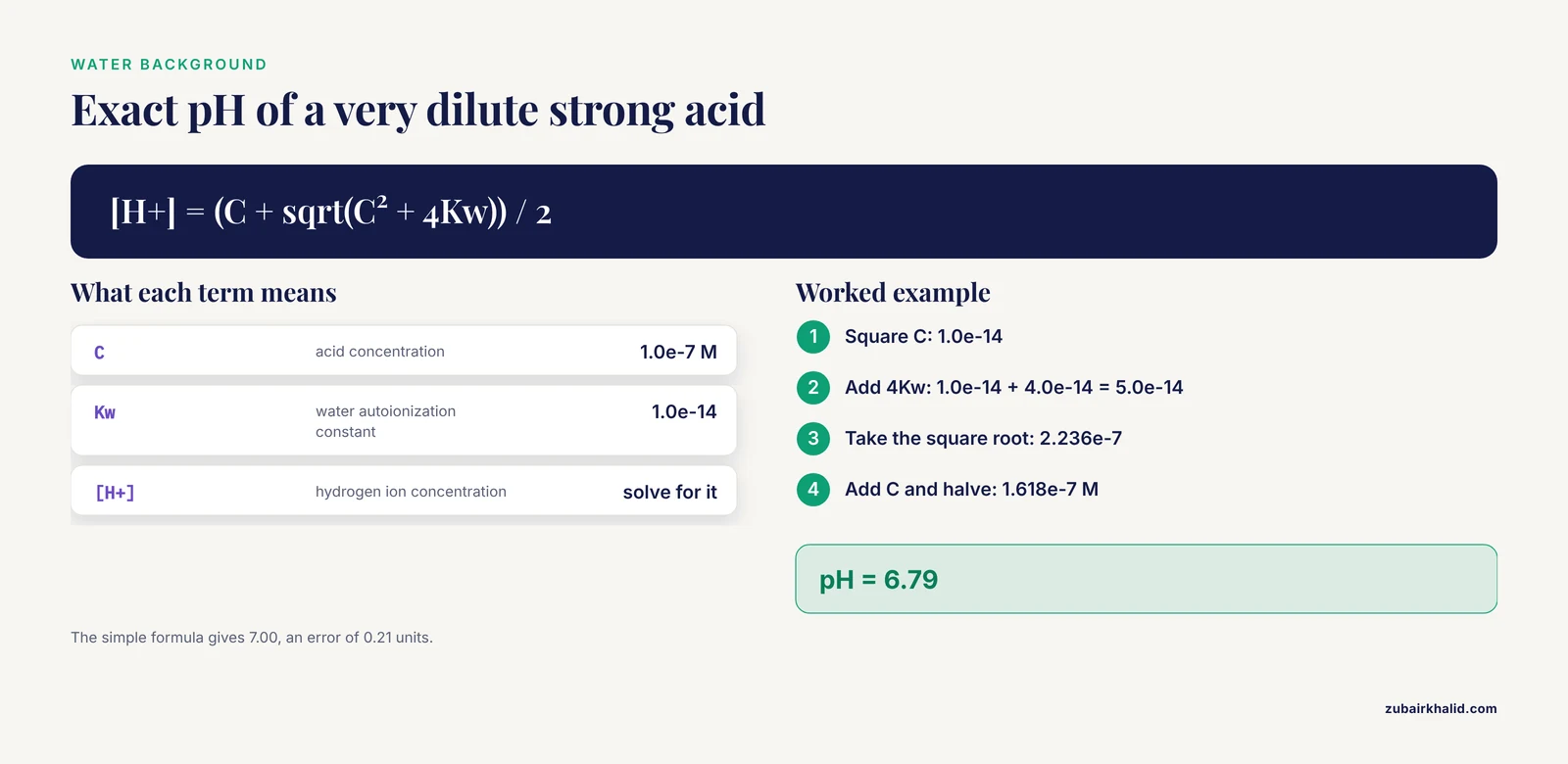
[H+] = (C + sqrt(C^2 + 4Kw)) / 2
For 1.0 × 10^-7 M HCl, C = 1.0 × 10^-7 and Kw = 1.0 × 10^-14. Then
[H+] = (1.0e-7 + sqrt(1.0e-14 + 4.0e-14)) / 2 = (1.0e-7 + 2.236e-7) / 2 = 1.618e-7 M
so pH = 6.79. The simple formula gives pH = 7.00, an error of 0.21 units. At 1.0 × 10^-6 M, the exact pH is 5.996 versus 6.000, an error of only 0.004 units.
| C (M) | Simple pH | Exact pH | Error |
|---|---|---|---|
| - | - | - | - |
| 1.0e-5 | 5.000 | 5.000 | <0.001 |
| 1.0e-6 | 6.000 | 5.996 | 0.004 |
| 1.0e-7 | 7.000 | 6.791 | 0.209 |
| 1.0e-8 | 8.000 | 6.978 | 1.022 |
The practical cutoff is clear. Use the exact quadratic when C is below 1.0 × 10^-6 M. Above that, the simple formula agrees within 0.01 pH units and is fine for almost all purposes. When C = 0, the quadratic gives [H+] = sqrt(Kw) = 1.0 × 10^-7 M, so pH = 7.00, as it must. The same quadratic works for any strong monoprotic acid, since the anion identity does not enter the equation. For a weak acid at these dilutions, the same water background matters, but the full treatment requires solving the weak-acid equilibrium together with Kw, which is beyond the scope of this section.
Buffer pH After Adding Strong Acid or Base
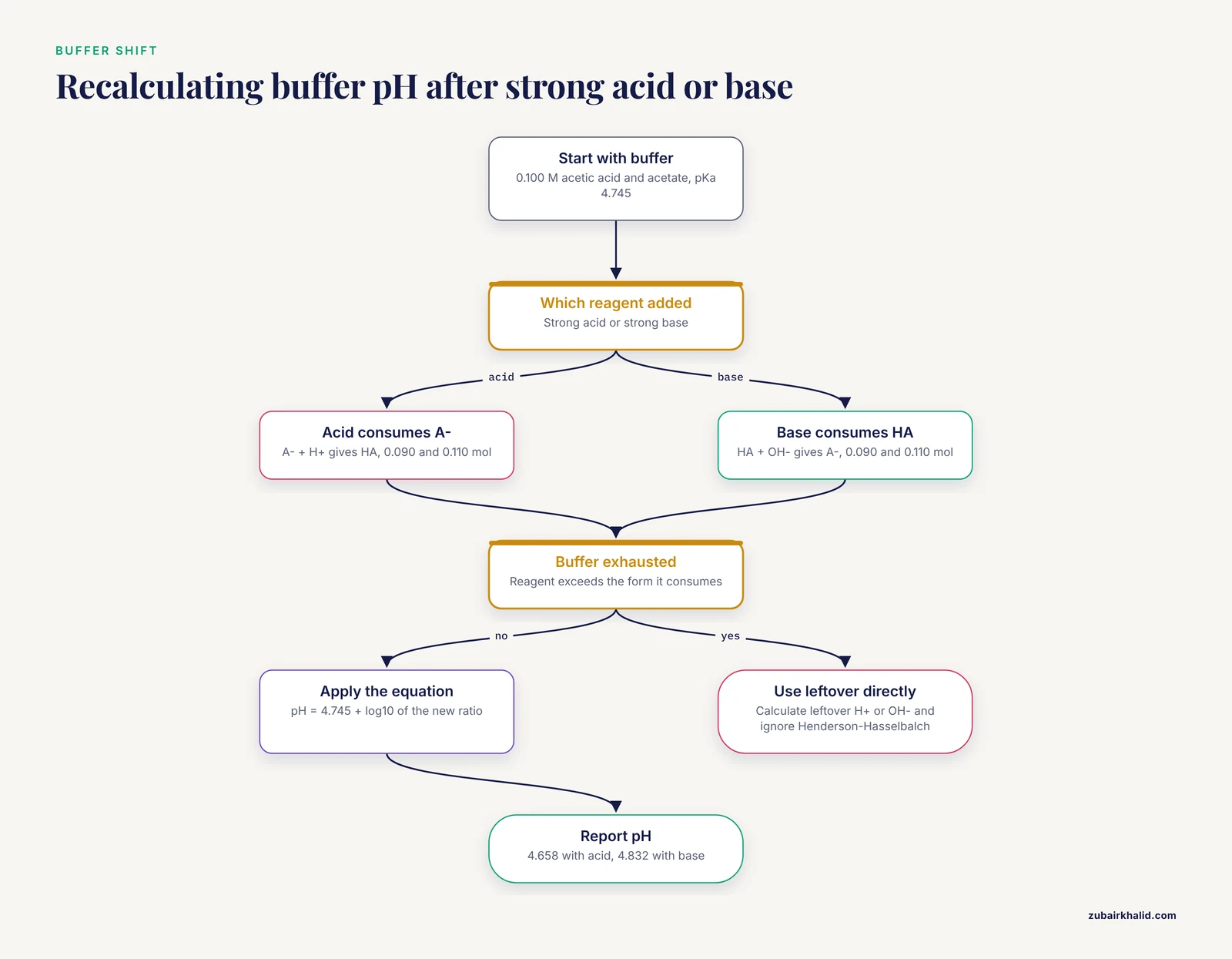
When HCl or NaOH is added to a buffer, the strong reagent reacts almost completely with the conjugate pair. Recalculate in two steps: let the strong acid or base consume one buffer form, then apply Henderson-Hasselbalch to the new amounts.
For added strong acid, H+ converts the base form to the acid form: A- + H+ → HA. For 1.00 L of a 0.100 M acetic acid/acetate buffer (pKa 4.745) plus 0.010 mol HCl, the ICE amounts are:
Species: A-, H+, HA Initial (mol): 0.100, 0.010, 0.100 Change (mol): -0.010, -0.010, +0.010 Final (mol): 0.090, ~0, 0.110
The strong acid is the limiting reactant, so it is consumed. Then pH = 4.745 + log10(0.090/0.110) = 4.745 - 0.087 = 4.658. The buffer started at pH 4.745.
For added NaOH, OH- removes HA and produces A-: HA + OH- → A- + H2O. Use the same ICE layout with HA decreasing and A- increasing by the moles of OH- added. Adding 0.010 mol NaOH to the same buffer gives 0.090 mol HA and 0.110 mol A-, so pH = 4.745 + log10(0.110/0.090) = 4.832. If the strong reagent exceeds the amount of the buffer form it consumes, the buffer is exhausted; calculate the leftover OH- or H+ directly and ignore Henderson-Hasselbalch.
The example shows why the ratio controls pH, not total concentration. HA plus A- remains 0.200 mol in 1.00 L, yet pH moves by 0.087 units because the A-/HA ratio changes from 1.00 to 0.818. The size of the shift depends on how much the ratio changes, not on the starting total. A more concentrated buffer at the same ratio shifts less for the same added moles. If the added volume is large, divide final moles by the new total volume before taking the ratio. Keep the final ratio within about 0.1 to 10, or the buffer is too depleted for the equation to be reliable.
Amphiprotic Salts: The pH of Bicarbonate and Hydrogen Phosphate
An amphiprotic ion can both donate and accept a proton. Bicarbonate, HCO3-, is the conjugate base of carbonic acid (pKa1) and the acid of carbonate (pKa2). Dihydrogen phosphate, H2PO4-, sits between the first and second pKa values of phosphoric acid. For a solution of the pure sodium salt NaHA, the proton balance is [H+] + [H2A] = [A2-] + [OH-]. The left side counts protons gained by water and by HA- to form H2A; the right side counts protons lost by HA- to form A2- and by water to form OH-. When the salt concentration is high enough that [H+] and [OH-] are negligible compared with [H2A] and [A2-], the balance simplifies to [H2A] = [A2-]. Expressing both concentrations in terms of [HA-] gives [H+][HA-]/Ka1 = Ka2[HA-]/[H+]. Canceling [HA-] and rearranging gives [H+] = sqrt(Ka1 Ka2), so pH = ½(pKa1 + pKa2). The result is independent of concentration. This is why the pH of a sodium bicarbonate solution is close to 8.3 whether the concentration is 0.01 M or 0.1 M.
| Salt | Amphiprotic ion | pKa1 | pKa2 | pH = ½(pKa1 + pKa2) |
|---|---|---|---|---|
| - | - | - | - | - |
| NaHCO3 | HCO3- | 6.35 | 10.33 | 8.34 |
| NaH2PO4 | H2PO4- | 2.15 | 7.20 | 4.68 |
The same formula applies to Na2HPO4 using pKa2 and pKa3 of phosphoric acid, giving pH ≈ 9.78. For example, 0.050 M NaHCO3 gives an approximate pH of 8.34, and the exact equation returns 8.34 to two decimals.
The exact charge balance for a salt NaHA at concentration C is C + [H+] = [HA-] + 2[A2-] + [OH-], with [HA-] = C / (1 + [H+]/Ka1 + Ka2/[H+]). This equation is a cubic in [H+], so a pH calculator solves it numerically. For 0.10 M NaHCO3 the exact result is pH 8.34, and for 0.10 M NaH2PO4 it is pH 4.68. The approximation is within 0.01 pH units at these concentrations.
The approximation holds when C is large compared with both Ka1 and Kw/Ka2. For NaHCO3, Kw/Ka2 is about 2 × 10^-4, so the formula is reliable above roughly 0.01 M. For NaH2PO4, Kw/Ka2 is about 1.6 × 10^-7, so the formula is reliable above roughly 1 × 10^-5 M. At 1 × 10^-5 M NaHCO3, the exact charge-balance equation gives pH about 7.7, not 8.34, because water autoionization contributes a comparable amount of H+ and OH-. Use the full equation whenever the salt concentration is below about 10^-4 M.
Related Guides
- Molarity and Dilution Calculators for Molecular Biology: Molarity and dilution conversions underpin the concentration inputs for pH equations
- Blood Gas Analysis and Acid-Base Interpretation in Veterinary Patients: Connects pH and acid-base chemistry to clinical veterinary patient assessment
- How to Cite an Online Calculator in Your Research Paper: Explains how to cite online calculators if you use one in a paper
- Percent Solution Calculator: Step-by-Step Guide: Useful when converting percentage concentrations to molarity for pH work
- Solution Preparation Calculator: Amount of Solute: Helps prepare accurate solutions before you calculate or measure pH
- How to Calculate the Isoelectric Point (pI) of an Amino Acid or Protein: Shows how pKa values determine charge and isoelectric points, extending pH logic
- Amino Acid Properties: Side Chains, Charge, Polarity and What Substitutions Do: Details side-chain charge and polarity, useful for understanding zwitterionic species
- Peptide Molarity Calculator: Converting Mass to Moles: Useful for converting peptide mass to moles before pH calculations
- Molarity to Percent Conversion Calculator: Converts molarity to percent, useful for checking concentration units
- How to Calculate PPM: Converting ppm to mg/L, ppb, Percent and Molarity: Explains ppm and molarity conversions relevant to concentration inputs
Frequently Asked Questions
What is the difference between pH and pOH?
pH measures hydrogen ion activity and pOH measures hydroxide ion activity. They sum to pKw, which is 14.00 at 25 °C.
Can I calculate pH from molarity alone?
Only for a strong acid or strong base in dilute aqueous solution. Weak acids, buffers, and concentrated solutions need Ka values and activity corrections.
Why does my calculated pH differ from my meter reading?
The usual causes are ignored activity coefficients, a temperature mismatch, carbon dioxide in the sample, or a miscalibrated electrode. Recalibrate first, then revisit the model.
What is the 5 percent rule in weak acid calculations?
It is a test of whether the shortcut x ≈ √(Ka·Ca) is valid. Divide the calculated x by Ca. Below 5 percent, the shortcut is fine. Above it, solve the quadratic.
How do I calculate the pH of a buffer?
Use pH = pKa + log10([A-]/[HA]) with the analytical concentrations of the conjugate pair. Keep the ratio between 0.1 and 10 for a usable buffer.
Does temperature change the pH of a solution?
Yes. Ka, Kw, and the electrode response all shift with temperature. Neutral pH falls below 7 as temperature rises.
What is the pH of pure water at 25 °C?
Pure water at 25 °C has a pH of 7.00 because [H+] equals [OH-] at 1.0 × 10^-7 M. Water exposed to air settles near 5.6 as it absorbs carbon dioxide.
How do I handle a polyprotic acid like citric acid?
Compute the pH from the first dissociation, then compare it to the second pKa. If the pH is more than one unit below the second pKa, ignore the later steps. Otherwise solve the full equilibrium system numerically.
Sources
- Lewis acid-base chemistry enables ultrastable zinc iodine battery through overall iodine species management.
- Breaking Micropore Confinement: N,S-Codoped Carbon Nanocages With Lewis Acid-Base Synergy for High-Energy Zinc-Ion Hybrid Capacitors.
- In vivo Predictive Dissolution Test Using Biorelevant Bicarbonate Buffer for High-dose Free Acid Drug.
- N(2) Generation from Nitric Oxide Coordinated to Iron(III) Porphyrin in Acidic Glycine Buffer.
- Effect of food-simulating liquids on Martens parameters of denture base resins with different manufacturing techniques.
- Base-Mediated Synthesis of Zwitterionic Tetrazole Oxides: A Step Forward in Tetrazole Chemistry.
- Cationic-Dye-Coated Piezoelectric Surface for Rapid Perfluorooctanoic Acid (PFOA) Analyses.