How to Cite an Online Calculator in Your Research Paper
By Dr. Zubair Khalid, DVM, MS, PhD ·

By the end of this guide you will be able to write a complete citation for any web-based calculator in APA, AMA, Vancouver, MLA, Chicago, IEEE, or BibTeX format, record the version, inputs, and outputs a reader needs to reproduce your number, and fix the citation problems reviewers most often flag.
Have these on hand before you start:
- The direct URL of the calculator itself, not the site homepage
- The date you ran a calculation
- Any version number or last-updated date shown on the page
- The name of the person or organization responsible for the tool
- Your target journal's style guide, or the style your degree program requires
- Optionally, a reference manager such as Zotero, Mendeley, or EndNote
Biology calculators and bioinformatics calculators have become ordinary lab instruments. They compute sample sizes, dilutions, allele frequencies, protein molecular weights, and primer melting temperatures. When one of them produces a number that appears in your paper, that tool is part of your methodology, and it needs a citation a reader can actually use.
Why an Online Calculator Needs a Citation
An online calculator is a method you used, and methods belong in your reference list for the same reason reagents and software do. A reader who wants to check your sample-size justification, your Hardy-Weinberg test, or your protein molecular-weight estimate has to know which tool produced the number, which version ran, and when.
Citations also carry the intellectual trail. Bibliometric methods such as co-citation analysis map how research fields develop by studying which references appear together in published papers, and that only works when references point precisely to the sources actually used [1]. Loose citations blur that trail.
The failure mode is common. A systematic review of 52 sources on moderators in asynchronous online discussions, spanning four decades of published work, found that nearly half of the publications did not cite a conceptual framework at all [2]. Frameworks and tools get used silently, and readers cannot tell which ones shaped the results.
Web calculators sit in a category librarians call gray literature, meaning material produced and distributed outside commercial peer-reviewed publishing. Gray literature is a normal part of evidence synthesis. In a scoping review of glucose-spike research, 59 sources were reviewed under the PRISMA-ScR reporting guideline (the Preferred Reporting Items for Systematic reviews and Meta-Analyses extension for Scoping Reviews), and 48 of them were gray literature rather than peer-reviewed papers [3]. Citing the calculator tells your reader exactly which gray source produced your value.
There is also a credibility question. Online sources can frame results differently from the peer-reviewed literature. The same glucose-spike review found that online sources presented glucose spikes as broadly harmful while the medical literature showed most people without diabetes maintain normal glucose levels, a divergence the authors flagged as a potential route to misinformation [3]. A citation, plus a note on who maintains the tool, lets readers judge for themselves.
Finally, online tools are now ordinary parts of research and health workflows. A systematic review in the Journal of Medical Internet Research screened 1,187 papers to synthesize how online resources support patient empowerment, one measure of how deeply web tools have moved into care and self-management [4]. When a web tool contributes a number to your paper, it has become part of your methodology.
What Counts as an Online Calculator
An online calculator is a web page or web service that computes a result from inputs you supply, with the computation running in your browser or on the operator's server. That definition separates calculators from three neighbors you will cite differently:
- A static web page presents fixed text and computes nothing.
- Downloadable software runs on your own machine and is cited as software, with the version in the entry.
- A database is a curated collection you query, and it follows its own citation conventions.
Biology calculators you are likely to meet at the bench:
- Hardy-Weinberg equilibrium calculators, which take genotype counts and return allele frequencies (how common each gene variant is) plus a test of whether observed genotype proportions match the frequencies expected under random mating
- Solution and dilution calculators built on C1V1 = C2V2, the relation between starting concentration and volume and final concentration and volume
- Nucleic acid quantification calculators that convert an A260 reading (light absorbance at 260 nm) into concentration, using the standard conversions of 50 µg/mL per absorbance unit for double-stranded DNA and 40 µg/mL for RNA
- Cell-counting and plating calculators for hemocytometer data
Bioinformatics calculators you are likely to meet at the keyboard:
- Sequence property tools such as ExPASy ProtParam, hosted by the SIB Swiss Institute of Bioinformatics, which return molecular weight, theoretical isoelectric point (the pH at which a protein carries no net charge), and amino-acid composition from a raw protein sequence
- Melting-temperature and GC-content calculators for primers and probes, where melting temperature is the point at which half of a DNA duplex separates and GC content is the percentage of guanine and cytosine bases
- Oligonucleotide analyzers such as the OligoAnalyzer maintained by Integrated DNA Technologies, a manufacturer tool that screens candidate primers for hairpins and self-dimers
- Restriction-site finders that scan a sequence for enzyme cut positions
Clinical calculators, such as estimated glomerular filtration rate (eGFR) tools for kidney function, follow the same citation rules with one extra step: pair the tool with the published equation it implements.
Online medical tools are studied as research objects in their own right. A systematic review of online medical mobile applications in Malaysia searched the Scopus database and applied the PRISMA checklist to 58 papers published between 2014 and 2018 [5]. Mobile apps are cited with app-store conventions rather than web-page conventions, so keep them separate from web calculators in your reference manager.
When a calculator implements a published equation, cite the paper as well. A melting-temperature calculator built on nearest-neighbor thermodynamics should be paired with the primary paper that derived the thermodynamic tables. The calculator citation documents which implementation you ran. The paper citation documents the science behind it.
The Citation Template: Eight Fields to Collect
Every citation style asks for the same underlying information, arranged differently. Collect these eight fields once and you can build the entry in any format.
- Author or responsible organization. The person or body accountable for the calculation. For university tools this is often the department. For manufacturer tools it is the company.
- Calculator title. The name exactly as it appears on the page.
- Version or revision date. Many tools print a version number, a copyright year, or a last-updated stamp. Record whatever the page offers.
- Host site or publisher. The site that serves the tool, for example a university, a company, a journal, or a consortium.
- Direct URL. The address of the calculator page itself. A homepage link forces readers to hunt.
- Access date. The date you used the tool. Calculators change silently, so this date does real work.
- Preferred citation, if one exists. Many bioinformatics resources publish a recommended citation or a methods paper. If the tool names one, that paper becomes your primary citation and the URL becomes supporting information.
- Inputs and outputs. Not part of the reference entry, but part of your methods section. A citation alone cannot reproduce a dynamic calculation.
The generic template looks like this:
Author or Organization. (Year, or n.d. if no date). Title of
Calculator (Version X.X, if shown). Site Name. Retrieved
Month Day, Year, from https://direct-url-to-the-calculator
Journals do correct and replace things after publication. A 2024 corrigendum in the Journal of Technical Writing and Communication asked that, going forward, authors cite the corrected online version of the reviewed manuscript [6]. Calculators get corrected the same way, which is why the version field and the access date earn their place in the template.
Citation Formats by Style
APA Format Example (7th edition)
Treat the calculator as a web page with dynamic content. APA asks for a retrieval date when content is designed to change over time and is not archived, which describes most calculators.
In-text: (Department of Biology, State University, 2024)
Reference list entry:
Department of Biology, State University. (2024). Hardy-Weinberg
equilibrium calculator (Version 2.1). BioTools Hub. Retrieved
November 11, 2026, from https://example.edu/biotools/hardy-weinberg
If the page shows no date, use n.d. inside the parentheses. If the tool is better described as software you run locally, use the software pattern instead: Author. (Year). Title (Version) [Computer software]. Publisher. URL.
AMA and Vancouver Format (biomedical journals)
AMA style, common in medical journals:
Department of Biology, State University. Hardy-Weinberg equilibrium
calculator, version 2.1. BioTools Hub.
https://example.edu/biotools/hardy-weinberg. Updated 2024.
Accessed November 11, 2026.
Vancouver style, following the NLM Citing Medicine pattern:
Department of Biology, State University. Hardy-Weinberg equilibrium
calculator [Internet]. BioTools Hub, State University. 2024
[cited 2026 Nov 11]. Available from:
https://example.edu/biotools/hardy-weinberg
MLA and Chicago Format
MLA 9th edition:
Department of Biology, State University. "Hardy-Weinberg Equilibrium
Calculator, version 2.1." BioTools Hub, 2024,
example.edu/biotools/hardy-weinberg. Accessed 11 Nov. 2026.
Chicago bibliography entry:
Department of Biology, State University. "Hardy-Weinberg Equilibrium
Calculator, Version 2.1." BioTools Hub, 2024. Accessed November 11,
2026. https://example.edu/biotools/hardy-weinberg.
IEEE and BibTeX Format
IEEE, used in engineering and some computational journals:
[7] Department of Biology, State University, "Hardy-Weinberg
equilibrium calculator, version 2.1," BioTools Hub, 2024.
[Online]. Available: https://example.edu/biotools/hardy-weinberg.
[Accessed: Nov. 11, 2026]
For LaTeX documents, a biblatex @online entry keeps every field machine-readable:
@online{stateu_hwe_2024,
  author  = {{Department of Biology, State University}},
  title   = {Hardy-Weinberg Equilibrium Calculator},
  version = {2.1},
  year    = {2024},
  url     = {https://example.edu/biotools/hardy-weinberg},
  urldate = {2026-11-11},
  note    = {BioTools Hub}
}
With a common biblatex style, this renders roughly as:
Department of Biology, State University (2024). Hardy-Weinberg
Equilibrium Calculator, version 2.1. BioTools Hub. Accessed
November 11, 2026. https://example.edu/biotools/hardy-weinberg.
The double braces around the organization keep BibTeX from parsing the last word as a first name. The urldate field carries your access date. If your workflow uses classic BibTeX rather than biblatex, use @misc with the same fields and put the access date in the note field.
Styles at a Glance
| Style | Treats the calculator as | Access date | Signature fields |
|---|---|---|---|
| APA 7 | Dynamic web page or software | Required for unarchived dynamic content | Author, year, title, site, retrieval date, URL |
| AMA | Website | Required | Author, title, site, URL, updated date, accessed date |
| Vancouver (NLM) | Internet resource | Required, as [cited date] | Author, title [Internet], publisher, year, available from |
| MLA 9 | Web page | Recommended for undated pages | Author, "Title," site, date, URL |
| Chicago | Web page | Required | Author, "Title," site, accessed date, URL |
| IEEE | Online source | Required, as [Accessed: date] | Numbered entry, quoted title, Available, Accessed |
| biblatex | @online entry | Required, as urldate | author, title, year, url, urldate |
How to Cite an Online Calculator in a Research Paper, Step by Step
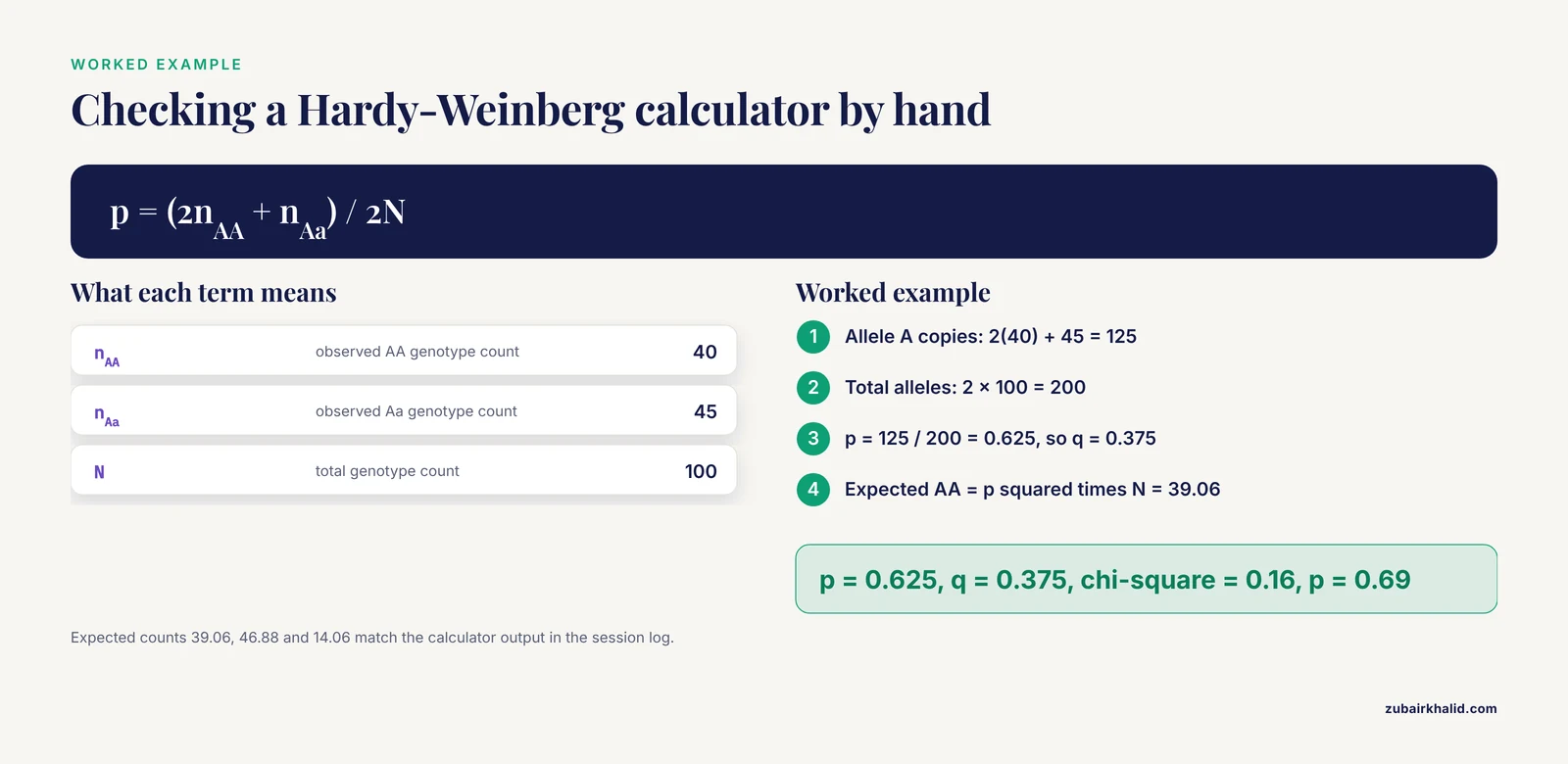
This walkthrough uses a Hardy-Weinberg calculator as the worked example. The same steps apply to any biology calculator or bioinformatics calculator.
Step 1. Capture the page while it works. Open the calculator and save a copy. Use your browser's Print to PDF on the calculator page and put the date in the file name. Web tools disappear or change without notice, and a saved copy is your evidence of what the tool did on the day you used it.
Step 2. Record a session log of inputs and outputs. While the tool is open, write down what you entered and what came back:
Tool: Hardy-Weinberg Equilibrium Calculator, version 2.1
URL: https://example.edu/biotools/hardy-weinberg
Date used: 2026-11-11
Inputs:
  observed genotype counts: AA = 40, Aa = 45, aa = 15 (N = 100)
Outputs:
  allele counts: A = 125, a = 75
  allele frequencies: p = 0.625, q = 0.375
  expected counts: AA = 39.06, Aa = 46.88, aa = 14.06
  chi-square = 0.16, df = 1, p = 0.69
You can sanity-check the output by hand. Allele A has 2(40) + 45 = 125 copies out of 200, so p = 0.625 and q = 0.375. Expected counts are p squared times N, 2pq times N, and q squared times N. The chi-square statistic (a test comparing observed and expected counts) sums the squared differences divided by the expected counts, giving 0.16 on 1 degree of freedom, p = 0.69.
A dilution calculator follows the same logging pattern. To make 500 mL of 0.5 M working solution from a 5 M stock, the tool applies C1V1 = C2V2 and returns V1 = 50 mL, which you dilute to a final volume of 500 mL.
Step 3. Look for a preferred citation. Check the page footer, an About or Documentation link, or a How to cite section. Established bioinformatics resources often name a publication to cite instead of the URL. When one exists, cite the publication as your primary source and mention the web tool in the methods text with its URL.
Step 4. Build the citation in your target style. Fill the template from the previous section. For APA, the finished entry is:
Department of Biology, State University. (2024). Hardy-Weinberg
equilibrium calculator (Version 2.1). BioTools Hub. Retrieved
November 11, 2026, from https://example.edu/biotools/hardy-weinberg
Step 5. Add the entry to your reference manager. In Zotero, create a new Web Page item, fill in Title, Author (use the organization if no person is named), Website Title, Date, and URL, then paste the version number into the Extra field so it survives export. Mendeley and EndNote have equivalent manual-entry forms. If you write in LaTeX, paste the BibTeX entry into your .bib file and cite it in the text with \cite{stateu_hwe_2024} (or \citep with the natbib package).
Step 6. Write the methods sentence. Use this pattern:
Calculations were performed with the [Title] calculator,
version [X.X], hosted by [Organization] ([URL]), accessed on
[Date]. Inputs were [inputs]. The tool returned [outputs].
Filled in:
Genotype proportions were tested with the Hardy-Weinberg equilibrium
calculator, version 2.1, hosted by State University
(https://example.edu/biotools/hardy-weinberg), accessed on
November 11, 2026. Observed counts were AA = 40, Aa = 45, aa = 15.
The tool returned p = 0.625, q = 0.375, chi-square = 0.16 on
1 degree of freedom, p = 0.69.
Step 7. Verify the citation. Work through this checklist:
- Every field matches what the page actually shows, including the organization name and version.
- The in-text citation and the reference entry match.
- The URL resolves. Test it in a private browser window, or from a terminal:
curl -o /dev/null -s -w "%{http_code}\n" https://example.edu/biotools/hardy-weinbergExpected output:
200A response of 404 means the page has moved.
- Compare your entry against the style manual's own web-page example.
- In LaTeX, compile until the warning "There were undefined references." disappears and the entry appears in the .bbl file.
Step 8. Archive and back up. Archive the calculator page with the Wayback Machine or a similar archival service and keep the archive URL in your notes. Save the session log and the PDF snapshot as supplemental material if the calculation is central to your results. If you rely on the calculator across many analyses, check whether the maintainers offer a citable software release or a versioned archive.
Common Errors and Fixes
"404 Not Found." The calculator page has moved or been deleted. Search the host site for the tool's new address. If it is gone, cite an archived copy from the Wayback Machine, give the archive URL, and note the original URL and your access date in the methods text.
"The DOI you entered could not be resolved." This message from the DOI registry means the DOI is mistyped, or you pasted a full URL into a DOI field. Enter the DOI string alone, in the form 10.xxxx/suffix, without https:// or dx.doi.org. Most calculators have no DOI at all, in which case a direct URL is the correct identifier.
"There were undefined references." This LaTeX warning appears when the bibliography has not been rebuilt or a cite key is misspelled. Run bibtex or biber, then compile again. Confirm that the key in your \cite command matches the key in the .bib file exactly, including capitalization.
"I found no \citation commands." BibTeX prints this when the document contains no citation commands. Add \cite or \citep commands in the text before running BibTeX.
Reviewer note: access date missing. Add the date you used the tool. For calculators this is not bureaucracy. The access date is the only way a reader can judge which version of the tool you ran.
Common Mistakes and Limitations
- Citing the homepage instead of the tool page. The reference should land the reader on the calculator itself.
- Dropping the version or date. Without it, a reader cannot tell whether the tool behaved when you used it the way it behaves now.
- Treating a dynamic tool as a static page. Calculators are designed to change, which is why APA and other styles want a retrieval or access date.
- Citing a bare URL in the text. A URL is not a citation. It carries no author, no date, and no title.
- Skipping the inputs and outputs. The reference entry identifies the tool. The methods sentence with your inputs and outputs is what makes the result reproducible.
- Citing the tool when the paper is the anchor, or the reverse. If the calculator implements a published equation, the equation's paper and the tool belong together in your citation set.
- Assuming the tool is validated. Research on online content credibility identifies source characteristics, meaning who stands behind the content, as a core antecedent of perceived credibility [7]. Before you cite a calculator, check who maintains it and whether the underlying method is published. Gray literature can diverge from peer-reviewed evidence [3].
- Ignoring version drift. Publishers correct works and ask that future citations point to the corrected version. Record the version you used, and re-verify the tool before resubmission if months have passed.
- Substituting the tool for expertise. For clinical calculators, individual patient decisions need a qualified clinician. For study design and analysis choices, a statistician should review the plan. The citation documents the tool, not your command of the method.
Frequently Asked Questions
Do I cite the online calculator or the paper behind it?
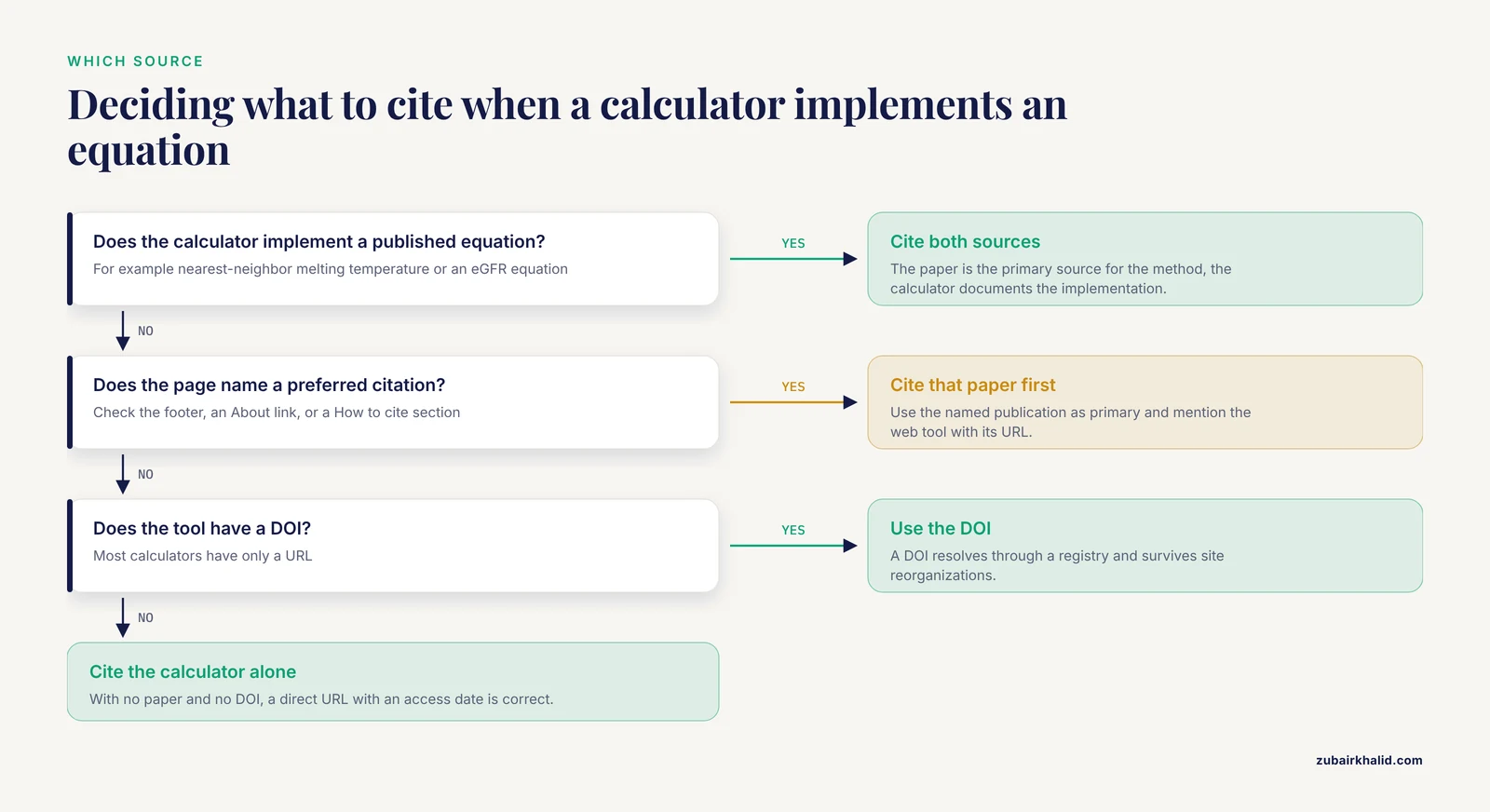
Cite both when the calculator implements a published equation. The paper is the primary source for the method, and the calculator citation documents the implementation you ran. If no paper exists, cite the calculator alone.
What if the online calculator has no author, date, or version?
Use the calculator title as the anchor, name the hosting organization as the author, and use n.d. for no date in APA style. State in your methods note that the page displayed no version.
How do I cite a calculator result in the methods section?
Name the tool, its version, its URL, and the access date, then give your inputs and the outputs you used. A reference entry alone cannot reproduce a dynamic calculation.
Is a DOI better than a URL for a calculator?
Yes, when the tool has a DOI, because a DOI resolves through a registry and survives site reorganizations. Most calculators have only a URL, and a direct URL is a correct citation.
How do I cite an online calculator in APA format?
Treat it as a web page with dynamic content and include a retrieval date. The pattern is Organization. (Year). Title (Version). Site Name. Retrieved Month Day, Year, from URL.
Can a reference manager like Zotero handle calculator citations?
Yes. Create a Web Page item manually, fill in the title, organization, site name, date, and URL, and paste the version number into the Extra field so it survives export.
What if the calculator link breaks before my paper is published?
Cite an archived copy from the Wayback Machine or a similar service, give the archive URL, and note the original URL and your access date in the methods text.
Do I need to cite a calculator I only used to check my own arithmetic?
Cite it if any result from the tool appears in your paper or shaped a reported decision. If you used it purely as a private scratchpad, no citation is needed.
Sources
- A Ten-Year Review of Online Learning Research through Co-Citation Analysis
- A Systematic Review of Research on Moderators in Asynchronous Online Discussions
- A Scoping Review of Glucose Spikes in People Without Diabetes: Comparing Insights from Grey Literature and Medical Research
- Online Communities as a Driver for Patient Empowerment: Systematic Review
- A Systematic Literature Review Paper on Online Medical Mobile Applications in Malaysia
- Corrigendum to “Generative AI in Technical Communication Research: A Review of Research from 2023 to 2024”
- What makes an online review credible? A systematic review of the literature and future research directions