Peptide Molarity Calculator: Converting Mass to Moles
By Dr. Zubair Khalid, DVM, MS, PhD ·

By the end of this guide you will be able to turn a weighed amount of peptide into an exact molar concentration, calculate the mass required for any target stock, correct for the salts and residual water hiding in a lyophilized vial, and check the number before it reaches an experiment. Everything rests on three inputs: the peptide molecular weight in g/mol, the mass in mg, and the volume in mL. Have the peptide sequence or certificate of analysis, an analytical balance, and a calculator, spreadsheet, or Python 3 installation on hand. A phone calculator handles single conversions, and a short script handles them in batches.
What a Peptide Molarity Calculator Does
A peptide molarity calculator is a specialized biology calculator that converts between the mass you weigh on a balance and the concentration you need in a tube. Chemistry counts molecules in moles. One mole is 6.02214076 × 10²³ molecules, a fixed number defined by the SI system. Molarity expresses how many moles of solute are dissolved in one liter of solution, written as mol/L or M. Molecular weight (MW), reported in g/mol, tells you how much one mole of your peptide weighs, and for any pure substance the MW in g/mol is numerically equal to its molar mass.
Peptides span a modest mass range. A five-residue peptide weighs roughly 500 g/mol, while a modified 31-amino-acid peptide such as semaglutide, a GLP-1 receptor agonist carrying a C18 fatty diacid for albumin binding, is far larger [1]. Because experimental concentrations usually land between nanomolar and millimolar, peptide work is done in mM (millimolar, one thousandth of a mole per liter) and µM (micromolar, one millionth of a mole per liter). The calculator solves C = m ÷ (MW × V) and its rearrangements, where C is molarity, m is mass, and V is volume.
Where a general bioinformatics calculator might translate a nucleotide sequence into a protein sequence, this tool translates a number on a balance screen into a concentration your assay can use.
The Core Formula and Unit Conversions
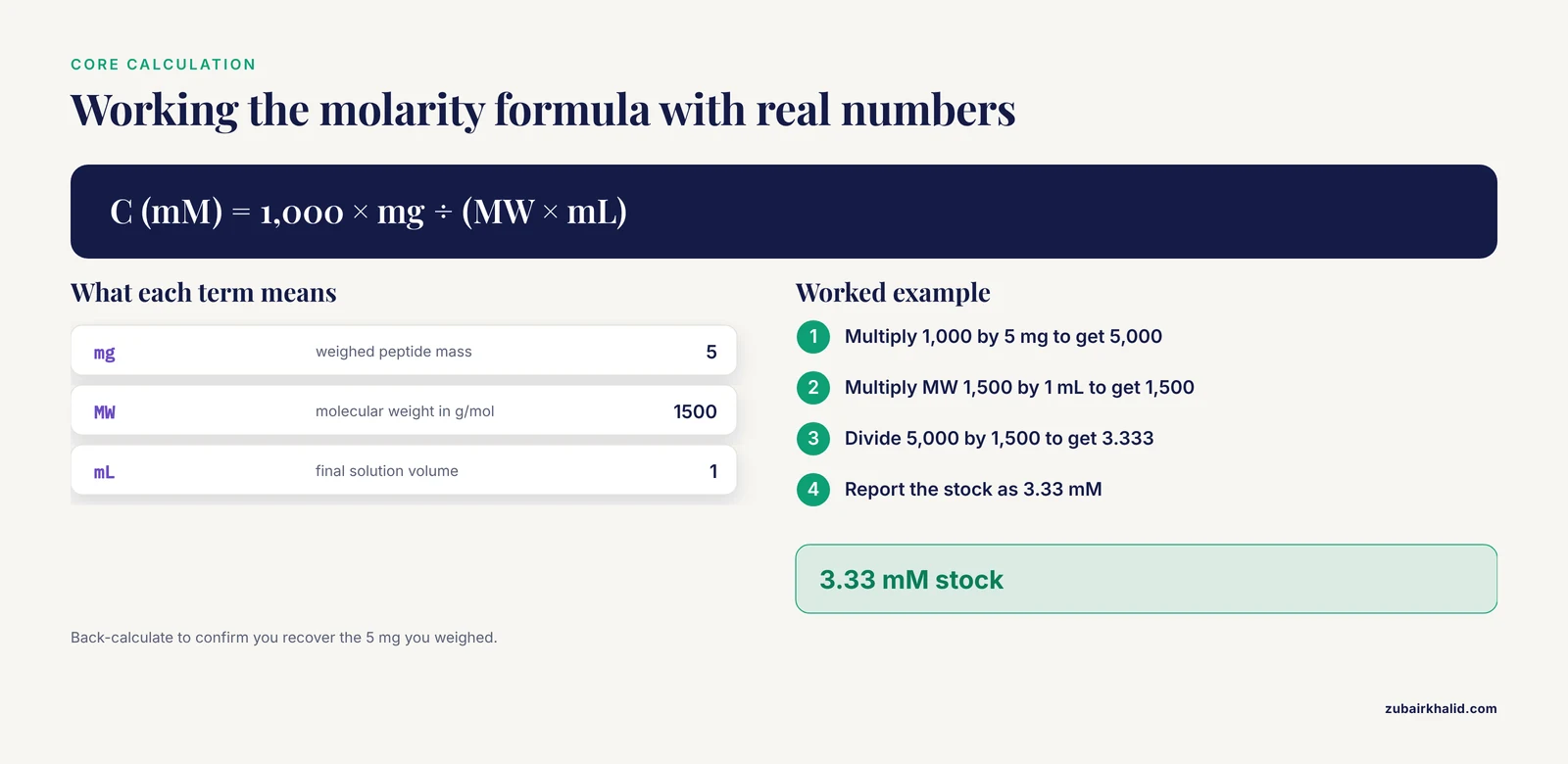
Molarity from mass:
C (mol/L) = m (g) ÷ (MW (g/mol) × V (L))
A lab-units shortcut makes mental arithmetic possible. Because 1 mg = 1/1,000 g and 1 mL = 1/1,000 L, the two factors of 1,000 cancel, so mass in mg divided by (MW × volume in mL) already gives mol/L. Multiply by 1,000 for mM.
C (mM) = 1,000 × mg ÷ (MW × mL)
The reverse, mass needed for a target stock:
mg = (mM × MW × mL) ÷ 1,000
The unit ladder runs 1 M = 1,000 mM = 1,000,000 µM = 1,000,000,000 nM.
| What you want | Formula | Worked example |
|---|---|---|
| Molarity from mass | C (mM) = 1,000 × mg ÷ (MW × mL) | 5 mg, MW 1,500, 1 mL → 3.33 mM |
| Mass for a target stock | mg = mM × MW × mL ÷ 1,000 | 1 mM, MW 2,000, 1 mL → 2 mg |
| Moles from mass | n (mol) = g ÷ MW | 0.005 g ÷ 1,500 g/mol = 3.33 µmol |
| Dilution | C1 × V1 = C2 × V2 | 3.33 mM stock to 10 µM: 3 µL into 997 µL |
| Content-corrected mass | true peptide mg = weighed mg × net peptide content | 5 mg at 80 percent content = 4 mg peptide |
Peptide Molarity Calculator Step by Step
- Confirm the molecular weight. Start from the sequence and the certificate of analysis. A 20-residue unmodified peptide has a MW near 2,200 g/mol, but the exact value depends on the sequence, terminal modifications, and disulfide bonds. Use the average mass for weighed material (explained below).
- Correct the weighed mass for net peptide content. Lyophilized synthetic peptides carry counterions such as trifluoroacetate from cleavage and purification, plus residual water. If the certificate states 75 percent net peptide content, then 5 mg of powder contains 3.75 mg of peptide. Use the corrected mass in every later step.
- Choose the target concentration and volume. Stocks are often prepared in the low millimolar range so that small microliter dilutions reach micromolar working concentrations. Pick a stock volume you can handle accurately, and keep it small enough to conserve precious peptide.
- Run the calculation. In Python:
def peptide_molarity_mM(mass_mg, mw_g_per_mol, volume_ml):
    """Convert peptide mass and volume to molarity in mM."""
    return round(1000 * mass_mg / (mw_g_per_mol * volume_ml), 3)

print(peptide_molarity_mM(5, 1500, 1))
Expected output:
3.333So 5 mg of a 1,500 g/mol peptide dissolved to 1 mL gives a 3.33 mM stock. In a spreadsheet with mass in B2 (mg), MW in C2 (g/mol), and volume in D2 (mL), the molarity in mM is =(B2/(C2*D2))*1000. For the reverse direction with the target mM in F2, the mass in mg is =(F2*C2*D2)/1000.
- Dissolve and bring to volume. Add the solvent, mix by pipetting or vortexing, then adjust to the final volume in a volumetric vessel. Add peptide first, solvent second.
- Back-calculate, then dilute. Multiply your computed concentration by the volume and the MW to confirm you recover the weighed mass. Then compute working dilutions with C1V1 = C2V2. To take the 3.33 mM stock to a 10 µM working solution: 3.33 mM × V1 = 0.01 mM × 1 mL, so V1 = 3 µL of stock into 997 µL of buffer.
Why Molarity Matters in Peptide Work
Concentration is not bookkeeping. It changes peptide chemistry. In a preformulation study of semaglutide, stress testing at 25, 40, 60, and 80 °C produced thirteen known impurities, and the extent of degradation depended on pH, buffer species, and buffer molarity at 25 and 40 °C [1]. A stock prepared at the wrong concentration, or diluted into a buffer of the wrong strength, can change how fast the molecule itself breaks down.
Concentration also controls labeling efficiency. For the bombesin antagonist RM2, a peptide tracer that targets the gastrin-releasing peptide receptor in prostate cancer imaging, newer chelators allowed near-quantitative incorporation of 68Ga at room temperature within 3 to 5 minutes at low ligand molarity, while the conventional DOTA version reached roughly 10 percent yield under the same conditions [2]. The molarity of the peptide stock sets how much tracer you can make from a single radionuclide elution.
In delivery systems, peptide loading is expressed in molarity terms. High-loading peptide nanoparticles for antithrombotic therapy carried the redesigned ExE peptide M3mP6 at up to 70 percent of the total nanoparticle molarity, a loading high enough to inhibit occlusive thrombosis in rodents [3].
Downstream, assays consume peptides at micromolar working concentrations, the same units pharmacology uses to report potencies such as IC50 values of 10.83 and 11.55 µM against liver and breast cancer cell lines [4]. Buffer strength matters here too, since thermal shift assay results shifted with protein concentration, buffer pH, and buffer molarity for immunoglobulin G, ovalbumin, and albumin [5].
Effective Molarity: A Related but Different Number
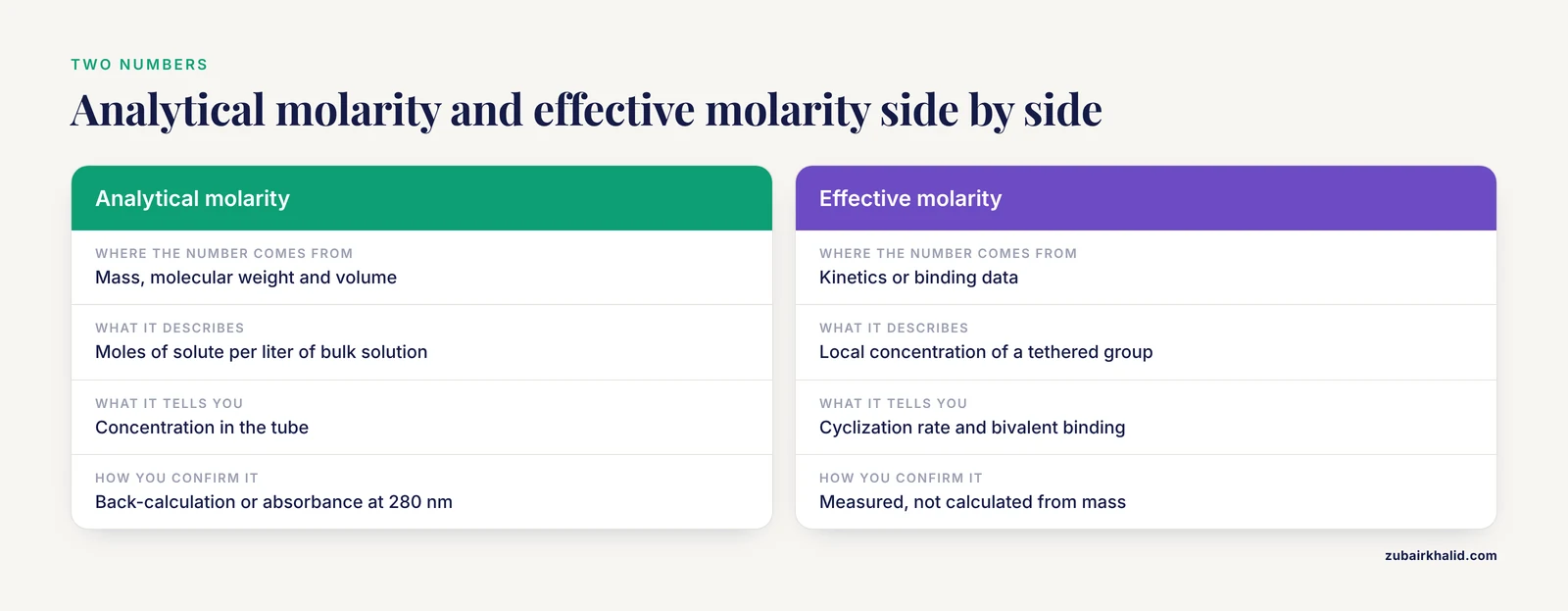
Analytical molarity is what the calculator returns. Effective molarity (EM) is a different quantity. It describes how concentrated a reactive group effectively is because it is tethered, confined, or oriented near its partner, and it is inferred from kinetics or binding data rather than from mass and volume.
The concept runs through peptide chemistry. In thermodynamic models of multivalent protein-protein interactions, such as the 14-3-3 scaffold binding its phosphorylated partners CFTR and LRRK2, effective molarity is the prime parameter governing intramolecular binding [6]. Macrocyclization reactions are scored by it, with the aziridine aldehyde multicomponent macrocyclization showing high effective molarity through an imidoanhydride pathway [7], and with backbone edits in sansalvamide A analogues, where replacing a leucine with glycine, β-alanine, or GABA raised the effective molarity of cyclization and improved yields [8]. Micelle-assisted native chemical ligation pushes the idea further, concentrating lipid-modified peptide reactants in mixed micelles so ligation proceeds at low analytical concentrations without thiol catalysts [9]. Proximity-driven reactions in chemical biology generalize the principle, using molecular recognition to raise local concentrations and orient reactive groups under highly dilute bulk conditions [10].
For bench work the lesson is simple. Your calculator gives the concentration in the tube. It cannot predict how fast a cyclization will run or how tightly a bivalent construct will bind, because those depend on effective molarity, which must be measured.
Peptide Molarity Calculator Tips
- Use the average mass for weighed powders. Calculators and mass spectrometry software often default to the monoisotopic mass, computed with only the lightest isotope of each element. A balance dispenses the natural isotope mixture, so molarity calculations on weighed material should use the average mass. The two values are close for short peptides and diverge by several daltons for long ones.
- Correct for net peptide content. The certificate of analysis lists net peptide content, the fraction of the lyophilized solid that is actual peptide. To end up with 5 mg of peptide at 80 percent content, weigh 6.25 mg of powder.
- Weigh by difference. Tare the receiving tube, add peptide, then reweigh the stock vial to see exactly what left it. Peptides are hygroscopic and pick up static, so the number on the weighing paper is rarely the number in the tube.
- Prepare concentrated stocks, then dilute. Weighing 0.2 mg accurately is hard. Dissolving a larger amount into a low-millimolar stock and diluting with C1V1 = C2V2 reduces the relative weighing error.
- Match the solvent to the peptide. Many peptides dissolve in sterile water or dilute acid or base. Hydrophobic sequences may need DMSO or acetonitrile first, followed by dilution into buffer. Confirm solubility with a small test aliquot before committing the whole lot.
- Aliquot and freeze. Repeated freeze-thaw cycles and adsorption to tube walls lower the true concentration over time, so split the stock into single-use aliquots.
- Log the details. Record the lot number, molecular weight used, net peptide content, solvent, concentration, and date. Six months later, that record is what lets you reproduce the concentration.
Common Mistakes and Limitations
- Entering the wrong molecular weight. This is the most damaging error. Use the mass of the exact molecule in the vial, including terminal modifications (an acetylated N-terminus, an amidated C-terminus) and any disulfide bonds, each of which removes about 2.02 Da from the reduced mass.
- Mixing monoisotopic and average mass. Sequence-based calculators often report the monoisotopic mass, while weighed powders follow the average mass. Pick one convention and stay with it.
- Confusing mg/mL with mM. A 1 mg/mL solution is 1 mM only for a 1,000 g/mol peptide. The same mass concentration of a 5,000 g/mol peptide is 0.2 mM. Always carry the MW through the calculation.
- Treating solvent volume as final volume. Dissolve the peptide, then bring the solution to the target volume. Powder displaces volume, so 5 mg of peptide plus 1.0 mL of water is not exactly a 1.0 mL final solution.
- Ignoring net peptide content. A vial labeled 5 mg rarely contains 5 mg of peptide. Apply the certificate value before calculating.
- Trusting the nominal concentration forever. Peptides are fragile during formulation, storage, and transportation, and their degradation products can compromise safety, efficacy, and regulatory compliance in pharmaceutical settings [1]. Recheck critical stocks instead of assuming the label.
- Rounding the molecular weight too hard. Carry at least four significant figures. Rounding a 1,234 g/mol peptide to 1,200 shifts every molarity by almost 3 percent.
- Expecting the calculator to predict behavior. The output is analytical molarity. Reaction rates, binding affinities, and stability depend on effective molarity, buffer composition, and temperature, none of which the mass-to-mole conversion captures.
Calculators also fail in two different ways. The loud failures are harmless. A volume of zero raises ZeroDivisionError: division by zero in the Python version, and an unknown residue letter raises KeyError: 'X' in the sequence-based version below. The dangerous failure is silent. Entering mass in grams instead of mg returns a value 1,000-fold too high with no warning at all, which is why the back-calculation in step 6 is nonnegotiable.
Every result rests on three assumptions, an accurate mass, an accurate molecular weight, and complete dissolution of a pure peptide. Real vials violate all three to some degree. For critical experiments, confirm the concentration by an independent method and follow your laboratory's standard operating procedures.
Building Your Own Bioinformatics Calculator
Web-based biology calculator pages are convenient, but a short script has real advantages. It removes transcription errors, keeps a versioned record in your notebook repository, and processes a plate worth of stocks in one run. The script below builds the molecular weight from the peptide sequence using standard average residue masses, then converts mass and volume to molarity.
AVG_RESIDUE = {
    "A": 71.0788,  "R": 156.1875, "N": 114.1038, "D": 115.0886,
    "C": 103.1388, "E": 129.1155, "Q": 128.1307, "G": 57.0519,
    "H": 137.1411, "I": 113.1594, "L": 113.1594, "K": 128.1741,
    "M": 131.1926, "F": 147.1766, "P": 97.1167,  "S": 87.0782,
    "T": 101.1051, "W": 186.2132, "Y": 163.1760, "V": 99.1326,
}
WATER = 18.01528

def peptide_mw(seq):
    """Average molecular weight of a linear peptide from its sequence."""
    return round(sum(AVG_RESIDUE[a] for a in seq.upper()) + WATER, 2)

def molarity_mM(mass_mg, seq, volume_ml):
    return round(1000 * mass_mg / (peptide_mw(seq) * volume_ml), 3)

print(peptide_mw("GAILGFNIVA"))
print(molarity_mM(5, "GAILGFNIVA", 2))
Expected output:
974.17
2.566
The dictionary holds average residue masses, which are the mass of each amino acid minus water, and the water term restores the mass of the terminal groups. Modifications must be added by hand. Acetylation adds about 42.01 Da, phosphorylation about 79.97 Da, and C-terminal amidation removes about 0.98 Da. A sequence-based bioinformatics calculator cannot know your salt form or net peptide content, so the certificate of analysis still governs the final number.
How to Verify Your Result
Three checks catch most errors. First, back-calculate. Take the computed concentration, multiply by the volume and the MW, and confirm you recover the weighed mass. Second, use spectrophotometry when the sequence allows it. If the peptide contains tryptophan or tyrosine, measure absorbance at 280 nm and apply the Beer-Lambert law, A = ε × l × c, with the molar extinction coefficient ε predicted from the sequence. Third, for tracer-grade or regulated work, confirm identity and purity analytically, the same way synthetic peptide tracers are characterized by analytical HPLC and LC/MS before radiolabeling [11]. Quantitative amino acid analysis remains the reference method when a concentration must be defensible.
Frequently Asked Questions
How do I convert mg per mL to mM for a peptide?
Multiply the concentration in mg/mL by 1,000 and divide by the molecular weight in g/mol. A 1 mg/mL solution of a 2,000 g/mol peptide is 0.5 mM.
Why does my calculated peptide concentration differ from the measured one?
The usual causes are net peptide content below 100 percent, incomplete dissolution, degradation, or adsorption to plastic. Correct the weighed mass with the certificate of analysis and verify by an independent method.
Should the molecular weight include TFA or counterions?
No. Use the molecular weight of the peptide itself, then correct the weighed mass for net peptide content, since counterions and residual water add mass without adding peptide.
What is the difference between molarity and effective molarity?
Molarity is moles of solute per liter of bulk solution. Effective molarity is the apparent local concentration of a tethered or confined reactive group, inferred from reaction rates or binding data rather than from mass and volume.
How much peptide do I need for a 1 mM stock in 1 mL?
Mass in mg equals target mM times MW times volume in mL, divided by 1,000. A 2,000 g/mol peptide therefore needs 2 mg.
Can the same calculator handle proteins and small molecules?
Yes. The formula C = m ÷ (MW × V) is universal, and only the molecular weight changes between a dipeptide, a protein, and a small molecule.
What units does a peptide molarity calculator expect?
Most expect mass in mg, molecular weight in g/mol or Da, and volume in mL, and they return concentration in mM. Check the labels, since some tools default to µM or liters.
Does the calculator account for peptide purity?
No. It assumes the weighed mass is pure peptide, so you must multiply the weighed mass by the net peptide content from the certificate of analysis before calculating.
Sources
- Effect of pH, buffers, molarity, and temperature on solution state degradation of semaglutide using LC-HRMS: A preformulation protocol for peptide drug delivery.
- The effects of novel macrocyclic chelates on the targeting properties of the (68)Ga-labeled Gastrin releasing peptide receptor antagonist RM2.
- High-loading Gα(13)-binding EXE peptide nanoparticles prevent thrombosis and protect mice from cardiac ischemia/reperfusion injury.
- Synthesis and multilevel evaluation of benzimidazole-based anticancer compounds: DNA/serum albumin interaction, and in-depth theoretical insights.
- Investigation of the thermal shift assay and its power to predict protein and virus stabilizing conditions.
- A Thermodynamic Model for Multivalency in 14-3-3 Protein-Protein Interactions.
- Mechanistic investigation of aziridine aldehyde-driven peptide macrocyclization: the imidoanhydride pathway.
- Incrementally increasing the length of a peptide backbone: effect on macrocyclisation efficiency.
- Traceless native chemical ligation of lipid-modified peptide surfactants by mixed micelle formation.
- Toward Ideal Proximity-Driven Reactions in Chemical Biology.
- Peptide synthesis, characterization and ⁶⁸Ga-radiolabeling of NOTA-conjugated ubiquicidin fragments for prospective infection imaging with PET/CT.