Percent Solution Calculator: Step-by-Step Guide
By Dr. Zubair Khalid, DVM, MS, PhD ·
By the end of this guide you will be able to calculate any percent solution used in a biology lab, weigh or measure the right amount of reagent on the first try, dilute a concentrated stock down to a working strength, and check your own answer two independent ways. You will also build a small percent solution calculator in a spreadsheet or in Python that you can reuse for every recipe in your notebook.
Here is what to have on hand: a calculator or a computer with Excel, Google Sheets, or Python 3, the protocol or reagent label you are working from, a balance that reads to 0.01 g, and graduated cylinders or a volumetric flask. No special software is required.
What a Percent Solution Means
A percent solution states concentration as parts per hundred. The phrase "percent of what" has three standard answers, and each one carries its own symbol. Picking the wrong one is a frequent source of error in solution prep, so the definitions come first.
Weight per volume (w/v). Grams of solute per 100 mL of final solution. This is the default basis in biology for solids dissolved in water. A 3% (w/v) NaCl solution contains 3 g of sodium chloride in every 100 mL of finished solution. A 1% agarose gel contains 1 g of agarose per 100 mL of buffer.
Volume per volume (v/v). Milliliters of a liquid solute per 100 mL of final solution. Use it for miscible liquids such as ethanol, methanol, acetic acid, and Tween 20. A 70% (v/v) ethanol solution contains 70 mL of ethanol brought to a total of 100 mL.
Weight per weight (w/w). Grams of solute per 100 g of finished solution. Commercial concentrates are usually labeled this way. A 30% (w/w) hydrogen peroxide bottle holds 30 g of peroxide per 100 g of solution, not per 100 mL.
When a protocol writes "3% NaCl" with no letters after the number, read it as w/v. When it writes "70% ethanol", read it as v/v. When the number comes from a reagent bottle, check the label or the safety data sheet for the basis and the density.
The Formulas Every Percent Solution Calculator Uses
A percent solution calculator only runs a handful of formulas. The table below is the whole engine, and each row defines the parameters it needs.
| What you know | What you want | Formula | Worked example |
|---|---|---|---|
| Target % (w/v), final volume | Mass of solute | mass (g) = (% × mL) ÷ 100 | 3% in 500 mL → 15 g |
| Mass, final volume | % (w/v) | % = (g ÷ mL) × 100 | 9 g in 1 L → 0.9% |
| Stock %, target %, final volume | Stock volume | V₁ = (C₂ × V₂) ÷ C₁ | 70% from 95% in 1 L → 736.8 mL |
| Stock volume, final volume | Diluent volume | V water = V₂ - V₁ | 1000 - 736.8 → 263.2 mL |
| % (w/v) | mg/mL | mg/mL = % × 10 | 3% → 30 mg/mL |
| % (w/v), molar mass | Molarity | M = (% × 10) ÷ molar mass | 3% NaCl → 30 ÷ 58.44 ≈ 0.51 M |
| % (w/w), density | % (w/v) | % w/v = % w/w × density (g/mL) | 30% w/w at 1.11 g/mL → ≈ 33% w/v |
The dilution row is the classic C₁V₁ = C₂V₂ relationship. It works with any concentration units as long as both sides use the same units and the same basis. The subscripts follow the usual convention, where C₁ and V₁ describe the stock and C₂ and V₂ describe the working solution you want to end up with.
Step-by-Step Percent Solution Calculator Walkthrough
Work through the same seven steps every time and the arithmetic becomes routine.
- Identify the percent basis. Find w/v, v/v, or w/w in the recipe. If the recipe omits it, apply the defaults from the definitions above.
- List the inputs. Write down the target percent, the final volume, and, for dilutions, the stock percent. Attach a unit to every number.
- Pick the formula. Use the table above. Weighing a solid uses the mass formula. Diluting a liquid uses C₁V₁ = C₂V₂.
- Compute. Do the arithmetic in one pass and keep at least four significant figures until the end.
- Weigh or measure. Use a calibrated balance for grams and a graduated cylinder or volumetric flask for milliliters.
- Bring the solution to volume. Dissolve or mix in less than the final volume, then add solvent up to the mark. The abbreviation q.s. (quantity sufficient) on a recipe means exactly this, add solvent until the total volume is reached.
- Label and log. Write the contents, percent, basis, date, and your initials on the bottle, and record the calculation in your notebook.
The three worked calculations below cover the cases you will meet most often.
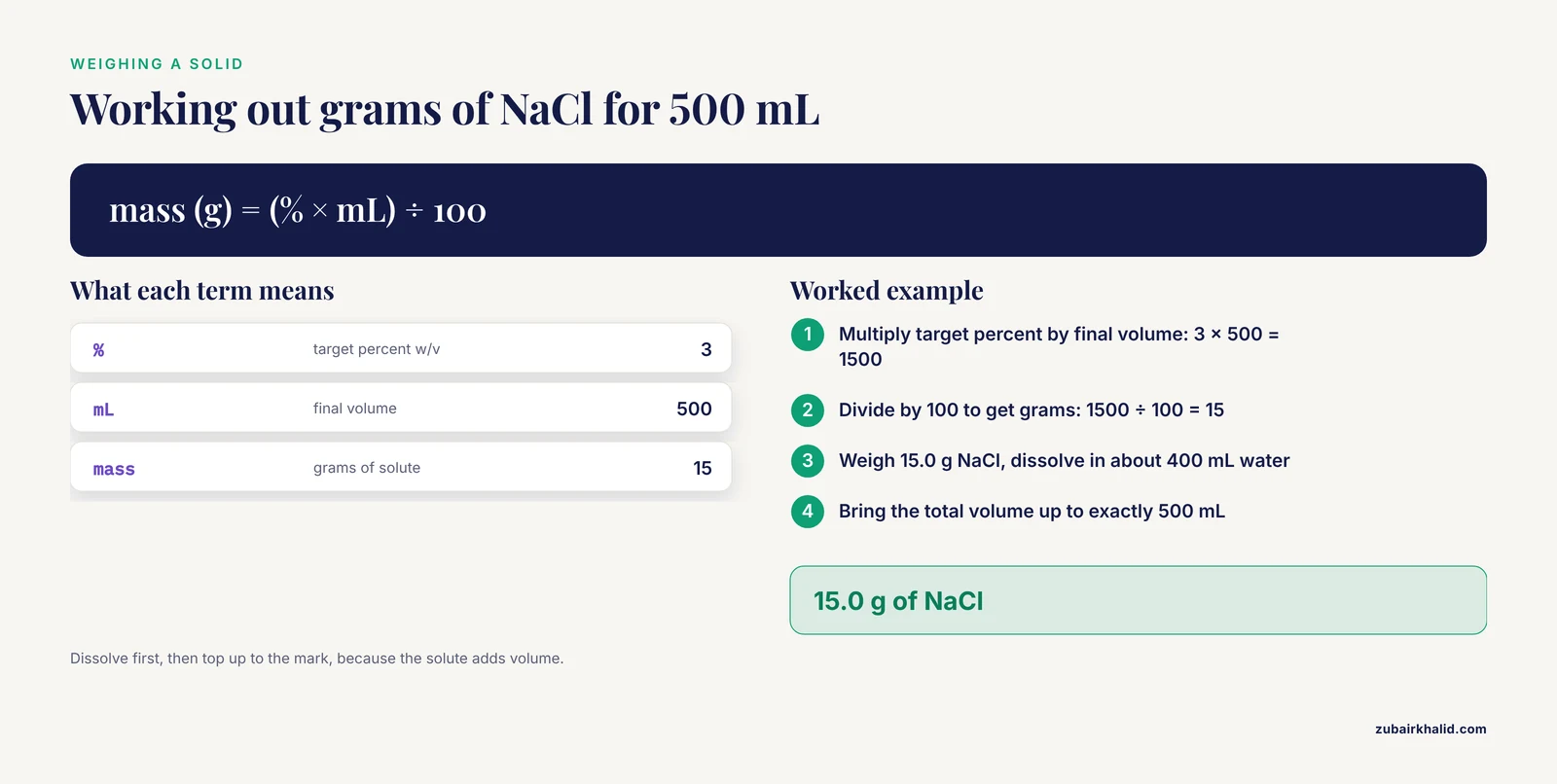
Worked calculation A, weighing a solid. Prepare 500 mL of 3% (w/v) NaCl.
mass (g) = target % × final volume (mL) ÷ 100
mass (g) = 3 × 500 ÷ 100
mass (g) = 15
Weigh 15.0 g of NaCl, dissolve it in about 400 mL of water, then bring the total to exactly 500 mL.
Worked calculation B, diluting a liquid stock. Prepare 1 L of 70% (v/v) ethanol from a 95% stock.
V1 (mL)  = target % × final volume (mL) ÷ stock %
V1 (mL)  = 70 × 1000 ÷ 95
V1 (mL)  = 736.8
water    = 1000 - 736.8
water    = 263.2 mL
Measure 736.8 mL of the 95% ethanol into a graduated cylinder, add water, and confirm the total reads 1000 mL. Topping up to the mark matters because ethanol and water contract slightly on mixing, so the sum of the two measured volumes can fall just short of a liter.
Worked calculation C, diluting a concentrated stock. Prepare 100 mL of 1% (w/v) SDS from a 10% (w/v) stock.
V1 (mL) = target % × final volume (mL) ÷ stock %
V1 (mL) = 1 × 100 ÷ 10
V1 (mL) = 10
water   = 100 - 10 = 90 mL
Add 10 mL of the 10% stock to about 80 mL of water, then bring to 100 mL. Keeping both concentrations on the w/v basis is what makes the ratio valid.
Build the Calculator in a Spreadsheet or Python
A percent solution calculator is four formulas, which makes it a natural first biology calculator to build yourself. In a spreadsheet, set up two small blocks.
Block one, mass from percent:
- A1: target %, B1: final volume (mL), C1: grams needed
- A2: 3, B2: 500, C2:
=A2*B2/100
Cell C2 displays 15.
Block two, dilution:
- A5: stock %, B5: target %, C5: final volume (mL), D5: stock mL, E5: water mL
- A6: 95, B6: 70, C6: 1000, D6:
=B6*C6/A6, E6:=C6-D6
Cell D6 displays 736.842105 and cell E6 displays 263.157895.
The same two functions in Python:
def grams_for_wv(percent_wv, final_ml):
    """Grams of solute for a weight-per-volume solution."""
    return percent_wv * final_ml / 100

def stock_ml(stock_percent, target_percent, final_ml):
    """Milliliters of stock for a dilution on one percent basis."""
    if stock_percent <= 0:
        raise ValueError("stock_percent must be greater than zero")
    if target_percent > stock_percent:
        raise ValueError("target_percent cannot exceed stock_percent")
    return target_percent * final_ml / stock_percent

print(grams_for_wv(3, 500))
print(round(stock_ml(95, 70, 1000), 1))
Expected output:
15.0
736.8
The habit you practice here, labeled inputs, one formula per cell, and an output you can back-check, transfers directly to every other biology calculator you will build, from molarity converters to serial dilution planners. It also carries over to any bioinformatics calculator, where GC percent and percent identity use the same discipline of a defined numerator over a defined denominator.
Exact Error Messages and Fixes
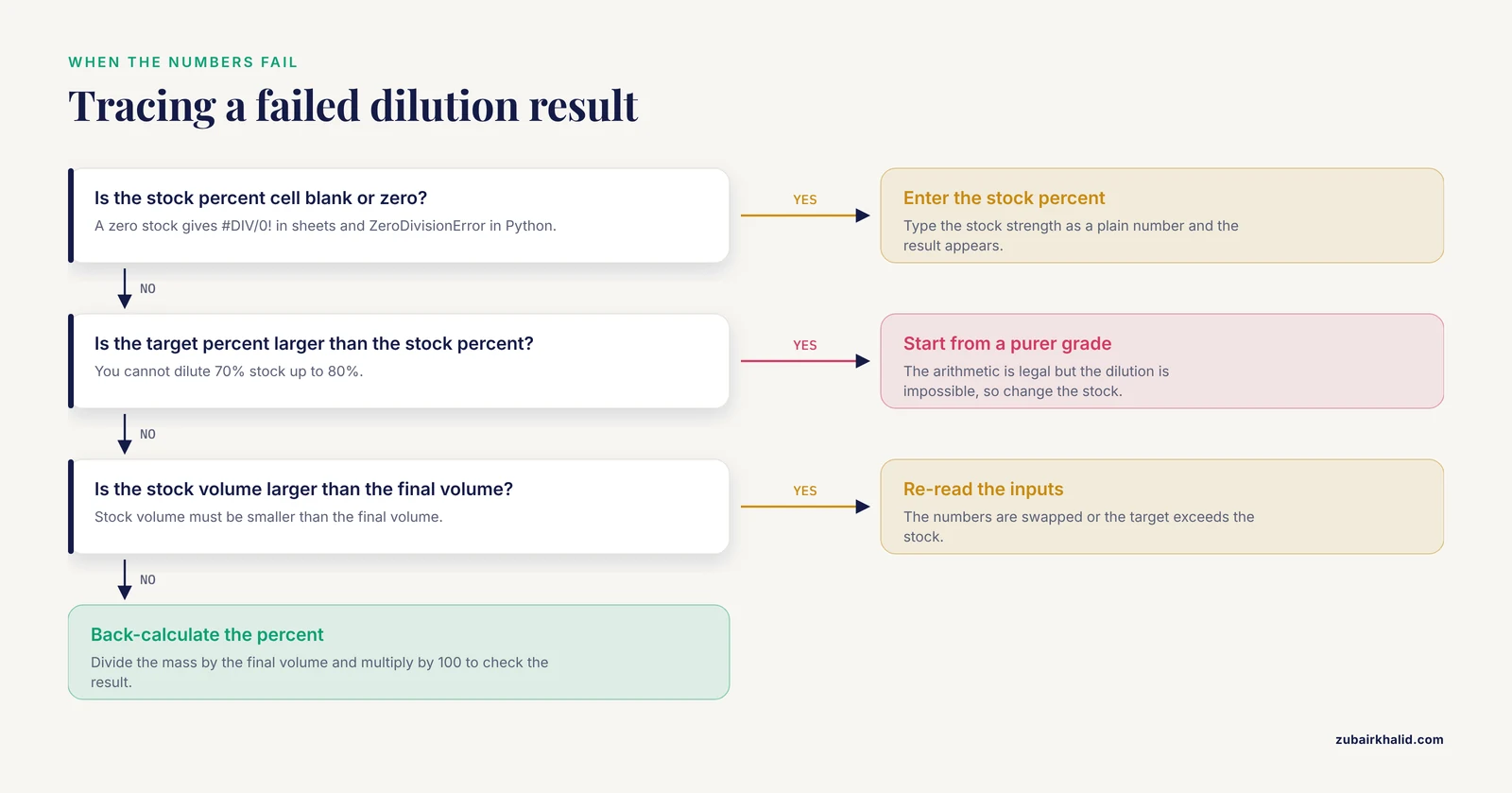
#DIV/0!in Excel or Google Sheets. The stock concentration cell is empty or zero. Enter the stock percent and the result appears.ZeroDivisionError: division by zeroin Python. Same cause in code. The guard clause above converts it toValueError: stock_percent must be greater than zero, which tells you what to fix.#VALUE!in Excel. A cell holds text where a number belongs, often "95%" typed as text or a stray space left in the cell. Retype the value as a plain number.- A negative stock volume. The target percent exceeds the stock percent, so the calculator returns something like -142.9 mL. No software flags this because the arithmetic is legal. The fix is conceptual, you cannot dilute 70% stock up to 80%, so start from a purer grade.
Percent Solutions in Clinical and Research Practice
Percent solutions are not a classroom exercise. They carry real work in clinics and research labs, and the number on the bottle drives the number in the protocol.
Root canal irrigation is a clear example. A prospective in vivo study of 45 single-rooted teeth compared four working length determination methods across three irrigants, one of which was three percent sodium hypochlorite, a standard endodontic percent solution [1]. Each irrigant group in that study was defined by an exact percent strength, which is how clinical teams communicate composition to one another without ambiguity.
Wound care runs on the same convention. A trial of 57 patients with mildly to moderately infected diabetic foot ulcers compared two antiseptic cleansing solutions, 0.02% hypochlorous acid and 10% povidone iodine, and found the dilute hypochlorous acid solution more effective against Gram-negative bacteria [2]. Those two strengths differ by a factor of 500, and the lower number still won that comparison. The lesson for anyone preparing solutions is to compute and state the exact percent rather than assume that more concentrated means better.
Percent Solution Calculator Tips
These percent solution calculator tips follow from the way the arithmetic behaves, not from personal preference.
- Write the basis next to every percent. "3% NaCl (w/v)" and "70% ethanol (v/v)" leave no room for doubt.
- Check the bottle label for w/w. Commercial concentrates state weight per weight. Convert to w/v with the density from the safety data sheet before you dilute.
- Keep one basis inside each equation. C₁V₁ = C₂V₂ with C₁ in w/w and C₂ in w/v is wrong by the density factor.
- Make concentrates once. A 10% (w/v) SDS stock diluted tenfold beats weighing 0.1 g portions every week, and small masses sit near the readable limit of many lab balances.
- Dissolve first, then bring to volume. Solutes add volume. Fifteen grams of NaCl pushed into a full 500 mL of water leaves you with more than 500 mL of solution and a concentration just under 3%.
- Work at room temperature with calibrated glassware. Volumetric flasks and cylinders are calibrated for 20 °C, so hot or cold solutions read inaccurately at the mark.
- Carry digits, round once. Keep 736.842105 through the calculation and report 736.8 mL at the end.
- Log the calculation, not just the result. A notebook entry with inputs, formula, and result lets a colleague reproduce your solution exactly.
Common Mistakes and Limitations
The common mistakes below account for most failed batches and most of the surprise when a solution comes out wrong.
- Reading a w/w label as w/v. Thirty percent (w/w) hydrogen peroxide delivers about 33 g per 100 mL because the solution is denser than water. Treat the label basis and the recipe basis as two different numbers until you have converted one of them.
- Adding solute to the full final volume. Always dissolve in a partial volume, then bring to the mark in a flask or cylinder.
- Solving the dilution equation backwards. If V₁ comes out negative, or larger than V₂, the inputs are swapped or the target exceeds the stock. Re-read the numbers before you measure anything.
- Confusing percent with molarity or with X-strengths. 0.9% (w/v) NaCl is about 0.154 M. A 10X buffer is a tenfold concentrate, a different system entirely. Convert explicitly when a protocol switches systems.
- Entering 0.7 when the calculator expects 70. Decide whether your tool takes percent as a whole number or a fraction and stay consistent. A tenfold slip here produces a tenfold error in the flask.
- Rounding during the calculation. Early rounding compounds. Round only the final answer, then only to the precision your glassware supports.
- Trusting the calculator to check feasibility. The formulas will happily return a mass for a solute that will not dissolve at that concentration and temperature, or a volume that demands a fume hood. Solubility limits and safety rules stay on you.
On limitations: a percent solution calculator does arithmetic and nothing more. It does not know whether a reagent suits your experiment, whether the solution needs sterilization or pH adjustment, or whether a given antiseptic strength is the right choice for a particular patient. Those judgments belong to the experiment plan and to treating clinicians working under institutional protocols.
Percentages in Papers That Are Not Solutions
Once you start reading the literature, most percentages you meet are not concentrations. Three current examples show the range.
Diagnostic validation studies report percent agreement between a new assay and a reference method. A cross-priming amplification system for norovirus, evaluated on 224 fecal samples, reached total percent agreement with RT-qPCR of 98.7% for genotype GII.3, 99.3% for GII.4, and 96.9% for GII.17 [3]. Those percentages compare test outcomes, not reagent strengths.
Wound research uses percent area reduction, the percent decrease in ulcer area between visits, to track healing. A comparative analysis of 173,816 wounds found that an AI-powered healing index predicted delayed healing with 65% balanced accuracy by week 3, while percent area reduction needed until week 4 to reach the same level [4]. Here the percent describes a change in a measured area and a model's accuracy, neither of which you can mix in a flask.
Physical science models express corrections as percent change. A Wiener-Hopf analysis of dendritic growth near a wall found suppression below 1% while the tip was far from the boundary, rising to a 31% increase in feeding as the gap closed [5]. Those percentages describe growth rates relative to a baseline.
The habit that keeps you safe is to ask "percent of what?" For solutions, the answer is grams or milliliters per hundred of a preparation. For results, it is a ratio between measured quantities. Bioinformatics calculators follow the same logic, with GC percent as the fraction of G and C bases in a sequence and percent identity as the fraction of matching positions in an alignment. Same word, different denominators.
Checking Your Result and What to Learn Next
Verify every percent solution two ways before it touches an experiment. First, back-calculate. Divide the mass you weighed by the final volume and multiply by 100, and the original target percent should reappear. Fifteen grams in 500 mL returns 3.0%. Second, cross-check the units. A 3% (w/v) solution is 30 mg/mL, which is 30 g per liter, which is about 0.51 M for NaCl. Three formats, one concentration, and any mismatch means an input error upstream.
Two quick sanity checks catch most slips. Doubling the final volume should double the mass. The stock volume in a dilution must be smaller than the final volume, and stock volume plus diluent volume must equal the final volume.
From here, the natural next steps are molarity-based recipes, serial dilutions, and buffer preparation where pH enters the calculation. Each one reuses the pattern you just practiced, defined inputs, one formula, and an independent check.
Frequently Asked Questions
What does a percent solution calculator compute?
It converts between a target percent concentration, a final volume, and the amount of solute or stock you need. Enter any two of the three values on the same percent basis and it returns the third.
What is the difference between w/v, v/v, and w/w?
w/v means grams of solute per 100 mL of final solution, v/v means milliliters of liquid solute per 100 mL of solution, and w/w means grams of solute per 100 g of solution. Biology recipes default to w/v for solids and v/v for liquids.
How many grams of NaCl go into 500 mL of a 3% (w/v) solution?
15 g. Multiply 3 by 500, divide by 100, and weigh 15.0 g before bringing the volume to the mark.
How do I prepare 70% (v/v) ethanol from a 95% stock?
Measure 736.8 mL of the 95% stock and add water to a final volume of 1 L, which works out to about 263.2 mL of added water. The formula is stock volume = (70 × 1000) ÷ 95.
How do I convert a percent solution into mg/mL or molarity?
Multiply a w/v percent by 10 to get mg per mL, so 3% becomes 30 mg/mL. For molarity, divide grams per liter by the molar mass, so 3% NaCl is 30 ÷ 58.44, about 0.51 M.
Why did my dilution calculation return a negative volume or an error?
The target percent exceeds the stock percent, or the stock input is zero or blank. A zero stock causes #DIV/0! in spreadsheets and ZeroDivisionError in Python, and an impossible target produces a negative stock volume.
Are the percentages reported in research papers the same as percent solutions?
No. Percent agreement, percent area reduction, and percent change compare measured quantities, while a percent solution states grams or milliliters per hundred of a preparation.
Can a spreadsheet work as a biology calculator, or do I need special software?
A spreadsheet handles percent solutions, dilutions, and molarity conversions with one formula per row. Dedicated lab calculators add convenience, but the arithmetic is identical.
Further Reading
Sources
- Precision in endodontics: Comparison of four different working length determination methods with three irrigation solutions - An in vivo study.
- Efficacy of hypochlorous acid solution in comparison with povidone iodine solution for the management of infected diabetic foot ulcers.
- Isothermal cross-priming amplification for field-deployable norovirus surveillance: a cost-effective and rapid solution.
- Predicting wound healing outcomes: a comparative accuracy analysis of AI-driven indices and percent area reduction.
- Wall-enhanced dendritic growth: An exact Wiener-Hopf-Hankel solution for oblique reflection.