Evaluating the Source of an Online Scientific Calculator
By Dr. Zubair Khalid, DVM, MS, PhD ·

An online scientific calculator is both a tool and a source. A tool computes. A source makes claims, and every calculator output you copy into a lab notebook, a methods section, or a clinical note is a claim about the physical world. The one-sentence difference between a calculator you can trust and one you are hoping is right is traceability. A trustworthy calculator names its operator, states or cites its formula, and points to evidence that someone tested its output. An untrustworthy one asks for faith.
The rule of thumb for choosing is to trace three things before you trust any number, who operates the calculator, what formula or dataset the calculation uses, and whether anyone has tested the output against reality. Match the depth of the check to the stakes. A homework arithmetic check deserves a minute. A calculation that drives an experiment, a purchase order, or a patient-facing risk number deserves the full treatment described here.
Evaluating the source of an online scientific calculator is a skill, and like pipetting it improves with a checklist. This guide covers the four main source types, a side-by-side comparison, a reusable scoring rubric, three worked scenarios from biology and bioinformatics work, and the mix-ups that trip people up.
Why the Source of an Online Calculator Matters
Every calculator encodes choices made by someone else. A molecular weight calculator picks an atomic weight table. A primer tool picks a thermodynamic parameter set. A clinical risk calculator embeds a statistical model trained on a specific cohort of patients. When you press the button, you inherit those choices, whether or not the site discloses them. When a methods section reads "calculated using [website]", the website becomes part of the paper's citation chain, which is exactly why it deserves the scrutiny you would give any cited reference.
Research on online science and health content shows why inheritance without disclosure is risky. A scoping review of COVID-19 misinformation research on social media described a fragmented evidence base spread across public health, computing, communication, and information science, with a persistent gap between detecting unreliable content and acting on it [1]. The volume of low-quality material is large enough that systematic evaluation, not impression, has to carry the weight.
Quality also varies far more than search rankings suggest. In one cross-sectional analysis of online guidance on introducing solid foods to infants with cleft palate, only 4 of 30 included sources (13.3%) cited peer-reviewed literature, and DISCERN scores (a 16-item instrument for judging written health information, each item rated 1 to 5) ranged from 16 to 80, which the authors called substantial variability [2]. A study of printed online education materials about transoral robotic surgery took the first 50 websites returned for the search term and found a mean Flesch-Kincaid Grade Level of 11.35, close to college level, with a median DISCERN score of 41, summarized by the authors as limited readability, understandability, and quality [3]. The top of a search results page is not a quality filter.
Who stands behind content matters too. Among 329 short videos about pulpitis on three Chinese platforms, quality, reliability, and understandability scores differed by platform, and the study specifically examined how dental practitioner uploaders shaped video quality [4]. A calculator's operator deserves the same scrutiny as a video uploader.
What "Source" Means for an Online Calculator
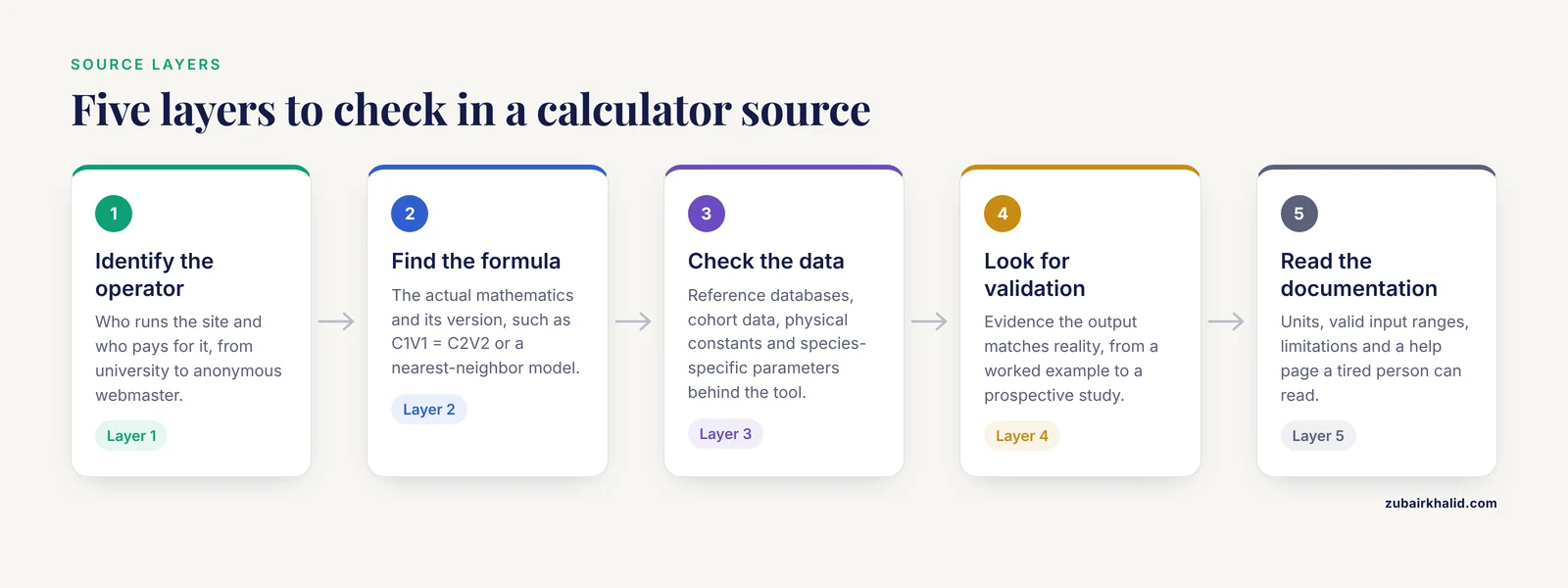
For a calculator, the word source has five layers, and each layer can fail independently.
- Operator and funder. Who runs the site and who pays for it. A university department, a government database such as NCBI, a curated resource like UniProt or EMBL-EBI, a company, or an anonymous webmaster each carry different expectations of accuracy and error correction.
- Formula or algorithm, with version. The actual mathematics. A dilution calculator runs C1V1 = C2V2. A Hardy-Weinberg calculator runs p² + 2pq + q² = 1. A melting-temperature tool runs either a simple rule or a nearest-neighbor model, and that choice changes the answer. Version matters because sites update silently.
- Input data and constants. Reference databases, cohort data, physical constants, species-specific parameters. A bioinformatics calculator is only as good as the table it reads from.
- Validation evidence. Evidence that the output matches reality, from a hand-checkable worked example at the low end to a prospective peer-reviewed study at the high end.
- Documentation. Units, valid input ranges, limitations, and a help page a tired person can actually read.
The same five layers apply whether the tool is a plain biology calculator for a Punnett square or a bioinformatics calculator for primer design. What changes with stakes is how many layers you verify. For a quick unit conversion, layer 2 might be enough. For a number that enters a publication or a patient conversation, verify all five.
The Four Main Options for Online Calculator Sources
Most calculators you will meet fall into one of four source types. Here are the options, each with its pros and cons, followed by the comparison that decides real choices.
Validated research models and curated scientific resources
These calculators come from universities, government and consortium databases, or research groups that publish a prediction model together with its algorithm. The strongest examples publish the formula, cite the paper that produced it, and state the population the model was built on. Some go further and put the working algorithm online for anyone to run.
The pros are formula transparency, versioning tied to publications, and sometimes genuine validation evidence. The cons are narrow scope, inputs that can require expertise, and interfaces that are rarely polished. A model can be excellent inside its tested scope and meaningless outside it, so the validation population is part of the source, not a footnote.
Vendor and manufacturer calculators
Reagent calculators, buffer preparation tools, and unit converters tied to a product line. The authoritative reference is the manufacturer's technical documentation, which specifies the parameters the calculator assumes.
The pros are parameters that match the actual product you will pipette, and support channels that exist when something looks wrong. The cons are a built-in sales agenda, validation that is usually internal, and results that may not transfer to a competitor's reagents.
Aggregator and SEO calculator sites
Ad-supported sites that generate hundreds of calculators to capture search traffic.
The pros are speed, zero cost, and coverage of obscure conversions nobody else bothers with. The cons are formulas that are rarely stated or cited, usually no named operator, silent failure on out-of-range inputs, and updates that happen without notice. Treat these as scratch paper, useful for arithmetic you could verify by hand, unsafe for anything you would cite.
AI chatbots as calculators
Large language model chatbots now function as general-purpose calculators and explainers, and the evidence on their quality is mixed and metric-dependent. In one comparative study, nine standardized cancer pain queries were submitted to four chatbots, and two oncology clinicians rated all 36 responses with DISCERN, the EQIP criteria (Ensuring Quality Information for Patients), JAMA benchmark criteria, and the Global Quality Score, a five-point overall quality rating. Reliability did not separate the models, but transparency and benchmark scores did, with Microsoft Copilot ahead on the transparency measure [5]. A separate evaluation put four chatbots through 11 standardized queries on a different condition and found significant differences across models on DISCERN, EQIP, and GQS, with readability assessed by six standard indices against a sixth-grade benchmark [6].
The pros are flexibility, step-by-step explanations, and tolerance for messy natural-language input. The cons are occasional arithmetic errors, outputs that vary with prompt and model version, and citations that need verification before use.
Side-by-Side Comparison of Online Calculator Sources
| Criterion | Validated research model or curated resource | Vendor or manufacturer tool | Aggregator site | AI chatbot |
|---|---|---|---|---|
| Formula transparency | Published and cited, versioned with papers | Documented in technical documentation | Rarely stated | Not inspectable, generated per answer |
| Data provenance | Stated cohort or reference database | Product-specific parameters | Unknown | Training data undisclosed |
| Independent validation | Sometimes prospectively tested in peer-reviewed studies | Usually internal quality control only | Essentially none | Emerging, mixed results by metric |
| Citation practice | Cites literature for models and constants | Cites internal specifications | Usually none | May cite references that do not exist |
| Update and versioning | Tied to publications | Tied to product releases | Unpredictable | Continuous and undocumented |
| Error handling | States valid ranges and limitations | States product-specific ranges | Often silent on bad inputs | Can produce confident wrong answers |
| Cost and access | Usually free | Free, product-linked | Free, ad-supported | Free tier or subscription |
| Best use | Citable calculations, risk models | Lab workflows with the matching product | Quick arithmetic you can verify | Exploration and cross-checking |
Two rows decide most real choices. Validation evidence separates a calculator you can cite from one you can only use, and formula transparency tells you whether a disagreement with another tool is a bug or a different assumption. The remaining rows are convenience factors, weighted by your situation.
How to Evaluate the Source of an Online Calculator, Step by Step
Step 1, identify the operator. Look for an about page, an institutional address, and a contact route. Ask what happens when the tool is wrong, whether there is anyone to tell. Content from identifiable, credentialed sources tends to score better on quality instruments, a pattern documented across online health content.
Step 2, find the formula. Is the math stated on the page, cited to a publication, or hidden? Peer-reviewed citations are rare among general online health sources, so a calculator that names the paper behind its formula is already ahead of most of the web. For a biology calculator, the formula should also state its scope, for example which organisms, buffer conditions, or concentration ranges its constants apply to.
Step 3, check the data. For tools built on datasets, look for documentation of where the data came from, how duplicates were handled, and whether training and test data were kept separate. Dataset defects are a known source of inflated performance claims, so undocumented datasets deserve skepticism.
Step 4, look for validation. Distinguish three tiers. Tier one is a hand-checkable worked example on the site. Tier two is an internal benchmark number. Tier three is external or prospective evaluation in a peer-reviewed study, with a stated population, time window, and performance metric. Only the third tier tests whether the calculator works on inputs it was not tuned on. When evidence is scattered, triangulate, the way service evaluators combine routinely collected data, published literature, and direct outcome evaluation into one judgment [7].
Step 5, read the documentation critically. Quality instruments give you a vocabulary. DISCERN judges the reliability of written health information. The Global Quality Score rates overall quality on five points. PEMAT, the Patient Education Materials Assessment Tool, scores understandability and actionability. Readability indices such as the Flesch-Kincaid Grade Level, Flesch Reading Ease, Gunning Fog Index, SMOG, ARI, and Coleman-Liaoi estimate the education level a text demands, and patient-facing materials are usually benchmarked near a sixth-grade level [6]. A calculator whose help page cannot explain its units at that level is a calculator you will misuse under time pressure.
Step 6, test it with known answers. Build a small test set, three to five inputs whose answers you know from a textbook, a hand calculation, or a reference standard. Run the same inputs through every candidate. Score each tool absolutely against the rubric, then compare candidates head-to-head on identical inputs, because the two modes answer different questions, a distinction formalized in large evaluation benchmarks that support both absolute scoring and side-by-side comparison, one of which contains 220,000 instances with 1.32 million human annotations [8]. Check consistency too, same input, same output, twice.
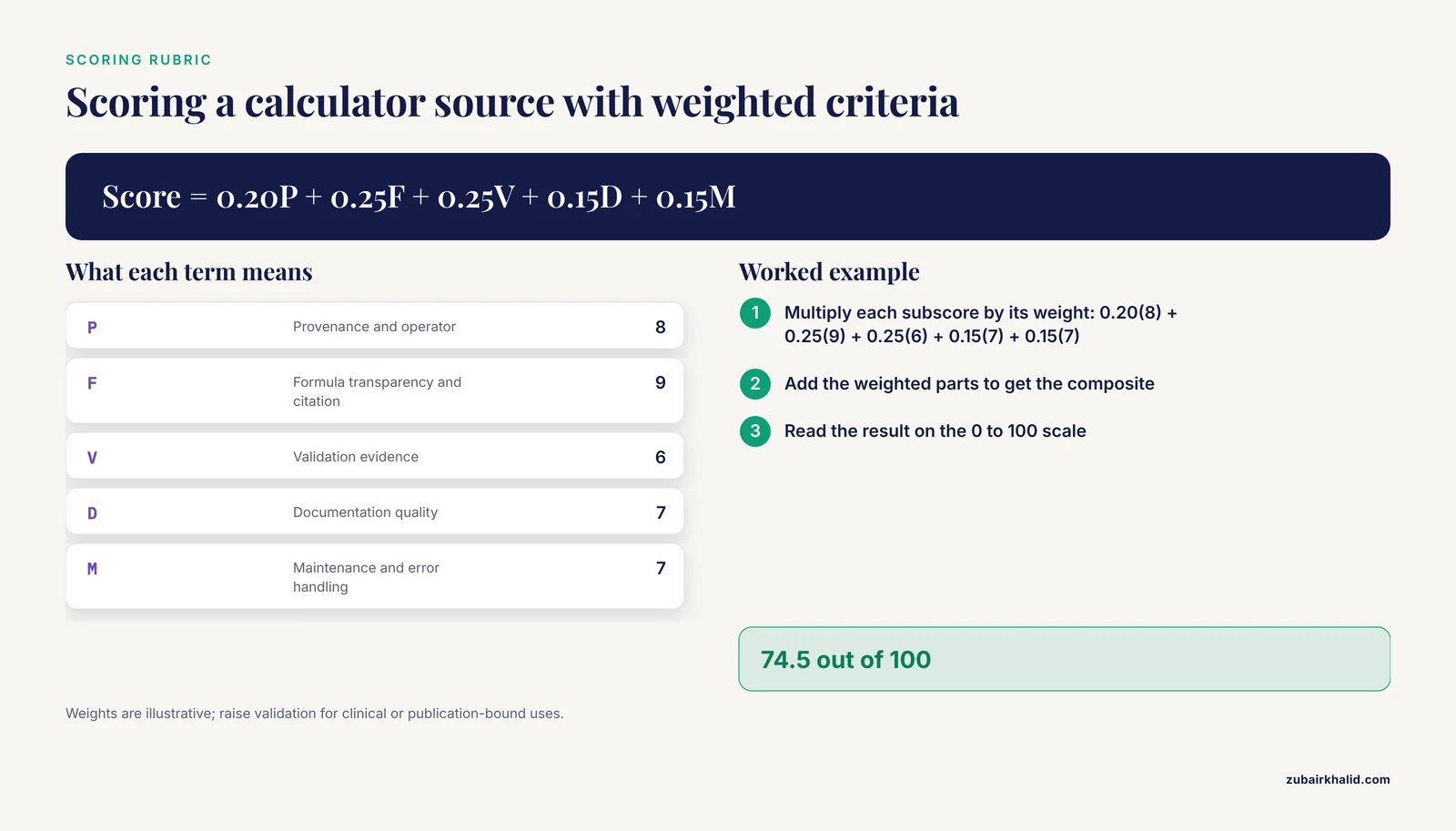
Step 7, score, weight, and decide. Convert your findings into a weighted score. Index systems built through Delphi consensus rounds and analytic hierarchy process (AHP) weighting, which derives weights from pairwise comparisons, are standard practice in health measurement, and they typically output a weighted composite on a 0 to 100 scale. One preconception health example used two Delphi rounds, 27 indicators, and AHP weights to produce exactly that [9]. A workable rubric for calculators looks like this:
- Provenance and operator, weight 0.20
- Formula transparency and citation, weight 0.25
- Validation evidence, weight 0.25
- Documentation quality, weight 0.15
- Maintenance and error handling, weight 0.15
Score each criterion from 0 to 10, multiply by the weight, and sum. A university-hosted tool with a cited formula, one internal benchmark, decent help text, and a visible changelog might score 8, 9, 6, 7, 7, which gives 0.20(8) + 0.25(9) + 0.25(6) + 0.15(7) + 0.15(7) = 74.5 out of 100. The weights are illustrative, adapt them to your stakes, and weight validation higher for clinical or publication-bound uses.
One refinement helps when criteria are fuzzy. Record a confidence level, high, medium, or low, next to each subscore, so a 9 you are sure about and a 9 you guessed at look different in your records. Methods built for decisions under uncertainty formalize exactly this, pairing each value with a measure of its reliability [10].
Worked Scenarios
Scenario 1, a dilution calculation for Monday's lab
A biology student needs 500 mL of 0.5 M sodium chloride from a 5 M stock. The stakes are low, the answer is checkable by hand, and the five-layer evaluation takes two minutes. C1V1 = C2V2 gives V1 = (0.5 × 500) / 5 = 50 mL. Any calculator that returns something else is wrong, no matter how polished the site. The student uses the calculator on the university teaching lab page, confirms the arithmetic once by hand, and notes that the page states its units explicitly. An ad-covered aggregator would have worked too, but only because the student could verify the answer independently. That is the right way to use a low-trust source, with an independent check attached.
Scenario 2, choosing a bioinformatics calculator for primer melting temperature
A graduate student is designing qPCR primers, and two online Tm calculators disagree by several degrees Celsius on the same 20-nucleotide sequence. The disagreement is not necessarily an error. One tool may use the simple Wallace rule, another a salt-adjusted formula, and a third nearest-neighbor thermodynamics, which calculates Tm from the stacking energies of adjacent base pairs and the salt conditions. The source evaluation tells the student which difference they are looking at. They check which parameter set each tool cites, run both on a primer with a published Tm value where possible, and pick the tool whose formula matches the protocol the lab has used in prior experiments, so the new values are comparable with the old ones. The choice and its justification go into the methods notes. For a bioinformatics calculator, comparability with your lab's prior work is often the deciding criterion, more than abstract accuracy.
Scenario 3, a clinical risk calculator at the research-clinic boundary
A clinician-scientist considers an online preeclampsia risk calculator for twin pregnancies. This is the high-stakes end, and the evaluation standard is validation. The Simple Fetal Medicine Foundation first-trimester model publishes its algorithm freely online, and a prospective, non-intervention study used that online calculator to compute a patient-specific preeclampsia risk for each of 464 twin pregnancies scanned at 11 to 13+6 weeks of gestation (13+6 meaning 13 weeks and 6 days) at a tertiary center. Preeclampsia developed in 24.14% of participants, and the researchers tested how well the calculator's risks predicted actual outcomes using receiver operating characteristic (ROC) curves, which plot sensitivity against the false-positive rate, along with detection rates at a fixed false-positive threshold [11].
That study is the model of what validation evidence looks like, a stated population, a stated gestational window, a stated outcome rate, and a stated performance metric, all published for anyone to read. It also shows the boundary of the evidence. The evaluation covers twin pregnancies in that gestational window at one center, so confidence outside that scope has to come from other studies, not from the calculator's own display.
Common Mix-Ups
Six confusions cause most bad decisions about online calculators.
Precision for accuracy. An output with eight decimal places can come from an uncited formula with wrong constants. Digits past the decimal measure the display, not the truth.
Search rank for quality. Studies that audit the first page or two of search results keep finding readability and quality problems in highly ranked health content, so position in the results list is not evidence of anything except search engine optimization.
Popularity for validity. User ratings and review counts feel like evidence and behave like noise. Research comparing online review data with structured questionnaire data lists the recurring problems with review data, incompleteness, algorithm interference, dirty data, and sensitivity to platform choices, alongside the complementary limits of structured data, high cost and small samples [12]. For calculators, reviews can surface complaints worth checking, but they cannot certify a formula.
A citation for a real citation. A reference list pasted under a chatbot answer is not a bibliography until you open the papers. Evaluations of chatbot health advice now explicitly test for reference hallucinations, checking whether the papers a chatbot cites actually exist, which tells you how common the problem has become [13]. Verify every reference before you repeat it.
A reported metric for a real-world guarantee. Model papers report their best split. One lower-limb joint angle prediction study reported an R² (coefficient of determination, the fraction of variance the model explains) of 0.9726 and a root mean square error of 2.0684° for hip angle prediction, and the authors explicitly cautioned that these were within-cohort estimates under a mixed-participant chronological split, not evidence of participant-independent generalization [14]. When a calculator advertises accuracy, read the evaluation protocol before the number.
Benchmark accuracy for leak-free accuracy. Open datasets can contain defects that flatter any model trained on them. An audit of a public meat freshness dataset found byte-identical images across classes, verified by MD5 hashes, a fingerprint check that flags identical files, and image augmentation performed before the data split, which leaked variants of the same images across training and test sets. After rebuilding a leak-free benchmark of 1,849 verified original images, the best model's mean test accuracy was 98.51% [15]. That number means something only because the leaks were removed first. If a calculator's underlying dataset cannot document that kind of hygiene, discount its accuracy claims.
Common Mistakes and Limitations
Using a calculator outside its tested scope. Validation evidence applies to the population, input range, and version that the study tested. A risk model validated in one patient group does not transfer automatically to another, and a Tm formula tuned for one primer length range degrades at the edges.
Trusting chatbot arithmetic without a check. Chatbot quality varies by model and by metric, and the same model can excel on one measure and trail on another. Any chatbot number that matters gets confirmed with a dedicated tool.
Skipping the version check. Sites update silently. Record the date and, where possible, a screenshot of the page when a calculation matters, so your methods section describes what you actually used.
Treating one instrument score as a total quality measure. DISCERN, GQS, and PEMAT were designed to judge written health information. Applying them to a calculator's documentation is a sensible adaptation, not a validated measurement, and no rubric score captures computational correctness. A known-answer test remains necessary.
Relying on a single evidence source. One good evaluation beats none, and several independent lines of evidence beat one. Combine the site's own documentation, external studies, and your own test calculations before committing.
Forgetting that a calculator supports judgment rather than replacing it. Individual clinical, experimental, or animal-care decisions need a qualified professional, a clinician, a biosafety officer, or the study's principal investigator, and the calculator's job is to hand that person a defensible number.
Frequently Asked Questions
What is the fastest way to evaluate the source of an online calculator?
Check three things in under five minutes, who operates the site, whether the formula is stated or cited, and whether any validation evidence is linked. If any of the three is missing, treat the output as a draft until you verify it against a known answer.
Can I use an AI chatbot as a scientific calculator?
Yes for exploration, drafting, and cross-checking, no as a final authority. Chatbot quality differs by model and by the metric you care about, and chatbots can produce fabricated references, so confirm any citation and verify important numbers with a dedicated tool.
What counts as validation for an online calculator?
A prospective or external test in a peer-reviewed study, with a stated population, time window, and performance metric. Internal benchmarks, testimonials, and user ratings do not count as validation.
Do biology calculators need different checks than plain math calculators?
Yes. A biology or bioinformatics calculator embeds model assumptions, parameter sets, and species- or context-specific constants, so the formula's stated scope matters as much as its arithmetic.
How do I check the dataset behind a bioinformatics calculator?
Look for documentation of the data sources, deduplication steps, and train/test separation. Dataset defects such as duplicate records and leakage between training and test data can inflate reported accuracy, so undocumented datasets deserve skepticism.
Do user ratings help when I evaluate a calculator's source?
Only weakly. Reviews can be incomplete, algorithmically amplified, and noisy, so treat them as leads for problems to check, not as evidence of correctness.
Sources
- Online COVID-19 Misinformation and Infodemic Governance During the Peak Pandemic Period: Scoping Review of Social Media Research From 2020 to 2022.
- Online Information Available to Caregivers on Introducing Solid Foods to Infants with Cleft Palate: A DISCERN-Based Cross-Sectional Analysis.
- An Appraisal of Printed Online Education Materials on Transoral Robotic Surgery (TORS) Online Education for Patients.
- Evaluating pulpitis-related content on Chinese social media: platform comparison, dental practitioner impact and associated factors.
- Artificial Intelligence Chatbots as Sources of Cancer Pain Information: A Comparative Evaluation of Quality, Transparency, and Readability.
- Artificial intelligence chatbots as information sources for postherpetic neuralgia: An evaluation of reliability and readability.
- Australian Digital Mental Health Services for Anxiety and Depression: Meta-Analysis and Comparison Study.
- Q-Eval+: From Absolute to Relative Quality Evaluation for Text-to-Vision Content.
- [[Development and validation of a comprehensive evaluation index system for preconception health behaviors in reproduc-tive-aged populations].](https://pubmed.ncbi.nlm.nih.gov/42515973/)
- A fuzzy multiple-attribute decision-making under Z-number environment for online teaching effectiveness evaluation for college database technology courses.
- Prospective evaluation of the Simple Fetal Medicine Foundation's first-trimester prediction model for preeclampsia in twin pregnancies.
- Post-occupancy evaluation of former residences of celebrities in Yangzhou based on the comparison of online reviews and questionnaire data.
- Comparative Evaluation of ChatGPT-5.2, Claude Sonnet 4.5, and DeepSeek-V3.2 for Rosacea-Related Information: Accuracy, Reliability, Readability, and Reference Hallucinations.
- Multi-Source Motion Inputs and FA-TA-BiLSTM for Lower-Limb Joint Angle Prediction.
- Filtering Out Defects in Open-Source Meat Freshness Datasets: A New Leak-Free Benchmark and a Comparative Analysis of Four Different Mobile Deep Learning Models.