Do Budgies Have Their Own Language? Calls Decoded
By Dr. Zubair Khalid, DVM, MS, PhD ·
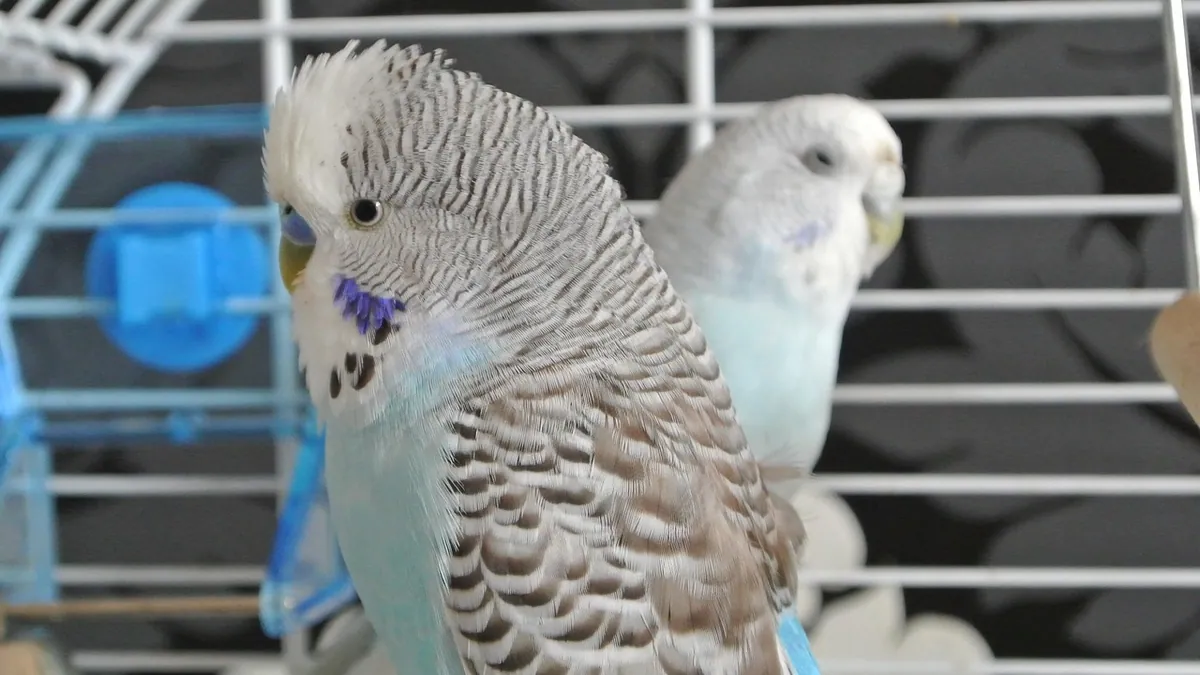
Do budgies have their own language? Yes, in a practical sense. Budgies are parrots, and parrots are one of the few animal groups that learn their vocalizations instead of being born with a fixed set of calls [1][2]. That means your bird builds a personal sound library, and many of those sounds carry consistent meaning you can learn to read.
This article is educational and is not a substitute for veterinary diagnosis or treatment.
Quick Answer
- Budgies are open-ended vocal learners, meaning they can keep adding and adjusting calls throughout life, not only as babies [3].
- Contact calls are the sounds your budgie uses to check in with you and with other birds. These calls can shift when your bird joins a new social group [3].
- Budgies need to hear themselves to keep their full vocal range. When adult males were deafened in a study, high-frequency syllables dropped within 6 months and stayed reduced a year later [1].
- Loud, sharp, repetitive alarm calls plus a stiff body, flattened feathers, and rapid head turns usually mean fear or a perceived threat, not aggression for its own sake.
- Soft chattering, beak grinding, and one-foot resting are contentment signals. A single loud flock call when you leave the room is normal contact behavior, not a crisis.
Why Budgies Vocalize: Normal Reasons First
Budgies are wired to learn sounds
Parrots sit in a small club of vocal learners alongside songbirds and hummingbirds [1]. Unlike birds that inherit a fixed call set, budgies shape their calls based on what they hear and who they live with [1][3]. This is why two budgies in the same home often develop similar contact calls, and why a budgie may pick up a whistle or phrase from you.
Contact calls keep the flock together
In the wild, a budgie that wanders off needs to find its flock. The contact call does that job. Research on budgerigars shows they develop new contact call types that get shared with social associates when they join a new flock [3]. In your home, you are part of the flock. That loud "where are you?" call when you walk into another room is your bird doing exactly what a budgie should do.
Age changes vocal variety
Older budgies tend to show less vocal diversity than younger adults, and this appears tied to weaker or sparser social bonds instead of a loss of the underlying ability [3]. If your senior budgie chatters less than it used to, that can be a normal social shift. It is still worth mentioning at a checkup.
Turn-taking is part of the system
Bird communication often follows a back-and-forth pattern, similar in structure to human conversation turn-taking [4]. When you answer your budgie's call with a whistle or a word, you are participating in that exchange. This is one reason budgies respond so well to parrot speech training and to how to teach your bird to talk.
Budgie Sounds Meaning: A Practical Decoder
Contact and flock calls
A single, moderately loud chirp or two-note call, repeated every few minutes, means "I am here, where are you?" Expect it when you leave the room, when a cagemate is out of sight, or at dawn and dusk. Answer it. A quick whistle back often settles the bird.
Contentment sounds
Soft, continuous warbling and chattering while the bird is relaxed, often with puffed head feathers and half-closed eyes, means all is well. Beak grinding before sleep is a classic comfort signal. So is standing on one foot with a relaxed body.
Alarm and warning calls
Short, harsh, repeated notes at higher volume, often with the body held stiff and tall, mean alarm. Your budgie may also freeze, flatten feathers, or stare at a window or doorway. Check for real triggers first: a hawk outside, a new object, a ceiling fan, a sudden noise.
Begging and baby sounds
Young budgies and newly weaned birds make rapid, insistent food-begging calls with head bobbing and wing quivering. In an adult bird, this pattern can also show up with a bonded mate or a favored person. It is usually social, not medical, unless the bird is also losing weight or eating poorly.
Distress and pain sounds
A single sharp scream, especially with fluffed feathers, a hunched posture, or sitting on the cage floor, is different from routine noise. Birds hide illness well. Any sudden change in the sound of your bird's voice, or a drop in how much it vocalizes, deserves a veterinary look.
Mimicry and learned sounds
Parrots are lifelong vocal learners, and companion parrots readily imitate human speech, whistles, and household sounds [2]. A survey of companion parrot owners found that most parrots could improvise, such as rearranging words, and used mimicry in appropriate human contexts [2]. Budgies are not the largest mimics among parrots, but they are capable and often surprisingly clear. If you want to build on this, see talking parrots: how parrots learn to mimic speech and best talking pet birds.
Medical Causes to Rule Out
Sudden voice change
A budgie that was noisy and goes quiet, or that develops a hoarse, raspy, or strained call, may have a respiratory problem, a crop issue, or another illness. This is not a behavior problem until a veterinarian says it is.
Excessive screaming with other signs
Screaming paired with tail bobbing, open-mouth breathing, sitting low, or reduced appetite points toward a medical cause. So does screaming that starts suddenly in a previously calm bird.
Feather damage and skin problems
A budgie that over-grooms or plucks while vocalizing in distress may have mites, a skin infection, or a hormonal issue. Your veterinarian can examine the skin and feathers directly.
Neurologic signs
Head tilting, circling, loss of balance, or a change in the quality of the voice can point to neurologic disease. These signs need prompt evaluation.
When Budgie Vocalizing Becomes a Problem
Noise itself is rarely the real issue. Budgies are quiet compared with most parrots. Problems usually look like this:
- Constant alarm calling that does not stop when you check the room
- Screaming that starts the moment you leave and continues for hours
- Aggression toward hands or cagemates during vocal outbursts
- Vocalizing that stops entirely, which is often the bigger red flag
If your bird's calling is disrupting sleep for you or your household, or if it is paired with any change in eating, droppings, or activity, treat it as a health and behavior question together.
What to Do: Step by Step
1. Keep a simple log
For one week, note the time, the sound, and what happened right before and after. Patterns show up fast. You may find the 7 a.m. racket is a hunger call, and the 6 p.m. racket is a flock call when you get home.
2. Answer contact calls
When your budgie calls and you are nearby, answer with a whistle or a short phrase. This meets the social need behind the call. Ignoring it entirely often makes the calling louder and more frequent.
3. Build a predictable routine
Feed, clean, and socialize at roughly the same times each day. Budgies are flock animals, and predictability lowers alarm behavior.
4. Enrich the environment
Rotate toys weekly. Offer foraging opportunities, shreddable materials, and perches at different heights. A bored budgie vocalizes more, not less.
5. Protect sleep
Give your bird 10 to 12 hours of dark, quiet time. A sleep-deprived budgie is a louder, more reactive budgie.
6. Teach a replacement sound
Pick a short whistle. Reward it every time your bird makes it. Over weeks, you can shift some of the loud contact calling into that whistle. This works because budgies learn and adjust vocalizations throughout life [3].
7. Support hearing and vocal health
Because budgies rely on hearing their own voice to maintain their full range of syllables [1], protect your bird from constant loud noise and from respiratory irritants such as smoke, aerosols, and scented candles.
8. Consider a companion
Budgies are highly social. Some birds calm dramatically with a compatible cagemate. Quarantine any new bird and have it examined before introduction.
What Not to Do
Do not punish with noise or sprays
Yelling, tapping the cage, or spraying water teaches fear, not quiet. It can increase alarm calling and damage your bond.
Do not assume all screaming is behavioral
Pain, respiratory disease, and hormonal conditions can all change vocal behavior. Rule out medical causes first.
Do not rely on the "male birds talk more" myth
A survey of companion parrot owners found a human bias to assume that talking parrots are male, and only 5 of the 19 best-sampled species showed actual sex differences [2]. Do not write off a female budgie's talking potential.
Do not expect a fixed dictionary
Budgie calls are learned and socially shaped, so the same sound can vary between households [3]. Read your bird's sounds in context with its body language, not from a universal chart.
Do not skip auditory and social needs
A budgie kept alone in a silent room with no interaction will show altered vocal behavior. Social contact is part of normal vocal maintenance [3].
When to Involve a Veterinarian or Behavior Professional
Call your avian veterinarian if your budgie stops vocalizing, develops a hoarse or changed voice, or shows any breathing change. Bring in a certified avian behavior consultant if calling is severe, if there is self-injury or aggression, or if you have tried routine changes for several weeks with no improvement. A veterinarian and a behavior professional often work best together.
Limitations and When to Contact a Veterinarian
This guide covers normal budgie vocal behavior. It cannot tell you whether your specific bird is sick.
Contact a veterinarian the same day if your budgie:
- Stops vocalizing suddenly
- Has a hoarse, raspy, or strained voice
- Shows tail bobbing, open-mouth breathing, or clicking sounds when breathing
- Sits fluffed on the cage floor
- Has a change in droppings, appetite, or activity
Go to an emergency clinic now if your budgie:
- Collapses, gasps, or breathes with obvious effort
- Has a seizure, head tilt, or cannot perch
- Bleeds from anywhere
- Was exposed to fumes, smoke, or a nonstick pan overheated on the stove
Schedule a routine visit if your budgie:
- Gradually vocalizes less over weeks
- Shows a slow change in call quality
- Has feather or skin changes alongside behavior changes
Every bird is an individual, and only a veterinarian who examines your budgie can diagnose or treat a medical problem.
Frequently Asked Questions
Do budgies understand each other's calls?
Yes, to a meaningful degree. Budgies share contact call types within their social group, and those shared calls help flock members stay in touch [3]. The exact sound can differ between flocks, which is why your bird's calls may not match a stranger's budgie.
Why does my budgie scream when I leave the room?
That is a contact call, not a tantrum. Your budgie treats you as flock and is checking your location. Answering with a whistle or a word often reduces the intensity over time.
Can budgies learn new sounds as adults?
Yes. Budgies are open-ended learners, meaning they can keep acquiring and adjusting vocalizations into adulthood [3]. Older birds may show less vocal variety, but the underlying ability remains [3].
Does a quiet budgie mean a sick budgie?
Not always, but it is a warning sign worth acting on. A sudden drop in vocalizing, especially with fluffed feathers or reduced appetite, should be checked by a veterinarian.
Do budgies need to hear themselves to keep their voice?
Yes. Adult male budgies deprived of hearing lost high-frequency syllables within 6 months, and those changes persisted a year later [1]. Auditory feedback matters for maintaining normal vocal range.
Is my budgie's chatter a sign it is happy?
Soft, steady warbling with a relaxed body and puffed head feathers usually signals contentment. Pair the sound with posture before you decide, since the same bird can chatter while alert and while calm.
Related Articles
- How to Teach Your Bird to Talk
- Talking Parrots: How Parrots Learn to Mimic Speech
- Best Talking Pet Birds
- Breeding Soundness Examination of Bulls: Standards and Interpretation
- Parrot Speech Training
- Budgie Cage
- Can Budgies Talk? What to Expect From a Pet Budgie
- Do Budgies Cry? What Sad-Sounding Budgie Noises Mean
- Do Parrots Understand What They Say? What Science Says
References
- Auditory feedback is necessary for long-term maintenance of high-frequency sound syllables in the song of adult male budgerigars (Melopsittacus undulatus). Journal of comparative physiology. A, Neuroethology, sensory, neural, and behavioral physiology, 2007.
- A survey of vocal mimicry in companion parrots. Scientific reports, 2022.
- Evidence for maintenance of key components of vocal learning in ageing budgerigars despite diminished affiliative social interaction. Proceedings. Biological sciences, 2023.
- Taking turns: bridging the gap between human and animal communication. Proceedings. Biological sciences, 2018.