Can Dogs Eat Green Peas? Puppy Safety
By Dr. Zubair Khalid, DVM, MS, PhD ·
Yes, dogs can eat green peas. Plain cooked green peas are a safe treat or food topper for most healthy dogs when they are given in small amounts. Puppies can eat peas too, once they are eating solid food, as long as the peas are soft, plain, and cut or mashed into small pieces. Peas are not a complete meal, and they should not replace a puppy's balanced growth diet.
The safety question has two parts. A few garden peas from your plate are low risk. A pea-heavy diet that replaces animal protein or unbalances a puppy's nutrition is a different matter. Green peas also sit inside a larger debate about legume-rich dog foods and dilated cardiomyopathy, or DCM. The evidence there is mixed, and it does not support panic over a few peas. It does support careful diet choices for growing puppies.
This article is educational and is not a substitute for veterinary diagnosis or treatment.
At a Glance
| Question | Practical answer |
|---|---|
| Can dogs eat green peas? | Yes, plain cooked green peas in small amounts. |
| Can puppies eat peas? | Yes, after weaning and once they eat solid food, as a soft small treat. |
| Best form | Fresh, plain frozen, or no-salt-added canned peas, cooked until soft. |
| Avoid | Salted, buttered, sauced, fried, or heavily seasoned peas. |
| Main risks | Overfeeding, digestive upset, choking on hard peas, and unbalanced homemade diets. |
| DCM concern | Mixed evidence about pea-heavy commercial diets. A few peas are not a pea-based diet. |
| First step | Offer one or two soft peas, watch for vomiting or diarrhea, and keep the regular puppy food as the main meal. |
Can Dogs Eat Green Peas Safely? The Short Answer
Green peas are a plant food, not a toxin. They supply carbohydrate, fiber, and plant protein. In a digestibility study of six starch sources, pea and lentil diets had lower total tract apparent digestibility than brewer's rice, cassava, corn, and sorghum diets, although starch digestibility remained above 98% in all diets [1]. That finding does not make peas dangerous. It does explain why peas work best as a small add-on rather than a large bowl of food.
Peas are also not a complete protein. A pulse ingredient analysis found that essential amino acids except methionine were highly digestible, with values around 80% to 90% on a dry matter basis [2]. Methionine is the weak point. Peas have a poor sulfur amino acid ratio, and methionine is the first limiting amino acid in peas [3]. Research on methionine availability in peas and chicken meal has used indicator amino acid oxidation methods, and those methods are still being refined for extruded dog diets [4][5]. For an owner, the practical point is simple. Peas can contribute protein, but they cannot carry a puppy's growth diet alone.
Small amounts of plain peas are safe for most dogs. The serving matters more than the food itself. A few peas used as a training reward are very different from a homemade pea-only stew or a legume-heavy diet fed for months.
What Green Peas Add to a Dog's Bowl
Green peas add bulk, fiber, and a little plant protein. They also add a softer texture and a slightly sweet flavor that many dogs accept. In one study of beagles, a pea-based diet and a rice-based diet had a similar glycemic index, but the pea diet produced lower peak insulin and lower insulin area under the curve after a glucose challenge [6]. That study was about whole diets, not handfuls of peas, but it shows that peas can be a legitimate carbohydrate source in formulated food.
Fiber is part of the story. Peas contain fermentable fiber, and fiber can influence gut bacteria and bile acid metabolism [7]. That is one reason pea-heavy diets are studied for effects beyond simple nutrient content. For a healthy dog eating a balanced commercial diet, a few peas are unlikely to change that system in a meaningful way. For a puppy eating a homemade diet built around peas, the fiber load and amino acid profile deserve veterinary review.
The biggest nutritional caution is protein quality. Peas are low in methionine relative to animal proteins, and methionine is limiting [3]. A puppy needs enough total protein and enough of each essential amino acid for growth. Peas can be part of a complete and balanced diet, but they should not be the main protein source in a puppy's bowl unless the diet is formulated to cover those gaps.
Can Puppies Eat Peas?
Yes, puppies can eat peas. The safe version is soft, plain, and small. Wait until the puppy is eating solid food and has no trouble chewing. Then offer a single cooked pea, mashed or cut into small pieces, and watch for vomiting, diarrhea, gas, or refusal to eat.
Puppies are not small adult dogs. They need a complete and balanced growth diet with enough energy, protein, fat, vitamins, and minerals for bone growth, immune development, and brain development. Veterinary nutrition guidelines from AAHA and WSAVA center on complete and balanced nutrition for growth. Peas should be a treat, a training reward, or a small mixer. They should not be a meal replacement, and they should not crowd out the puppy food that provides the bulk of the nutrition.
Texture matters for puppies. Whole hard peas can be a choking risk for small mouths, and hard pieces can be swallowed too quickly. Mash cooked peas with a fork, split them, or flatten them. For toy breed puppies, a small mashed pea is safer than a whole pea. For larger puppies, a few soft peas are usually easy to manage, but supervision still matters.
Start small. One or two soft peas are enough for a first taste. If the puppy tolerates them, they can be used occasionally as a treat. Do not offer a bowl of peas as a meal. Do not use peas as the main protein in a homemade puppy diet. Do not assume that because peas are a vegetable, a puppy can eat as many as they want.
Puppies with sensitive stomachs, food allergies, or a history of diarrhea should get a veterinarian's advice before adding new foods. The same applies to puppies on a prescription diet. A treat that seems harmless can matter when a diet is being used to manage a medical condition.
The DCM and Pea Controversy, Explained for Owners
The DCM concern is the main reason green peas attract attention. In 2018, the FDA reported cases of dilated cardiomyopathy in dogs, including breeds without known genetic predisposition, fed diets containing a high proportion of legumes or potatoes, many labeled grain-free [7]. Peas are legumes. The report led to years of research, owner concern, and reformulation.
The evidence is not one-sided. A 2025 narrative review summarized the peer-reviewed literature and noted a strong link between diet and DCM, particularly regarding legumes. Dogs of various breeds showed larger left ventricular diameters, reduced systolic function, and more premature ventricular complexes when fed non-traditional, grain-free, legume-rich diets compared with traditional, low-legume diets. Many affected dogs improved clinically and functionally with dietary changes and treatment, which suggests nutritional DCM can be reversible. The mechanisms remain unclear. The review points to possible roles for legumes, particularly peas, in gut microbiota and fiber-related bile acid metabolism. It also separates taurine-deficiency-related DCM as a distinct form, with Golden Retrievers being more susceptible [7].
Foodomics work adds another layer. In a metabolomic profiling study of diets associated with canine DCM, peas showed the greatest association with higher concentrations of certain compounds in the DCM-linked diet group [8]. That is an association, not proof that peas cause DCM. A separate review concluded that causation had not been established and that taurine supply, amino acid adequacy, fiber fermentability, and overall diet formulation all matter [9].
Other studies have not found the same cardiac signal. An 18-month randomized, parallel-group, double-blind study in healthy adult dogs fed four different foods found no clinically significant changes or between-group differences in cardiac troponin-I or NT-BNP. Whole blood and plasma taurine levels remained within the normal range and were unaffected by diet. All dogs were considered clinically normal regarding DCM, although 24 dogs were diagnosed with mild endocarditis by study end, which may explain some echocardiographic changes. The foods included a grain-free diet with potatoes and peas, a grain-inclusive diet with peas and pea fiber, a grain-inclusive diet without peas or potatoes, and a grain-free diet with potatoes [10].
A cross-sectional study of 188 healthy Doberman Pinschers, Golden Retrievers, Miniature Schnauzers, and Whippets found no differences in echocardiographic variables, NT-proBNP, or whole blood taurine between dogs eating grain-free and grain-inclusive diets. Dogs eating grain-free diets did have higher median high-sensitivity cardiac troponin I [11]. That finding is a signal, not a diagnosis.
For an owner, the useful takeaway is this. A few plain green peas are not the same as a legume-rich commercial diet. The DCM concern is about long-term, whole-diet patterns, especially diets that are grain-free, legume-heavy, or poorly formulated. Puppies should eat a complete and balanced growth diet from a reputable manufacturer or a diet formulated with veterinary nutrition support. If a dog has DCM, a taurine deficiency, or a heart murmur, diet changes should be guided by a veterinarian.
How to Prepare and Offer Green Peas Step by Step
You need plain peas, a small saucepan or microwave-safe bowl, a fork, a cutting board, and a shallow bowl. No brand is required. The selection criteria are simple. The peas should be plain, soft, and free of added salt, butter, oil, sauce, or seasoning.
- Choose the right peas. Fresh shelled peas, plain frozen peas, and no-salt-added canned peas are the best options. Avoid creamed peas, buttered peas, fried pea snacks, and peas mixed with sauces or seasonings.
- Cook until soft. Steam or boil the peas in plain water until they mash easily with a fork. If using plain frozen peas, thaw and cook them or let them thaw fully before mashing. If using no-salt-added canned peas, drain them first.
- Make them puppy-sized. Mash the peas with a fork or cut them into small pieces. For very small puppies, flatten each pea. Whole hard peas are a choking risk.
- Offer one or two pieces first. Put them in the bowl alone or mix them into the regular food. Watch the puppy eat. Do not let the puppy gulp a handful.
- Keep the regular diet in charge. Peas should not replace the puppy's complete and balanced food. If you mix them in, keep the pea portion small.
- Supervise the first few servings. Watch for choking, gagging, vomiting, diarrhea, or abdominal discomfort. Stop if any of these occur.
- Store leftovers safely. Refrigerate cooked peas and use them within a short time. Discard peas that have been left out or that look or smell spoiled.
Processing changes pea starch. In a study of pea flakes for canine dinners, soaking, steam treatment, and infrared radiation increased starch gelatinization [12]. That is one reason soft cooked peas are a better choice than hard raw peas for a puppy. Heat and moisture make the pea easier to chew and easier to mix into food.
How Many Peas Can a Dog Eat?
There is no universal number of peas that fits every dog. Size, age, diet, and stomach sensitivity all matter. A small puppy needs only a few mashed peas as a treat. A large adult dog can manage more, but more is not better. The goal is a small taste or reward, not a bowl of peas.
Use peas as a treat, not a staple. If the puppy is in training, a few peas can be a low-calorie reward when the regular diet is complete and balanced. If the puppy has a sensitive stomach, start with one pea and wait a day. If the stool changes, stop and try a different treat.
Do not use peas to stretch a commercial diet or to make a homemade diet go further. That is where nutritional imbalances creep in. A puppy's growth diet should provide the right amount of protein, amino acids, fat, calcium, phosphorus, and vitamins. Peas cannot fill those gaps on their own.
Common Mistakes to Avoid
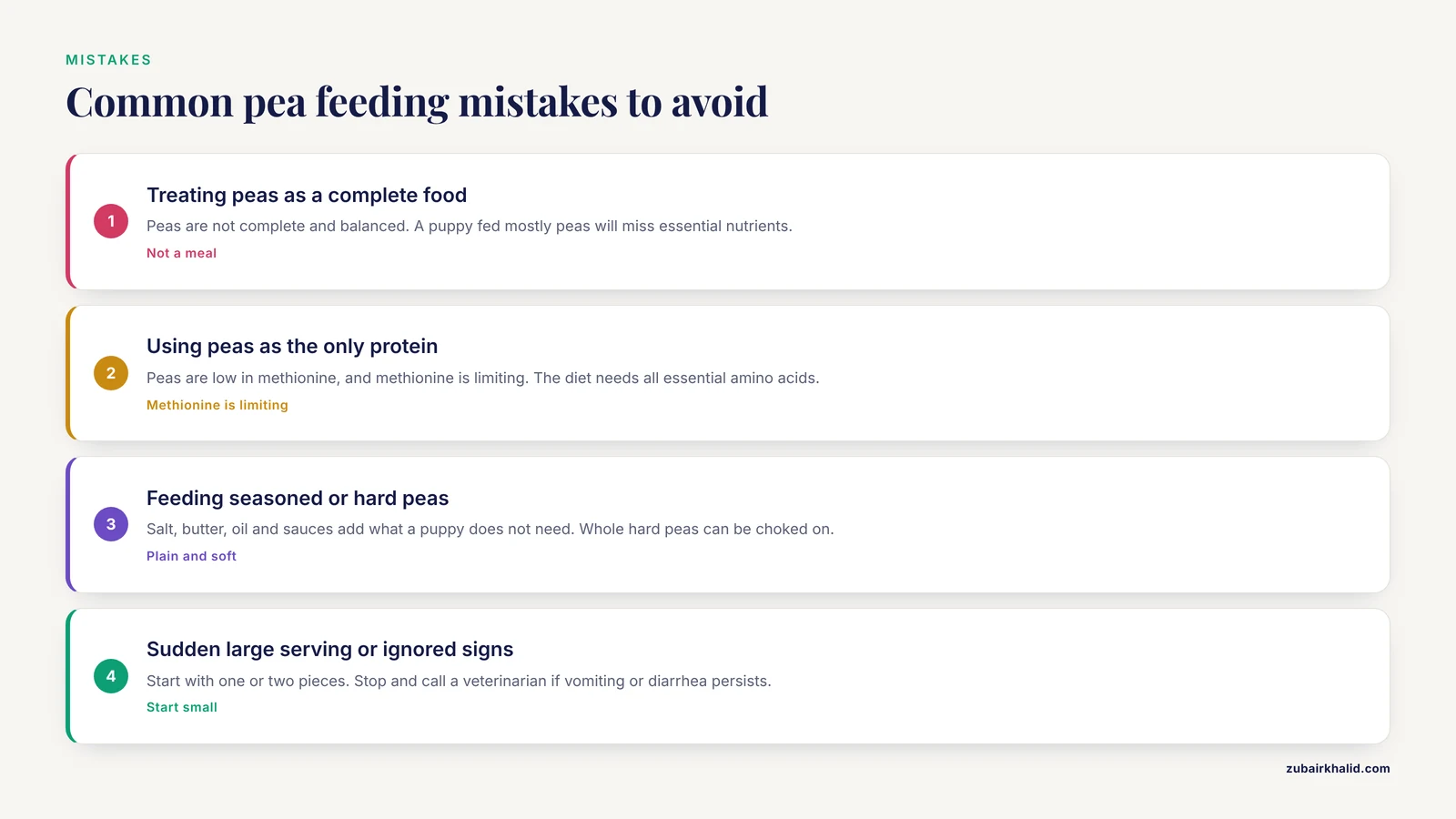
The first mistake is treating peas as a complete food. Peas are not complete and balanced. A puppy fed mostly peas will miss essential nutrients.
The second mistake is using peas as the only protein source. Peas are low in methionine, and methionine is limiting [3]. A puppy needs a protein source or combination of sources that covers all essential amino acids.
The third mistake is feeding seasoned peas. Salt, butter, oil, sauces, and seasonings add things a puppy does not need. Plain peas are the target.
The fourth mistake is giving whole hard peas to a small puppy. Hard peas can be swallowed whole or choked on. Mash or cut them.
The fifth mistake is a sudden large serving. A puppy that has never eaten peas does not need a bowlful. Start with one or two pieces and watch the response.
The sixth mistake is assuming grain-free means safer. The DCM discussion is not a simple grain-free versus grain-inclusive contest. It involves legumes, fiber, taurine, amino acid balance, and whole-diet formulation [7][9].
The seventh mistake is ignoring digestive signs. If peas cause vomiting, diarrhea, or discomfort, stop feeding them and talk to a veterinarian if signs persist.
Troubleshooting: What If Your Puppy Ate Peas?
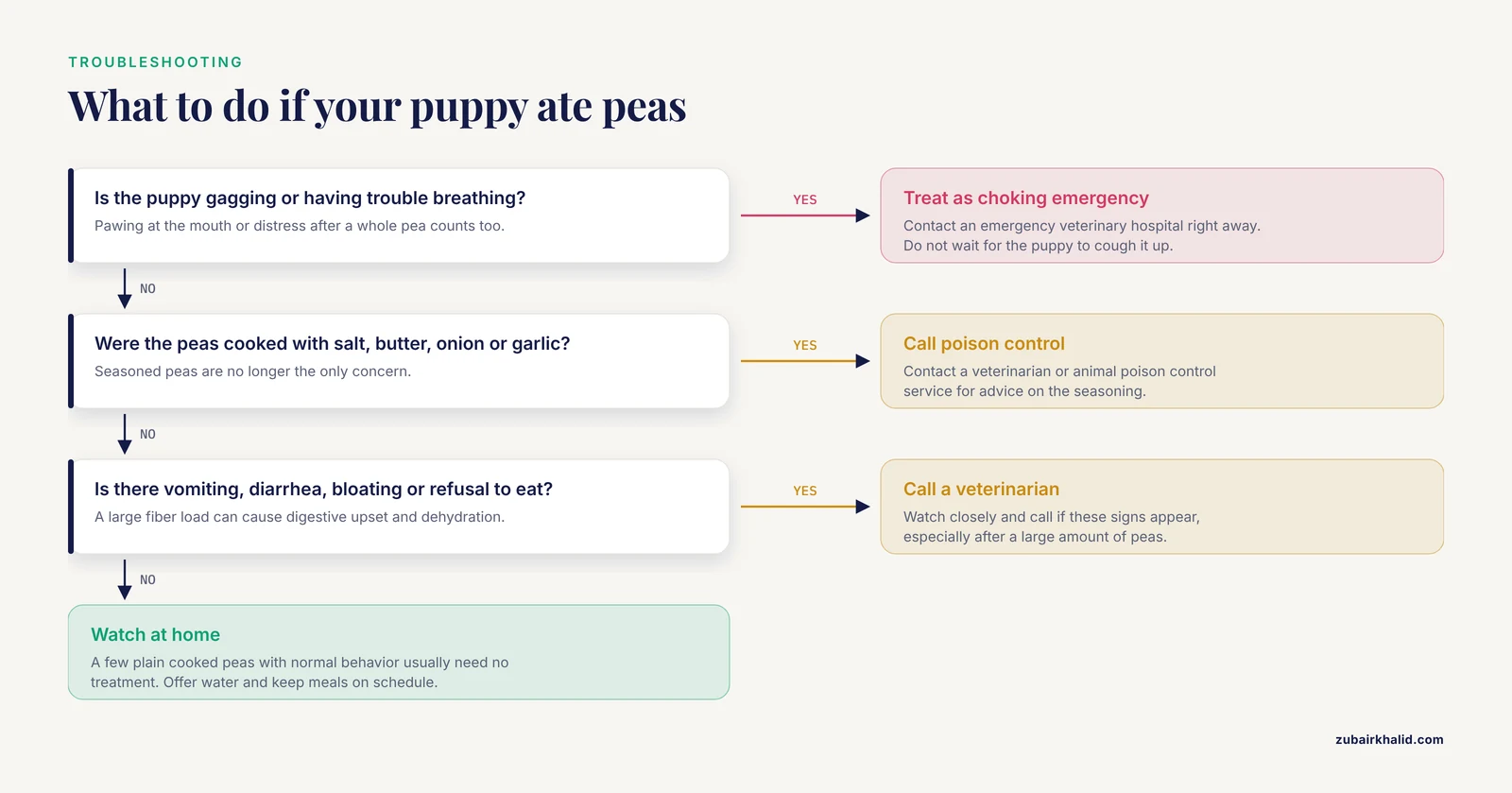
If your puppy ate a few plain cooked peas and is acting normal, watch for vomiting, diarrhea, abdominal discomfort, or a change in appetite. Most small exposures do not need treatment. Offer water and keep the regular diet on schedule.
If your puppy ate a large amount of peas, watch closely for vomiting, diarrhea, bloating, abdominal pain, lethargy, or refusal to eat. Call a veterinarian if any of these signs appear. A large fiber load can cause digestive upset, and a puppy can become dehydrated quickly.
If your puppy is gagging, pawing at the mouth, having trouble breathing, or seems distressed after eating a whole pea, treat it as a choking emergency. Contact an emergency veterinary hospital right away. Do not wait for the puppy to cough it up on its own.
If the peas were cooked with salt, butter, onion, garlic, or another seasoning, call a veterinarian or animal poison control service for advice. The peas are no longer the only concern.
If vomiting or diarrhea lasts more than a day, contains blood, or is paired with weakness or pain, seek veterinary care. Puppies dehydrate faster than adult dogs.
Welfare and Safety Points
Fresh water should always be available. A puppy eating peas still needs normal meals and normal water intake.
Safe food handling matters. Cooked peas should be cooled before serving. Leftovers should be refrigerated and discarded if they are old or spoiled.
Supervision matters. Watch the puppy during the first few pea treats. Small puppies can gulp food, and hard pieces can be a choking risk.
Body condition matters. Peas add calories and fiber. If peas become a regular treat, they need to be counted as part of the daily food intake. A puppy that gains too much weight or has softer stools should have the treat routine reviewed.
The complete diet matters most. A puppy should eat a diet formulated for growth or all life stages. Treats should be small enough that they do not unbalance the diet. If you want to cook for your puppy, use a recipe formulated by a veterinary nutritionist, not a recipe built around peas.
Limitations and When to Contact a Veterinarian
Individual puppies vary. Age, breed size, stomach sensitivity, existing diet, and health status all affect how a food is tolerated. This article gives general guidance, not a diagnosis or a feeding plan for your puppy.
Contact a veterinarian if your puppy has repeated vomiting, diarrhea lasting more than a day, blood in the stool, abdominal pain, bloating, refusal to eat, lethargy, choking, trouble breathing, collapse, or a known exposure to seasoned or unsafe food. Contact a veterinarian before adding peas to the diet of a puppy with a heart condition, a taurine deficiency, kidney disease, a prescription diet, or a history of food allergies. Contact a veterinarian if you are feeding a homemade diet, if the puppy is not growing well, or if you are concerned about DCM risk.
Are Snow Peas, Sugar Snap Peas, and Pea Shoots Safe for Dogs?
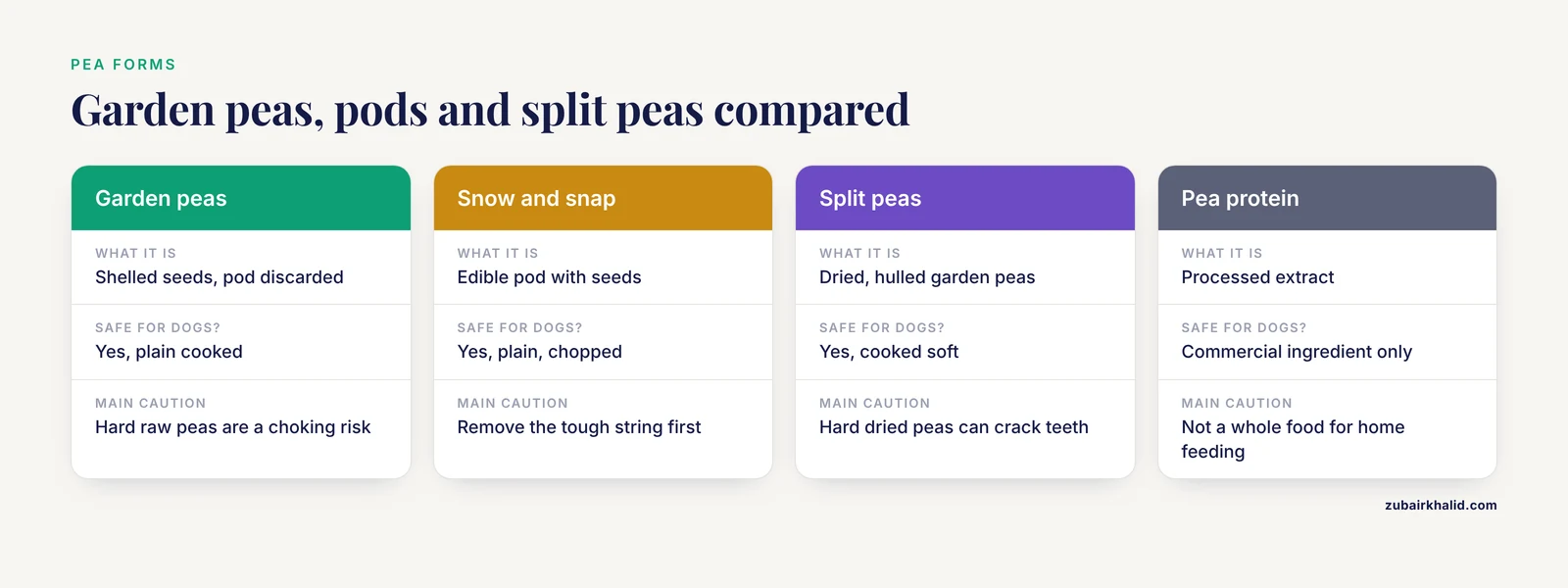
Snow peas, sugar snap peas, and pea shoots are related to garden peas but are not the same food. The table below shows the main forms.
| Form | What it is | Safe for dogs? |
|---|---|---|
| - | - | - |
| Garden peas | Shelled seeds; pod discarded | Yes, plain cooked |
| Snow peas | Flat edible pod with tiny seeds | Yes, plain, chopped |
| Sugar snap peas | Plump edible pod with fuller seeds | Yes, plain, chopped |
| Pea shoots | Young leaves and tendrils | Yes, plain, chopped |
| Split peas | Dried, hulled garden peas | Yes, cooked soft |
| Pea protein | Processed extract | Commercial ingredient only |
Pea protein is a processed extract used in commercial dog foods, not a whole food for home feeding.
The key difference from shelled garden peas is the pod. Snow peas and sugar snap peas have a fibrous seam, or string, along the edge. This string is tough and hard to chew, especially for puppies and small dogs. A whole pod can be swallowed without chewing, creating a choking risk or an esophageal obstruction. Remove the string and cut the pods into small pieces. For puppies, chop finely or mash.
Pea shoots are tender and pose less of a choking risk, but they should still be chopped for small dogs. Serve them raw or lightly steamed, with no salt, butter, oil, sauce, or seasoning. The same plain rule applies to snow peas and sugar snap peas.
Split peas must be cooked until soft before serving. Dried split peas are hard and can crack teeth or be inhaled. Cooked plain split peas are safe in small amounts, but they are more filling than fresh pods and can cause digestive upset if overfed.
Serving limits are the same as for garden peas. A few small pieces are a treat, not a meal. Too much fiber and water can cause gas, vomiting, or diarrhea. Keep the portion small and watch the dog's first response.
Consult a veterinarian before offering these forms to a puppy, a dog with dental disease, a dog with a history of gastrointestinal obstruction or foreign body surgery, or a dog on a prescription diet. If the dog has trouble chewing or swallowing, or shows signs of choking, gagging, or abdominal discomfort after eating pods, seek veterinary care promptly.
Can Dogs Be Allergic to Green Peas?
True allergy to green peas is uncommon in dogs, but it is possible. Peas are a plant protein, and any protein can trigger an immune-mediated food reaction in a susceptible dog. Most adverse food reactions in dogs are directed at animal proteins such as beef, chicken, or dairy, but plant proteins including peas are occasionally responsible.
The signs of a pea allergy are the same as for other food allergies. The most common sign is itching, often on the face, paws, belly, or ears. The itching is usually non-seasonal, meaning it continues through the year rather than appearing only in certain seasons. Some dogs develop recurrent ear infections, red or inflamed skin, hives, or hair loss from scratching. Gastrointestinal signs can also occur, including vomiting, diarrhea, increased gas, or more frequent bowel movements. Some dogs have both skin and digestive signs, while others have only one.
Cross-reactivity between peas and other legumes is not well understood in dogs. In theory, a dog allergic to one legume such as soy, lentils, or chickpeas might also react to peas, but this has not been clearly demonstrated. The reverse is also uncertain. A dog that tolerates one legume may still react to another. For this reason, veterinarians do not assume that a pea allergy means an allergy to all legumes, nor do they assume safety based on tolerance of a different legume.
If you suspect your dog is allergic to peas, do not switch diets on your own. Random diet changes make it harder to identify the trigger and can introduce new problems. The reliable approach is a veterinarian-guided elimination diet. Your veterinarian will recommend a prescription hydrolyzed or novel protein diet, fed exclusively for several weeks, until signs resolve. If signs improve, the suspected food, such as peas, is reintroduced under supervision to confirm the link. This process is called a dietary rechallenge.
Stop feeding peas and contact your veterinarian if your dog develops itching, vomiting, diarrhea, ear inflammation, or skin changes after eating them. Mild digestive upset from a large serving is not the same as an allergy, but a veterinarian needs to distinguish the two. Do not give antihistamines or other allergy medications without veterinary advice.
How to Read Pea Ingredients on Dog Food Labels
Pea ingredients are not interchangeable. Their place on the label tells you what form was used, not how much total legume the diet contains.
What the names mean
- Split peas: whole peas split and dried. They supply starch, fiber, and some protein.
- Pea protein: a concentrated protein fraction. It raises the protein number but does not fix pea's limiting amino acid, methionine [3].
- Pea fiber: isolated fiber. It can add bulk and fermentable fiber.
- Pea starch: isolated starch used for energy and texture.
Pea protein is not a complete protein for growth. Pulse ingredients have good digestibility for most amino acids, but methionine remains the weak point [2][3].
Ingredient splitting
Ingredient lists are ordered by weight. A maker can list peas, pea protein, pea fiber, and pea starch separately, so no single pea entry tops the list even when legumes dominate the formula. Group the pea ingredients mentally and compare that total with named animal proteins. This is a reading aid, not proof of a bad diet.
| Label entry | What it signals |
|---|---|
| - | - |
| Peas first, then chicken meal | Whole peas are a major ingredient by weight |
| Peas, pea protein, pea fiber, pea starch | Legume fractions are split across several entries |
| "With peas" or "pea-fortified" | Peas are present, but the amount is unclear |
If the first five entries read chicken, peas, pea protein, pea fiber, pea starch, the formula has one animal protein and three pea fractions. Ask the maker for the total pea inclusion and the complete nutrient statement.
Check the growth claim
For a puppy, find a complete and balanced statement for growth or all life stages. A label that says grain-free, natural, or with peas is not a nutrition claim. Look for the AAFCO statement and a manufacturer that gives a nutrient profile, not just marketing.
DCM context
Legume-rich diets have been linked to DCM in some reports, but causation is not established and study results differ [7][9][10]. Use the label to judge the whole diet, not to fear every pea. A food with several pea fractions high on the list deserves a question to the maker. A few peas as treats do not.
If your puppy needs a prescription, home-cooked, or special diet, have the formula reviewed by a veterinary nutritionist before changing pea content.
Related Guides
- Can Dogs Eat Green Peppers? Safety, Risks and How Much Is Too Much: Another green vegetable safety guide for dogs and portions
- Can Dogs Eat Green beans? Weight Loss & Raw Safety: Similar green vegetable with raw safety and weight notes
- Can Dogs Eat Turnips? Raw, Cooked, and Greens Safety: Root vegetable safety covering raw, cooked, and greens
- Can Dogs Eat Tomatoes? Solanine Toxicity and Ripe vs Green: Tomato toxicity guide covering ripe and green fruit
- Can Dogs Eat Beet Greens, Leaves, and Juice?: Beet greens safety for leaves and juice
- Can Dogs Eat Mustard? Seeds, Greens, and Condiments: Mustard safety for seeds, greens, and condiments
- Can Dogs Eat Collard Greens Raw or Cooked?: Collard greens safety for raw or cooked feeding
Frequently Asked Questions
Can dogs eat green peas every day?
Yes, small amounts of plain cooked green peas can be given daily if the dog tolerates them and they do not replace complete food. Keep them as a treat or topper, not a main meal.
Can puppies eat peas?
Yes, puppies can eat peas after they are eating solid food. Serve them soft, plain, and mashed, and keep the regular growth diet as the main source of nutrition.
Are frozen peas safe for dogs?
Yes, plain frozen peas are safe when thawed or cooked and served without sauce, butter, or seasoning. Avoid frozen pea mixes with added ingredients.
Are canned peas safe for dogs?
Only plain no-salt-added canned peas are appropriate. Drain them and serve them plain. Avoid canned peas with salt, sugar, butter, or seasonings.
Are raw peas safe for dogs?
Hard raw peas are a choking risk and are harder to digest than soft cooked peas. Cook and mash them before offering them to a puppy.
Do peas cause dilated cardiomyopathy in dogs?
The evidence is mixed and causation has not been established. Pea-heavy diets are under study, but a few plain peas are not the same as a legume-based diet.
Can peas replace dog food for a puppy?
No. Peas are not a complete and balanced growth diet. A puppy needs a diet that supplies all essential nutrients in the right amounts.
What should I do if my puppy ate too many peas?
Watch for vomiting, diarrhea, bloating, abdominal pain, lethargy, or refusal to eat. Call a veterinarian if signs appear or if the amount eaten was large.
Sources
- Effects of six carbohydrate sources on dog diet digestibility and post-prandial glucose and insulin response.
- Macronutrient composition, true metabolizable energy and amino acid digestibility, and indispensable amino acid scoring of pulse ingredients for use in canine and feline diets.
- Chicken meal is not an appropriate reference protein for estimating protein quality of ingredients used in extruded diets intended for dogs.
- Reformulation of a crystalline amino acid reference diet improves oxidation response but remains insufficient for assessing methionine bioavailability in extruded dog diets.
- Semi-synthetic reference diets containing crystalline amino acids at 120% of recommendations for adult dogs are not appropriate for estimating the protein quality of ingredients used in extruded diets.
- Effect of an extruded pea or rice diet on postprandial insulin and cardiovascular responses in dogs.
- Role of Diet as a Predisposing Factor for Dilated Cardiomyopathy in Dogs: A Narrative Review.
- Investigation of diets associated with dilated cardiomyopathy in dogs using foodomics analysis.
- Special topic: The association between pulse ingredients and canine dilated cardiomyopathy: addressing the knowledge gaps before establishing causation.
- Different carbohydrate sources in dog foods supported overall health and cardiac function: an 18-mo prospective study in healthy adult dogs.
- Effect of type of diet on blood and plasma taurine concentrations, cardiac biomarkers, and echocardiograms in 4 dog breeds.
- Starch gelatinization and physical quality of pea flakes in canine dinners as affected by soaking, steam treatment and infrared radiation.