Small Dog Breeds That Don't Shed: Low-Allergy Options
By Dr. Zubair Khalid, DVM, MS, PhD ·
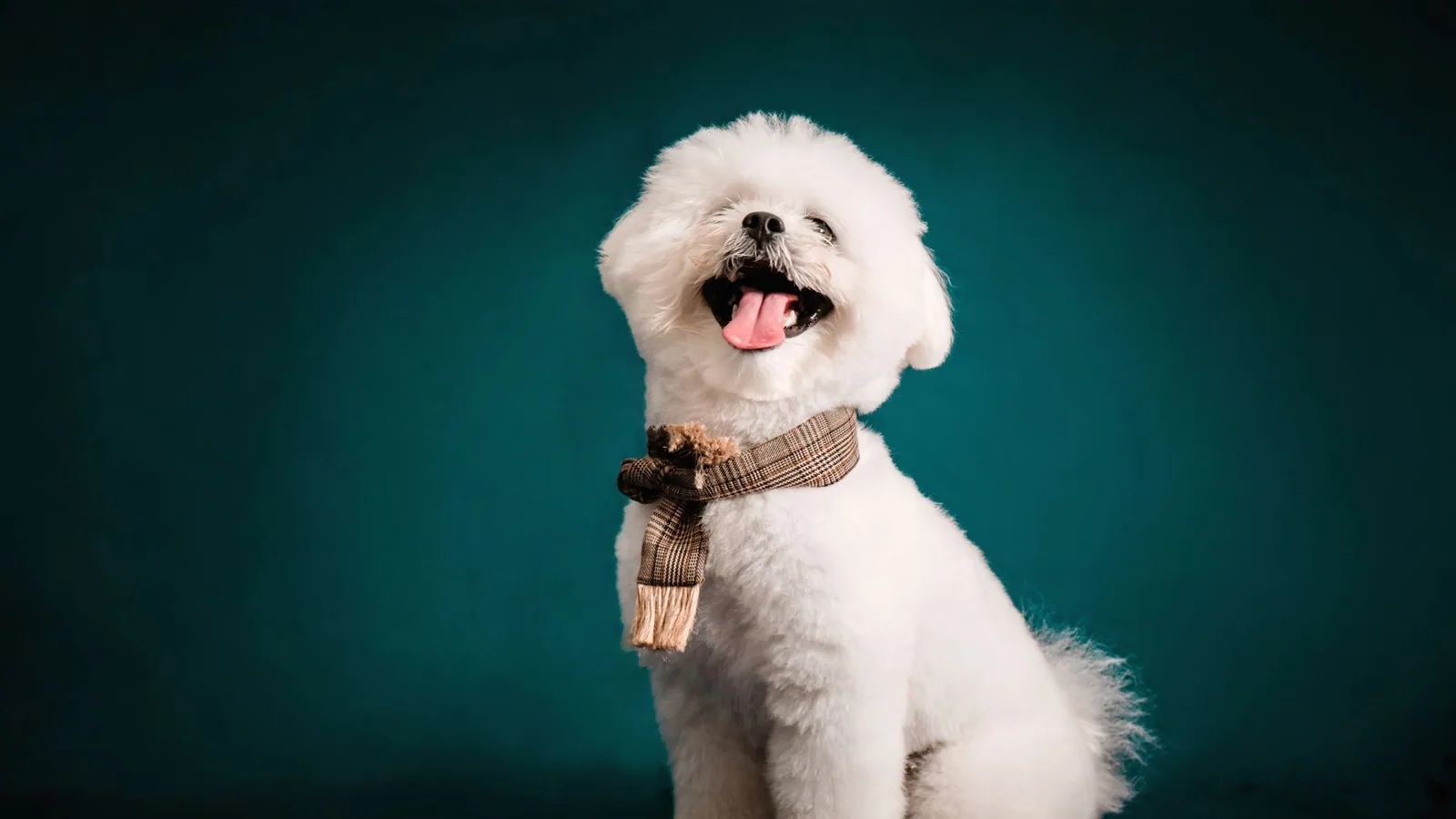
Owners looking for small dog breeds that don't shed are usually chasing two goals at once: less hair on the floor and fewer allergy symptoms in the house. The breeds most often recommended for the first goal are the Toy and Miniature Poodle, Bichon Frise, Maltese, Shih Tzu, Havanese, Yorkshire Terrier, Miniature Schnauzer, and Chinese Crested. Each has a coat that grows continuously or sheds in very small amounts, so the vacuum fills more slowly than it would with a Husky or a Labrador.
The second goal is harder. A coat that holds onto hair does not reliably mean less dog allergen in the home, and the research on that point is consistent [1]. You can absolutely pick a small dog that leaves little fur behind. You should not assume that choice, by itself, will fix an allergy.
This article is educational and is not a substitute for veterinary diagnosis or treatment.
At a Glance: Small, Low-Shedding Breeds
| Breed | Coat type | Shedding | Grooming load | Owner note |
|---|---|---|---|---|
| Toy and Miniature Poodle | Dense curly single coat, grows continuously | Very low | High, brushing to the skin plus clipping | The reference coat for low shedding |
| Bichon Frise | Soft curly double coat, grows continuously | Very low | High, mats at friction points | White coat shows tear staining |
| Maltese | Long silky single coat, no undercoat | Very low | High if kept long, moderate in a puppy cut | Fine hair tangles easily |
| Shih Tzu | Long double coat of hair, grows continuously | Very low | High, daily combing if kept long | Flat face, ask about airway health |
| Havanese | Soft wavy double coat, grows continuously | Very low | Moderate to high | Coat can cord if neglected |
| Yorkshire Terrier | Fine silky single coat, grows continuously | Very low | Moderate to high | Small body means low total hair volume |
| Miniature Schnauzer | Harsh wiry double coat | Low | Moderate, clipping or stripping | Beard and leg furnishings trap debris |
| Chinese Crested | Hairless or powderpuff varieties | Very low | Skin care or coat care, depending on variety | Hairless skin needs protection |
| Soft Coated Wheaten Terrier, Lagotto Romagnolo, Portuguese Water Dog | Curly or wavy continuously growing coats | Low | High | Medium size, for owners who can go larger |
Why "Doesn't Shed" and "Low Allergy" Are Not the Same Thing
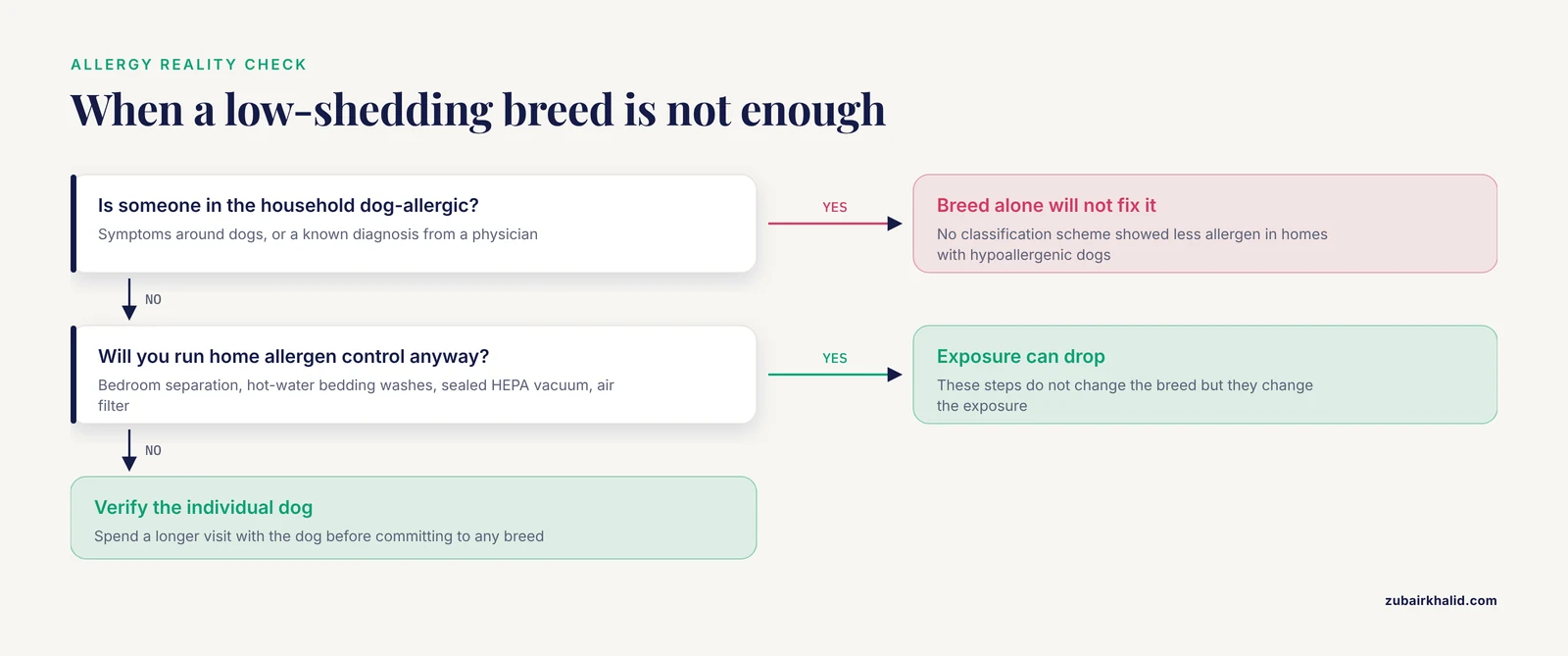
Dog allergen is not hair. The major dog allergen, Canis familiaris 1, is a protein found mainly in saliva, urine, and skin, and it travels through a home on dander, dust, and hair [1]. A dog that drops almost no hair still licks its coat, sheds skin flakes, and leaves protein on furniture. This is why the two promises split apart.
The strongest test of the "hypoallergenic breed" idea looked at dust samples from homes in an established birth cohort. The researchers built four separate classification schemes for what counts as a hypoallergenic dog, mixing purebred and mixed-breed dogs, and compared the allergen levels in each home. No classification scheme showed that homes with hypoallergenic dogs had less dog allergen than other homes [1]. The authors concluded that dog-allergic people deserve real information about allergen shedding by breed rather than marketing claims.
That does not mean breed is irrelevant. Shedding is a measurable, inherited trait. A genome-wide study that compiled 149 breeds, including shedding alongside body size, snout ratio, and lifespan, found statistical evidence that such traits cluster by breed [2]. Coat behavior runs in families. Allergen concentration in your particular house depends on far more than the breed label on the paperwork.
The doodle problem
Poodle crosses are the clearest example of the gap between expectation and reality. A survey of 2,191 dog owners found that many people believe doodles are non-shedding and hypoallergenic, although that is not always the case [3]. The same study found that doodle owners were more influenced by appearance, and by the belief that doodles are good with children and generally healthy, than owners of other dogs [3]. Coat inheritance in a cross is not guaranteed. A puppy that takes after the non-Poodle parent can shed heavily.
What Actually Makes a Coat Low-Shedding
Hair follicles cycle through growth, transition, and rest. In most breeds, a large share of hairs sit in the resting phase and then drop out on a schedule. That is the seasonal coat blow that fills brushes in spring and fall.
Breeds marketed as non-shedding have a different pattern. A high proportion of their follicles stay in the growth phase for years, so the hair keeps lengthening instead of being released. Left alone, that hair reaches the floor, forms cords, or mats against the skin. The coat does not disappear. It accumulates, and a person has to cut it.
Three practical consequences follow:
- No breed is truly hair-free. Every dog loses some hair through breakage, friction, grooming, and normal turnover. The difference is volume.
- Body size reduces the mess. A five-pound dog has a fraction of the skin surface of a fifty-pound dog, so total hair and dander production is lower even before coat type is considered.
- Coat type predicts grooming, not allergy. The narrower the shedding, the more the coat depends on human hands to stay healthy.
Double-coated breeds with a soft undercoat, such as Pomeranians and Shetland Sheepdogs, are not in this group. Their undercoat releases in clumps. Single-coated breeds with continuously growing hair are the low-shedding group described here.
Small Dog Breeds That Don't Shed: The Practical List
Toy and Miniature Poodle
The Poodle coat is dense, curly, and single-layered, and it grows continuously. It sheds very little because the hair stays in the follicle until it is cut or breaks. The trade-off is real: the coat must be line-brushed to the skin several times a week and clipped every four to six weeks. A Poodle that is only brushed on the surface develops tight mats underneath. Both the Toy and Miniature sizes suit owners who want a small dog and accept a grooming bill.
Bichon Frise
The Bichon has a soft, curly white double coat that grows continuously and mats at friction points: behind the ears, under the front legs, at the collar line, and around the tail base. The breed sheds very little, which is exactly why mats form. Bichons are usually kept in a rounded clip that is easier to maintain than a full coat. White hair shows tear staining and every bit of dirt.
Maltese
The Maltese has a long, silky, single coat with no undercoat. It sheds very little and the hair grows continuously. Kept in a full show coat, it needs daily combing and protection from breakage. Most pet Maltese wear a shorter puppy cut, which drops the grooming time considerably while keeping shedding low. The fine texture tangles easily, especially after bathing.
Shih Tzu
The Shih Tzu carries a long double coat of hair rather than fur, and it grows continuously with minimal shedding. A full-length coat needs daily combing. A short trim is far more practical for most homes. The breed is flat-faced, so ask your veterinarian about airway assessment and heat tolerance before committing, and have the eyes and face checked at each wellness visit.
Havanese
The Havanese has a soft, wavy double coat that grows continuously and sheds very little. It is one of the more forgiving breeds in this group because the coat is lighter and less dense than a Bichon's, but it still mats without regular brushing. Some Havanese coats cord if left alone, which requires intentional management rather than neglect.
Yorkshire Terrier
The Yorkshire Terrier has a fine, silky, single coat that grows continuously and sheds very little. The small body keeps total hair volume low. The trade-off is fragility: the hair breaks and tangles, and the coat needs regular brushing and trims. Many owners keep the body clipped short and leave the head and face longer.
Miniature Schnauzer
The Miniature Schnauzer has a harsh, wiry double coat that sheds little. Traditionally the jacket is hand-stripped to keep the texture, though most pets are clipped, which softens the coat over time. The beard, leg furnishings, and eyebrows collect food, dirt, and burrs and need attention at every grooming session.
Chinese Crested
The Chinese Crested comes in two forms. The hairless variety has hair on the head, tail, and feet with bare skin elsewhere, so skin care replaces coat care. The powderpuff variety has a long, soft double coat that grows continuously and sheds very little. Both are small and lightly built. Discuss skin protection for the hairless variety with your veterinarian rather than guessing at products.
If You Can Go Slightly Larger
The Soft Coated Wheaten Terrier, Lagotto Romagnolo, and Portuguese Water Dog all carry continuously growing curly or wavy coats with low shedding. They are medium dogs rather than small ones, and their grooming demands are at least as high as a Poodle's. They belong here because owners who cannot find a small breed that fits often find these three easier to live with than a mat-prone toy coat.
Grooming: The Real Workload of a Low-Shedding Coat
This is where most new owners are caught out. The survey of doodle owners found that more than twice as many doodle owners as owners of other dogs reported that maintenance requirements, such as the need for regular grooming, were more intensive than expected [3]. Low shedding moves work from the vacuum to the grooming table. It does not remove work.
Brushing that actually works
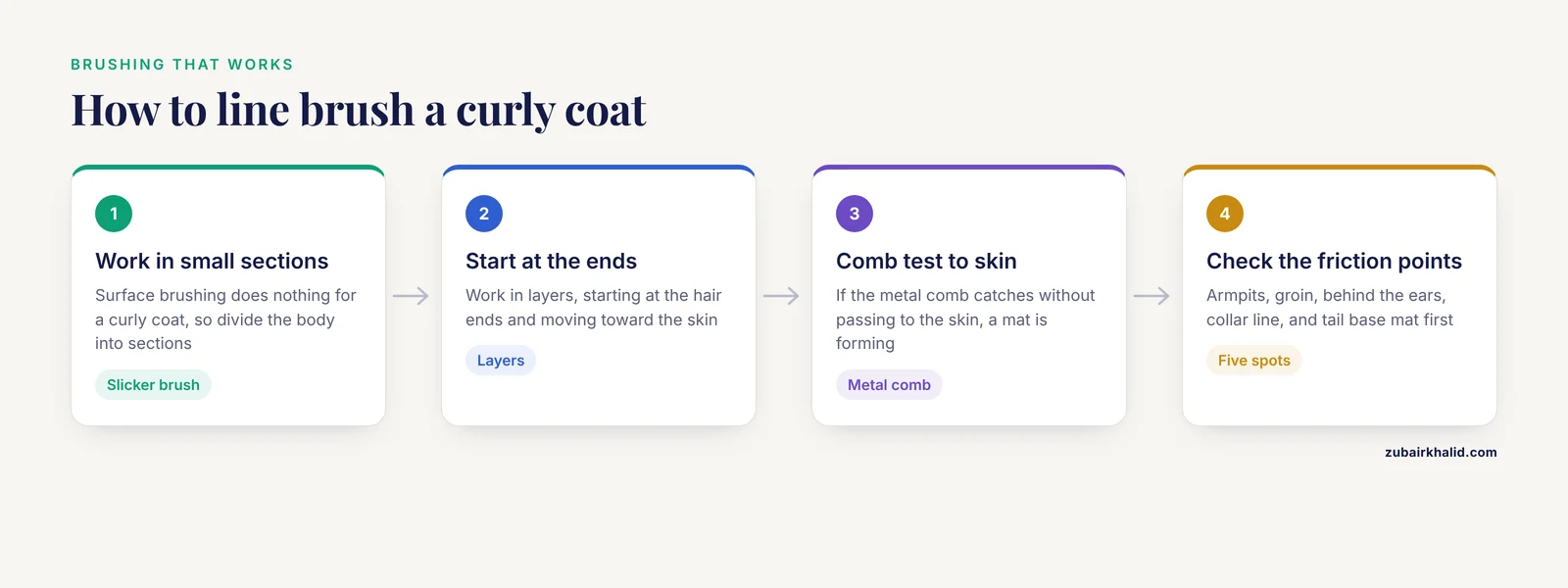
Surface brushing does nothing for a curly coat. Use a slicker brush in small sections, then follow with a metal comb. The comb is the test: if it will not pass through the coat to the skin without catching, there is a mat forming. Work in layers, starting at the ends and moving toward the skin. Pay attention to the armpits, groin, behind the ears, the collar line, and the tail base.
Bathing and drying
Use a shampoo formulated for dogs. Human shampoo strips the coat and disrupts the skin barrier. Dry the coat completely, because a damp curly coat tightens into mats as it dries. For thick coats, a forced-air dryer speeds this up and separates the hair.
Clipping
Most coats in this group need clipping every four to six weeks to stay at a manageable length. Waiting longer means the groomer has to shave close to the skin, which is harder on the dog and the coat. Book the next appointment before leaving the current one.
The parts owners forget
- Ears. Have them checked and cleaned as your veterinarian advises, particularly in drop-eared breeds.
- Nails. Trim every few weeks, or ask the groomer to do it.
- Eyes and face. Clean the face daily in flat-faced breeds and in breeds that tear.
- Sanitary trim. Keep the rear and groin short for hygiene.
- Paw pads. Hair between the pads collects ice, mud, and burrs.
Allergen Control in the Home: What Actually Moves the Number
If someone in the household is dog-allergic, the breed decision is only one variable. Dust allergen is what triggers symptoms, and dust allergen responds to cleaning and housing choices. Discuss the plan with the allergic person's physician, and ask your veterinarian what level of bathing your dog's skin can tolerate before you commit to a frequent bathing routine.
Practical steps that reduce allergen load in a home:
- Keep the dog out of the bedroom of the allergic person and close that door.
- Wash dog bedding and blankets in hot water on a regular schedule.
- Vacuum with a sealed, high-efficiency filtration unit rather than a basic upright.
- Reduce wall-to-wall carpet where possible, since carpet holds dust.
- Wipe hard surfaces and window areas regularly.
- Use a high-efficiency air filter in the room where the family spends the most time.
- Wash hands after handling the dog and before touching your face.
None of these steps changes the breed. Together they change the exposure.
Choosing a Puppy or Rescue Dog: What to Ask and Verify
Coat type is inherited, and a puppy's coat at eight weeks does not reliably predict the adult coat, especially in a crossbreed. Do these things before you pay a deposit:
- See both parents. Ask to see the dam and, if possible, the sire. Look at their coats and ask how often they are groomed.
- Ask for video. Request a short video of the adult dog being brushed, not just standing.
- Visit twice. Spend time in the home or facility with the dog. Allergy symptoms often show up during a longer visit.
- Ask about health testing. A responsible breeder can tell you what screening the parents have had. Ask your veterinarian what screening matters for the breed you are considering.
- Get a veterinary check. Schedule an examination soon after adoption. The AVMA and AAHA both emphasize a wellness examination as the foundation of a new pet's care plan, and the first visit is when vaccination status, parasite prevention, and any inherited concerns get sorted out.
- Follow AAHA and AVMA vaccination guidance. Puppies need a series, not a single shot, and the schedule depends on age at adoption.
- Follow CAPC parasite guidance. Fleas, ticks, heartworm, and intestinal parasites are a separate problem from coat type and are managed with year-round prevention.
- Consider a rescue. Breed-specific rescues place adults whose coats are already fully grown, which removes the guessing game about how much a puppy will shed.
Common Mistakes
- Believing "hypoallergenic" means allergy-free. The label has no standardized definition, and home allergen levels do not track it [1].
- Buying a doodle and expecting a Poodle coat. Coat inheritance in a crossbreed is not guaranteed, and many doodle owners find grooming harder than expected [3].
- Skipping brushing because the dog "doesn't shed." The hair is still there. It is trapped in the coat.
- Brushing only the top layer. Mats form underneath and are invisible until they are tight.
- Bathing without drying. Damp curly coats mat as they dry.
- Waiting too long between clips. Overgrown coats hide skin problems and make grooming stressful.
- Using human shampoo or human clippers. Dog skin and coat have different needs.
- Choosing a breed for the coat alone. Temperament, activity level, and health all matter more over a decade than shedding volume.
Welfare and Safety Points
A matted coat is not a cosmetic problem. Mats pull on the skin, trap moisture, and hide infections, and they hurt when handled. A dog that yelps or snaps during brushing is often telling you the coat is already beyond home care, and the kindest response is a professional groom and a shorter haircut, not more force.
Grooming is a handling skill that needs to be taught. Short, frequent sessions with treats build tolerance better than long battles. If your dog cannot tolerate having its feet, face, or rear handled, work on that at home and ask your veterinarian for guidance.
Flat-faced breeds in this group, particularly the Shih Tzu, need extra care in heat and during grooming because their airways are less efficient. Ask your veterinarian to assess the airway before you choose one of these breeds, and avoid strenuous activity in hot weather.
Small size brings its own advantages. Large and heavy dogs tend to live shorter lives, and the genome-wide analysis of 149 breeds identified body size as one candidate factor in canine life expectancy [2]. That does not mean small dogs are free of health problems. It does mean you are likely signing up for a longer relationship, which makes the grooming commitment worth planning properly. Ask your veterinarian about dental care and joint assessment at each annual visit, since small breeds have specific concerns that are best handled early.
Routine Care Calendar
| Frequency | Task |
|---|---|
| Daily | Quick visual check of eyes, ears, and skin. Comb the face and any long furnishings. |
| Every 2 to 3 days | Full line brush and comb test on curly or long coats. |
| Weekly | Ear check, nail check, and a full body hands-on exam for lumps, mats, and sores. |
| Every 4 to 6 weeks | Professional grooming or clipping. Book the next appointment at pickup. |
| Monthly | Review parasite prevention and refill as needed. |
| Every 6 to 12 months | Wellness examination with your veterinarian, following AAHA and AVMA preventive care guidance. |
| Annually | Discuss breed-specific screening with your veterinarian as the dog ages. |
Limitations and When to Contact a Veterinarian
No breed description can tell you how an individual dog's coat, skin, or allergy profile will behave. A veterinarian who can examine your dog, review the coat in person, and take a full history is the only reliable source for your specific situation.
Contact a veterinarian promptly if you notice:
- Scratching, licking, or chewing that is frequent enough to interrupt sleep or daily activity
- Redness, rash, odor, or greasy discharge on the skin
- Hair loss in patches or bald areas under a matted coat
- A mat that is tight against the skin, or skin visible underneath a mat
- Head shaking, ear discharge, or an ear that is painful to touch
- Eye redness, squinting, or discharge
- A coat that has stopped growing or has developed a sudden bald patch
- Vomiting, diarrhea, lethargy, or appetite loss
- Breathing difficulty, especially in a flat-faced breed
- A dog that cannot be handled for grooming without sedation-level distress
For allergies in people, the family physician or an allergist directs the treatment plan. For allergies in dogs, including itchy skin and recurrent ear infections, your veterinarian will decide whether allergy testing, medication, or a dietary trial is appropriate.
Health Screening Priorities for Low-Shedding Small Breeds
The continuously growing coat that makes these breeds appealing can also hide the problems that shorten small-dog lives. Dental disease, patellar luxation, tracheal collapse, and eye conditions are the recurring themes.
Dental disease. Small mouths hold the same teeth as large mouths in less space, so crowding traps food and accelerates plaque. Periodontal disease is the most common condition in small breeds. Ask for a dental assessment at every wellness visit, and budget for professional cleaning when your veterinarian recommends it.
Patellar luxation. The kneecap slips out of a shallow groove, most often in Toy Poodles, Yorkshire Terriers, Bichons, and Maltese. A veterinarian can detect it by palpating the stifle during a routine exam. Mild, intermittent cases may respond to weight control and physical therapy; surgery is reserved for recurrent or painful luxation.
Tracheal collapse. The tracheal rings flatten during breathing, producing a goose-honk cough with excitement, leash pressure, or heat. Toy breeds and Yorkshire Terriers are overrepresented. A harness instead of a collar reduces pressure, and any persistent cough needs veterinary evaluation.
Eye problems. Many of these breeds have prominent or shallow-set eyes. Progressive retinal atrophy, cataracts, and tear staining are common. Have the eyes assessed at each visit, and seek prompt care for squinting, discharge, or cloudiness.
Skin allergies. The same skin that grows a continuous coat is prone to atopic dermatitis, food allergy, and secondary infections. Chronic scratching, licking, or odor warrants investigation rather than over-the-counter products.
Flat-faced airway concerns. For Shih Tzu and similar brachycephalic breeds, request airway assessment before any planned anesthesia and watch for noisy breathing, exercise intolerance, or collapse in heat.
Weight and exercise. Small dogs gain weight easily, and obesity worsens patellar luxation, tracheal collapse, and cardiovascular strain. Ask for a body condition score at each visit and match exercise to the breed's airway and joint limits.
When to call. Any persistent cough, lameness, eye change, or skin flare deserves a visit before the next scheduled checkup.
Skin and Ear Care Beneath a Coat That Grows Continuously
A coat that sheds very little keeps hair, but it also keeps moisture, oil, and debris pressed against the skin. The same mechanism that keeps fur off the floor traps warmth and humidity close to the body. After bathing, swimming, or a humid day, a dense curly or silky coat dries slowly, and the damp layer against the skin becomes a breeding ground for bacteria and yeast. Mats make this worse: a tight mat holds moisture against the skin and hides the redness, sores, and discharge that form underneath it.
Ear problems follow the same pattern. Many low-shedding small breeds have drop ears that cover the ear canal. The continuously growing coat around the ear base, combined with limited air circulation, traps wax and moisture. A dog that shakes its head, scratches at one ear, or flinches when the ear is touched needs a veterinary examination. The same applies to a persistent odor, redness, or dark discharge from either ear.
Skin folds add another site for trouble. Flat-faced breeds such as the Shih Tzu have facial folds that stay moist, and the tail base, armpits, and groin can develop fold dermatitis in any breed with a heavy coat. Check these areas weekly by running your fingers to the skin and looking for odor, redness, greasy discharge, or pain.
Bathing is safe and helpful when done correctly. Use a dog shampoo, rinse thoroughly, and dry the coat completely. A forced-air dryer is the most reliable way to dry a thick coat to the skin. Dry the ears by wiping the outer flap with a cotton pad; never insert anything into the ear canal. Keep facial folds dry after bathing and after meals.
Contact a veterinarian for any of these signs: a musty or sour odor that returns within a day or two of cleaning, redness or swelling of the skin or ear flap, discharge that is yellow, green, brown, or bloody, pain when the coat, skin, or ear is handled, head shaking or ear scratching, or a mat so tight that the skin beneath it cannot be seen or reached.
Grooming Time, Tools, and Costs: Planning Before You Commit
The coat that keeps hair off your floor puts that hair on your calendar. In a survey of 2,191 dog owners, doodle owners were more than twice as likely as other owners to say maintenance was more intensive than expected [3]. The same lesson applies to every continuously growing coat: plan the time and the budget before the puppy arrives.
Weekly brushing time
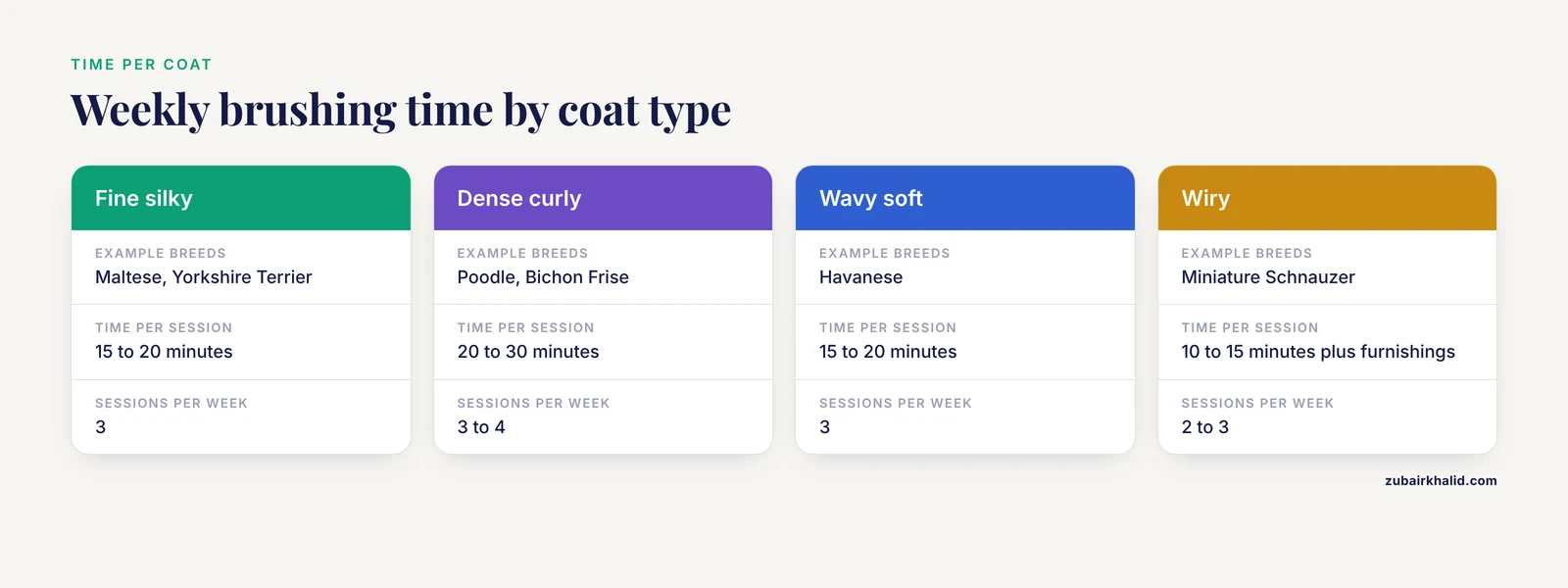
| Coat type | Examples | Time per session | Sessions per week |
|---|---|---|---|
| - | - | - | - |
| Fine silky | Maltese, Yorkshire Terrier | 15 to 20 minutes | 3 |
| Dense curly | Poodle, Bichon Frise | 20 to 30 minutes | 3 to 4 |
| Wavy soft | Havanese | 15 to 20 minutes | 3 |
| Wiry | Miniature Schnauzer | 10 to 15 minutes, plus beard and leg furnishings | 2 to 3 |
| Hairless | Chinese Crested (hairless) | Minimal brushing; skin care replaces it | Daily skin check |
Tool costs by category
- Entry kit: slicker brush, metal comb, nail clippers, dog shampoo, towels. About $40 to $60.
- Home clipping kit: entry kit plus clippers, scissors, and a non-slip grooming surface. About $150 to $250.
- Professional-grade setup: adds a forced-air dryer and higher-end clippers. About $400 to $700. The dryer is the largest single expense and the one that most reduces matting, because damp curly coats tighten as they dry.
DIY versus groomer
Home grooming saves the per-visit fee but costs time, space, and skill. A professional groom at the usual interval for the coat type shifts clipping, nail trims, ear cleaning, and sanitary work to someone with the right tools and experience. Many owners run a hybrid plan: home brushing and bathing, professional clipping. Decide which route fits your schedule before the dog arrives.
Contingency plan
If a mat is tight against the skin, do not try to brush it out. Book a groomer promptly. If the dog cannot be handled without distress, ask your veterinarian about sedation or a veterinary groomer. A close shave is kinder than a painful brush-out, and the coat will regrow. Keep contact details for two groomers and your veterinary clinic where you can find them quickly.
Related Guides
- Dog Allergy Treatment: Diagnosis and Care Options: Explains diagnosis and care options for dog allergies
- Why Your Dog Sheds Constantly: Explores chronic shedding causes and what owners can do
- Why Dogs Shed More in Cold Weather: Explains seasonal shedding patterns and cold-weather coat changes
- Dog Breeds That Potty Train Easily: Lists breeds that are easier to housebreak for new owners
- When to Spay a Dog: Optimal Age for Small vs Large Breeds: Covers optimal spay timing for small versus large breeds
- Multi-Step Dog Stairs for Small & Senior Breeds: Tread Depth, Stability Ratios, and Joint Strain Reduction: Addresses joint strain and mobility aids for small senior dogs
- Can I Give My Dog Xyzal? Allergy Medication Safety: Details whether Xyzal is safe for dogs with allergies
- Can Dogs Take Claritin D? Allergy Medicine Safety: Reviews safety of Claritin D for dogs with allergies
Frequently Asked Questions
Do any small dog breeds truly not shed at all?
No. Every dog loses some hair through breakage and normal turnover, but the breeds listed here release far less than double-coated breeds.
Are low-shedding small dogs hypoallergenic?
Not reliably. Coat type controls how much hair lands on the floor, while allergen levels in the home depend on many other factors [1].
Are Poodle mixes, like doodles, non-shedding?
Sometimes, but not always. Coat inheritance in a crossbreed varies, and many doodle owners find grooming more demanding than expected [3].
How often does a non-shedding small dog need professional grooming?
Most need clipping every four to six weeks, plus brushing at home several times a week to prevent mats.
Do non-shedding dogs cause fewer allergies in children?
A low-shedding coat does not guarantee lower allergen in the home. Families with a dog-allergic child should speak with a physician before choosing any breed.
Which small breed is best for a first-time owner with allergies?
None is guaranteed. Choose for coat and temperament, spend time with the dog before committing, and plan for consistent home allergen control.
Should I shave my non-shedding dog in summer?
Ask your veterinarian. Short clips help some coats and can harm others, and the answer depends on the individual coat and skin.
Can I reduce dog allergen at home without rehoming my dog?
Often you can reduce exposure with consistent cleaning, bedding changes, bedroom separation, and air filtration, and your physician can tailor a plan to the allergic person.
Further Reading
- Efficacy and safety of a non-adjuvanted Bordetella bronchiseptica extract vaccine with recombinant pertactin administered subcutaneously to dogs.
- Novel robotic tools used for the detection of faecal shedding of Escherichia coli resistant to critically important antimicrobials in healthy dogs.
- Immunogenicity and protective efficacy of a novel bacterium-like particle-based vaccine displaying canine distemper virus antigens in mice and dogs.