Chinese Powder Puff Dog Breed Guide
By Dr. Zubair Khalid, DVM, MS, PhD ·
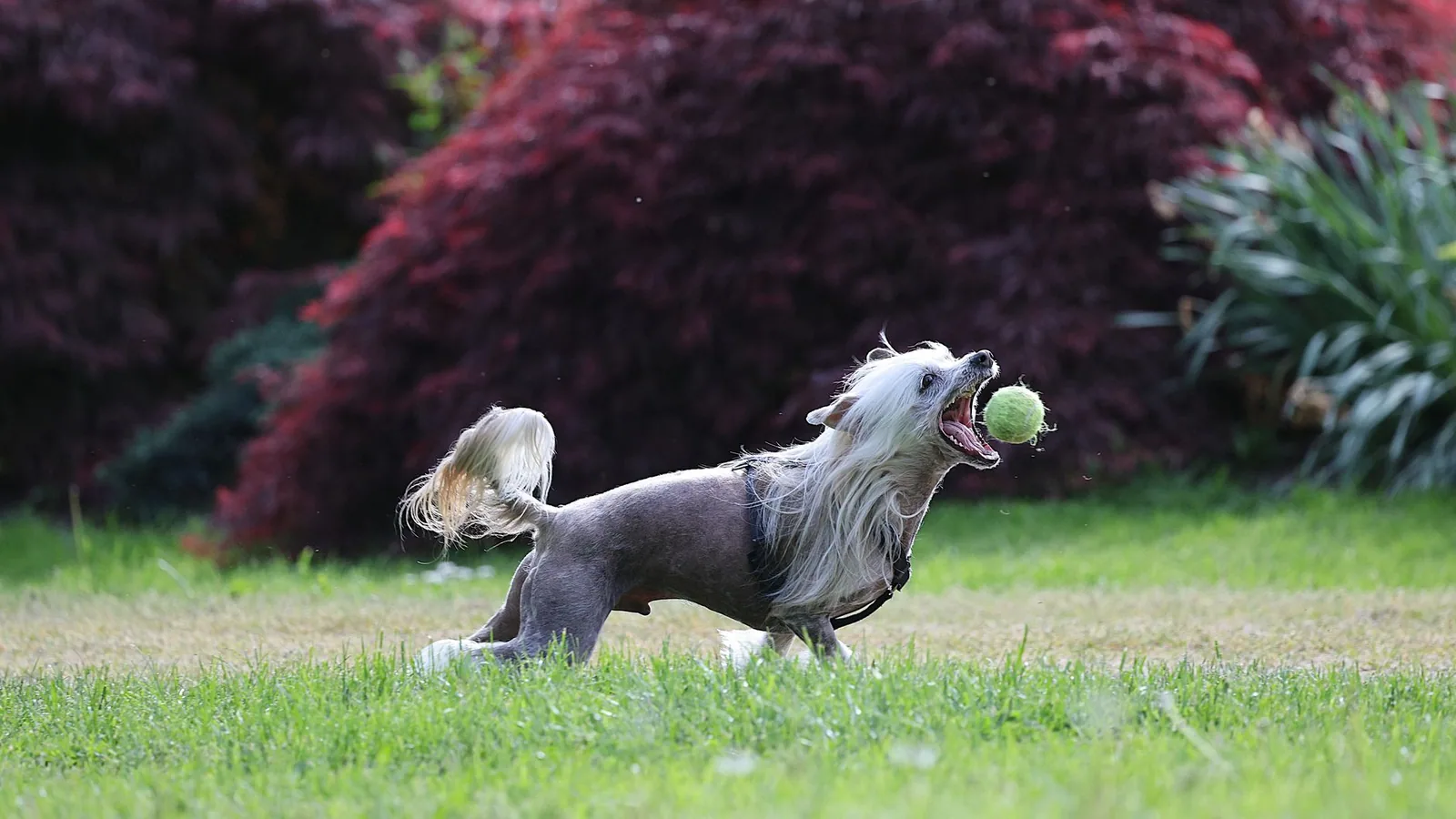
A Chinese Powder Puff is the coated variety of the Chinese Crested, not a separate breed. That single fact drives most of the health advice in this guide. Powder Puffs are born with a full coat, and the Powder Puffs examined in the veterinary literature did not carry the FOXI3 variant responsible for the hairless variety's skin and dental abnormalities [1][2]. A Powder Puff still inherits the rest of the Chinese Crested health profile, including a fatal recessive movement disorder documented in the breed [3]. Coat type changes the risk map. It does not erase the breed.
This article is educational and is not a substitute for veterinary diagnosis or treatment.
At a Glance: Powder Puff Health Checklist
| Topic | What is known | What to do |
|---|---|---|
| Variety status | The coated variety of one breed, the Chinese Crested [2] | Register, insure, and describe your dog as a Chinese Crested (Powder Puff) |
| Hairless gene | A 7-base-pair duplication in FOXI3, inherited in a semi-dominant pattern, shared by the three hairless breeds [1] | Ask the breeder about the parents' status and discuss genotyping with your veterinarian |
| Teeth | Hairless dogs lose permanent canines, premolars, and some incisors, and their molars lack normal cusps [1]. Powder Puffs are not expected to follow that pattern | Oral examination at every wellness visit |
| Skin | Superficial pyoderma occurs secondary to the hairless condition [4]. Powder Puff follicles and glands are not the mutant phenotype [2] | Check skin weekly for pustules, crusts, and odor |
| Movement disorder | Canine multiple system degeneration (CMSD) is a fatal autosomal recessive disease characterized in Chinese Cresteds [3] | Report any gait or coordination change promptly |
| Breeding | Ectodermal dysplasia segregates as an autosomal dominant trait with homozygous lethality [3] | Avoid pairings that risk homozygous embryos and screen pedigrees first |
| Coat | Compound hair follicles like other coated breeds, with an anagen-dominated cycle [2] | Set a brushing schedule with your groomer |
What Chinese Powder Puff Dogs Are, and What They Are Not
One breed, two varieties
The Chinese Crested breed contains two varieties. Hairless dogs show hypotrichosis, meaning sparse hair, along with dentition abnormalities. Coated dogs, the Powder Puffs, have a normal coat [2]. Both varieties appear in the same breed registry and share the same breed history, which is why a Powder Puff puppy can be born to a breeding program that also produces hairless dogs.
The hairless variety's appearance is the visible result of a form of canine ectodermal dysplasia. Hairless Chinese Cresteds are obligate heterozygotes for a FOXI3 mutation, and the phenotype is classified as ectodermal dysplasia because the gene affects more than coat, including tooth development [2].
Why the coat variety changes the medical picture
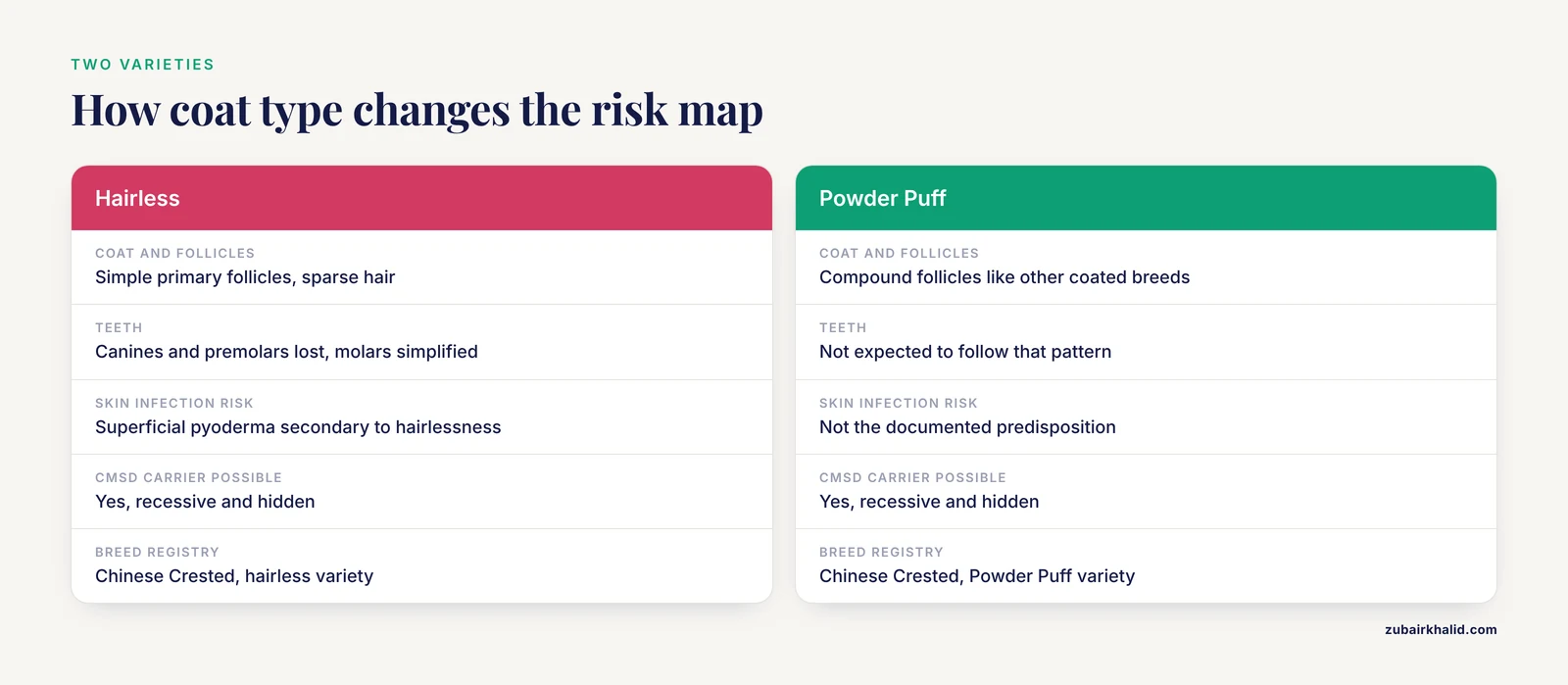
Ectodermal dysplasia describes abnormal development of tissues derived from the embryonic ectoderm, chiefly hair, teeth, and glands. When a dog carries the FOXI3 variant, those structures develop abnormally [1][2]. When a dog does not carry it, those structures develop along ordinary canine lines. Skin biopsies from nonmutant Powder Puffs showed compound hair follicles identical to those of other dog breeds [2].
That is the core distinction for owners. A Powder Puff's mouth, skin, and coat should be evaluated as a coated dog's mouth, skin, and coat. The breed's other genetic problems do not respect coat type, and those are covered below.
The Genetics Behind the Coat
FOXI3 and the hairless variety
The hairless trait in the three hairless dog breeds has been attributed to a semi-dominant 7-base-pair duplication in the first exon of the forkhead box I3 gene, FOXI3 [1]. The same variant was confirmed in a historical museum sample of pedigreed hairless dog skulls using ancient DNA extraction, which tied the genotype directly to the dental anatomy preserved in those specimens [1].
Inheritance is described as semi-dominant. Hairless dogs are heterozygotes, and the homozygous state is lethal, a pattern reported in a 51-dog pedigree of Chinese Cresteds, Kerry Blue Terriers, and their crosses in which ectodermal dysplasia segregated as an autosomal dominant trait with homozygous lethality [3].
The genes that are not responsible
Two candidate genes have been examined and excluded for the Chinese Crested phenotype. EDAR, the gene for the ectodysplasin A1 receptor, sits in the mapped region for canine ectodermal dysplasia on chromosome 17 but was excluded as the cause [3]. A separate analysis of the canine EDAR gene likewise excluded it as a candidate for the hairless phenotype in the Chinese Crested [5]. This matters to owners only in one practical sense: the genetics here are specific, and general statements about "the hairless gene" in dogs are usually oversimplified.
Hairlessness elsewhere in dogs
Hairlessness in dogs has more than one genetic cause. Whole-genome sequencing of a Scottish Deerhound family linked hairlessness in that breed to a single base pair insertion in exon two of SGK3 [6]. A review of canine pelage genetics reports a separate gene associated with absence of coat in the American Hairless Terrier [7]. These findings do not change the FOXI3 story in the Chinese Crested. They do explain why hairless breeds should never be lumped together clinically, and why a Powder Puff's genetic counseling should be breed-specific.
Dental Health: Where the Two Varieties Diverge
The hairless dental phenotype
The dental consequences of FOXI3 haploinsufficiency are well described. In hairless dogs, both the upper and lower dentition showed loss of the permanent canines, premolars, and to some extent incisors. The deciduous fourth premolars and the permanent first and second molars consistently lacked the distal and lingual cusps, leaving a single enlarged cusp in the basin-like heel of the tooth [1].
The same study noted that this simplified molar form appears in several living and fossil carnivorans and in the extinct order Creodonta, where it is associated with hypercarnivory. The authors suggested FOXI3 may be involved in dental cusp development more broadly across mammals [1].
What this means for a Powder Puff
A Powder Puff carries a normal coat, and the histological work on the breed found that nonmutant Powder Puffs had compound follicles identical to other dog breeds [2]. The dental phenotype described above belongs to the FOXI3 mutant phenotype, so a Powder Puff is not expected to show the same pattern of missing canines and simplified molars.
Coat type is the visible part of a semi-dominant trait, not a full genetic report. A Powder Puff from a breeding program that also produces hairless dogs may warrant a conversation with your veterinarian about whether genotyping is available and useful for that individual dog. That conversation is worth having before breeding, not after.
Dental care priorities
Every Chinese Crested, coated or not, deserves a real oral examination rather than a quick glance. Ask your veterinarian to chart the dentition at the first wellness visit and to note any missing, retained, crowded, or malformed teeth. Home oral care products, cleaning frequency, and whether professional scaling is appropriate are decisions your veterinarian makes after examining the mouth, not decisions to copy from a breed forum. The AAHA dental care guidance sets the general framework for home care and professional assessment in US practice.
Skin and Coat Health
What the histology shows
Skin biopsies from 22 Chinese Crested dogs, spanning true hairless, semi-coated, and Powder Puff subphenotypes, showed that hair follicular abnormalities decreased as the number of hairs increased across the three phenotypes [2]. The FOXI3 mutants had only simple primary hair follicles. The nonmutant Powder Puffs had compound follicles identical to other dog breeds [2].
All Chinese Crested dogs in that study had an anagen-dominated hair cycle, meaning most follicles were in the growth phase rather than the resting phase [2]. The study also found that apocrine glands in the skin and respiratory mucous glands of the mutant dogs were present and normal, which corrects a common assumption that hairless dogs simply lack these glands [2].
Grooming and skin monitoring
A Powder Puff coat is structurally an ordinary dog coat [2]. Grooming tools should match coat length and texture, with rounded pin tips on brushes, a metal comb for the legs and ears, and a detangling spray used sparingly. A professional groomer can set a schedule that fits your dog's coat density and your local climate. Between appointments, run your hands over the body weekly and look for mats behind the ears, under the collar, and in the armpits.
Skin infections: a hairless problem, not a Powder Puff problem
Superficial pyoderma has been documented as a secondary consequence of the hairless nature of the breed [4]. That risk belongs chiefly to the hairless variety, where skin lacks the protective coat. A Powder Puff with a full coat does not carry that specific predisposition, but any dog can develop bacterial skin infection from allergies, moisture trapped under a mat, or parasites. Do not treat a suspected infection with leftover ointment from a previous dog. Have the skin examined and, if a lesion is recurrent, ask about cytology.
Canine Multiple System Degeneration
What is known
A movement disorder of Chinese Crested dogs was characterized clinically and pathologically as indistinguishable from canine multiple system degeneration, a disease previously recognized in Kerry Blue Terriers [3]. The disease is fatal. In a 51-dog pedigree that included both breeds and their crosses, it segregated as an autosomal recessive trait, and affected dogs appeared among first-generation crosses, showing that the mutations in the two breeds are allelic [3].
The CMSD locus maps to canine chromosome 1, with haplotype analysis narrowing the target region to a 15-megabase segment that contains orthologs of genes on human chromosome 6, including PARK2, the gene for the ubiquitin ligase parkin. Mutations in human PARK2 cause autosomal recessive juvenile parkinsonism, which shares clinical and pathological features with the canine disease [3].
What owners should do
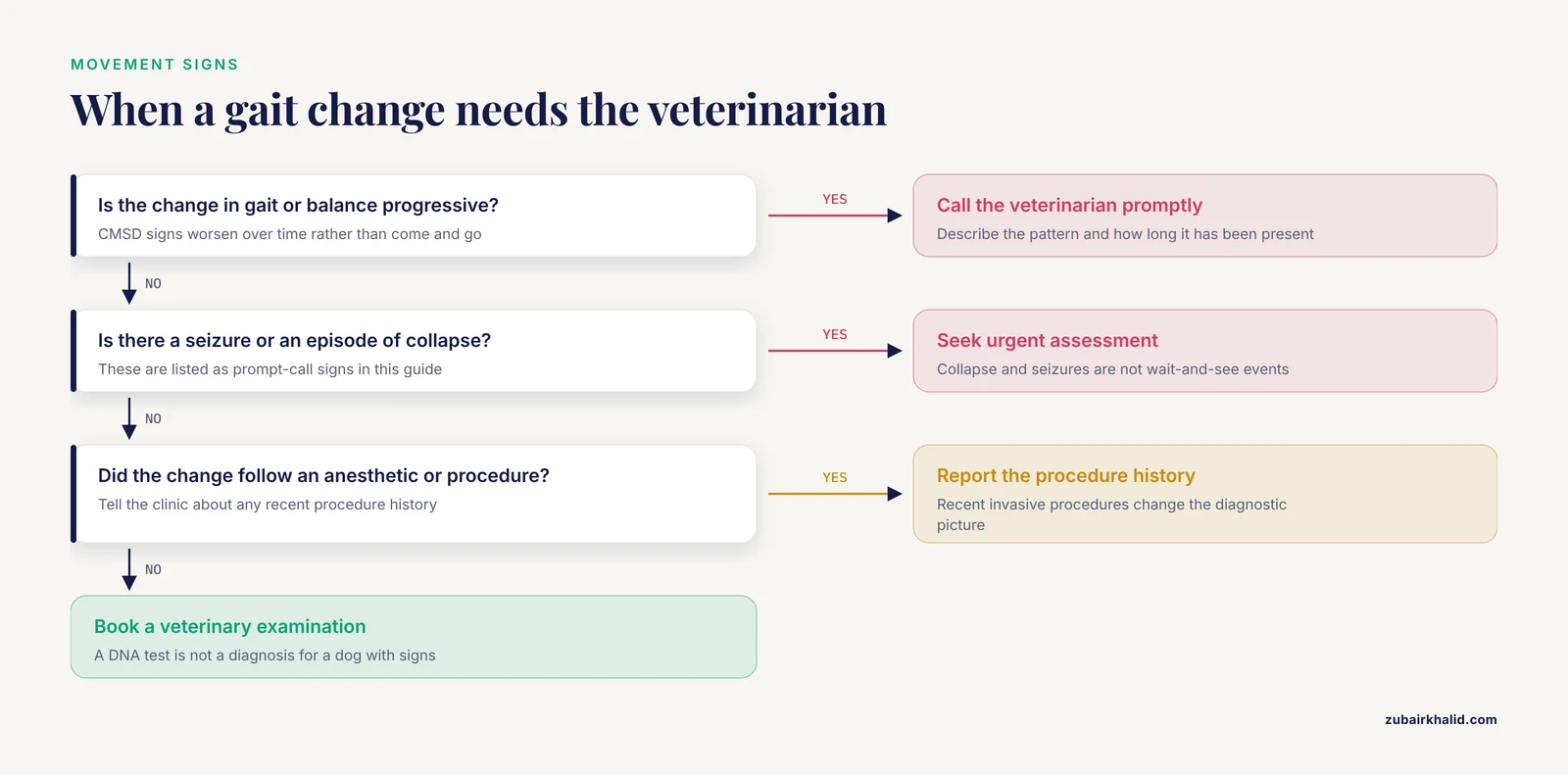
Because CMSD is recessive, an affected dog inherits one copy of the mutation from each parent, and carrier dogs are not themselves affected [3]. A Powder Puff can be a carrier without any sign of illness. That is precisely why the disease matters in breeding decisions and why a movement problem in any Chinese Crested deserves prompt veterinary assessment rather than a wait-and-see approach.
Ask your veterinarian what to watch for and how to describe changes accurately. A gait that shortens, a dog that scuffs a paw, a change in balance, or a reluctance to climb stairs all warrant a call. Early description of the pattern helps your veterinarian decide what diagnostics are appropriate.
Breeding, Welfare, and the Homozygous Lethality Problem
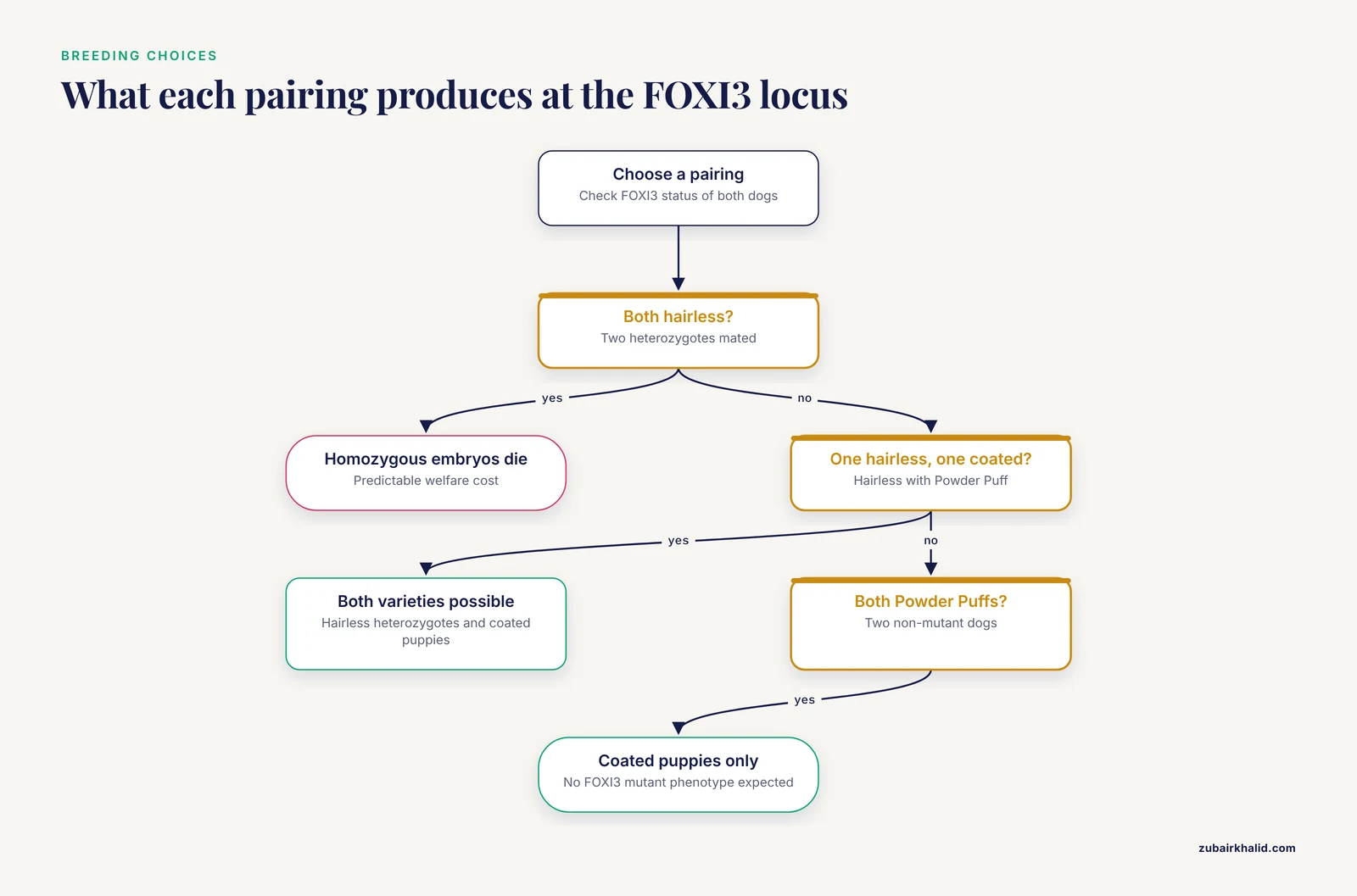
Ectodermal dysplasia segregates as an autosomal dominant trait with homozygous lethality [3]. In plain terms, a puppy that inherits two copies of the variant does not survive. Pairings that bring two hairless dogs together therefore carry a predictable welfare cost, and the same logic applies when a breeding program does not track FOXI3 status across generations.
The inheritance of hairlessness in dogs has been studied in other hairless breeds as well, where it behaved as an autosomal dominant monogenic trait [8]. The details differ by breed, which is why Chinese Crested breeding decisions should rest on Chinese Crested data, not on rules borrowed from another breed.
Any breeding program producing Powder Puffs should be able to discuss CMSD in the pedigree, explain how the hairless and coated varieties are paired, and provide health records for both parents. A breeder who brushes off a question about a fatal recessive disease is telling you something.
Bringing Home a Powder Puff: Step by Step
- Confirm the variety on paper. Your dog is a Chinese Crested, Powder Puff variety [2]. Use that description with your insurer and your veterinarian.
- Ask for the pedigree and any health records for both parents, including any information about CMSD and FOXI3 in the lines.
- Book a wellness examination with your own veterinarian soon after arrival, and bring every record the breeder provided.
- Ask your veterinarian to perform and document a full oral examination, including a dental chart.
- Set parasite prevention and vaccination through your veterinarian, following the CAPC parasite guidelines and AAHA lifestyle-based vaccination guidance as applied to your dog's age and risk.
- Establish a grooming schedule with a groomer familiar with drop-coated breeds, and buy tools that match the coat you actually have.
- Record a baseline weight and body condition score, then recheck on the schedule your veterinarian sets.
- Ask what specific signs should prompt a call: gait change, skin pustules, tooth problems, appetite loss, or vomiting.
Supplies and Selection Criteria
| Item | Selection criteria | Why it matters |
|---|---|---|
| Brush and metal comb | Rounded pin tips, size matched to your dog, plus a comb for the ears and legs | A compound-follicle coat [2] tangles where friction is highest |
| Dog-formulated toothpaste and soft brush | Product made for dogs, chosen with your veterinarian | Home oral care is part of the dental plan your vet sets after an oral exam |
| Gentle dog shampoo | Formulated for dogs, used at a frequency your veterinarian approves | Frequent bathing without medical reason can dry skin |
| Nail trimmers | Sharp, correctly sized, with a clear view of the nail | Overgrown nails change posture and gait |
| Scale and record file | Home scale for trends, plus a folder for records | Weight loss is an early signal for several problems, including liver disease [9] |
| Parasite prevention | Product and schedule set by your veterinarian per CAPC guidance | Prevention is easier than treatment |
Daily and Weekly Care Routine
Coat
Brush on the schedule your groomer recommends for your dog's coat density. Check behind the ears, under the collar, and in the armpits each week. Bathe only when the coat is genuinely dirty or your veterinarian advises it.
Mouth
Follow the oral care plan your veterinarian sets after examining the teeth. Lift the lip weekly and look for broken teeth, heavy tartar, red gums, or a sudden odor.
Skin and parasites
Run your hands over the whole body weekly. Note any new lump, scab, pustule, or patch of hair loss, and photograph it so you can describe change accurately. Keep parasite prevention current according to the CAPC guidelines as your veterinarian applies them.
Weight and records
Weigh monthly and log the number. Keep vaccination dates, dental charts, and any lab work in one place so every veterinarian you see has the same history.
Common Mistakes
- Treating the Powder Puff as a distinct breed. It is a variety of the Chinese Crested [2], and that is the health profile your dog inherits.
- Assuming a full coat guarantees a clean genetic bill of health. Coat type is the visible part of a semi-dominant trait [1], and the breed carries a separate recessive movement disorder [3].
- Skipping the dental chart. Missing or malformed teeth are a documented feature of the hairless variety [1], and a baseline dental record makes later changes visible.
- Buying from a breeder who cannot discuss CMSD. The disease is fatal and recessive [3]. A pedigree without that conversation is incomplete.
- Breeding two hairless dogs. Homozygous lethality is part of the inheritance pattern [3].
- Using leftover skin ointment on a new lesion. Skin problems have different causes, and the hairless variety's pyoderma risk [4] does not automatically apply to a coated dog.
- Ignoring a subtle gait change. Movement disorders are easiest to evaluate when the history is detailed.
Troubleshooting: Signs and Next Steps
| What you notice | Why it matters in this breed | What to do |
|---|---|---|
| Missing, crowded, or misshapen teeth | The hairless variety has a documented dental phenotype [1] | Book an oral examination and dental chart |
| Pustules, crusts, or greasy odor | Superficial pyoderma is documented secondary to hairlessness [4] | Have the skin examined before starting any treatment |
| Gradual change in gait, balance, or strength | CMSD is a fatal recessive disorder characterized in Chinese Cresteds [3] | Contact your veterinarian promptly |
| Vomiting, poor appetite, weight loss, or yellow tinge to the gums | Chronic hepatitis with dissecting fibrosis has been reported in a Powder Puff [9] | Same-day or next-day veterinary visit |
| Deterioration after an invasive procedure | A case report described hepatic emphysema and clostridial infection after an ultrasound-guided liver biopsy in an 11-year-old Powder Puff [9] | Seek urgent care, and report the procedure history |
| Matting or coat odor that returns quickly | Dense coat plus compound follicles [2] | Groomer visit and a skin check |
Limitations and When to Contact a Veterinarian
Breed guides describe patterns. Your dog is an individual, and only a veterinarian who has examined your dog can diagnose or treat it.
Contact a veterinarian promptly for any of the following:
- A change in gait, coordination, balance, or strength, especially if it is progressive.
- A seizure or an episode of collapse.
- Skin lesions that are painful, spreading, oozing, or accompanied by fever.
- Broken teeth, a swollen face, drooling, or difficulty eating.
- Vomiting that persists beyond a day, diarrhea with blood, or refusal of food for more than 24 hours.
- Weight loss you did not plan, or increased drinking and urination.
- Jaundice, a distended abdomen, or sudden weakness.
- Any acute deterioration in the days after a biopsy or another invasive procedure [9].
Go to an emergency facility for breathing difficulty, collapse, uncontrolled bleeding, or a suspected toxin exposure.
Exercise, Weight, and Climate Safety for Powder Puffs
Activity needs
A Powder Puff is a small companion breed with moderate exercise needs. Most adults do well with two 20 to 30 minute walks daily plus indoor play and training. Puppies need shorter, more frequent sessions, and their growing joints are better served by free play than by forced running or jumping. Schedule activity rather than waiting for the dog to ask.
Body condition at home
Assess body condition monthly and weigh the dog on the same scale each time. Run your hands along the ribcage. You should feel each rib with a thin layer of fat, similar to the back of your hand. Ribs that feel like knuckles mean the dog is too thin; ribs you cannot feel without pressing mean overweight. From above, there should be a visible waist behind the ribs. From the side, the belly should tuck up toward the groin. In a small breed, a gain of half a kilogram is a large percentage of body weight, so track the trend.
Heat, humidity, cold, and pavement
The full Powder Puff coat traps heat in warm weather and provides limited insulation in cold. Humidity makes panting less effective, so a humid day can be more dangerous than the air temperature alone suggests. Walk in the early morning or evening during warm months, carry water, and stop at the first sign of heavy panting, drooling, or slowing down.
Test pavement with the back of your hand for five seconds. If it is uncomfortable for you, it can burn the paw pads. In cold weather, use a well-fitted sweater or coat and keep walks short. Shivering, lifting paws, or reluctance to move means the dog is too cold.
When to call a veterinarian
Call your veterinarian the same day for new lethargy, reduced willingness to exercise, or any episode of collapse. Heatstroke is an emergency: uncontrollable panting, vomiting, staggering, or inability to rise. Cool the dog gently with room-temperature water and go to an emergency facility immediately.
Genetic Testing and Screening Decisions for Owners and Breeders
Genetic testing for this breed addresses two separate loci, and the two are easily confused. FOXI3 testing examines the coat and dental phenotype. CMSD testing examines a fatal movement disorder. The genes are inherited independently, so one result says nothing about the other.
FOXI3 testing
A FOXI3 test detects the 7-base-pair duplication associated with the hairless phenotype [1]. A hairless dog is expected to be heterozygous, since the homozygous state is lethal [3]. A Powder Puff with a full coat is expected to be non-mutant, and the histology in the breed literature supports that expectation [2]. Testing can confirm a dog's status at this locus, which is useful when a coated dog comes from a line that also produces hairless puppies.
FOXI3 testing cannot tell you whether a dog carries CMSD, whether its teeth will stay healthy, or whether it will develop skin disease. It answers one question only.
CMSD testing
CMSD testing identifies clear, carrier, or affected status at the locus on canine chromosome 1 [3]. Because the disease is recessive, a carrier shows no signs [3]. A test result is the only way to know carrier status before breeding.
CMSD testing cannot tell you anything about coat type or FOXI3 status.
Why a full coat is not a clean genotype
A full coat proves only that the dog does not show the FOXI3 mutant phenotype. It says nothing about CMSD, which segregates independently [3]. A coated dog can be a CMSD carrier, and a breeding program that selects only for coat will not remove the movement disorder from its lines.
Using results in breeding
Results should inform pairing decisions, not replace veterinary care. Avoid pairings that risk homozygous lethal embryos [3]. For CMSD, carrier-to-carrier pairings should be avoided, and a veterinarian or genetic counselor can help interpret results within a pedigree.
A genetic test is not a diagnosis. A dog that develops a gait change needs a veterinary examination, not a repeat DNA test. Likewise, a clear CMSD result does not remove the need for regular oral examinations and wellness visits.
Spay, Neuter, and Anesthetic Planning for a Coated Chinese Crested
Timing as an individualized decision
The right age for spay or neuter in a Powder Puff is an individualized decision between you and your veterinarian, not a fixed breed rule. Body size, adult weight, behavior, and the dog's intended role all factor in. Your veterinarian may recommend a different age for a pet puppy than for a show prospect or a breeding dog. Ask for the reasoning.
Pre-anesthetic assessment
Before any anesthetic event, your veterinarian should perform a full physical examination and review the dog's history. Baseline blood work helps identify problems not visible on examination. Tell your veterinarian about any gait change, fainting episode, or previous reaction to medication. The breed carries a fatal recessive movement disorder [3], so any neurologic sign deserves a workup before elective anesthesia. The same applies to a history of liver disease, reported in a Powder Puff [9].
Dental evaluation under the same anesthetic event
Spay or neuter is a practical time for a complete oral examination and dental charting. The hairless variety has a documented dental phenotype [1], and while a Powder Puff is not expected to share it, every Chinese Crested benefits from a baseline dental record. Ask whether dental radiographs are indicated during the same procedure. Combining procedures reduces anesthetic events.
Post-operative coat and incision care
Check the incision twice daily for swelling, redness, discharge, or opening. Prevent licking with an e-collar or recovery suit as directed. Keep the incision dry and do not apply creams or ointments unless prescribed. The Powder Puff coat has compound follicles and an anagen-dominated growth cycle [2], so clipped hair will regrow, but it may take weeks to match the surrounding coat. Brush gently around the incision and check for mats from the collar.
Call your veterinarian if your dog is not eating, is vomiting, seems painful, or if the incision becomes swollen or discharges. A quiet first day is normal; a dog still dull on day two is not.
Related Guides
- Probiotics For Dogs Gut Health Powder: Probiotic powder information for general canine gut health support
- Dog Itchy Ears Powder: Ear powder product information for dogs with itchy ears
- Dog Ear Itch Powder: Uses and Cautions: Ear itch powder uses and cautions for canine ear care
- Hairless Cat: Care, Health, and Breed Guide
Frequently Asked Questions
Is a Chinese Powder Puff a separate breed from the Chinese Crested?
No. The Powder Puff is the coated variety of the Chinese Crested breed [2]. It shares the breed's history, its registries, and most of its health risks.
Do Powder Puffs have the same dental problems as hairless Chinese Cresteds?
No. The missing canines, missing premolars, and simplified molars are features of the FOXI3 mutant, hairless phenotype [1]. The Powder Puffs examined histologically did not carry the mutation and had normal compound hair follicles [2]. Still, every Chinese Crested should have its teeth charted.
Are Powder Puffs hypoallergenic?
No dog is truly hypoallergenic. A Powder Puff has a full coat, which means it sheds and carries dander like other coated breeds. Discuss allergy concerns with your physician before bringing any dog home.
How is hairlessness inherited in this breed?
It follows a semi-dominant pattern tied to a FOXI3 duplication, with the homozygous state being lethal [1][3]. That is why hairless dogs are heterozygotes and why certain pairings carry a welfare cost.
What is CMSD and could my Powder Puff be at risk?
Canine multiple system degeneration is a fatal autosomal recessive movement disorder characterized in Chinese Cresteds [3]. A Powder Puff can carry the mutation without showing signs, so pedigree information and veterinary assessment matter.
Does a Powder Puff's coat need special grooming?
It needs consistent grooming, not exotic grooming. The coat has compound follicles like other coated breeds [2], so brushing and detangling routines designed for long coats apply.
Are Powder Puffs prone to skin infections?
The documented pyoderma risk is tied to the hairless condition [4]. A coated Powder Puff does not share that specific predisposition, though any dog can develop skin infection from allergies, parasites, or trapped moisture.
What health questions should I ask before buying a Powder Puff puppy?
Ask about CMSD in the pedigree, how the breeder pairs hairless and coated dogs, whether FOXI3 status is known for the parents, and whether both parents have had recent veterinary examinations. Then have your own veterinarian examine the puppy and chart its teeth.
Sources
- The dental phenotype of hairless dogs with FOXI3 haploinsufficiency.
- Clinical and histological characterization of hair coat and glandular tissue of Chinese crested dogs.
- Genetic mapping of canine multiple system degeneration and ectodermal dysplasia loci.
- Superficial pyoderma, secondary to the hairless nature of the breed.
- Analysis of the canine EDAR gene and exclusion as a candidate for the hairless phenotype in the Chinese Crested dog.
- Whole Genome Analysis of a Single Scottish Deerhound Dog Family Provides Independent Corroboration That a SGK3 Coding Variant Leads to Hairlessness.
- The bald and the beautiful: hairlessness in domestic dog breeds.
- The inheritance and breeding results of hairless descendants of Mexican hairless dogs.
- Hepatic emphysema associated with ultrasound-guided liver biopsy in a dog.