American Hairless Terrier Breed Guide
By Dr. Zubair Khalid, DVM, MS, PhD ·

The American Hairless Terrier is one of the few dog breeds that is entirely bald. Unlike the Xoloitzcuintli, which has sparse hair on its extremities, the American Hairless Terrier has no coat at all. This distinctive appearance is the result of a recessive gene [2], and modern genomic research has identified a new gene associated with the absence of coat in the breed [3].
This guide covers what owners and prospective owners need to know about this rare hairless terrier, including the genetics of hairlessness, growth patterns, skin care, breeding considerations, and when to contact a veterinarian.
At a Glance
| Feature | Details |
|---|---|
| Breed group | Terrier |
| Coat type | Hairless, entirely bald [1] |
| Inheritance of hairlessness | Recessive gene [2] |
| Genetic discovery | New gene associated with hairlessness [3] |
| Growth pattern | Unusually rapid growth and large adult stature documented in one case [4] |
| Skin care | Dedicated skin care required [5] |
| Research value | Useful in dermatological science [6] |
Breed Overview and History
Domestic dogs display an extraordinary range of coat types. Variation in color, texture, length, curl, and growth pattern is a hallmark of the nearly 400 dog breeds recognized worldwide [1][3]. Among these variations, partial or full hairlessness appears in only a small number of breeds [1].
The American Hairless Terrier belongs to the fully bald group. The breed standard calls for no coat at all, which distinguishes it from breeds such as the Xoloitzcuintli, where the standard requires only sparse hair on the extremities.
Hairlessness has been selected by breeders as a defining trait in several dog breeds. Along with coat length, curl, growth, and shedding, the presence or absence of fur is one of the pelage traits that breeders have shaped over generations [3]. The American Hairless Terrier is a product of this selection, and its hairlessness is now a fixed characteristic of the breed.
Understanding the breed's place in the dog world helps owners appreciate what makes the American Hairless Terrier special. Among the nearly 400 recognized breeds, only a handful are hairless [1][3]. The American Hairless Terrier is one of the few that is completely bald, with no hair on any part of the body [1]. This makes it a striking example of how breeders have shaped dog morphology through selection [3].
The breed's name reflects its terrier heritage, and the American Hairless Terrier is classified within the terrier group. What sets it apart from other terriers is the complete absence of a coat [1].
Hairless Terrier Genetics
A Recessive Gene
The genetic basis of hairlessness in the American Hairless Terrier was established in the 1980s. Research published in the Journal of Heredity demonstrated that a recessive gene causes hairlessness in the breed [2]. This means a dog must inherit two copies of the variant, one from each parent, to be hairless. A dog with one copy of the variant and one normal copy is a carrier and has a normal coat.
The recessive pattern of inheritance has practical implications for breeders and owners. Two coated dogs that both carry the variant can produce hairless puppies. This is consistent with recessive inheritance, as observed in a Scottish Deerhound family where coated parents produced hairless offspring [1].
A New Gene Discovery
In 2017, researchers reported the discovery of a new gene associated with the absence of coat in the American Hairless Terrier [3]. This finding came from a comprehensive review of pelage traits in domestic dogs, which examined fur length, curl, growth, shedding, and the presence or absence of fur [3].
The gene responsible for hairlessness in the American Hairless Terrier is distinct from the gene that causes hairlessness in other breeds. In Scottish Deerhounds, for example, a single base pair insertion in exon two of the SGK3 gene leads to a potential frameshift and causes hairlessness [1]. This variant was identified through whole genome sequencing of a family in which coated parents produced both coated and hairless offspring [1]. Of 325 homozygous alternative alleles found in both hairless dogs, only one high-impact variant within a coding region was observed, and that was the SGK3 insertion [1].
The study that identified the SGK3 variant compared single nucleotide polymorphisms and small insertions and deletions against an established catalog of 91 million canine variants [1]. This approach allowed the researchers to narrow the search to a single high-impact coding variant [1]. Similar genomic approaches are being used to understand the genetic basis of hairlessness in other breeds, including the American Hairless Terrier [3].
Interestingly, gene expression levels between coated and hairless Scottish Deerhounds are similar, which suggests that a mechanism other than nonsense-mediated decay is responsible for the hairless phenotype [1]. This level of detail matters for researchers studying hair follicle biology, but for owners the key takeaway is simpler: hairlessness in dogs has multiple genetic causes, and the American Hairless Terrier has its own distinct genetic pathway [1][3].
What This Means for Owners
For owners, the recessive inheritance of hairlessness means that litters can be mixed. A litter from two coated carriers can include both coated and hairless puppies, as demonstrated by the birth of hairless offspring in a Scottish Deerhound family [1]. Prospective owners who want a hairless puppy should ask the breeder about the genetic status of the parents.
Growth and Physical Development
One documented case of an American Hairless Terrier puppy showed unusually rapid growth and an unexpectedly large adult stature [4]. Published in the Journal of Small Animal Practice, this case describes a puppy whose growth trajectory exceeded typical expectations for the breed [4].
The significance of this case is that American Hairless Terriers may show more variation in growth than owners expect. A puppy that grows rapidly may reach an adult size that differs from breed averages. This is not necessarily a health problem, but it is worth monitoring.
For owners, regular weight checks and body condition scoring during the puppy phase are useful. A growth pattern that seems unusually fast is worth discussing with a veterinarian, especially if it is accompanied by changes in appetite, energy, or gait.
Health Considerations
The scientific literature on the American Hairless Terrier identifies three areas of health relevance: growth, skin, and genetics.
Growth deserves attention because of the documented case of unusually rapid growth and large adult stature in a puppy [4]. Owners should monitor growth and body condition, especially during the first year.
Skin is the most visible health concern. Because the breed is entirely bald [1], the skin is exposed to environmental stress and requires routine care. Skin problems are often visible early, which is an advantage for prompt treatment.
Genetics underlies both the defining trait of the breed and potential health considerations. The recessive gene that causes hairlessness [2] and the newly identified gene associated with the trait [3] are the focus of ongoing research. As with any breed, prospective owners should ask breeders about the health history of the parents and any genetic testing that has been done.
Regular veterinary examinations are the cornerstone of preventive care. During these visits, the veterinarian can assess body condition, examine the skin, and discuss any concerns about growth or development. This is especially important for puppies, given the documented variation in growth patterns.
Skin Health and Dermatologic Care
Why Hairless Skin Needs Special Care
The American Hairless Terrier has no coat to protect its skin [1]. This means the skin is directly exposed to sun, wind, temperature changes, and minor abrasions. The care of hairless dogs has been the subject of veterinary study for decades, and the principles developed for breeds such as the Mexican hairless dog apply to hairless dogs generally [5].
Hairless dogs are also valuable in dermatological science. Studies of hairless descendants of Mexican hairless dogs have contributed to understanding skin development and biology [6]. The exposed skin of hairless dogs allows researchers to observe skin conditions directly, without the confounding effects of a hair coat.
A Skin Care Routine for Your American Hairless Terrier
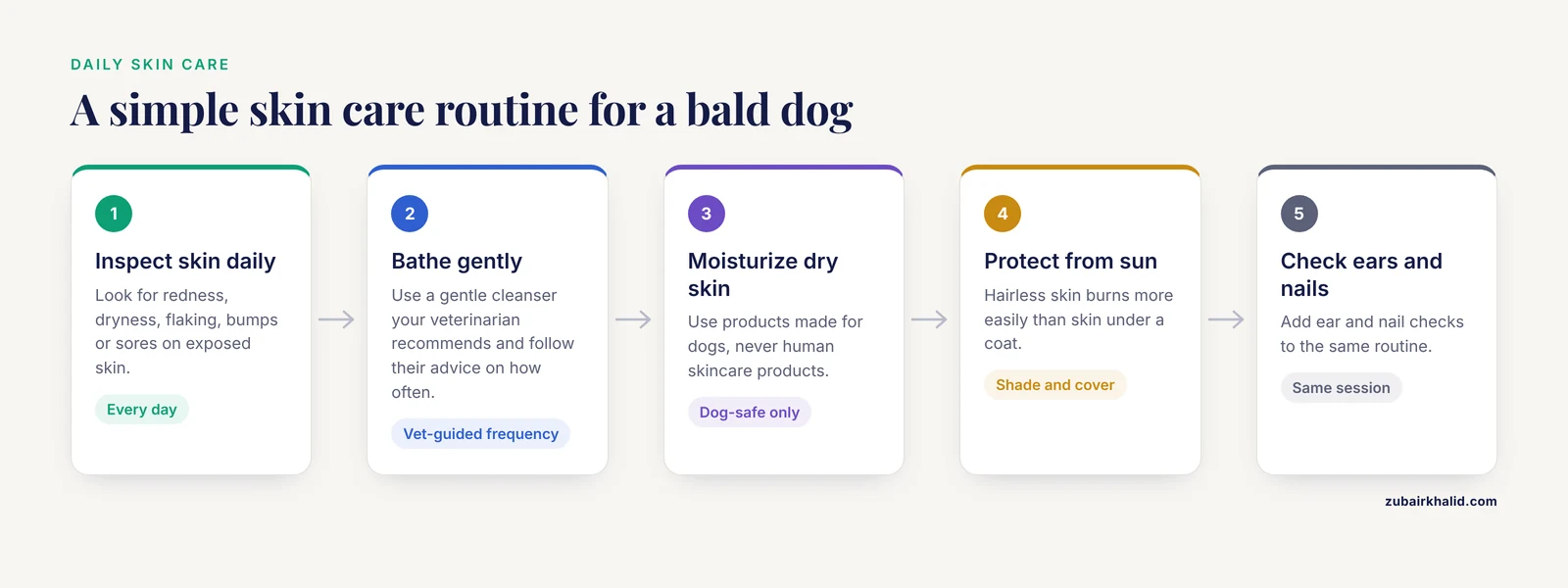
A basic skin care routine for a hairless dog includes regular inspection, gentle cleansing, and moisturizing. The specific products and frequency depend on the individual dog, so discuss a routine with your veterinarian.
- Inspect the skin daily. Look for redness, dryness, flaking, bumps, or sores.
- Bathe with a gentle cleanser recommended by your veterinarian. Over-bathing can strip natural oils, so follow your veterinarian's guidance on frequency.
- Moisturize if the skin is dry. Use products formulated for dogs, not human skincare products.
- Protect the skin from excessive sun exposure. Hairless skin can burn more easily than skin protected by a coat.
- Monitor for changes. Because the skin is exposed, problems are visible early, which allows prompt intervention.
- Check the ears and nails during skin inspections. Routine ear and nail care is part of overall health for any dog.
Every hairless dog is an individual. Some have naturally oily skin, while others are prone to dryness. Learning what is normal for your dog takes time and observation. Keep a mental note of what the skin looks like on a good day, so you can recognize changes early.
Common Mistakes and Troubleshooting
The most common mistakes owners make with hairless dogs stem from treating them like coated dogs or, conversely, ignoring their skin entirely. A hairless dog still needs grooming, but the grooming is skin care rather than coat care. Harsh products, human skincare products, and over-bathing can all irritate exposed skin.
If your dog develops dry, flaky skin, review the bathing routine first. Too-frequent bathing or harsh products can strip the skin's natural oils. If the skin is red, itchy, or sore, stop any new product and contact your veterinarian. Hairless skin can heal well when given proper care, but irritation can progress quickly on exposed skin.
Seasonal changes can affect hairless skin. In dry winter months, the skin may become flakier. In humid summer months, the skin may be more prone to irritation. Adjust the care routine as needed and consult your veterinarian if problems persist.
Living with an American Hairless Terrier
Daily Care
Daily care for an American Hairless Terrier centers on the skin. Because the breed is entirely bald [1], the skin is the primary organ that needs attention. A daily once-over of the skin, a quick check of the ears and nails, and a consistent routine for bathing and moisturizing will keep most hairless dogs comfortable.
The environment also matters. A hairless dog has no insulation from cold and no protection from sun [1]. Owners should consider how temperature and weather affect their dog and make adjustments accordingly. This might mean a sweater in cold weather, shade and limited sun exposure in warm weather, and always having a comfortable resting area indoors.
Exercise needs vary by individual dog. A daily walk, play sessions, and opportunities to explore safely are appropriate for most terriers. Because the breed has no coat, outdoor activity should be planned with temperature and sun exposure in mind. Consider the surface temperature of the ground and the weather conditions before outdoor time. A dog with no coat [1] is more exposed to environmental temperatures than a coated dog.
Socialization is part of raising any dog, and the American Hairless Terrier is no different. Early, positive experiences with people, other dogs, and new environments help shape a well-adjusted adult. Discuss training and socialization plans with your veterinarian or a qualified trainer.
Routine Veterinary Care
Every dog benefits from regular veterinary checkups, and hairless dogs are no exception. The skin should be part of every wellness examination. If you notice any change in your dog's skin, from a small bump to a patch of redness, have it checked promptly. Early attention prevents minor issues from becoming major ones.
Temperament and Behavior
The American Hairless Terrier is a terrier breed, and the breed name reflects its terrier heritage. The scientific literature on this breed focuses on genetics and skin biology rather than behavior. Individual dogs vary widely in temperament, so prospective owners should spend time with the specific dog they plan to bring home and discuss behavioral expectations with their breeder.
Breeding and Inheritance
Understanding Recessive Inheritance
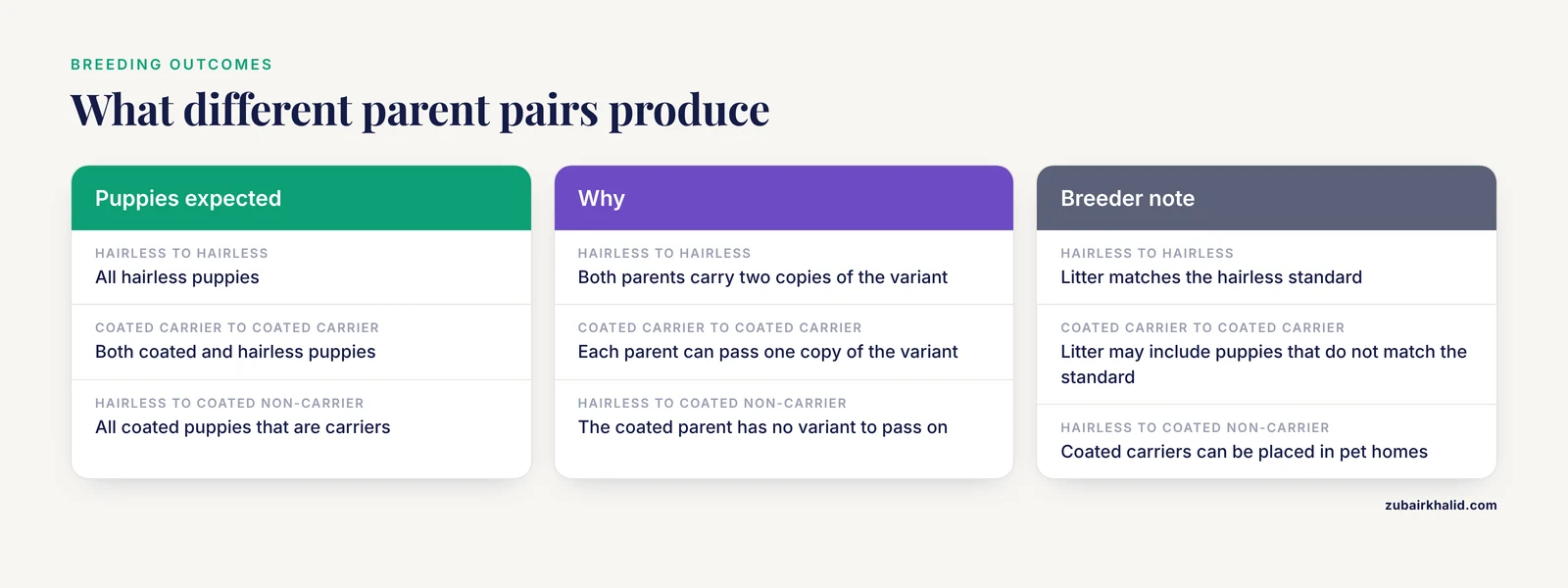
Breeding American Hairless Terriers requires a solid understanding of the recessive inheritance of hairlessness [2]. Because the trait is recessive, a hairless dog has two copies of the variant. A coated dog may carry one copy and pass it to offspring.
The inheritance pattern means that:
- Two hairless parents produce all hairless puppies.
- Two coated carriers can produce both coated and hairless puppies.
- A hairless dog bred to a coated non-carrier produces all coated puppies that are carriers.
The Scottish Deerhound family studied by Parker and colleagues illustrates the second scenario, where coated parents produced hairless offspring [1].
Responsible breeding goes beyond understanding the genetics of the coat. Breeders should also consider the health and temperament of both parents, and they should be prepared to place both coated and hairless puppies in appropriate homes. Because the recessive gene can produce coated carriers, a litter may include puppies that do not match the hairless breed standard [2][1]. Breeders should also document the outcomes of their litters. Knowing which puppies are hairless, which are coated carriers, and which are coated non-carriers helps build a clearer picture of the genetics at work in a particular bloodline [2].
Genetic Testing
The gene responsible for hairlessness in the American Hairless Terrier has been identified [3], which opens the door to targeted genetic testing. Breeders who understand the genetic status of their dogs can make informed breeding decisions and predict the likelihood of hairless puppies in a litter.
The American Hairless Terrier in Research
Hairless dogs have a long history of use in dermatological research. Studies on hairless descendants of Mexican hairless dogs have demonstrated their value in dermatological science [6]. The exposed skin of hairless dogs allows researchers to study skin development, wound healing, and skin diseases without the confounding effects of a hair coat.
The American Hairless Terrier, as an entirely bald breed [1], is part of this research tradition. The discovery of a gene associated with hairlessness in the breed [3] adds to the understanding of how hair follicles develop and why they fail to form in some dogs. This knowledge has implications beyond dog breeding, because hair follicle biology is relevant to human dermatology as well.
Limitations and When to Contact a Veterinarian
This article is educational and is not a substitute for veterinary diagnosis or treatment. Individual cases need a veterinarian. Contact a veterinarian promptly if your American Hairless Terrier shows any of the following:
- Skin redness, rash, itching, or sores that do not resolve with routine care
- Hair loss or patchy coat in a coated American Hairless Terrier
- Rapid weight gain or loss, especially in a puppy
- Changes in appetite, thirst, energy, or behavior
- Lameness or difficulty moving
- Any sign of pain or discomfort
Because hairless dogs have exposed skin, minor irritations can become serious quickly. Early veterinary attention is always better than waiting.
Nutrition and Feeding for American Hairless Terriers
American Hairless Terriers are active terriers, but their energy needs change with age, activity, and season. Feed a complete and balanced commercial diet that carries an AAFCO statement for the dog's life stage, or a home-prepared diet formulated with a veterinarian or board-certified veterinary nutritionist. Hairlessness does not change core nutrient requirements, but exposed skin makes good nutrition part of skin care.
Life-Stage Feeding
Puppies need a growth diet until they reach adult size. Growth is not uniform in this breed. One documented American Hairless Terrier puppy grew unusually rapidly and reached a large adult stature [4], so weigh puppies regularly and review the growth curve with a veterinarian. Adults need maintenance nutrition. Seniors may need a senior formula or adjusted portions if activity declines or body condition changes. Transition foods gradually over several days to avoid digestive upset.
Portion Control and Obesity Risk
Measure portions with a scale or measuring cup rather than free feeding. Use the label as a starting point, then adjust according to body condition score, not appetite alone. Keep treats small and count them in the daily total. Obesity is easy to underestimate in a hairless dog because there is no coat to hide body shape, but extra weight still stresses joints and increases disease risk. Regular weigh-ins and hands-on rib checks help catch gradual gain.
Skin-Supportive Nutrients
A balanced diet supplies protein for skin repair, essential fatty acids for the skin barrier, and adequate zinc, vitamin A, and vitamin E. Deficiencies are more likely with unbalanced homemade diets than with reputable commercial foods. Supplements do not replace a complete diet. Discuss oils, vitamins, or mineral supplements with a veterinarian before adding them.
Appetite Changes
Appetite can shift with seasonal changes, stress, food changes, dental pain, gastrointestinal disease, or systemic illness. Consult a veterinarian for weight loss, persistent picky eating, vomiting, diarrhea, or other gastrointestinal signs rather than guessing or repeatedly changing diets. Do not withhold food as a weight-loss strategy without veterinary guidance. For a dog that is eating less, keep a simple record of intake and body weight so the veterinarian has useful information. Offer meals at consistent times and remove uneaten food after a reasonable period.
Exercise, Temperature, and Outdoor Safety
The American Hairless Terrier is energetic and needs daily exercise, but its complete lack of coat [1] changes how exercise is planned. Most adults do well with 30 to 60 minutes of activity daily, split between walks, play, and secure off-lead running. Puppies need shorter, more frequent sessions to protect developing joints. Mental enrichment is part of exercise. Puzzle feeders, nose work, and hide-and-seek tire a terrier's mind and reduce problem behaviors.
Sun Protection
Hairless skin has no fur to block ultraviolet radiation. Sunburn can affect the back, ears, and nose. Apply dog-safe broad-spectrum sunscreen 15 to 30 minutes before outdoor time and reapply as directed. Avoid human sunscreens containing zinc oxide or para-aminobenzoic acid, which can be toxic if licked. Provide shade, use protective clothing, and limit outdoor time between late morning and mid-afternoon.
Cold Weather
Without a coat, the breed loses body heat quickly. A dog-safe sweater or jacket is needed below about 10°C (50°F), and some dogs need one at higher temperatures. Limit time outdoors in cold, wind, or rain. Watch for shivering, lifting paws, or reluctance to move, and bring the dog inside promptly. Frostbite can affect the ears, tail tip, and paw pads before it is obvious.
Hot Surfaces and Heat Stress
Pavement, asphalt, sand, and artificial turf can burn paw pads even when air temperature feels moderate. Use the back-of-hand test: if a surface is too hot to hold for five seconds, it is too hot for the dog's paws. Walk on grass or dirt, exercise in early morning or evening, and carry water. Signs of heat stress include excessive panting, drooling, lethargy, vomiting, and collapse.
Acclimation and Supervision
Introduce the dog to new temperatures gradually. Indoor dogs cannot safely spend long periods in heat or cold without adjustment. Never leave a hairless dog outdoors unattended. Indoor time with supervised outdoor breaks is the safest pattern.
When to Contact a Veterinarian
Seek immediate veterinary care for heat stress, hypothermia, or burns. For heat stress, move the dog to a cool area, offer small amounts of water, and wet the paws and belly with cool, not cold, water. For cold injury, warm the dog slowly with blankets and avoid direct heat. For burns, cool the area with water and cover it with a clean cloth. Do not apply ointments or home remedies. A veterinarian should evaluate any burn, even a minor one, because hairless skin can hide deeper damage.
Training, Socialization, and Enrichment
The American Hairless Terrier responds best to training methods based on positive reinforcement. Reward-based training, where desired behaviors earn treats, praise, or play, builds reliability without suppressing the terrier's natural confidence. Harsh corrections are counterproductive with this breed and can create fear or defensive behavior.
Positive-Reinforcement Training
Keep training sessions short and consistent. Five to ten minutes, two or three times daily, works better than long, repetitive drills. Use high-value rewards for difficult behaviors and lower-value rewards for known cues. Teach impulse control early, such as waiting at doors and settling on a mat, because terriers are quick to act on their own judgment.
Early Socialization
Early socialization is essential. Expose the puppy to a wide range of people, surfaces, sounds, and well-mannered dogs during the first months of life. The goal is neutral, calm responses rather than forced interaction. Puppy classes that use positive methods provide a structured setting for this exposure. Continue social experiences throughout adulthood, because terriers can become selective with unfamiliar dogs if their social skills are not maintained.
Terrier-Specific Challenges
The breed carries the typical terrier traits of prey drive and stubbornness. Small animals that run, such as squirrels and cats, can trigger chasing behavior, so a secure yard and a well-fitted harness or leash are practical safeguards. Stubbornness shows up as selective hearing when the dog is focused on something more interesting than the handler. This is not defiance; it is a terrier's instinct to work independently. Manage it by making training rewarding enough to compete with distractions, and by practicing recall with a long line in safe areas before relying on it off leash.
Enrichment and Mental Stimulation
Mental stimulation is as important as physical exercise. Puzzle toys that dispense food, nose work games that ask the dog to find hidden treats, and structured routines that give the dog a predictable job all help channel terrier energy into acceptable outlets. A dog that is mentally occupied is less likely to develop repetitive behaviors or excessive barking.
When to Seek Professional Help
If the dog shows aggression toward people or animals, persistent fear, or compulsive behaviors such as tail chasing or constant licking, consult a veterinarian or certified trainer. These signs can indicate an underlying medical issue or a behavior problem that needs individualized assessment. Early professional guidance is more effective than waiting for the behavior to become entrenched.
Preventive Health Care and Parasite Protection
Core Wellness Visits
 Schedule a wellness examination at least once yearly for healthy adults, and more often for puppies, seniors, or dogs with ongoing skin or ear issues. The visit should include weight and body condition, a full skin check, ear and nail assessment, dental evaluation, vaccination review, and parasite screening. For puppies, monitor growth because one documented American Hairless Terrier showed unusually rapid growth and large adult stature [4]. Ask the veterinarian to show you how to check gums, paw pads, and nail length at home. Keep a simple log of weight, appetite, and skin changes so trends are easier to discuss at the next appointment. Bring a list of home observations, especially new lumps, redness, or scratching.
Vaccination and Parasite Prevention
Vaccination schedules depend on age, previous vaccines, lifestyle, and local disease risk. Follow your veterinarian's plan rather than a fixed internet schedule. Core vaccines and any optional vaccines should be timed and repeated as directed. Parasite control covers fleas, ticks, heartworm, and intestinal worms. Hairless dogs are not exempt from external parasites, and a lack of coat does not prevent infestation. Use veterinarian-approved products and testing schedules; do not guess doses or share products between pets. Fecal checks and heartworm testing should follow clinic guidance. Home remedies are not a substitute for proven prevention.
Dental, Nail, and Ear Maintenance
Brush teeth regularly with dog-safe toothpaste, and ask the clinic about professional dental cleaning when needed. Dental disease can progress silently, so home brushing and clinic checks work together. Trim nails every few weeks, including dewclaws, and learn to avoid the quick. Check ears during handling, but clean only with veterinary direction and never push cotton swabs deep into the canal. Do not use cotton buds or unknown drops, because they can pack debris or irritate the canal. Persistent head shaking, discharge, odor, or ear pain needs veterinary examination.
Skin Inspection Between Visits
The breed has no coat to shield the skin, so inspect the body regularly for lumps, bumps, sores, redness, discharge, odor, or areas of sun damage. Hairless skin is exposed to sun and minor trauma, and small problems are easier to manage when found early. Use shade and sun protection according to veterinary advice. If skin or ear problems persist after routine care, book a veterinary visit rather than repeating over-the-counter products.
Related Guides
- Boston Terrier Dog Breed Guide: Temperament, Size, Lifespan, Health Problems and Care: Boston Terrier guide helps compare temperament and care with another companion terrier
- Staffordshire Bull Terrier Dog Breed Guide: Temperament, Size, Lifespan, Health Problems and Care: Staffordshire Bull Terrier guide provides insight into terrier group characteristics and needs
- Jack Russell Terrier Dog Breed Guide: Temperament, Size, Lifespan, Health Problems and Care: Jack Russell Terrier guide illustrates typical terrier energy and training requirements
- Soft Coated Wheaten Terrier Dog Breed Guide: Temperament, Size, Lifespan, Health Problems and Care: Soft Coated Wheaten Terrier guide contrasts a coated terrier with the hairless breed
- Bull Terrier Dog Breed Guide: Temperament, Size, Lifespan, Health Problems and Care: Bull Terrier guide useful for understanding terrier temperament and breed-specific health
- West Highland White Terrier Dog Breed Guide: Temperament, Size, Lifespan, Health Problems and Care: West Highland White Terrier guide offers another terrier breed perspective for comparison
- Airedale Terrier Dog Breed Guide: Temperament, Size, Lifespan, Health Problems and Care: Airedale Terrier guide covers the largest terrier breed, useful for breed comparisons
- Norwich Terrier: Breed Traits and Health Problems: Norwich Terrier guide provides terrier breed traits and health considerations for owners
Frequently Asked Questions
Are American Hairless Terriers completely hairless?
Yes. The American Hairless Terrier is entirely bald, unlike breeds such as the Xoloitzcuintli that have sparse hair on their extremities [1].
What causes hairlessness in American Hairless Terriers?
A recessive gene causes hairlessness in the breed [2], and researchers have identified a new gene associated with the absence of coat in American Hairless Terriers [3].
Can two coated dogs produce a hairless puppy?
Yes. This is consistent with recessive inheritance. In a Scottish Deerhound family, coated parents produced a mixed litter of coated and hairless offspring [1].
Do American Hairless Terriers need special skin care?
Yes. Hairless dogs require dedicated skin care, and the principles for caring for hairless breeds emphasize regular attention to skin health [5].
How large do American Hairless Terriers get?
Size varies. One documented American Hairless Terrier puppy showed unusually rapid growth and reached a large adult stature [4].
Is hairlessness caused by the same gene in all hairless dog breeds?
No. Different genes cause hairlessness in different breeds. The gene identified in Scottish Deerhounds [1] is distinct from the gene associated with hairlessness in American Hairless Terriers [3].
Why are hairless dogs used in dermatological research?
Hairless dogs, including descendants of Mexican hairless dogs, are useful in dermatological science because their exposed skin allows direct study of skin biology [6].
What is the difference between an American Hairless Terrier and a Xoloitzcuintli?
The American Hairless Terrier is entirely bald, while the Xoloitzcuintli standard requires only sparse hair on the extremities [1].
Sources
- Whole Genome Analysis of a Single Scottish Deerhound Dog Family Provides Independent Corroboration That a SGK3 Coding Variant Leads to Hairlessness.
- American hairless terriers: a recessive gene causing hairlessness in dogs.
- The bald and the beautiful: hairlessness in domestic dog breeds.
- Unusually rapid growth and adult stature in an American hairless terrier puppy.
- Care and breeding of the Mexican hairless dog.
- Studies on development of hairless descendants of Mexican hairless dogs and their usefulness in dermatological science.