Silvervine for Cats: Effects, Safety, and Enrichment
By Dr. Zubair Khalid, DVM, MS, PhD ·
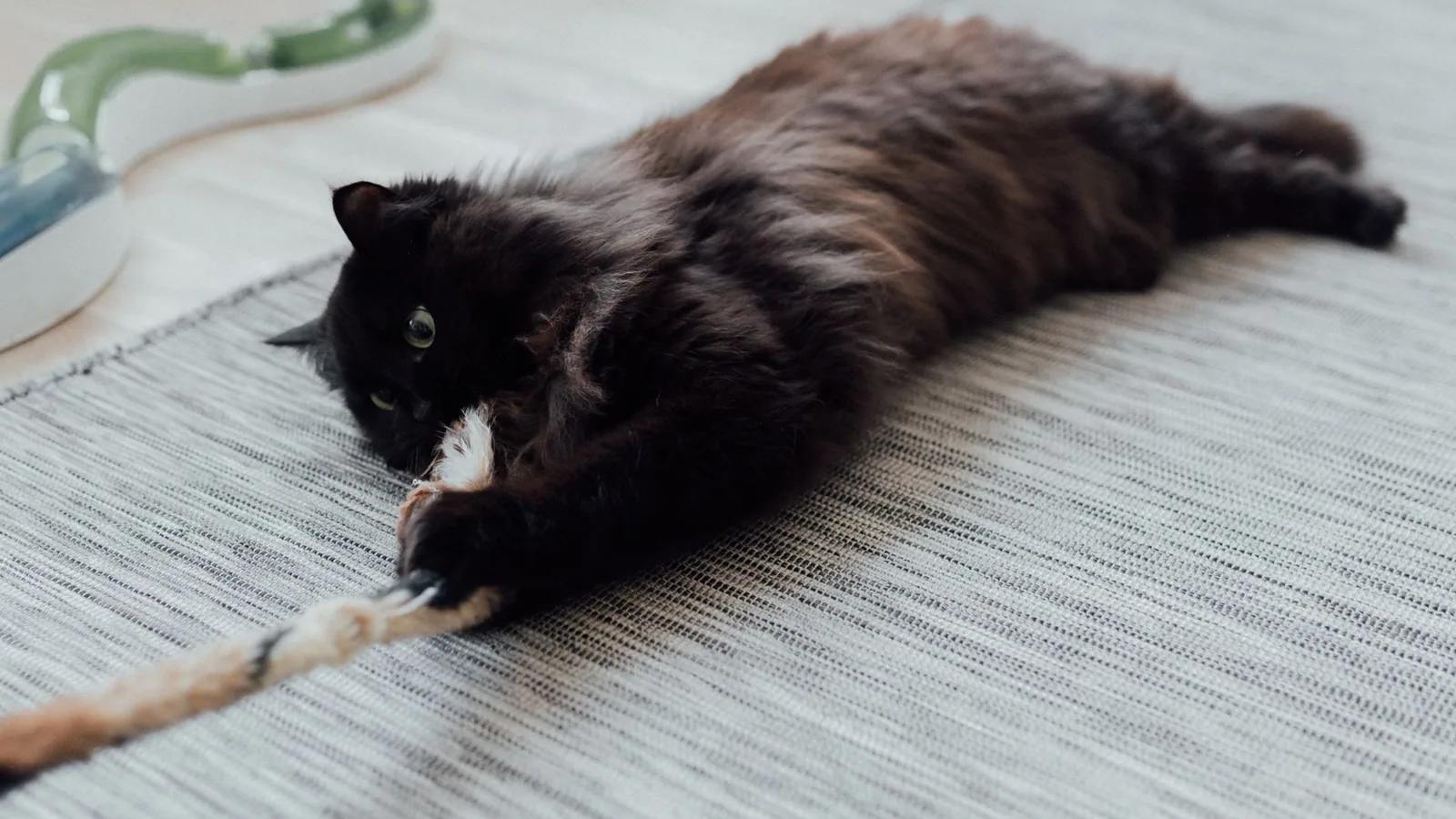
Silvervine is the dried leaf of Actinidia polygama, a climbing vine in the kiwi family, and it triggers the same rolling, rubbing, and licking reaction that most people know from catnip. It also works on a larger share of the cat population. In a study that offered four cat-attracting plants to 100 domestic cats, almost 80% responded to silver vine, while roughly one in three cats ignored catnip entirely [1]. Cats that do nothing for catnip often light up for silver vine.
The reaction is not a random quirk. It is a self-anointing behavior tied to the cat's opioid system, and it appears to serve a practical purpose: moving plant compounds onto the fur and face that repel mosquitoes [2]. Controlled safety work has found no signs of addictive behavior, no increase in blood markers of stress, and no evidence of liver or kidney injury in cats exposed continuously to silver vine [3]. For most cats, it is a low-risk, high-value form of olfactory enrichment.
This article is educational and is not a substitute for veterinary diagnosis or treatment.
At a Glance
| Question | Short answer |
|---|---|
| What is silvervine? | Dried leaves, powder, or extract of Actinidia polygama, known in Japan as matatabi |
| How many cats respond? | About 80% of domestic cats in a 100-cat trial, compared with roughly two-thirds for catnip [1] |
| What will I see? | Sniffing, licking, chewing, chin and cheek rubbing, head rubbing, body rolling, then a gradual return to normal |
| How long does it last? | Response length varies widely between cats, and each cat tends to behave the same way across different plants [4] |
| Which form works best? | Dried leaf, because drying shifts the iridoid profile and strengthens the response [3] |
| Is it safe? | Continuous exposure produced no dependence, no stress marker increase, and no liver or kidney injury [3] |
| How often can I offer it? | Daily access is reasonable. Continuous exposure has not been linked to dependence [3] |
| When should I skip it? | When a cat shows fear, hissing, or avoidance instead of interest, or when a veterinarian has already advised against plant material |
What Silvervine Actually Is
Actinidia polygama is a deciduous vine native to Japan, Korea, and parts of China. Its leaves, and the fleshy galls that form on the plant, produce a family of compounds called iridoids. Japanese chemists isolated and structurally characterized the biologically active components of the plant in the 1960s [5], and pharmacological studies of those components followed [6]. That early work established silver vine as a plant with measurable chemistry rather than a folk curiosity.
The two iridoids that matter most for feline behavior are nepetalactol and actinidine. Nepetalactol is the major compound in silver vine that produces the classic rubbing and rolling response [2]. Actinidine is a structurally distinct molecule that also drives the behavior, and its concentration varies between plant sources [4][7]. This matters for owners because two bags of silver vine are not interchangeable. They can differ in which compounds they contain and how much of each is present.
Why Cats Respond to Silvervine
The iridoid cocktail
Cats are not reacting to a single smell. They are reacting to a blend. When researchers tested five plants and thirteen single compounds on cats in a low-stress setting, roughly half a dozen lactones with a structure similar to nepetalactone could trigger the response, and so could structurally more distant molecules such as actinidine [4]. The plant is a chemical mixture, and different components can reach the same behavioral endpoint.
The opioid pathway
The mechanism is better understood than it was a decade ago. Nepetalactol raises plasma beta-endorphin levels in cats, and blocking mu-opioid receptors with a drug suppresses the rubbing response [2]. That is direct evidence that the reaction runs through the body's own opioid system rather than through simple scent interest. It also explains why the behavior looks involuntary. The cat is not deciding to roll. The cat is responding to a neurochemical signal.
The mosquito connection
The behavior has a payoff. Rubbing transfers nepetalactol onto the cat's face and head, where it repels Aedes albopictus mosquitoes [2]. Licking and chewing add to the effect. When cats bite and tear silver vine leaves, the damage substantially increases iridoid emission and diversifies the iridoid mixture, and that more complex cocktail repels mosquitoes at lower concentrations than the individual compounds do [8]. Cats appear to be finely tuned to plant-specific iridoid production for maximizing the protection they gain [8]. Self-anointing is chemical pest defense, and silver vine is one of its raw materials.
Why some cats respond and others do not
Responsiveness is individual. Some cats respond strongly from the first exposure. Others show nothing for years. The difference has a neurological basis. In an early experiment, cats that showed no visible silver vine response began responding after a unilateral lesion was made in the amygdala, while cats that already responded showed no change [9]. The authors concluded that the amygdala, a structure involved in sexual and emotional behavior, influences whether the response appears at all [9]. That finding does not give owners a way to predict which cat will respond. It does explain why a non-responder is not broken and why forcing the issue is pointless.
What the Response Looks Like
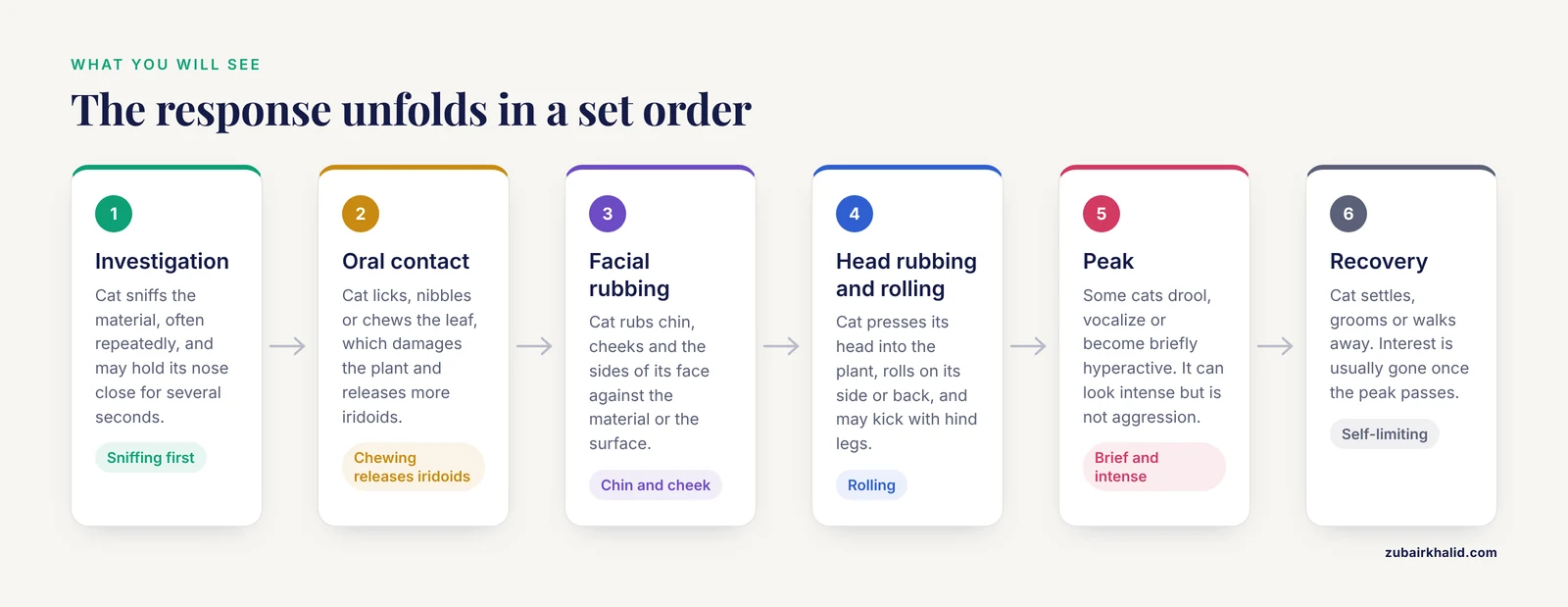
The reaction unfolds in a recognizable sequence. Not every cat performs every step, and the order can shift.
- Investigation. The cat sniffs the material, often repeatedly, and may hold the nose close to it for several seconds.
- Oral contact. The cat licks, nibbles, or chews the leaf. This is not incidental. Chewing damages the plant and releases more iridoids [8].
- Facial rubbing. The cat rubs its chin, cheeks, and the sides of its face against the material or the surface it sits on.
- Head rubbing and rolling. The cat presses its head into the plant, rolls on its side or back, and may kick with the hind legs.
- Peak. Some cats drool, vocalize, or become briefly hyperactive. The behavior can look intense, but it is not aggression.
- Recovery. The cat settles, grooms, or walks away. Interest is usually gone once the peak passes.
The intensity is not fixed across cats. In a video-based study of six cats, both the duration of the response and the specific behaviors differed significantly between individuals, yet each cat's behavior stayed consistent across all the plants tested [4]. A cat that rolls hard on catnip will usually roll hard on silver vine. A cat that gives a polite chin rub will do the same. Individual cats also showed preferences for particular plants [4], so a cat can be a strong responder in general and still favor one source over another.
Silvervine Compared With Catnip
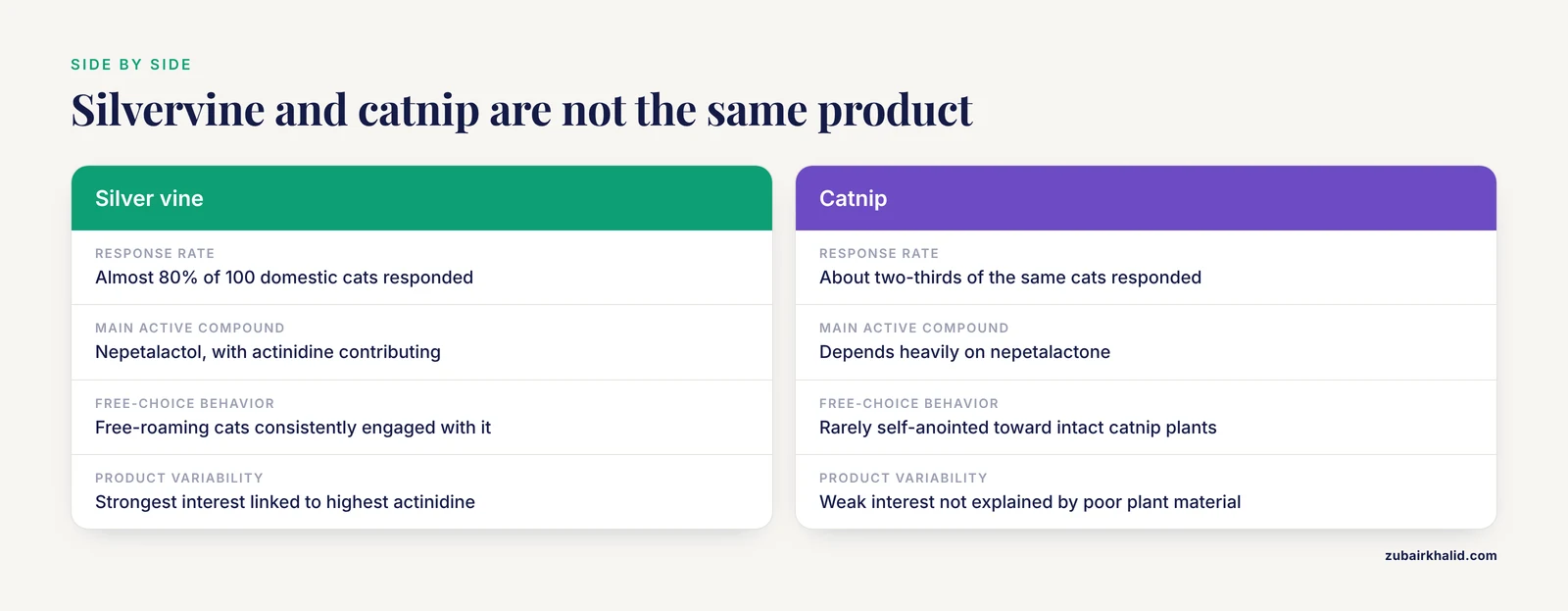
Catnip (Nepeta cataria) and silver vine both work through iridoids, but they are not the same product.
- Response rate. Silver vine reaches more cats. Almost 80% of the 100 domestic cats tested responded to silver vine, compared with about two-thirds for catnip [1].
- Active chemistry. Catnip depends heavily on nepetalactone, while silver vine's response is driven largely by nepetalactol, with actinidine contributing [2][4].
- Free-choice behavior. When free-roaming cats were given intact plants to approach or ignore, they rarely self-anointed toward catnip but consistently engaged with silver vine. The same bias appeared in captive cats offered plant extracts side by side, and chemical analysis confirmed the catnip contained abundant nepetalactone, so weak interest was not explained by poor-quality plant material [10]. Laboratory potency does not guarantee that a cat will choose the plant in a real environment.
- Product variability. In a controlled test of four commercial plant products with twelve feral cats, the amount of time cats spent interacting differed significantly between products, and the silver vine material that drew the strongest interest had the highest actinidine concentration, while nepetalactone, isodihydronepetalactone and its isomers, and iridomyrmecin were present in all silver vine samples [7].
The practical takeaway is simple. If your cat ignores catnip, silver vine is the logical next trial, and it is the better first choice for many cats.
Safety: What the Evidence Shows
Dependence and addiction
Silver vine does not produce dependence. Cats exposed continuously to silver vine showed no hallmarks of addictive behavior [3]. The response is self-limiting. Cats satiate and walk away, which is the opposite of a compulsion to seek more.
Stress, liver, and kidney markers
Blood indicators of stress showed no increase in cats stimulated with silver vine, and markers of hepatic or renal injury did not rise either [3]. That is reassuring for the organs owners worry about most when a cat eats plant material. The study is a controlled laboratory assessment rather than a decade-long field survey, so it does not answer every question about a cat with pre-existing disease. It does mean that the common worry about silver vine damaging a healthy cat's liver or kidneys is not supported by the available data.
Physical safety in practice
Chewing and licking are normal parts of the response and are part of how the plant works, since feline leaf damage releases more of the active iridoids [8]. Offer material the cat can tear easily, such as dried leaf, rather than hard stems. Replace material that has been thoroughly shredded, drooled on, or tracked through the litter box. Wash your hands after handling used material, and keep the supply in a closed container away from moisture.
The enrichment benefit
Olfactory stimulation is an underused form of environmental enrichment for cats in captivity, and the plants in this group are the best-known examples [1]. For an indoor cat with a predictable environment, a plant that reliably triggers rolling, rubbing, and chewing is a genuine outlet for species-typical behavior. The mosquito-repellent benefit is a bonus rather than the reason to offer it.
Choosing Silvervine: Selection Criteria
Form. Dried leaf is the best-supported option. Drying the leaves changes the iridoid profile and enhances the feline response, which is why dried silver vine leaves are the most suitable resource for enrichment that maximizes the typical reaction [3]. Powder is convenient to sprinkle on a toy or scratch pad but loses aroma faster. Extracts vary widely in composition.
Aroma. Good dried silver vine has a distinct, somewhat green and woody smell. Material that smells flat or dusty is unlikely to do much. Store it sealed and away from heat.
Composition. Products differ in iridoid content and in how much cats engage with them [7]. If the first product you try falls flat, try a different source before concluding your cat is a non-responder.
Additives. Choose plain plant material. Added dyes, perfumes, or essential oils are not part of the plant and are not needed.
Containers. Loose leaf can go into a cotton pouch, a cardboard box, or a shallow dish. Refillable toys with small openings work well for cats that like to work at things.
How to Use Silvervine: A Step-by-Step Plan
- Start small. Offer a teaspoon of dried leaf in a shallow dish on washable flooring or a wipeable mat. Rolling and drooling make a mess.
- Let the cat come to it. Place the material near the cat's resting area and step back. Pressure turns a novelty into a threat.
- Allow the full sequence. Do not interrupt sniffing, licking, or rolling. The behavior runs on its own timeline.
- Offer the plant material intact. Chewing is part of the response, and the damage a cat does to the leaf increases the release of active compounds [8].
- Leave it out until interest fades. Then remove the material, dispose of it, and wipe the surface.
- Vary the delivery. Loose leaf, a stuffed pouch, a sprinkle on a scratch pad, or a refillable toy all count. Novelty helps.
- Trial other plants if needed. Tatarian honeysuckle and valerian root each drew a response in about half of the domestic cats tested [1], and individual cats have plant preferences [4].
- Keep a simple log. Note the product, the form, and how your cat responded. Patterns emerge quickly, and the log prevents wasted purchases.
Troubleshooting Common Problems
| Problem | What to try |
|---|---|
| Cat ignores silver vine completely | Confirm the product still smells fresh, then try a different source. A true non-responder is possible, and the amygdala work suggests the trait is neurological [9] |
| Cat responded once, then lost interest | Offer less material, less often, and rotate with another plant such as Tatarian honeysuckle or valerian [1][4] |
| Cat eats the material instead of rolling | Some ingestion is normal during licking and chewing [8]. Offer smaller portions and finer leaf |
| Cat becomes agitated or hisses | End the session, remove the material, and do not repeat with that cat without veterinary advice |
| Cat reacts strongly to one product and not another | This is expected. Commercial products vary in composition and in how much cats engage with them [7] |
| Cat rolls on the carpet after the material is gone | Residual compound transfers to fur and surfaces. Wipe down hard surfaces and wash soft items |
Special Situations
Multi-cat homes. Offer separate piles in separate locations so one cat cannot monopolize the material. Cats that compete for resources may show more interest in the container than in the plant.
Cats that ignore catnip. This is the strongest reason to try silver vine. Nearly one in three cats does not respond to catnip, and almost 80% of cats responded to silver vine in the same trial [1].
Older cats. Aging cats often have reduced sensory input and less physical activity. Olfactory enrichment is low-effort and does not require jumping or chasing. Offer material at floor level near the cat's usual resting spot.
Kittens. Young cats are still developing their behavioral repertoire. If you plan to offer silver vine to a kitten, raise the question with your veterinarian first, particularly for kittens under a few months of age.
Big cats and sanctuaries. Silver vine is not a domestic-cat-only phenomenon. Nine tigers were tested alongside the domestic cats, and the response extends across felids [1]. Facilities that manage large cats can use the same enrichment principle.
Cats with chronic illness. A cat with liver or kidney disease is a different patient from the healthy cats in the safety study [3]. Ask your veterinarian before adding any new plant product. The same applies to cats taking medication.
Limitations and When to Contact a Veterinarian
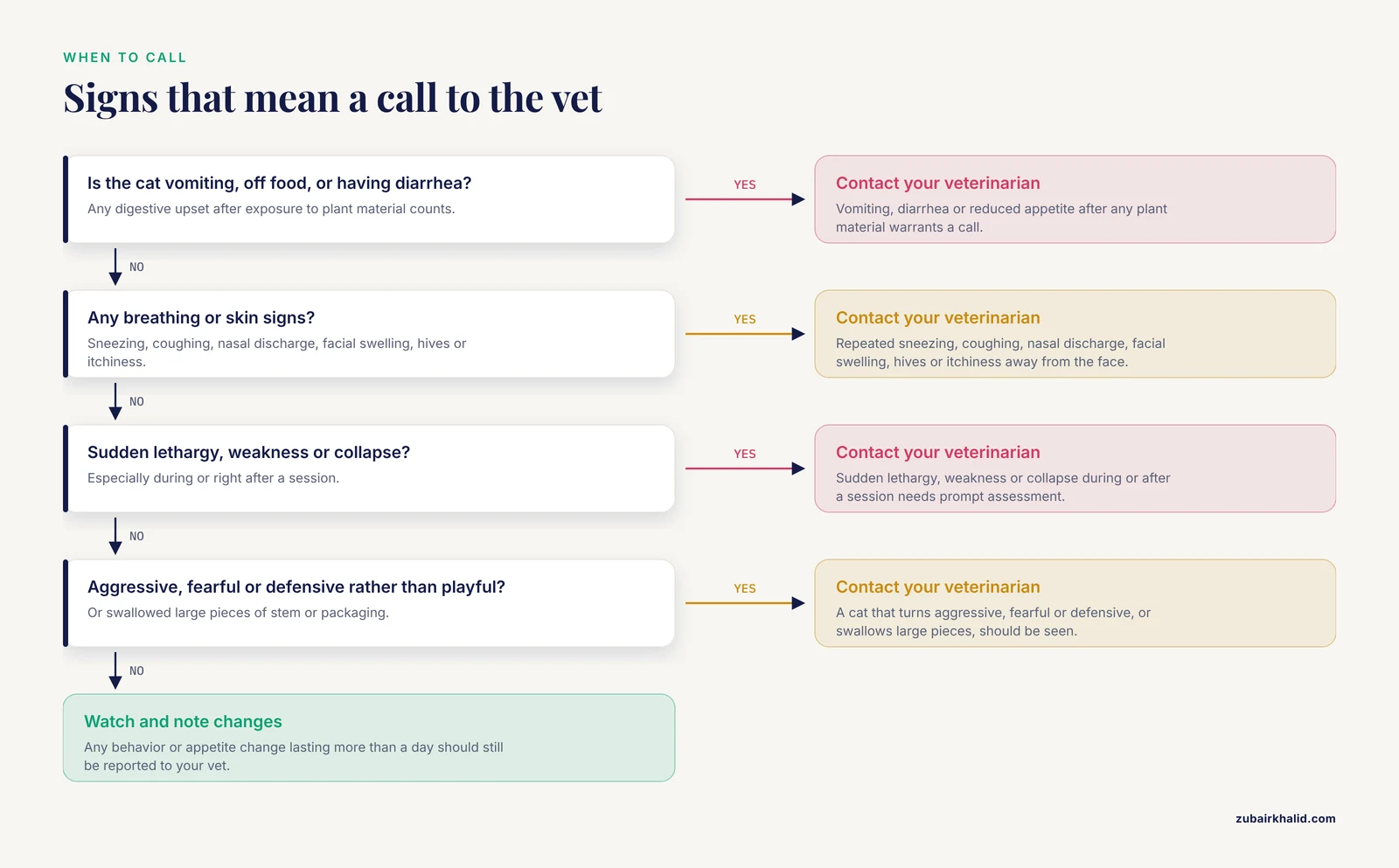
Silver vine research is encouraging, but it is not a complete safety dossier. The controlled work followed cats over a defined exposure period and measured specific blood markers [3]. It did not track thousands of cats for years, and it did not enroll cats with organ disease. Individual animals vary, and a plant that is well tolerated by most cats can still cause a problem in one.
Contact your veterinarian if any of the following occur:
- Vomiting, diarrhea, or reduced appetite after exposure to any plant material
- Repeated sneezing, coughing, or nasal discharge around the plant
- Facial swelling, hives, or itchiness away from the face
- Sudden lethargy, weakness, or collapse during or after a session
- A cat that becomes aggressive, fearful, or defensive rather than playful
- A cat that swallows large pieces of stem or product packaging
- Any change in behavior or appetite that persists for more than a day
A cat with a known plant allergy, a history of gastrointestinal obstruction, or a chronic organ disease should be evaluated before silver vine is introduced. For every other cat, the decision is usually one of preference. Some cats love it, some ignore it, and both are normal.
Growing Silvervine at Home: Identification, Harvesting, and Pesticide Risks
Owners can grow Actinidia polygama at home in temperate climates. It is a vigorous deciduous vine in the kiwi family, native to East Asia, and it needs a sturdy support, well-drained soil, and a position in sun or partial shade. The plant is dioecious, so both male and female vines are required for fruit, but leaves can be harvested from either. A single mature vine can produce more leaf material than most households will use.
Reliable plant identification matters because silvervine is not a common garden plant in many regions, and young vines resemble other Actinidia species. The leaves are variable in shape, and the fleshy galls that sometimes form on the leaf surface are not always present. If you cannot confirm the species from botanical references or a knowledgeable source, do not offer the material to your cat. Misidentification is the main risk of home cultivation.
Pesticide and fertilizer risks are the second major concern. Do not treat homegrown silvervine with pesticides, herbicides, or fertilizers that contain added chemicals. Systemic insecticides are taken up into the leaves and cannot be washed off. Even products labeled organic or natural can be harmful to cats. If the plant has been treated, or if it grew near a roadside or in soil of unknown contamination, the leaves should not be used.
Harvest leaves on a dry day, choosing healthy, mature leaves without spots or insect damage. Rinse them briefly in clean water to remove dust and surface insects, then pat them dry. Air dry in a single layer in a warm, dark, well-ventilated space until the leaves are crisp. Drying changes the iridoid profile and strengthens the feline response, which is why dried leaf is the preferred form [3]. Store the dried leaves whole in an airtight glass jar, away from light and moisture. Crush them only when offering to your cat, because crushing releases the aroma.
Do not use homegrown material if you have any doubt about the species, if the plant was treated with chemicals, if the leaves are moldy or discolored, or if the growing site may have been contaminated. For a cat with a chronic illness, ask your veterinarian before introducing any homegrown plant material.
Silvervine for Multi-Species Homes: Dogs, Children, and Other Pets
Silvervine is a cat enrichment product, not a household-wide botanical. The controlled safety data come from cats [3], and the rolling and rubbing reaction is a feline response to plant iridoids [2]. No established safe-use guidance exists for offering it to dogs, children, rabbits, guinea pigs, hamsters, birds, reptiles, or fish. Treat it as cat equipment that happens to be plant material.
Storage and household placement
- Keep dried leaf, powder, and filled pouches in a closed, labeled container behind a door or on a shelf that dogs and young children cannot reach. A locked cabinet is rarely necessary.
- Store it away from pet food and human food. Fine powder contaminates counters and bowls easily.
- Do not leave refillable cat toys where a dog can chew them. The toy, string, and packaging can cause more harm than the plant.
- Bag and bin used material. Do not leave drooled-on leaf in a cat bed, on the floor, or in a shared toy box.
Offering it safely
Supervise cat sessions. Give a small amount in a dish or on a mat used only for this purpose, then remove leftovers when the cat loses interest. Keep the material off shared furniture and away from toddlers who mouth objects. Do not let a child sprinkle powder or handle the container as a play activity.
Why other species are not targets
A dog may investigate and eat a scented pouch or scatter loose leaf, and a large amount of plant material can cause vomiting or diarrhea. Small mammals and birds have different digestive anatomy and should not be given plant material as a treat. Children can choke on leaf or inhale powder. None of these groups should receive silvervine as a reward, toy filling, or enrichment item.
If exposure happens
Call your veterinarian or a pet poison service if a dog or small pet eats silvervine, packaging, or a cat toy, particularly with vomiting, drooling, abdominal pain, lethargy, or choking. For a child, call a pediatric poison service or physician. For a cat, use the warning signs already listed in this article. Do not induce vomiting unless a veterinarian or poison service tells you to.
Silvervine as a Training and Veterinary-Care Tool: Limits and Safe Use
Silvervine is an enrichment tool, not a training aid or a sedative. It can support low-stress handling when used correctly, but it has clear limits.
What it can support
Carrier training is the most practical use. Place a small amount of dried leaf in the carrier several days before travel, while the cat is calm and free to leave. Pair the leaf with treats. The goal is to build a positive association with the carrier itself, not to lure the cat in at the moment of departure.
Nail trims and brief handling can be made easier by offering silvervine before the session, not during restraint. A cat that has just rolled and rubbed is often relaxed for a short window. That window is brief and varies between cats, so it is not a reliable substitute for cooperative handling.
A familiar silvervine toy can be brought to the clinic, but only if the cat already associates the scent with calm, safe contexts at home. Introducing it for the first time in the exam room adds novelty, which is not what a stressed cat needs.
What it cannot do
Silvervine does not reduce fear or pain. It triggers a neurochemical response through the opioid system [2], but that response is not a choice the cat makes, and it does not override a fearful emotional state.
It must not be used to mask fear or aggression. A hissing, retreating, or defensive cat is not a candidate for olfactory enrichment. Offering the plant in that state can deepen the cat's distress and create a lasting negative association with the scent.
It should not be used as a lure into a carrier or crate right before a stressful event. A cat that is coaxed in with silvervine and then trapped or transported may learn to avoid both the carrier and the scent.
Pairing with positive reinforcement
The correct sequence is calm behavior first, then silvervine as a reward. During carrier training, wait until the cat voluntarily steps inside, then drop a small amount of leaf on the floor. During handling, reward calm acceptance of touch with silvervine afterward. This keeps the plant on the reward side of the equation.
Veterinary guidance
If a cat shows persistent fear or aggression during handling, silvervine is not the answer. A veterinarian or veterinary behaviorist should assess the cat first. For cats with chronic illness, the available safety data come from healthy adults [3], so veterinary clearance is needed before introducing any new plant product.
Related Guides
- Indoor Enrichment Activities for Dogs and Cats: Offers broader enrichment ideas for households with multiple pets
- Is Catnip Essential Oil Toxic to Cats? Safety: Explains risks of essential oil products, relevant to avoiding additives
- Can Cats Eat Catnip? Nepetalactone and Safe Use Guide: Answers common questions about ingesting catnip versus silvervine
- Is Too Much Catnip Harmful to Cats? Overdose Signs: Discusses overdose concerns that also apply to silvervine quantities
- Is Catnip Harmful to Pregnant Cats? Vet Answer: Addresses safety in special populations, similar to silvervine precautions
- Is Catnip Harmful to Dogs? Safety, Effects, and What to Do: Useful for multi-species homes considering plant sharing
Frequently Asked Questions
Is silvervine safe for cats?
Yes for most healthy cats, based on controlled safety testing. Continuous exposure produced no signs of dependence, no increase in stress markers, and no evidence of liver or kidney injury [3]. A cat with an existing illness should be cleared by a veterinarian first.
How is silvervine different from catnip?
They are different plants with different active compounds. Silver vine works largely through nepetalactol, while catnip depends on nepetalactone [2]. Silver vine also reaches more cats, with almost 80% of test cats responding compared with about two-thirds for catnip [1].
How often can I give my cat silvervine?
Daily access is reasonable. Continuous exposure in a controlled study did not produce addictive behavior [3]. Offer it as part of a rotating enrichment schedule rather than leaving the same material out indefinitely.
Why does my cat ignore silvervine?
Some cats simply do not have the response. The trait appears to have a neurological basis involving the amygdala, and cats that show no response can differ from strong responders at that level [9]. Check that your product still has a fresh aroma, then try a different source before giving up.
Can kittens have silvervine?
Ask your veterinarian first. The published safety work was done in adult cats [3], and kittens are not simply small adults. Older kittens with a fully developed behavioral repertoire are a more reasonable starting point than very young ones.
Does silvervine make cats high or addicted?
Cats show a euphoric-looking response, but they do not become addicted. The behavior runs through the body's opioid system [2], and it is self-limiting. Cats walk away when they are done, and continuous exposure did not produce hallmarks of addictive behavior [3].
Does silvervine work on big cats too?
Yes. Silver vine was tested on tigers as well as domestic cats, and the response occurs across felids [1]. Sanctuaries and zoos use the same plants for behavioral enrichment.
What is the best form of silvervine to buy?
Dried leaf. Drying the leaves changes the iridoid profile and enhances the feline response, making dried silver vine leaves the most suitable form for enrichment [3]. Look for plain plant material with a fresh aroma and no added perfumes or dyes.
Sources
- Responsiveness of cats (Felidae) to silver vine (Actinidia polygama), Tatarian honeysuckle (Lonicera tatarica), valerian (Valeriana officinalis) and catnip (Nepeta cataria).
- The characteristic response of domestic cats to plant iridoids allows them to gain chemical defense against mosquitoes.
- Assessing the safety and suitability of using silver vine as an olfactory enrichment for cats.
- Behavioral differences among domestic cats in the response to cat-attracting plants and their volatile compounds reveal a potential distinct mechanism of action for actinidine.
- [[Matatabi (Actinidia polygama Miq.)--isolation and structure of its biologically active components].](https://pubmed.ncbi.nlm.nih.gov/5341300/)
- [[Matatabi (Actinidia polygama)--pharmacological studies on its components].](https://pubmed.ncbi.nlm.nih.gov/6068343/)
- Feral Cat Responses to Silver Vine: Implications for Feral Cat Management.
- Domestic cat damage to plant leaves containing iridoids enhances chemical repellency to pests.
- Effect of unilateral lesion of amygdala on unmanifested response to Matatabi (Actinidia polygama) in cats.
- Free-Roaming and Captive Cats Prefer Silver Vine to Catnip for Self-Anointing.