Most Intelligent Dog Breeds and What It Means
By Dr. Zubair Khalid, DVM, MS, PhD ·
The question of which dog breeds are the most intelligent is one of the most common questions veterinarians, trainers, and behaviorists hear from owners. The short answer is that dog intelligence is not a single quality but a set of distinct abilities, and breed rankings based on obedience or trainability tell only part of the story. Research shows that what owners perceive as intelligence in dogs often reflects physical capability, motivation, and breed-specific behavioral traits as much as actual learning ability [1]. Understanding how canine cognition is measured, and what the science actually shows about breed differences, can help owners choose a dog that fits their lifestyle and train their dog more effectively.
Popular lists of "smartest dog breeds" typically rank Border Collies, Poodles, German Shepherds, Golden Retrievers, and Labrador Retrievers at the top. These rankings are usually based on obedience trials and the speed with which a dog learns new commands. But the scientific picture is more nuanced. Studies that examine problem-solving, memory, cognitive control, and social cognition reveal that breeds excel in different domains, and that factors such as skull shape, body size, food motivation, and genetic background all influence how a dog performs on cognitive tests [2][3][4][5][6].
At a Glance
| Aspect of Intelligence | What Research Shows | Source |
|---|---|---|
| Trainability rankings | May reflect physical ability more than learning ability | [1] |
| Problem-solving | Brachycephalic breeds solve fewer problems but seek human help more | [2] |
| Food motivation | Labradors work harder for food than German Shepherds | [3] |
| Size and memory | No difference in spatial memory between large and small dogs | [4] |
| Genetics | Behavior traits in German Shepherds have genetic associations | [6] |
| Brain activity | Dogs show EEG signatures of cognitive control similar to humans | [7] |
| Aging | Cognitive decline varies by breed, task, and prior experience | [8] |
What Does Dog Intelligence Actually Mean?
When owners ask about the most intelligent dog breeds, they usually mean trainability: how quickly a dog learns commands and how reliably it obeys. This is the basis for most popular breed intelligence rankings. But canine cognition researchers distinguish between several types of intelligence:
- Trainability, or the ability to learn and follow human cues
- Problem-solving ability, or the capacity to figure out novel challenges independently
- Social intelligence, or the ability to read and respond to human social signals
- Memory, including spatial memory and recognition memory
These abilities are not the same thing. A dog that excels at one may be average at another. For example, a study comparing problem-solving performance in brachycephalic breeds (English and French bulldogs) and a mesocephalic breed (Mudi) found that the bulldogs were significantly less successful at opening boxes containing food rewards, but they oriented much more toward humans during the task [2]. The researchers interpreted this as evidence that brachycephalic breeds may display infant-like behavioral traits, seeking human help rather than solving problems independently. Owners might perceive this dependence as helplessness, but it reflects a different behavioral strategy, not necessarily lower intelligence [2].
The distinction between perceived intelligence and actual cognitive ability matters. One researcher conducted four studies to investigate whether perceived breed differences in trainability reflect underlying differences in learning or differences in physical capabilities [1]. The results were striking: breeds perceived as highly trainable did not differ from breeds perceived as less trainable in the time needed to achieve agility precision mastery, but they did differ in speed [1]. The study concluded that perceived breed differences in trainability are better explained by physical capability than by cognitive differences [1]. In other words, a breed that is fast and agile may appear smarter in obedience and agility contexts because it completes tasks more quickly, not because it learns faster.
The Science of Breed Differences in Cognition
Problem-Solving and Human Orientation
The problem-solving study comparing English bulldogs, French bulldogs, and Mudis provides one of the clearest demonstrations of breed differences in cognitive style [2]. The dogs were given the task of opening boxes containing food rewards. Both brachycephalic breeds had longer opening latencies than the mesocephalic breed, and they oriented less at the problem box and more at the humans present [2]. This human-directed behavior suggests that these breeds have been selected for companionship and dependence on humans, rather than for independent problem-solving [2].
The study also noted that owners might interpret these behaviors as helplessness and dependence [2]. The results support the hypothesis that infant-like traits may be present not only in appearance but also in behavior in brachycephalic breeds, eliciting care from humans [2]. This has important implications for how owners perceive intelligence in these breeds. A French Bulldog that looks to its owner for help with a puzzle may be judged as less intelligent than a Mudi that solves the puzzle independently, but the bulldog is simply using a different, more socially oriented strategy.
Food Motivation and Learning
Food motivation is a major driver of performance in training and cognitive testing. A study comparing Labrador Retrievers and German Shepherd Dogs, breeds commonly characterized as highly food responsive and toy responsive respectively, found that Labradors reached significantly higher progressive ratio breakpoints than German Shepherds, meaning they were willing to work harder for food rewards [3]. This difference persisted regardless of training level [3].
The study also found that age had a breed-dependent effect on performance, with increasing age associated with lower breakpoints particularly in Labradors [3]. In a probabilistic choice task, breed differences emerged only through interactions with questionnaire-based measures of food motivation, with higher scores predicting increased win-stay and reduced lose-shift tendencies specifically in Labradors [3]. This means that Labradors with high food motivation were more likely to persist with a previously chosen option even when it was no longer rewarded, consistent with sustained motivation to keep trying [3].
These findings have practical implications for training. A dog that is highly food motivated may be easier to train using food rewards, but this does not mean the dog is more intelligent. It means the dog is more motivated to perform for a particular type of reward. Owners who understand their dog's motivational profile can tailor their training approach accordingly.
Genetics of Behavior
Behavioral traits in dogs have a genetic component, and breed differences in behavior are shaped by selective breeding. A genome-wide association study of German Shepherd Dogs identified genetic clusters corresponding to working and show sub-populations that differed in most behavioral scores measured by the Dog Mentality Assessment [6]. These behavioral differences were strongly correlated with a higher-order trait called boldness, which measures the shyness-boldness personality continuum [6].
The strongest association signals were found for traits correlating with boldness, including a region on CFA1 encompassing the TCF4 gene, for which multiple associations with neuroticism have been reported in humans [6]. Signals of association were found in regions containing genes with important roles in the nervous system [6]. This research shows that breed and line differences in behavior, including traits that owners might interpret as intelligence or trainability, have a genetic basis. But it also shows that within a single breed, there can be substantial variation between working and show lines [6].
Size and Cognitive Ability
Many owners assume that larger dogs are smarter than smaller dogs. One study tested this assumption by comparing large and small dogs on a series of spatial cognition tasks [4]. The researchers found no differences between the two groups [4]. The study noted that previous findings of large dogs outperforming small dogs in a social cognition task (a pointing choice task) may not be due to size differences but rather to other factors such as methodology, prior training experience, or past experience with humans in general [4].
This finding is reassuring for owners of small breeds. Size does not predict spatial memory ability in dogs [4]. The study also noted that dogs have undergone intensive artificial selection yielding distinctive breeds that differ both phenotypically and behaviorally, and no other species has a wider range in brain size [4]. Yet this wide range in brain size does not translate into predictable differences in spatial memory performance [4].
Brachycephaly, Sleep, and Brain Function
The popularity of brachycephalic breeds such as French Bulldogs and English Bulldogs has raised concerns about their health and cognitive function. Research has shown that brachycephalic dogs display potentially harmful changes in neuroanatomy, and there are implications for differences in behavior [5]. Sleep-physiological markers of white-matter loss, including high delta power and low frontal spindle frequency, along with a spectral profile for REM sleep associated with low intelligence in humans, are each linked to higher cephalic index values in dogs [5].
Brachycephalic subjects also spent more time sleeping, suggesting that the sleep apnea these breeds usually suffer from increases daytime sleepiness [5]. Within sleep, more time was spent in REM sleep than in non-REM sleep [5]. The researchers noted that it is not clear whether these sleep patterns are mainly caused by sleep-impairing troubles in breathing and thermoregulation, present a juvenile-like sleeping profile, or are caused by neuropsychological factors [5].
These findings matter for owners of brachycephalic breeds. The cognitive differences observed in problem-solving tasks [2] may be related to the neuroanatomical and sleep-related changes associated with brachycephaly [5]. However, these breeds have been selected for human-oriented behavior, and their tendency to seek human help rather than solve problems independently may be a feature of their temperament rather than a deficit [2]. Owners should also be aware that brachycephalic breeds face significant health challenges related to their skull shape, and these health issues can affect behavior and cognition [5].
Cognitive Control and Brain Activity
Cognitive control, the ability to regulate behavior in pursuit of goals, is a key component of what owners perceive as intelligence. A recent study used EEG to investigate the neural correlates of cognitive control in family dogs by comparing brain activity during passive wakefulness and a delayed gratification challenge [7]. The researchers observed an increase in neural activity during the test that resembles human cognitive theta activity in frequency range (4 to 8 Hz) and is more pronounced over the frontal midline [7]. They also found a reduction in broadband power and a flattening of the spectrum, implicating the work of fronto-parietal connections [7].
This research demonstrates that dogs, like humans, show measurable brain activity patterns associated with self-control. The study noted that these markers do not differentiate between different facets of cognitive control, but they provide a foundation for understanding the neural basis of canine cognition [7]. For owners, this research reinforces that dogs have genuine cognitive control abilities that can be measured and studied, and that breed differences in self-control are likely rooted in brain function as well as behavior.
Aging, Memory, and Breed Differences
Cognitive aging in dogs is an important consideration for owners of senior pets. Research has shown that dogs, like other species, show age-dependent deterioration in cognitive function, and the extent of deterioration is a function of both task and previous experience [8]. In one study, old, middle-aged, and young dogs were compared on discrimination and reversal learning and on acquisition of a delayed-nonmatching-to-sample test of recognition memory [8]. Young dogs acquired the recognition memory task more rapidly than older dogs [8].
The study also found that aged mixed-breed dogs learned the discrimination task more slowly than age-matched beagles, highlighting breed differences in cognitive aging [8]. The study noted that at least part of the age-related deterioration in cognitive function is a result of increased behavioral rigidity, with old dogs being more persistent in responding to previously rewarded stimulus objects [8]. The researchers emphasized the importance of controlling for breed differences and previous experience in studies of canine cognition [8].
More recent research has explored pharmacological approaches to cognitive decline in aging dogs. A randomized, placebo-controlled study of aged beagle dogs (7 to 15 years) found that treatment with octreotide, a long-acting somatostatin analog that attenuates IGF-1 signaling, significantly improved performance on tests of executive function, cognitive flexibility, selective attention, and visuospatial working memory [9]. This research is still in the experimental stage, but it suggests that cognitive decline in aging dogs may be modifiable [9].
What Intelligence Rankings Really Measure
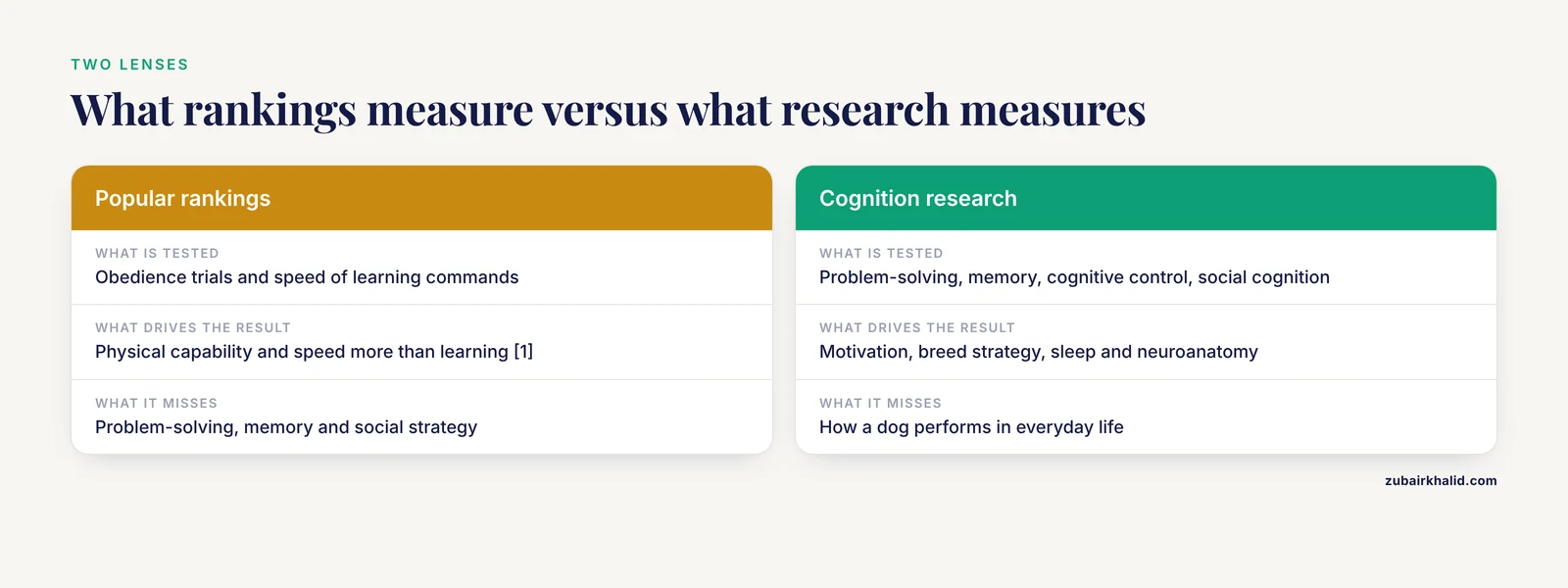
Popular intelligence rankings for dog breeds are typically based on obedience and trainability. The research reviewed here suggests that these rankings may be more about physical capability, motivation, and breed-specific behavioral traits than about cognitive ability [1]. Dogs perceived as highly trainable tend to be physically homogeneous in height, whereas breeds perceived as less trainable are more variable [1]. This physical homogeneity may contribute to their success in obedience and agility, where speed and agility are important [1].
Food motivation is another factor that influences perceived intelligence [3]. A dog that is highly motivated by food will work harder and longer in training sessions, which can create the impression of greater intelligence. But this is a motivational difference, not a cognitive one [3].
Breed differences in problem-solving style also affect how intelligence is perceived [2]. Brachycephalic breeds that seek human help rather than solving problems independently may be perceived as less intelligent, but they are simply using a different strategy [2]. This strategy may reflect selection for companionship and dependence on humans [2].
The takeaway is that intelligence rankings should be interpreted with caution. They measure specific behaviors in specific contexts, and they do not capture the full range of canine cognitive abilities. A dog that ranks low on a trainability scale may excel at social cognition, memory, or problem-solving in a different context.
Practical Training Implications
Understanding what intelligence rankings really measure can help owners train their dogs more effectively:
Match rewards to your dog's motivation. If your dog is highly food motivated, use food rewards in training. If your dog is more toy motivated, use toys [3]. A dog that is not responding to training may simply need a different type of reward, not a different training method.
Be patient with breeds that are less independent problem-solvers. Brachycephalic breeds may look to you for guidance during training tasks [2]. This can be an advantage in obedience training, where the goal is for the dog to respond to human cues, even if it appears as dependence in problem-solving contexts.
Recognize that physical ability affects performance. A dog that is slower or less agile may appear less trainable in agility or obedience trials, but this is a physical limitation, not a cognitive one [1]. Adjust your expectations and training goals accordingly.
Consider your dog's breed and line. Working lines and show lines within the same breed can differ substantially in behavioral traits [6]. If you are choosing a dog for a specific purpose, such as a working dog or a family companion, research the breed line as well as the breed.
Adjust expectations for senior dogs. Cognitive aging is normal, and older dogs may show increased behavioral rigidity [8]. Be patient with older dogs and adapt training methods to accommodate age-related changes.
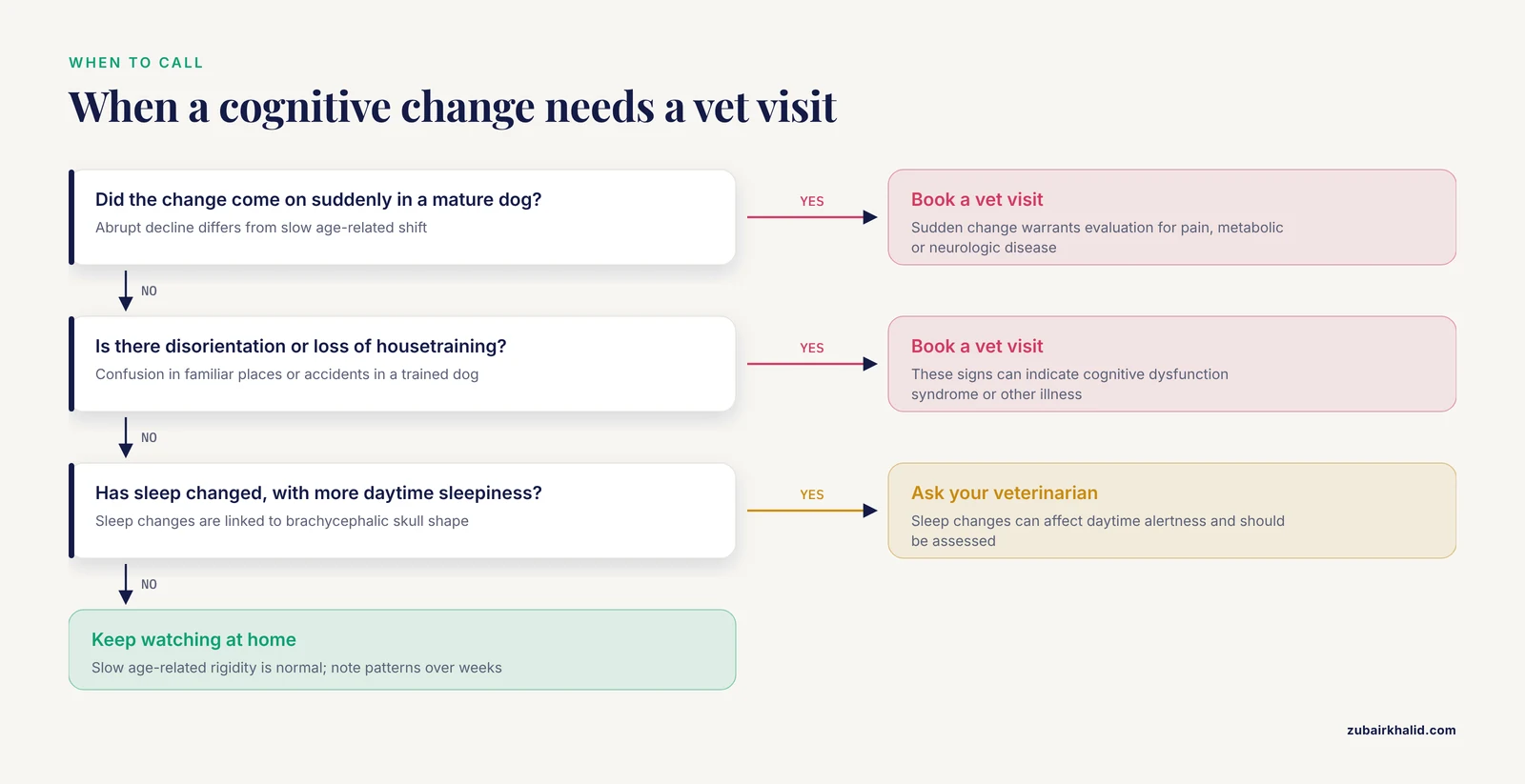
Monitor for signs of cognitive decline. If your dog shows sudden changes in learning ability, disorientation, changes in sleep patterns, or loss of housetraining, contact your veterinarian [5][8]. These signs can indicate medical conditions that require evaluation.
Limitations and When to Contact a Veterinarian
This article is educational and is not a substitute for veterinary diagnosis or treatment. Individual cases vary, and a veterinarian should evaluate any concerns about your dog's behavior or cognition.
Contact your veterinarian if you notice any of the following:
- Sudden changes in your dog's ability to learn or respond to commands
- Disorientation or confusion in familiar environments
- Changes in sleep patterns, especially excessive daytime sleepiness [5]
- Loss of housetraining in a previously house-trained dog
- Changes in appetite or food motivation [3]
- New or worsening anxiety or behavioral rigidity [8]
- Any signs of pain or discomfort that might affect behavior
These signs can indicate medical conditions that require evaluation, including cognitive dysfunction syndrome, pain, or other health problems. Early detection and intervention can improve outcomes for many conditions.
How Environment and Training History Shape a Dog's Measured Intelligence
A dog's score on any cognitive or obedience task is a snapshot of that dog on that day. Genetics sets a range of tendencies, but environment and learning history determine how much of that range is expressed during testing. Two dogs with similar breeding can look very different depending on socialization, prior experience, stress, health, and the test itself.
Factors That Change the Score
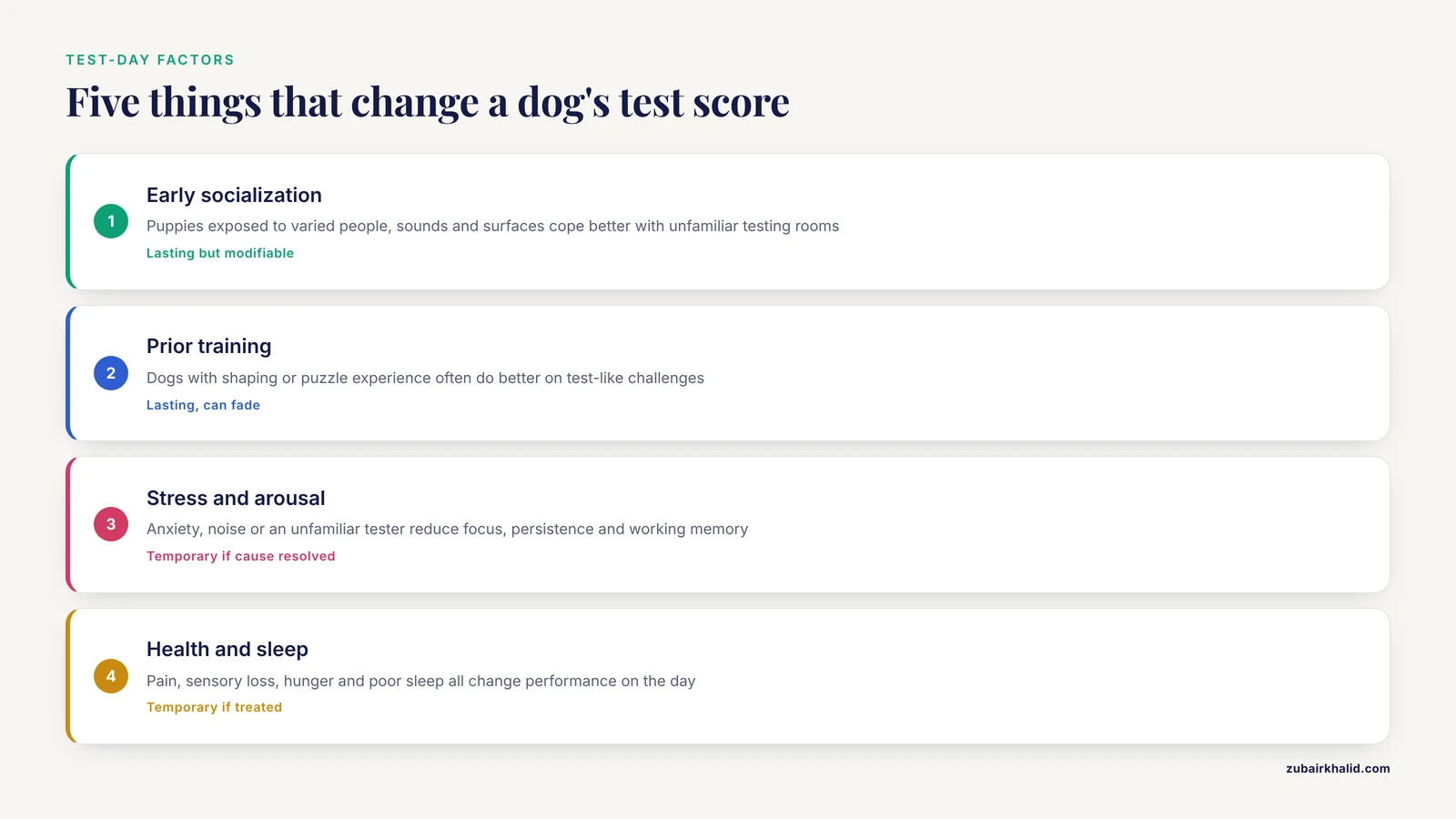
- Early socialization. Puppies exposed to varied people, sounds, surfaces, and handling tend to cope better with unfamiliar testing situations. A dog that has rarely left its home may shut down in a novel room, not because it cannot learn but because the setting is overwhelming.
- Prior training. Dogs with experience in shaping, puzzle tasks, or cooperative games often perform better on test-like challenges. Prior training and experience also affect performance in aging studies, which is why researchers try to control for it [4][8].
- Stress and arousal. Anxiety, noise, separation from the owner, or an unfamiliar tester can reduce focus, persistence, and working memory. A frightened dog may fail a task it can do easily at home.
- Health and sleep. Pain, sensory loss, hunger, and poor sleep change performance. Brachycephalic dogs, for example, spend more time sleeping and show sleep patterns that may affect daytime cognition [5]. Food motivation also changes how hard a dog works for a reward [3].
- Test context. Reward type, human presence, and breed-typical strategy all shape results. A dog may appear less independent if it looks to people for help [2], or less trainable if it is physically slower rather than cognitively slower [1].
Temporary Performance Versus Lasting Ability
A single poor test result is weak evidence of low intelligence. Stress, pain, sleep loss, or a reward the dog does not value can temporarily suppress performance. Lasting ability is better judged from patterns over weeks, across different settings, and with a familiar handler.
| Factor | Usual effect | Duration |
|---|---|---|
| Genetics and breed | Sets tendencies and physical limits | Lasting |
| Early socialization | Improves coping with novelty | Lasting but modifiable |
| Prior training | Builds test familiarity and cooperative skills | Lasting, can fade |
| Stress, pain, poor sleep | Reduces focus and persistence | Temporary if cause resolved |
| Reward mismatch | Low apparent motivation | Context-specific |
A sudden change in a mature dog's learning, house training, sleep, or recognition is different from a slow age-related shift. Cognitive aging is normal, and older dogs may become more rigid in their responses [8], but abrupt decline warrants veterinary evaluation for pain, sensory loss, metabolic disease, neurologic problems, or cognitive dysfunction syndrome.
Do Mixed-Breed Dogs Belong in Breed Intelligence Rankings?
Breed intelligence rankings are built around registered breeds, so mixed-breed dogs are usually absent by default. The deeper question is whether a mixed-breed dog can be meaningfully compared with purebred dogs on the traits these rankings measure. The honest answer is that breed ancestry, especially when guessed, is a poor basis for predicting an individual dog's cognitive performance.
Why Breed Labels and Shelter Guesses Are Imperfect
Most mixed-breed dogs arrive at shelters with no pedigree. Staff and veterinarians assign breed labels from appearance, but visual identification is unreliable. Even DNA-based ancestry tests cannot predict behavior with precision. Breed behavior itself is not uniform: working and show lines within a single breed, such as the German Shepherd, differ substantially in measured behavioral traits, and these differences have a genetic basis [6]. If two purebred German Shepherds can behave differently depending on line, a mixed-breed dog carrying a fraction of that ancestry tells you even less.
What Rankings Miss in Mixed-Breed Dogs
Rankings assume that breed membership predicts trainability. Research suggests that perceived trainability reflects physical capability more than learning ability [1], and physical traits in a mixed-breed dog are not predictable from a guessed breed list. Motivation also varies by individual. Labradors work harder for food rewards than German Shepherds, but this is a breed-level tendency, not a guarantee for any individual [3]. A mixed-breed dog's food or toy motivation depends on its own history and temperament, not just its ancestry.
Studies of mixed-breed dogs do exist. In one aging study, aged mixed-breed dogs learned a discrimination task more slowly than age-matched beagles, a difference the authors attributed to breed variation in cognitive aging [8]. This shows mixed-breed dogs can be assessed with the same cognitive tests used for purebreds, but it also shows that results vary widely within the mixed-breed population.
The Better Approach
For a mixed-breed dog, individual factors matter more than presumed ancestry. Health status affects cognition; brachycephalic breeds show sleep and brain differences that can influence behavior [5], and any dog with untreated pain or illness will perform poorly on cognitive tests. Training history and prior experience also shape performance. Owners should evaluate their dog's motivation, health, and learning history directly, and consult a veterinarian if behavior changes suddenly.
Can Mental Enrichment Improve Cognitive Performance in Dogs?
Owners often ask whether puzzle toys, scent games, and extra social time can make their dog smarter. The direct evidence is thinner than many product claims suggest, but several findings point to which forms of enrichment are most promising.
What the Evidence Shows
Puzzles and problem-solving. Dogs differ in how they approach novel problems. In one study, brachycephalic breeds solved fewer food-box puzzles but looked to humans more often, while a mesocephalic breed worked more independently [2]. This suggests that puzzle toys may encourage independent problem-solving in some dogs, but the same task can produce frustration or prompt a dog to wait for help. No controlled study in the cited literature shows that regular puzzle use raises general cognitive ability.
Scent work. Dogs have a highly developed olfactory system, and scent-based tasks draw on natural abilities. However, none of the cited studies directly test whether scent work improves memory, attention, or learning. It remains a reasonable form of enrichment, but its cognitive benefits are unproven.
Social contact. Social behavior is a core part of canine cognition. The same problem-solving study found that some breeds preferentially seek human assistance, which is a valid social strategy rather than a failure of intelligence [2]. Regular positive social contact may reinforce attention to human cues, but evidence that it improves cognitive performance is indirect.
Exercise. Physical capability can shape how trainable a dog appears. Breeds perceived as highly trainable differ from less trainable breeds in speed, not in learning time [1]. Exercise improves physical condition and may make training sessions more productive, but it has not been shown to enhance cognition directly.
Lifelong learning. Cognitive aging in dogs depends on the task and on previous experience [8]. This suggests that continued learning opportunities may help maintain cognitive function in older dogs, although the finding comes from observational aging studies rather than enrichment trials.
When to See a Veterinarian
Enrichment is not a substitute for medical care. If a dog that previously learned commands quickly begins to struggle, or if sleep patterns change markedly, a veterinary assessment is warranted. Changes in sleep are linked to brachycephalic skull shape and can affect daytime alertness [5]. Age-related cognitive decline also produces measurable changes in learning and memory [8]. Sudden disorientation, loss of housetraining, or new rigidity in responding to familiar cues should be evaluated by a veterinarian rather than managed with more puzzles.
Related Guides
- Why Dogs Scratch Their Ears and What It Means: Explains common ear-scratching causes and when to seek help
- Do Dogs Smile? What a Dog's Smile Really Means: Covers whether dog smiles are real social signals
- Are Dog Zoomies Good or Bad? What They Mean: Explains zoomies and whether they signal healthy behavior
- When Do Dogs Stop Growing? Age by Breed Size: Useful for understanding breed-size growth and age stages
- Hypoallergenic Dogs: Best Breeds for Allergy Sufferers: Helps readers choose breeds with fewer allergy triggers
- Osteosarcoma in Large Dogs: Amputation, Chemotherapy and Prognosis: Relevant for large-dog health risks beyond cognition
- Are All Dogs Natural Swimmers? Breeds and Safety: Explores breed physical ability and swimming safety
Frequently Asked Questions
What is the most intelligent dog breed?
There is no single answer because dog intelligence is multidimensional. Breed rankings based on obedience and trainability reflect physical capability and motivation as much as learning ability [1]. Different breeds excel at different types of tasks.
Are small dogs less intelligent than large dogs?
No. Research comparing large and small dogs on spatial memory tasks found no differences between the groups [4]. Previous findings of large dogs outperforming small dogs in social cognition tasks may be due to methodology or training experience rather than size [4].
Do brachycephalic breeds like French Bulldogs have lower intelligence?
Brachycephalic breeds solve fewer independent problem-solving tasks, but they orient more toward humans [2]. This reflects a different behavioral strategy, not necessarily lower intelligence. They may also have sleep and neuroanatomical differences associated with brachycephaly [5].
Can dog intelligence be measured objectively?
Researchers use a variety of tests, including problem-solving tasks, discrimination and reversal learning, delayed non-matching to sample, and EEG measures of cognitive control [8][7]. Each test measures a different aspect of cognition.
Does food motivation affect how trainable a dog is?
Yes. Labradors, for example, work harder for food rewards than German Shepherds [3]. A highly food-motivated dog may appear more trainable because it is more willing to work for rewards.
Does dog intelligence decline with age?
Yes, dogs show age-dependent deterioration in cognitive function, and the extent depends on the task and the dog's previous experience [8]. Older dogs may show increased behavioral rigidity and persistence in responding to previously rewarded stimuli [8].
Are working line and show line German Shepherds different in intelligence?
Working and show line German Shepherds differ in most behavioral scores measured by standardized assessments, and these differences are strongly correlated with boldness [6]. These behavioral differences have a genetic basis [6].
How can I tell if my dog's cognitive change needs veterinary attention?
Contact your veterinarian if you notice sudden changes in learning, disorientation, changes in sleep patterns, loss of housetraining, or new behavioral rigidity [5][8]. These signs can indicate medical conditions that require evaluation.
Sources
- Does perceived trainability of dog (Canis lupus familiaris) breeds reflect differences in learning or differences in physical ability?
- The difference between two brachycephalic and one mesocephalic dog breeds' problem-solving performance suggests evidence for paedomorphism in behaviour.
- Variation in food-maximizing behaviour as a function of context, breed, and individual characteristics: A study of Labrador Retrievers and German Shepherd Dogs.
- Does size really matter? Investigating cognitive differences in spatial memory ability based on size in domestic dogs.
- Sleep-physiological correlates of brachycephaly in dogs.
- The Genetic Architecture of Behavior in the German Shepherd Dog.
- A human-like EEG signature of cognitive control in the domestic dog.
- Cognitive functions and aging in the dog: acquisition of nonspatial visual tasks.
- Octreotide treatment improves multiple domains of cognitive performance in aged beagle dogs.