How to Get Your Cat to Play: Toys, Timing and Techniques
By Dr. Zubair Khalid, DVM, MS, PhD ·
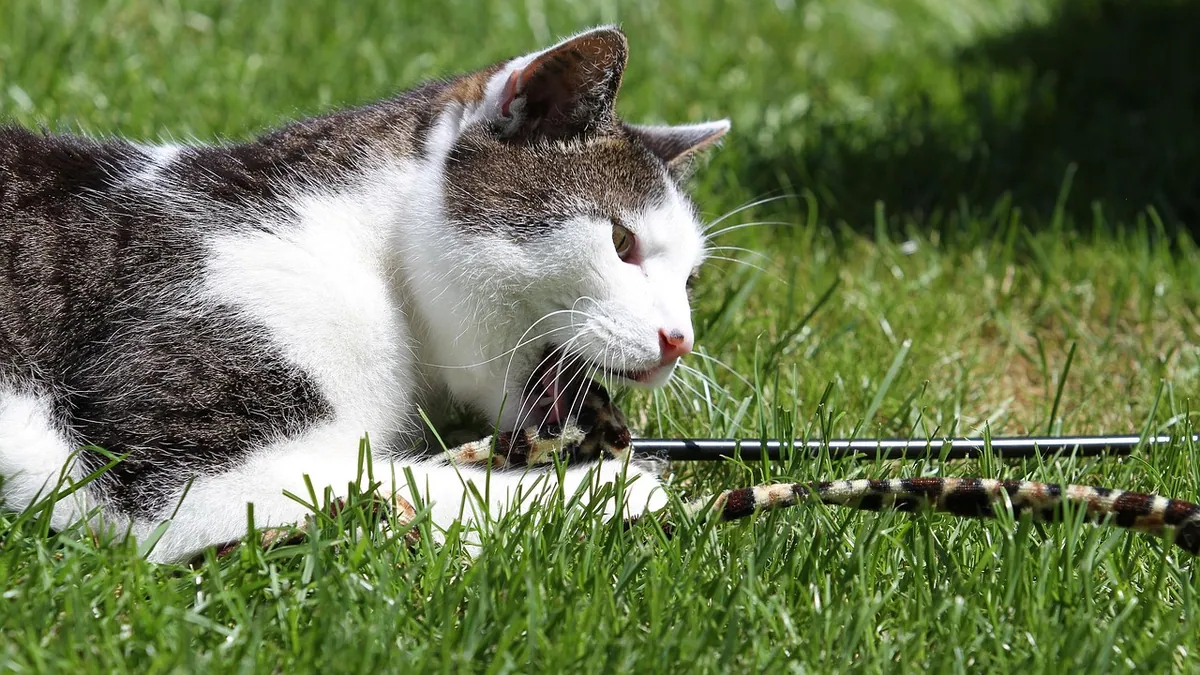
If you want to know how to get my cat to play, the answer starts with movement, timing, and short sessions that mimic a hunt. Cats are wired to chase, pounce, and catch, so a toy that darts and hides will beat one that sits still. You also need to read your cat's signals, because play and overstimulation can look alike at first.
This article is educational and is not a substitute for veterinary diagnosis or treatment.
Quick Answer
- Move the toy like prey: quick darts, pauses, hiding spots, and a final "catch" your cat can grab.
- Keep sessions short, often 5 to 10 minutes, and stop while your cat is still interested.
- Play when your cat is naturally active, usually early morning and evening.
- Watch the tail, ears, and pupils. A lashing tail or flattened ears means stop, not more play.
- If your cat suddenly stops playing, hides, or seems painful, call your veterinarian.
Why Cats Play and Why Some Stop
Play in cats shares a common basis with predation and social interaction [1]. That is why a wand toy that skitters under a rug feels like a hunt, and why a bored indoor cat may sleep instead of stalk. Play is normal behavior, not a luxury.
Kittens learn a lot about the world in their first weeks. Early experiences have lasting effects on adult behavior and welfare [2]. A kitten who was handled by several people and exposed to everyday sounds often grows into a cat who is easier to engage. If your cat was under-socialized, you may need to go slower and use quieter toys.
Cats also have individual preferences. In a study of four adult cats in their homes, three of four worked harder for their most preferred stimulus than their least preferred one [3]. Your cat may care more about a feather than a ball, or more about food than either. Finding the favorite item is half the battle.
Age changes play too. Older cats often play in shorter bursts. They may still want to hunt, but their joints and stamina set the pace. That is normal. Adjust the session instead of pushing through it.
How to Tell If My Cat Wants to Play
Cats do not always bring you a toy. They send signals. Learn these and you will stop guessing.
Signs your cat is ready to play
- Crouching low with the rear end wiggling
- Dilated pupils while staring at a toy or your hand
- Ears forward and relaxed
- Tail up or gently curved
- A soft chirp, trill, or short meow
- Pawing at a toy, a door, or your ankle
Meowing is an acoustic signal tied to motivation and emotion, and cats meow more in some highly motivating contexts than others [1]. A cat who meows at the toy drawer is telling you something.
Signs your cat wants to stop
- Tail lashing or thumping
- Ears rotating back or flattening
- Skin twitching along the back
- Hissing, growling, or a sharp swat
- Freezing, then walking away
- Pupils pinned to slits while staring at you
These are overstimulation signals. Play has tipped into stress. End the session calmly and let your cat leave. Do not pick them up to "calm them down."
Medical Causes to Rule Out First
A sudden drop in play is a medical question before it is a behavior question. Cats hide pain well, and joint pain, dental disease, and vision changes can all make a cat quit playing.
Watch for these changes and call your veterinarian:
- Limping, stiffness, or reluctance to jump
- Dropping toys early or missing easy swats
- Weight loss, vomiting, or diarrhea
- Increased drinking or urination
- Hiding more, or sleeping far more than usual
- Irritability when touched, especially on the back or hips
Your veterinarian will examine your cat and decide what testing is needed. There is no single test for "won't play." The workup depends on the exam findings and your cat's age and history.
When Play Becomes a Problem
Play is a problem when it hurts someone or when the lack of it damages welfare.
A cat who ambushes ankles, bites hands, or attacks another cat during play needs a plan. This is often play that never got a proper outlet. The cat is practicing hunting on the wrong target.
The opposite problem matters too. A cat with nothing to do may over-groom, vocalize at night, or bother other pets. In a cat café study, cats used elevated structures more during busy times and often chose vertical levels or cat-only rooms [4]. Indoor cats need that same kind of control over their space. Without it, they may act out or shut down.
If you have more than one cat, tension can look like play. Watch for one cat who always hides, eats less, or avoids a certain room. That cat is not playing. That cat is coping. A slow, structured introduction helps, and these guides walk you through it: How To Introduce New Cat To Cat and How To Introduce New Cat To Home.
How to Get My Cat to Play More: Step by Step
Step 1: Pick the right toy
Offer a few types and see what your cat chooses. Wand toys with feathers, small plush mice, crinkle balls, and food puzzles all work for different cats. A preference assessment can identify the most preferred item, and that item can then maintain stronger responding [3]. In plain terms, find the toy your cat loves and use it as your main tool.
Rotate toys every few days. A toy that disappears for a week feels new again. For ideas on what to buy, see Best Cat Toys: Engaging Playthings for Your Feline Friend and Cat Toys And Accessories.
Step 2: Mimic the prey sequence
A hunt has stages: scan, stalk, chase, pounce, catch, and eat. Your toy should follow that arc.
- Start slow. Drag the toy along the floor or behind furniture so your cat can watch.
- Let your cat stalk. Freeze the toy. Wait for the wiggle.
- Dart away. Short, fast pulls, then a pause.
- Let your cat catch it. This is the payoff. Do not yank it away every time.
- Finish with a small meal or treat. This closes the sequence and tells your cat the hunt is over.
Cats who never get to catch often lose interest. The catch is the reward.
Step 3: Time it right
Play when your cat is already awake and alert. Many cats are most active at dawn and dusk. Try a session before breakfast and one before dinner.
Keep sessions short. Five to ten minutes is plenty for most cats. Two or three short sessions beat one long one. Stop while your cat still wants more. That keeps the toy valuable.
Step 4: Build a play-friendly home
- Add cat trees, shelves, and window perches. Vertical space matters, and cats use it more when the house is busy [4].
- Give hiding spots and cat-only zones.
- Put a bird feeder outside a window for passive hunting.
- Use food puzzles so mealtime involves work.
- Keep a consistent daily routine.
Step 5: Respect your cat's style
Some cats like to chase across open floor. Others want to ambush from behind a couch. Some prefer to bat at a toy from a resting spot. Match your technique to your cat.
If your cat is shy, sit on the floor and let the toy come to them. Do not loom over them. If your cat is bold, use bigger movements and more speed.
How to Get My Kitten to Play
Kittens have short attention spans and lots of energy. Play in many short bursts, and expect them to lose interest fast.
Kitten socialization shapes adult behavior, and breeders in one survey reported that multiple people handling kittens was important, though practice did not always match that belief [2]. If you have a kitten, invite calm visitors to interact. Expose your kitten to different rooms, sounds, and gentle handling.
Use toys, not hands, as targets. A kitten who learns that hands are toys becomes a cat who bites hands. If your kitten bites during play, freeze, then offer a toy instead. End the session if the biting continues.
Kittens also need safe spaces to retreat to. A crate or a quiet room gives them a break from the action.
What Not to Do
- Do not punish your cat. Yelling, spraying, or swatting adds stress and can make biting worse.
- Do not use your hands or feet as toys. Ever.
- Do not force interaction. In one study, forced interactions raised cortisol and lowered oxytocin, while passive interactions did the opposite [5]. Let your cat choose to engage.
- Do not drag a toy away every time your cat catches it. Let them win.
- Do not assume a lazy cat is just lazy. Pain and illness are common reasons for quitting play.
- Do not leave string, ribbon, or wand toys out unsupervised. Cats can swallow them, and that is a surgical emergency.
When to Get Help
Call your veterinarian if your cat stops playing suddenly, shows pain signs, or has other health changes. A certified behavior professional can help if your cat bites, attacks another pet, or cannot be engaged at all.
Look for a veterinarian who works with behavior, or a certified applied animal behaviorist. Ask about their training and experience with cats. Behavior plans take weeks, not days. Expect homework.
Limitations and When to Contact a Veterinarian
This article cannot tell you why your specific cat stopped playing. Only an exam and history can do that. Individual cases need a veterinarian.
Contact your veterinarian the same day if your cat:
- Stops eating or drinking
- Vomits repeatedly or has diarrhea
- Limps or cries when moving
- Hides and will not come out
- Suddenly avoids being touched
Go to an emergency clinic now if your cat:
- Breathes with an open mouth or struggles to breathe
- Collapses or cannot stand
- Has a swollen, painful belly
- Swallowed string, ribbon, or a toy part
- Cannot urinate, especially a male cat straining in the litter box
For poison exposure, call the ASPCA Animal Poison Control Center at (888) 426-4435 or the Pet Poison Helpline at (855) 764-7661. These lines may charge a consultation fee.
Schedule a routine visit if your cat's play has slowly declined over weeks, if your cat is gaining or losing weight, or if you notice stiffness after rest. Early arthritis care keeps cats playing longer.
Frequently Asked Questions
Why does my cat ignore every toy I buy?
Most cats ignore toys that do not move like prey. Try a wand toy you control, and vary the speed and direction. Also test different categories, since cats show clear preferences among toys, food, and social contact [3]. If your cat still ignores everything, ask your veterinarian to check for pain or illness.
How long should a play session last?
Most cats do best with short sessions of a few minutes, repeated two or three times a day. Stop before your cat loses interest so the toy keeps its value. Older cats and kittens often need even shorter bursts.
My cat bites my hands during play. What should I do?
Stop the session the moment teeth touch skin, and walk away. Then redirect to a wand toy on your next attempt. Never use hands as toys, even with kittens. If biting continues or draws blood, ask your veterinarian about a behavior referral.
Can I play with my cat using a laser pointer?
Lasers can work for chasing, but your cat never catches anything, which can frustrate some cats. If you use one, finish by tossing a treat or a plush toy your cat can grab. Many cats do better with a wand toy that ends in a real catch.
Do older cats still need play?
Yes. Play keeps muscles, joints, and minds active, and it is a good way to spot early pain. Older cats often prefer slower toys, floor-level movement, and shorter sessions. If your cat seems stiff or sore afterward, call your veterinarian.
Related Articles
- Cat Toys And Accessories
- How To Introduce New Cat To Cat
- How To Introduce New Cat To Home
- How Do You Introduce A New Cat To Your Cats
- Best Cat Toys: Engaging Playthings for Your Feline Friend
- Best Interactive Cat Toys: Keep Your Feline Active and Engaged
- How to Get Your Cat to Be More Active: Play and Exercise Plan
- How Do Cats Play? Reading Feline Play Behavior
- Play Aggression in Cats: Why It Happens and How to Stop It
References
- Vocal signals produced by the domestic cat (Felis silvestris catus) in highly motivating contexts. Journal of comparative psychology (Washington, D.C. : 1983), 2026.
- Exploring kitten socialisation practices and welfare implications within a Swedish breeding association. Animal welfare (South Mimms, England), 2026.
- Preference assessment and reinforcer effectiveness in domestic cats. Journal of the experimental analysis of behavior, 2026.
- Cats in a Cat Café: Individual Cat Behavior and Interactions with Humans. Animals : an open access journal from MDPI, 2025.
- EXPRESS: The hormonal effects of owner-cat interactions on pet cats of different potential attachment styles. Journal of feline medicine and surgery, 2026.