Ocean Decomposers: Types and Examples
By Dr. Zubair Khalid, DVM, MS, PhD ·
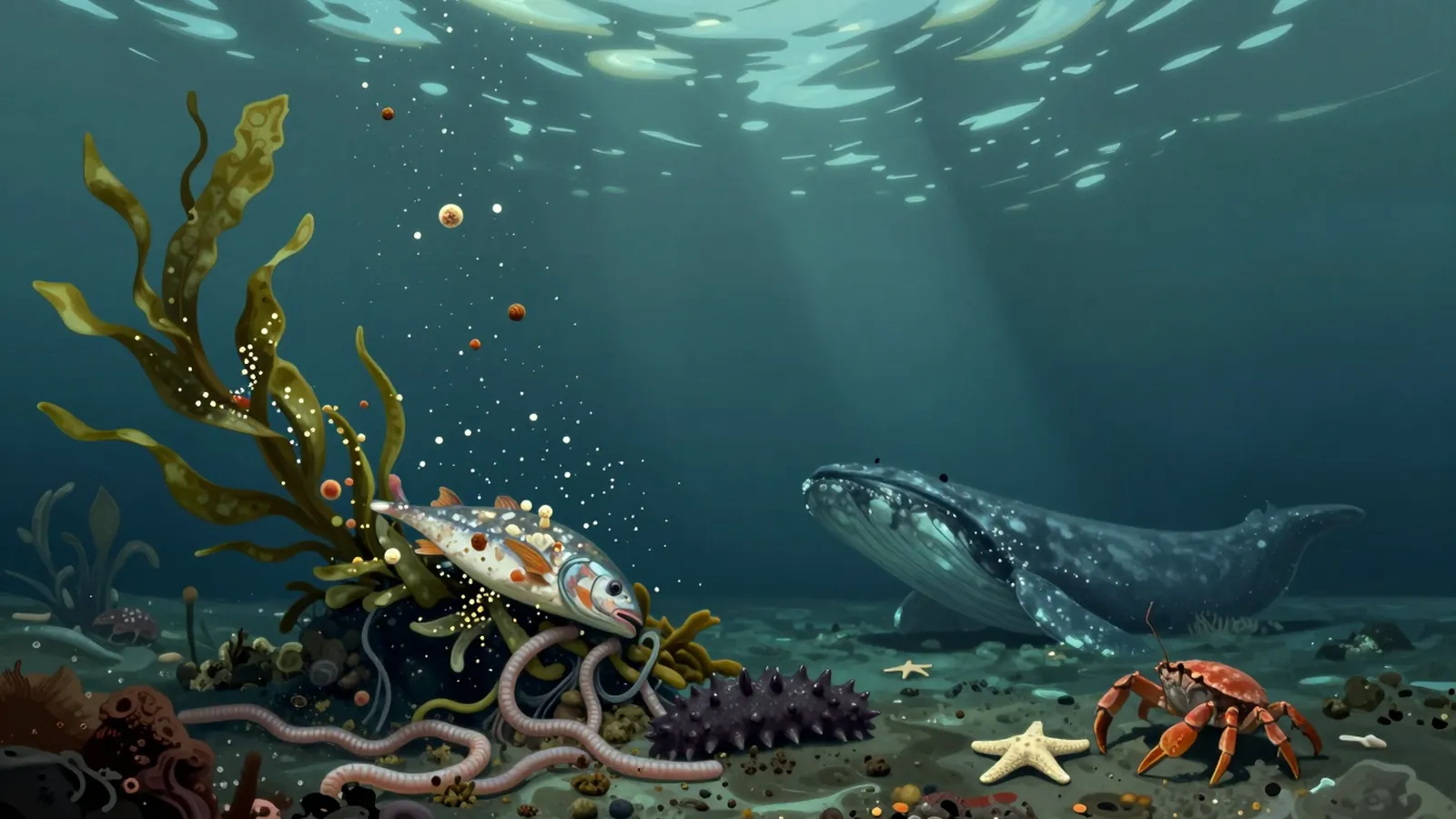
Ocean decomposers are organisms that break down dead plant, algal, and animal matter in seawater, in sediments, and on submerged surfaces, releasing nutrients that re-enter the marine nutrient cycle (Little-Known Marine Decomposers Attract The Attention Of ...; Georgia Institute of Technology). The main marine decomposers are bacteria; fungi, marine worms, echinoderms, crustaceans, mollusks, and labyrinthulomycetes are also important (Decomposers in the Ocean; Little-Known Marine Decomposers Attract The Attention Of ...).
Decomposer communities vary with temperature and habitat. Warm water speeds up decay, and some general references describe tropical seas as holding more decomposer organisms than colder oceans (Decomposers in the Ocean).
Key Points
- Bacteria are the main decomposer organisms in marine ecosystems; fungi, marine worms, echinoderms, crustaceans, and mollusks are other important decomposer groups (Decomposers in the Ocean).
- Warm water speeds up decomposition; in cold polar and deep water, microbial decay is slower, but scavenging crustaceans, worms and echinoderms still break down dead material.
- Echinoderm decomposers include sea urchins, sea stars, and sea cucumbers, which eat live food and also consume decaying organic matter covering rocks and other surfaces.
- The Christmas tree worm (Spirobranchus giganteus) is a marine worm that spreads feathery appendages to catch organic matter floating in the water.
- Labyrinthulomycetes are single-celled marine decomposers that eat non-living plant, algal, and animal matter and are particularly abundant on dead vegetation, in salt marshes, and in mangrove swamps (Little-Known Marine Decomposers Attract The Attention Of ...).
- In some regions labyrinthulomycetes may be as important as bacteria in degrading organic matter, and because they make long-chain polyunsaturated fatty acids, they are thought to improve the nutritional value of poor-quality organic detritus.
At a Glance
| Item | Summary |
|---|---|
| Definition | Organisms that break down dead marine matter (Decomposers in the Ocean) |
| Main groups | Bacteria, archaea, fungi, protists, and animal decomposers (Decomposers in the Ocean; Marine microorganisms) |
| Key role | Nutrient recycling and food-web support (Aquatic food webs; Marine microorganisms) |
| Where they work | Water column, seafloor, sediments, and deep ocean |
| Common examples | Marine bacteria, fungi, marine worms, sea cucumbers, crabs, and sea stars |
Ocean decomposers break dead material into simpler compounds that can return to the food web (Decomposers in the Ocean). Their work links sinking organic matter with nutrient cycles that support marine producers (Aquatic food webs; Marine microorganisms).
What Are Ocean Decomposers?
Ocean decomposers are organisms that break down dead organic matter in seawater and marine sediments (Decomposers in the Ocean). They consume remains, waste products, and particles that sink from surface waters. Their activity releases nutrients that other organisms can use again.
Definition and Boundaries
A decomposer is not a single taxonomic group. Marine decomposers include bacteria, fungi, protists, and animals such as worms, crustaceans, mollusks, and echinoderms (Decomposers in the Ocean). Some are microscopic; others are large enough to see. The shared function is the processing of dead material, not a shared family tree.
What They Process
Ocean decomposers handle several forms of dead matter:
- Dead plankton, algae, and small animals that settle from the water column
- Marine snow, the loose clumps of organic particles that sink through the ocean
- Decaying fish, invertebrates, and other larger remains
- Fecal pellets and other waste from living animals
- Detritus coating rocks, shells, and sediment grains (Decomposers in the Ocean)
The material can be fresh or partly degraded. Bacteria and fungi often start the chemical breakdown. Animal decomposers then fragment and consume remaining pieces (Decomposers in the Ocean).
Microbes, Fungi, Protists, and Animals
Bacteria are the main decomposers in marine ecosystems (Decomposers in the Ocean). Archaea are also part of the marine microbiome and contribute to nutrient cycling (Marine microorganisms). Fungi break down tough plant and animal remains. Protists include single-celled consumers and decomposers. Labyrinthulomycetes are single-celled marine decomposers that eat nonliving plant, algal, and animal matter; in some regions they may be as important as bacteria in degrading organic matter (Little-Known Marine Decomposers Attract The Attention Of ...). Animal decomposers include marine worms, echinoderms, crustaceans, and mollusks. These larger forms are sometimes called macrodecomposers.
Worked Example: A Sinking Particle
Consider a dead plankton cell that sinks from surface water. Bacteria attach and begin breaking down the cell's organic compounds. A protist grazes on bacteria or on the particle itself. A marine worm or small crustacean consumes the remaining fragment. At each step, some carbon and nutrients are released into the water or sediment, where producers and other microbes can use them again (Decomposers in the Ocean; Aquatic food webs). The exact pathway varies with depth, temperature, and oxygen, but the overall function is the same: dead matter becomes part of the living food web again.
Why Ocean Decomposers Matter
Ocean decomposers recycle carbon, nitrogen, phosphorus, and other nutrients through marine ecosystems (Decomposers in the Ocean; Marine microorganisms). They turn dead tissue and waste into simpler compounds that producers and microbes can use again. Without this recycling, nutrients would remain locked in dead matter.
Nutrient Recycling
Marine microorganisms act as decomposers and are central to nutrient recycling (Marine microorganisms). A decomposing fish or algal mat releases nitrogen and phosphorus compounds. Phytoplankton can take up those compounds and grow. The cycle continues as those producers die or are eaten. Labyrinthulomycetes may break down material that is difficult to degrade, including land-derived particulate organic matter in coastal systems (Little-Known Marine Decomposers Attract The Attention Of ...).
Food-Web Support
Decomposers support food webs by transferring energy from dead matter to living consumers (Aquatic food webs). Food webs describe who eats whom and how energy flows through an ecosystem. Decomposers and detritivores are part of that flow. Bacteria and fungi are eaten by protists and small animals. Those consumers are eaten by larger animals. This detrital pathway connects dead matter with predators such as crabs and fish (Decomposers in the Ocean; Aquatic food webs).
Marine Snow and Sinking Particles
Much of the organic matter in the open ocean sinks as marine snow. Decomposers in the water column intercept these particles and break them down as they fall (Decomposers in the Ocean; Aquatic food webs). Shallow-water decomposers may process material before it reaches the seafloor. Deep-sea decomposers process what remains. This vertical transport helps move carbon and nutrients from surface waters to sediments and back into food webs (Aquatic food webs).
Limits on Dead Matter Buildup
Decomposition limits the buildup of dead organic material in seawater (Decomposers in the Ocean). When decomposition is slow, dead matter and organic detritus can accumulate. Temperature affects decomposer activity; tropical oceans have more decomposer organisms than the Atlantic or Arctic because of warmer temperatures. In colder ocean waters, only bacteria and fungi do the decomposing because other creatures cannot survive the extreme conditions. The table below summarizes the main effects.
| Effect | Why it matters |
|---|---|
| Nutrient release | Returns carbon, nitrogen, and phosphorus to usable forms (Decomposers in the Ocean; Marine microorganisms) |
| Energy transfer | Moves energy from dead matter into detrital food webs (Aquatic food webs) |
| Particle breakdown | Processes marine snow and sinking organic matter (Decomposers in the Ocean) |
| Waste removal | Reduces accumulation of dead organic material |
Main Types of Ocean Decomposers
Ocean decomposers fall into several groups that differ in size, habitat, and method of feeding. Bacteria are the main decomposers, with fungi, protists, marine worms, echinoderms, crustaceans, and mollusks also important (Decomposers in the Ocean). The table below gives a quick comparison.
| Group | Typical examples | Main contribution |
|---|---|---|
| Bacteria and archaea | Marine bacteria, archaea | Chemical breakdown of dead matter and nutrient cycling (Decomposers in the Ocean; Marine microorganisms) |
| Fungi | Marine fungi | Breakdown of tough plant and animal remains (Decomposers in the Ocean) |
| Protists | Labyrinthulomycetes, protozoa | Single-celled consumption and decomposition (Marine microorganisms; Little-Known Marine Decomposers Attract The Attention Of ...) |
| Animals | Marine worms, sea cucumbers, crabs, mollusks | Fragmentation and consumption of detritus |
| Scavengers | Crabs, sea stars | Consumption of larger remains |
Bacteria and Archaea: The Smallest Recyclers
Bacteria are the main decomposer organisms in marine ecosystems (Decomposers in the Ocean). They are abundant in seawater, sediments, and on surfaces. Archaea are also part of the marine microbiome, and marine microorganisms as a group participate in the global cycling of carbon, nitrogen, phosphorus, and other elements (Marine microorganisms). Many of these organisms are tiny, but their combined chemical capacity is large. They produce enzymes that break down organic matter into simpler compounds. In cold ocean waters, bacteria and fungi can continue decomposition when larger animals cannot survive the conditions.
Fungi and Protists in Marine Decomposition
Fungi break down tough plant and animal remains (Decomposers in the Ocean). In the ocean, they work on wood, algal material, and other resistant debris. Protists are single-celled consumers and decomposers (Marine microorganisms). Labyrinthulomycetes are a notable group of single-celled marine decomposers that eat nonliving plant, algal, and animal matter (Little-Known Marine Decomposers Attract The Attention Of ...). They are common on dead vegetation and in salt marshes and mangrove swamps. In some regions, they may be as important as bacteria in degrading organic matter, and they can break down material that is difficult to degrade.
Marine Animals as Decomposers
Animal decomposers include marine worms, echinoderms, crustaceans, and mollusks (Decomposers in the Ocean). These organisms fragment dead material, making it more accessible to microbes. Marine worms such as the Christmas tree worm use feathery appendages to catch organic matter floating in the water. Echinoderms such as sea urchins, sea stars, and sea cucumbers consume decaying organic matter that coats rocks and other surfaces. These larger forms are called macrodecomposers.
Scavengers and Macredecomposers
Scavengers consume larger remains. Crabs and sea stars are examples of animal decomposers that can feed on dead organisms and detritus (Decomposers in the Ocean). Their feeding breaks carcasses into smaller pieces and exposes inner tissues to bacteria and fungi. This combination of animal fragmentation and microbial breakdown supports the return of nutrients to the ecosystem (Decomposers in the Ocean; Aquatic food webs).
Bacteria and Archaea: The Smallest Recyclers
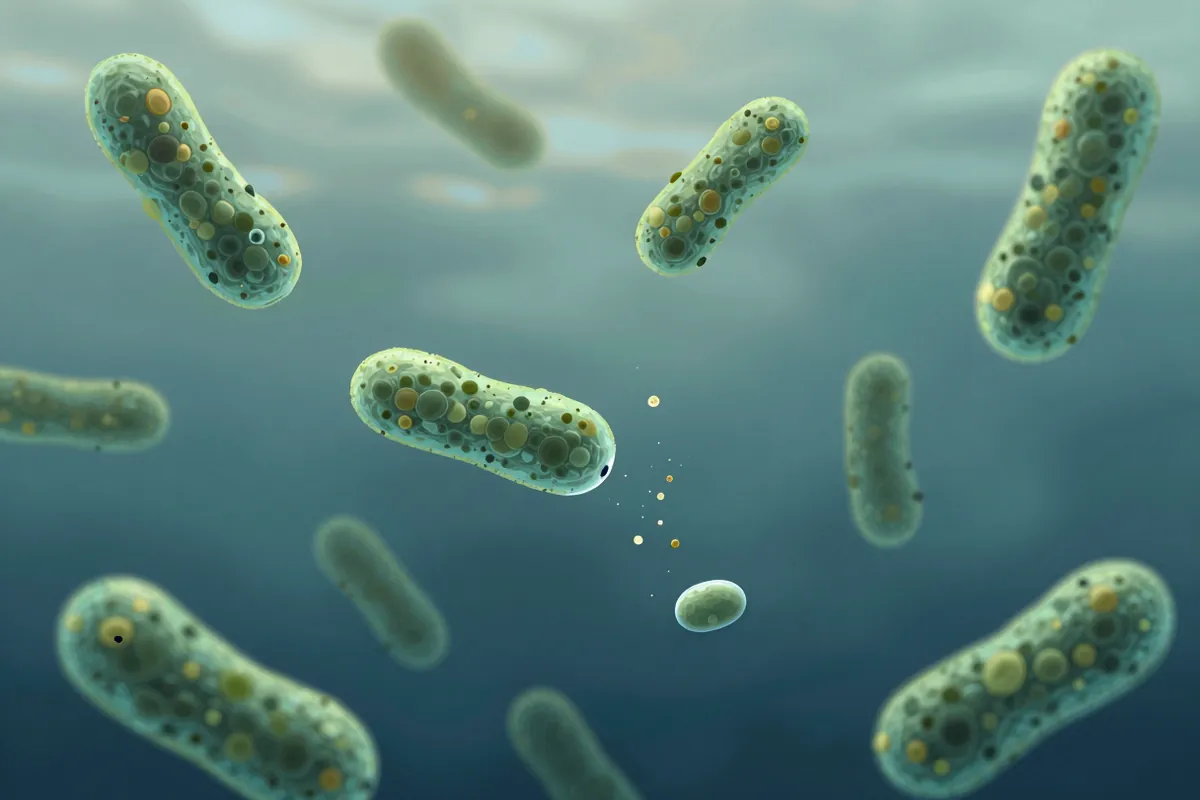
Marine microorganisms have been estimated to make up between 70 and 90 percent of the biomass in the ocean, and together they recycle the major chemical elements, producing and consuming about half of all organic matter generated on the planet every year (Marine microorganisms). Bacteria and archaea sit at the small end of that community and carry the largest share of its chemical work. Microbes are the greatest decomposers of marine ecosystems, breaking down natural organic matter and releasing particulates that re-enter the nutrient cycle (Georgia Institute of Technology).
Bacteria carry the main load
Bacteria dominate decomposition in seawater and sediments (Marine microorganisms). They are abundant, easily dispersed, and metabolically flexible, so they colonize dissolved compounds, suspended flakes, and settled mud with equal ease. Water temperature shapes the community: tropical oceans such as the Pacific hold more decomposer organisms than the Atlantic or Arctic because of the warmer temperatures (Decomposers in the Ocean). Cold water narrows the guild. In colder ocean waters, only bacteria and fungi do the decomposing, because the other decomposer creatures cannot survive the extreme conditions.
Archaea in deep, cold, and low-oxygen habitats
Archaea thrive in deep, cold, or low-oxygen marine habitats (Marine microorganisms). Those conditions are common in deep water, in buried sediment, and inside organic particles where oxygen is used up quickly. The marine microbiome has evolved many life styles and adaptations over billions of years and now participates in the global cycling of almost all chemical elements.
Enzymes break the bonds
Microbes release enzymes that break down organic matter (Decomposers in the Ocean). Proteins, polysaccharides, and lipids are too large to cross a cell membrane, so extracellular enzymes cut them into smaller fragments that can be absorbed and used for energy and growth. Some microbes use oxygen; others live without it (Marine microorganisms). Where oxygen is present, aerobic bacteria and archaea oxidize organic carbon and release carbon dioxide. Where oxygen is absent, anaerobic microbes continue the breakdown using other electron acceptors, so decay does not stop in buried sediment or in the center of a large particle.
Marine snow carries the community downward
Marine snow carries microbes and food to the deep sea (Aquatic food webs). Each sinking particle is a small, moving decomposing system: microbial cells ride the aggregate, keep digesting it during the fall, and release dissolved nutrients and gases along the way. Because the particle settles slowly, a large share of its carbon is respired before it reaches the seafloor.
| Setting | Oxygen status | Typical decomposer metabolism | Outcome |
|---|---|---|---|
| Surface seawater | Aerobic | Bacteria and archaea respiring oxygen | Rapid conversion of fresh organic matter to carbon dioxide and nutrients |
| Sinking particles | Aerobic at the edge, anoxic inside | Mixed aerobic and anaerobic communities | Carbon lost as dissolved and gaseous products during descent |
| Surface sediment | Often low in oxygen within millimeters | Anaerobic archaea and bacteria | Slow but persistent breakdown of settled material |
The practical result is that bacteria and archaea control how much organic carbon stays dissolved, how much reaches the seabed, and how much is returned to the food web as nutrients (Marine microorganisms).
Fungi and Protists in Marine Decomposition
Fungi and protists are less abundant than bacteria in most seawater samples, yet they add capabilities that bacteria lack, especially on hard, woody, and fibrous material. Marine fungi decompose wood, algae, and animal remains (Decomposers in the Ocean). Fungi can form partnerships with marine plants and animals. Protists graze on bacteria and consume detritus (Marine microorganisms). Some protists are parasites or predators of marine organisms. Both groups link microbial food webs to larger consumers (Aquatic food webs).
Fungi: wood, algae, and partnerships
Fungi grow as filaments, and filaments penetrate solid material that bacteria cannot easily colonize. In the ocean they attack waterlogged wood, dead algal fronds, and animal remains, softening and fragmenting these substrates while releasing enzymes into the surrounding water (Decomposers in the Ocean). The partnership habit is notable. Some marine fungi live in association with marine plants and animals, exchanging nutrients or receiving shelter from the host. Fungi also appear as decomposers in colder ocean waters, where larger animals cannot survive and only bacteria and fungi carry out breakdown.
Protists: grazers, parasites, and predators
The most common decomposition role for protists is grazing. Single-celled protists eat bacteria and detrital particles, turning microbial biomass into larger, more easily captured food packages (Marine microorganisms). Grazing also releases nitrogen and phosphorus held in bacterial cells, which feeds primary producers. Not all protists are decomposers. Some are parasites or predators of marine organisms, and a few cause disease in plants and animals. A small proportion of marine microorganisms are pathogenic, causing disease and even death in marine plants and animals.
Labyrinthulomycetes: fungus-like marine decomposers
Labyrinthulomycetes are single-celled marine decomposers that eat non-living plant, algal, and animal matter (Little-Known Marine Decomposers Attract The Attention Of ...). They are abundant on dead vegetation and in salt marshes and mangrove swamps, and in some regions they may be as important as bacteria in degrading organic matter. Their abundance in coastal systems tracks particulate organic matter from land sources, which suggests a role in breaking down material that is difficult to degrade. Unlike bacteria, they make long chain polyunsaturated fatty acids, so they are thought to improve the nutritional value of poor quality detritus. The group also produces a wide array of enzymes, and some species can degrade crude oil. A few members are pathogens, causing eelgrass wasting disease and QPX disease in hard clams.
The link to larger consumers
Both fungi and protists sit between microbes and animals in the food web (Aquatic food webs). A protist that eats bacteria is itself eaten by a copepod, a rotifer, or a small filter feeder, and the carbon moves upward. Aquatic food webs show how plants and animals are connected through feeding relationships, with energy passing from prey to predator.
| Group | Main substrate | Decomposition role | Example |
|---|---|---|---|
| Marine fungi | Wood, algae, animal remains | Filamentous colonizers, enzymatic breakdown, partnerships with hosts (Decomposers in the Ocean) | Wood-decaying marine fungi |
| Protists | Bacteria, detritus | Grazing, nutrient release, some parasitism (Marine microorganisms) | Bacterivorous flagellates and ciliates |
| Labyrinthulomycetes | Dead plant and algal matter, oil | Single-celled decomposition, enzyme production (Little-Known Marine Decomposers Attract The Attention Of ...) | Species that degrade crude oil |
Marine Animals as Decomposers
The main decomposer organisms in marine ecosystems are bacteria, but other important decomposers are fungi, marine worms, echinoderms, crustaceans, and mollusks (Decomposers in the Ocean). These larger animals are also called macrodecomposers. They rarely break down molecules themselves. Instead they shred, swallow, filter, and bury organic matter, which increases the surface area and oxygen exposure that microbial decomposers need.
Worms and crustaceans shred detritus
Worms and crustaceans take in dead material and reduce it to smaller fragments. Marine worms such as the Christmas tree worm, Spirobranchus giganteus, have feathery appendages which they spread out and use to catch organic matter floating in the water (Decomposers in the Ocean). Crustaceans work on the seafloor, breaking up mats of settled material and consuming particles that bacteria have already colonized.
Echinoderms process organic films and sediment
Echinoderms like sea urchins, sea stars, and sea cucumbers hunt and eat live food, but they also move around and consume decaying organic matter that covers rocks and other surfaces (Decomposers in the Ocean). The granulated sea star, Choriaster granulatus, cleans up dead organic matter by moving along rocks and other stationary surfaces. Sea cucumbers do comparable work in soft sediment, passing mud and organic debris through the gut.
Scavengers and filter feeders
Scavengers remove larger carcasses and dead animals, converting a concentrated food source into scattered fragments and dissolved waste (Decomposers in the Ocean). Filter feeders work at the other end of the size range. Bivalves and snails filter particles from seawater, removing suspended detritus and plankton remains before they settle.
Animal activity speeds microbial breakdown
Burrowing and feeding mix sediment and push oxygen deeper into it. This animal work is well documented in soils, where fauna modify porosity, aggregation, and bulk density and create an ideal environment for microbial activity, and where partially digested organic matter in fecal aggregates provides a good habitat for enhanced microbial activity (Decomposers). Comparable effects in marine sediments help explain why animal-rich bottoms decompose settled material faster than sterile ones.
| Group | Example | Activity | Effect on decomposition |
|---|---|---|---|
| Marine worms | Christmas tree worm (Decomposers in the Ocean) | Filter organic matter with feathery appendages | Capture and concentrate suspended detritus |
| Echinoderms | Granulated sea star, sea cucumbers | Consume films and sediment | Clean surfaces, process sediment organic matter |
| Crustaceans | Bottom-dwelling crabs and amphipods | Shred and fragment settled debris | Increase surface area for microbes |
| Mollusks | Bivalves and snails | Filter particles | Remove suspended organic matter |
| Scavengers | Various fishes and invertebrates | Consume carcasses | Disperse nutrients from dead animals |
Cold slows microbial decay, so decomposition takes longer in polar and deep water (Decomposers in the Ocean). Macrodecomposers still matter there: amphipods, bone-eating worms and other scavengers strip carcasses on cold seafloors.
Where Decomposition Happens in the Ocean
Decomposition is not one process in one place. The ocean offers at least five distinct settings, each with its own light, temperature, oxygen, and pressure conditions, and each favoring a different mix of decomposers.
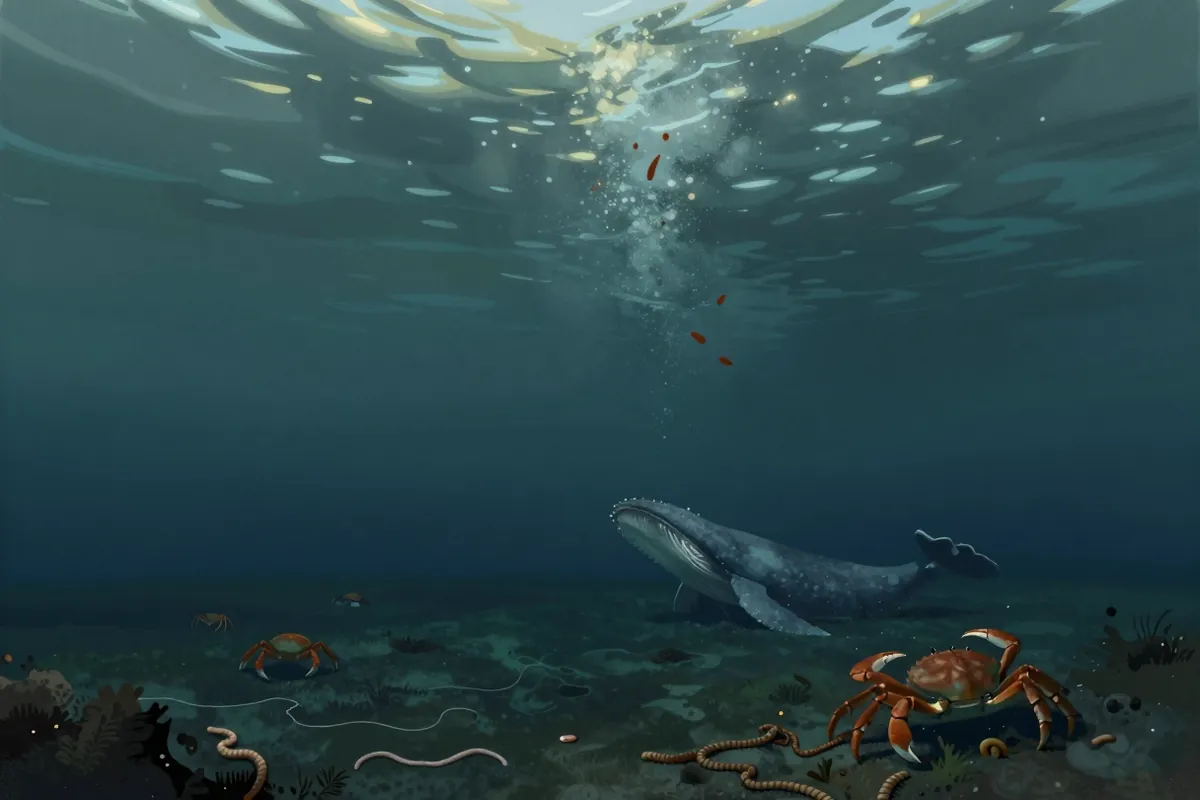
Sunlit surface waters: fresh material, fast turnover
In the upper ocean, microbes break down organic matter released by phytoplankton and algae as soon as it appears. Aquatic food webs trace energy from tiny plants and algae to small animals and then to larger animals (Aquatic food webs). Most of the fresh material is consumed or respired near the surface, so little of it leaves the sunlit layer intact.
The water column: sinking particles and decay in transit
Marine snow carries microbes and food to the deep sea (Aquatic food webs). Particles built from dead plankton, mucus, and fecal pellets sink slowly, and the decomposers riding them continue working during the descent. Each particle loses mass as it falls, so the food reaching deep water is smaller in quantity and poorer in quality than what left the surface.
Seafloor sediments: dense communities at the bottom
Sediments hold some of the densest microbial and animal communities in the ocean (Marine microorganisms). Microorganisms are essential to nutrient recycling in ecosystems as decomposers, and they drive the cycling of carbon, nitrogen, phosphorus, and trace elements. Burrowing animals mix sediment and supply oxygen to microbes, which accelerates breakdown of settled material (Decomposers).
The deep sea: cold and slow
Deep, cold, and low-oxygen conditions slow decomposition, and archaea are well suited to such habitats (Marine microorganisms). Cold water holds more dissolved gases but slows enzyme activity, so breakdown rates drop. Pressure and the scarcity of fresh material matter as well. Material that reaches the abyss may decay over much longer periods than the same material would in warm surface water.
Coastal marshes and estuaries: heavy plant input
Estuaries and salt marshes receive large inputs of dead plant matter, and decomposition there is strongly tied to temperature and water chemistry (Decomposers). Species of labyrinthulomycetes are abundant on dead vegetation in salt marshes and mangrove swamps, where their abundance tracks particulate organic matter from land sources (Little-Known Marine Decomposers Attract The Attention Of ...). Nitrogen and phosphorus released during breakdown can leave the marsh in drainage water. In river-dominated ecosystems, deforestation can lead to increased concentrations of ammonium and nitrate in drainage waters associated with eutrophication in streams and rivers.
| Zone | Conditions | Main decomposers | Pace |
|---|---|---|---|
| Sunlit surface water | Warm, oxygenated, bright | Bacteria, archaea, protists | Fast |
| Water column | Cooling with depth, particles sinking | Particle-attached bacteria, fungi, protists (Aquatic food webs) | Moderate, declining with depth |
| Seafloor sediment | Low oxygen below the surface layer | Bacteria, archaea, burrowing animals (Marine microorganisms) | Slow to moderate |
| Deep sea | Cold, dark, often low oxygen | Archaea, cold-adapted bacteria | Slow |
| Coastal marsh and estuary | Variable salinity, heavy plant litter | Bacteria, fungi, labyrinthulomycetes (Little-Known Marine Decomposers Attract The Attention Of ...) | Variable, temperature-linked (Decomposers) |
Temperature links these zones. Where warming raises sediment temperature, decomposition rates rise, and where cold and oxygen scarcity dominate, breakdown slows and organic matter accumulates (Decomposers).
How Ocean Decomposers Fit in Food Webs
A food web describes who eats whom in an ecosystem, and therefore how energy moves from prey to predator (Aquatic food webs). Most diagrams put producers at the bottom and consumers in layers above. Decomposers usually appear as a small box off to the side, which hides their real position. They sit at the junction where dead matter turns back into living matter.
Two ways into the web
Marine food webs have two entry points for energy. Photosynthesis by phytoplankton, algae, and seagrasses is the familiar one. The other is detritus, dead organic matter that still holds chemical energy and nutrients. Detritus food chains begin with that dead material instead of a living plant (Aquatic food webs). A dead fish, a shed crab shell, a clump of sinking marine snow, and a leaf washed out of a mangrove creek all start detritus pathways.
Bacteria and fungi break the material down and release inorganic nitrogen, phosphorus, and carbon compounds into the water (Decomposers in the Ocean). Phytoplankton take up those dissolved nutrients and build new cells, and the grazing chain starts again. Nutrient release and nutrient uptake are two halves of the same loop.
Decomposers are processors, and they are also food
Decomposers do not stand outside the food web as a disposal service. Microbial cells are eaten by protists and small animals, which are eaten in turn by larger consumers (Aquatic food webs). A bacterium that absorbs carbon from a dead copepod may itself be consumed within hours, passing that carbon up a trophic level. This short path keeps carbon and energy in the sunlit surface layer instead of letting them settle out. Plankton ecologists often call it the microbial loop.
| Position in the web | Main players | What moves |
|---|---|---|
| Dead organic matter | carcasses, molts, fecal pellets, marine snow | stored carbon and nutrients |
| Primary decomposers | bacteria, fungi, fungus-like protists | material converted to dissolved forms (Decomposers in the Ocean) |
| Grazers of microbes | protists, small zooplankton | microbial biomass (Aquatic food webs) |
| Higher consumers | fish, birds, marine mammals | energy from the grazing chain |
Carbon that leaves the system
Breakdown returns carbon to the water column and to sediments (Decomposers in the Ocean). Dissolved compounds can be taken up again, or they can bind to particles and settle. Some material sinks before microbes finish with it. Carbon that reaches the deep ocean can be stored there for long periods, out of contact with the atmosphere, which is why surface and deep waters behave as different carbon reservoirs (Aquatic food webs).
A worked example
Consider a salp that dies at 20 m depth. Bacteria colonize the carcass within hours and begin releasing dissolved nutrients. Flagellates graze on those bacteria, returning part of the carbon to the surface grazing chain. The carcass fragments and sinks. Material that reaches the seafloor is worked over again by sediment bacteria, worms, and deposit feeders. How much is left, and how fast it moves, depends on temperature, oxygen, and the tissue's chemical make-up.
The practical point: dead matter is not waste in the ecological sense. It is a stock of nutrients and energy that decomposers convert into forms other organisms can use, and that some organisms eat directly.
Common Misconceptions About Ocean Decomposers
Decomposition is often taught as a footnote to food webs: bacteria break things down, and that is the end of it. That shortcut creates several persistent misunderstandings.
| Myth | Why it fails |
|---|---|
| Decomposers are only bacteria and fungi | Marine worms, echinoderms, crustaceans, and mollusks also break down dead matter (Decomposers in the Ocean) |
| All decomposition happens on the seafloor | Dead matter is processed while floating, on rock surfaces, and in sediment |
| Decomposers matter little in open ocean food webs | Marine microbes recycle the major chemical elements and handle a huge share of the planet's organic matter (Marine microorganisms) |
| Scavengers and decomposers are the same group | Scavengers eat pieces; decomposers break material down chemically |
| Marine fungi and fungus-like organisms are rare and unimportant | In some regions they degrade organic matter about as effectively as bacteria (Little-Known Marine Decomposers Attract The Attention Of ...) |
Bacteria are the main recyclers, but not the only ones
Bacteria are the main decomposers in marine ecosystems, and in the coldest waters only bacteria and fungi can do the work because other creatures cannot survive there (Decomposers in the Ocean). Elsewhere the guild is much broader. Marine worms, echinoderms, crustaceans, and mollusks all take part. The Christmas tree worm spreads feathery appendages to catch organic particles drifting past. Sea stars and sea cucumbers move across rock and consume the decaying film that coats surfaces. These animals are sometimes called macrodecomposers because their contribution is physical as well as chemical: they fragment material and expose more surface to microbial attack.
Fungi, fungus-like protists, and a case of mistaken identity
The claim that marine fungi are rare often comes from confusing true fungi with a group that looks and behaves like them. Labyrinthulomycetes are single-celled marine decomposers that feed on nonliving plant, algal, and animal matter (Little-Known Marine Decomposers Attract The Attention Of ...). They are widespread and abundant, especially on dead vegetation and in salt marshes and mangrove swamps. In some regions they may be as important as bacteria in degrading organic matter, and their abundance tracks land-derived particulate matter more closely than marine organic matter. Because they make long-chain polyunsaturated fatty acids, they are thought to improve the nutritional value of poor-quality detritus for whatever eats it next. Some species are pathogens of eelgrass and hard clams, and some can degrade crude oil.
The seafloor is not the only workshop
Breakdown happens wherever dead material happens to be: drifting in the water column, resting on rock, buried in mud, or inside the gut of an animal. Filter-feeding worms capture particles suspended in the water (Decomposers in the Ocean), and echinoderms graze across stationary surfaces. On the abyssal plain, decomposition is slow and concentrated near the sediment surface. In shallow reefs and estuaries, a great deal of processing happens in the water column as well as on the bottom. Assuming that everything occurs in one place misses most of the activity.
Scavengers and decomposers overlap but are not the same
A shark feeding on a whale carcass is a scavenger. A bacterium dissolving that same tissue at the molecular level is a decomposer. Many animals do both: sea urchins and sea stars hunt live prey and also consume decaying organic matter coating surfaces (Decomposers in the Ocean). The distinction matters because scavengers remove biomass quickly, while decomposers control how fast nutrients return to the dissolved pool.
Each of these myths comes from the same habit of treating decomposition as one step performed by one group.
Threats and Limits to Ocean Decomposition
Decomposition in the ocean is uneven. Rates depend on temperature, oxygen, pressure, the chemical make-up of the material, and which organisms are present. Some of these limits are natural and permanent. Others are created or worsened by human activity.
| Limit | Mechanism | Consequence |
|---|---|---|
| Cold temperature | slows microbial metabolism | slower breakdown; in the coldest waters only bacteria and fungi remain active (Decomposers in the Ocean) |
| Low oxygen | removes aerobic respiration | breakdown slows and alternative pathways dominate |
| High pressure | restricts which microbes can grow | deep-sea communities differ from surface ones (Marine microorganisms) |
| Nutrient inputs | change microbial growth and oxygen demand | altered decomposition and knock-on food web effects (Aquatic food webs) |
| Plastic debris | resists microbial attack | persists in ocean gyres for decades (Georgia Institute of Technology) |
Cold water and pressure
Temperature is one of the strongest controls on microbial breakdown. Tropical oceans hold more decomposer organisms than the Atlantic or Arctic because of warmer temperatures, and in the coldest waters only bacteria and fungi do the decomposing because the larger creatures cannot survive there (Decomposers in the Ocean). In the deep sea, high pressure adds a second constraint, shaping which microbes can grow and how they allocate energy (Marine microorganisms). The communities that live there are adapted to those conditions, and they differ from communities in surface water.
Oxygen and nutrient loading
Where oxygen runs short, aerobic decomposers stall and anaerobic pathways take over. This is why organic-rich mud and stratified water columns accumulate partly degraded material. Adding nutrients to a water body shifts food web interactions directly and indirectly, and those effects cascade through the system (Aquatic food webs). The excess algal growth that follows nutrient loading eventually dies, and its decomposition consumes oxygen. The result can be water too low in oxygen for fish and for the decomposers themselves.
Plastic and synthetic debris
Plastic is carried by major currents to the centers of ocean gyres, where it resides for decades and exceeds 2 kg per square kilometer in the middle of the gyres (Georgia Institute of Technology). It affects marine organisms through ingestion, entanglement, and as a source of toxic chemicals, and it influences ocean biogeochemical cycles. Microbes can attack some plastics, and research continues on the rates, pathways, and controls of that degradation. Even so, breakdown lags far behind accumulation, which is why the material builds up in gyre centers.
Warming and shifting microbial activity
Marine microbes produce and consume roughly half of all organic matter generated on the planet each year, and they drive changes in every global system (Marine microorganisms). That scale means shifts in their activity reach far beyond the organisms themselves. Because decomposition rates respond to temperature, warming surface waters change how quickly nutrients return to the dissolved pool and how much carbon sinks before it is processed (Aquatic food webs). Predicting those shifts is difficult, because the microbiology is still poorly described, and the role of viruses in marine ecosystems has barely been explored.
What the limits mean in practice
For anyone managing a fishery, an aquaculture site, or a coastal bay, decomposition capacity sets a ceiling on how much organic waste a water body can absorb. Two measurements carry most of the signal: dissolved oxygen and nutrient concentration. When oxygen falls or nutrients climb, decomposition is already being pushed past its comfortable range.
Related Guides
- Cleaning Symbiosis in the Ocean: How Cleaner Fish and Shrimp Help Their Clients: Marine symbiotic interactions among reef animals
- Phenotypic Identification of Yeasts and Molds: Fungal identification methods for yeasts and molds
- Selective Isolation of Fungi from Mixed Cultures: Isolation techniques for studying marine fungi
- DNA Extraction from Fungi: Protocols for Yeast and Mold: DNA extraction methods for fungal decomposer research
- Neobenedenia melleni: Biology, Pathogenesis, Diagnosis, and Control of a Capsalid Monogenean Ectoparasite of Marine Teleosts: Marine parasite example affecting reef fish
- Tenacibaculum maritimum: A Comprehensive Reference on the Etiological Agent of Marine Tenacibaculosis: Specific marine bacterium example from aquaculture
- Coral Reef Facts: Essential Knowledge for Marine Aquarists: Coral reef ecosystem background for marine aquarists
- Coral Reef Fish: Species Selection and Compatibility for Marine Aquariums: Reef fish ecology and aquarium species selection
Frequently Asked Questions
What are ocean decomposers?
Ocean decomposers are organisms that break down dead plants, animals, and organic debris in seawater and seafloor sediments. Their activity releases inorganic nutrients such as nitrogen and phosphorus back into the water, where producers can use them again. Bacteria and fungi carry out most of this chemical work because they produce the enzymes needed to convert organic matter into inorganic forms (Decomposers). Larger animals, called macrodecomposers, also consume detritus and fragment it, which exposes more surface area to microbial attack (Decomposers in the Ocean). Microbes are the greatest decomposers of marine ecosystems (Georgia Institute of Technology).
What are examples of decomposers in the ocean?
Bacteria are the main marine decomposers, and tropical waters hold more of them than cold polar seas (Decomposers in the Ocean). Fungi, marine worms, echinoderms, crustaceans, and mollusks also take part. In the coldest water decay is slower, but scavenging animals and microbes still recycle dead matter.
| Group | Examples | Role |
|---|---|---|
| Bacteria | open-water and sediment microbes | main decomposers of marine systems (Decomposers in the Ocean) |
| Fungi and labyrinthulomycetes | single-celled forms on dead vegetation | abundant in salt marshes and mangroves (Little-Known Marine Decomposers Attract The Attention Of ...) |
| Marine worms | Christmas tree worm | feathery appendages catch drifting organic matter |
| Echinoderms | sea stars, sea urchins, sea cucumbers | graze decaying matter from rocks |
| Crustaceans and mollusks | various coastal species | listed among marine decomposers |
Do ocean decomposers need oxygen?
Oxygen availability strongly shapes how fast decomposition proceeds. The physiological requirements for growth and metabolism determine which microbial reactions can run in a given place, and adding oxygen can speed the microbial removal of contaminants from seawater (Georgia Institute of Technology). Well-mixed surface water carries more dissolved oxygen than stagnant bottom mud, so the same dead material can decay at very different rates depending on where it settles. Temperature matters as well: warm tropical seas support more decomposer organisms than cold polar waters (Decomposers in the Ocean).
How do decomposers help marine food webs?
They close the nutrient loop. Decomposition converts organic matter into inorganic nitrogen and phosphorus that producers can absorb again, which makes decomposers essential components of nutrient cycles (Decomposers). Microbial breakdown also releases particulates that re-enter the nutrient cycle (Georgia Institute of Technology). Because a food web traces energy from prey to predator, this steady return of dissolved nutrients to the producers at the base keeps the whole chain supplied (Aquatic food webs). Detritus fragments and microbial growth are themselves eaten by worms, crustaceans, and other small animals.
Are fungi decomposers in the ocean?
Yes, though they share the work with bacteria. Fungi appear on the standard list of marine decomposers, and in cold ocean water only bacteria and fungi carry out decomposition (Decomposers in the Ocean). A separate group, the labyrinthulomycetes, behaves ecologically like fungi: these single-celled organisms eat non-living plant, algal, and animal matter and are abundant on dead vegetation in salt marshes and mangrove swamps (Little-Known Marine Decomposers Attract The Attention Of ...). In some regions they may be as important as bacteria in degrading organic matter, including material that is hard to break down (Little-Known Marine Decomposers Attract The Attention Of ...).
What happens to dead animals in the ocean?
Decay starts almost at once. Scavengers and macrodecomposers such as sea stars, sea urchins, and crustaceans strip soft tissue and graze the films that form on rocks and other surfaces, while bacteria and fungi break down what remains (Decomposers in the Ocean). Microbial action releases particulates and inorganic nutrients that re-enter the nutrient cycle (Georgia Institute of Technology). Carcasses that sink are worked over on the seafloor. In cold water the job falls to bacteria and fungi alone, since the larger decomposers cannot survive there.
References and Further Reading
- Little-Known Marine Decomposers Attract The Attention Of ..., you.stonybrook.edu
- Georgia Institute of Technology, ocean.gatech.edu
- Decomposers in the Ocean, biologydictionary.net
- Marine microorganisms, en.wikipedia.org
- Aquatic food webs, noaa.gov
- Decomposers, dnr.sc.gov
- Little-Known Marine Decomposers Attract The Attention Of ..., news.stonybrook.edu