Detritivores vs Decomposers: Definitions and Examples
By Dr. Zubair Khalid, DVM, MS, PhD ·
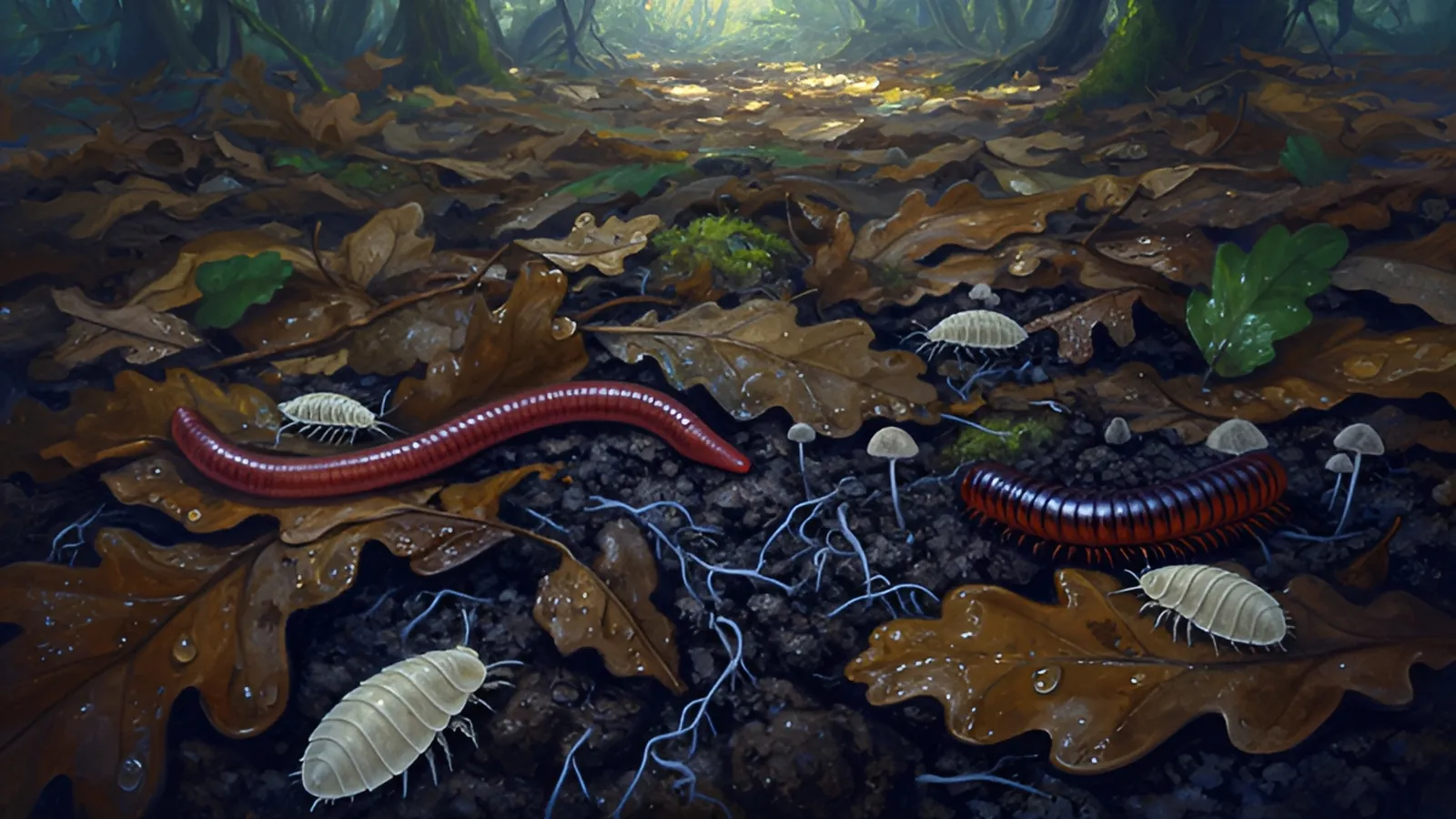
A detritivore is a heterotroph that gets its nutrients by consuming detritus, which includes decomposing plant and animal parts as well as feces (Detritivore). Invertebrates, vertebrates, and even some plants feed this way, and their consumption of dead matter contributes to decomposition and to nutrient cycles.
Detritivores differ from the other main group of decomposers. Bacteria, fungi, and protists cannot ingest discrete lumps of matter; they live by absorbing and metabolizing nutrients at a molecular scale, a mode of nutrition called saprotrophic nutrition (Detritivore). Despite this difference, the terms detritivore and decomposer are often used interchangeably, even though they describe different organisms. Detritivores fragment dead plant matter in the first stage of remineralization, which then allows decomposers to carry out the second stage.
Key Points
- Detritivores ingest discrete pieces of detritus, while bacteria, fungi, and protists feed by absorption at the molecular scale, so the two groups are distinct (Detritivore).
- Detritivores perform the first stage of remineralization by fragmenting dead plant matter; decomposers complete the second stage.
- Plant tissues are built from slow-decaying molecules such as cellulose, lignin, and xylan, and detritivore activity is the reason plant litter does not pile up in nature.
- Typical detritivores include millipedes, springtails, woodlice, dung flies, slugs, many terrestrial worms, sea stars, sea cucumbers, fiddler crabs, and terebellid polychaetes; in aquatic habitats, deposit feeding describes the ingestion of sediment to extract the particulate organic matter stuck to it.
- Macro-detritivores tolerate desiccation better, move farther, and fragment and relocate recalcitrant detritus to nutrient-enriched, climate-buffered sites, which enhances microbial decomposition when conditions are stressful (Revisiting decomposition theory through a macro-detritivore lens).
- Global environmental changes reduce the feeding activity of soil detritivores by 47.8 percent on average, a figure drawn from 650 observations across 55 studies (Global environmental changes threaten the feeding activity of soil detritivores).
At a Glance
| Item | Key point |
|---|---|
| Detritivore | Animal that ingests dead organic matter as particles (Detritivore) |
| Decomposer | Microorganism that digests dead matter outside its body and absorbs the products |
| Common detritivores | Earthworms, millipedes, woodlice, termites, springtails, and many aquatic invertebrates |
| Shared role | Both groups recycle nutrients, and detritivores also shred and move litter |
| Sensitivity | Detritivore feeding activity responds sharply to environmental change (Global environmental changes threaten the feeding activity of soil detritivores) |
Detritivores are animals that swallow dead plant and animal material, including feces, as solid particles, while decomposers such as bacteria and fungi digest dead matter outside the body and absorb the products (Detritivore). Both groups drive nutrient cycling, and a global meta-analysis of 650 observations from 55 studies found that global environmental changes reduce the feeding activity of soil detritivores by 47.8% on average (Global environmental changes threaten the feeding activity of soil detritivores).
What Is a Detritivore? Definition and Key Traits
Definition
A detritivore is a heterotroph that obtains nutrients by consuming detritus, which means decomposing plant and animal parts as well as feces (Detritivore). The group includes invertebrates, vertebrates, and even some plants that eat detritus or carry out coprophagy. All of them contribute to decomposition and to nutrient cycles through that feeding.
The defining feature is ingestion. A detritivore takes in solid particles of dead matter. Bacteria, fungi, and protists cannot ingest discrete lumps of material; they absorb and metabolize on a molecular scale, a mode of nutrition called saprotrophic (Detritivore). That single difference separates detritivores from the microbial decomposers they work alongside.
Alternative names
The same organisms appear in the literature under several labels: detrivores, detritophages, detritus feeders, and detritus eaters (Detritivore). The meaning does not change. Detritivores are usually arthropods and assist in remineralization.
Key traits
- Particle feeding. Detritus enters the mouth as solid fragments, not as a dissolved solution (Detritivore).
- Chewing or grinding structures. Mandibles, radulae, and muscular gizzards reduce litter to smaller pieces.
- Gut symbionts. Bacteria, fungi, and other microbes in the gut help break down plant cell walls (Detritivore).
- Size range. Macro-detritivores include millipedes, springtails, and woodlice, while microdetritivores are smaller organisms, a category that some sources extend to bacteria.
- Habitat breadth. Detritivores live in any soil with an organic component, and in marine ecosystems, where the term overlaps with bottom feeders.
Where detritivores live
Soil and leaf litter hold the best-known communities. Freshwater sediment, estuaries, and the deep sea hold others. In aquatic systems, deposit feeding describes detritivores that swallow sediment to extract the particulate organic matter stuck to the grains (Detritivore). Diets often include the microbial film on dead plant material, since detritivores consume dead plant tissue and the bacteria and fungi associated with it (Detritivore).
Typical examples
Millipedes, springtails, woodlice, dung flies, slugs, and many terrestrial worms are common detritivores. Marine examples include sea stars, sea cucumbers, fiddler crabs, and sedentary polychaetes such as worms of the family Terebellidae (Detritivore). Earthworms and termites are the standard soil examples used in teaching, and both combine particle feeding with microbial help in the gut.
Detritivores vs Decomposers: The Core Difference
Two feeding strategies
Decomposers are mainly bacteria and fungi, with some protists. They cannot ingest discrete lumps of matter. They release enzymes into the dead tissue around them, break it down outside the body, and absorb the products at a molecular scale, a process called saprotrophic nutrition (Detritivore). Detritivores are animals. They swallow pieces of detritus and digest them internally, often with help from gut microbes (Detritivore; Detritivore).
Side-by-side comparison
| Feature | Detritivore | Decomposer |
|---|---|---|
| Main groups | Animals, usually arthropods (Detritivore) | Bacteria, fungi, protists |
| Feeding mode | Ingestion of solid particles | External digestion, then absorption |
| Site of digestion | Inside the gut | Outside the body |
| Stage in remineralization | First stage, fragmentation | Second stage |
| Body size | Larger and mobile | Microscopic, mostly immobile |
| Effect on litter | Shreds, mixes, and moves it | Chemically breaks down what remains |
One processing chain
The two groups act in sequence. Detritivores perform the first stage of remineralization by fragmenting dead plant matter, which allows decomposers to carry out the second stage (Detritivore). Fragmentation increases the surface area available to microbial enzymes and mixes litter into the soil.
Plant tissues contain resilient molecules such as cellulose, lignin, and xylan that decay far more slowly than other organic molecules. Detritivore activity is the reason plant litter does not accumulate without limit in nature (Detritivore).
Macro-detritivores add a second effect. Larger body size, lower sensitivity to desiccation, nutritional adaptations, and greater mobility allow them to process detrital resources when decomposition by smaller organisms is limited. They also enhance microbial decomposition under stressful conditions by fragmenting and moving recalcitrant detritus to nutrient-enriched, climate-buffered locations (Revisiting decomposition theory through a macro-detritivore lens). Those pathways could become more influential in a warmer and drier world.
A terminology trap
The terms detritivore and decomposer are often used interchangeably, but they describe different organisms (Detritivore). Some textbooks treat detritivores as a subset of decomposers, which works when "decomposer" means any organism that contributes to decay. The label becomes confusing when the same word refers to the microbial group alone. Detritivores are usually arthropods and assist in remineralization.
Detritivores vs Saprophytes and Scavengers: Sorting the Terms
Saprophyte and saprotroph
Saprophyte is an older term for an organism that feeds on dead matter. The root suggests a plant, which misleads, because most organisms in this group are fungi or bacteria. Saprotroph is the modern term. It describes fungi, bacteria, and protists that digest dead tissue outside the body and absorb the products, the mode of nutrition called saprotrophic (Detritivore). A detritivore is an animal that ingests particles; a saprotroph is a microorganism that absorbs molecules. The two labels are not interchangeable.
Scavengers
Scavengers are not typically treated as detritivores because they generally eat large quantities of organic matter at once, such as a carcass (Detritivore). Both groups are the same type of case in consumer-resource systems, so the same mathematical description of a consumer finding and consuming a resource applies to each. The practical difference is particle size and timing. A vulture removes a whole carcass in hours; a millipede works through fine litter over weeks.
Coprophages and xylophages
Coprophagy is the consumption of feces, and detritivores include animals that carry out coprophagy (Detritivore). Dung beetles and dung flies are the familiar examples. Xylophagy is the consumption of wood, whether the wood is alive or dead. Termites and wood-boring beetle larvae are xylophages, and most depend on gut microbes to extract energy from cellulose and lignin.
Comparison table
| Term | Who | What is eaten | How it is processed |
|---|---|---|---|
| Detritivore | Animals, mostly arthropods (Detritivore) | Fine litter, debris, feces | Ingested as particles, digested internally |
| Saprotroph | Fungi, bacteria, protists | Dead tissue and dissolved organic matter | Enzymes released outside the body, products absorbed |
| Scavenger | Animals | Large carcasses | Ingested in bulk |
| Coprophage | Animals | Dung | Ingested |
| Xylophage | Animals | Wood, alive or dead | Ingested, usually with microbial help |
| Deposit feeder | Aquatic animals | Sediment with attached organic matter | Sediment ingested, organic fraction extracted |
Why the labels matter
The labels describe feeding mode, not taxonomy, and one animal can fit several. A dung beetle is a coprophage and a detritivore. A termite is a xylophage and a detritivore. A fiddler crab can act as a deposit feeder in mud and a scavenger around a dead fish (Detritivore). In food web studies, the useful question is which pathway the organism uses: ingestion of particles, absorption of dissolved molecules, or bulk consumption of a carcass.
Where Detritivores Fit in the Food Web
A food web is often drawn as a green chain: plants, herbivores, predators. A second pathway runs beside it, and it begins with dead material. Detritivores are heterotrophs that obtain nutrients by consuming detritus, a category that includes decomposing plant and animal parts and feces (Detritivore). This detrital pathway carries a large share of the energy that enters an ecosystem.
The Detrital Pathway Runs Parallel to Grazing Chains
Every trophic level above the soil produces dead tissue. Leaves fall, roots die back, insects molt, animals defecate and die. Detritus therefore carries energy that originated at every level of the grazing chain (Detritivore). Detritivores intercept that material before it is fully mineralized and convert it into living animal tissue and feces.
The two pathways are not sealed off from each other. A caterpillar that eats a leaf may be eaten by a bird, or it may die and enter the detrital pathway. A detritivore that eats the fallen leaf may later be eaten by that same bird. Energy crosses between the grazing chain and the detrital chain at many points, which is why detritivores cannot be treated as a side branch of the food web.
Detritivores as Prey
Detritivores are food for a wide range of predators. Birds, ground beetles, spiders, centipedes, frogs, and fish all take them. Because detritivores are often slow-moving and concentrated in litter or sediment, they form a dense and predictable food supply. In streams, caddisfly larvae and amphipods are eaten by trout and other fish. In soil, earthworms and millipedes are taken by birds, shrews, and beetles. Predators that feed on detritivores link the detrital pathway back to the grazing chain.
Feces, Frass, and the Microbial Loop
What detritivores do not assimilate leaves the gut as feces, frass, or casts. This material is partly processed, finely divided, and rich in microbial cells, so it is a better substrate for bacteria and fungi than the original litter. Feces also become part of soil organic matter. Detritivores therefore feed the decomposers that work at the molecular scale, and the two groups act in sequence on the same material (Detritivore).
Deposit Feeding in Water and Sediment
In aquatic systems, many detritivores are deposit feeders. They ingest sediment in order to extract the particulate organic matter stuck to the particles (Detritivore). The same term is used for marine bottom feeders. Deposit feeding links the water column, where dead plankton sinks, to the sediment, where the material is processed again by worms, crustaceans, and microbes.
Where Scavengers Sit
Scavengers are not typically treated as detritivores because they generally eat large quantities of organic matter at once, but detritivores and scavengers are both cases of consumer-resource systems (Detritivore). A vulture at a carcass and a millipede at a fallen leaf occupy different positions on the same broad pathway, and both return nutrients to circulation.
Types of Detritivores: Examples Across Habitats
Detritivores appear in nearly every habitat that accumulates dead organic matter. They can live on any type of soil with an organic component, including marine ecosystems, where the term is used interchangeably with bottom feeders (Detritivore). The table below groups common examples by habitat.
| Habitat | Common detritivores | Notes |
|---|---|---|
| Soil and leaf litter | Earthworms, millipedes, springtails, woodlice, enchytraeid worms | Fragment litter and mix it into soil |
| Freshwater | Caddisfly larvae, amphipods, isopods, some mayfly nymphs | Shred fallen leaves in streams |
| Marine sediment | Polychaete worms such as Terebellidae, sea cucumbers, brittle stars, crabs | Many are deposit feeders |
| Dead wood and coarse litter | Termites, cockroaches, land snails, mites | Some are xylophagous |
| Vertebrates | Some fish, tadpoles, vultures at carcasses | Scavenging vertebrates are usually treated separately |
Soil and Litter
Soil holds the best-known detritivores. Millipedes, springtails, woodlice, dung flies, slugs, and many terrestrial worms all feed on dead plant material and associated microbes (Detritivore). Earthworms and enchytraeid worms work through both litter and mineral soil, while woodlice and millipedes stay closer to the surface.
Freshwater
Stream detritivores depend on leaves that fall from the surrounding land. Caddisfly larvae, amphipods, isopods, and some mayfly nymphs shred this material, which would otherwise be exported downstream. Their feeding converts leaf litter into insect biomass that fish can use.
Marine
Marine detritivores include sea stars, sea cucumbers, fiddler crabs, and sedentary marine polychaetes such as worms of the family Terebellidae (Detritivore). Many of these animals are deposit feeders that ingest sediment and digest the organic film attached to the grains.
Dead Wood
The consumption of wood, whether alive or dead, is known as xylophagy (Detritivore). Termites, some beetle larvae, and certain cockroaches and mites fall into this group. Wood is among the most recalcitrant of detrital resources, so these animals rely heavily on gut symbionts.
Vertebrates and the Scavenger Boundary
Some fish and tadpoles feed on detritus, and vultures consume carcasses. Scavengers are not typically classified as detritivores because they eat large quantities of organic matter at once, though both are consumer-resource systems (Detritivore).
Size Classes
Detritivores are sometimes divided by size. Macrodetritivores are larger organisms such as millipedes, springtails, and woodlice, while microdetritivores are smaller organisms, a group that has included bacteria in some classifications (Detritivore). Bacteria are usually treated as decomposers instead, because they absorb nutrients at a molecular scale. Body size across the group spans from tiny soil mites to crabs and sea cucumbers many times their size (Revisiting decomposition theory through a macro-detritivore lens). Larger body size, lower sensitivity to desiccation, nutritional adaptations, and greater mobility allow macro-detritivores to keep processing detritus when smaller organisms are limited.
How Detritivores Feed: Ingestion, Gut Symbionts, and Fragmentation
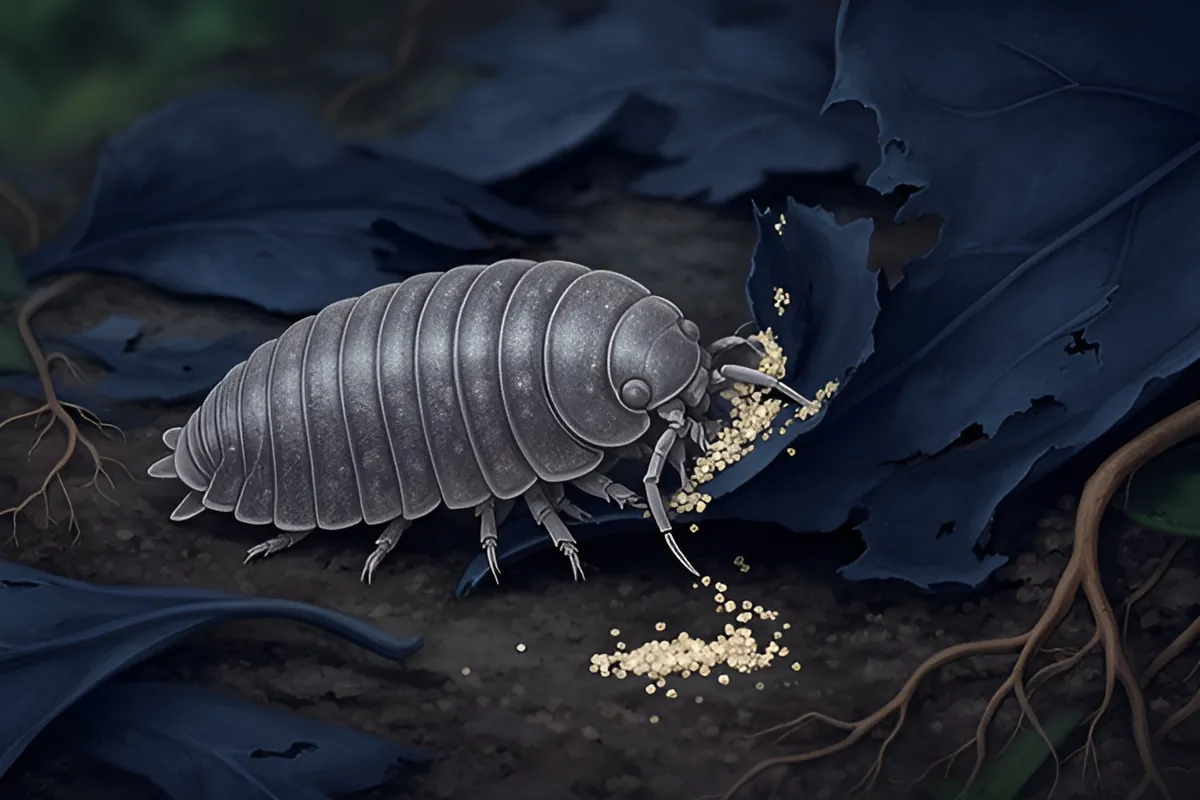
Detritivore is a broad term that covers organisms consuming dead plant material or the microorganisms associated with it (Detritivore). Feeding is physical before it is chemical: the animal must bite, tear, or grind detritus before enzymes can reach the interior of the particles.
Step 1: Shredding and Fragmentation
Detritivores perform the first stage of remineralization by fragmenting dead plant matter, which allows decomposers to perform the second stage (Detritivore). Shredding multiplies the surface area available to microbes and enzymes, and it breaks the waxy and lignified barriers that protect leaf tissue.
Step 2: Enzymes and Gut Symbionts
Plant tissues are built from resilient molecules such as cellulose, lignin, and xylan that decay much more slowly than other organic molecules (Detritivore). Gut enzymes and resident microbes attack these polymers. Chitin from dead arthropods and fungal walls is another tough substrate. The animal supplies the grinding and the gut environment; the symbionts supply part of the chemistry.
Step 3: Assimilation and What Passes Through
Assimilation efficiency is low in most detritivores, so a large fraction of ingested material passes through the gut. The residue leaves as frass, pellets, or casts. This is not waste from the ecosystem's point of view. The output is finer, wetter, and more colonized by microbes than the input, which makes it easier for bacteria and fungi to finish the job (Detritivore).
Worked Example: One Leaf Through a Millipede
A dead leaf falls to the forest floor. A millipede chews the edge, breaking the leaf into fragments and increasing exposed surface area. In the gut, enzymes and symbionts strip away soft tissue and part of the cellulose. The millipede assimilates a modest share of the carbon and nitrogen. The rest leaves as a fecal pellet, which holds partly digested tissue, microbial cells, and moisture. Fungi and bacteria colonize the pellet, and nutrients are released into the soil solution. The leaf has moved from litter to animal tissue to soil organic matter in a few days.
| Stage | What happens | Main agents |
|---|---|---|
| Shredding | Litter is torn into smaller pieces | Mouthparts of detritivores |
| Digestion | Cellulose, chitin, and other polymers are attacked | Gut enzymes, symbionts |
| Assimilation | A small share of carbon and nitrogen is absorbed | Detritivore gut |
| Excretion | Frass and casts return to soil or sediment | Detritivore, then microbes |
What Controls Feeding Rate
Feeding rates depend on temperature, moisture, and litter quality (Global environmental changes threaten the feeding activity of soil detritivores). Macro-detritivores are less sensitive to desiccation and more mobile, so they can continue processing detritus when smaller organisms slow down (Revisiting decomposition theory through a macro-detritivore lens). They also move recalcitrant material into nutrient-enriched, climate-buffered spots where microbial breakdown proceeds faster.
Why Detritivores Matter: Nutrient Cycling and Soil Health
Litter Does Not Pile Up
The activity of detritivores is the reason plant litter does not accumulate in nature (Detritivore). Without shredding, fallen leaves and dead wood would build up faster than microbes alone could process them. Their feeding activity accelerates the turnover of organic matter and nutrients, enhancing energy and material flows within soil food webs (Global environmental changes threaten the feeding activity of soil detritivores).
Mixing, Structure, and Water
Burrowing detritivores move surface litter into mineral soil, where it is protected and processed further. Earthworm channels and insect burrows create pores that improve water infiltration and soil structure. Macro-detritivores also translocate recalcitrant detritus to nutrient-enriched and climate-buffered locations, which raises microbial decomposition rates under stressful conditions (Revisiting decomposition theory through a macro-detritivore lens).
Seeds, Spores, and Microbes
Detritivores redistribute more than carbon. As they move through litter and soil, they carry seeds, fungal spores, and microbial cells on their bodies and through their guts. Some seeds pass through intact and germinate later. This dispersal spreads decomposer communities into fresh litter and helps maintain soil biodiversity.
When Feeding Activity Falls
A global meta-analysis of 650 observations from 55 studies found that global environmental changes reduce the feeding activity of soil detritivores by 47.8% on average (Global environmental changes threaten the feeding activity of soil detritivores). The strongest drivers were climate change, chemical pollution, fire, and land-use intensification.
| Driver | Change in feeding activity |
|---|---|
| Climate change | -59.8% |
| Chemical pollution | -57.6% |
| Fire | -49.1% |
| Land-use intensification | -34% |
| Drought | -68.9% |
| Warming | -25.4% |
| Insecticides | -98.9% |
| Fungicides | -59.7% |
| Heavy metals | -59.5% |
| Mineral fertilization | -45.6% |
| Grazing | -20.3% |
| Tillage | -11.8% |
Drought suppresses feeding far more than warming, and insecticides are the most damaging chemical class in the dataset (Global environmental changes threaten the feeding activity of soil detritivores). Within land-use intensification, mineral fertilization drives most of the loss, while grazing and tillage have minor effects. The size of the reduction depends on ecosystem type, soil organic carbon, soil pH, and detritivore species richness and abundance.
Why the Loss Matters
Fewer active detritivores mean slower litter breakdown, slower nutrient release, and weaker energy transfer through soil food webs (Global environmental changes threaten the feeding activity of soil detritivores). Because macro-detritivores can work when moisture and temperature are unfavorable for microbes, losing them removes a buffer that keeps decomposition running in dry or disturbed systems (Revisiting decomposition theory through a macro-detritivore lens). Protecting detritivore communities is one way to keep nutrient cycling intact as climates shift.
Common Misconceptions About Detritivores
Detritivores are common, easy to find in a garden or under a log, and still widely misunderstood. Five myths account for most of the confusion.
Myth: Detritivores eat only dead plants
Detritus is broader than fallen leaves. It includes decomposing plant and animal parts as well as feces (Detritivore). Carrion, dung, shed skin, and dead invertebrates all qualify. Coprophagy, the consumption of feces, is documented among detritivores. A millipede feeding on a dead earthworm and one feeding on a dead leaf are doing the same ecological job.
Myth: Detritivores and decomposers are the same thing
The terms are often used interchangeably, but they describe different organisms (Detritivore). Bacteria, fungi, and protists absorb and metabolize on a molecular scale, a mode called saprotrophic nutrition, and cannot ingest discrete lumps of matter. Detritivores ingest and fragment. The two groups work in sequence: detritivores fragment dead plant matter and perform the first stage of remineralization, which allows decomposers to perform the second stage.
| Feature | Detritivore | Microbial decomposer |
|---|---|---|
| Feeding mode | Ingests discrete particles | Absorbs dissolved molecules |
| Typical groups | Arthropods, worms, echinoderms | Bacteria, fungi, protists |
| Sequence | Fragmentation, first stage of remineralization | Molecular breakdown, second stage |
| Where they act | Litter layer, soil, sediment, gut | Surfaces, pore water, biofilms |
Myth: Detritivores are unimportant because they eat waste
Their activity is the reason plant litter does not accumulate in nature (Detritivore). Plant tissues are built from resilient molecules such as cellulose, lignin, and xylan that decay far more slowly than other organic molecules. Without fragmentation, that material would sit on the surface for years. Detritivores are an important aspect of many ecosystems.
Myth: All detritivores are insects
Many are not insects at all. Typical detritivorous animals include millipedes, springtails, woodlice, dung flies, slugs, many terrestrial worms, sea stars, sea cucumbers, fiddler crabs, and sedentary marine polychaetes such as worms of the family Terebellidae (Detritivore). Woodlice are crustaceans, sea stars and sea cucumbers are echinoderms, and earthworms are annelids. Invertebrates, vertebrates, and even some plants eat detritus or carry out coprophagy.
Myth: Detritus is worthless
Detritus still carries usable energy and nutrients. Detritivores are heterotrophs that obtain nutrients by consuming it (Detritivore). The energy in a dead leaf is locked inside tough polymers, not destroyed. Detritivores release it, and the nutrients return to the soil food web. In aquatic systems, the same logic applies to deposit feeders, which ingest sediment to extract the particulate organic matter stuck to it.
Threats to Detritivore Feeding Activity
Soil detritivores represent a major portion of terrestrial biodiversity and biomass, and their feeding accelerates the turnover of organic matter and nutrients (Global environmental changes threaten the feeding activity of soil detritivores). That activity is now measurable as a declining variable. A global meta-analysis of 650 observations from 55 studies found that global environmental changes reduce the feeding activity of soil detritivores by 47.8% on average.
Climate change: drought is worse than warming
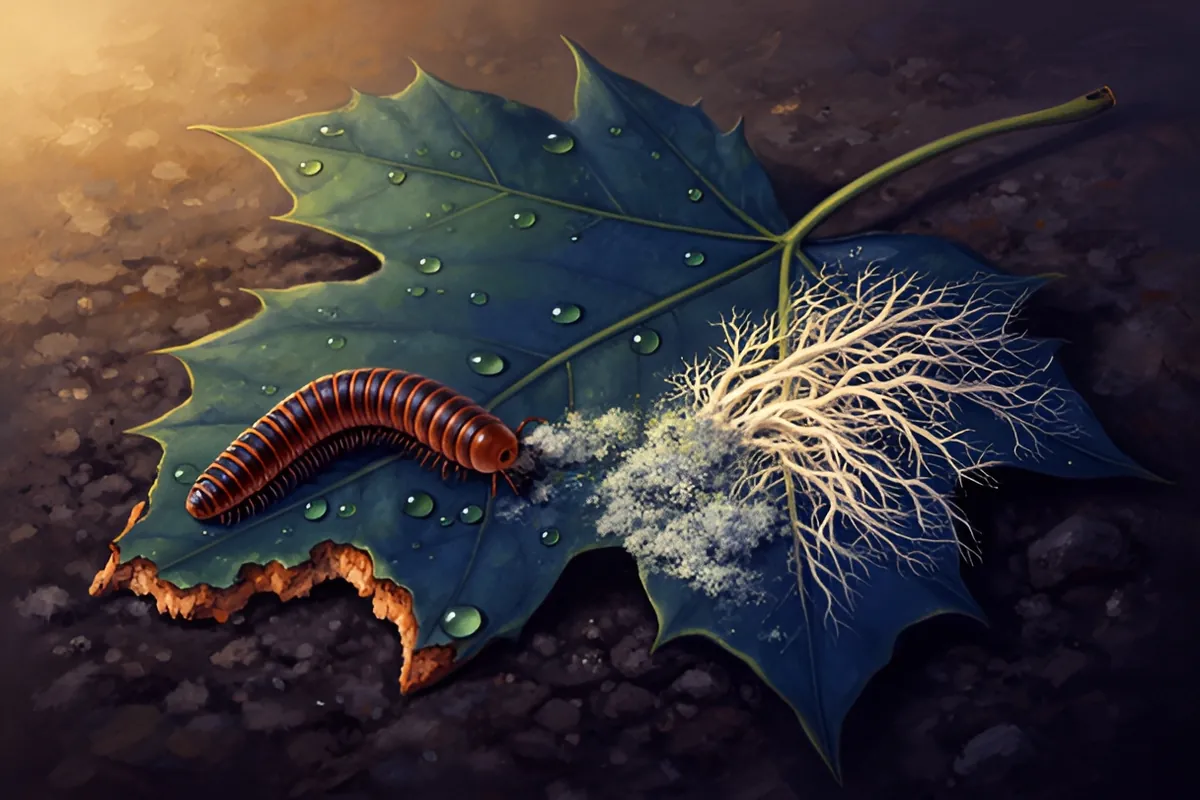
Climate change as a whole reduced feeding activity by 59.8% (Global environmental changes threaten the feeding activity of soil detritivores). Within it, drought suppressed feeding by 68.9%, far more than warming at 25.4%. Soil animals depend on water films for movement and foraging, so drying is a direct constraint. Macro-detritivores are less sensitive to desiccation than smaller organisms and can keep processing litter when microbial decomposition is limited (Revisiting decomposition theory through a macro-detritivore lens). That buffering is real but partial.
Chemical pollution
Chemical pollution reduced feeding activity by 57.6% overall (Global environmental changes threaten the feeding activity of soil detritivores). Insecticides were the most damaging class, at 98.9%, followed by fungicides at 59.7% and heavy metals at 59.5%. A near-total loss of feeding activity under insecticide exposure means the fragmentation step effectively stops in treated soil.
Fire
Fire reduced feeding activity by 49.1% (Global environmental changes threaten the feeding activity of soil detritivores). Burning removes the litter layer that detritivores feed on and changes soil temperature and moisture.
Land use intensification
Land use intensification reduced feeding activity by 34% (Global environmental changes threaten the feeding activity of soil detritivores). The effect was driven mainly by mineral fertilization, at 45.6%, while grazing and tillage had minor effects, at 20.3% and 11.8%.
Invasive species
Introduced detritivores and predators can displace native species, change litter chemistry, and alter the structure of the litter layer. The community that remains processes detritus differently from the one it replaced.
Effect sizes at a glance
| Driver | Reduction in feeding activity |
|---|---|
| Climate change (all) | 59.8% |
| Drought | 68.9% |
| Warming | 25.4% |
| Chemical pollution | 57.6% |
| Insecticides | 98.9% |
| Fungicides | 59.7% |
| Heavy metals | 59.5% |
| Fire | 49.1% |
| Land use intensification | 34% |
| Mineral fertilization | 45.6% |
| Grazing | 20.3% |
| Tillage | 11.8% |
All values are from a global meta-analysis of 650 observations from 55 studies (Global environmental changes threaten the feeding activity of soil detritivores).
Why the decline matters
Feeding activity accelerates the turnover of organic matter and nutrients and enhances energy and material flows within soil food webs (Global environmental changes threaten the feeding activity of soil detritivores). When it falls, energy transfer within those webs is impaired, with consequences for ecosystem functioning. The size of the reduction depends on ecosystem type, soil organic carbon, pH, and detritivore species richness and abundance. Slower feeding also slows decomposition and nutrient cycling, because the fragmentation step that opens plant tissue to microbial attack becomes less frequent.
Studying Detritivores: Methods and Measurement
Detritivores are small, often nocturnal, and hidden in soil or sediment. Measuring what they eat and how fast they process it requires specific methods, and each method has a different time window and bias.
Litter bags
The litter bag is the workhorse of decomposition research. A known mass of dried leaf litter is sealed in a mesh bag, placed on the soil surface or buried, and retrieved at intervals. Mass loss over time gives a breakdown rate. Mesh size controls access: fine mesh excludes macrofauna, coarse mesh admits it, and the difference between the two estimates the faunal contribution to decomposition. Litter bags are simple and comparable across sites, but they exclude some large animals and can alter moisture and temperature inside the bag.
Berlese funnels and pitfall traps
A Berlese-Tullgren funnel extracts animals from a soil or litter sample. Heat and light from above drive mobile invertebrates downward, and they fall into a preservative below. The method recovers mites, springtails, and small insects well. Pitfall traps are cups set flush with the soil surface that catch surface-active animals such as ground beetles, millipedes, and woodlice. Pitfall catches measure activity and relative abundance, not absolute population size, because catch rates depend on movement and weather.
Gut content analysis and stable isotopes
Dissecting guts and identifying fragments under a microscope shows what an animal has eaten most recently. Stable isotope analysis of carbon and nitrogen integrates diet over weeks to months and separates detritus-based feeding from predation. Fatty acid profiles add another line of evidence. Because the time windows differ, studies often combine these approaches.
Mesocosm experiments
Mesocosms are controlled containers of soil, litter, and a known assemblage of detritivores. Researchers manipulate species richness, moisture, temperature, or litter quality, then measure decomposition, respiration, and nutrient release (Revisiting decomposition theory through a macro-detritivore lens). Mesocosms isolate faunal effects from microbial ones and allow replication that field sites cannot provide. Work in this area shows that macro-detritivores enhance microbial decomposition under stressful conditions by fragmenting and moving recalcitrant detritus to nutrient-enriched, climate-buffered locations.
Trait-based frameworks and synthesis
New frameworks link detritivore traits to ecosystem models (Revisiting decomposition theory through a macro-detritivore lens). Body size, desiccation tolerance, mobility, and nutritional adaptations determine when macro-detritivores can process detritus that smaller organisms cannot reach. At a larger scale, meta-analysis pools many studies into one estimate. One global synthesis used 650 observations from 55 studies to quantify how environmental change alters the feeding activity of soil detritivores (Global environmental changes threaten the feeding activity of soil detritivores). Feeding activity itself is often scored with bait lamina, thin sticks holding a substrate in small holes that are inserted into soil, retrieved after a set period, and rated by how many holes show consumption. Combining trait data, field methods, and synthesis gives a fuller picture of detritivore function than any single method.
Related Guides
- The Carbon Cycle: Steps, Diagram and Why It Matters
- The Nitrogen Cycle: Steps, Bacteria and Diagram
- What Is an Ecosystem? Definition, Components and Examples
- Trophic Level: Definition and Examples
- Primary Consumer: Definition and Food Chain Role
Frequently Asked Questions
What is a detritivore?
Detritivores are heterotrophs that obtain nutrients by consuming detritus, which includes decomposing plant and animal parts as well as feces (Detritivore). They ingest discrete lumps of matter, unlike bacteria and fungi that absorb nutrients on a molecular scale. The group spans invertebrates, vertebrates, and even some plants that eat detritus or practice coprophagy. By feeding this way, detritivores contribute to decomposition and nutrient cycles. Typical examples include millipedes, springtails, woodlice, dung flies, slugs, many terrestrial worms, sea stars, sea cucumbers, and fiddler crabs.
What is the difference between a detritivore and a decomposer?
Both terms describe organisms that break down dead material, but they feed differently. Detritivores ingest and fragment solid detritus, while many decomposers such as bacteria, fungi, and protists cannot ingest discrete lumps of matter and instead absorb and metabolize nutrients on a molecular scale through saprotrophic nutrition (Detritivore). Detritivores perform the first stage of remineralization by fragmenting dead plant matter, which allows decomposers to carry out the second stage. The two terms are often used interchangeably, yet they describe different organisms.
Are earthworms detritivores or decomposers?
Earthworms are detritivores. They are listed among the many terrestrial worms that consume detritus, ingesting solid dead plant and animal material along with associated microorganisms (Detritivore; Detritivore). Because they swallow and fragment this material, they act in the first stage of remineralization, breaking litter into smaller pieces that bacteria and fungi then process further (Detritivore). Earthworms are not decomposers in the strict sense, since decomposers such as bacteria and fungi absorb nutrients at a molecular scale instead of ingesting lumps of matter.
What are examples of detritivores?
Common detritivores include millipedes, springtails, woodlice, dung flies, slugs, many terrestrial worms, sea stars, sea cucumbers, fiddler crabs, and sedentary marine polychaetes such as worms of the family Terebellidae (Detritivore). Aquatic detritivores that ingest sediment to extract particulate organic matter are called deposit feeders, and in marine settings they are sometimes termed bottom feeders. Detritivores can also be grouped by size: macrodetritivores are larger organisms such as millipedes, springtails, and woodlice, while microdetritivores are smaller organisms.
Are detritivores consumers or producers?
Detritivores are consumers. They are heterotrophs, meaning they cannot build their own food and must obtain nutrients by consuming detritus, which consists of decomposing plant and animal parts and feces (Detritivore). Producers, by contrast, assemble organic matter from inorganic sources. As consumers, detritivores feed on dead organic material and, in doing so, contribute to decomposition and nutrient cycling. Their feeding activity accelerates the turnover of organic matter and nutrients, enhancing energy and material flows within soil food webs (Global environmental changes threaten the feeding activity of soil detritivores).
Why are detritivores important in an ecosystem?
Detritivores fragment dead plant matter, allowing decomposers to complete the second stage of remineralization (Detritivore). Their activity prevents plant litter from accumulating in nature, since molecules such as cellulose and lignin decay slowly on their own. Soil detritivores represent a major portion of terrestrial biodiversity and biomass, and their feeding accelerates the turnover of organic matter and nutrients, supporting energy flow through soil food webs (Global environmental changes threaten the feeding activity of soil detritivores). Macro-detritivores can also decompose detrital resources when conditions limit smaller organisms, moving recalcitrant material to nutrient-enriched, climate-buffered locations (Revisiting decomposition theory through a macro-detritivore lens).
References and Further Reading
- Detritivore, en.wikipedia.org
- Revisiting decomposition theory through a macro-detritivore lens, Trends in ecology & evolution (2026)
- Global environmental changes threaten the feeding activity of soil detritivores, Current biology : CB (2026)
- Detritivore, sciencedirect.com