How to Calculate Win Percentage (Formula and Examples)
By Dr. Zubair Khalid, DVM, MS, PhD ·
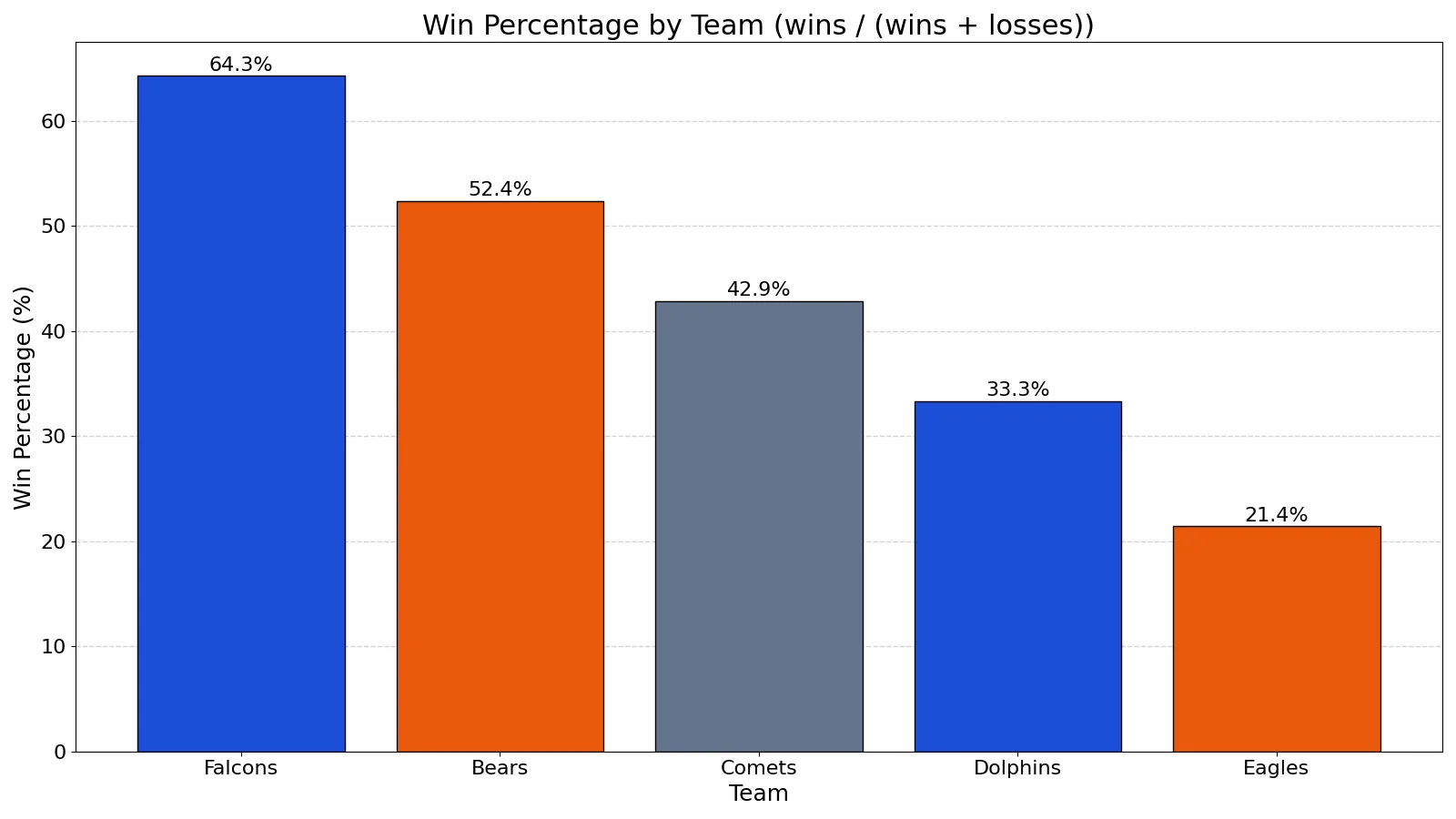
Win percentage is the number of games a team or player has won divided by the total number of games played. If a team went 27-15, that is 27 wins out of 42 games, or 0.6429. This article shows how to calculate win percentage for a full season, how ties change the formula, and how to do it in Excel or Python.
Quick Answer
- Win percentage = wins ÷ total games played.
- Total games = wins + losses + ties.
- A tie counts as half a win, so the numerator becomes wins + 0.5 × ties [1].
- A 27-15 record gives 27 ÷ 42 = 0.6429, or 64.29%.
- In North American sports, the result is usually written as a three-decimal value like .643 instead of a percentage [1].
The Formula
The basic formula for a record with no ties is:
$$\text{Win percentage} = \frac{\text{wins}}{\text{wins} + \text{losses}}$$
When ties or draws are possible, the standard formula adds half a win for each tie [1]:
$$\text{Win percentage} = \frac{\text{wins} + 0.5 \times \text{ties}}{\text{wins} + \text{losses} + \text{ties}}$$
Each symbol means the following:
- Wins: games the team finished ahead, or matches the player won.
- Losses: games the team finished behind.
- Ties: games that ended level. Each one contributes 0.5 to the numerator.
- Total games: every game played, win, loss or tie. This is the denominator.
Multiply the result by 100 to express it as a percentage. Leave it as a decimal to match the North American convention, where .650 means 65.0% [1].
How to Calculate It Step by Step
- Count the wins. Write down the number of games won.
- Count the losses. Write down the number of games lost.
- Count the ties, if your sport allows them. If not, use zero.
- Add the three counts to get total games played.
- Add half the tie count to the win count to get adjusted wins.
- Divide adjusted wins by total games. That is the win percentage as a decimal.
- Multiply by 100 if you want a percentage.
For a record with no ties, steps 3 and 5 drop out and you simply divide wins by games played.
Worked Example
The table below holds five teams' season win-loss records. No ties appear, so the simple formula applies.
| Team | Wins | Losses |
|---|---|---|
| Falcons | 27 | 15 |
| Bears | 22 | 20 |
| Comets | 18 | 24 |
| Dolphins | 14 | 28 |
| Eagles | 9 | 33 |
Take the Falcons. Games played is wins plus losses:
27 + 15 = 42
Win percentage is wins divided by games:
27 / 42 = 0.6429
As a percentage:
0.6429 * 100 = 64.29%
The same division for every team gives the full standings:
| Team | Wins | Losses | Games | Win % |
|---|---|---|---|---|
| Falcons | 27 | 15 | 42 | 0.6429 |
| Bears | 22 | 20 | 42 | 0.5238 |
| Comets | 18 | 24 | 42 | 0.4286 |
| Dolphins | 14 | 28 | 42 | 0.3333 |
| Eagles | 9 | 33 | 42 | 0.2143 |
The Falcons lead at 64.3% and the Eagles trail at 21.4%.
You can also compute a rolling win percentage over a recent stretch. If the Falcons won 7 of their last 10 games, that window gives:
7 / 10 = 0.7000
A rolling figure like this shows current form, while the season figure shows the whole year.
Here is the same calculation in Python:
wins, losses = 27, 15
win_pct = wins / (wins + losses)
print(round(win_pct, 4))  # 0.6429
Output:
0.6429How to Interpret the Result
A win percentage of 0.6429 means the team won about 64% of its games. Values above 0.500 mean more wins than losses. Values below 0.500 mean more losses than wins. Exactly 0.500 is an even record.
Win percentage is a rate, so it lets you compare teams that played different numbers of games. A 27-15 team and a 22-20 team have both played 42 games here, but that will not always be true. Dividing by games played puts every team on the same 0-to-1 scale.
The number is also easy to convert. To turn a win percentage into an expected win total, multiply it by the games in a season. To compare two teams, subtract one win percentage from the other. The gap between the Falcons at 0.6429 and the Bears at 0.5238 is 0.1191, or about 12 percentage points.
If you need to convert between decimals and percentages in general, the same mechanics apply as in how to calculate a percentage.
Doing It in Software (Excel, R or Python)
Excel. Put wins in column A and losses in column B, starting at row 2. In C2, enter:
=A2/(A2+B2)That returns 0.6429 for the Falcons row. Format column C as a number with three decimals, or multiply by 100 for a percentage. If you have a ties column, the formula becomes =(A2+0.5*C2)/(A2+B2+C2) with ties in column C and the formula entered in column D.
Python. The snippet above uses plain division. For a whole table, pandas handles it in one line:
import pandas as pd
df = pd.DataFrame({"wins": [27, 22, 18, 14, 9], "losses": [15, 20, 24, 28, 33]})
df["win_pct"] = df["wins"] / (df["wins"] + df["losses"])
print(df)
R. With a data frame called df holding wins and losses columns:
df$win_pct <- df$wins / (df$wins + df$losses)All three approaches use the same arithmetic. The software only saves you from repeating the division by hand.
Common Mistakes
- Dividing by wins plus losses when ties exist. Ties belong in the denominator. Use wins + losses + ties, and add 0.5 per tie to the numerator [1].
- Counting a tie as a full win or a full loss. A tie is worth half a win in the standard formula [1]. Treating it as a win inflates the result.
- Dividing by games remaining instead of games played. The denominator is games already played, not the season length.
- Mixing percentage and decimal formats. 0.643 and 64.3% are the same value. Writing 0.643% is wrong by a factor of 100.
- Comparing win percentages across sports with different tie rules. A sport that allows ties and one that does not will produce different denominators for the same number of decisions.
- Using win percentage on a tiny sample. A 2-0 start gives 1.000, which says almost nothing about team quality.
Limitations
Win percentage ignores margin of victory. A team that wins every game by one point and a team that wins every game by twenty points both finish at 1.000. It also ignores strength of schedule, so a 0.700 record against weak opponents can rank below a 0.600 record against strong ones. For ranking purposes, win percentage is a starting point, not a complete measure.
The statistic also depends on how ties are handled. The half-win convention is standard in many standings, but some competitions use different rules, and a few exclude tied games from the denominator entirely. Always check the tie policy before comparing numbers from two sources [1].
Frequently Asked Questions
How do you calculate win percentage with ties?
Add half the number of ties to the win total, then divide by wins plus losses plus ties. A 30-15-5 record becomes (30 + 2.5) ÷ 50, which is 0.650 [1]. The five ties contribute 2.5 adjusted wins.
What is the difference between win percentage and win-loss percentage?
They are the same statistic. "Win-loss percentage" and "winning percentage" both mean wins divided by total games played [1]. The hyphenated name simply references the win-loss record the number comes from.
Can win percentage be higher than 1?
No, if every game is counted once. The numerator can never exceed the denominator, so the maximum is 1.000, or 100%. A value above 1 means the wins and games played counts disagree, usually because of a data entry error.
How do I calculate win percentage in Excel?
Divide the wins cell by the sum of the wins and losses cells. With wins in A2 and losses in B2, the formula =A2/(A2+B2) returns the decimal value. Format the cell to show three decimals or multiply by 100 for a percentage. The steps mirror those in how to find percentage in Excel.
Is win percentage the same as winning percentage?
Yes. Both terms describe wins divided by games played, and both appear in standings and sports statistics [1]. Use whichever your audience expects, and keep the format consistent across a table.
If you want to check a single division or convert between decimals and percentages, the Percentage & Percent Change Calculator handles it quickly. For related rate calculations, see how to average percentages correctly and the percentage decrease formula.
References
Further Reading
- NIST/SEMATECH e-Handbook of Statistical Methods
- OpenStax. Introductory Statistics 2e
- Krzywinski M, Altman N (2013). Importance of being uncertain. Nature Methods
- Krzywinski M, Altman N (2013). Significance, P values and t-tests. Nature Methods
- Wasserstein RL, Lazar NA (2016). The ASA Statement on p -Values: Context, Process, and Purpose. The American Statistician
Related Articles
- How to Calculate a Percentage: Formula and Examples
- Percentage Increase Formula in Excel: How to Calculate
- How Do You Calculate Percentile? Formula and Example
- How to Find Percentage in Excel (Step by Step)
- How to Average Percentages Correctly (With Examples)
- Test Statistic Formula: How to Calculate and Use It