How to Calculate a Percentage: Formula and Examples
By Dr. Zubair Khalid, DVM, MS, PhD ·
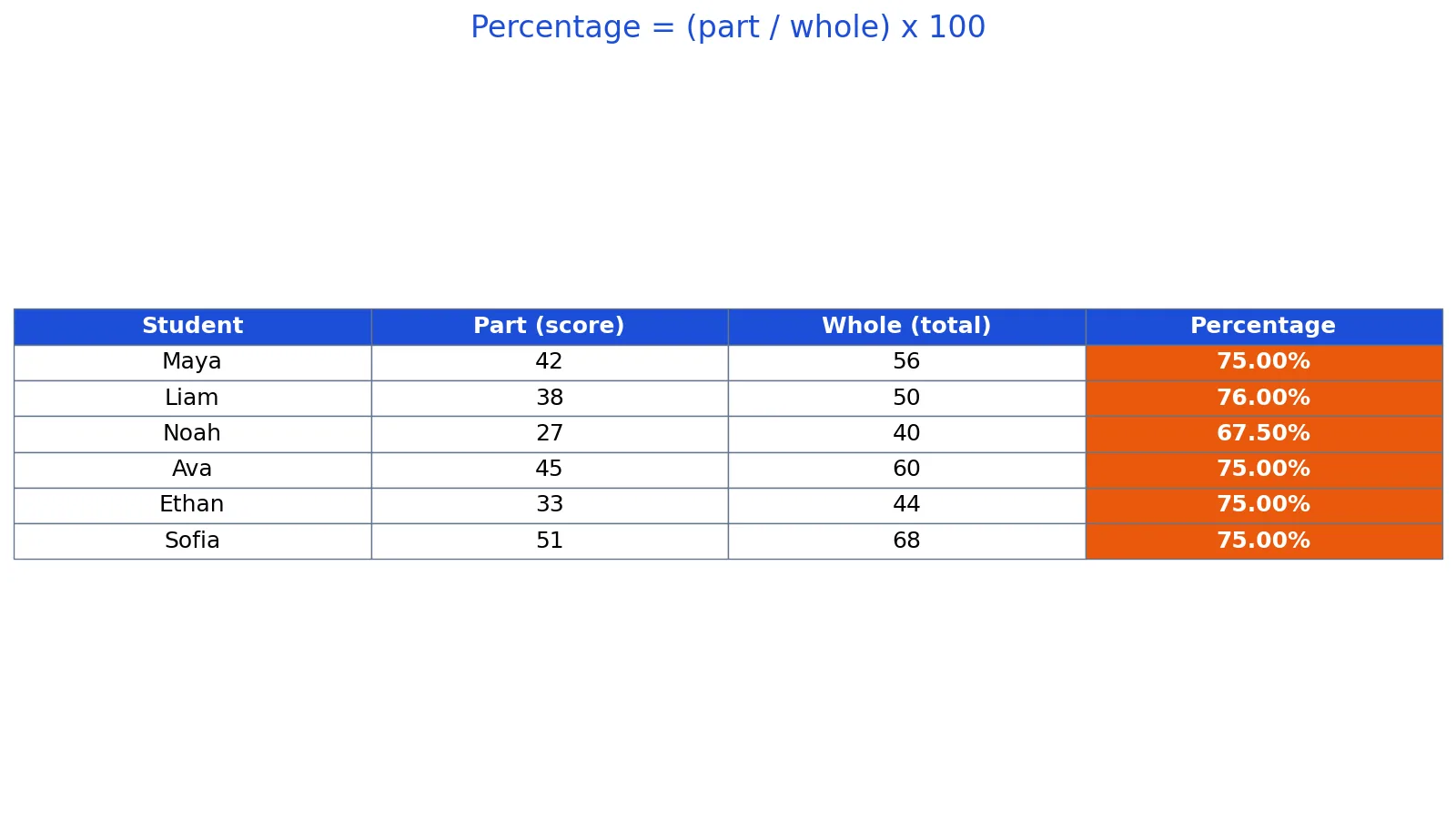
To calculate a percentage, divide the part by the whole and multiply by 100. If you scored 42 out of 56, then $42 / 56 = 0.75$, and $0.75 \times 100 = 75\%$. That single formula covers test scores, discounts, tips, and most proportion questions you will meet.
Quick Answer
- Formula: $\text{percentage} = \left(\dfrac{\text{part}}{\text{whole}}\right) \times 100$
- Divide first, then multiply by 100. The division turns the comparison into a decimal, and the multiplication converts it to "per hundred."
- To find a percentage of a number, convert the rate to a decimal and multiply: $15\%$ of $80$ is $0.15 \times 80 = 12$.
- The percent value is the ratio multiplied by 100, so $50$ out of $1{,}250$ apples is $0.04 \times 100 = 4\%$ [1].
- Round at the end, not in the middle, so small rounding errors do not pile up.
Before You Start
You need two numbers and a clear idea of which is which.
The part is the piece you are measuring. The whole is the full amount it belongs to. In "42 correct out of 50 questions," 42 is the part and 50 is the whole. Getting this backwards is the single most common source of wrong answers, so say the sentence out loud before you type anything.
Both numbers must be in the same unit. If one is in dollars and the other in cents, convert first. If the part is larger than the whole, you will get a result above 100%, which is fine and often meaningful, for example when a value grows past its starting point.
Percentages are unitless. They compare two quantities of the same kind, so the units cancel in the division. That is why a percentage works equally well for scores, money, and counts.
The percent sign itself comes from the Italian per cento, meaning "for a hundred," which is exactly what the formula produces [1].
Step by Step
- Identify the part and the whole. Write them down as a fraction: $\dfrac{\text{part}}{\text{whole}}$.
- Divide the part by the whole. This gives a decimal between 0 and 1 for most everyday cases. For 42 out of 56, the division is $42 / 56 = 0.7500$.
- Multiply by 100. Move the decimal two places to the right. Here $0.7500 \times 100 = 75.0000$.
- Attach the percent sign and round. Report $75.00\%$ if you want two decimals, or $75\%$ for everyday use.
- Check the direction. A part smaller than the whole must give a result under 100%. If it does not, you swapped the numbers.
The same three operations handle the reverse question, finding a percentage of a number. Convert the rate to a decimal by dividing by 100, then multiply by the amount. For a 15% tip on an $80 bill: $15 / 100 = 0.1500$, then $0.1500 \times 80 = 12.0000$, so the tip is $\$12.00$.
That is the whole method. Everything else is a variation on it.
Worked Example
The dataset below is a class test, with each student's score and the total points available.
| Student | Score (part) | Total (whole) | Percentage |
|---|---|---|---|
| Maya | 42 | 56 | 75.00% |
| Liam | 38 | 50 | 76.00% |
| Noah | 27 | 40 | 67.50% |
| Ava | 45 | 60 | 75.00% |
| Ethan | 33 | 44 | 75.00% |
| Sofia | 51 | 68 | 75.00% |
Take Maya's row and walk through it.
Formula
$$\text{percentage} = \left(\frac{\text{part}}{\text{whole}}\right) \times 100$$
Substitute the test score
$$\left(\frac{42}{56}\right) \times 100$$
Divide
$$42 / 56 = 0.7500$$
Multiply by 100
$$0.7500 \times 100 = 75.0000$$
Rounded score
$$75.00\%$$
Now the second use of the same formula, finding a percentage of an amount. A 15% tip on an $80 bill:
Substitute the bill
$$\left(\frac{15}{100}\right) \times 80$$
Divide the rate
$$15 / 100 = 0.1500$$
Multiply
$$0.1500 \times 80 = 12.0000$$
Rounded tip
$$\$12.00$$
Here is the same arithmetic in Python.
part, whole = 42, 56
pct = part / whole * 100
print(round(pct, 2))  # 75.0
tip = 15 / 100 * 80
print(round(tip, 2))  # 12.0
Output:
75.0
12.0
In Excel, the same two calculations return 75 and 12. The score formula is =42/56 formatted as a percentage, and the tip formula is =15/100*80. Microsoft's own worked example uses 42 out of 50 correct answers and returns 84.00% [2].
Other Ways to Do It
Mental arithmetic. Ask what 1% or 100% is, then scale up. If 42 kg is 7%, then 1% is $42 / 7 = 6$ kg, and 100% is $6 \times 100 = 600$ kg [1]. This is the fastest route when the numbers divide cleanly.
Proportion form. Set the ratio equal to the unknown over 100 and cross-multiply:
$$\frac{p}{100} = \frac{W}{G}$$
where $W$ is the part and $G$ is the whole. Rearranged, $G = \dfrac{W}{p} \times 100$ [1]. This is the same formula written differently, and it is handy when you know the percentage and the part but not the whole.
Spreadsheets. Type the division and apply percentage formatting. Our guide on how to find percentage in Excel covers the cell setup and formatting steps.
A calculator. If you just want the answer, the Percentage & Percent Change Calculator handles both plain percentages and change between two numbers.
Percentage of a percentage. Convert both to decimals and multiply. 50% of 40% is $0.5 \times 0.4 = 0.2$, or 20% [1].
Troubleshooting
The answer is over 100% and should not be. You likely swapped the part and the whole. Recheck which number is the subset.
The decimal looks right but the percentage is off by 100. You forgot the multiplication step, or you multiplied twice.
Two numbers have different units. Convert to a common unit before dividing. Percentages only work on like quantities.
The result will not settle. Round only the final value. Carrying extra decimals through intermediate steps keeps the answer stable.
You need change between two values, not a share of a total. That is a different calculation. Subtract the original from the new value, then divide by the original. Microsoft's example takes earnings of \$2,342 in November and \$2,500 in December, computes $(2500-2342)/2342$, and returns 6.75% [2]. See the percentage increase formula in Excel for the full walkthrough, or the percentage decrease formula when the value falls.
Common Mistakes
- Swapping part and whole. Fix: label both numbers before dividing, and check that the part is the smaller one in ordinary share questions.
- Forgetting to multiply by 100. Fix: remember the sign means "per hundred," so the decimal must be scaled before you write the % symbol.
- Multiplying before dividing when finding a percentage of an amount. Fix: convert the rate to a decimal first, then multiply by the amount. Both orders give the same answer here, but converting first keeps the units clear.
- Averaging percentages by adding and dividing. Fix: this only works when the denominators are equal. Otherwise weight each percentage by its whole. Our article on how to average percentages correctly shows the weighted method.
- Rounding too early. Fix: keep full precision until the last step, then round once.
- Treating a percentage point as a percent. Fix: a move from 4% to 6% is a 2 percentage point rise, which is a 50% increase. Keep the two ideas separate.
Limitations
A percentage tells you the size of a share, not the size of the underlying quantity. A 50% failure rate means something very different in a class of 6 than in a class of 6,000. Always report the base alongside the percentage, because the same figure can describe a trivial or a serious situation depending on what it is a percentage of.
Percentages also hide the direction and the starting point. A 50% drop followed by a 50% rise does not return you to where you started, since the second calculation uses a smaller base. When values move over time, report the change and the original value together. And when you compare percentages across groups, check that the groups are defined the same way, since a change in the denominator changes every percentage built on it.
Frequently Asked Questions
How do I calculate a percentage of a number?
Convert the rate to a decimal by dividing by 100, then multiply by the number. For 15% of 80, compute $15 / 100 = 0.15$, then $0.15 \times 80 = 12$. The order of the two operations does not matter for the result, but converting first keeps the units obvious.
How do you figure out percentages from two numbers?
Divide the first number by the second and multiply by 100. If you want to know what share 42 is of 56, compute $42 / 56 = 0.75$, then $0.75 \times 100 = 75\%$. Decide which number is the part before you start, since reversing them gives a different and usually wrong answer.
What is the difference between a percentage and a percentage point?
A percentage is a share of a whole. A percentage point is the arithmetic difference between two percentages. If a rate rises from 4% to 6%, that is a 2 percentage point increase, which is also a 50% increase relative to the starting rate. Mixing the two terms makes small changes sound larger than they are.
Can a percentage be more than 100?
Yes. A percentage above 100 means the part is larger than the whole you compared it to. This happens naturally with growth, where a value can exceed its starting point, and with ratios such as a 120% completion rate against a target. It is only a problem when the part is supposed to be a subset of the whole.
How do I calculate a percentage in Excel?
Type the division as a formula, for example =42/56, then format the cell as a percentage. Excel multiplies by 100 for display, so you do not type the multiplication yourself. For a percentage of an amount, use =15/100*80. The Excel percentage guide covers formatting and decimal places.
References
Further Reading
- NIST/SEMATECH e-Handbook of Statistical Methods
- OpenStax. Introductory Statistics 2e
- Krzywinski M, Altman N (2013). Importance of being uncertain. Nature Methods
- Krzywinski M, Altman N (2013). Significance, P values and t-tests. Nature Methods
Related Articles
- How to Calculate Win Percentage (Formula and Examples)
- How Do You Calculate Percentile? Formula and Example
- How to Average Percentages Correctly (With Examples)
- Percentage Decrease Formula: How to Calculate
- How to Find Percentage in Excel (Step by Step)
- Test Statistic Formula: How to Calculate and Use It