What Colors Can Cats See? Feline Vision Explained
By Dr. Zubair Khalid, DVM, MS, PhD ·
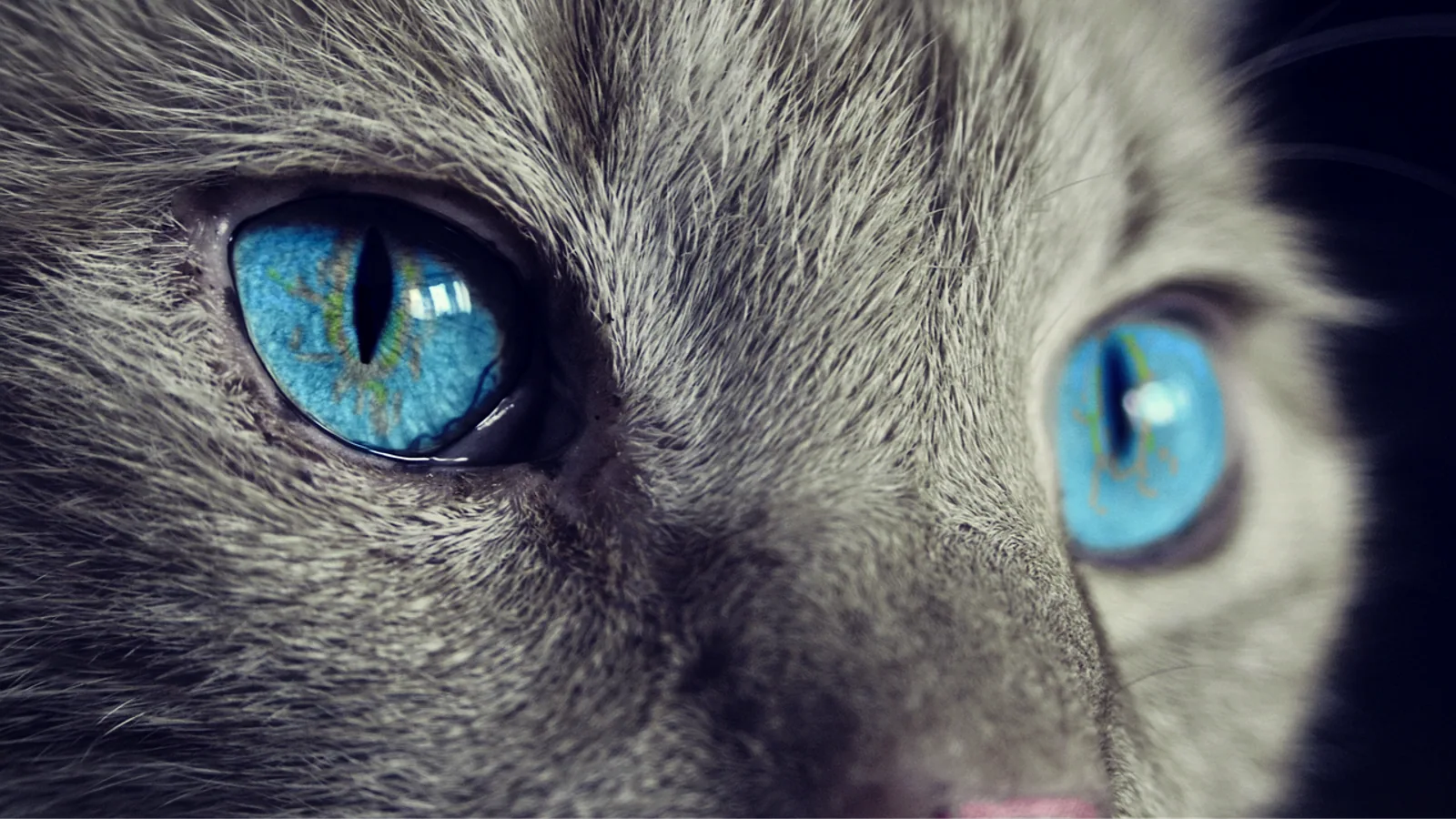
Cats can see color, but their color world is narrower than ours. They are dichromats: they have two functional cone types, a short-wavelength cone sensitive to blue light (peak near 450 nm) and a medium-wavelength cone sensitive to green-yellow light (peak near 550 nm), and they lack the long-wavelength cone that lets humans see red [1][2][3].
The practical result is simple. A cat distinguishes blue from gray, but it does not reliably separate red from green. Those two colors fall along a confusion line, a set of wavelengths that a dichromat cannot tell apart [4]. A red toy on a green lawn is close to invisible to a cat in color terms, while a blue toy on that same lawn stands out.
This article is educational and is not a substitute for veterinary diagnosis or treatment.
The Photoreceptors Behind Feline Vision
Vision starts in the retina, the light-sensitive layer at the back of the eye. The retina contains two main classes of photoreceptor cells: rods and cones. Rods work in dim light and do not carry color information. Cones work in brighter light and provide color discrimination. The relative numbers of rods and cones, and the number of cone types, determine what an animal can see.
Two cone types, not three
A cone type is defined by the photopigment it contains. Each photopigment absorbs light best at a particular wavelength, called its peak sensitivity. Humans normally have three cone types, which makes us trichromats. Cats have two, which makes them dichromats [2][3].
- Short-wavelength (S) cone: peak sensitivity near 450 nm, in the blue part of the spectrum [1][2].
- Medium-wavelength (M) cone: peak sensitivity near 550 nm, in the green-yellow part of the spectrum [1][2].
- Long-wavelength (L) cone: absent in cats. This is the cone humans use to see red [1][2].
Because the cat M cone peaks around 550 nm, it still absorbs some light at longer wavelengths. That is why a cat is not completely blind to red. The problem is discrimination, not detection. A red object can still appear as a shade of gray or dull yellow-green, but it does not look red in the way a human sees it.
Rods dominate the feline retina
Cats have far more rods than humans relative to cones. This is the anatomical basis of their reputation for night vision. Rods are packed densely across the cat retina, and the cat eye also has a tapetum lucidum, a reflective layer behind the retina that bounces light back through the photoreceptors for a second chance at absorption. Together, these features give cats excellent sensitivity in low light.
The trade-off is color resolution. Color vision depends on comparing signals from different cone types. When cones are sparse and rods dominate, the color signal is weaker. Cats therefore have better low-light vision but poorer color discrimination than humans [2][3].
A note on the cat retina
The cat retina is not simply a scaled-down human retina. Research in cat retina has identified cone bipolar cells that receive input from both rods and cones, including OFF-cone bipolar cells that make flat contacts with rod and cone axon terminals [5]. This kind of mixed rod-cone pathway is a common feature of mammalian retinas and helps explain how cats integrate dim-light and color signals. It also reinforces that feline vision is optimized for a different set of demands than human vision.
Human Trichromat vs Cat Dichromat: A Direct Comparison
The table below summarizes the core differences. Peak sensitivities are approximate values from the feline color vision literature [1][2][3].
| Feature | Human (trichromat) | Cat (dichromat) |
|---|---|---|
| Cone types | 3 (S, M, L) | 2 (S, M) |
| S cone peak | ~420 to 440 nm (blue) | ~450 nm (blue) [1][2] |
| M cone peak | ~530 to 540 nm (green) | ~550 nm (green-yellow) [1][2] |
| L cone peak | ~560 to 570 nm (red) | Absent [1][2] |
| Color perception | Full red, green, blue mixing | Blue and green-yellow only, red appears grayish or indistinct |
| Rod density | Moderate | High, supports dim-light vision |
| Low-light sensitivity | Lower | Higher |
| Color discrimination | Fine | Coarse, especially for red vs green |
The key row is the last one. Cats can distinguish blue from gray, but they cannot reliably distinguish red from green [4][1]. This is the same class of red-green confusion seen in human dichromats such as protanopes and deuteranopes, who lack one of the three human cone types [6][7].
How Dichromatic Color Vision Works
To understand why cats confuse red and green, it helps to think about how the brain builds color.
The brain compares cone signals
The retina does not send a labeled color to the brain. It sends signals from each cone type, and the brain compares them. With three cone types, the visual system can compute two independent color-opponent channels plus a brightness channel. That gives humans a two-dimensional color space with red-green and blue-yellow axes.
With two cone types, only one chromatic comparison is available. The cat visual system can compare S cone output against M cone output, which produces a blue versus yellow-green axis. There is no second axis to separate red from green. Any two lights that produce the same ratio of S to M cone stimulation will look identical to the cat, no matter how different they look to a human [4].
Confusion lines explained
A confusion line is a set of colors that a dichromat cannot tell apart [4]. For a cat, red and green can fall on the same confusion line because both stimulate the M cone strongly and the S cone weakly. The cat sees a difference in brightness, not in hue. If the red and green objects have similar luminance, the cat may not see them as different at all.
This is why dichromatic vision is sometimes described as a reduced color space rather than a loss of color. The cat still has color vision. It simply has fewer dimensions to work with [8][9].
What the cat color space looks like
In practical terms, the cat color space runs along a blue to yellow-green axis. Blues and blue-grays are distinct. Greens, yellows, oranges, and reds collapse into a narrower band of yellow-green to gray. Purples and violets, which humans see as a mix of red and blue, may appear as blue to a cat because the red component is not represented.
What Colors Do Cats See? A Practical Breakdown
The question "what colors do cats see" has a short answer and a longer one. The short answer is blue and green-yellow. The longer answer is that the cat sees a muted, blue-to-yellow-green world with weak red discrimination.
Colors cats can distinguish
- Blue: clearly visible, especially against a green or gray background.
- Blue-gray and blue-violet: distinguishable from gray, though the violet component is not seen as red.
- Green-yellow: visible as a distinct hue, though it may not be separated from pure green or yellow.
- Gray and white: brightness differences are seen well.
Colors cats confuse
- Red and green: these fall along a confusion line and are not reliably separated [4].
- Red and orange: both stimulate the M cone and appear as similar yellow-green or gray shades.
- Brown: often appears as a dark yellow-green or gray.
- Pink: may appear as a pale gray or blue-gray.
Colors cats see in dim light
In very low light, cats rely on rods, and rods do not carry color information. At night, a cat sees a monochromatic world of grays and brightness levels. Color vision requires enough light to activate cones, so the cat color world fades as the light dims.
Why Cats Evolved Dichromatic Vision
Color vision is not a single trait with a single best design. Different species have different cone complements because different visual tasks matter to them [10][11].
Cats are crepuscular and nocturnal predators. Their ancestors hunted small mammals and birds in dim light, at dawn, dusk, and night. In that setting, sensitivity and motion detection matter more than fine color discrimination. A high rod density, a tapetum lucidum, and a wide pupil all support dim-light hunting. Two cone types are enough to detect broad color differences that might help with prey detection or social signaling, but three cone types would add little for a nocturnal hunter.
The same pattern appears in other mammals. Horses, for example, have two cone types with peak sensitivities near 428 nm and 539 nm, which supports dichromatic color vision [11]. Many ungulates, including pigs, goats, cows, sheep, and deer, also have two spectrally distinct cone types [11]. Dichromacy is common among mammals. Trichromacy is the exception, and in primates it is linked to tasks such as detecting subtle skin color changes that signal health, emotion, or reproductive state [12].
Common Myths About Cat Color Vision
Myth: Cats see only in black and white
This is the most persistent myth, and it is wrong. Cats have two cone types and can discriminate blue from gray [1][2][3]. They are not colorblind in the sense of seeing no color. They are dichromats, which means a reduced color range, not an absent one.
Myth: Cats see red
Cats lack the long-wavelength cone that humans use for red [1][2]. A red object may still be detected because it reflects some light that the M cone absorbs, but it does not appear red. It appears as a shade of gray or dull yellow-green.
Myth: Cats see the same colors as dogs
Dogs are also dichromats, and the general principle is similar, but the exact peak sensitivities differ between species. The cat M cone peaks near 550 nm [1][2]. The horse M/L cone peaks near 539 nm [11]. It is more accurate to say that cats and dogs both have dichromatic vision than to say they see identical colors.
Myth: A cat's color vision is just a weaker version of human vision
It is not weaker in every way. Cats outperform humans in dim light because of their rod density and tapetum lucidum. Their color vision is reduced, but their low-light sensitivity is enhanced. The two traits trade off against each other.
How Feline Color Vision Is Studied
Feline color vision has been studied with behavioral and neurophysiological methods [3]. Behavioral tests train cats to discriminate between stimuli and then test whether they can still discriminate when brightness cues are controlled. If a cat can choose the correct stimulus only when hue differs, and not when brightness differs, that is evidence of color vision.
Neutral point testing is one approach used in the domestic cat [1]. The neutral point is the wavelength at which a dichromat's two cone systems produce equal signals, so the stimulus appears achromatic. By finding the neutral point, researchers can infer which cone types are present and how they compare.
Stimulus size, shape, and viewing distance all affect cat color discrimination performance [2][13]. This matters for interpreting older studies. A cat may fail a color test not because it cannot see color, but because the test stimulus was too small or too far away. Careful studies control these variables.
Dichromatic vision is also studied in other species as a model. Macaques, which normally have trichromatic vision similar to humans, have been used to compare dichromatic and trichromatic color behavior [6]. Dichromatic macaques cannot discriminate colors along the protanopic confusion line, and they show higher thresholds for longer-wavelength light [6]. This confirms the general principle that losing a cone type reduces sensitivity at the wavelengths that cone would have captured.
Practical Implications for Cat Owners
Understanding feline color vision changes how you choose toys, design a cat-friendly home, and interpret your cat's behavior.
Choosing toys
A red toy on a green carpet is a poor choice if you want the toy to stand out visually. A blue toy on a green or gray background is a better choice because blue is the color cats discriminate most reliably. Motion matters more than color for most cats, so a toy that moves erratically will attract attention even if its color is not ideal.
Designing a cat-friendly environment
Cats navigate by brightness, texture, and motion as much as by color. A cat tree with contrasting light and dark surfaces is easier to see than one with red and green surfaces of similar luminance. Food bowls and litter boxes are best distinguished by brightness contrast rather than by color alone.
Reading your cat's behavior
If a cat seems uninterested in a red laser dot or a red toy, color is one possible reason. The cat may see the object as a low-contrast gray shape. This is not a sign of vision loss. It is normal feline color perception.
When color vision matters clinically
Color vision itself is not a common clinical complaint in cats. Owners rarely report that a cat cannot see red. More often, vision problems present as bumping into objects, reluctance to jump, or changes in pupil appearance. Those signs warrant a veterinary examination. A veterinarian can assess vision, pupil reflexes, and retinal health. Color vision testing is a research tool, not a routine clinical test.
Clinical Relevance, Limitations and Common Mistakes
Feline color vision is a stable anatomical feature, not a disease. The clinical relevance is mostly indirect.
The first common mistake is assuming that a cat's failure to respond to a colored object means the cat is blind. Cats may ignore objects for many reasons, including low contrast, lack of motion, or disinterest. Color discrimination is only one part of vision.
The second mistake is overinterpreting a single behavioral observation. A cat that chooses a blue toy over a red toy once has not proven color discrimination. Controlled testing requires repeated trials with brightness controlled [2][13].
The third mistake is confusing dichromacy with total color blindness. Dichromats have color vision. They simply have fewer color dimensions than trichromats [8][9].
The fourth mistake is applying human color categories to cats. Terms like "red" and "green" describe human perceptual experience. A cat does not have a red experience that is simply dimmer. It has a different color space in which red and green are not separate categories [4].
Individual variation exists in all sensory systems, and a veterinarian should evaluate any cat with suspected vision loss. This article is educational and is not a substitute for veterinary diagnosis or treatment.
What Is Still Uncertain
The broad picture of feline dichromacy is well established. Cats have two cone types with peaks near 450 nm and 550 nm, and they lack a long-wavelength cone [1][2][3]. Several details remain less settled.
The exact peak sensitivities vary somewhat between studies and methods. Reported values for the cat S cone and M cone differ by a few nanometers depending on whether the measurement is behavioral, electrophysiological, or based on photopigment extraction. The values used here are representative.
The neural processing of color in the cat visual system is also an active area. The retina sends signals to the brain, and the brain combines them. How the cat brain constructs its color space from two cone signals is not fully mapped. Models of dichromatic color vision exist [4][9], but they are models, not direct recordings of cat perception.
Finally, the ecological role of color vision in the cat's natural behavior is not fully understood. Cats are predators, and color may help with prey detection, but motion and brightness are likely more important. The relative contribution of color to real-world cat behavior is difficult to measure.
Frequently Asked Questions
Can cats see color?
Yes. Cats are dichromats with two cone types, so they see a reduced range of colors compared with humans.
What colors can cats see?
Cats see blue and green-yellow most clearly. They can distinguish blue from gray but not red from green.
Do cats see in color or black and white?
Cats see in color, not black and white. Their color range is narrower than a human's, but it is not absent.
Can cats see red?
Cats lack the long-wavelength cone used for red vision. A red object may be detected as a gray or dull yellow-green shade, not as red.
Can cats see green?
Cats have a medium-wavelength cone that peaks near 550 nm, so they can see green-yellow. They cannot reliably separate green from red.
Why do cats have better night vision than humans?
Cats have more rods than humans and a reflective tapetum lucidum behind the retina. These features improve low-light sensitivity but reduce color discrimination.
Does cat color vision affect what toys I should buy?
Blue toys stand out best against most backgrounds. Motion and brightness contrast matter more than color for attracting a cat's attention.
Are cats colorblind?
Cats are not colorblind in the sense of seeing no color. They are dichromats, which means they have color vision with fewer color categories than humans.
Related Articles
- Can Cats See in the Dark? Feline Vision Explained
- Cat Eyes: Understanding Feline Vision, Common Eye Problems & Care Tips
- Dog Vomiting Yellow Colour
- Feline Chin Acne: Causes, Home Care, and When to See a Veterinarian
- Computer Vision for Livestock Health and Welfare Observation
- Budgie Cere Color Meaning
- Can Dogs See Red? Dog Color Vision Explained
- Do Dogs See in the Dark? Canine Night Vision
Sources
- Neutral point testing of color vision in the domestic cat.
- Cat color vision: the effect of stimulus size, shape and viewing distance.
- Behavioral and neurophysiological studies on cat color vision.
- Dichromatic Confusion Lines and Color Vision Models
- Identification of a cone bipolar cell in cat retina which has input from both rod and cone photoreceptors.
- Color vision test for dichromatic and trichromatic macaque monkeys.
- Color-Vision Mechanisms in the Peripheral Retinas of Normal and Dichromatic Observers
- Image enhancement for dichromatic vision by geometric approach in RGB color space
- Vector model for normal and dichromatic color vision.
- Relative advantages of dichromatic and trichromatic color vision in camouflage breaking
- Photopigment basis for dichromatic color vision in the horse.
- Social Perception of Facial Color Appearance for Human Trichromatic Versus Dichromatic Color Vision
- Cat color vision: the effect of stimulus size.