Rainbow Lory Care: Diet, Housing, and Health
By Dr. Zubair Khalid, DVM, MS, PhD ·
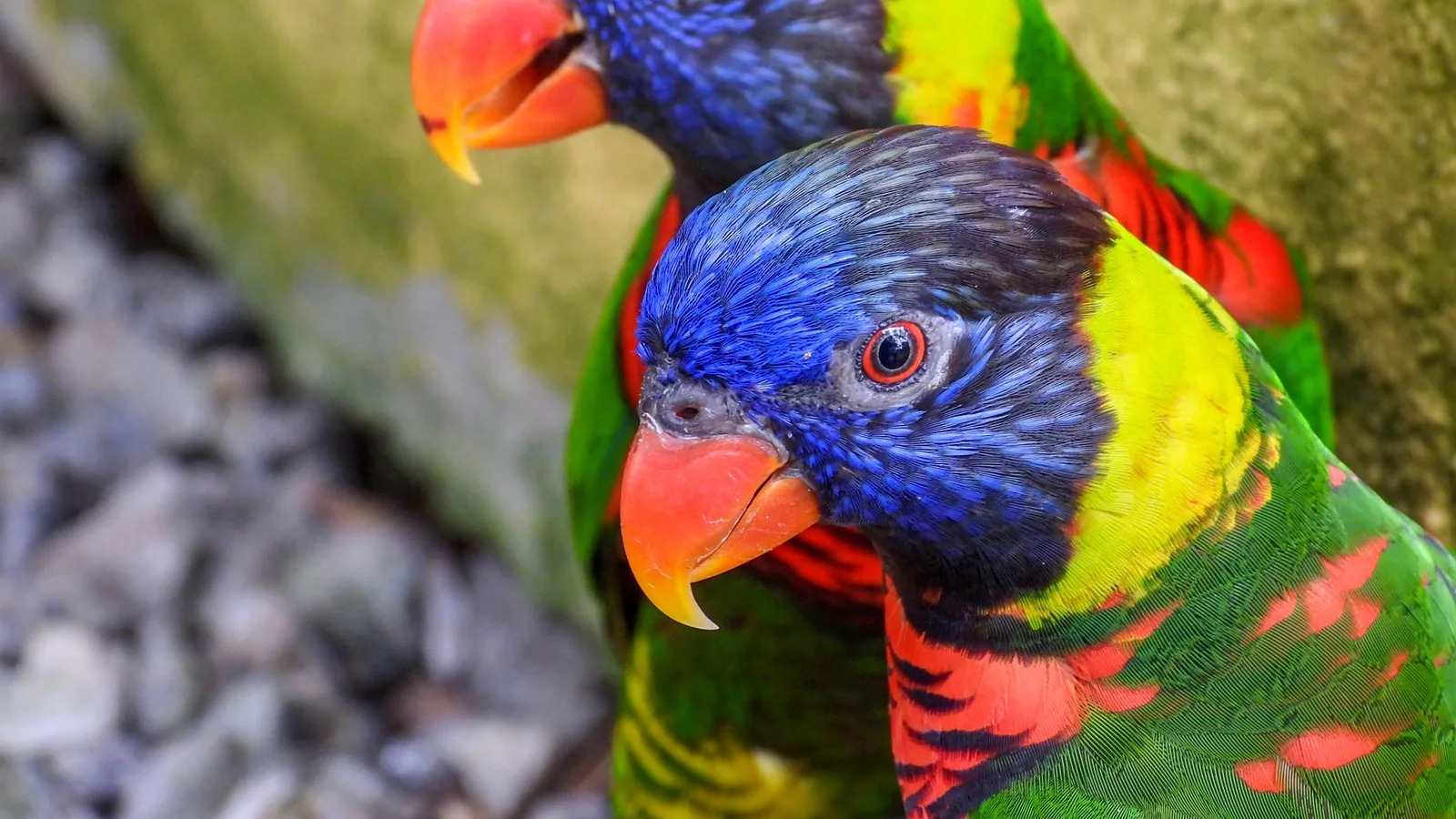
A rainbow lory is a nectarivore, and that single fact sets the terms for everything else. The diet is a formulated nectar powder mixed with water at a measured ratio. The enclosure has to be long enough for real flight because the bird's energy turnover is high. The health plan has to include honest questions about breeding lines and prompt veterinary care for any bird that cannot perch.
Get those three things right and the daily work is manageable. Get them wrong and problems appear quickly, usually as weight loss, droppings that look different from the bird's own baseline, or a lory that sits low on the perch and stops calling.
This guide covers diet, housing, health, and the practical decisions that separate a thriving rainbow lory from one that merely survives. The guidance draws on published nutrition and clinical research on this species and on standard avian practice.
This article is educational and is not a substitute for veterinary diagnosis or treatment.
At a Glance
| Priority | Action | Why it matters |
|---|---|---|
| 1 | Mix nectar powder by weight at the label ratio | Dilution directly changes energy intake [1] |
| 2 | Offer fresh drinking water in a separate, heavy bowl | Much of a lory's water arrives in its food |
| 3 | Keep fruit to a small optional portion | Fruit displaces nectar and shifts the nutrient balance [1] |
| 4 | Provide horizontal flight space, not just perches | A nectarivore burns energy fast and flies hard |
| 5 | Weigh the bird weekly and write it down | Weight trend is the earliest warning sign you can see |
| 6 | Book a baseline exam with an avian veterinarian | Establishes normal bloodwork and dropping appearance |
| 7 | Ask the breeder about related parents and color mutation lines | Juvenile kidney disease has been reported in line-bred blue birds [2] |
| 8 | Remove and wash nectar bowls every day | Sugar solutions spoil quickly and grow bacteria |
Meet the Rainbow Lory
Rainbow lories, also called rainbow lorikeets, are small to medium nectarivorous parrots native to Australia. In the veterinary and aviculture literature they appear under two scientific names. Nutrition studies and case reports use Trichoglossus moluccanus [3][2], while Australian field and clinical work uses Trichoglossus haematodus [4][1]. The difference reflects taxonomic revision, not two separate birds. Records using either name describe the same species complex.
The bird's defining trait is its feeding strategy. Lories and lorikeets are nectarivores, and their anatomy and behavior are built around liquid, energy-dense food [3]. That fact drives almost every husbandry decision an owner makes: the diet, the mess, the enclosure design, and the health risks.
Captive propagation of lories has historically been difficult. Health problems, low breeding success, and shortened lifespan have limited success across many species, and wild capture has met a large share of trade demand. That history has a practical consequence for buyers. Ask for parentage records, ask whether the parents are related, and ask what health screening the breeder performs. A cheap bird with no paperwork is a gamble.
Diet: The Core of Rainbow Lory Care
Dilution is the first decision
Commercial nectar powders are mixed with water, and the ratio you use changes how much energy the bird actually takes in.
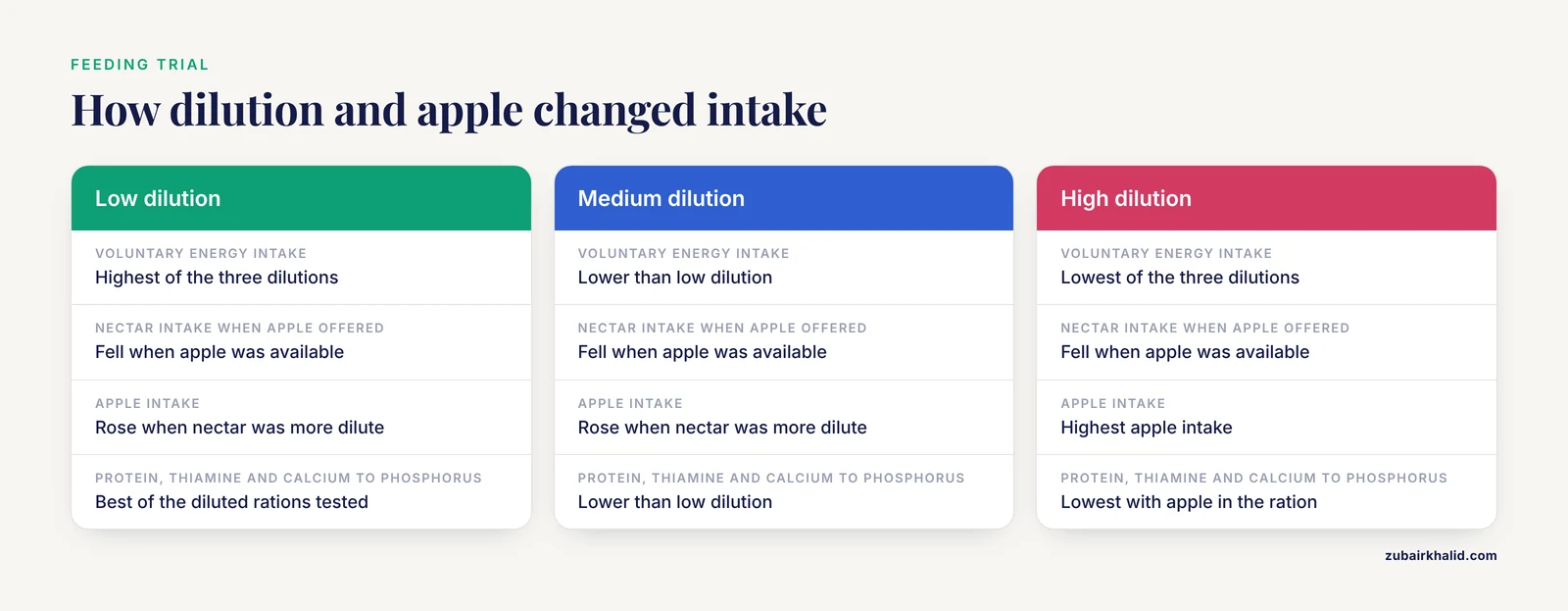
In a controlled feeding trial, 12 adult rainbow lorikeets of two subspecies received nectar powder diluted at 1:3 (low dilution), 1:4 (medium), and 1:5 (high) by volume. Higher dilution reduced voluntary energy intake in both subspecies [1]. The birds did not drink enough extra thin nectar to make up the energy difference. They simply took in less.
The practical rule is straightforward. Mix to the concentration printed on the product label and do not stretch the powder to make a container last longer. A thin mix is not a low-calorie diet in any controlled sense. It is a diet that delivers less energy, and a lory may not compensate.
What fruit actually does to the ration
Fruit is the second variable, and it is the one owners misjudge most often.
In the same trial, half the birds had free access to apple pieces alongside nectar. When apple was available, nectar intake fell. When the nectar was more dilute, apple intake rose [1].
The nutrient consequence is the part that matters. Protein, thiamine, and the calcium-to-phosphorus ratio of the total ingested ration were lowest when birds received highly diluted nectar plus apple. The authors note that minimum requirements were still covered in that trial, which is reassuring for a well-formulated product mixed at a sensible dilution. It is not reassurance for a heavily diluted product combined with a fruit-heavy bowl.
Energy patterns differed between subspecies. Green-naped lorikeets eating nectar plus apple took in similar energy across dilutions but less than birds fed low or medium nectar alone. Red-breasted lorikeets given apple with medium or highly diluted nectar took in more energy than on nectar alone [1]. The lesson is not that fruit is good or bad. It is that fruit changes the whole ration, and the direction of the change depends on the bird in front of you.
Treat fruit as a small optional extra. Never use it to fill a gap left by a thin nectar mix.
Protein and the self-selection model
A second study offered 36 pairs of lories and lorikeets at a large bird park an ad libitum choice between a low-protein and a moderate-protein diet. Every genus tested took in significantly different amounts of dry matter, metabolizable energy, protein, and non-protein-to-protein energy ratio. Nectar-to-fruit energy ratio also differed between genera [3].
Two conclusions follow for a pet owner.
First, the rainbow lorikeet is the reference species for most captive dietary recommendations, because field data on the Asian lory species are limited while Australian species are better studied [3]. If you keep a rainbow lory, the available diet research applies to your bird more directly than it does to a poorly studied relative.
Second, lories regulate intake. When offered a choice, they select a balance of protein to energy rather than eating a fixed volume. That supports a feeding approach built around a formulated base diet offered ad libitum, with intake tracked by weight and observation, rather than rigid portions based on guesswork.
A daily feeding routine
- Weigh the powder. Use a kitchen scale in grams. Volume scoops drift as powder settles, and a settled scoop can hold far more or far less than a fresh one.
- Mix at the label ratio with fresh water. Stir until fully dissolved. Measure the water rather than estimating.
- Use a shallow, stable dish the bird cannot tip. Lories bill-feed and splash, and a tipped bowl means a lost meal and a wet cage floor.
- Provide drinking water in a separate, heavier bowl. Refresh it daily and more often if the bird bathes in it.
- Offer a small portion of fruit or vegetables as an optional extra. Do not let it replace nectar.
- Remove and discard leftover nectar within a few hours. Sugar solutions support rapid bacterial growth, and soured food is a digestive upset waiting to happen.
- Wash bowls daily with hot water and detergent, rinse thoroughly, and dry.
- Log how much powder you use each week. A change in consumption is one of the earliest signals that something is off.
Foods to keep out of the bowl
A seed mix is not a substitute for a nectar diet in a nectarivorous species [3]. Do not swap a formulated nectar for seed on the assumption that all parrots eat seeds. Do not assume a pellet designed for granivorous parrots is interchangeable either. Ask your avian veterinarian whether a specific product suits your bird before you change the base diet.
Keep table food, dairy, and human snacks out of the bowl. When you want to try something new, ask your veterinarian first rather than experimenting on your own.
Housing a Rainbow Lory
Space for flight, not just perching
A lory takes in energy fast and flies fast. An enclosure sized for a perch-and-bowl bird produces a bored, overweight, or feather-damaged lory. Prioritize horizontal length, because that is the axis the bird uses for real flight.
Selection criteria rather than fixed dimensions:
- Length greater than height, with a clear flight path from one end to the other.
- Several perch diameters, including natural branch perches, so the feet can flex and grip differently at each station.
- Perches positioned so droppings do not fall into food and water bowls.
- Mesh or bar spacing appropriate for a bird that can reach through or catch a beak. Confirm suitability with the manufacturer and your avian veterinarian before purchase.
- Solid or easily scrubbed flooring. A nectar-based diet produces wet, bulky droppings, and the floor will show it.
Cleaning is a daily job
Because the diet is liquid, cleaning is daily rather than weekly. Line the floor with a disposable or washable tray and replace it every day. Wipe down perches and bowls. A clean enclosure lowers bacterial load and, just as importantly, lets you notice a change in droppings before it becomes a crisis.
Environment and household safety
Lories are acrobatic and curious, which makes ordinary household objects dangerous. Ceiling fans, open toilets, open water containers, and unscreened windows are common sources of injury. Cats and dogs in the home are a risk even when the interaction looks supervised.
Nonstick cookware and some space heaters release fumes that are lethal to birds. Keep the bird out of the kitchen and away from any appliance that can off-gas when overheated.
Provide a dark, quiet rest period every night. Cover the cage or move it to a room that stays quiet after the household goes to bed.
A second bird
Lories are social, and many owners consider a companion. Quarantine any new arrival and have it examined before introduction. Mixing species carries disease and aggression risks that are best assessed by an avian veterinarian who can see both birds.
Health Problems Documented in Rainbow Lorikeets
Polycystic kidney disease in line-bred juveniles
A published case series described three 2-month-old juvenile rainbow lorikeets, two males and one female, with polycystic kidney disease. All three were the progeny of full sibling parents that were intentionally line bred to establish a blue color mutation [2].
The signs an owner would notice were lethargy, dehydration, regurgitation, anorexia, polyuria, and pelvic limb paresis. Bloodwork showed a normocytic normochromic nonregenerative anemia, hyperuricemia, hyperphosphatemia, hypercalcemia, and azotemia. One bird had marked renomegaly on radiographs, and severe renal dysfunction was diagnosed in all three. Despite intensive critical care, one bird died and the other two were euthanized after rapid deterioration. Postmortem examination found marked renomegaly, visceral gout, and polycystic kidney disease [2].
This is a report of three birds, not a prevalence estimate. It does not prove that every blue lory will develop kidney disease. It does mean that a buyer considering a color-mutation bird should ask direct questions. Were the parents related? Was the line bred specifically for the mutation? Can the breeder produce health records for the parents?
Any juvenile lory with polyuria, pelvic limb weakness, or regurgitation needs same-day veterinary assessment.
Lorikeet paralysis syndrome
Lorikeet paralysis syndrome (LPS) is a seasonal condition of rainbow lorikeets described in eastern Australia. Reviewing admissions from 2017 and 2018, investigators found affected birds presented with lower motor neuron signs during warmer months. Cases were distributed across south-east Queensland, with hotspots around Brisbane and the Sunshine Coast [4].
Affected lorikeets had a heterophilic leukocytosis and elevated muscle enzymes, uric acid, sodium, and chloride. Histologic examination found no specific lesions. Testing for pesticides and toxic elements found cadmium exposure commonly in both affected and unaffected birds, so cadmium was not established as the cause [4].
Treatment was supportive, and prognosis was fair to good, though it varied with the severity of signs [4].
The clinical point for owners is about differential diagnosis. A weak or paralyzed lory is an emergency, and LPS belongs on the list for any rainbow lory with lower motor neuron signs, especially in a warm season or in a bird with Australian origins [4]. Do not wait to see whether it passes.
Nutrition-related risk
A heavily diluted nectar mix lowers energy intake [1]. Over weeks that can show up as weight loss, poor feather condition, or a bird that acts hungry constantly. The opposite problem, an over-concentrated mix plus unlimited fruit, pushes energy intake up. Neither pattern is a diagnosis on its own, and both are correctable once you are measuring powder and weighing the bird.
Routine veterinary care
A wellness examination with an avian veterinarian is the baseline for any pet bird, and the Association of Avian Veterinarians (AAV) maintains owner resources on preventive care. For a lory, the useful visit includes a physical examination, a weight trend, a diet review, and a look at fresh droppings. Bring the nectar product label, a written diet history, and a sample of the bird's droppings.
Common Mistakes
- Mixing nectar by eye. Ratio errors change energy intake directly [1].
- Treating fruit as the main course. Fruit displaces nectar, and when nectar is dilute the total ration drops in protein, thiamine, and calcium-to-phosphorus ratio [1].
- Buying a color mutation without asking about the line. Inbreeding for a blue mutation has been linked to juvenile kidney disease in this species [2].
- Using a cage sized for a small granivore. Flight space is not a luxury for a bird with this energy turnover.
- Leaving nectar in the bowl all day. Spoilage risk rises with every hour in a warm room.
- Skipping the scale. Weekly weight is the cheapest early warning system available to you.
- Waiting on weakness or paralysis. Renal disease in juveniles deteriorates quickly [2], and LPS prognosis depends on supportive care [4].
Troubleshooting
| What you see | What it may mean | What to do |
|---|---|---|
| Droppings wetter than the bird's usual baseline | Normal variation on a nectar diet, or a change in mix ratio | Compare with your log, recheck the mixing ratio, call the veterinarian if the change is sudden |
| Steady weight loss | Nectar too dilute, fruit displacing food, or underlying illness | Recheck the ratio, remove fruit for a few days, book an examination |
| Regurgitation with polyuria and weakness in a young bird | Renal disease has been reported in juveniles of this species [2] | Emergency veterinary assessment |
| Limb weakness or inability to perch | LPS is a differential [4] | Emergency veterinary assessment |
| Nectar intake drops when fruit is added | Expected displacement effect [1] | Reduce fruit, monitor intake and weight |
| Reduced appetite with no other signs | Stress, new environment, illness | Check weight daily, book an examination if it persists |
Welfare and Safety Points
A lory needs more than food and a perch. Offer foraging opportunities that make the bird work for small amounts of nectar, provide destructible materials to shred, and give it room to fly rather than climb. Bathing opportunities matter for feather condition and are usually welcomed.
Keep the bird's environment predictable. Sudden changes in diet, cage placement, or household routine show up as appetite loss and feather problems. Introduce changes one at a time so you can tell what caused a reaction.
Never leave a lory unsupervised with a cat, dog, or ferret. A single paw strike is enough to cause fatal internal injury even when no blood is visible.
Limitations and When to Contact a Veterinarian
This article is educational and is not a substitute for veterinary diagnosis or treatment. Individual birds differ in baseline weight, dropping appearance, and tolerance for dietary change, so use your own bird's records as the reference point and let an avian veterinarian interpret anything unusual.
Contact a veterinarian promptly for any of the following:
- Paralysis, paresis, or a bird that cannot grip a perch.
- Regurgitation combined with polyuria, lethargy, or loss of appetite, particularly in a bird under six months old.
- A full day without eating, or a refusal of favored food.
- Weight loss that continues across two consecutive weekly checks.
- Droppings with blood, unusual color, or a sudden change in consistency that does not resolve within a day.
- Labored breathing, tail bobbing, or open-mouth breathing at rest.
- Suspected exposure to fumes, lead, zinc, or any household toxin.
- A fight with another pet, even if the bird appears normal afterward.
Call an emergency clinic rather than waiting for a scheduled appointment when a bird stops eating or loses the ability to perch. Birds mask illness until compensation fails, and the window for effective treatment is short.
Bringing Home a Rainbow Lory: Pre-Purchase Checks and First 30 Days
The first month sets the pattern for years of care. Ask the right questions before you pay, then use the first 30 days to establish a health baseline and a stable feeding routine.
Pre-Purchase Questions
Ask the breeder whether the parents are related. A case series of three juvenile rainbow lorikeets with polycystic kidney disease found all three were progeny of full sibling parents line bred for a blue color mutation [2]. Ask for parentage records, health screening results, and the exact nectar product and mixing ratio the bird currently eats. Ask about weaning status and any previous illness. Do not buy a bird that cannot perch firmly or has a stained vent.
First 30 Days: Quarantine and Baseline Exam
Keep the new bird separate from any existing birds for at least 30 days. Book a baseline avian examination within the first week. Bring a fresh dropping sample, a written diet history, and the nectar product label. The exam establishes normal bloodwork and weight for that bird.
Supply Setup Before Arrival
Have the enclosure, nectar powder, bowls, perches, and a gram scale ready before the bird comes home. Use the same nectar product and mixing ratio the breeder used for the first week. Change only one variable at a time.
Gradual Diet Transition
To switch nectar products, transition over 7 to 10 days by mixing increasing amounts of the new powder with the old. Do not dilute the mix beyond the label ratio. Higher dilution reduces voluntary energy intake in rainbow lorikeets [1]. Measure powder by weight, not volume.
Red Flags Warranting Veterinary Assessment
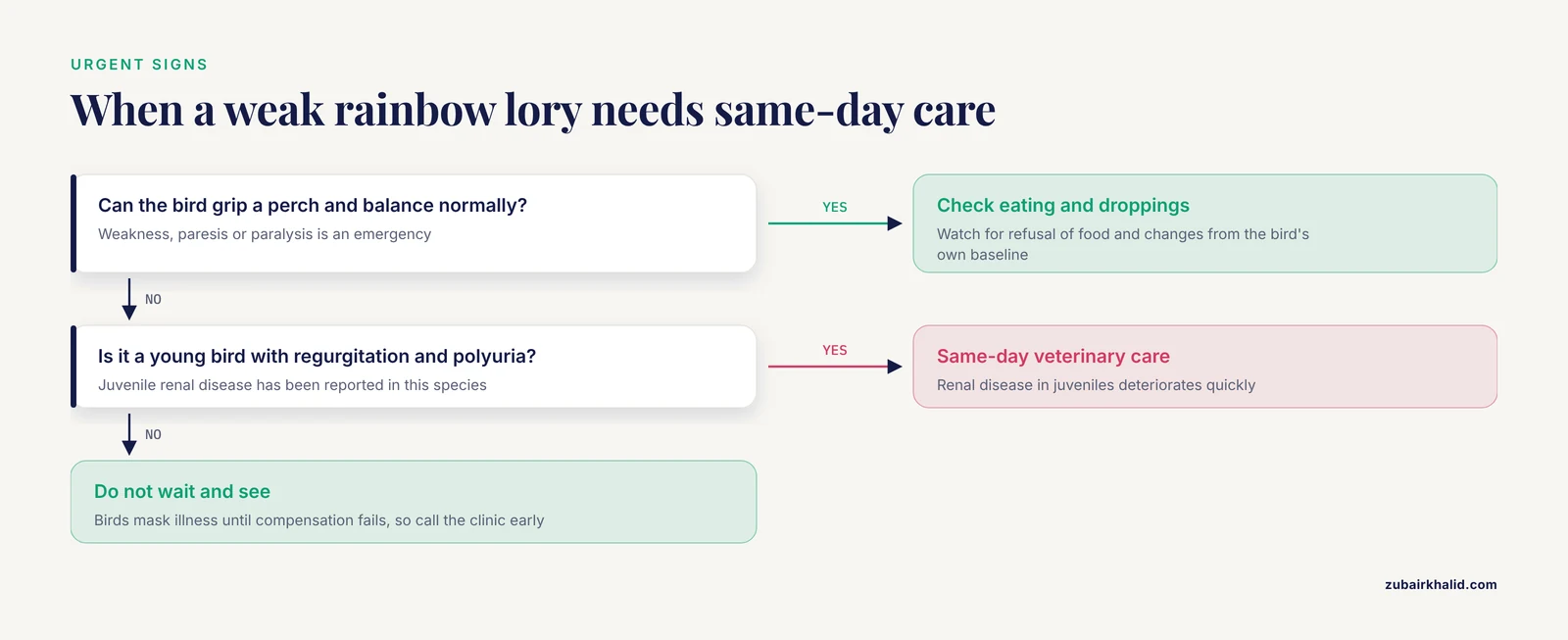
Before purchase, reject any bird that is lethargic, has labored breathing, nasal discharge, or cannot grip a perch. After arrival, seek same-day veterinary care for regurgitation combined with polyuria or weakness, pelvic limb paresis, or a juvenile that stops eating. Renal disease in juveniles deteriorates quickly [2]. Seasonal weakness or paralysis in a rainbow lory warrants urgent assessment for lorikeet paralysis syndrome [4]. Refusal to eat for over 24 hours, continued weight loss, or sudden droppings changes also require a veterinary visit.
Daily Monitoring: Weight, Droppings, and Nectar Intake Logs
Keep a daily log of weight, nectar powder used, and droppings. Compare each entry against the bird's own baseline, not a book value.
Weight
Weigh the lory at the same time each morning before feeding, on the same gram scale. Daily fluctuations of 2 to 3 grams are normal. A trend matters more than a single reading. A sustained loss of more than 10% of baseline body weight, or any loss continuing across three consecutive days, is a reason to call an avian veterinarian.
Nectar Intake
Record the grams of dry powder used each day, not just the volume of mixed nectar. Because dilution changes energy intake [1], a drop in powder consumption can signal illness, while a sudden increase may mean the mix is too dilute. Write down the mixing ratio and any fruit offered. If intake changes by more than a quarter of the usual daily amount for two days running, review the ratio and contact the veterinarian if weight or droppings also change.
Droppings
Lory droppings are naturally wet and bulky. The useful comparison is the bird's own normal appearance. Each day, note the urates, the color of the fecal portion, and any change in wetness. Sudden polyuria with regurgitation or weakness is an emergency in a juvenile, as renal disease has been reported in this species [2]. Blood in droppings, or a dark or unusually colored fecal portion, also warrants a veterinary call.
Setting Baselines and Acting on Changes
Use a simple table with columns for date, weight, powder used, and droppings. After two weeks you have a personal baseline. For example, a lory that normally weighs 130 g and uses 18 g of powder daily is not the same as a 110 g bird using 12 g. A change that is small for one bird may be large for another.
Call a veterinarian when: weight loss exceeds 10% of baseline, intake stops for more than a day, droppings become bloody or suddenly much wetter, or any weakness or inability to perch appears. Do not wait for a scheduled appointment if the bird is also lethargic or not eating.
Boarding, Travel, and Emergency Preparedness for a Nectar-Fed Bird
Carrier and travel feeding
Use a sturdy, well-ventilated carrier with a secure latch. Check it for gaps before every trip. Line the floor with a nonslip mat or paper towel. Add one low perch or a flat resting surface so the bird can balance without climbing. Remove loose bowls and water containers during motion; offer water and fresh nectar only at stops. Carry the bird in a seat-belted position, out of direct sun, and never leave it in a parked car. A towel can shade part of the carrier, but ventilation must stay clear.
Offer a normal nectar meal before departure, then mix small fresh portions at the label ratio at each stop. Do not carry a full day's mix in the carrier; spoiled sugar solution is a risk. For long trips, plan stops every few hours and log intake.
Boarding instructions
Choose a boarder experienced with nectarivores or an avian veterinarian's hospital. Send pre-weighed bags of the exact powder, a written ratio by weight, measuring tools, the bird's bowls, and a cleaning schedule. Include the bird's normal weight, dropping appearance, and daily intake. Ask the boarder to weigh the bird daily and send weight and intake records. Leave written authorization for veterinary care, cost limits, and the contact details of your avian veterinarian.
Emergency supplies and outages
Keep a kit with a spare carrier, nectar powder, bottled water, bowls, gram scale, paper towels, and a copy of the diet and health record. Store it where you can reach it in the dark. During a power outage, nectar mixing needs no electricity, but have bottled water and a battery light. Do not use candles or open flames. If heat support is needed, use only a bird-safe method advised by your veterinarian and monitor for overheating. Identify a backup location with power and water before storm season.
When to seek urgent care
A nectar-fed bird that cannot perch, has limb weakness, or shows paralysis needs emergency assessment; lorikeet paralysis syndrome is a differential [4]. Regurgitation with polyuria, lethargy, or appetite loss in a young lory also warrants same-day care because juvenile renal disease has been reported [2]. Refusal of food for a full day, labored breathing, or suspected toxin exposure is urgent. Call the clinic before you travel so staff can prepare.
Related Guides
- Mourning Dove Care: Housing, Diet, and Health Essentials: Mourning dove care covers avian housing and health essentials
- Button Quail Care: Housing, Diet and Health: Button quail care offers perspectives on small bird enclosure and feeding
- Coturnix Quail Care Guide: Housing, Diet and Egg Laying: Coturnix quail care includes housing and diet details for ground birds
- House Finch Care: Feeding, Housing, and Health: Finch-specific feeding and housing guidance for bird owners
Frequently Asked Questions
What do rainbow lories eat?
A rainbow lory eats a formulated nectar powder mixed with water at the label ratio, plus fresh drinking water. Lories are nectarivores, and their diet should be built around a product designed for that feeding strategy [3]. Fruit is a small optional extra, not a staple.
Can a rainbow lory eat fruit every day?
Yes, in small amounts, but fruit should not displace nectar. When apple was available in a feeding trial, nectar intake fell, and with highly diluted nectar the total ration dropped in protein, thiamine, and calcium-to-phosphorus ratio [1]. Keep fruit modest and keep the nectar mix at the correct strength.
How do I mix nectar powder correctly?
Weigh the powder in grams, measure the water, and follow the label ratio exactly. Higher dilution reduces voluntary energy intake in rainbow lorikeets [1]. Mix only what the bird will consume within a few hours and discard leftovers.
Are rainbow lories messy birds?
Yes. A liquid diet produces wet, bulky droppings, and lories splash when they bill-feed. Plan for daily tray changes, bowls washed every day, and perches placed so droppings miss the food and water.
Do rainbow lories need a companion bird?
They are social, and many owners keep pairs. Quarantine and examine any new bird before introduction, because mixing species carries disease and aggression risks. Ask an avian veterinarian to assess the pairing before you commit.
What is lorikeet paralysis syndrome?
It is a seasonal condition of rainbow lorikeets in eastern Australia that causes lower motor neuron signs such as weakness and inability to perch. Affected birds showed heterophilic leukocytosis and elevated muscle enzymes, uric acid, sodium, and chloride, with no specific lesions on histology [4]. Any paralyzed lory needs emergency veterinary care.
Are blue rainbow lories more likely to have health problems?
Not automatically, but the breeding line matters. A case series of three juvenile rainbow lorikeets with polycystic kidney disease found all three were progeny of full sibling parents line bred for a blue mutation [2]. Ask whether the parents are related before buying a color-mutation bird.
How often should a rainbow lory see a veterinarian?
At least once a year for a wellness examination, and sooner for any change in weight, appetite, droppings, or perch ability. Bring a fresh dropping sample, a diet history, and the nectar product label so the visit produces usable information.
Sources
- Effect of dilution degree of commercial nectar and provision of fruit on food, energy and nutrient intake in two rainbow lorikeet subspecies.
- Polycystic Kidney Disease in 3 Juvenile Rainbow Lorikeets (Trichoglossus moluccanus).
- Feeding cluster preferences in four genera of Lories and Lorikeets (Loriinae) that should be considered in the diet of nectarivorous psittacine species in captivity.
- Investigation into clinicopathological and pathological findings, prognosis, and aetiology of lorikeet paralysis syndrome in rainbow lorikeets (Trichoglossus haematodus).