Button Quail Care: Housing, Diet and Health
By Dr. Zubair Khalid, DVM, MS, PhD ·
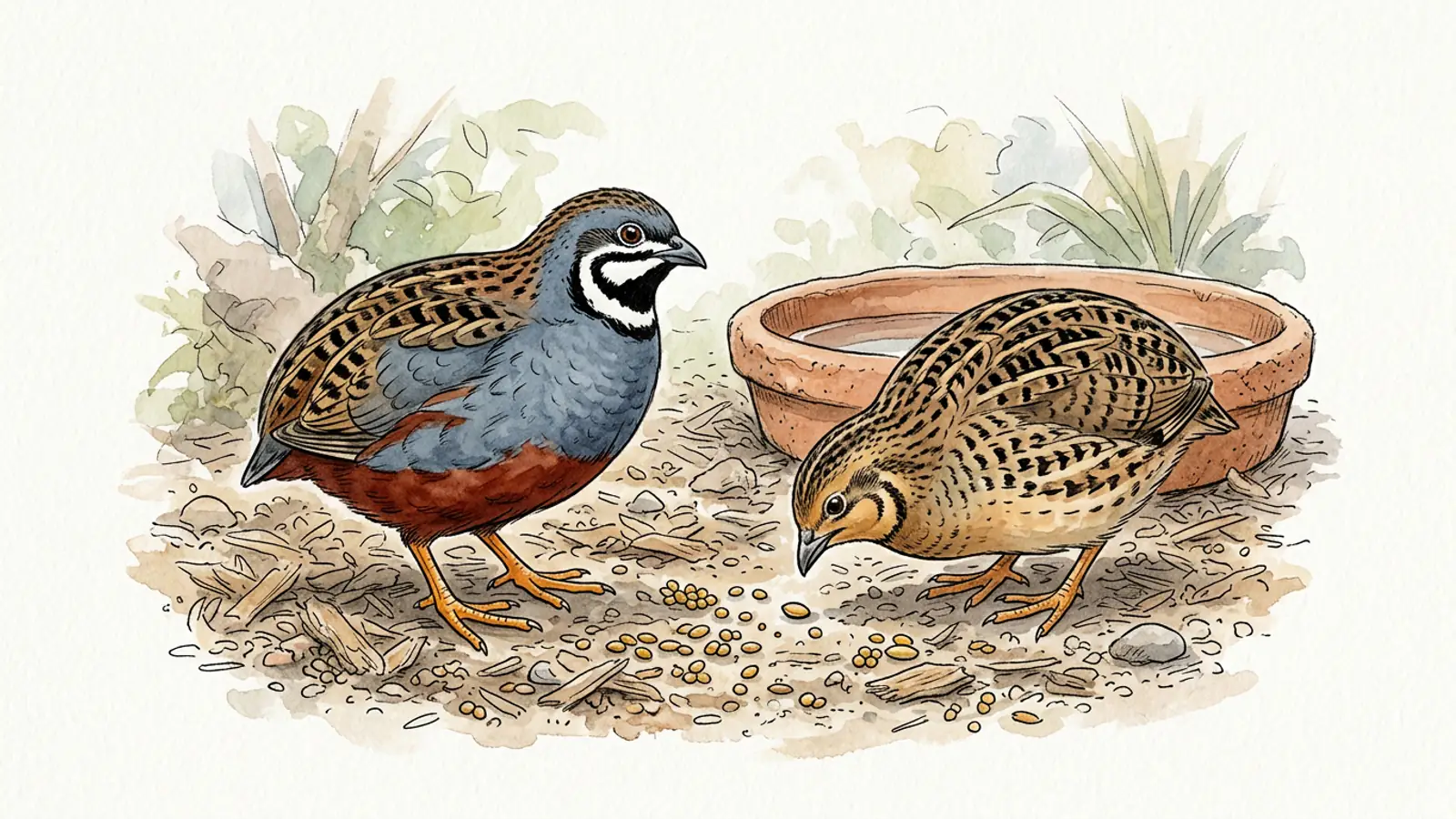
Button quail are small, ground-dwelling birds that owners keep in planted aviaries, indoor flight pens, and screen enclosures. They are hardy, productive layers, and easy to handle when their housing is built to match how they behave [1]. The single most important design rule is a low or soft ceiling. These birds explode straight upward when startled, and a hard roof causes head injuries. The second most important rule is diet. A dish of finch seed alone will not meet their protein needs. Button quail need a high-protein game bird or quail feed, grit, and a calcium source for laying hens.
This article is educational and is not a substitute for veterinary diagnosis or treatment.
Key Takeaways
- Button quail are king quail or Chinese painted quail (Synoicus chinensis), the smallest true quail, weighing about 47.66 g for adult males and 55.89 g for adult females.
- A hard ceiling causes head injuries because startled button quail launch straight upward, so owners should use a low ceiling or line the top with foam, fabric, or soft netting.
- Growing button quail need roughly 20 to 25 percent crude protein, since research calculated the dietary crude protein requirement at 211 g/kg for weight gain from 7 to 21 days of age.
- Laying hens need a calcium source such as cuttlebone or crushed oyster shell available at all times, because a hen that lays without enough calcium draws it from her own bones.
- Button quail reach sexual maturity around 8 to 9 weeks of age, and artificial light at night reduces digestive efficiency in growing king quail.
What Is a Button Quail?
The pet called a "button quail" is the king quail or Chinese painted quail, Synoicus chinensis. It appears in the older scientific literature as Excalfactoria chinensis and Coturnix chinensis [1][2][3]. It is a true quail in the family Phasianidae.
It is not a buttonquail. The birds in the family Turnicidae are also called buttonquails, but they are not true quail and are rarely kept as cage pets. When you buy a "button quail" from a breeder or pet supplier, you are buying a king quail.
The Chinese painted quail is the smallest true quail. Its body weight is roughly half that of the Japanese quail (Coturnix coturnix japonica), the species used in commercial egg and meat production and in most laboratory work [1]. That size difference is why button quail fit into small spaces that would be cruel for a Japanese quail, and why the two species are managed differently.
Size and Body Weight
Published weights give a clear picture of how small these birds are. Newly hatched chicks average 3.93 g. Adult males average 47.66 g. Adult females average 55.89 g [1]. Females are consistently heavier than males.
A bird that weighs about 50 g has very little thermal mass. It loses body heat quickly and depends on its environment and its own metabolism to stay warm. The ontogeny of thermoregulation in painted quail has been studied directly, which tells you that young chicks are not fully competent at regulating body temperature from day one [4][5]. Chicks need a heat source and a draft-free brooder. Adults in a sheltered aviary do fine at ordinary indoor or mild outdoor temperatures.
Color Mutations
The wild-type bird has a distinctive pattern. Males carry a black chin and throat with a white stripe, a slate-blue breast, and a reddish-brown body. Females are duller, with a brownish body, pale speckling on the breast, and no black face.
Selective breeding has produced many color forms. One well documented mutation is "brown," described in the Chinese painted quail as the second plumage color mutation reported in the species [6]. In brown birds, the black pigment of the wild type is missing, though the rest of the pattern stays the same. The female's dorsal surface is brown with a gray tinge. The male's dorsal surface is dark brown with a bluish-gray tinge. The female's breast is creamy light-brown with many gray speckles. The male's chin is charcoal gray with a brown tinge rather than dense black [6]. The chick down is greenish creamy-yellow with a bright brown tinge and lighter brown stripes than the wild type [6].
Genetically, brown behaves as an autosomal recessive trait [6]. In practical terms, two visual brown parents breed true for brown chicks, and a brown bird crossed with a wild-type bird usually produces wild-type-looking chicks that carry the gene.
Beyond brown, breeders work with silver, white, cinnamon, and other lines. Color does not change care. It only changes what you expect the chicks to look like.
Why Button Quail Behave the Way They Do
Button quail live on the ground. They scratch, dust bathe, hide under cover, and nest on the floor of the enclosure. They do not perch on branches the way finches do, and they do not fly for long distances.
What you see instead is short bursts of running, brief low flights, and a startle response that goes up rather than away.
The Startle Flush and Why the Ceiling Matters
When a button quail is startled, it launches itself vertically. Many ground birds do this. The problem is that a 50 g bird hitting a solid roof or a wire top at speed can break its skull, split the skin over the crown, or damage the beak and eyes.
The fix is simple. Use a low ceiling, or make the ceiling soft.
A low enclosure limits how much speed the bird can build before it hits. A soft ceiling absorbs the impact instead of stopping it abruptly. Soft options include solid panels lined with foam or fabric, or a ceiling of soft bird netting that flexes on contact.
Avoid bare hardware cloth or rigid wire directly over the birds if they can reach it. Avoid sharp metal corners, exposed staples, and any protruding hardware at head height. If you use a wire cage, mount a soft ceiling layer just below the wire.
This is not a minor detail. Scalp wounds from upward flights are one of the most common injuries in small ground quail, and the injury is entirely preventable with the right top.
Ground Cover and Cover Objects
Button quail feel safe when there is something above their heads. A clump of grass, a low artificial plant, a piece of cork bark, or a small hide box gives them a place to retreat.
Cover is also a welfare item for mixed-species aviaries. A bird that can hide is a bird that is less likely to panic when a larger cage mate moves nearby.
Housing Button Quail
A button quail enclosure needs three things: enough floor area for the number of birds, a safe ceiling, and a substrate the birds can work through.
Floor Space
There is no single official floor-space figure for king quail. Use behavior as your guide, then scale up.
For a breeding pair or trio, a floor footprint of at least 2 square feet is a reasonable starting point for an indoor pen, with more being better. A planted aviary that holds a small flock should give every bird room to feed without crowding, to dust bathe, and to move away from a cage mate. Crowding drives feather pecking, scalping, and stress.
As a general rule, more floor area is the cheapest form of health insurance for a bird this small.
Ceiling Height and Type
Keep the interior height modest. You are not trying to build a flight cage. You are trying to prevent a bird from reaching dangerous speed before impact.
If the enclosure is tall, line the ceiling with a soft material or install a net ceiling a few inches below the hard top. Either approach gives the bird a shock-absorbing layer.
Substrate
Sand, fine wood shavings, dry soil, and dried grass litter all work. What matters is that the substrate is dry, clean, and loose enough for the birds to scratch and dust bathe.
Damp bedding grows mold and bacteria. Replace soiled areas daily and do a full substrate change on a schedule that matches your bird density. For a small indoor pen, a full change every one to two weeks is common. For a planted aviary with good drainage, less often.
Do not use cedar shavings. Do not use cat litter. Do not use anything sharp, dusty, or strongly scented.
Heat, Shelter, and Drafts
Chicks need a brooder with a warm zone and a cooler zone so they can regulate their own temperature. The physiology of thermoregulation in painted quail develops after hatching, so a chick cannot be expected to hold its own body temperature in a cold room [4][5].
Adults in a sheltered aviary handle mild temperatures well. Provide a dry, draft-free corner. In cold weather, give them a deeper litter layer and wind protection. In hot weather, give shade and shallow water for bathing, but keep water dishes shallow enough that a chick or a small adult cannot drown.
Light
Artificial light at night reduces digestive efficiency in growing king quail. In a controlled experiment, chicks exposed to weak blue light (about 0.3 lux) every night for six consecutive weeks had measurably lower digestive efficiency at two time points between weeks 4 and 9 after hatching, the window that overlaps their fastest skeletal growth [8]. Growth rate itself was not affected [8].
For a home keeper, the practical takeaway is to keep the enclosure dark at night. Avoid night lights over the cage, avoid bright room lighting that spills into the pen, and avoid blue LED indicators on equipment near the birds. If you use supplemental light to drive egg production, keep it on a consistent daytime schedule and let the birds have a true dark period.
Indoor Versus Outdoor
Indoor pens give you control over temperature, light, and predator access. They also concentrate dust and odor, so ventilation matters.
Outdoor aviaries give the birds natural light, natural insects, and space. They also expose them to predators, wild birds, and weather. Wild birds and rodents are disease vectors. Use hardware cloth, not chicken wire, and bury or weight the base to keep rodents out. Roof the aviary fully.
Button Quail as Aviary Floor Birds
One of the most attractive ways to keep button quail is as floor birds in a mixed aviary under finches or other small softbills.
The two species use different parts of the enclosure. Finches occupy the upper space and the perches. Button quail occupy the floor, the low cover, and the substrate. They rarely compete for food if each species has its own feeding station.
The quail pick up fallen seed and insects, turn the litter, and add life to the lower half of the aviary. The finches ignore them for the most part.
This arrangement has rules.
First, the quail floor must be safe. No deep water, no open gaps under doors, and no sharp edges at quail level.
Second, the quail need their own feed. Do not rely on spilled finch seed. Button quail need a higher protein diet than a finch mix provides, and a diet of finch seed alone is not adequate.
Third, watch for aggression during breeding. Male button quail can be persistent with females, and a female that cannot get away can be injured. In a mixed aviary, provide multiple hiding spots so any bird can break line of sight.
Fourth, screen any floor drain or gap. A 50 g bird fits through openings that would not pass a finch.
Feeding Button Quail
Diet is where most new owners go wrong. Button quail are not seed-only birds. They are small game birds with a high protein requirement, especially while growing and while laying.
Protein Requirements
The protein needs of this species have been measured in controlled feeding trials. Growing blue-breasted quail (Excalfactoria chinensis) fed a diet with 125 g/kg crude protein could not maintain body weight and had negative feed efficiency [9]. In a study of protein requirements from 7 to 21 days of age, the dietary crude protein requirement was calculated at 211 g/kg for weight gain and 202 g/kg for feed efficiency [9].
A separate study looked at crude protein across a wider range. Quail receiving 160 g/kg crude protein showed the least weight gain, and higher protein concentrations supported better gains during the first weeks of life [10].
Translate those numbers for the home keeper. A growing button quail needs a diet in the neighborhood of 20 to 25 percent crude protein. Adult maintenance and laying birds also need protein well above what a plain finch or budgie seed mix supplies.
The simplest reliable approach is a commercial game bird starter or a formulated quail feed with a stated crude protein percentage in that range, offered as the base of the diet. If you cannot find a quail-specific feed, a game bird starter that is appropriate for the bird's age is the standard substitute.
Seed, Insects, and Greens
Seeds, insects, and greens are supplements, not the foundation.
Small seeds add variety and give the birds something to scratch for. They should not be the main food.
Insects add protein and give the birds natural foraging behavior. Small live insects are useful for breeding birds and for chicks.
Finely chopped dark leafy greens, grated carrot, and similar fresh items can be offered in small amounts and removed before they spoil.
Fresh food bowls should be small, shallow, and cleaned daily. A 50 g bird walking through wet mash tracks it everywhere, and spoiled mash grows bacteria fast.
Grit and Calcium
Button quail need grit to break down hard seeds and to keep the gizzard working. Offer a fine insoluble grit, such as a chick grit product, in a separate small dish. Oyster shell supplies calcium but does not replace grinding grit. Do not mix grit into the feed bowl so that birds cannot overeat it.
Laying females need a calcium source. A cuttlebone, crushed oyster shell, or a calcium grit dish should be available at all times. A hen that lays without enough calcium draws it from her own bones and can become weak, thin-shelled, or prone to egg binding.
Water
Use shallow water dishes with a low lip. Deep dishes drown chicks and small adults. Add marbles or clean pebbles to a dish that is too deep for the birds, or use a chick waterer base.
Change water daily. Scrub the dish every few days. Biofilm builds fast in warm rooms.
Feeding Stations and Competition
If you keep a group, place more than one feed and water station. A single station lets a dominant bird block access. Multiple stations spread the birds out and let the shyer birds eat.
Button Quail Eggs and Reproduction
Button quail are productive. The species reaches sexual maturity around 8 to 9 weeks of age. In a research setting, laying ability was reported at 60 to 80 percent, fertility at 91 percent, hatchability at 84 percent, and viability to maturity at 78 percent [1]. Those are strong reproductive figures for such a small bird.
Egg Production
A healthy hen lays small eggs that are often described as miniature chicken eggs, with a pointed shape and a range of colors depending on the line. She will lay without a male present.
Production depends on light, diet, and condition. A hen on a protein-adequate diet with adequate calcium and a normal light cycle will lay steadily. A hen on a seed-only diet will slow down, thin out, or stop.
Button quail eggs are edible. They are tiny, and the shell is delicate. Many owners simply leave them for the birds or use them in the kitchen.
Incubation and Chicks
Button quail eggs are commonly incubated in a small forced-air incubator. Handle the eggs gently. A shell this small loses heat quickly.
Chicks are tiny at hatch, averaging under 4 g [1]. They need a warm brooder, a shallow water source, and a crumble or finely ground starter feed. Because their thermoregulation is still developing, they cannot be treated like adult birds in a cool room [4][5].
Sexing
Males and females look different in most color lines. The male's face pattern (black chin, white stripe, blue breast in the wild type) makes him easy to identify once he is feathered out. In the brown mutation, the male's chin is charcoal gray with a brown tinge rather than black, and the dorsal surface is darker than the female's [6]. If you are unsure, wait until the birds are feathered and listen for the male's crow, a descending whistle [3].
Health Problems in Button Quail
Small size makes some problems more dangerous. A 50 g bird has very little reserve. An illness that a chicken would fight off can kill a button quail in a day or two.
Scalping and Head Injuries
The classic button quail emergency is a scalp wound from a startle flush into a hard ceiling. Wounds range from a small cut to a large avulsion. Bleeding can be significant for a bird this small.
Prevention is the ceiling design described above. Treatment depends on the wound. A small, clean cut may need only cleaning and monitoring. A large, gaping, or bleeding wound needs a veterinarian. Watch for swelling, discharge, and changes in behavior after any head injury.
Scalping can also happen within a group. A dominant bird can peck the crown of a subordinate bird, especially in a crowded pen with no cover. Separate the injured bird and review your density and cover.
Egg Binding
Egg binding is a hen that cannot pass an egg. She may sit fluffed, strain, or look weak. She may stop eating.
Risk factors that an owner can control include calcium deficiency, obesity, cold, and stress. A hen on a proper diet with free-choice calcium is at lower risk.
A bound hen is a veterinary emergency. Do not massage the abdomen or try to pull the egg. Keep the bird warm and quiet and contact a veterinarian.
Respiratory Disease
Button quail are susceptible to respiratory disease, and they can carry organisms that are not obvious until stress triggers an outbreak. One documented case in painted quail was avian tuberculosis caused by Mycobacterium avium complex, found at a zoo, with lesions in the liver and spleen [11]. That report illustrates that quail can carry serious mycobacterial infections.
Signs of respiratory illness include open-mouth breathing, clicking or rattling sounds, nasal discharge, swollen eyes, and a drop in activity. Any of these needs veterinary assessment. Because button quail are kept near other birds, a sick quail can be the first sign of a problem that affects the whole flock.
Viral and Bacterial Threats from Other Poultry
Button quail can be infected by pathogens shared with domestic poultry. A documented outbreak of fowl adenovirus serotype 4 (FAdV-4) in blue-breasted quail (Excalfactoria chinensis) showed cross-species transmission between ornamental quail and domestic poultry. The isolated strain retained high pathogenicity to both specific pathogen free chickens and the quail themselves, with 100 percent morbidity and over 90 percent mortality in the experimental groups [12].
The practical point for the home keeper is biosecurity. If you keep chickens, ducks, or pigeons, keep them away from your button quail. Do not move equipment between pens. Change shoes and wash hands between flocks.
Overgrown Toenails
Button quail kept on soft bedding, paper, or flat surfaces do not wear their toenails down. The nails curl, catch on fabric, and can grow into the toe pad.
Trim nails with a small pair of nail clippers or scissors, taking off only the clear tip. If you cannot see the quick, take off very little and check again in a month. If you are unsure, have a veterinarian or an experienced breeder show you the first time.
Sand or fine grit areas in the enclosure help with natural wear. They do not replace trimming for birds that spend most of their time on soft surfaces.
Other Common Issues
Coccidiosis, worms, and external parasites can affect quail kept on damp or dirty substrate. Keep litter clean and dry.
Feather loss, pecking, and scalping are usually management problems. Check density, cover, and feeder access before assuming disease.
Sudden death in a healthy-looking bird can follow a startle injury, and a veterinarian can perform a necropsy to find the cause. Body weight this small leaves little margin.
Handling Button Quail
Button quail are easy to handle because they are small and hardy [1]. They are also fragile if handled badly.
How to Pick One Up
Cup the bird with both hands from the sides, cradling the body so the wings stay folded. Do not grab from above the way you would a chicken. An overhead grab triggers the startle response.
Hold the bird close to a surface. If it flutters out of your hands, a low drop is far less dangerous than a high one.
Keep handling brief. Move the bird from point A to point B, then put it down.
Catching Birds in an Aviary
Use a soft net or herd the bird gently into a corner with a soft cloth. Do not chase it around the enclosure. A panicked bird flushes up and hits the roof.
If you must catch a bird from a planted aviary, do it in dim light and remove the obstacles in your path first.
After Handling
Check the bird's feet, beak, eyes, and vent before releasing it. Look for nail overgrowth, injuries, and any discharge. This is the easiest time to catch a problem early.
Care Checklist
Use this as a starting framework and adjust for your bird count and enclosure type.
| Item | What to Do | Frequency |
|---|---|---|
| Ceiling | Soft or low top, no rigid wire directly above birds | Ongoing |
| Substrate | Dry sand, shavings, soil, or grass litter, no cedar | Spot clean daily, full change 1 to 2 weeks |
| Base diet | Game bird or quail feed at roughly 20 to 25 percent crude protein | Daily, fresh |
| Seed and insects | Small amounts as foraging and enrichment | Daily or several times a week |
| Greens | Finely chopped, small portions, remove leftovers | Several times a week |
| Grit | Separate small dish, do not mix into feed | Available at all times |
| Calcium | Cuttlebone or oyster shell for laying hens | Available at all times |
| Water | Shallow dish, marbles if too deep | Change daily, scrub every few days |
| Light | Dark nights, no blue night lights over the pen | Every night |
| Nail check | Inspect and trim if needed | Monthly |
| Body check | Feet, beak, eyes, vent, weight | Weekly or at any handling |
| Biosecurity | Keep away from chickens, ducks, pigeons | Ongoing |
| Cover and hides | Multiple hiding spots per bird | Ongoing |
Common Mistakes
Mixing only finch seed. A seed-only diet does not meet the protein requirement. Growing quail need a diet near 20 to 25 percent crude protein, and birds on 125 g/kg crude protein cannot even maintain weight [9].
Using a hard wire ceiling. This is the most common cause of preventable head injury in pet button quail.
Skipping calcium for layers. A hen that lays without a calcium source is at risk for egg binding and poor shell quality.
Leaving a bright night light on. Night light reduces digestive efficiency in growing king quail [8].
Keeping button quail with chickens. Cross-species transmission of serious poultry pathogens is documented in this species [12].
Crowding. Too many birds in too little space drives pecking, scalping, and stress.
Using deep water dishes. Small birds can drown.
Forgetting nail trims on soft bedding. Nails overgrow, curl, and injure the foot.
Ignoring a sick bird because it "looks small." A 50 g bird has very little reserve, and a day of waiting can be too long.
Limitations and When to Contact a Veterinarian
This article is educational and is not a substitute for veterinary diagnosis or treatment. Individual birds need individual assessment.
Contact a veterinarian promptly if you see any of the following:
- A head wound, split scalp, or bleeding after a startle flush
- A hen that strains, sits fluffed, or cannot pass an egg
- Open-mouth breathing, clicking, rattling, nasal discharge, or swollen eyes
- A bird that stops eating, loses weight, or sits apart from the group
- Sudden death in a bird that looked healthy the day before
- Toenails you cannot safely trim, or a nail grown into the toe pad
- Any bird newly introduced to your flock that looks unwell
- Any suspicion of disease shared with chickens, ducks, or pigeons
Find a veterinarian who sees birds. Not every small animal clinic treats quail, and a 50 g patient needs a clinician with avian experience.
Frequently Asked Questions
What is a button quail?
A button quail is the king quail or Chinese painted quail, Synoicus chinensis, the smallest true quail. It is not a buttonquail in the family Turnicidae.
How big do button quail get?
Adults weigh about 48 g for males and 56 g for females, and chicks hatch at under 4 g [1].
Why does my button quail jump straight up?
The vertical flush is a startle response. A low ceiling or a soft netted top prevents head injuries from the jump.
Can button quail live with finches?
Yes, they work well as aviary floor birds under finches. Each species needs its own feeding station and the quail still need a high-protein diet.
What is the best diet for button quail?
A game bird or quail feed in the range of 20 to 25 percent crude protein as the base, with seed, insects, and greens as supplements, plus grit and calcium [9][10].
How many eggs do button quail lay?
A healthy hen lays regularly once mature, and the species reaches sexual maturity around 8 to 9 weeks of age [1]. Production depends on light, diet, and condition.
How long do button quail live?
King quail typically live about 3 to 6 years in captivity and occasionally much longer, while wild birds may live only about 1.5 years. The species matures quickly and reproduces well in captivity [1]. Lifespan depends heavily on housing, diet, and injury prevention.
Do button quail need a heat lamp?
Chicks need a warm brooder because thermoregulation is still developing after hatch [4][5]. Sheltered adults usually do not need supplemental heat.
Related Articles
- Quail Farming: Housing, Breeding, and Egg Production
- Quail Farming Equipment: Essential Tools for Housing, Feeding, and Incubation
- Pet Bird Nutrition: Formulating a Balanced Diet for Parrots and Finches
- Raising Quail in the Backyard
Sources
- Excalfactoria quail as a new laboratory research animal.
- Coturnix chinensis (blue-breasted quail or king quail) - INFORMATION - Animal Diversity Web (animaldiversity.org)
- King quail - Wikipedia (en.wikipedia.org)
- Development of thermoregulation in painted quail, Excalfactoria chinensis.
- Cutaneous and respiratory evaporation in the painted quail, Excalfactoria chinensis, during ontogeny of thermoregulation.
- Brown: a plumage color mutation in Chinese painted quail (Excalfactoria chinensis).
- [[Histology, immunocytology, histochemistry and muscle fiber innervation of the pectoralis major and supracoracoideus muscles of Excalfactoria chinensis chinensis (L.)].](https://pubmed.ncbi.nlm.nih.gov/1414211/)
- Light at night reduces digestive efficiency of developing birds: an experiment with king quail.
- Apportioning protein requirements for maintenance v. growth for blue-breasted quail (Excalfactoria chinensis) from 7 to 21 days of age.
- Estimating the requirement of dietary crude protein for growing blue-breasted quail (Excalfactoria chinensis).
- Pathogenicity of Mycobacterium avium complex serovar 9 isolated from painted quail (Excalfactoria chinensis).
- Outbreak of FAdV-4 infection in blue-breasted quail (Excalfactoria chinensis) reveals novel cross-species transmission of virus in domestic poultry and ornamental pet birds.