Heifer vs Cow vs Steer vs Bull: What Each Term Means
By Dr. Zubair Khalid, DVM, MS, PhD ·
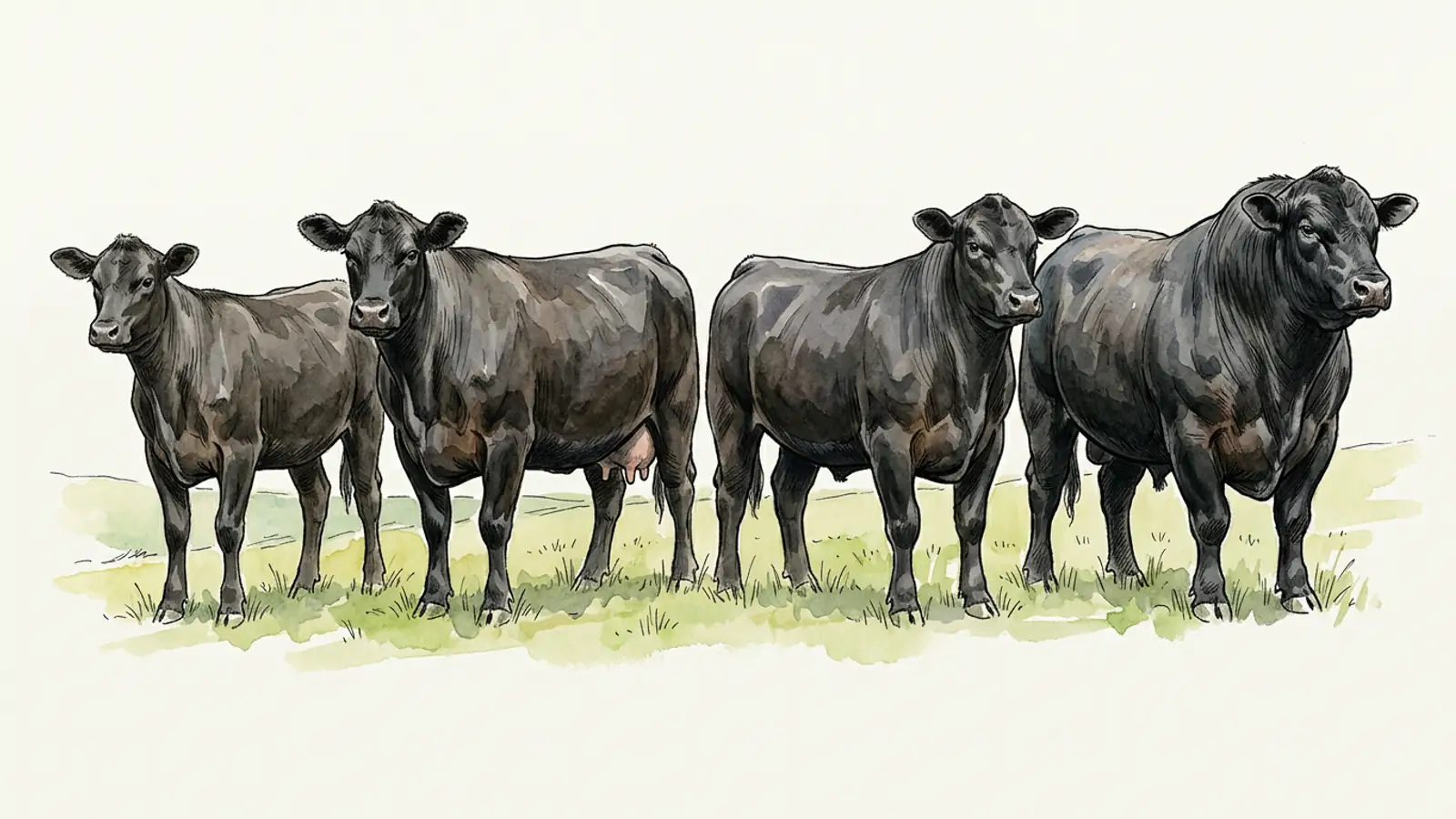
A heifer is a female bovine that has not yet given birth. A cow is a female bovine that has calved at least once. A steer is a male castrated before puberty, and a bull is an intact (uncastrated) male. Those four words describe sex and reproductive status, not age, breed, or size, and that single fact resolves most of the confusion behind the search phrase heifer vs cow.
Cattle terminology matters to anyone who buys beef, raises a few head, works with 4-H or FFA youth, or simply wants to understand a farm sign or a meat label. The words are old, regional, and sometimes overlapping, which is why a stockman in Texas, a farmer in Somerset, and a grazier in Queensland can use the same word to mean slightly different things. This guide defines each term precisely, explains the biology behind the labels, covers the horn question that trips up so many people, and lays out how to tell heifers, cows, steers, and bulls apart in the field.
This article is educational and is not a substitute for veterinary diagnosis or treatment.
Key Takeaways
- A heifer is a female bovine that has not yet given birth, while a cow is a female bovine that has calved at least once, and this reproductive definition, not age, resolves most confusion.
- A steer is a male bovine castrated before puberty, a bull is an intact uncastrated male, and a stag is a male castrated after sexual maturity who retains some masculine characteristics.
- A freemartin is a female calf born twin to a bull calf, typically infertile because hormonal exchange in the womb affects development of her reproductive tract, so she is not kept as a replacement heifer.
- Horns depend on breed and genetics rather than sex, since the polled gene is dominant to horned, so a heifer can have horns and sex does not determine horn status.
- The fastest field check is the rear end: a female has a vulva and a male has a sheath, then a developed udder indicates a cow while testicles indicate a bull.
The Core Definitions
Calf
A calf is a young bovine of either sex, generally under one year of age. The word covers both bull calves (intact males) and heifer calves (females). Calves can be born singly, and twins occur at a low rate. When twins are a bull calf and a heifer calf, the female is often a freemartin, a topic covered below.
Heifer
A heifer is a female bovine that has not had a calf. The definition is reproductive, not chronological. A 30-month-old female that has never conceived is still a heifer. A 20-month-old female that calved last week is a cow, even though she is young. This is the single most common point of confusion in the heifer vs cow comparison.
A first-calf heifer, also called a first-calf cow or a primiparous cow, is a female that has just delivered her first calf. She sits in a gray zone. Many producers still call her a heifer through her first lactation, while others switch to "cow" the moment she calves. Both usages are correct in practice.
A springer is a heifer or cow in late gestation, close to calving. The term describes the physical signs of impending birth, including a relaxed pelvic ligament and an enlarged udder. It is a stage, not a category.
Cow
A cow is a female bovine that has calved at least once. In strict cattle terminology, the word is reserved for a female that has produced a calf. This is why a rancher might say "that heifer is bred" but "that cow is raising a good calf."
The word "cow" is also used loosely as a generic term for any bovine, as in "cattle are cows." In casual speech this is common. In technical writing and in the show ring, the distinction between heifer and cow is enforced.
Bull
A bull is an intact male bovine, meaning he has not been castrated. Bulls are used for breeding. They are typically larger and more muscular than steers and carry the secondary sexual characteristics of an intact male, including a heavier neck, a more prominent crest, and often a more aggressive temperament.
A bull calf is an intact male before weaning. A mature bull is generally over two years old. The term "bull" is also used in other species (bull elephant, bull moose), but in cattle it always means an uncastrated male.
Steer
A steer is a male bovine castrated before sexual maturity. Castration is typically performed in the first few months of life. The timing matters because males castrated before puberty do not develop the full masculine secondary characteristics. Steers grow more slowly than bulls but are calmer and easier to handle, and their meat is generally more tender and better marbled than that of intact males.
Steers, along with heifers not kept for breeding, are the main source of fed beef in the United States. The steer vs bull distinction is largely about management, temperament, and meat quality.
Stag
A stag is a male bovine castrated after sexual maturity. Because he was castrated late, he retains some masculine characteristics, including a heavier frame and sometimes more aggressive behavior. Stags are uncommon in modern commercial production because castration is usually done early. The term is more common in older texts and in some regional usage.
Ox
An ox is a mature, castrated male bovine trained for draft work. Oxen are used in pairs to pull carts, plows, and logs. The term implies training, not just castration. A steer that is never trained is not an ox. Oxen are still used in parts of the world where mechanized equipment is unavailable or impractical, and they appear in historical and hobby contexts in the United States.
Bullock
Bullock is a term used in British and Australian English for a castrated male bovine, roughly equivalent to a steer in American usage. In some contexts, bullock refers specifically to a young castrated male, and in others it is used for a mature one. The word is also used for a young bull. Because usage varies, the safest reading is that a bullock is a castrated male, and the exact age range depends on the speaker.
Yearling
A yearling is a bovine between one and two years of age. The term applies to either sex. A yearling heifer is a female that has not calved and is in her second year. A yearling steer is a castrated male in the same age range. Yearling is an age category, not a reproductive one, so it can overlap with heifer, steer, or bull.
Springer
A springer is a female in late pregnancy, close to calving. The term is used for both heifers and cows. A springer heifer is carrying her first calf. A springer cow is carrying a subsequent calf. The word describes the stage of gestation, not the number of calves she has had.
Freemartin
A freemartin is a female calf born twin to a bull calf. She is typically infertile or subfertile because of hormonal exchange in the womb. The condition occurs when a female fetus shares a placenta with a male fetus, and the male's hormones affect the development of the female reproductive tract. Freemartins are usually sterile and are not kept as replacement heifers. The condition is well recognized in cattle and is one reason twin pregnancies in cattle are monitored closely.
Terminology Table
| Term | Sex | Reproductive Status | Typical Age Range | Notes |
|---|---|---|---|---|
| Calf | Either | Not yet mature | Birth to about 1 year | Includes bull calves and heifer calves |
| Heifer | Female | Has not calved | Birth to first calving | Reproductive definition, not age |
| First-calf heifer | Female | Has calved once | Around 2 years | Also called primiparous cow |
| Cow | Female | Has calved at least once | Usually 2 years and older | Strict definition requires a calf |
| Bull | Male | Intact, not castrated | Any age | Used for breeding |
| Steer | Male | Castrated before puberty | Usually castrated in first months | Standard beef animal |
| Stag | Male | Castrated after puberty | Variable | Retains some masculine traits |
| Ox | Male | Castrated and trained | Mature | Draft animal |
| Bullock | Male | Castrated | Variable | British and Australian usage |
| Yearling | Either | Variable | 1 to 2 years | Age category |
| Springer | Female | Late gestation | Variable | Close to calving |
| Freemartin | Female | Infertile | Calf | Twin to a bull calf |
The Biology Behind the Labels
Cattle terminology tracks two biological facts: sex and reproductive history. Sex is determined at conception. Reproductive history is determined by whether the animal has calved. Everything else, including age, breed, and size, is secondary.
A heifer becomes a cow at calving. That transition is the single most important event in the life of a female bovine from a terminology standpoint. Before calving, she is a heifer. After calving, she is a cow. The change is not gradual and it is not a matter of size. A small two-year-old that has calved is a cow. A large three-year-old that has never calved is a heifer.
For males, the key event is castration. A male castrated before puberty becomes a steer. A male castrated after puberty becomes a stag. A male that is never castrated remains a bull. The timing of castration affects growth, temperament, and carcass characteristics, which is why the distinction matters in beef production.
The terms also carry management implications. Heifers require different nutrition and breeding management than cows because they are still growing while carrying a calf. Bulls require different handling than steers because of their size and temperament. Steers are the standard beef animal because they are easier to manage and produce consistent meat quality.
Do Heifers Have Horns?
Horns depend on breed and genetics, not sex. A heifer can have horns, and so can a bull, a steer, and a cow. The presence or absence of horns is determined by a gene, not by whether the animal is female or male.
The polled gene is the genetic basis for hornlessness in cattle. Polled is dominant to horned, which means an animal needs only one copy of the polled allele to be hornless. An animal with two copies of the horned allele will have horns. This is why two polled parents can produce a horned calf if both carry a hidden horned allele, and why a horned animal bred to a polled animal can produce polled offspring [1][2].
The genetics of polledness are not identical across all breeds. Research has identified at least two different polled-associated haplotypes in cattle, one in Simmental and other beef breeds and another in Holstein. These are independent mutations that both produce hornlessness, and they are located on bovine chromosome 1 [3]. This is why polledness can appear in different breeds through different genetic pathways.
Many dairy calves are disbudded, which means the horn buds are removed before they attach to the skull. Disbudding is performed for human and animal safety, because horned cattle can injure people and other cattle during handling [1][2][4]. The procedure is typically done in the first weeks of life, before the horn bud attaches to the skull, which makes removal easier and less traumatic [5]. Common methods include hot-iron cautery and caustic paste, and pain control with a local anesthetic and a nonsteroidal anti-inflammatory drug is recommended by veterinary organizations and quality assurance programs [6][7][8].
Dehorning is the removal of horns after they have attached to the skull. It is a more invasive procedure than disbudding and is generally performed less often because of welfare concerns and the availability of disbudding. The trend in dairy and beef production is toward disbudding at a young age, genetic selection for polled animals, and the use of pain control during the procedure [1][2][6][4].
So the answer to "do heifers have horns" is: it depends on the breed and the individual animal's genetics. A horned breed will produce horned heifers unless they are disbudded. A polled breed will produce hornless heifers. Sex does not determine horn status.
How to Tell Heifers, Cows, and Steers Apart
Telling cattle apart in the field requires looking at the right features. The most reliable indicators are the udder, the external genitalia, the body shape, and the head and neck.
Udder and Teats
A cow that has calved will have a developed udder, even if she is not currently lactating. The udder may be large and pendulous in a lactating cow or smaller and less prominent in a dry cow, but the presence of a developed udder and visible teats is a strong indicator that the animal has calved.
A heifer that has never calved will have a small udder and small teats. A springer heifer in late gestation may have an enlarged udder as she approaches calving, but she will not have the stretched, pendulous udder of a cow that has raised several calves.
External Genitalia
The external genitalia are the most reliable way to determine sex. A female has a vulva below the anus. A male has a sheath and, if intact, visible testicles. A steer has a sheath but no testicles, and the sheath is usually smaller than that of a bull.
Body Shape and Muscling
Bulls and steers tend to be more heavily muscled than females. A bull has a thick neck, a prominent crest, and a broad head. A steer has a similar but less pronounced build. Heifers and cows have a narrower neck and a more feminine head.
Head and Neck
A bull's head is broader and heavier than a steer's or a female's. The neck of a bull is thick and muscular, and the crest is prominent. A steer's neck is thinner. A heifer's neck is finer still. These differences are most obvious in mature animals and less reliable in young stock.
Horns and Polledness
Horns or the absence of horns can help identify breed but not sex. A horned heifer and a horned steer look similar in the head. Polled animals of either sex lack horns. Do not use horn status to determine sex.
Behavioral Cues
Bulls can be more aggressive, especially during breeding season. Steers are generally calmer. Heifers and cows may be protective of calves. Behavior is not a reliable identifier on its own, but it can support other observations.
Practical Field Identification
The fastest field check is to look at the rear end. A female has a vulva. A male has a sheath. If the animal is female, check the udder. A developed udder means cow. A small udder means heifer or springer heifer. If the animal is male, check for testicles. Testicles mean bull. No testicles mean steer or stag. The distinction between steer and stag depends on the age at castration, which is usually not visible.
Regional Usage Differences
Cattle terminology varies by country and region. The core definitions are consistent, but the edges blur.
In the United States, "steer" is the standard term for a castrated male. "Bullock" is uncommon and is sometimes used for a young bull. "Ox" is used for a trained draft animal. "Cow" is used strictly for a female that has calved in technical contexts, but loosely for any bovine in casual speech.
In the United Kingdom, "bullock" is the standard term for a castrated male, roughly equivalent to a steer. "Steer" is understood but less common. "Ox" is used for a trained draft animal and also appears in historical and ceremonial contexts. "Heifer" is used as in the United States.
In Australia and New Zealand, "bullock" is also used for a castrated male, and "steer" is used in beef production. "Ox" is used for draft animals. "Heifer" is standard. The term "cow" is used strictly for a female that has calved in industry contexts.
In Ireland and parts of rural Britain, "bullock" can refer to a young bull as well as a castrated male, which is a source of confusion. The safest approach is to ask the speaker what they mean when the context is ambiguous.
The word "cattle" itself has an interesting history. It comes from the same root as "chattel" and "capital," reflecting the historical importance of cattle as a measure of wealth. The singular "cow" is often used for any bovine, and the plural "cows" is used for a group of cattle of mixed sex and age. This is a linguistic convenience, not a technical usage.
Why the Terminology Matters
Precise terminology matters for several practical reasons.
Buying and Selling
When you buy a heifer, you expect a female that has not calved. When you buy a cow, you expect a female that has calved. When you buy a steer, you expect a castrated male. When you buy a bull, you expect an intact male. Misunderstandings can lead to disputes, especially in auctions and private sales.
Breeding and Reproduction
Heifers and cows have different nutritional and reproductive management needs. A heifer is still growing and needs to reach a target weight before breeding. A cow is mature and can be managed differently. Bulls are managed for breeding soundness, and steers are not used for breeding at all.
Meat Labeling
Beef labels may use terms like "heifer," "steer," "cow," or "bull" to describe the source animal. In the United States, beef from heifers and steers is generally considered the highest quality for the mainstream market. Beef from cows and bulls is often used for ground beef and processed products. The terminology on the label tells you something about the expected eating quality.
Youth Programs
In 4-H and FFA, market classes are divided by sex and reproductive status. A youth exhibitor showing a heifer is in a breeding class. A youth showing a steer is in a market class. The terminology determines which class the animal enters and how it is judged.
Veterinary Care
Veterinarians use precise terminology to communicate about reproduction, nutrition, and herd health. A heifer with a difficult calving has different needs than a cow with a difficult calving. A bull with a breeding soundness issue is managed differently than a steer with a musculoskeletal problem. Clear terminology supports clear communication.
Common Myths and Misconceptions
Myth: A heifer is a baby cow.
A heifer is a female that has not calved. She can be a calf, a yearling, or a two-year-old. The term is not about age.
Myth: A cow is any female bovine.
In technical usage, a cow is a female that has calved. A female that has not calved is a heifer.
Myth: Steers are born without testicles.
Steers are castrated. They are born as intact males and are castrated before puberty.
Myth: Bulls are always aggressive.
Bulls can be aggressive, but temperament varies by individual, breed, and management. Steers are generally calmer, which is one reason they are preferred for beef production.
Myth: Heifers do not have horns.
Horns depend on genetics, not sex. A heifer from a horned breed will have horns unless she is disbudded.
Myth: All cattle with horns are bulls.
Horn status is not a reliable indicator of sex. Cows, heifers, steers, and bulls can all have horns depending on breed and genetics.
Myth: A freemartin is a hermaphrodite.
A freemartin is a female calf born twin to a bull calf. She is typically infertile because of hormonal exchange in the womb. She looks female externally, but she carries some of her twin's male cells and her internal reproductive tract is underdeveloped.
Practical Implications for Owners and Keepers
If you keep cattle, the terminology affects how you manage them.
Heifers need to reach a target weight before breeding. They are still growing, so their nutritional needs differ from those of mature cows. A heifer that calves too young or too small may have difficulty calving and may not rebreed on schedule.
Cows that have calved need adequate nutrition to support lactation and rebreeding. Their management depends on whether they are lactating, dry, or in late gestation.
Bulls need to be managed for breeding soundness and safety. They should be evaluated before each breeding season, and they should be handled with appropriate facilities and caution.
Steers are managed for growth and carcass quality. They are typically fed a ration designed to promote efficient gain and desirable marbling.
Disbudding and dehorning decisions affect management and welfare. If you keep horned cattle, you will need to plan for disbudding or dehorning and for pain control. If you keep polled cattle, you avoid the procedure entirely. Genetic selection for polledness is a long-term solution, and gene editing has been proposed as a faster route to polled cattle in some populations [1][2][9].
Pain control during disbudding is a welfare issue and a regulatory one in some jurisdictions. In Canada, dairy farmers are required to use a local anesthetic and an analgesic before disbudding and dehorning [10]. In the United States, the Farmers Assuring Responsible Management (FARM) program requires disbudding before 8 weeks of age with pain-control medication [7]. Veterinary organizations recommend the use of a local anesthetic and a nonsteroidal anti-inflammatory drug, and research supports the welfare benefits of this approach [6][4][11].
What Is Still Uncertain
The genetics of polledness are well understood in broad terms, but the exact molecular regulation of horn growth is still being studied. Research has identified multiple polled-associated mutations and has shown that hornless cattle with scurs are obligate heterozygous for one of the polled mutations, which complicates simple inheritance models [3]. The full picture of how these mutations interact with other genes is not yet complete.
The long-term welfare effects of different disbudding methods are also an active area of research. Studies have compared hot-iron cautery, caustic paste, and other methods, and have evaluated different pain-control protocols [12][13][11][14][15]. The goal is to identify the least painful and most practical approach, but no single method has been shown to eliminate pain entirely.
Public attitudes toward genetic modification of cattle for polledness are mixed. In a survey of US adults, about two-thirds rated genetically modified hornless cattle as a good thing and about 23 percent as a bad thing [9]. The acceptance of gene-edited polled cattle will depend on public trust, regulatory approval, and the perceived welfare benefits.
Limitations and When to Contact a Veterinarian
This article provides general information about cattle terminology and the biology behind it. It is not a substitute for veterinary diagnosis or treatment. Individual animals and herds have specific needs that require professional evaluation.
Contact a veterinarian if you have questions about cattle reproduction, calving, breeding soundness, disbudding or dehorning, pain control, or herd health. Contact a veterinarian immediately if an animal shows signs of illness, injury, difficult calving, or distress. A veterinarian can provide specific advice based on the animal's age, sex, reproductive status, and health history.
Frequently Asked Questions
What is a heifer?
A heifer is a female bovine that has not yet given birth. The term describes reproductive status, not age, so a heifer can be a calf, a yearling, or an older female that has never calved.
Is a heifer the same as a cow?
No. A heifer has not calved. A cow has calved at least once. The transition from heifer to cow happens at first calving.
What is the difference between a steer and a bull?
A steer is a male castrated before puberty. A bull is an intact male. Steers are calmer and are the standard beef animal. Bulls are used for breeding.
Do heifers have horns?
Horns depend on breed and genetics, not sex. A heifer from a horned breed will have horns unless she is disbudded. A heifer from a polled breed will not have horns.
What is a freemartin?
A freemartin is a female calf born twin to a bull calf. She is typically infertile because of hormonal exchange in the womb and is not kept as a replacement heifer.
What is a bullock?
Bullock is a British and Australian term for a castrated male bovine, roughly equivalent to a steer in American usage. In some contexts, it can also refer to a young bull.
What is a springer?
A springer is a female in late pregnancy, close to calving. The term applies to both heifers and cows.
How can you tell a heifer from a cow?
The most reliable way is to look at the udder. A cow that has calved has a developed udder and visible teats. A heifer that has never calved has a small udder and small teats.
Related Articles
- Cattle Grazing Lease Agreements: Terms, Rates, and Legal Considerations
- Beef Replacement Heifer Development
- Dairy Heifer Growth Monitoring
- Dairy Replacement Heifer Housing
- Dairy Heifer Breeding Readiness
- Beef Heifer Breeding Season Management
- What Do Cows Eat? Pasture, Hay, Grain and Minerals
- Jersey Cows: Milk, Size, Temperament and Care
- How Much Milk Does a Cow Produce a Day?
Sources
- Comparison of Gene Editing Versus Conventional Breeding to Introgress the POLLED Allele Into the Tropically Adapted Australian Beef Cattle Population.
- Comparison of gene editing versus conventional breeding to introgress the POLLED allele into the US dairy cattle population.
- Independent polled mutations leading to complex gene expression differences in cattle.
- Welfare Effects of the Use of a Combination of Local Anesthesia and NSAID for Disbudding Analgesia in Dairy Calves: Reviewed Across Different Welfare Concerns
- Calf disbudding: animal welfare considerations
- Graduate Student Literature Review: Role of pain mitigation on the welfare of dairy calves undergoing disbudding.
- Disbudding and dehorning practices for preweaned dairy calves by farmers in Wisconsin, USA.
- Utility of an online learning module to teach cautery disbudding technique for dairy calves, including cornual nerve block application
- Public attitudes towards genetically modified polled cattle.
- Ontario Dairy Producers’ Perceived Barriers and Motivations to the Use of Pain Control for Disbudding and Dehorning Calves: A Qualitative Study
- Effect of bupivacaine liposome suspension administered as a cornual nerve block on indicators of pain and distress during and after cautery dehorning in dairy calves.
- Evaluating Policresulen for Disbudding Dairy Calves: A Two-Part Study on Calf Welfare and Consumer Perceptions
- The analgesic effect of preventive administration of meloxicam in calves submitted to hot-iron dehorning
- Multi-dimensional evaluation of pain response in low day-age calves to two types of dehorning
- A comparison of short-term analgesic effects of xylazine alone or combined with levomethadone or ketamine in calves after hot-iron disbudding.