How Much Milk Does a Cow Produce a Day?
By Dr. Zubair Khalid, DVM, MS, PhD ·
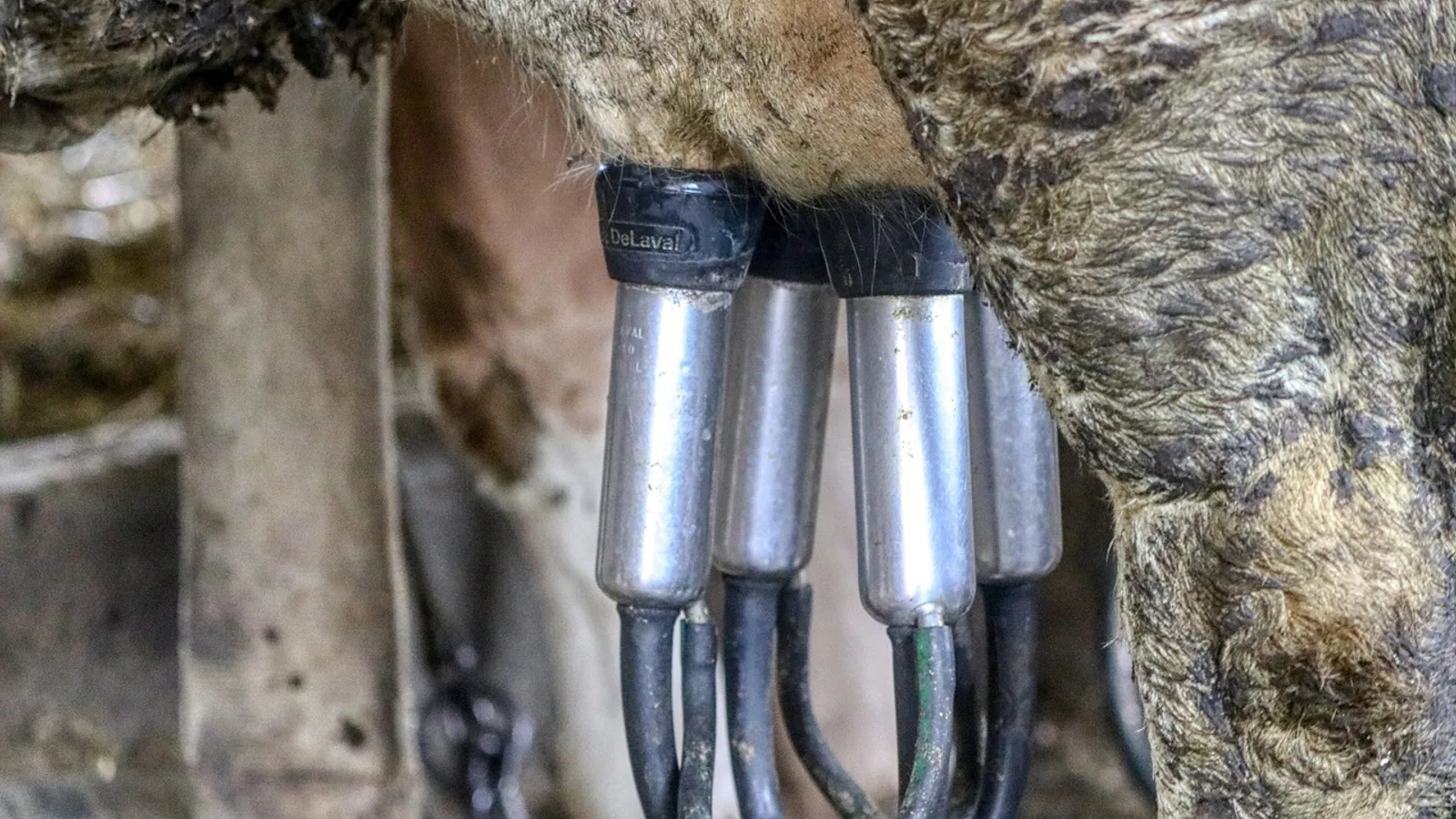
A typical dairy cow in the United States produces roughly 7 to 8 gallons of milk per day when averaged across a full year. That works out to about 65 to 70 pounds of milk daily, or close to 2,500 gallons and more than 22,000 pounds over a standard 305-day lactation.
Those numbers describe the national average for cows in commercial dairy herds. An individual cow can give far more or far less on any given day. Production swings with breed, genetics, feed quality, milking frequency, health, heat stress, and where she sits on her lactation curve. A family milk cow on pasture might give 2 to 4 gallons a day. A top Holstein in a well-managed herd can exceed 12 gallons at peak.
This article explains the biology behind those figures, how the lactation curve works, why a cow must calve before she gives milk, and what realistic production looks like for different breeds and management systems.
Key Takeaways
- A typical US dairy cow produces about 65 to 70 pounds of milk per day, which equals roughly 7 to 8 gallons daily.
- A cow must calve before she produces milk, because the hormonal changes of late pregnancy and calving switch the udder into active milk synthesis.
- The lactation curve peaks around 40 to 60 days after calving, and the standard lactation length used for records is 305 days.
- Holstein cows give the highest volume of milk, while Jersey cows give lower volume with higher butterfat, and a pasture-based family cow may give only 2 to 4 gallons daily.
- Heat stress above a temperature-humidity index of 72 lowered milk yield from 17.882 kg to 16.503 kg per day in one Holstein study.
The Direct Answer: Milk Production Per Cow Per Day
The most reliable US figure comes from national milk production statistics, which report total milk volume divided by the number of milk cows. That average sits near 24,000 pounds of milk per cow per year in recent years, which is the figure most commonly cited for the national herd. Using the standard conversion that a gallon of milk weighs about 8.6 pounds, the arithmetic is straightforward.
| Step | Calculation | Result |
|---|---|---|
| Annual milk per cow | National average | ~24,000 lb |
| Daily milk per cow | 24,000 lb ÷ 365 days | ~65.8 lb per day |
| Daily milk in gallons | 65.8 lb ÷ 8.6 lb per gallon | ~7.6 gallons per day |
| Annual milk in gallons | 24,000 lb ÷ 8.6 lb per gallon | ~2,790 gallons |
| Milk per lactation (305 days) | Most of the annual total, because the annual average already includes dry days | ~22,000 lb or more |
So the short answer to "how much milk does a cow produce a day" is about 65 to 70 pounds, or roughly 7 to 8 gallons, for the average US dairy cow. The short answer to "how many gallons of milk does a cow produce" per year is around 2,500 to 2,800 gallons.
Two cautions apply. First, the daily figure is an average. A cow does not give 7.6 gallons every single day of the year. She gives much more in early lactation and much less late in lactation, and she gives nothing during her dry period. Second, the annual figure is averaged over all milk cows, including dry cows, but not heifers that have not yet calved.
Why a Cow Must Calve to Produce Milk
A cow has to give birth before she produces milk. This is the single most important biological fact behind all dairy production, and it answers the common search question "does a cow have to be pregnant to produce milk."
Milk secretion is triggered by the hormonal changes of late pregnancy and calving. The mammary gland develops through pregnancy under the influence of hormones, and the sharp drop in progesterone at calving, combined with rising prolactin, switches the udder from a preparatory state into active milk synthesis. Without a completed pregnancy and a calving event, the udder does not turn on.
A common misconception is that a cow must stay pregnant the whole time she is milking. She does not. A cow can produce milk for months after calving without being pregnant again. In fact, she is typically rebred partway through her lactation so that she calves again about a year later, keeping her in a yearly calving rhythm. The pregnancy itself does not drive milk production. The calving event does.
This has a practical consequence for anyone keeping a family cow. To get milk, you need a calf. To keep getting milk year after year, you need a calving roughly every 12 months. That means breeding, pregnancy, and the calf that follows are permanent parts of the cycle, not optional extras.
The Yearly Calving Cycle
Dairy cows are usually rebred so they calve about once a year. A typical timeline looks like this:
- Calving and the start of lactation
- A voluntary waiting period, then breeding
- About 9 months of pregnancy running alongside lactation
- Dry-off roughly 60 days before the next calf
- Calving again, and the cycle repeats
The dry period matters. Research on dry period length shows that cutting the dry period from the traditional 60 days to 30 days improved postpartum energy balance and reproduction but reduced milk yield [1]. That trade-off is why the traditional dry period remains the standard. The dry period is also when the udder involutes and resets, a process that supports udder health and productive performance in the next lactation [2].
The Lactation Curve: How Production Changes Over a Lactation
The lactation curve is the shape of milk yield over time from calving to dry-off. Understanding it explains why "how much milk does a cow produce a day" has no single answer.
The Standard Shape
A normal lactation curve rises steeply after calving, reaches a peak, then declines gradually until the cow is dried off. The key features:
- Rising phase. Milk yield climbs from calving.
- Peak yield. The highest daily production, typically around 40 to 60 days after calving.
- Declining phase. After peak, yield falls steadily but slowly.
- 305-day lactation. The standard lactation length used for records and comparisons is 305 days.
- Dry period. Milking stops before the next calving.
Peak yield is the anchor of the whole lactation. A cow that peaks high tends to produce more total milk, because the decline phase starts from a higher point. Days to peak and persistency (how slowly yield falls after peak) are separate traits that breeding programs track. Genetic studies of lactation curve parameters derived from daily milk yield records confirm that the shape of the curve has a genetic basis and is a target for selection in Holstein breeding programs [3].
Why the Curve Matters Economically
The shape of the lactation curve, not just total yield, affects herd economics. A study of 1,664 Dutch herds over 8 years compared herd 305-day milk production against herd lactation curve characteristics (magnitude, time to peak, and persistency) to see which better explained economic performance [4]. This shows that when and how a cow gives her milk matters, not only how much she gives in total.
Peak Yield and Persistency in Practice
A cow peaking at 100 pounds per day and holding that production well will outproduce a cow that peaks at 80 pounds and drops fast, even if both calve on the same day. This is why dairy managers watch the curve closely. Persistency is heritable, though less so than yield. Studies in Thai Holstein and crossbred cattle found moderate to high heritability for 305-day milk yield and peak milk yield, ranging from 0.19 to 0.45, while days to peak and persistency had lower heritability [5].
How Much Milk Different Breeds Produce
Breed is one of the biggest single factors in cow milk production per day. The table below compares the major dairy breeds in general terms. Exact figures vary by herd, management, and country.
| Breed | General production level | Notes |
|---|---|---|
| Holstein | Highest volume | Dominant US dairy breed, lower butterfat percentage |
| Jersey | Lower volume, higher fat | Smaller cow, richer milk, efficient on pasture |
| Brown Swiss | Moderate to high | Good volume with solid components |
| Guernsey | Moderate | Rich, golden milk |
| Ayrshire | Moderate | Hardy, good udder health |
| Milking Shorthorn | Moderate | Dual-purpose heritage breed |
Holstein cows dominate US milk volume because they give the most pounds of milk. Research on Holstein-Friesian cows in commercial herds reported an adjusted overall mean 305-day milk yield of 10,287.14 kg for first-lactation cows, which is about 22,680 pounds [6]. That is a first-lactation figure from a specific population, and mature cows typically give more.
Crossbreeding changes the picture. A study of grazing dairy cattle in the Andean high tropics found that Holstein cows and KiwiCross × Holstein F1 crossbreds had higher milk yields, while F2 and F3 crossbreds produced significantly less [7]. The same study found that cows with 88% KiwiCross genetics had markedly reduced odds of averaging more than 10 liters per cow per day, and that some crossbred groups showed no defined lactation peak. Genetics and nutrition have to line up.
Factors That Change Daily Milk Yield
Daily milk yield is not fixed. It responds to a long list of management and biological variables.
Stage of Lactation
This is the dominant factor. A cow in early lactation can give two or three times what she gives in late lactation. The lactation curve explains most of the day-to-day and week-to-week variation in a single cow's output.
Genetics
Heritability estimates for milk yield traits are moderate. Studies report heritability of 305-day milk yield and peak yield in the range of 0.19 to 0.45 depending on population and model [5]. Heritability of the age at first calving and 305-day milk yield in Hungarian Holstein-Friesian cows was moderate, at 0.19 to 0.34 depending on the trait and model used [6]. Genetics sets the ceiling. Management decides how close a cow gets to it.
Feed and Nutrition
Feed drives production. A grazing study found that cows offered pasture allowance at or above 35 kg dry matter per cow per day had greater average daily milk yield, and cows offered 6 or 8 kg of concentrate per day gave more milk than cows offered 4 kg, though they ate less pasture [8]. More energy in means more milk out, up to a point.
Milking Frequency
Cows milked more often generally give more milk per day. Milking frequency interacts with stage of lactation and udder capacity. The general principle is that more frequent udder emptying supports higher output.
Health
Disease cuts milk yield. A study of milk yield dynamics as indicators of disease found that cows with health problems during the first 56 days in milk had different lactation curve characteristics, including peak production, day of peak production, and total milk yield, compared with healthy cows [9]. Early lactation is when most disease occurs, and it is also when the curve is climbing, so illness at that stage can cost a whole lactation.
Transition-period disorders such as abomasal displacement and abomasal ulcers are linked to negative energy balance, hypocalcemia, and systemic inflammation, all of which reduce dry matter intake and milk production [10].
Heat Stress
Heat stress is a major production drag. A study modeling the temperature-humidity index (THI) on Holstein cows found that milk yield fell from 17.882 kg per day at moderate THI (68 to 72) to 16.503 kg per day at high THI (above 72), with fat and protein content also declining as THI rose [11]. Calving season matters too. In a semi-desert climate, cows calving in summer had lower initial milk production and a slower rise to peak than winter- or autumn-calved cows, though summer- and autumn-calved cows had better persistency and total lactation yield [12].
Age at First Calving
When a heifer calves for the first time affects her lactation. A study of 115,291 Holstein heifers found that increased age at first calving was associated with increased partial and 305-day lactation performance, higher initial milk yield, and higher milk production at peak [13]. The relationship is not simply "younger is better." It is a balance between getting a heifer into the milking herd and letting her develop.
Calfhood and Early-Life Management
Early-life events carry through to lactation. A study of dairy calf social housing found that socially housed heifers were less likely to be culled during lactation and had greater first-lactation milk yield, with the biggest effects in the first 100 days after calving [14]. Preweaning diarrhea is another early-life factor linked to later production outcomes [15].
What a Family Milk Cow Might Give
A family milk cow is a different animal from a commercial herd cow. She is usually a single cow or a small number, often on pasture, often milked once or twice a day by hand or with a small machine, and often a dual-purpose or heritage breed rather than a high-output Holstein.
Realistic expectations for a family cow:
| Situation | Approximate daily yield |
|---|---|
| High-producing Holstein, peak lactation, grain-fed | 8 to 12+ gallons |
| Average commercial dairy cow, annual average | 7 to 8 gallons |
| Family cow, good breed, good feed | 3 to 6 gallons |
| Family cow, pasture-based, moderate genetics | 2 to 4 gallons |
| Late lactation or lower-output cow | 1 to 2 gallons |
A family cow giving 3 to 4 gallons a day produces far more milk than most households can drink. That is why many family-cow owners make cheese, butter, yogurt, or share milk with neighbors. A cow giving 2 gallons a day is still a serious amount of milk.
The grazing study from the Andean high tropics is a useful reality check for pasture-based systems. In that study, some crossbred groups failed to reach an average of 10 liters (about 2.6 gallons) per cow per day [7]. Pasture-based production depends heavily on pasture quality, allowance, and supplementation.
The Dry Period and Why It Exists
Every lactation ends with a dry period. Milking stops, the udder involutes, and the cow rests before her next calf. The traditional dry period is about 60 days.
The dry period is not idle time. Mammary involution during early dry period is important for subsequent udder health and productive performance [2]. Shortening the dry period to 30 days improved postpartum energy balance and reproduction but reduced milk yield [1]. Shortening it further or skipping it entirely would cost more milk.
For a family cow, the dry period is a break from milking and a chance to prepare for the next calving. It is also a period when the cow's nutritional needs shift toward the growing calf and her own body condition.
How Milking Frequency and Management Affect Output
Milking frequency is one of the few production levers a keeper can pull directly.
- Twice-daily milking is the standard in most commercial herds.
- Three-times-daily milking can raise yield in early lactation.
- Once-daily milking reduces yield but can suit low-input systems.
- Automatic milking systems allow cows to be milked more often on their own schedule, and daily milk yield data from these systems is used to model lactation performance [16].
The principle is consistent: more frequent and complete udder emptying supports higher production, within the limits of the cow's genetics and feed intake.
How Milk Yield Is Measured and Recorded
Dairy production is measured in pounds in the United States. A gallon of milk weighs about 8.6 pounds, so the conversion between volume and weight is not one to one. This trips people up when they compare a gallon figure from a farm store with a pounds figure from a dairy record.
- 1 gallon of milk ≈ 8.6 pounds
- 1 pound of milk ≈ 0.116 gallons
- 100 pounds of milk ≈ 11.6 gallons
Test-day records are used to estimate 305-day yield. The Wood model and test interval method are common approaches, and the Wood model is used to estimate cumulative 305-day yield, peak yield, days to peak, and persistency [5]. Different mathematical models can give different estimates of total production and milk loss, so the model matters when comparing records [16].
Common Myths and Misunderstandings
Myth: A cow only gives milk when she is pregnant
A cow must calve to start producing milk, but she does not need to stay pregnant to keep producing. She produces milk through her lactation whether or not she conceives again. She is usually rebred during lactation so she calves about a year later, but the milk comes from the previous calving, not the current pregnancy.
Myth: All cows give the same amount
Breed, genetics, feed, health, and stage of lactation all change output. The gap between a top Holstein and a low-output crossbred on poor pasture is enormous.
Myth: More milk always means better
High yield is not the only goal. Persistency, udder health, fertility, and feed efficiency all matter. Selection for high yield alone has been linked to reduced resilience to environmental disturbances and negative effects on health and fertility [17].
Myth: A dry cow is a wasted cow
The dry period is essential. It supports udder involution and prepares the cow for the next lactation [2]. Cutting it short costs milk [1].
Practical Implications for Owners and Keepers
If you keep a cow for milk, plan around the biology.
- Expect a calving every year. No calving, no milk. Breeding and pregnancy are part of the cycle.
- Plan for the dry period. About 60 days off milk before the next calf.
- Match the cow to your system. A high-output Holstein needs high-quality feed and careful management. A lower-output breed may suit a smallholder better.
- Watch the curve. Peak production comes around 40 to 60 days after calving. That is when the cow needs the most support.
- Manage heat. Heat stress cuts yield and milk components [11]. Shade, ventilation, and water matter.
- Manage health early. Most disease happens in early lactation, when the curve is climbing [9]. Early detection protects the whole lactation.
- Feed to production. Pasture allowance and concentrate level both change yield [8].
Limitations and When to Contact a Veterinarian
This article is educational and is not a substitute for veterinary diagnosis or treatment. Individual cows vary widely, and production figures are averages, not guarantees.
Contact a veterinarian if:
- A cow's milk yield drops suddenly and does not recover within a day or two.
- The udder is hot, swollen, painful, or the milk looks abnormal.
- The cow goes off feed, has a fever, or seems depressed.
- A fresh cow does not clean, or shows signs of metritis.
- A cow is lame, which reduces feed intake and milk yield.
- A dry cow shows signs of udder problems before calving.
- A cow fails to conceive after repeated breeding attempts.
- A calf is born weak or a calving is difficult.
A veterinarian can examine the cow, check for mastitis, metabolic disease, or reproductive problems, and advise on treatment and management. Production problems are often the first visible sign of a health problem, so a drop in milk is worth investigating.
Frequently Asked Questions
How much milk does a cow produce a day?
A typical US dairy cow produces about 65 to 70 pounds of milk per day on an annual average, which is roughly 7 to 8 gallons. Individual cows and breeds vary widely.
How many gallons of milk does a cow produce in a year?
About 2,500 to 2,800 gallons per year for the average US dairy cow, based on roughly 24,000 pounds of milk divided by 8.6 pounds per gallon.
Does a cow have to be pregnant to produce milk?
A cow must give birth to start producing milk, but she does not need to stay pregnant to keep producing. She is usually rebred during lactation so she calves about once a year.
How long does a cow produce milk after calving?
A standard lactation is 305 days, followed by a dry period of about 60 days before the next calf. Peak production comes around 40 to 60 days after calving.
What is the lactation curve?
The lactation curve is the shape of milk yield over a lactation. It rises after calving, peaks around 40 to 60 days, then declines gradually until dry-off.
How much milk does a family milk cow give?
A family milk cow typically gives 2 to 6 gallons per day depending on breed, feed, and stage of lactation. That is far more than most households can use.
Do all breeds of cows give the same amount of milk?
No. Holsteins give the most volume. Jerseys give less but richer milk. Crossbreds and lower-output breeds give less than high-producing Holsteins.
What reduces a cow's milk production?
Heat stress, disease, poor feed quality, low pasture allowance, late stage of lactation, and short dry periods all reduce milk yield.
Related Articles
- Lighting Design for Dairy Barns to Improve Cow Welfare and Milk Production
- Understanding Dairy Cow Nutrient Requirements by Lactation Stage
- Dairy Cow Grouping Strategies: Feeding, Lactation Stage, and Social Dynamics
- Dairy Cow Milk Fever Risk Management
- Dairy Cow Ration Adjustments for Milk Protein Percent
- Dairy Cow Ration Adjustments for Milk Fat Depression
- Fresh Cow Monitoring in the First 21 Days
- Jersey Cows: Milk, Size, Temperament and Care
- How Much Does a Cow Weigh? By Breed, Age and Sex
- Holstein Cows: Milk Yield, Size and Health Issues
Sources
- Short dry period improves postpartum energy balance and reproduction but reduces milk yield in dairy cows.
- Combined chitosan and baicalein promote mammary involution during early dry period in dairy cows.
- Genomic background of lactation curve parameters derived from daily milk yield in Holstein cattle using parametric functions.
- Herd level economic comparison between the shape of the lactation curve and 305 d milk production.
- Genetic parameters of milk and lactation curve traits of dairy cattle from research farms in Thailand.
- Relationship Between Age at First Calving and 305-Day Milk Yield in Hungarian Holstein-Friesian Cows: Trends and Genetic Parameters.
- Milk yield performance in KiwiCross x Holstein crossbred dairy cows under rotational grazing conditions in the Andean high-tropics.
- The effect of pasture allowance and amount of concentrate offered to grazing dairy cows on milk production, dry matter intake, and grazing behavior.
- Milk yield dynamics as indicators for disease in dairy cows.
- Abomasal Disorders in Dairy Cows During the Transition Period: Interconnected Risk Factors and Repercussions on Health and Culling Rate.
- Modelling THI effects on milk production and lactation curve parameters of Holstein dairy cows.
- Effect of calving season on the parameters and components of the lactation curve in Holstein dairy cows managed in a semi-desert climate.
- Association between age at first calving and lactation performance, lactation curve, calving interval, calf birth weight, and dystocia in Holstein dairy cows.
- Long-term effects of dairy calf social housing on first lactation survival and milk yield.
- Retrospective cohort study investigating the relationship between diarrhea during the preweaning period and subsequent survival, health, and production in dairy cows.
- Comparison of 3 mathematical models to estimate lactation performance in dairy cows.
- Beyond milk yield: could resilience be revealed as deviations through the first lactation curve in Holstein cows?