Jersey Cows: Milk, Size, Temperament and Care
By Dr. Zubair Khalid, DVM, MS, PhD ·
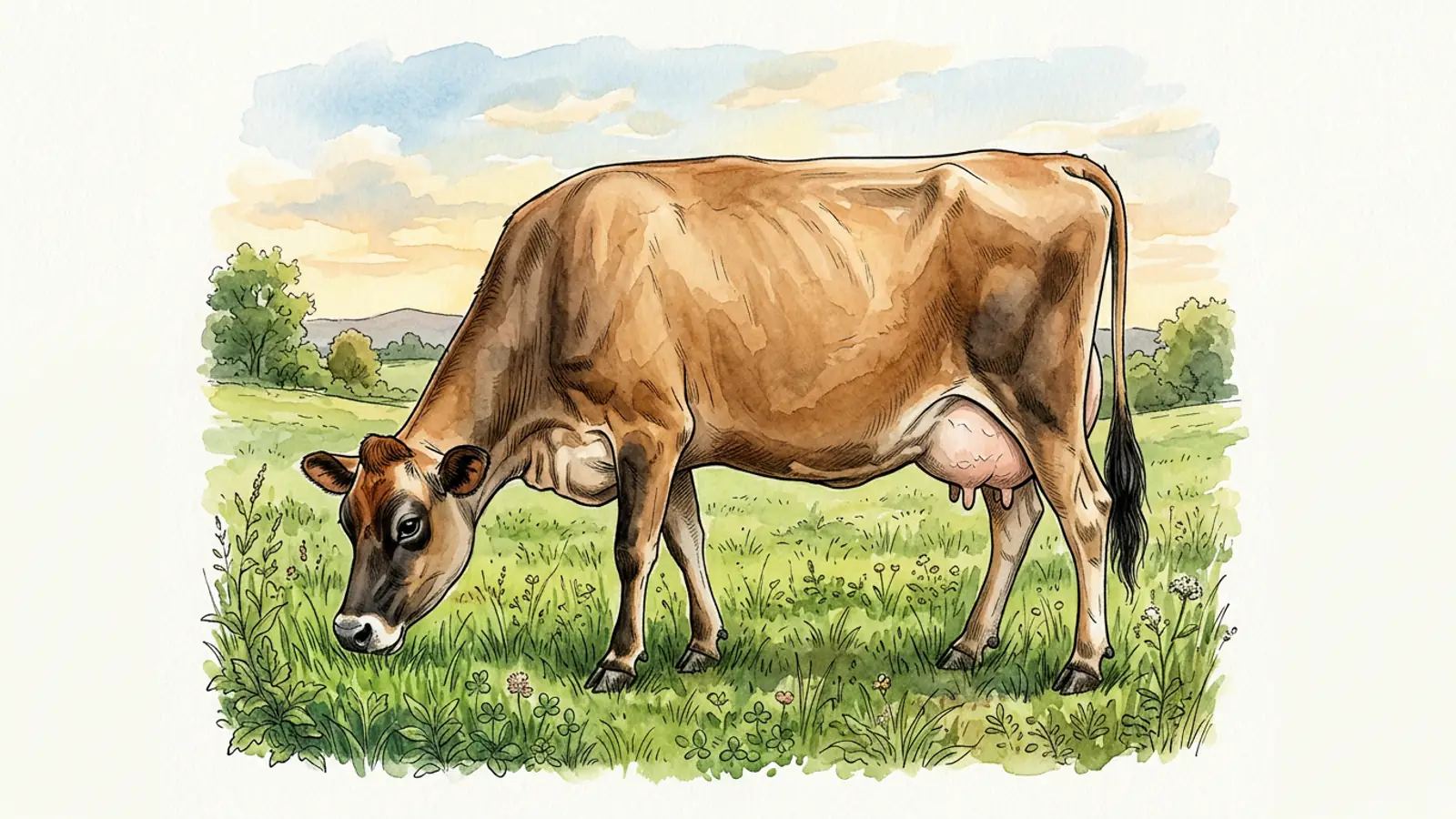
The Jersey cow is the smallest of the major dairy breeds and one of the oldest, developed on the Isle of Jersey in the English Channel and named for that island. A mature Jersey dairy cow is a compact, fine-boned animal with a fawn to dark brown coat, a dished face, and a reputation for producing milk with the highest fat, protein, and casein concentrations of the specialized dairy breeds [1]. Jerseys reach puberty and mature early, calve with relative ease because of their small calves, tolerate heat better than the larger European breeds, and convert feed into energy-corrected milk efficiently relative to their body weight [2]. They are alert, curious, and often described as more interactive than Holsteins, which is a large part of why the Jersey milk cow has become the default choice for families who want a small homestead dairy animal. The same traits that make Jerseys appealing also create specific health obligations. Jersey cattle are more prone than larger breeds to milk fever (hypocalcemia) around calving, and prepartum diet management is the single most important preventive tool an owner controls [3][4][5]. This guide covers origin, appearance, size, milk production, temperament, feeding, housing, the major health risks, and the miniature Jersey size category.
This article is educational and is not a substitute for veterinary diagnosis or treatment.
Key Takeaways
- The Jersey cow is the smallest major dairy breed, originating on the Isle of Jersey in the English Channel, and is known for milk with the highest fat, protein, and casein concentrations of the specialized dairy breeds.
- Jersey cattle are more prone than larger breeds to milk fever (hypocalcemia) around calving, and prepartum diet management is the single most important preventive tool an owner controls.
- A mature Jersey cow commonly weighs 800 to 1,200 pounds (about 360 to 545 kg), eats less, needs less barn space, and does less pasture damage than larger breeds.
- Jersey milk had fat concentration higher by 16.1 g/kg and true protein concentration higher by 6.98 g/kg than Holstein milk in a meta-analysis of 30 peer-reviewed studies.
- In Jersey crossbred cows, milk yield declined by 0.04 kg per unit of temperature humidity index beyond a break point of 77, showing even this heat-tolerant breed loses production under high heat load.
At a Glance
| Attribute | Jersey cow |
|---|---|
| Origin | Isle of Jersey, English Channel |
| Primary use | Dairy (milk, butter, cheese) |
| Coat color | Fawn to dark brown |
| Face | Dished profile |
| Frame | Small, fine-boned |
| Body weight (mature) | About 800 to 1,200 lb (roughly 360 to 545 kg) |
| Milk fat concentration | Higher than Holstein by 16.1 g/kg in a meta-analysis [2] |
| Milk true protein concentration | Higher than Holstein by 6.98 g/kg in the same meta-analysis [2] |
| Dry matter intake | Lower than Holstein by 4.15 kg/d and lower per animal unit on pasture [2][7] |
| Feed efficiency (milk/DMI) | Lower than Holstein by 0.26 kg/kg, but energy-corrected milk per unit dry matter did not differ between breeds [2] |
| Temperament | Alert, curious, interactive |
| Heat tolerance | Better than larger European dairy breeds |
| Calving ease | Generally favorable because of small calf size |
| Maturity | Early |
| Lifespan | Varies with management and herd |
| Grooming | Routine brushing, fly control, hoof trimming |
| Good with children | Handled quietly, yes, but cattle are large animals and require supervision |
Origin and History
The Jersey breed takes its name from the Isle of Jersey, the largest of the Channel Islands, where cattle were isolated and selected for dairy production for centuries. Island isolation and a strict ban on the importation of outside cattle produced a genetically distinct population with a small frame, a high-yielding mammary system, and milk with unusually high fat content. The breed spread to the United States, New Zealand, Australia, Denmark, and beyond, and it is now one of the most widespread dairy breeds in the world.
Historical records of the breed in North America appear in university and agricultural archives. The American Jersey Cattle Club began registering pedigrees in 1868, and show champions such as Sultane's Magnolia Belle, the 1936 National Champion Jersey, are preserved in institutional archives [8][9]. Breed type standards are maintained today by the American Jersey Cattle Association, which publishes type trait appraisal criteria used in classification [10].
The Jersey's economic niche has always been butterfat. Where milk is priced on fat and protein rather than on volume alone, Jersey milk commands a premium. That pricing structure, combined with small body size and efficient grazing, made the breed dominant in pasture-based systems in New Zealand and increasingly popular in grass-fed and organic operations in the United States.
Appearance
A Jersey cow has a distinctly different silhouette from a Holstein. The head is small with a dished face and a broad forehead, the neck is fine and often heavily folded with skin, and the body is angular and fine-boned. The udder is typically well attached with prominent veining, and the teats are small and close together, which matters for hand-milking families because small teats can be harder to grip than the larger teats of a Holstein.
Coat color ranges from light fawn through mid-brown to dark brown, and many Jerseys have a dark or black muzzle, dark eyes, and a dark switch on the tail. Some animals carry a lighter band around the muzzle or a darker dorsal stripe. The hair coat is short and fine, and Jerseys often show less winter hair growth than Holsteins, which is part of why they tolerate heat better and cold slightly less well.
Breed type appraisal programs score individual animals on frame, dairy strength, rump, feet and legs, and udder, and the American Jersey Cattle Association publishes the trait categories used in those evaluations [10]. For owners buying an animal, a classification score is a useful but not decisive indicator. Function matters more than show-ring type for a family milk cow.
Size and Weight
The Jersey is the smallest of the major dairy breeds. Precise mature weights vary by country, feeding system, and selection pressure, and published figures differ. One controlled comparison from the University of Minnesota reported Jersey x Holstein crossbred cows at 467 kg during the first 150 days of first lactation, compared with 500 kg for pure Holstein cows in the same herd and the same feeding program [6]. Pure Jersey cows are smaller than that crossbred figure, with mature cows commonly weighing 800 to 1,200 pounds (about 360 to 545 kg). The same study also recorded higher body condition scores in the crossbred group, 2.90 versus 2.76, which reflects the Jersey's tendency to deposit fat more readily than Holsteins at the same level of intake [6].
Small size has practical consequences. A Jersey eats less, requires less barn space, does less damage to pasture in wet conditions, and is easier to handle on a small acreage. The tradeoff is that a Jersey produces less total milk volume than a Holstein. A meta-analysis of 30 peer-reviewed studies that enrolled purebred Holsteins and Jerseys under similar conditions found Jerseys had lower dry matter intake by 4.15 kg/d and lower milk yield by 10.8 kg/d than Holsteins [2]. Owners who want a manageable daily volume rather than a commercial-scale yield often find that difference to be a benefit rather than a limitation.
Miniature Jersey Cows
Miniature Jersey cattle are a size category rather than a separate breed recognized in the mainstream dairy registry system. Breeders select for progressively smaller mature height and weight while retaining the Jersey phenotype: fawn to brown coat, dished face, and high-butterfat milk. A miniature Jersey cow is typically kept as a family milk cow on small acreage, where a standard Jersey would be more animal than the household can manage. Buyers should ask for documented height and weight records of the dam and sire, because "miniature" is not a standardized term and animals marketed under it vary widely in actual mature size. The same health and nutrition principles that apply to standard Jerseys apply to miniature Jerseys, and the same milk fever risk applies around calving.
Milk Production and Composition
Jersey milk is the richest of the mainstream dairy breeds in fat, protein, and casein. A large multibreed study using mid-infrared spectroscopy on 139,821 milk records from 16,566 cows found that Holstein-Friesian cows produced milk with the lowest fat, protein, and casein concentrations and the lowest calcium, magnesium, and phosphorus contents, while Jersey cows produced milk with the greatest fat, protein, and casein concentrations and the greatest calcium and magnesium contents [1]. That finding is one reason Jersey milk is prized for butter, cream, yogurt, and aged cheese, and it is why mixing milk from different breeds can improve the technological performance of a processing plant's raw supply [1].
The meta-analysis comparing Jerseys and Holsteins under similar experimental conditions quantified the gap. Jersey milk had fat concentration higher by 16.1 g/kg and true protein concentration higher by 6.98 g/kg than Holstein milk [2]. Absolute yields of fat and protein were lower in Jerseys because total milk volume was lower, with fat yield lower by 61.6 g/d and true protein yield lower by 211 g/d [2]. For a family milking one or two cows, concentration matters more than total yield. A Jersey giving a modest daily volume of high-fat milk produces more cream and more cheese per gallon than a Holstein giving a larger volume of dilute milk.
The genetic architecture behind Jersey milk composition has been studied directly. In an F2 Holstein-Friesian x Jersey crossbred herd, researchers identified a highly significant quantitative trait locus for beta-lactoglobulin concentration on bovine chromosome 11, and cows with the BB beta-lactoglobulin genotype produced milk with a 30% lower concentration of beta-lactoglobulin than cows with the AA genotype [11]. Beta-lactoglobulin is a whey protein relevant to cheese-making and to human milk protein sensitivity, so this variant is one of the genetic levers that shapes Jersey milk behavior in the vat.
Milk composition is not fixed. It shifts with stage of lactation, diet, and heat load. In Jersey crossbred cows in India, researchers used test-day records and NASA POWER satellite weather data to model the response of milk traits to the temperature humidity index. They identified a break point for milk yield at a temperature humidity index of 59 and a second break point at 77, with a significant decline in milk yield of 0.04 kg per unit of temperature humidity index beyond the second break point. Fat yield, protein percentage, and protein yield each had a break point at a temperature humidity index of 76, with declines of 1.18 g per unit for fat yield and 0.61 g per unit for protein yield [12]. That study documents the shape of the heat response in Jersey genetics, and it is a useful reminder that even a heat-tolerant breed loses production when the heat load climbs high enough.
Milk composition also varies with the cow's nitrogen status. In a dataset of 133,624 Holstein-Friesian, Jersey, and crossbred cows on pasture, mean milk urea nitrogen concentration was 14.4 mg/dl for Jerseys, compared with 14.0 mg/dl for Holsteins and 13.9 mg/dl for crossbreds [13]. Milk urea nitrogen is a practical on-farm indicator of how well dietary protein is being used, and it is measured routinely on Dairy Herd Improvement test days.
Feed Efficiency
Feed efficiency in Jerseys is a nuanced topic, and the popular claim that Jerseys are simply more efficient than Holsteins needs qualification. The meta-analysis found that feed efficiency expressed as milk yield divided by dry matter intake was lower in Jerseys by 0.26 kg/kg, but breed did not affect feed efficiency when it was expressed as energy-corrected milk yield divided by dry matter intake, and breed did not affect milk nitrogen efficiency [2]. In plain terms, a Jersey produces less milk per pound of feed on a volume basis, but produces the same energy-corrected milk per pound of feed once the higher fat and protein content is accounted for. Jerseys also consumed more dry matter as a percentage of body weight, 0.44% higher, and as a percentage of metabolic body weight, 0.64% higher, than Holsteins [2]. Energy-corrected milk yield as a percentage of body weight was 0.64% higher and as a percentage of metabolic body weight was 1.63% higher in Jerseys [2].
On pasture, the breed difference is clearer. A three-year study of prepubertal heifers grazing either grass monoculture or a grass-birdsfoot trefoil mixture found that Holsteins had the greatest overall dry matter intake at 4.4 kg per animal unit, crossbreds were intermediate at 4.0 kg per animal unit, and Jerseys had the least at 3.6 kg per animal unit, where animal units were normalized to 40% of metabolic mature body weight for each breed type [7]. Jerseys simply need less forage to maintain themselves, which is a major advantage on limited acreage.
Behavior interacts with efficiency, and the interaction differs by breed. In a study of 97 Holstein and 91 Jersey cows milked in an automatic milking system, individual-level correlations between feed efficiency and behavior traits were stronger in Jerseys than in Holsteins. Eating rate correlated weakly negatively with feed efficiency in Holsteins and more strongly so in Jerseys, meaning efficient Jerseys were slower eaters. Physical activity was weakly and negatively correlated with feed efficiency in Jerseys but not in Holsteins [14]. Owners using automated feeding systems should expect that a highly efficient Jersey may eat more slowly and move less than a less efficient herdmate.
Research on liver gene expression suggests that Jersey feed efficiency is genetically regulated and diet-dependent, not a fixed breed constant [15][16].
Temperament and Handling
Jerseys have a well-earned reputation for being alert, curious, and interactive. They are often described as more like pets than Holsteins, which is a large part of the breed's appeal to families. That same alertness means a Jersey notices changes in routine, reacts to unfamiliar people, and can become pushy if handlers are inconsistent. A Jersey that has been handled quietly from calfhood is generally easy to move, easy to milk, and easy to halter-train. A Jersey that has been handled roughly or not at all can be flighty and difficult to catch.
Extension breed descriptions note that Jersey cows, while usually docile and easy to manage, can be somewhat more nervous in disposition than other dairy breeds.
Handling recommendations for a family Jersey:
- Start halter training and touching the udder, legs, and head within the first weeks of life.
- Use a consistent routine for milking, feeding, and moving between pasture and barn.
- Speak and move calmly. Jerseys respond to tone and pace.
- Never let children handle a cow unsupervised. A mature Jersey weighs several hundred kilograms and can injure a person without intending to.
- Provide a head gate or stanchion for veterinary procedures and hoof trimming.
- Never treat a Jersey bull as a pet. Jersey bulls have a reputation as the least docile of the common dairy breeds and should be considered dangerous once mature.
Housing, Exercise, and Daily Care
A Jersey needs the same basic infrastructure as any dairy cow: secure fencing, clean water, shade, dry lying areas, and a milking routine. Because Jerseys are smaller, they work well on smaller acreage, and because they eat less, they place less grazing pressure on pasture than Holsteins [2][7]. They still need adequate space, and they still need protection from extreme weather.
Heat tolerance is a genuine Jersey advantage. The breed's smaller body size, finer coat, and greater surface area relative to body mass allow better heat dissipation than in Holsteins. That does not make Jerseys immune to heat stress. The Jersey crossbred study documented a decline in milk yield beginning at a temperature humidity index of 59 and a steeper decline beyond a temperature humidity index of 77, with fat and protein yield declining beyond a temperature humidity index of 76 [12]. A review of heat stress in dairy cattle in tropical and subtropical countries confirms that heat stress reduces milk yield, dry matter intake, and alters fat, protein, lactose, and solids-not-fat percentages, and that identifying heat-tolerant breeds and using them in breeding programs is central to maintaining productivity in hot climates [17]. Practical heat management includes shade, ventilation, and access to cool water. Cold tolerance is comparatively lower in Jerseys because of the lighter coat, so winter housing and windbreaks matter in northern climates.
Exercise is important for hoof health, rumen function, and general fitness. Pasture access, even limited, supports normal behavior and reduces the incidence of lameness associated with continuous standing on concrete. Hoof trimming should be scheduled on a routine basis, typically once or twice a year depending on housing and ground conditions. A veterinarian or trained hoof trimmer should handle trimming, because improper trimming can cause permanent lameness.
Grooming needs are modest. Routine brushing removes loose hair and stimulates circulation, and it is an opportunity to check the udder, teats, legs, and hooves for problems. Fly control in summer is important because flies spread mastitis pathogens and cause irritation that reduces milk let-down. Fly control is a management decision to discuss with a veterinarian, who can recommend products appropriate to the region, the stage of lactation, and the withdrawal periods that apply to milk.
Feeding Considerations
A Jersey's ration should be built around forage, with concentrate adjusted to stage of lactation, body condition, and milk production. Because Jerseys eat less than Holsteins in absolute terms, they can be maintained on fewer acres, but they still have specific nutrient requirements that change dramatically around calving.
The most important nutritional window in a Jersey's year is the weeks immediately before calving, when the prepartum diet determines the risk of milk fever. The dietary cation-anion difference of the prepartum ration is the key variable. In a study of 47 Jersey cows fed an alfalfa haylage-based diet supplemented with either anions (chloride) or cations (sodium), cows fed the high-cation diet suffered significantly more cases of milk fever, 6 out of 23, than cows fed the high-anion diet, 1 out of 24. Calcium concentrations at parturition and during the first two days of lactation were significantly higher in cows fed the anionic diet, plasma hydroxyproline (an index of bone calcium resorption) was greater in the anionic group, and the magnitude of the 1,25-dihydroxyvitamin D response per unit increase in parathyroid hormone was greatly reduced in cows fed the high-cation diet [3]. A follow-up study in multiparous Jersey cows confirmed that high dietary cation-anion difference diets in late gestation create a compensated metabolic alkalosis and reduce tissue sensitivity to parathyroid hormone, producing a pseudohypoparathyroid state that blunts calcium homeostatic responses [4]. Together these studies explain why prepartum ration formulation is the single most effective milk fever prevention tool available to a Jersey owner, and why it should be designed with a veterinarian or dairy nutritionist rather than improvised.
Protein and energy density in the ration also matter for growth and milk. A study of Jersey bull calves fed milk replacers with different protein and fat contents found that feed efficiency and average daily gain were greatest in calves fed whole milk and least in calves fed a 20.6% protein, 20.6% fat replacer, while calves fed 28.5% protein, 16.4% fat and 27.3% protein, 33.4% fat replacers did not differ from each other [18]. The practical point for anyone raising Jersey calves is that milk replacer composition and intake level directly determine growth and body composition, and that whole milk remains a highly efficient calf feed.
In a trial in lactating Jerseys, adding ruminally protected methionine and lysine raised milk fat and protein percentages but not component yields [19].
Water is the most overlooked nutrient. A lactating Jersey drinks a large volume of water daily, and intake rises sharply in heat. Clean, cool, freely available water is non-negotiable.
Health: Milk Fever (Hypocalcemia)
Milk fever is the defining health risk of the Jersey breed around calving. Clinical hypocalcemia affects approximately 5% of dairy cows each year, and subclinical hypocalcemia may affect half of all multiparous cows [4]. Jerseys are overrepresented in the condition. A 1971 study documented the incidence of milk fever in a large Jersey herd [5], and the breed's high milk calcium output relative to body size is one reason it is considered a high-risk breed.
The physiology is well described. Around calving, the cow's calcium demand for colostrum and milk production rises abruptly. The cow must mobilize calcium from bone and increase intestinal absorption, and both processes depend on parathyroid hormone and on the renal production of 1,25-dihydroxyvitamin D. When the prepartum diet is high in cations, particularly potassium and sodium, the cow develops a compensated metabolic alkalosis that reduces tissue sensitivity to parathyroid hormone. The result is a pseudohypoparathyroid state in which the calcium homeostatic response is too slow and too weak to meet the sudden demand [3][4]. The high-cation Jersey study showed exactly this pattern, with more clinical milk fever cases, lower periparturient calcium concentrations, less bone resorption activity, and a blunted 1,25-dihydroxyvitamin D response in the high-cation group [3].
Prevention
Prevention is built on the prepartum ration. Feeding a diet with a low or negative dietary cation-anion difference in the weeks before calving, typically by supplementing chloride or sulfate salts of anionic minerals, acidifies the cow and restores parathyroid hormone sensitivity. The Jersey studies demonstrate that this approach raises periparturient calcium concentrations, increases bone calcium resorption, and reduces clinical milk fever cases [3][4]. The ration must be formulated to a target dietary cation-anion difference and monitored, because over-acidification causes its own problems (reduced dry matter intake, negative calcium balance) and under-acidification fails to protect the cow. Urine pH monitoring is the standard on-farm check, and the target range should be set by the formulating veterinarian or nutritionist.
Additional preventive measures that a veterinarian may recommend include managing dietary potassium and sodium in the close-up dry cow ration, avoiding excessive dietary calcium in the dry period, and ensuring adequate magnesium. Every one of these decisions depends on the specific forage analysis of the farm, so a one-size-fits-all recommendation does not exist. Owners should have forages tested and have the close-up ration balanced before the last four to six weeks of gestation.
When to Call a Veterinarian
Milk fever is a medical emergency. A cow that is down and cannot rise, is cold to the touch, has cold ears, is muscle-trembling, is lying with her head turned to her flank, or is unresponsive needs immediate veterinary attention. Untreated clinical hypocalcemia can progress to lateral recumbency (lying flat on the side), coma, and death. Treatment typically involves intravenous calcium, which must be given by a veterinarian because rapid administration can cause cardiac arrhythmia and death. Subclinical hypocalcemia is harder to detect and may present only as reduced feed intake, reduced rumen motility, and lower milk yield in the first days after calving. A veterinarian can diagnose it with a blood calcium measurement and can advise on oral calcium supplementation protocols. Any Jersey owner with a fresh cow that is not eating normally in the first 48 hours after calving should call a veterinarian rather than wait.
Health: Mastitis
Mastitis is the most economically important disease of dairy cattle worldwide, and Jerseys are not exempt. The breed's small teats and high-producing udder create specific management considerations, and hand-milking families need to be especially attentive to hygiene.
A study of 1,508 cows across 41 multibreed herds, including Holstein Friesian, Brown Swiss, and Jersey, investigated associations between pathogen-specific subclinical mastitis and milk yield, quality, protein composition, and cheese-making traits [20]. The findings underscore that subclinical mastitis changes milk composition and processing behavior even when the udder looks normal and the milk looks normal, which is why somatic cell count monitoring is essential.
Prevention of mastitis in a Jersey herd rests on hygiene and consistency:
- Clean, dry bedding changed frequently.
- Pre-milking teat preparation with a single-use towel per cow.
- Post-milking teat disinfection.
- Consistent milking order, with known infected cows milked last.
- Regular somatic cell count testing through a Dairy Herd Improvement program or a veterinary laboratory.
- Prompt veterinary evaluation of any quarter that is hot, swollen, painful, or producing abnormal milk.
Clinical mastitis requires veterinary diagnosis and treatment. The choice of antibiotic, the duration of treatment, and the milk withdrawal period depend on the pathogen and on the product used, and these are decisions for a veterinarian who knows the herd's history and the regional resistance patterns. Owners should never use a human antibiotic or an expired product, and should never sell or consume milk from a treated cow before the labeled withdrawal period has passed.
Genetic Conditions and Breed-Associated Risks
The Jersey breed carries genetic conditions that owners should be aware of when buying an animal or selecting a bull. The beta-lactoglobulin variant described earlier is a normal polymorphism rather than a disease, but it affects milk composition and cheese-making [11]. Recessive conditions tracked in Jersey pedigrees include Jersey haplotype 1 (JH1), which causes early embryonic loss, and Jersey neuropathy with splayed forelimbs (JNS), in which affected calves are born alive but cannot stand.
Owners buying a Jersey should ask the seller for health and genetic testing documentation. The specific tests that matter depend on the registry and the country, and a veterinarian familiar with dairy genetics can advise on which tests are relevant to a particular purchase. Any animal with a known genetic defect should be evaluated by a veterinarian before purchase.
Reproduction and Calving
Jerseys mature early and are typically bred as heifers at a younger age than the larger breeds. Calving ease is generally favorable because Jersey calves are small, which reduces the risk of dystocia in first-calf heifers. That said, calving ease is not guaranteed, and owners should be prepared to recognize and respond to a difficult calving.
The relationship between milk composition and reproductive performance has been studied in pasture-based herds. In a study of 205 Holstein-Friesian, 77 Jersey, and 351 Holstein x Jersey crossbred cows on two New Zealand dairy farms, researchers evaluated associations between reproductive performance and milk composition, milk yield, live weight, and breed. The proportion of Holstein-Friesian genes had a significant effect on pregnancy rate at 21 days, and deviation from the herd's median calving date had a significant effect on all reproductive traits measured [21]. This is a reminder that calving date management and body condition are as important as breed in determining reproductive success.
Studies in other dairy breeds also show that milk composition and fertility are genetically linked [22].
For a family Jersey, the practical reproduction checklist is straightforward: breed at the appropriate age and weight, monitor body condition through the dry period, keep calving records, and have a calving protocol that includes when to call a veterinarian. A cow in active labor for more than a few hours without progress, a malpresented calf, or a cow that is exhausted and no longer straining all warrant an immediate call.
Finding a Jersey Cow or Calf
Responsible sourcing for a family Jersey means buying from a breeder or farm that can document the animal's health history, vaccination status, and parentage, and that will let a veterinarian examine the animal before purchase. The American Jersey Cattle Association maintains registration and type appraisal records, and a registered animal with a classification score has a documented production and type history [10].
Questions to ask a seller:
- What is the dam's production record and somatic cell count history?
- Has the animal been tested for the genetic conditions relevant to the breed?
- What is the vaccination and deworming history?
- Has the animal had mastitis, milk fever, or lameness, and how was it treated?
- What is the animal's temperament, and has it been halter-trained and hand-milked?
- Can a veterinarian examine the animal before purchase?
Rescue and rehoming of dairy cattle occurs through breed rescue organizations, farm sanctuaries, and agricultural university networks. A rescued Jersey may have an unknown health history, so a veterinary examination and a milk culture before bringing the animal into a milking routine are prudent.
Who Should Not Get a Jersey Cow
A Jersey cow is not a good fit for every household. Anyone without secure fencing, adequate pasture or hay storage, a milking facility, and a plan for manure management should not take on a dairy cow of any breed. Anyone who cannot commit to milking twice daily for the length of a lactation should not buy a Jersey milk cow. Anyone who cannot afford routine veterinary care, emergency care for milk fever or a difficult calving, and hoof trimming should not buy a Jersey. Anyone who expects a cow to be a low-maintenance lawn ornament should not buy a Jersey, because a dairy cow that is not milked or dried off properly is likely to develop mastitis and suffer.
Families with young children should understand that cattle are large animals and that even a gentle Jersey can injure a child by stepping on a foot or knocking a person over. Supervision is mandatory.
Limitations and When to Contact a Veterinarian
Breed-level information cannot replace an examination of an individual animal. Every Jersey is different, and the decisions that matter most (ration formulation, milk fever prevention, mastitis treatment, calving management) depend on the specific cow, the specific farm, and the specific forage analysis. A veterinarian who knows the herd is the right person to make those calls.
Contact a veterinarian immediately if any of the following occur:
- A cow is down and cannot rise, especially within 72 hours of calving.
- A fresh cow is not eating, is cold to the touch, is trembling, or is unresponsive.
- A quarter is hot, swollen, painful, or producing clotted, watery, or bloody milk.
- A cow has a fever, is off feed, or has a sudden drop in milk production.
- A cow is in active labor for more than a few hours without progress, or a calf is malpresented.
- A cow has a retained placenta beyond the normal period after calving.
- A cow is lame, has a swollen joint, or has a hoof lesion.
- A calf is scouring, is dehydrated, or will not suckle.
- A cow has a sudden drop in body condition despite adequate feed.
Routine veterinary care for a Jersey herd includes a pre-breeding examination, pregnancy diagnosis, close-up dry cow ration review, fresh cow monitoring in the first days after calving, and a herd health plan that addresses vaccination, parasite control, and mastitis prevention. The specific schedule depends on the region and the production system, and it should be set with a veterinarian.
Frequently Asked Questions
How much milk does a Jersey cow produce per day?
A Jersey produces less total milk volume than a Holstein, with a meta-analysis of 30 studies finding a difference of 10.8 kg/d in favor of Holsteins under similar conditions [2]. The milk is more concentrated, with fat higher by 16.1 g/kg and true protein higher by 6.98 g/kg than Holstein milk [2]. The exact daily volume depends on the individual cow, stage of lactation, and diet.
Is Jersey milk healthier than Holstein milk?
Jersey milk is higher in fat, protein, casein, calcium, and magnesium than Holstein milk [1]. Whether that makes it "healthier" depends on the consumer's goals. Higher fat and protein content means more cream, more cheese yield, and a richer drinking experience. Anyone with a medical condition that requires a specific fat intake should consult a physician.
Are Jersey cows good family milk cows?
Yes, for households with the land, facilities, and time to milk twice daily. Jerseys are small, eat less than Holsteins, produce rich milk, and are generally calm and interactive when handled quietly. They are not low-maintenance animals, and they require the same veterinary care as any dairy cow.
What is a miniature Jersey cow?
A miniature Jersey is a size category, not a separate breed. Breeders select for smaller mature height and weight while retaining the Jersey phenotype and high-butterfat milk. Buyers should ask for documented height and weight records of the dam and sire, because the term is not standardized.
Why do Jersey cows get milk fever more often?
Jerseys are overrepresented in milk fever because of their high production relative to body size and their sensitivity to high-cation prepartum diets. Studies in Jersey cows show that high dietary cation-anion difference in late gestation reduces parathyroid hormone sensitivity and blunts the calcium response, increasing clinical milk fever cases [3][4]. Prepartum ration formulation is the primary prevention tool.
How do I prevent milk fever in a Jersey cow?
Feed a prepartum ration with a low or negative dietary cation-anion difference in the weeks before calving, formulated and monitored with a veterinarian or nutritionist. The Jersey studies show that anionic diets raise periparturient calcium, increase bone calcium resorption, and reduce clinical milk fever cases compared with high-cation diets [3][4]. Monitor urine pH and adjust the ration as directed.
Do Jersey cows tolerate heat well?
Better than Holsteins, but not perfectly. Jersey crossbred cows showed a decline in milk yield beginning at a temperature humidity index of 59 and a steeper decline beyond 77, with fat and protein yield declining beyond 76 [12]. Provide shade, ventilation, and cool water during hot weather.
How do I know if my Jersey has mastitis?
Subclinical mastitis can be present with no visible signs, which is why somatic cell count monitoring matters [20]. Visible signs include a hot, swollen, or painful quarter, clotted or watery milk, and a drop in production. Any suspected case needs veterinary diagnosis and treatment.
Comparison Table: Jersey vs Holstein vs Guernsey
| Trait | Jersey | Holstein | Guernsey |
|---|---|---|---|
| Origin | Isle of Jersey, English Channel | Netherlands (Friesland) | Isle of Guernsey, English Channel |
| Frame | Smallest of the three | Largest of the three | Intermediate |
| Coat color | Fawn to dark brown | Black and white or red and white | Fawn and white |
| Milk fat concentration | Highest of the specialized dairy breeds [1] | Lowest, with fat 16.1 g/kg lower than Jersey in a meta-analysis [2] | Between Jersey and Holstein |
| Milk protein concentration | Highest, with true protein 6.98 g/kg higher than Holstein [2] | Lowest [1] | Between Jersey and Holstein |
| Milk casein concentration | Highest [1] | Lowest [1] | Varies by herd |
| Calcium and magnesium in milk | Highest [1] | Lowest [1] | Varies by herd |
| Dry matter intake | Lowest, 4.15 kg/d lower than Holstein [2] | Highest [2] | Varies by herd |
| Feed efficiency (ECM/DMI) | No breed difference from Holstein [2] | No breed difference from Jersey [2] | Varies by herd |
| Heat tolerance | Better than Holstein | Lower than Jersey | Varies by herd |
| Calving ease | Generally favorable because of small calf size | Lower because of larger calf size | Varies by herd |
| Milk fever risk | High, overrepresented in the condition [3][4][5] | Lower than Jersey | Varies by herd |
| Mastitis | Susceptible, included in multibreed mastitis studies [20] | Susceptible [20] | Susceptible, like all dairy breeds |
Owners considering a Guernsey should consult breed association records and a veterinarian for the specific data they need.
Related Articles
- Dairy Cow Milk Fever Risk Management
- Dairy Cow Ration Adjustments for Milk Protein Percent
- Dairy Cow Ration Adjustments for Milk Fat Depression
- Dairy Cow Milk Fever Prevention: Nutritional Approaches
- Dairy Cow Population Trends: Herd Size and Regional Shifts
- Lighting Design for Dairy Barns to Improve Cow Welfare and Milk Production
- How to Milk a Cow by Hand: A Hygienic Step-by-Step Guide
- Holstein Cows: Milk Yield, Size and Health Issues
- How Much Milk Does a Cow Produce a Day?
- Ayrshire Cows: Breed Traits, Milk and Hardiness
Sources
- Mineral composition of cow milk from multibreed herds.
- A meta-analysis and meta-regression to compare the production performance, feed efficiency, and milk N efficiency in Jersey versus Holstein cows.
- Addition of chloride to a prepartal diet high in cations increases 1,25-dihydroxyvitamin D response to hypocalcemia preventing milk fever.
- Diet-induced pseudohypoparathyroidism: A hypocalcemia and milk fever risk factor.
- Milk fever in a large Jersey herd. 1. The incidence of the condition.
- Crossbreds of Jersey x Holstein compared with pure Holsteins for body weight, body condition score, dry matter intake, and feed efficiency during the first one hundred fifty days of first lactation.
- Dry matter intake and feed efficiency of heifers from 4 dairy breed types grazing organic grass and grass-birdsfoot trefoil mixed pastures.
- "Pedigree Chart for Unnamed Jersey Cow" - Scholars Junction (scholarsjunction.msstate.edu)
- Sultane's Magnolia Belle: 1936 National Champion Jersey ... (saumag.edu)
- Type Traits Appraisal - USJersey - Jersey Journal (usjersey.com)
- Mapping a quantitative trait locus for the concentration of beta-lactoglobulin in milk, and the effect of beta-lactoglobulin genetic variants on the composition of milk from Holstein-Friesian x Jersey crossbred cows.
- Elucidating the effect of heat stress on milk production and composition in Jersey crossbred cows using test day records integrated with NASA POWER satellite data.
- Genetic variation in milk urea nitrogen concentration of dairy cattle and its implications for reducing urinary nitrogen excretion.
- The relationship between feed efficiency and behaviour differs between lactating Holstein and Jersey cows.
- Identification of functional candidate variants and genes for feed efficiency in Holstein and Jersey cattle breeds using RNA-sequencing.
- Novel alternative splicing associated with feed efficiency in dairy cattle under distinct diet compositions.
- Heat stress effects on milk yield traits and metabolites and mitigation strategies for dairy cattle breeds reared in tropical and sub-tropical countries.
- Influence of dietary fat and protein on body composition of Jersey bull calves.
- Production and composition of milk from Jersey cows administered bovine somatotropin and fed ruminally protected amino acids.
- Associations between pathogen-specific cases of subclinical mastitis and milk yield, quality, protein composition, and cheese-making traits in dairy cows.
- A statistical evaluation of associations between reproductive performance and milk composition and animal factors on grazing dairy cows in two New Zealand dairy farms.
- Genetic correlations between fertility traits and milk composition and fatty acids in Holstein-Friesian, Brown Swiss, and Simmental cattle using recursive models.