Ayrshire Cows: Breed Traits, Milk and Hardiness
By Dr. Zubair Khalid, DVM, MS, PhD ·
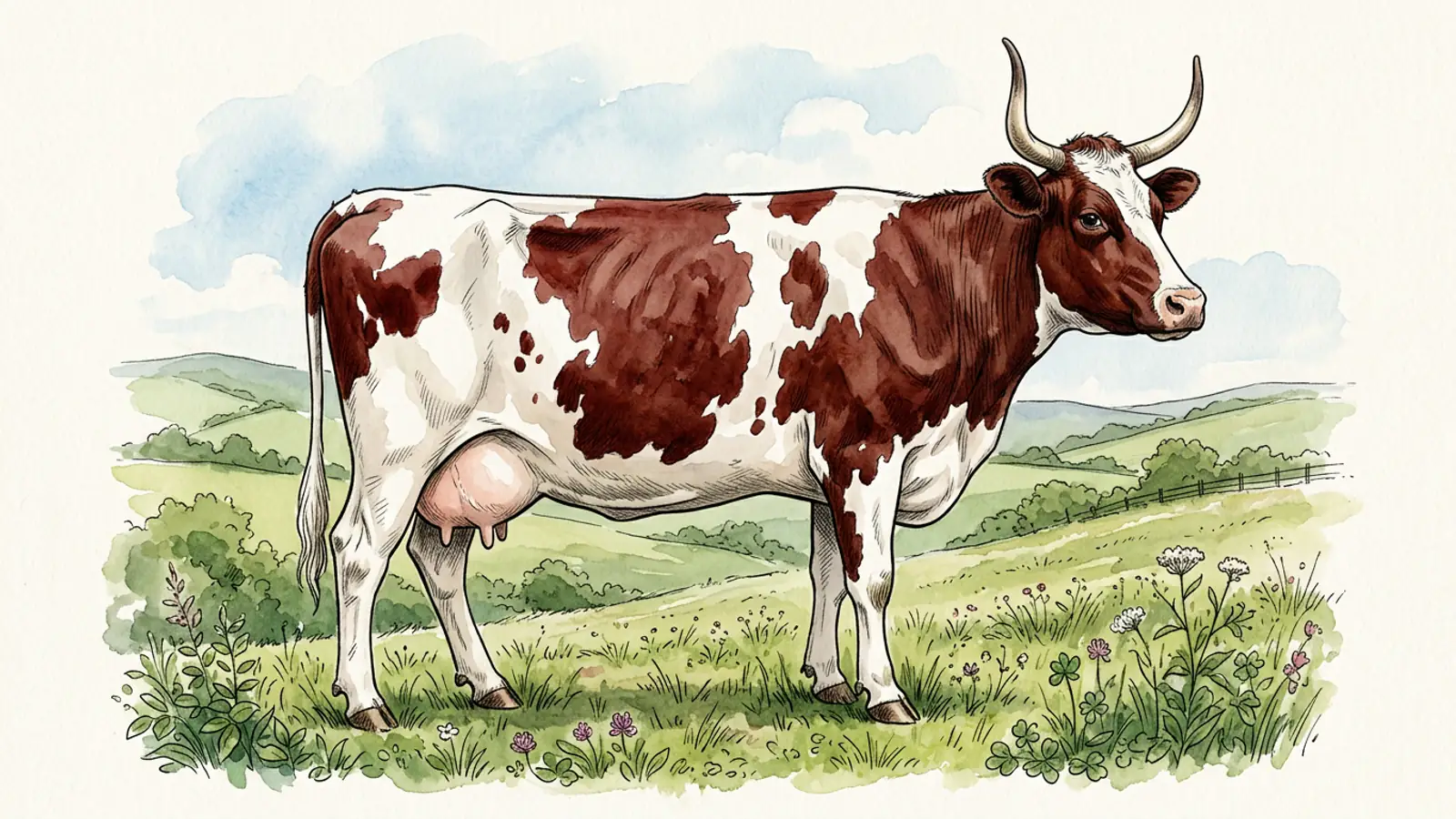
The Ayrshire cow is a Scottish dairy breed from the County of Ayr, developed on rough hill pasture and known for red or mahogany and white coloring, upward-curving horns when not dehorned, and a reputation for hardiness that outlasts many higher-producing rivals. Ayrshire cattle are medium in size, alert and active in temperament, and unusually well suited to grazing systems, small dairies, and family-cow operations. The breed is a practical choice for a homestead that wants a durable, long-lived dairy cow with milk that carries useful butterfat and protein without the extreme input demands of the highest-yielding commercial breeds. This article covers the origin, traits, milk, hardiness, health considerations, and management of the Ayrshire dairy cow, with a side-by-side comparison against the Holstein and the Jersey.
This article is educational and is not a substitute for veterinary diagnosis or treatment.
Key Takeaways
- The Ayrshire cow is a Scottish dairy breed from the County of Ayr, developed on rough hill pasture and known for red or mahogany and white coloring and hardiness.
- Ayrshire cattle are medium framed, with mature cows weighing about 1,200 lb (545 kg) or more, lighter than the Holstein and heavier than the Jersey.
- Ayrshire milk yield is moderate relative to the Holstein but strong relative to the Jersey, with useful butterfat and protein for cheese, butter, and yogurt.
- Ayrshire cattle are reported to have relatively easy calving and productive longevity, which reduces obstetrical assistance and the number of replacement heifers a farm must raise.
- Ayrshire cattle carry Ayrshire Haplotype 1 and Ayrshire Haplotype 2, genetic defects linked to pregnancy loss, so breeding decisions can affect pregnancy maintenance.
At a Glance
| Attribute | Ayrshire cow |
|---|---|
| Origin | County of Ayr, Scotland [1][2][3] |
| Primary use | Dairy (milk production) [1][2] |
| Coat color | Red or mahogany and white, with color patterns varying [1][2][3] |
| Horns | Horned by default, with distinctive upward-curving horns when not dehorned [2][3] |
| Size | Medium frame relative to other dairy breeds [2][4] |
| Weight | Mature cows weigh about 1,200 lb (545 kg) or more, lighter than Holstein and heavier than Jersey [1] |
| Temperament | Alert, active, and noted for being manageable [1][2] |
| Milking ability | Strong udder attachment and sound feet reported by breed sources [1][2] |
| Hardiness | High, developed on exposed hill country [2][3] |
| Grazing ability | Excellent, a defining trait of the breed [2][4] |
| Calving | Reported as relatively easy, a documented breed advantage [2] |
| Longevity | Noted for productive longevity in breed literature [2] |
| Good with children | Generally calm and workable, but cattle handling always requires adult supervision |
Origin and History of the Ayrshire Breed
The Ayrshire breed takes its name from the County of Ayr in southwest Scotland, where it was developed from native cattle on the exposed, hilly terrain of that region [1][2][3]. The breed's early history reflects the environment that shaped it. Cows that could not forage efficiently, tolerate wet and cold weather, or maintain condition on poor pasture did not survive as useful dairy animals. Selection pressure favored animals that could convert rough grazing into milk and stay sound while doing it.
That origin story explains most of the breed's modern traits. The Livestock Conservancy notes the Ayrshire's development in the County of Ayr and its adaptation to rugged conditions [2]. The Cattle Site describes the breed as originating in the County of Ayr and emphasizes its grazing ability [4]. The official breed association, the US Ayrshire Breeders' Association, presents the breed as a dairy animal built for practical production [1]. Wikipedia's breed entry corroborates the Scottish origin and the breed's historical development [3].
Ayrshire cattle were exported widely, and the breed established itself in North America, Scandinavia, and other dairy regions. In the United States, the breed is represented by the US Ayrshire Breeders' Association, which maintains the registry and breed standards [1]. The breed is also recognized by the Purebred Dairy Cattle Association alongside the other major US dairy breeds [5]. The Livestock Conservancy lists the Ayrshire as a heritage breed with a documented history in North America [2].
The breed's history matters to a small-farm owner because it explains why the Ayrshire behaves and performs the way it does. This is not a breed built for confinement and maximum grain input. It is a breed built for pasture, weather, and years of service.
Appearance and Identification
Color and Markings
The Ayrshire is a red or mahogany and white breed [1][2][3]. The red can range from a lighter shade to deep mahogany, and the white markings vary from animal to animal. Breed sources describe the color pattern as variable, with no single fixed pattern required [1][3]. This variability is one reason Ayrshires are easy to identify in a mixed herd. The red and white pattern is distinct from the solid black and white of the Holstein and the fawn or tan coloring of the Jersey.
Horns
Ayrshire cattle are a horned breed by default. The horns are described as curving upward, which gives the breed a distinctive silhouette when animals are not dehorned [2][3]. Many commercial and small-farm operations choose to dehorn or use polled genetics for safety and handling reasons. If horns are left intact, they curve upward and outward and require management attention in close-quarters handling. A family-cow owner should decide early whether to keep horns, dehorn, or select polled stock, and should plan handling facilities accordingly.
Size and Frame
The Ayrshire is a medium-framed dairy breed [2][4]. Breed sources describe the Ayrshire as smaller than the Holstein and larger than the Jersey, which places it in the middle of the common dairy breeds for body size. The Livestock Conservancy notes the breed's medium size as part of its practical appeal [2]. The Cattle Site describes the breed as medium in size with good dairy character [4].
Growth research on Ayrshire cattle provides additional context. A study comparing growth models in purebred Ayrshire and crossbred (Norwegian Red × Ayrshire) cattle followed monthly live-weight records of 725 cows from birth to 540 days of age [6]. The growth curves showed that crossbred cattle were generally heavier than purebred Ayrshire [6]. This is a useful detail for a small-farm owner planning pasture and housing: purebred Ayrshire cattle tend to be moderate in mature size, and crossbreeding can shift that upward.
Udder and Feet
Breed sources emphasize udder quality and foot soundness in the Ayrshire. The US Ayrshire Breeders' Association presents the breed as having strong udder attachment and sound feet, traits that support a long productive life [1]. The Livestock Conservancy notes the breed's durability and its suitability for pasture-based systems [2]. Sound feet and a well-attached udder matter more on a grazing operation than in a confinement barn, because cows walk farther and stand on varied ground. A cow with weak feet or a poorly attached udder breaks down faster on pasture, which is exactly the environment the Ayrshire was developed for.
Temperament and Handling
Ayrshire cattle are described as alert, active, and manageable [1][2]. The breed is not known for the extreme docility of some beef breeds, nor for the flightiness of some range cattle. Breed sources present the Ayrshire as a practical dairy animal that works well in a handling system and in a family setting [1][2].
Temperament in dairy cattle is partly genetic and partly a product of handling. A heifer that is halter-trained and handled calmly from a young age is easier to milk, move, and treat than one that is not. For a 4-H family or a small dairy, the Ayrshire's moderate temperament is an advantage. It is active enough to graze and travel, and calm enough to enter a milking parlor or stanchion without excessive stress.
Any cattle handling carries risk. Even a calm cow can injure a person, particularly around calving or when frightened. Children should never handle cattle without adult supervision, regardless of breed temperament.
Milk Production and Composition
Yield
Ayrshire milk yield is moderate relative to the Holstein but strong relative to the Jersey. Breed sources describe the Ayrshire as a solid producer with good persistency [1][4]. The breed's milk is valued for its balance of volume and components, which makes it useful for both fluid milk and manufactured dairy products.
Research on Ayrshire milk yield provides specific figures. A study of prolactin gene diversity in Ayrshire dairy cattle from southern Russia examined 300 cows and reported milk yield per lactation of 7,378.50 kg for cows with the PRL_AA genotype and 6,569.63 kg for cows with the PRL_BB genotype [7]. Cows with the PRL_BB genotype yielded less milk than their PRL_AA counterparts by 10.96 percent, a statistically significant difference (p < 0.05) [7].
These figures describe a specific population under specific management, so they should not be read as a universal Ayrshire average. They do show that Ayrshire cattle are capable of substantial milk yield and that genetic variation within the breed affects that yield. For a small-farm owner, the practical takeaway is that Ayrshire milk production is solid and that within-breed selection matters.
Composition
Ayrshire milk is known for useful butterfat and protein content. Breed sources present the Ayrshire as producing milk with a favorable ratio of components, which supports cheese, butter, and yogurt production on a small farm [1][4]. The breed's milk is often described as sitting between the high-volume, lower-component Holstein and the lower-volume, higher-component Jersey.
A family-cow owner who wants to make cheese or butter should weigh component content heavily. Ayrshire milk offers a practical middle ground: enough volume to supply a household or small dairy, and enough butterfat and protein to make value-added products worthwhile.
Hardiness and Environmental Adaptation
Hardiness is the Ayrshire's signature trait. The breed was developed in the County of Ayr on exposed, hilly terrain, and it was selected for the ability to survive and produce in that environment [2][3]. The Livestock Conservancy describes the breed as hardy and well adapted to pasture [2]. The Cattle Site emphasizes the breed's ability to graze and thrive on rough forage [4].
This hardiness shows up in several ways on a working farm:
- Weather tolerance. Ayrshire cattle handle cold, wet conditions better than breeds developed in milder climates. Their red and white coat and their body condition suit outdoor living.
- Foraging ability. Ayrshires are strong grazers and can maintain condition on pasture that would challenge a higher-input breed [2][4].
- Feed efficiency. A breed developed on poor pasture tends to convert forage efficiently. This matters when grain is expensive or when a farm wants to minimize purchased feed.
- Soundness. Good feet and legs allow Ayrshire cows to travel and graze rather than stand in a barn.
For a homestead or small dairy that relies on pasture, these traits reduce input costs and management complexity. A cow that can graze and stay healthy on your land is worth more than a cow that produces more milk but needs more grain, more housing, and more health intervention.
Grazing and Foraging Ability
The Ayrshire's grazing ability is one of the main reasons the breed suits grass-based and small-dairy systems. Breed sources consistently describe the Ayrshire as an excellent grazer [2][4]. The breed was developed to convert rough pasture into milk, and that ability remains central to its value.
On a grazing operation, the Ayrshire's strengths compound. A cow that grazes well needs less harvested feed. A cow with sound feet can walk to and from pasture without breaking down. A cow with a well-attached udder can be milked on a pasture-based schedule without udder injury. A cow with a moderate frame uses less energy for maintenance, leaving more energy for milk.
A small dairy or family-cow owner should think about the whole system, not just peak milk yield. A moderate-producing Ayrshire on good pasture can suit a low-input farm better than a high-producing Holstein that requires purchased grain and intensive housing. The breed's design fits the land.
Longevity and Calving
Longevity
Breed sources note the Ayrshire's productive longevity [2]. A cow that stays in the herd for many lactations spreads her cost of development over more years of milk. Longevity also reduces the number of replacement heifers a farm must raise, which lowers cost and simplifies management.
Longevity is not automatic. It depends on sound feet, a sound udder, good nutrition, and timely health care. The Ayrshire's genetic foundation supports longevity, but management determines whether that potential is realized.
Calving
The Ayrshire is reported to have relatively easy calving, a documented breed advantage [2]. Easy calving matters on a small farm because it reduces the need for obstetrical assistance and lowers the risk of calf loss and cow injury. A breed with a reputation for calving ease is a practical choice for a first-time family-cow owner or a homestead without full-time veterinary support.
Calving ease is influenced by calf size, dam size, and calf presentation. Ayrshire calves tend to be moderate in size relative to the dam, which supports unassisted calving in most cases. A small-farm owner should still monitor calving closely and have a plan for assistance if labor does not progress normally.
Health Considerations in Ayrshire Cattle
Genetic Defects and Pregnancy Loss
Ayrshire cattle carry specific genetic defects that affect reproduction. A study of genetic defects and pregnancy loss in Swedish dairy cattle examined Ayrshire Haplotype 1 and Ayrshire Haplotype 2 among the defects studied in Red Dairy Cattle [8]. The study analyzed data from 158,795 inseminations in 28,432 Red Dairy Cattle and 22,018 Holstein females across 1,429 herds [8]. Pregnancy loss was defined as failure to maintain pregnancy, and losses were reported on average within the first month after insemination [8].
The practical implication for Ayrshire breeders and owners is that carrier status for these haplotypes can affect pregnancy maintenance. A small-farm owner who is breeding Ayrshire cattle should be aware that these defects exist in the breed and that breeding decisions can influence reproductive outcomes. A veterinarian or breed association can advise on testing and mating strategies.
Mortality and Culling
A study of 10,023 Ayrshire and Holstein cows in Finland followed cows for 305 days and grouped them by how they left the herd [9]. Of the study population, 2 percent died unassisted, 4 percent were euthanized on farm, 17 percent were sent to slaughter, and 77 percent remained alive in the herd at the end of follow-up [9]. The study examined associations between veterinary treatments and on-farm deaths [9].
These figures describe a specific population and management system, so they should not be applied directly to every Ayrshire herd. They do illustrate that most cows in a well-managed herd remain alive and productive through a lactation, and that a minority leave the herd through death, euthanasia, or slaughter. For a small-farm owner, the takeaway is that routine veterinary care and early treatment of illness support cow survival and herd productivity.
General Health Management
Ayrshire cattle benefit from the same core health management as other dairy breeds: vaccination according to veterinary advice, parasite control, hoof care, udder health monitoring, and nutrition balanced for stage of lactation. The breed's hardiness reduces some environmental risk, but it does not replace a health program.
Mastitis, lameness, and metabolic disorders around calving are common dairy cattle health concerns. A small-farm owner should work with a veterinarian to establish a herd health plan, learn to detect early signs of illness, and know when to call for help. The AVMA and other veterinary organizations provide general guidance on cattle health and welfare that applies across dairy breeds.
Feeding and Nutrition
Ayrshire cattle are efficient converters of forage. Their grazing ability and moderate size mean they can maintain condition on pasture with less supplemental grain than larger, higher-producing breeds [2][4]. A small-farm owner should still provide balanced nutrition, because even a hardy breed cannot produce milk without adequate energy, protein, minerals, and water.
A practical feeding approach for an Ayrshire on a small farm includes:
- Pasture or forage as the base. The breed is built for grazing, so high-quality pasture or hay should form the foundation of the diet.
- Supplemental grain as needed. Grain supports milk production during peak lactation, but the Ayrshire's efficiency means less grain may be required than for a Holstein.
- Minerals and salt. A balanced mineral program supports health, fertility, and milk production.
- Fresh water at all times. Lactating cows need constant access to clean water.
A veterinarian or livestock nutritionist can help balance a ration for a specific farm, forage base, and production level. Nutrition is a major management factor in milk yield, health, and longevity, and it should be planned rather than improvised.
Housing and Facilities
Ayrshire cattle are adaptable to a range of housing systems. Their hardiness makes them suitable for pasture-based operations with simple shelter, as well as for more conventional barn housing. The breed's medium size means facilities do not need to be built for the largest dairy breeds.
Key considerations for housing Ayrshire cattle on a small farm include:
- Shelter from wind and wet. Even hardy cattle need dry, wind-protected resting areas.
- Handling facilities. A head gate, chute, or stanchion makes routine care, milking, and veterinary work safer and easier.
- Milking area. A clean, functional milking space supports udder health and milk quality.
- Fencing. Secure fencing keeps cattle in and predators out. Fence specifications depend on the farm and the local predator pressure.
A family-cow owner should design facilities around the cow's needs and the handler's safety. Good facilities reduce stress for both the animal and the people working with her.
Reproduction and Breeding
Ayrshire cattle are bred for dairy production, and breeding decisions affect milk yield, health, and longevity. The breed has a documented history of selection for practical dairy traits [1][2]. A small-farm owner can use registered Ayrshire genetics, crossbreeding, or a combination, depending on goals.
The growth study of purebred Ayrshire and Norwegian Red × Ayrshire crossbred cattle found that crossbred cattle were generally heavier than purebred Ayrshire [6]. This is relevant to a farm considering crossbreeding. Crossbred animals may offer hybrid vigor and different growth patterns, but they also move away from the purebred Ayrshire type.
Genetic defects in the breed, including Ayrshire Haplotype 1 and Ayrshire Haplotype 2, should be considered in breeding plans [8]. A veterinarian or breed association can advise on testing and mating strategies to reduce the risk of pregnancy loss.
Ayrshire vs Holstein vs Jersey
The three breeds most often compared for small dairies and family cows are the Ayrshire, the Holstein, and the Jersey. Each has a distinct profile.
| Trait | Ayrshire | Holstein | Jersey |
|---|---|---|---|
| Origin | County of Ayr, Scotland [1][2][3] | North Holland and Friesland, Netherlands | Isle of Jersey, Channel Islands |
| Color | Red or mahogany and white [1][2][3] | Black and white, or red and white | Fawn to dark brown |
| Size | Medium [2][4] | Larger than Ayrshire (per breed comparisons) | Smaller than Ayrshire (per breed comparisons) |
| Milk yield | Moderate to high, with documented within-breed variation [7] | Highest of the three | Lowest of the three |
| Milk components | Balanced butterfat and protein [1][4] | Lower components relative to volume | Highest butterfat and protein |
| Hardiness | High, developed on hill pasture [2][3] | Lower hardiness on pasture | Good, but different adaptation |
| Grazing ability | Excellent [2][4] | Lower | Good |
| Calving ease | Reported as relatively easy [2] | More calving difficulty reported | Reported as relatively easy |
| Longevity | Noted for productive longevity [2] | Variable | Variable |
| Best fit | Grazing dairies, small farms, family cows | High-input commercial dairies | Small dairies focused on components |
The comparison shows the Ayrshire's position. It produces less milk than the Holstein but more than the Jersey. It carries better components than the Holstein but lower than the Jersey. It is hardier and a better grazer than the Holstein, and it is larger and higher-producing than the Jersey. For a small farm that wants a durable, low-input cow with useful milk, the Ayrshire sits in a practical middle ground.
The Purebred Dairy Cattle Association recognizes the Ayrshire alongside the other major US dairy breeds, which supports its status as a mainstream dairy option rather than a niche curiosity [5].
Why Ayrshires Suit Grazing and Small Dairies
The Ayrshire's fit for grazing and small dairies comes down to a few traits that work together:
- Grazing ability. The breed was developed to convert pasture into milk, and it remains an excellent grazer [2][4].
- Hardiness. Ayrshire cattle tolerate weather and rough conditions that challenge less hardy breeds [2][3].
- Moderate size. A medium frame means lower maintenance energy needs and facilities that do not require the scale of a commercial Holstein barn [2][4].
- Sound feet and udder. These traits support a long, productive life on pasture [1][2].
- Calving ease. Reported easy calving reduces the need for intervention on a small farm [2].
- Milk quality. Balanced butterfat and protein support household use and value-added products [1][4].
A small dairy or homestead that wants to minimize purchased feed, housing cost, and health intervention will find the Ayrshire a better fit than a high-input breed. The breed's design matches the land and the management style.
Finding Ayrshire Cattle and Responsible Breeding
A buyer should start with the US Ayrshire Breeders' Association, which maintains the registry and can connect buyers with breeders [1]. The Livestock Conservancy also provides breed information and may help with heritage breed networks [2]. Local dairy clubs, 4-H programs, and agricultural extension offices are additional resources.
When evaluating Ayrshire cattle for purchase, a buyer should consider:
- Registration and pedigree. Registered animals come with documented ancestry and breed association records [1].
- Health records. Vaccination history, testing results, and treatment records help assess an animal's health status.
- Udder and feet. These are the traits that determine productive life on a grazing farm [1][2].
- Temperament. Observe the animal's behavior and ask about handling history.
- Production records. Milk records, if available, show what the animal or her dam has produced.
A veterinarian should examine any animal before purchase, particularly for udder health, lameness, and reproductive soundness. A pre-purchase examination is a small cost relative to the cost of a cow that breaks down early.
Rescue and rehoming of dairy cattle is less common than for companion animals, but it does occur. A family looking for a family cow should consider both registered breeders and dairy farms that sell cull or retired cows. A retired dairy cow can make an excellent family cow if she is sound and healthy.
Who Should Not Get an Ayrshire
An Ayrshire is not the right choice for every operation. A farm that needs maximum milk volume and has the facilities, feed, and labor to support a high-input breed may be better served by a Holstein. A farm that wants the highest possible butterfat and protein and has a market for value-added dairy products may prefer a Jersey.
An Ayrshire is also not a good choice for someone who cannot provide daily care, secure fencing, adequate shelter, and access to veterinary services. Cattle are large animals with specific needs. A family that cannot commit to daily feeding, milking, and health monitoring should not take on a dairy cow of any breed.
Finally, an Ayrshire with intact horns requires handling facilities and management that account for those horns. A farm that cannot manage horned cattle should plan to dehorn, use polled genetics, or choose a different animal.
Limitations and When to Contact a Veterinarian
This article provides general breed information and is not a substitute for veterinary diagnosis or treatment. Individual animals vary, and management, nutrition, and environment affect health and production as much as breed does.
Contact a veterinarian promptly if an Ayrshire cow shows any of the following:
- Refusal to eat or drink for more than a short period
- Sudden drop in milk production
- Hot, swollen, or painful udder
- Lameness or reluctance to walk
- Difficulty calving or failure to progress in labor
- Retained placenta or abnormal discharge after calving
- Fever, depression, or unusual behavior
- Signs of respiratory distress
- Any condition that does not improve within a day or worsens quickly
A veterinarian should also be involved in routine herd health planning, vaccination, parasite control, and reproductive management. Early intervention improves outcomes and reduces cost.
Frequently Asked Questions
What is an Ayrshire cow?
An Ayrshire cow is a dairy breed from the County of Ayr in Scotland, known for red or mahogany and white coloring, hardiness, and strong grazing ability [1][2][3].
What color are Ayrshire cattle?
Ayrshire cattle are red or mahogany and white, with color patterns that vary between animals [1][2][3].
Do Ayrshire cows have horns?
Yes, Ayrshire cattle are a horned breed by default, with distinctive upward-curving horns when not dehorned [2][3].
How much milk does an Ayrshire cow produce?
Yields vary with genetics, feeding and management. In one study of a Russian Ayrshire herd, lactation yields were roughly 6,600 to 7,400 kg (about 14,500 to 16,300 lb), depending on prolactin genotype [7].
Is Ayrshire milk good for cheese and butter?
Yes. Ayrshire milk has a balanced butterfat and protein content that supports cheese, butter, and yogurt production [1][4].
Are Ayrshire cows good for small farms?
Yes. Ayrshire cattle suit small farms and grazing dairies because of their hardiness, grazing ability, moderate size, sound feet and udder, and reported calving ease [1][2][4].
Are Ayrshire cows easy to calve?
The breed is reported to have relatively easy calving, which is a documented advantage for small farms [2].
How long do Ayrshire cows live?
Breed sources note the Ayrshire's productive longevity, though individual lifespan depends on management, health, and soundness [2].
Related Articles
- Dairy Cow Milk Fever Risk Management
- Dairy Cow Ration Adjustments for Milk Protein Percent
- Dairy Cow Ration Adjustments for Milk Fat Depression
- Dairy Cow Milk Fever Prevention: Nutritional Approaches
- Lighting Design for Dairy Barns to Improve Cow Welfare and Milk Production
- Jersey Cows: Milk, Size, Temperament and Care
- Holstein Cows: Milk Yield, Size and Health Issues
- How Much Milk Does a Cow Produce a Day?
- How Much Does a Cow Weigh? By Breed, Age and Sex
Sources
- The Breed - ABA (usayrshire.com)
- Ayrshire Cattle - The Livestock Conservancy (livestockconservancy.org)
- Ayrshire cattle - Wikipedia (en.wikipedia.org)
- Ayrshire - The Cattle Site (thecattlesite.com)
- Purebred Dairy Cattle Association - Breeds (purebreddairycattle.com)
- Comparison of non-linear models for growth characterization of purebred Ayrshire and crossbred cattle.
- Prolactin gene diversity and its influence on milk yield traits in Ayrshiredairy cattle from Southern Russia.
- The effect of genetic defects on pregnancy loss in Swedish dairy cattle.
- Died, euthanised, slaughtered or alive? outcomes for 10 023 Ayrshire and Holstein cows and associations between veterinary treatments and mortality.