What Do Cows Eat? Pasture, Hay, Grain and Minerals
By Dr. Zubair Khalid, DVM, MS, PhD ·
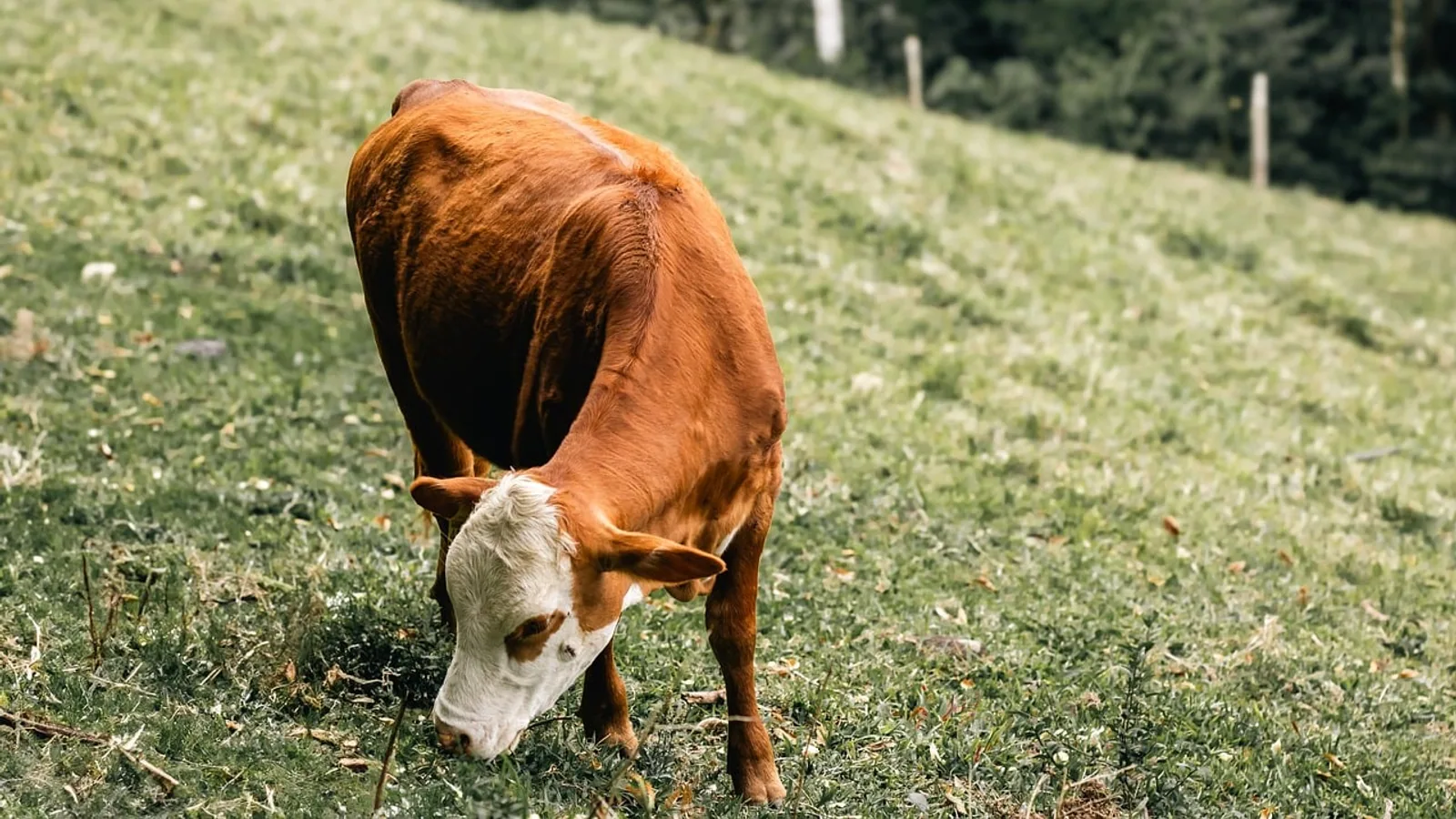
Cows eat forage first. Pasture grass, hay, and silage make up the bulk of almost every cattle diet, and grain, protein supplements, salt, and minerals are added on top of that base in amounts that depend on the animal's age, weight, and production stage. A dry beef cow may eat about 2 percent of her body weight in dry matter each day, while a high-producing dairy cow can eat about 4 percent or more, and both need constant access to clean water.
That single paragraph answers most of the search traffic behind "what do cows eat," but the details matter. A cow is not a simple grazer. She is a walking fermentation vat, and the rumen inside her determines what she can and cannot eat, how much she can eat, and what happens when the diet changes too fast. This guide walks through the biology, the feedstuffs, the numbers, and the hazards.
This article is educational and is not a substitute for veterinary diagnosis or treatment.
Key Takeaways
- Cows eat forage first, with pasture grass, hay, and silage making up the bulk of almost every cattle diet, while grain, protein supplements, salt, and minerals are added based on age, weight, and production stage.
- A dry beef cow may eat about 2 percent of her body weight in dry matter daily, while a high-producing dairy cow can eat about 4 percent or more, and both need constant access to clean water.
- The rumen is a fermentation chamber packed with bacteria, protozoa, and fungi that break down plant fiber, and forage fiber stimulates chewing, saliva production, rumen motility, and the floating mat that regulates feed passage.
- Grasses generally contain more neutral detergent fiber (roughly 592 to 763 g/kg of dry matter) and less crude protein (76 to 166 g/kg) than legumes, and the indigestible fiber fraction limits intake, rumen fill, and digestibility.
- Grain is energy that ferments fast and lowers rumen pH, so when grain crowds out forage the rumen environment shifts, pH falls, and health problems such as acidosis follow.
The Rumen: Why Forage Is the Base of the Cow Diet
Cattle are ruminants. They have a four-compartment stomach, and the largest compartment, the rumen, is a fermentation chamber packed with bacteria, protozoa, and fungi. These microbes break down plant fiber that no mammal can digest on its own. The cow chews, swallows, regurgitates, chews again (rumination), and eventually the microbes and their fermentation products become the cow's real meal.
Fiber is not filler in this system. It is the substrate that keeps the rumen working. Forage fiber particles stimulate chewing, saliva production, and rumen motility, and they form the floating mat that regulates how fast feed moves through the gut. Research on forage fiber has shown that grasses generally contain more neutral detergent fiber (roughly 592 to 763 g/kg of dry matter) and less crude protein (76 to 166 g/kg) than legumes, and that the indigestible fraction of that fiber is what limits intake, rumen fill, and digestibility [1]. In plain terms, the tougher and more lignified a forage is, the longer it sits in the rumen and the less a cow can eat.
This is why nutritionists talk about physically effective fiber. A recent dairy study formulated diets with similar concentrations of undigestible fiber but varied the forage inclusion rate and particle length, and found that reducing the forage inclusion rate increased dry matter intake and changed rumination patterns [2]. Another study in dairy goats found that long forage particles increased eating time from 86 to 199 minutes per day and rumination time from 349 to 452 minutes per day compared with short particles, while also reducing dry matter intake and milk yield [3]. Particle size and forage amount are not cosmetic details. They change how the rumen functions.
The practical takeaway for anyone asking what cows eat: the cow diet is built around forage, and grain is a supplement to that base, not a replacement for it. When grain crowds out forage, the rumen environment shifts, pH falls, and health problems follow.
Pasture: The Natural Cow Diet
Pasture is the most familiar cattle feed and the cheapest source of nutrients when it is available. A grazing cow eats a mix of grasses and legumes, and the exact composition changes with season, species, and management.
Grasses and legumes
Cool-season grasses (ryegrass, orchardgrass, timothy, fescue) and warm-season grasses (bermudagrass, bahiagrass, buffel grass) differ in fiber and protein content. Legumes such as alfalfa and clover generally carry more protein and digest faster than grasses, which is a nutritional advantage and a bloat risk at the same time.
Pasture allowance, meaning how much forage is allocated per cow per day, directly drives intake. A grazing study in dairy cows offered pasture allowances of 20, 35, 50, or 65 kg of dry matter per cow per day found that milk yield and pasture dry matter intake were greater at allowances of 35 kg and above [4]. Cows offered 6 or 8 kg of concentrate per day produced more milk than cows offered 4 kg, but they ate less pasture, which is the classic substitution effect every grazier has to manage [4].
Grazing behavior
Cows graze in bouts, rest, ruminate, and repeat. Total daily eating and rumination time shifts with pasture quality and particle size. Because pasture is high in moisture and low in dry matter compared with hay, a grazing cow fills her rumen before she meets her energy needs, which is why pasture-based dairies often supplement with grain in the parlor.
Hay: Stored Forage for Every Season
Hay is grass or legume forage that has been cut and dried to roughly 85 to 90 percent dry matter so it can be stored. It is the backbone of winter feeding for beef herds and a major component of dairy rations.
Hay quality varies enormously. Early-cut, leafy hay is higher in protein and digestible fiber. Late-cut, stemmy hay is higher in lignin and indigestible fiber, which means lower intake and lower energy. The same fiber research that separated grasses from legumes showed that lignin content relative to fiber predicts how much of the forage a cow can never digest [1]. Buying hay on appearance alone is a gamble. A forage test tells you the protein, fiber, and energy content.
Hay also matters for rumen health even in high-grain diets. In feedlot research, bulls fed diets with 7 percent forage neutral detergent fiber performed better in the second half of the feeding period than bulls fed 12 percent, but the lower-forage diet also reduced estimated starch digestibility [5]. The lesson is not that forage should be minimized. The lesson is that forage level has to be matched to the animal, the production target, and the rumen environment.
Silage and Other Fermented Forages
Silage is forage that has been chopped and fermented under anaerobic conditions. Corn silage, grass silage, and legume silage are common. Fermentation preserves the crop and, in the case of corn silage, delivers both fiber and starch in one feed.
Silage quality depends on harvest moisture, packing, and sealing. Poorly made silage molds, heats, and loses nutrients. Storage and feeding practices that minimize nutrient loss are a recurring theme in extension guidance for dairy producers [6]. Moldy silage is also a direct health hazard, discussed later.
Alternative forages exist. A study replacing Rhodes grass hay with neem tree foliage in dry cows found that dry matter, organic matter, crude protein, and neutral detergent fiber intakes increased quadratically, peaking at intermediate inclusion levels of up to 66 percent [7]. Another trial replaced guinea grass with ensiled total mixed fiber made from cassava byproducts in early-lactating dairy cows and reported greater dry matter intake (15.6 kg per day) in one treatment group [8]. These are reminders that the cow diet is flexible in principle, but any novel forage has to be introduced carefully and tested for anti-nutritional factors.
Grain and Concentrates: Fuel for Production
Grain is energy. Corn, barley, oats, wheat, and sorghum are the common cereal grains, and soybean meal, canola meal, and distillers grains are common protein concentrates. Concentrates are fed when forage alone cannot meet the energy or protein needs of a growing, pregnant, or lactating animal.
The rumen handles grain differently from forage. Starch ferments fast, producing volatile fatty acids that lower rumen pH. Some acidity is normal. Too much is acidosis. A dairy study that replaced neutral detergent fiber with starch in reduced-forage rations found that increasing starch from 24 to 32 percent reduced fiber digestibility and lowered milk fat percentage and yield, even though dry matter intake and milk yield were unaffected [9]. Another study simulating uneven concentrate allocation in a total mixed ration found no effect on dry matter intake, milk yield, or composition, though yeast supplementation tended to raise rumen pH [10]. The rumen is resilient, but it has limits.
How much grain a cow gets depends entirely on her job. A dry beef cow on good pasture may need no grain at all. A feedlot steer may get 70 to 90 percent of dry matter from concentrate. A lactating dairy cow typically gets a concentrate portion that supplies the energy her milk production demands, balanced against forage to protect rumen health.
Minerals, Salt, and Water
Macrominerals and trace minerals
Forage does not supply everything a cow needs. Calcium, phosphorus, magnesium, potassium, sodium, sulfur, cobalt, copper, iodine, iron, manganese, selenium, and zinc all have to be balanced. Mineral status interacts with production. A systematic review of hypocalcemia in dairy cows described the condition as a failure of homeorhetic adaptation to abrupt mammary calcium export in early lactation, influenced by the parathyroid hormone and vitamin D axis, skeletal calcium mobilization, renal conservation, intestinal absorption, magnesium status, dietary cation-anion difference, dry matter intake, parity, and acid-base balance [11]. In other words, a mineral problem in a fresh cow is rarely just a mineral problem. It is a whole-animal adaptation issue.
Free-choice salt and mineral mixes are standard on pasture-based operations. The specific formulation should match the forage base, because a mineral program built for one region can be wrong for another.
Water
Water is the nutrient cattle consume in the largest quantity, and it is the one most often overlooked. A lactating dairy cow drinks many times more water than she eats dry matter. Water intake rises with milk production, heat, and dietary salt and protein. Clean, unrestricted water access is non-negotiable. Cows will reduce intake, and therefore milk or growth, if water is dirty, frozen, or hard to reach.
How Much Does a Cow Eat a Day?
Dry matter intake is the standard measure. It is the weight of feed minus its moisture content, and it is expressed as a percentage of body weight. Forage moisture varies enormously (pasture is 70 to 80 percent water, hay is 10 to 15 percent), so dry matter is the only fair way to compare diets.
The table below summarizes the intake ranges and diet composition for the two most common production scenarios. Study-derived figures reflect the conditions of those studies, not universal constants.
| Category | Dry matter intake | Forage base | Concentrate | Notes |
|---|---|---|---|---|
| Dry beef cow (maintenance) | About 2% of body weight per day | Pasture, hay, or silage | Often none | Forage quality drives whether supplement is needed |
| Lactating dairy cow (high producing) | About 4% of body weight per day or more | 30 to 35% forage in some formulated diets [2] | 4 to 8 kg DM per day in grazing systems [4] | Intake rises with milk yield and falls with heat stress |
| Grazing dairy cow | Varies with pasture allowance | 20 to 65 kg DM pasture offered per day [4] | 4, 6, or 8 kg DM per day [4] | Milk yield greater at pasture allowance of 35 kg DM or above |
| Feedlot steer | Varies with body weight and frame | 7 to 12% forage NDF in energy-dense diets [5] | High proportion of the ration | Lower forage NDF improved gain in the second feeding period [5] |
A practical rule for beef producers is that a mature cow eats roughly 2 percent of her body weight in dry matter daily on a maintenance diet. A 1,200-pound cow therefore eats about 24 pounds of dry matter per day, which is roughly 27 to 28 pounds of hay at typical moisture. A high-producing dairy cow may eat 50 to 60 pounds of dry matter or more, and she needs the forage particle length and fiber to support that intake without rumen upset [2].
Heat stress is a major driver of reduced intake. A study of rumen-protected choline supplementation in Holstein cows during warm summer days was designed around the well-established observation that elevated ambient temperature reduces dry matter intake and productivity [12]. When intake drops in hot weather, milk yield follows.
What Do Dairy Cows Eat?
Dairy cows eat the same base diet as beef cows (forage, grain, minerals, water) but the proportions are tuned to lactation. A lactating dairy cow has very high energy demands relative to her body size.
A typical lactating dairy ration includes:
- Forage: corn silage, alfalfa haylage, grass hay, or pasture, often 40 to 60 percent of dry matter depending on the system.
- Concentrate: corn grain, barley, soybean meal, canola meal, and byproduct feeds.
- Protein and amino acid supplements: to meet the needs of milk protein synthesis.
- Minerals and vitamins: calcium, phosphorus, magnesium, and trace minerals balanced for lactation.
- Feed additives: yeast, buffers, and other products used to stabilize the rumen.
In grazing dairy systems, concentrate is often fed twice daily in the parlor during milking [4]. The amount is a management decision based on pasture availability and milk price. Feeding more concentrate raises milk yield up to a point, but it also reduces pasture intake, so the economics have to be calculated per farm [4].
A study of reduced-forage rations in lactating dairy cattle is directly relevant to drought years, when high-quality forage is scarce. Replacing neutral detergent fiber with starch at 24, 28, and 32 percent of the diet reduced fiber digestibility and milk fat but did not change dry matter intake or milk yield [9]. The practical message is that cows can tolerate reduced forage for a time, but milk fat and rumen efficiency pay the price.
What Do Beef Cows Eat?
Beef cows are usually managed in two phases: a cow-calf herd on pasture or range, and a feedlot finishing phase.
The breeding herd lives on forage. A dry, pregnant beef cow on adequate pasture or good hay often needs no grain. When winter forage is low in quality or quantity, grain is used as a supplement. Extension guidance on feeding grain to stock cows emphasizes that grain should be introduced gradually and that the amount depends on forage quality and cow body condition [13]. A separate extension article on winter diet changes stresses the same principle: sudden shifts in diet cause digestive upset, and transitions should be made over days to weeks [14].
The feedlot phase is the opposite extreme. Cattle are fed energy-dense diets with a defined forage neutral detergent fiber level. In a study of Angus × Nellore bulls, diets contained either 12 percent or 7 percent forage NDF, and bulls switched from 12 to 7 percent in the second period showed greater average daily gain and improved feed efficiency than bulls kept at 12 percent [5]. Feedlot nutrition is a precision exercise in balancing starch, fiber, and rumen pH.
Changing the Cow Diet Safely
The rumen microbial population adapts to the diet it is fed. Change the diet faster than the microbes can adapt, and the result is reduced intake, diarrhea, acidosis, or worse.
The standard approach is a stepwise transition. When introducing grain, start with a small amount and increase over one to three weeks. When switching forage types, mix old and new forage during the transition. When moving cattle from pasture to a feedlot ration, use a series of step-up diets. Extension guidance on winter diet changes for beef cattle makes the same point: careful, gradual changes help cattle cope with new feeds [14].
For dairy cows, the total mixed ration is designed to prevent sorting and to deliver a consistent diet with every mouthful. Poor mixing or uneven concentrate allocation can create the same imbalance as a sudden diet change, which is why on-farm mixing accuracy matters [10].
Dangers and Toxicities in Cattle Feed
Grain overload and acidosis
When cattle eat too much grain too quickly, starch-fermenting bacteria explode in number, volatile fatty acid production outpaces the rumen's buffering capacity, and pH falls. The result is ruminal acidosis. Mild cases show reduced intake and loose manure. Severe cases cause staggering, dehydration, and death. The risk is highest when cattle break into a feed bin, when grain is introduced too fast, or when the concentrate-to-forage ratio is pushed too far. The dairy starch study cited above showed that pushing starch to 32 percent reduced fiber digestibility and milk fat even in a controlled setting [9]. In a real-world overload, the consequences are far more severe.
Frothy bloat on legumes
Pasture bloat occurs when fermentation gases get trapped in a stable foam in the rumen instead of being belched out. Classic research on alfalfa bloat found that rumen contents from the dorsal sac of cattle that subsequently bloated had higher chlorophyll concentrations, greater buoyancy of particulate matter, and higher rates of gas production than cattle that did not bloat [15]. The proposed mechanism is that suspended chloroplast particles trap gas in a frothy layer, and the microbial colonization of those particles drives rapid legume digestion and gas production when feeding begins [15]. Legume-dominant pastures, especially alfalfa and clover, are the highest risk. Management options include limiting legume intake, feeding dry hay before grazing, and monitoring cattle closely during high-risk periods.
Nitrate poisoning
Nitrate accumulates in plants under stress (drought, frost, high nitrogen fertilization) and converts to nitrite in the rumen, which impairs oxygen transport in the blood. A 2025 outbreak report described acute nitrate and nitrite poisoning in two feedlot pens affecting 17.5 percent and 5.7 percent of 8-month-old calves, caused by ingestion of purslane (Portulaca oleracea) growing in the pens [16]. High nitrate levels were confirmed in the plant material, and no gross or histopathological lesions were found at post-mortem, which makes the diagnosis dependent on feed and tissue testing [16]. Classic work on nitrate poisoning from forage crops established the syndrome in cattle fed high-nitrate forages [17]. A separate case series from a dairy heifer operation showed that nitrate toxicosis can be confounded by other feed components, including nonprotein nitrogen and monensin, which can mask the classic signs of dyspnea, salivation, cyanosis, and dark blood [18]. The practical rule is to test suspect forages before feeding and to introduce high-risk feeds cautiously.
Prussic acid (cyanide) poisoning
Prussic acid, or hydrogen cyanide, can accumulate in sorghum, sudangrass, and related forages, especially after frost or drought stress. The clinical picture overlaps with nitrate poisoning (rapid breathing, staggering, death), and the same principle applies: test before feeding and avoid grazing stressed stands.
Toxic plants
Many weeds and ornamental plants are toxic to cattle. Purslane caused a lethal nitrate outbreak in the feedlot report above [16]. Other common offenders include nightshades, milkweed, and various range plants. Pasture and hay contaminated with toxic weeds are a recurring cause of herd losses. The safest approach is to walk pastures, identify problem plants, and remove or avoid contaminated forage.
Moldy feed
Moldy hay, silage, and grain can contain mycotoxins that cause reduced intake, reproductive failure, and liver or immune damage. Proper storage and feeding practices to minimize nutrient loss also reduce mold risk [6]. Never feed obviously moldy or heated feed to cattle.
Hardware disease
Cattle swallow without much discrimination, and sharp metal objects (wire, nails, staples) can lodge in the reticulum and cause traumatic reticuloperitonitis, commonly called hardware disease. The classic prevention is a rumen magnet, and the classic management is to keep metal debris out of feed and pasture. Any cow with unexplained fever, reduced intake, and a stiff gait after access to a junk-filled area should be examined by a veterinarian.
The BSE feed ban
The United States prohibits feeding most mammalian protein, including meat and bone meal made from cattle, to cattle and other ruminants. This rule was introduced to break the transmission cycle of bovine spongiform encephalopathy (BSE), the prion disease that caused a major crisis in the British cattle herd and a variant form of Creutzfeldt-Jakob disease in people. The ban remains in force and is a legal requirement for anyone manufacturing or mixing cattle feed in the US. The rule has limited exceptions, such as milk, blood, gelatin, and pure pork or horse protein, and compliance is monitored by FDA and state regulators.
Practical Implications for Owners and Keepers
If you keep cattle, the daily routine is built around a few principles.
Forage first. Build the ration around pasture, hay, or silage that has been tested for protein, fiber, and energy. Grain and supplements fill the gap, they do not replace the base.
Water always. Clean water available at all times, checked daily, especially in heat and freezing conditions.
Minerals matched to forage. A free-choice mineral program should reflect the forage base and the production stage. A fresh dairy cow has different mineral needs than a dry beef cow, and the calcium transition around calving is a well-documented risk period [11].
Change slowly. Any new feed, any new forage, any increase in grain should be introduced over days to weeks, not overnight [14].
Watch the rumen. Cud chewing, manure consistency, and intake are the daily indicators of rumen health. A cow that stops chewing her cud is a cow with a problem.
Test suspect feeds. Nitrate, prussic acid, and mycotoxins are all detectable. Testing is far cheaper than losing animals [16][17][18].
Limitations and When to Contact a Veterinarian
This article covers the general principles of cattle feeding. Individual animals and herds need individual assessment, and a veterinarian who knows your operation, your forage, and your production goals should be involved in any major diet change or health problem.
Contact a veterinarian promptly if you see:
- Sudden death in one or more animals, especially after a feed change or access to a new pasture.
- Bloating that does not resolve with movement or time.
- Staggering, muscle tremors, rapid breathing, or blue-gray mucous membranes, which can indicate nitrate or prussic acid poisoning.
- Diarrhea, reduced intake, or a drop in milk yield that persists more than a day.
- A cow that stops chewing her cud or shows a stiff, guarded gait.
- Any suspicion of moldy feed, toxic plant exposure, or metal ingestion.
- A fresh calving cow that goes down or shows signs of hypocalcemia.
Early intervention is the difference between a manageable problem and a dead cow. Do not wait to see if she "comes around."
Frequently Asked Questions
What do cows eat daily?
Cows eat forage every day, primarily pasture, hay, or silage, with grain, protein supplements, minerals, and salt added according to production stage. A dry beef cow may eat about 2 percent of her body weight in dry matter daily, while a high-producing dairy cow can eat about 4 percent or more.
How much does a cow eat a day?
A mature beef cow on maintenance eats roughly 2 percent of her body weight in dry matter per day, which is about 24 pounds of dry matter for a 1,200-pound cow. A lactating dairy cow eats considerably more, often 50 to 60 pounds of dry matter or more, depending on milk yield and body weight.
What do dairy cows eat?
Dairy cows eat a forage base of corn silage, alfalfa, grass hay, or pasture, plus a concentrate mix of grains and protein meals, minerals, vitamins, and feed additives. Grazing dairy cows often receive 4 to 8 kg of concentrate dry matter per day in the milking parlor [4].
Can cows eat only grass?
Cows can live on grass alone if the pasture provides enough energy, protein, and minerals for their production stage. A dry beef cow on good pasture often needs nothing else. A high-producing dairy cow cannot meet her energy needs from grass alone and requires concentrate supplementation.
Why do cows need fiber?
Fiber stimulates chewing and rumination, supports the rumen microbial population, and forms the floating mat that regulates digestion. Forage fiber is the base of the rumen environment, and diets that are too low in physically effective fiber raise the risk of acidosis and can reduce milk fat [9].
What happens if a cow eats too much grain?
Too much grain causes ruminal acidosis. Starch ferments rapidly, volatile fatty acids accumulate, and rumen pH falls. Mild cases show reduced intake and loose manure. Severe cases cause dehydration, staggering, and death. Grain must always be introduced gradually and balanced with forage.
Can cows get nitrate poisoning from pasture?
Yes. Nitrate accumulates in plants under stress, and a 2025 report described a lethal outbreak in feedlot calves caused by purslane growing in the pens [16]. Nitrate poisoning from forage crops has been recognized in cattle for decades [17]. Suspect forages should be tested before feeding.
Why can't cattle be fed meat and bone meal?
The United States bans feeding most mammalian protein, including meat and bone meal made from cattle, to cattle to prevent the spread of bovine spongiform encephalopathy (BSE). The ban breaks the transmission cycle of the prion disease and remains a legal requirement for cattle feed manufacturers and mixers.
Related Articles
- Dairy Cow Mineral Supplementation: Requirements and Programs
- Pasture Seed Mix Selection for Dairy Cows
- Dairy Cow Mineral Supplementation: Balancing Calcium, Phosphorus, and Trace Minerals
- Pasture-Based Feed Budgeting for Beef Cattle
- Fresh Cow Monitoring in the First 21 Days
- Pasture Management for Dairy Cows: Grasses, Grazing, and Soil Health
- Evaluating Feed Additives for Dairy Cow Performance
- How Much Milk Does a Cow Produce a Day?
- How Much Does a Cow Weigh? By Breed, Age and Sex
- Jersey Cows: Milk, Size, Temperament and Care
Sources
- The indigestible core of forage fiber: estimation from long-term in vitro kinetics and prediction from lignin content.
- Effects of diets balanced for undigestible neutral detergent fiber varying in forage inclusion rate and particle length on rumen environment, digestibility, production, and efficiency in dairy cows.
- Forage particle size, rather than dietary iNDF concentration, affects chewing activity and lactation performance in lactating dairy goats.
- The effect of pasture allowance and amount of concentrate offered to grazing dairy cows on milk production, dry matter intake, and grazing behavior.
- Effects of forage NDF strategies on growth performance, starch digestion, ingestive behavior, and inflammatory responses in feedlot Angus × Nellore bulls.
- Cows need fiber too! Storage and feeding tips to minimize ... (dairy.extension.wisc.edu)
- Neem tree foliage as a substitute for Rhodes grass hay: effects on ruminal fermentation, intake, and digestibility in dry cows.
- Valorization of cassava-based agro-industrial byproducts as ensiled total mixed fiber for sustainable roughage replacement in early-lactating dairy cows.
- Evaluating dietary starch concentrations in reduced-forage rations fed to lactating dairy cattle.
- Modulation of the rumen microbiome and metabolism in dairy cows by altering the concentrate feeding pattern and the inclusion of Saccharomyces cerevisiae yeast.
- Hypocalcemia in Dairy Cows: A Systematic Review of Metabolic Implications and Management Strategies.
- Supplementation of rumen-protected choline during warm summer days reduces body surface temperature and improves dry matter intake of Holstein dairy cows.
- Feeding Grain to Stock Cows (ndsu.edu)
- Careful Changes In Diet Help Beef Cattle Cope With Winter ... (ndsu.edu)
- Rumen conditions that predispose cattle to pasture bloat.
- Nitrate and nitrite acute poisoning in feedlot cattle caused by ingestion of Portulaca oleracea.
- Nitrate/nitrite poisoining of cattle from forage crops.
- Forage-related nitrate toxicoses possibly confounded by nonprotein nitrogen and monensin in the diet used at a commercial dairy heifer replacement operation.