Why Cats Jump Off Balconies: High-Rise Syndrome Risks
By Dr. Zubair Khalid, DVM, MS, PhD ·
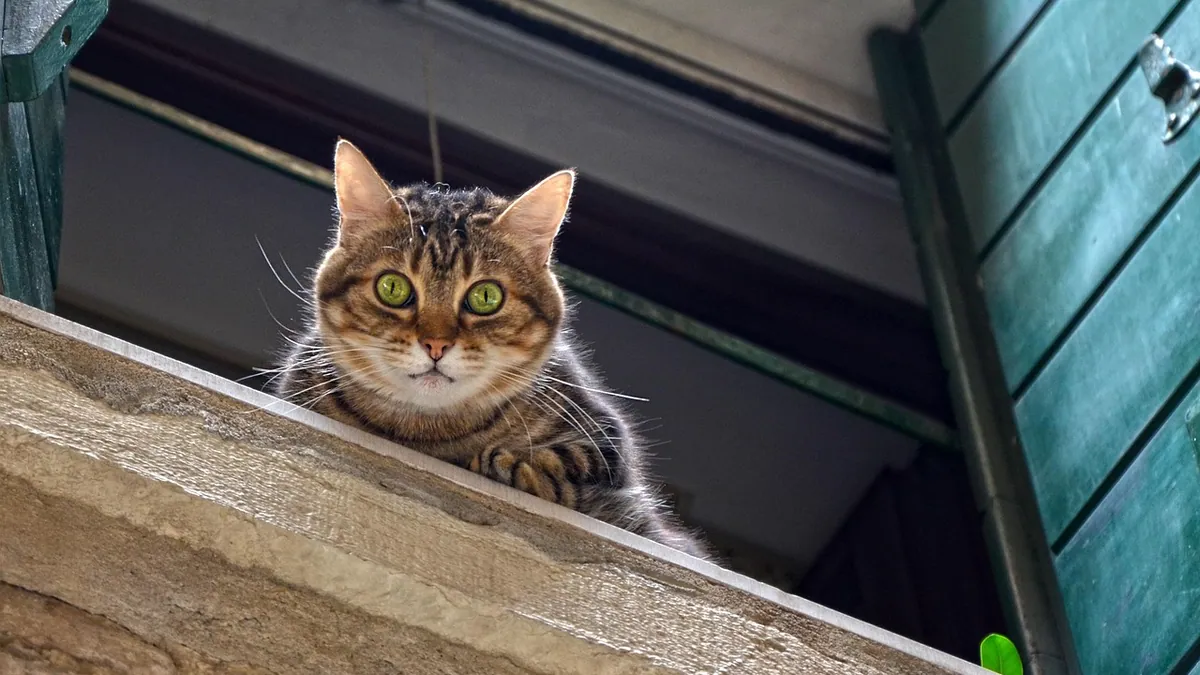
Do cats jump off balconies? Usually they do not jump on purpose. Most cats fall while chasing prey, slipping from a railing, or losing their balance during a jump. The result is a set of injuries veterinarians call high-rise syndrome, and it is one of the most common causes of trauma in cats [1].
This article is educational and is not a substitute for veterinary diagnosis or treatment.
Quick Answer
- High-rise syndrome means a fall from a height of two or more stories that causes chest, belly, bone, or face injuries [2].
- Cats often fall after slipping from windowsills, chasing prey, or during mating behavior, not because they decide to jump [2].
- Most cats in one large case series were under 1 year old, and the third floor was the most common fall height [3].
- Survival is better than many owners expect, but serious injuries are common. Chest trauma appeared in 58.3% of cats in one study [4].
- Screens, window stops, and balcony netting are the most reliable prevention tools. A cat that has fallen once is at risk of falling again.
What High-Rise Syndrome Is in Plain Words
High-rise syndrome is the pattern of injuries a cat gets after falling from a height. Veterinarians define it as a fall from two or more stories [2]. The injuries cluster in predictable places: the chest, the belly, the bones, and the face [2].
Cats are not built to survive long falls, but they do have two advantages. They have a righting reflex that helps them turn in the air, and their small body mass means less force on impact than a larger animal would take [2]. That is why cats often fare better than dogs after a similar fall [2].
Even so, a fall from a third-floor window can break a jaw, collapse a lung, or fracture a femur. The height alone does not tell your veterinarian how bad the injuries are. In one study of 1125 cats, no significant link was found between fall height and injury severity [3]. Another study found that height, ground type, and injury type did not reliably predict survival, while a trauma scoring system did [5].
Signs Owners Notice After a Fall
Some injuries are obvious right away. Others show up over hours.
Watch for:
- Trouble breathing, fast breathing, or open-mouth breathing
- A swollen or bleeding face, a drooping jaw, or a broken tooth
- Limping, dragging a leg, or refusing to stand
- Pain when you touch the belly or chest
- Bleeding from the nose or mouth
- Weakness, pale gums, or collapse
- Acting dull, hiding, or not responding normally
Breathing problems are especially common. In one study of 14 cats with high-rise syndrome, the average respiratory rate on arrival was 53 breaths per minute, and two cats were in respiratory distress [6]. Normal resting rates are much lower, so a cat breathing this fast needs emergency care.
Chest injuries are the most frequent serious problem. Thoracic trauma was found in 58.3% of cats in a large case series [4]. Circulatory shock was seen in 48.6% of those cats [4]. Shock can be present even when a cat looks calm.
If your cat is limping after a fall, see Cat Limping After a Jump: Is It a Sprain or a Break?. If your cat stops eating afterward, read Cat Not Eating for One Day: Why Cats Are at Higher Risk.
Causes and Risk Factors: Why Cats Fall From Balconies
Do cats jump off balconies on purpose?
Rarely. Most falls happen by accident. Cats slip from windowsills, lose footing on railings, or misjudge a jump while chasing a bird or insect [2]. A cat focused on prey may not notice the edge until it is too late.
How often do cats jump off balconies?
There is no single national number, but high-rise syndrome is one of the most common traumatic injuries veterinarians treat in cats [1]. In one study of 120 cats, about 75% had a history of high-risk behaviors reported by their owners [3]. Those behaviors included climbing on railings, leaping at windows, and perching on narrow ledges.
Do kittens jump off balconies?
Kittens and young cats are overrepresented. In one case series, most affected cats were under 1 year old [3]. Young cats are curious, bold, and still learning to judge distances. They are also more likely to chase a moth straight off a ledge.
Do cats jump off high balconies?
Yes, and height does not protect them. Cats fall from the first floor through the ninth floor and beyond. In one study, cats fell from 1 to 9 stories [6]. The third floor was the most common height in another group of 120 cats [3].
Other risk factors
- Season. Falls happen more often in warmer months, when windows and balcony doors stay open [2].
- Architecture. Open railings, wide ledges, and unscreened windows raise the risk [1].
- Sex and age. Young cats and intact cats that roam or seek mates are at higher risk [2].
- Prior falls. A cat that has fallen before may repeat the behavior.
- Senior cats. Older cats with weaker hind legs may slip more easily. See How to Help Your Senior Cat Get Up and Down from High Places Safely.
How Veterinarians Diagnose High-Rise Syndrome
Your veterinarian starts with a physical exam and a trauma score. The Animal Trauma Triage Score, or ATTS, rates injuries across body systems and predicts mortality better than fall height or ground type [5][7]. In one study of 60 cats, ATTS predicted death significantly better than another scoring system, with an area under the curve of 0.85 [7].
Imaging comes next. Radiographs and ultrasound can find pneumothorax (air around the lungs), pleural or abdominal fluid, fractures, and facial injuries [2]. In 14 cats, point-of-care lung ultrasound diagnosed pneumothorax in 5 cats, including 2 with air on both sides [6]. The same study found coalescent B-lines in 6 cats, a sign of lung bruising [6].
Blood work may show anemia, low platelets, or changes in liver, kidney, or pancreatic values consistent with organ trauma [2]. Serial blood gas tests help gauge how well the cat is breathing [2].
| Test or finding | What it looks for |
|---|---|
| Physical exam and ATTS | Overall injury burden and prognosis [5][7] |
| Chest radiographs | Pneumothorax, lung bruising, rib fractures [2] |
| Lung ultrasound | Pneumothorax, B-lines, consolidation [6] |
| Abdominal ultrasound | Free fluid, organ injury [2] |
| Blood work and blood gas | Anemia, organ damage, breathing status [2] |
Treatment Options
Treatment depends on which injuries your cat has. There is no single protocol.
Common steps include:
- Oxygen therapy for cats with low oxygen levels or heavy breathing [2]
- Chest taps to remove air or fluid around the lungs [2]
- Intravenous fluids for shock, which was present in nearly half of cats in one large series [4]
- Pain control, with the dose calculated by your veterinarian based on your cat's weight and health
- Surgery for fractures, jaw injuries, or internal bleeding
- A feeding tube or soft food for cats with facial or jaw damage
Cats with pneumothorax may need a chest tube. In the 14-cat study, 12 survived to discharge, and 2 were euthanized because of a poor prognosis or financial limits [6]. That outcome reflects how serious these cases can be even with good care.
Never give your cat human pain relievers or dog medications. Many are toxic to cats, and cats will often eat pills dropped on the floor [8]. Call your veterinarian before giving anything.
Recovery, Outlook, and Long-Term Management
Survival rates in recent studies are encouraging. One group of 120 cats had an overall survival rate of 92.5% [3]. In a separate study of 60 cats, 13% did not survive to discharge [7]. Higher injury severity, not fall height, was linked to death [3].
Recovery time varies. A cat with minor bruising may go home in a day or two. A cat with a femur fracture or spinal injury may need weeks of rest and physical therapy. Thoracolumbar spinal injuries, between the T13 and L1 vertebrae, made up half of the spinal injuries in one study [3]. Those cats need careful handling and often a neurology consult.
Long-term care may include:
- Recheck exams and repeat radiographs to confirm healing
- Restricted activity, often in a large crate or small room
- Weight management to reduce strain on healing bones
- Home changes to prevent another fall
Some cats become anxious or start overgrooming after a traumatic event. If you notice bald patches or constant licking, see Cat Overgrooming: Why It Happens and What to Do. Sudden odd behavior, such as hissing at nothing, can also have a medical cause. Read Cat Hissing at Nothing: When to Worry About Hallucinations or Medical Issues.
Prevention: How to Stop High-Rise Syndrome
Prevention is the part you control, and it works.
Windows
- Install sturdy screens on every window that opens. A screen meant to keep insects out will not hold a cat.
- Use window stops or locks that limit the opening to a few inches.
- Check screens each season for tears or loose frames.
- Do not rely on a closed window alone if it can be pushed open.
Balconies
- Wrap the balcony with cat-proof netting or wire mesh from floor to ceiling.
- Close gaps under and beside railings.
- Remove furniture, planters, and boxes that a cat can use as a step to the railing.
- Keep bird feeders away from the balcony edge. Prey drive is a common reason cats fall [2].
Supervision and enrichment
- Supervise balcony time, or skip it entirely and use a secure catio.
- Give indoor cats climbing trees, window perches, and puzzle feeders to reduce the urge to explore ledges.
- Neuter or spay cats that show mate-seeking behavior, since mating behavior is a known fall trigger [2].
- Keep the cat indoors. Indoor cats live safer lives overall.
If your cat has already fallen once, treat the balcony and windows as an emergency fix, not a someday project. Repeat falls happen.
Limitations and When to Contact a Veterinarian
No article can tell you how badly your cat is hurt. Only a veterinarian who examines your cat can do that. Individual cases need a veterinarian.
Call an emergency clinic right now if your cat:
- Breathes fast, hard, or with an open mouth
- Collapses, has pale gums, or cannot stand
- Bleeds from the nose, mouth, or anywhere that will not stop
- Has a visibly broken bone or a jaw that hangs open
- Fell from any height and is acting painful, dull, or hiding
Call your veterinarian the same day if your cat:
- Fell but seems fine, since internal injuries can appear hours later
- Limps, even mildly
- Refuses food or water
- Vomits or has diarrhea after the fall
Schedule a routine visit for a recheck if your cat was treated for a fall and is recovering. Follow the discharge instructions exactly, including activity limits and medication timing.
Frequently Asked Questions
Do cats always land on their feet?
No. The righting reflex helps cats turn during a fall, but it does not guarantee a safe landing [2]. Cats that land feet first can still break bones, and cats that land on their side or back can suffer chest and spinal injuries.
Can a cat survive a fall from a high floor?
Many do. Survival rates in recent case series are high, with one group reporting 92.5% [3]. Survival depends on the injuries, not the height, and a trauma score helps veterinarians predict the outcome [5][7].
Should I take my cat to the vet after a fall if it seems fine?
Yes. Cats hide pain well, and chest injuries can worsen over hours. A same-day exam with imaging is the safest choice, because problems like pneumothorax may not be obvious at home [6][2].
Is it safe to let my cat on the balcony with a harness?
A harness helps only if the balcony is also secured. A cat can slip a loose harness or reach a railing while leashed. Netting or mesh plus a harness is safer than a harness alone.
Will my cat try to jump again after a fall?
Possibly. About 75% of cats in one study had a history of high-risk behaviors before their falls [3]. Cats do not learn from one bad experience the way people do, so physical barriers are the real fix.
Can I give my cat pain medicine after a fall?
No, not without veterinary guidance. Human medications and dog flea products can be toxic to cats, and cats often eat pills they find on the floor [8]. Your veterinarian will choose a safe drug and calculate the dose for your cat.
Related Articles
- How to Help Your Senior Cat Get Up and Down from High Places Safely
- Cat Limping After a Jump: Is It a Sprain or a Break?
- Cat Overgrooming: Why It Happens and What to Do
- Cat Not Eating for One Day: Why Cats Are at Higher Risk
- Cat Hissing at Nothing: When to Worry About Hallucinations or Medical Issues
- Cat Not Eating for 24 Hours: Why Cats Are at Higher Risk
- Do Cats Jump Out of Windows? High-Rise Fall Risks Explained
- Is It Safe for Cats to Jump from High Places?
- How Far and High Can a Cat Jump? Facts and Safety
References
- High-rise syndrome in cats (part 1): epidemiology and risk factors. Journal of feline medicine and surgery, 2025.
- High-rise syndrome in cats and dogs. Journal of veterinary emergency and critical care (San Antonio, Tex. : 2001), 2022.
- Radiographic and Ultrasonographic Study of the Etiology of High-Rise Syndrome in Cats: A Retrospective Analysis. Veterinary medicine and science, 2026.
- High-rise syndrome in cats (part 2): injury patterns and survival rate. Journal of feline medicine and surgery, 2025.
- Survival Rate of High-Rise Syndrome Cases Using Animal Trauma Triage Score in Cats. Veterinary and comparative orthopaedics and traumatology : V.C.O.T, 2025.
- Point-of-Care Ultrasound and Clinical Findings in 14 Cats With High-Rise Syndrome. Journal of veterinary emergency and critical care (San Antonio, Tex. : 2001), 2026.
- The Animal Trauma Triage Score outperforms the VetCOT score in cats with high-rise syndrome. The Journal of small animal practice, 2026.
- Common Cat Hazards. Cornell University College of Veterinary Medicine.