What Do Cats Think? Feline Cognition Explained
By Dr. Zubair Khalid, DVM, MS, PhD ·
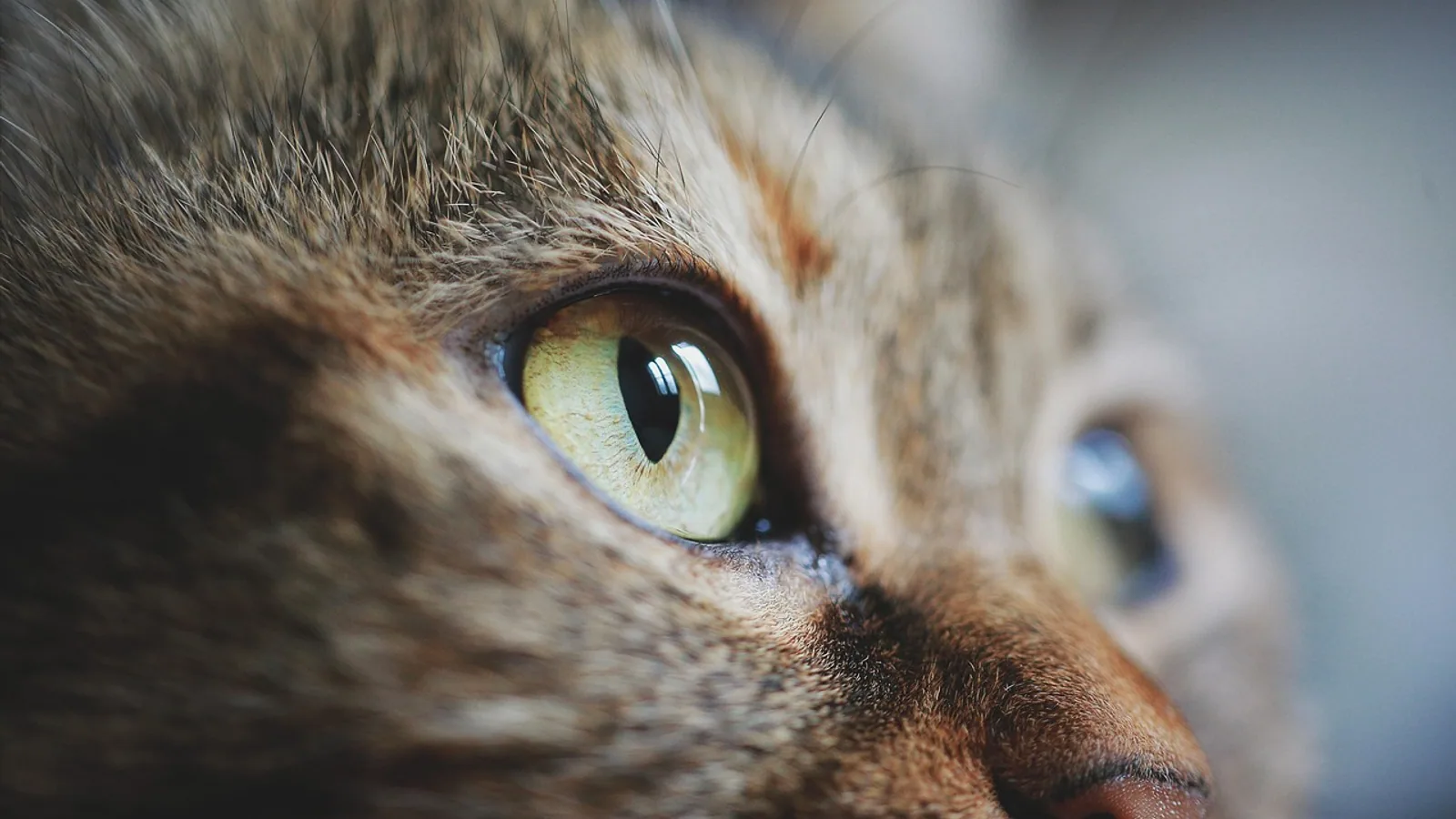
What a cat thinks is best understood as what a cat can do. Cats solve problems, remember locations, read human gestures, and adjust their behavior to a person's attention, and each of those abilities has been measured in controlled tests rather than inferred from how a cat looks at you.
The short answer is that feline cognition is real, specific, and narrower than the affectionate story owners often tell. Cats build working memories of movements they have directly watched, track hidden objects under some conditions and not others, learn from their social experience with people, and pick up emotional information through sight, sound, and smell. What they do not reliably do is reason about invisible events the way a human toddler eventually can. This article walks through the measured evidence, domain by domain, and explains what it means for living with a cat.
How Feline Cognition Is Actually Measured
Researchers borrow the tools of comparative psychology and developmental psychology. A cat is placed in front of a puzzle box, two boxes, a screen, or a set of bowls. The experimenter controls what the cat can see. Then the cat's choices, search paths, and pauses are recorded as data.
Several designs recur throughout feline cognition research, and understanding them makes the results easier to read.
Visible displacement tests. The cat watches a target move behind a screen or into a box, then is allowed to search. Success means the cat goes to the correct location.
Invisible displacement tests. The target is placed inside a container, moved behind a screen, and then removed from the container behind that screen so the cat never sees the final hiding place. Only an animal that represents the object's unseen trajectory should search correctly.
Violation-of-expectancy tests. The cat watches a sequence that is either physically consistent or physically impossible, such as an object reappearing from a box it was not hidden in. Longer looking or changes in engagement suggest the cat registered the violation.
Progressive elimination tasks. The cat must visit and deplete several targets, some visible and some hidden, without rechecking completed ones. This tests the interaction between perception and working memory.
Social cue tests. A person points, gazes, or reaches toward one of two locations while the cat watches. Success means the cat uses the human signal rather than chance.
These methods avoid the trap of asking owners whether their cat "seems smart." They produce a yes or no for a specific ability at a specific moment under specific conditions, which is exactly what makes the findings useful [1].
Object Permanence: Strong on Visible Moves, Weak on Invisible Ones
Object permanence is the understanding that an object still exists when it leaves sight. In human development it is described in stages, and cats have been tested against those stages. The pattern across studies is remarkably consistent: cats follow visible movement well, and they struggle when movement is hidden.
Visible displacement
Kittens and adult cats both pass visible displacement tasks. In one classic study, cats watched a bowl of meat move behind a screen and searched correctly at levels well above chance, and when the sequence was extended so the bowl reappeared and vanished behind a second screen, cats searched above chance again but took different paths to get there [2]. That difference in path suggests the cats were not just running to a memorized spot. They were tracking a sequence.
A later study confirmed the core finding and added a boundary. Cats do find an object moved visibly behind a succession of screens, but they encode the position changes they have directly perceived. When the object is invisibly transferred from a container to the back of a screen, cats search at or near the container rather than the true hiding place [3]. The authors concluded that only perceived position changes are activated in working memory.
Invisible displacement and the split in the literature
Invisible displacement is where feline cognition gets contested. Several older studies concluded that cats fail invisible displacement tasks and rely on immediate perception, searching at the last location they saw the object disappear or under the nearest cover [4]. That conclusion fits the working-memory finding above.
But not every study agrees. In a task where cats watched an object from behind a clear panel and then had to walk around an opaque panel to reach it, with the object hidden during that walk, cats solved the task with what the author described as great flexibility [5]. The critical difference was anticipation. In that design, cats had to predict where the object would be, rather than reason backward about where it had gone. The standard Piagetian task asks the cat to reconstruct a hidden event retrospectively, and cats are weak there. The ecological task asks the cat to anticipate a future position, and cats handle it well.
A 2025 study tested 18 cats at home on both a single visible displacement task and a violation-of-expectancy invisible displacement task. About 56 percent of cats did not find the hidden toy in the visible task, and 42 percent of those cats did not attempt to search at all, which the authors noted differs from earlier work showing successful retrieval in successive visible displacement tests [6]. In the invisible condition, cats were unexpectedly more likely to play with the toy after it reappeared from an unexpected box, which is not the classic surprise response. Person familiarity did not significantly change whether cats found the toy.
Two small older reports pushed the ceiling higher. One tested two adult cats on a multiple invisible displacement task using a dowel as a secondary reinforcer and three other cats on a single invisible displacement task. The authors judged the cats' searches consistent with representation of an unsensed object [7]. This remains a minority position against the larger body of negative results.
What this means in practical terms
A cat that watches you put a toy in a drawer will often return to the drawer. A cat that watches you put a toy in a bag, carry the bag to another room, and empty it there may not search the second room. The cat is not being stubborn or forgetful. It is working from the movements it actually saw.
Working Memory and Long-Term Memory
Feline memory research separates short-term storage of a recent location from longer retention of a learned task or site.
Working memory in cats is tightly bound to perception. In visible and invisible displacement experiments, only directly perceived position changes were encoded and held active [3]. When cats must choose between a target they can currently perceive and one they must remember, they follow a visibility rule: they search visible targets first and hidden targets last [8]. That ordering is not a failure. It is an efficient strategy that prioritizes certain information over uncertain information.
Retention over time is harder to state precisely from feline studies, and the evidence is more limited than in dogs [9], [1]. The clearest quantitative feline data on memory delays comes from clinical cognitive testing. Visuospatial working memory has been measured in cats by showing them a baited container and testing whether they remember the location after a set delay, with younger cats performing better than older cats of the same infection status [10]. This gives a measurable, age-sensitive memory task rather than a general claim about how long cats remember.
The A-not-B question
Human infants make a characteristic error when an object is moved from hiding place A to hiding place B: they keep reaching for A. Comparative work found that magpies, and by the same account dogs and cats, do not show this error [11]. That is one place where cats perform like other species and unlike human infants at a comparable stage, and it argues against a simple "cats are toddler-level" framing.
Problem Solving and Means-End Reasoning
Means-end problem solving means getting an intermediate step to work in order to reach a goal, such as pulling a tab to open a compartment holding food.
In a study of 86 domestic cats tested with a food-acquisition puzzle box that required pulling a tab to release a reward, 24 cats solved it. More socialized cats were more likely to solve the problem, solved it faster, and approached the apparatus sooner. Younger adult cats were also more likely to solve it than older adults [12]. Two conclusions follow. First, cats are capable of this kind of problem solving. Second, both social experience and age shape whether a given cat does it on a given day.
That socialization effect is one of the clearest links between a cat's history with people and its cognitive performance. Cats that were more comfortable with humans were not just bolder. They engaged with the task more effectively.
Search behavior also shows flexibility rather than rigid instinct. In object permanence tests, cats displayed pause behavior and searched by following a path opposite to the one the object took when it disappeared. Flexible behavior occurred on 69 percent of trials in a novel situation, but only 52 percent in a familiar setting where pauses were less frequent and shorter [13]. The authors interpreted pause and opposite search as decision processes used when a cat is dealing with prey that has disappeared while being pursued. In other words, some of what looks like hesitation is a cat running a search strategy shaped by hunting.
Social Cognition: Gaze, Pointing, and Reading Attention
Social cognition is where cats surprise people. Cats are often described as aloof and indifferent to human communication, yet the experimental record shows them using human signals.
Following human gaze and pointing
Cats are sensitive to human cues, including pointing and gaze direction, and this is one of the better-studied areas in feline cognition [1]. The evolutionary backdrop matters. Most felid species are solitary, but domesticated cats can live in social groups, engage in complex social encounters, and form strong attachments to humans [9]. A flexible social species that lives around people is a reasonable candidate for reading human signals, even if the research base is far smaller than the dog literature [1].
Reading owner attention
Cats adjust their behavior based on what a person is attending to. They also recognize individual humans and their voices, and they respond to intraspecific emotional cues through both visual and auditory channels. In one study, cats gazed longer and more frequently at negatively valenced visual stimuli showing higher activity levels than at other stimulus categories, and they showed more fear-related behaviors in response to negatively valenced active stimuli than positively valenced active stimuli. Valence and activity did not affect their responses to the auditory stimuli [14]. This tells us cats extract emotional information from cat body signals and postures, which is part of how they read social situations in general.
Scent, emotion, and the nose
Cats also read human emotion through smell. When presented with human odors collected in different emotional contexts, cats showed higher stress levels in response to fear odors than to physical-stress or neutral odors, indicating they perceived the valence of the olfactory signal and regulated their behavior accordingly. The same study found a right-nostril bias that increased with stress, which is the first evidence of lateralized emotional processing in the cat olfactory pathway [15].
Communication runs in both directions through the body. The tail up signal, with the tail held vertically and the tip curled, has been identified as a friendly greeting between cats and from cats to humans [16]. Some cats cannot produce the classic form because of a curled tail morphology, and in the two cases reported the cats displayed normal tail movement otherwise and their social behavior was not noticeably impaired [16]. The signal is real, but anatomy can change how it appears.
Sensory Constraints Shape Feline Thought
Cognition runs on sensory input, and a cat's input differs from a dog's and from a human's. These differences are not footnotes. They explain many test results.
Color vision. Cats are dichromats. They do not see the range of colors humans do, which matters in any test that depends on color discrimination.
Whiskers. A cat's whiskers provide close-range spatial information, and they can be used to judge openings and detect nearby objects.
Olfaction. Scent is a major channel for social information in cats, as the emotional odor findings show [15]. A cognitive test that removes scent removes a channel cats normally use.
Hearing. Cats hear to roughly 64 kHz, well above the human range and above what many other domestic species detect. High-frequency sound is part of how cats perceive their world, including small prey.
The practical consequence is that a cat may underperform a task for sensory reasons rather than conceptual ones. If a test or a puzzle depends on color discrimination or on precise vision at distance, a cat's result says as much about its eyes as about its mind.
Domestication, the Socialization Window, and Individual Variation
Domestication has not made cats into small dogs, but it has made them responsive to people. The evolutionary history of the domestic cat includes living on human streets and in human homes for thousands of years, and possible drivers of domestication are still discussed [9]. Modern domestic cats form strong attachments to humans and can live in social groups even though most felid species are solitary [9].
The socialization window
The socialization window, roughly 2 to 7 weeks of age, is the period when a kitten's experience with humans has outsized and lasting effects on later behavior. The problem-solving data fit this framework. Socialization toward humans, assessed with a structured behavioral measure, predicted whether cats solved a puzzle, how fast they solved it, and how quickly they approached the apparatus [12].
Individual variation is the headline
Domestication sets a range. Individual cats move within it. In the 2025 home study of object permanence, about half the cats failed the visible task and a large fraction did not even search [6]. In the 2024 problem-solving study, 24 of 86 cats solved the puzzle [12]. Those are wide spreads within a single species, and they mean that a statement about "cats" is often a statement about a study average rather than about the cat in your living room.
Age is a second major source of variation. Younger adult cats outperform older adult cats on both visuospatial working memory and problem solving [10]. In that study, age significantly affected both abilities, and younger cats with the same infection status performed better than older cats. Older cats infected with feline immunodeficiency virus had significantly worse visuospatial working memory than older uninfected cats, while problem-solving ability did not differ between those groups, and viral load predicted working memory but not problem solving [10]. The two abilities are separable and can decline at different rates.
Cognitive Domain, Typical Test, and Comparison with Dogs
| Cognitive domain | Typical feline test | How cats typically perform | Comparison with dogs |
|---|---|---|---|
| Object permanence, visible | Object moved behind one or successive screens | Above chance, tracks perceived movement [3], [2] | Dogs also reach Piagetian Stage 4 and show no A-not-B error [11] |
| Object permanence, invisible | Toy hidden in a container, transferred out of sight | Generally weak, searches at the container or last seen location [3], [4]. Some studies find success when anticipation is possible [5], and a small multiple invisible displacement study found representation [7] | Research base for cats lags well behind dogs [9], [1] |
| Working memory | Delay before searching for a baited container | Tied to directly perceived position changes [3]. Declines with age [10] | Declines with age in dogs too, with similar practical consequences [9] |
| Problem solving | Food-acquisition puzzle box requiring a pull | About 28 percent of cats solved it in one study. Socialization and younger age predicted success [12] | Cats were historically studied far less than dogs on physical causality tasks [1] |
| Social cue use | Human pointing and gaze toward a location | Cats are sensitive to human cues including pointing and gaze [1] | Both species read human cues. Cat research remains much thinner [1] |
| Emotion perception | Valenced visual and auditory stimuli, emotional human odors | Cats gaze longer at negative active cat stimuli [14] and show stress to human fear odors [15] | Sensitive to human emotional cues in both species [15] |
| Communication signals | Tail position, body posture | Tail up is a friendly greeting signal [16] | Different signal repertoire, similar function as a social regulator |
Common Myths and the Questions Owners Search
" Cats are solitary and do not care about people." Domestication produced a cat that can live alone or in groups and form strong attachments to humans [9]. Socialization toward humans predicts measured problem-solving performance [12], so a cat's relationship with people is not decorative. It shapes how the cat thinks through a task.
"Cats do not understand pointing." Cats are sensitive to human cues including pointing and gaze direction [1]. This does not mean every cat responds every time. It means the capacity is present in the species.
"If my cat fails at a puzzle, it is not smart." Puzzle performance depends on socialization, age, and method [12], [10]. The same cat may solve a task on a different day or in a different setup.
"Dogs are smarter than cats." The two species are measured on overlapping but not identical tasks, and feline cognition research lags behind canine research by a wide margin [9], [1]. A thinner evidence base is not the same as a lower ability.
"An older cat that seems confused is just old." Age significantly affects visuospatial working memory and problem solving, with younger cats outperforming older cats [10]. Gradual cognitive and behavioral change with aging is recognized in cats, and it is often written off as natural aging when it may warrant veterinary attention [9].
The Anthropomorphism Problem
Owners attribute complex emotions and cognitive abilities to cats, and the strength of that attribution rises with attachment. In a study of 448 university students, caregivers did not differ from non-caregivers in attributing primary emotions, and belief in animal minds predicted attribution of secondary emotions and cognition. For caregivers specifically, attachment strength was positively associated with attributing secondary emotions and cognition, and avoidant attachment style was negatively associated with attributing primary emotions. Housing conditions, indoor or outdoor, were not associated with these attributions [17].
That finding is useful for two reasons. First, it shows how much of what people believe about a cat's inner life tracks the relationship rather than the animal. Second, it explains why measured cognition and household intuition often diverge. The affectionate read is not irrational, but it is not a test result.
Practical Implications for Owners
Use visible sequences when you want a cat to understand where something went. Put a toy where the cat can watch you place it. Cats encode the position changes they directly perceive [3].
Expect wide individual differences. Roughly half of one sample did not retrieve a hidden toy even in the visible condition [6], and only about a quarter of another sample solved a food puzzle [12]. Adjust expectations per cat, not per species.
Invest early in gentle handling and positive human contact. Socialization toward humans predicted problem-solving success, speed, and approach latency, and the relevant developmental window opens in the first weeks of life [12].
Watch for age-related change specifically in memory-heavy tasks. Visuospatial working memory declines with age in cats and declines further in older cats with feline immunodeficiency virus [10]. If an older cat seems to lose track of things it used to find, that is a legitimate veterinary conversation, not just personality change.
Remember the sensory channel. Cats use scent and whisker contact heavily, and their emotional odor responses show they read human stress chemically [15]. A household with volatile emotions is not neutral to a cat.
Pay attention to what the cat's body is telling you. The tail up signal is a friendly greeting [16], and cats react more strongly to negatively valenced, high-activity cat signals than to other categories [14]. A cat watching another cat displays information you can read.
Limitations and When to Contact a Veterinarian
This article is educational and is not a substitute for veterinary diagnosis or treatment.
Feline cognition research is thin relative to canine research, sample sizes are often small, and results sometimes conflict across designs [6], [3], [5], [7], [4]. No article can tell you what your individual cat is thinking. A veterinarian who knows your cat's history can evaluate changes in behavior and memory in context.
Contact a veterinarian if you observe any of the following.
A previously reliable behavior disappears, such as a cat that used to find a food toy or a favorite resting spot and now cannot.
A cat seems to lose track of a person or object in a way that is new for that cat, particularly in an older cat [10].
Sleep-wake patterns change markedly, with more nighttime vocalization or restlessness.
A cat shows new fear-related behavior in ordinary situations, which can reflect pain, illness, or sensory change [14].
A cat stops eating, stops grooming, or hides more than usual.
A cat shows new aggression or new avoidance of a familiar person.
Any sudden change in behavior in a cat of any age deserves a veterinary examination, because pain, dental disease, sensory decline, and metabolic illness can look like a change in thinking.
Frequently Asked Questions
Do cats have object permanence?
Yes, but unevenly. Cats reliably search for objects they watched move behind a screen or screens [3], [2]. They are much weaker when the movement is hidden, and cats typically search at the container or at the last place they saw the object [3], [4]. Some studies find success when the task lets a cat anticipate rather than reconstruct [5].
How long do cats remember things?
Feline memory studies are limited compared with dog studies [9], [1]. The clearest feline evidence uses short delay tasks. Visuospatial working memory, measured by whether a cat remembers a baited container after a delay, is stronger in younger cats and weaker in older cats, and is worse in older cats with feline immunodeficiency virus [10].
Can cats solve puzzles?
Yes. In one study, 24 of 86 cats solved a food-acquisition puzzle box that required pulling a tab. More socialized cats solved it more often and faster and approached it sooner, and younger adult cats outperformed older adults [12].
Do cats understand pointing?
Cats are sensitive to human cues including pointing and gaze direction [1]. The ability is documented in the species. Whether a particular cat responds depends on the cat, the situation, and its history with people.
Are cats smarter than dogs?
The question does not have a clean answer because the species are not tested on the same tasks and feline cognition research is far less developed [9], [1]. On some shared tasks, such as object permanence and the absent A-not-B error, cats and dogs perform similarly [11]. On others, the evidence base is simply too thin to compare.
Do cats understand human emotions?
Cats respond to human emotional odors. They showed higher stress levels in response to fear odors than to physical-stress or neutral odors, indicating they perceived the emotional valence of the signal [15]. They also read cat emotional cues through visual and auditory channels [14].
Why does my cat stare at me?
Gaze is a social signal in cats. Cats are sensitive to human gaze direction as a cue, along with pointing [1]. A cat staring at you may be gathering information about what you are attending to, or simply waiting for the next thing to happen.
Can old cats develop cognitive problems?
Yes. Age significantly affects visuospatial working memory and problem solving, with younger cats outperforming older cats of the same infection status [10]. Cognitive and behavioral changes with aging are recognized in cats and are often dismissed as normal aging when they may warrant veterinary evaluation [9].
Related Articles
- Think.Check.Submit. Explained
- Feline Panleukopenia: Diagnosis and Management
- Feline Pancreatitis: Diagnosis and Management
- Feline Megacolon: Diagnosis and Management
- Feline Pancreatitis: Nutritional Support
- Feline Feline Hypertension: Diagnosis and Management
- Declawing Cats: Procedure, Risks and Alternatives
- Feline Distemper: Symptoms and Survival Guide
- What Does a Cat Eat? Feline Diet Guide
Sources
- What's inside your cat's head? A review of cat (Felis silvestris catus) cognition research past, present and future.
- Object permanence in cats: Analysis in locomotor space.
- Object permanence and working memory in cats (Felis catus).
- Search behaviour of cats (Felis catus) in an invisible displacement test: cognition and experience.
- Object permanence in cats (Felis catus): an ecological approach to the study of invisible displacements.
- Object permanence in domestic cats (Felis catus) using violation-of-expectancy by owner and stranger.
- Human analog tests of the sixth stage of object permanence.
- Decision making and visibility in cats (Felis catus) in a progressive elimination task.
- Feline Cognition and the Role of Nutrition: An Evolutionary Perspective and Historical Review.
- Age-related cognitive impairments in domestic cats naturally infected with feline immunodeficiency virus.
- Development of object permanence in food-storing magpies (Pica pica).
- Effects of Socialization on Problem Solving in Domestic Cats.
- Flexible search behavior in domestic cats (Felis catus): a case study of predator-prey interaction.
- Purr-ceiving feelings: domestic cats respond to intraspecific cues of emotion.
- Relationship between asymmetric nostril use and human emotional odours in cats.
- Spitz-like tail carriage in two domestic cats.
- Attachment as the Catalyst for the Attribution of Complex Cognition and Emotion to Companion Cats.