Laminar Flow Hood vs Biosafety Cabinet
By Dr. Zubair Khalid, DVM, MS, PhD ·

By the end of this guide you will be able to identify what any bench-top enclosure protects, choose between a laminar flow hood and a biosafety cabinet for a specific task, verify airflow with a tape measure and an anemometer, and set a cleaning and UV routine that matches the published evidence. You will also be able to read a certification report and spot the numbers that matter. Have on hand a tape measure, a calibrated thermal anemometer, the cabinet certification report, 70% ethanol, a logbook, and either a particle counter or 90 mm settle plates.
The two devices look similar from across the room. Both are stainless steel boxes with a glass front, a filter, a blower, and a work surface. The similarity ends at the filter. A laminar flow hood moves filtered air across the work and exhausts it into the room. A biosafety cabinet captures contaminated air, filters it, and returns only filtered air to the room. One protects the work. The other protects the worker, the room, and the work.
The core distinction in one paragraph
A laminar flow hood, often sold as a clean bench, draws room air through a prefilter and a high-efficiency particulate air (HEPA) filter and delivers it across the work surface as a unidirectional stream. The air then exits into the laboratory, either toward the operator in a horizontal hood or down and out through a front or rear grille in a vertical hood. The product is protected because the air washing over it has been filtered. The operator is not protected because aerosols generated inside the hood leave with the exhaust. A biosafety cabinet (BSC) is built around containment. Room air is drawn into a front inflow grille, filtered supply air washes the work surface, and the exhaust passes through a HEPA filter before it leaves the cabinet. Class II and Class III cabinets protect the product, the operator, and the environment. Class I cabinets protect the operator and environment but not the product.
That difference drives every purchase decision, every room layout, and every cleaning schedule.
Laminar flow hood working principle
The working principle is mechanical, not chemical. Air is moved, filtered, and directed. A laminar flow hood has four functional blocks in series: prefilter, blower, HEPA filter, and work zone. A fifth block, the exhaust path, determines whether the unit is a clean bench or a containment cabinet.
The air path, step by step
- Room air enters the unit through a coarse prefilter. The prefilter captures lint, dust, and large particles and extends the life of the HEPA filter.
- A centrifugal blower moves the air into a plenum above or behind the filter.
- The air passes through a HEPA filter rated to remove 99.97% of particles with a diameter of 0.3 µm or larger. Some units use an ultra-low penetration air (ULPA) filter with a higher removal rating.
- A diffuser or perforated plate distributes the filtered air so that it leaves the filter face at a uniform velocity.
- The air travels across the work surface in parallel streamlines. This is the unidirectional airflow that gives the device its name.
- The air exits the work zone. In a horizontal hood it exits through the front opening toward the operator. In a vertical hood it exits through a front or rear grille and then into the room.
A biosafety cabinet adds two more paths. Room air is pulled through a front inflow grille so that it cannot escape past the operator. The supply air is HEPA filtered before it reaches the work surface. The exhaust air passes through a second HEPA filter before it is discharged to the room or to a duct.
Why the flow is called unidirectional, not truly laminar
Laminar flow means streamlines run parallel and do not cross. In a real hood the air is unidirectional through the filter face and becomes disturbed at the edges of the work zone, at the operator's arms, and at equipment. The working area is therefore described as unidirectional airflow. Performance is measured by particle counts, velocity uniformity, and containment tests rather than by the mathematics of ideal laminar flow.
The engineering value of unidirectional airflow is measurable. In a simulated operating theater comparison, laminar airflow (LAF) ventilation significantly reduced colony-forming units (CFU) and particle counts compared with turbulent airflow at both 100% and 50% air influx [1]. In a separate study of scrub areas and laminar flow areas, background particle counts averaged 0.7 particles/m³ in laminar flow areas and 131.5 particles/m³ in scrub areas [2]. The clean bench applies the same principle at bench scale.
Horizontal and vertical flow
Horizontal hoods push air from the back of the cabinet toward the operator. They are common in electronics assembly and in some pharmacy cleanrooms. Vertical hoods push air from the top down onto the work surface and then to a front or rear grille. Vertical flow is the usual choice for tissue culture because open flasks and plates sit under a downward stream that does not blow directly into the operator's face.
A five-year in vitro fertilization (IVF) laboratory study used a laminar vertical flow hood for daily passive air sampling under the hood [3]. That is the practical configuration for embryo culture: vertical flow, work surface at a comfortable height, and a stream that sweeps down and away from open dishes.
Laminar flow hood diagram: components in airflow order
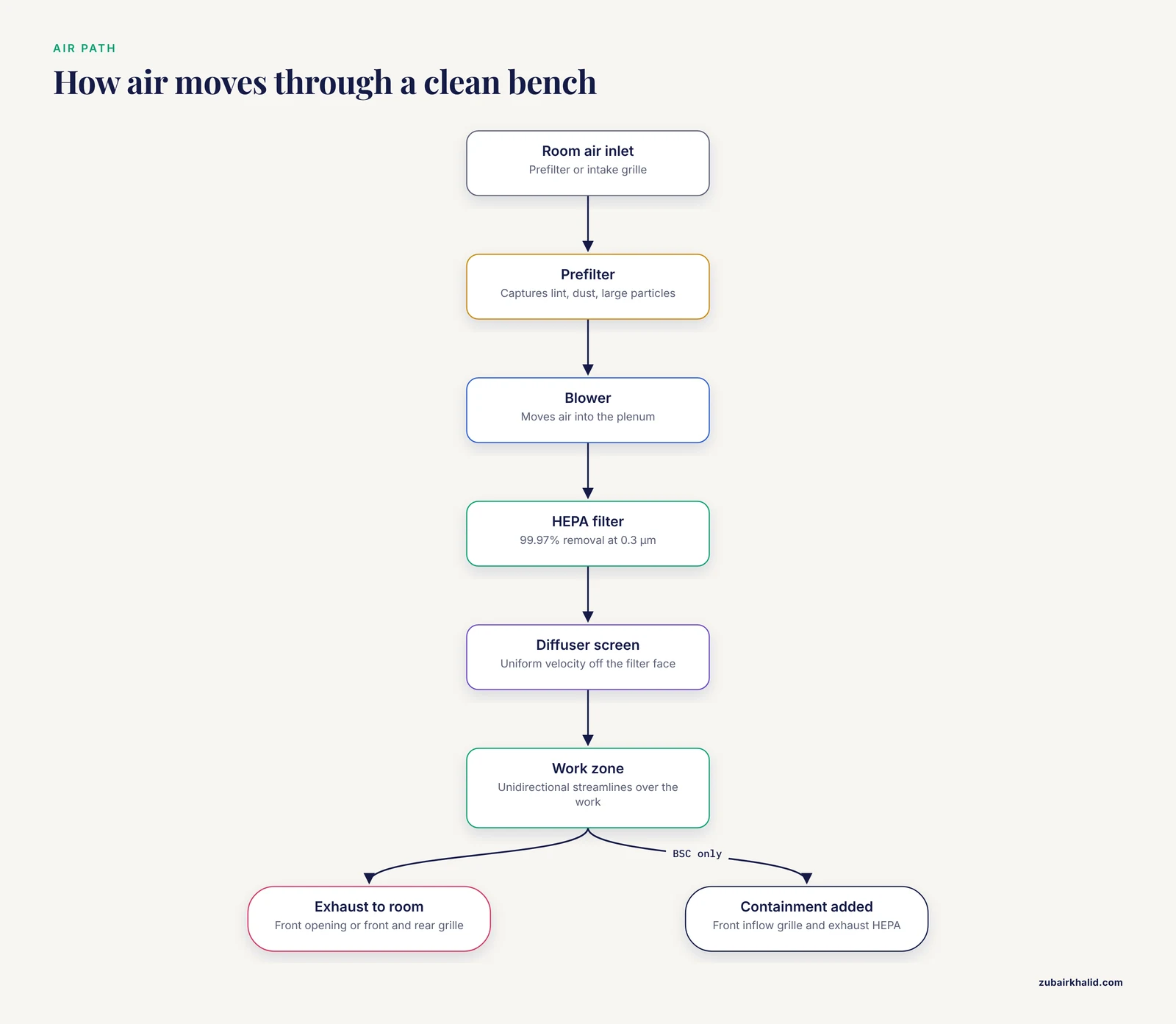
A service manual diagram for a vertical clean bench labels the same components in the same order. Read it from the room air inlet to the exhaust:
- Prefilter or intake grille at the top or rear of the unit.
- Blower compartment with a speed control.
- HEPA filter sealed into a frame with a gasket or gel seal.
- Plenum and diffuser screen below the filter.
- Stainless steel work surface with a raised lip or dished edge.
- Front or rear exhaust grille.
- UV lamp mounted above the work surface, usually behind a protective shield.
- Control panel with blower switch, light switch, UV switch, and a pressure gauge or digital display.
In a biosafety cabinet diagram, the front inflow grille and the exhaust HEPA filter are added, and the exhaust path is separated from the supply path by a plenum that is under negative pressure in most Class II designs.
Laminar flow hood classes and biosafety cabinet classes
The phrase "laminar flow hood classes" is used in two different ways, which causes most of the confusion in purchase orders. It can mean the cleanliness class of the air at the work surface, or it can mean the airflow direction. Biosafety cabinets have their own class system. Keep the two systems separate.
Cleanliness classes for clean benches
A laminar flow hood is usually specified by the cleanliness of the air it delivers. ISO 14644-1 is the cleanroom classification standard. ISO Class 5 allows no more than 3,520 particles of 0.5 µm or larger per cubic meter. Grade A, the pharmaceutical term used in European Union good manufacturing practice, corresponds to ISO 5 at rest and in operation. A clean bench that holds ISO Class 5 at the work surface is the bench-top equivalent of a Grade A zone.
The airflow direction is the second classification. Horizontal hoods are used where the work does not generate aerosols that must be kept away from the operator. Vertical hoods are used for cell culture, media preparation, and any open-vessel work where a downward stream is preferred.
Biosafety cabinet classes
Biosafety cabinets are classified by the level of protection they provide and by their exhaust configuration. The standard classification is Class I, Class II, and Class III.
| Class | Product protection | Personnel protection | Environmental protection | Typical use |
|---|---|---|---|---|
| , - | , - | , - | , - | , - |
| Laminar flow hood (clean bench) | Yes | No | No | Non-infectious cell culture, electronics, media prep |
| Class I BSC | No | Yes | Yes | Low-risk containment, equipment that cannot fit a Class II |
| Class II BSC | Yes | Yes | Yes | Cell culture, PCR, BSL-2 work |
| Class III BSC | Yes | Yes | Yes | BSL-3 and BSL-4, glovebox design |
Class II cabinets are further divided into types A1, A2, B1, B2, and C1. The differences are in the fraction of air that is recirculated, the fraction that is exhausted, and whether the plenums are under positive or negative pressure. A Type A2 cabinet recirculates most of its air and exhausts a smaller fraction, and it is the most common bench-top cabinet in a research laboratory. A Type B2 cabinet exhausts all of its air to the outside through a hard duct and recirculates none. The type matters when the work involves volatile chemicals or radionuclides, because recirculated air can carry them back over the work surface.
Laminar flow hood vs biosafety cabinet: the decision table
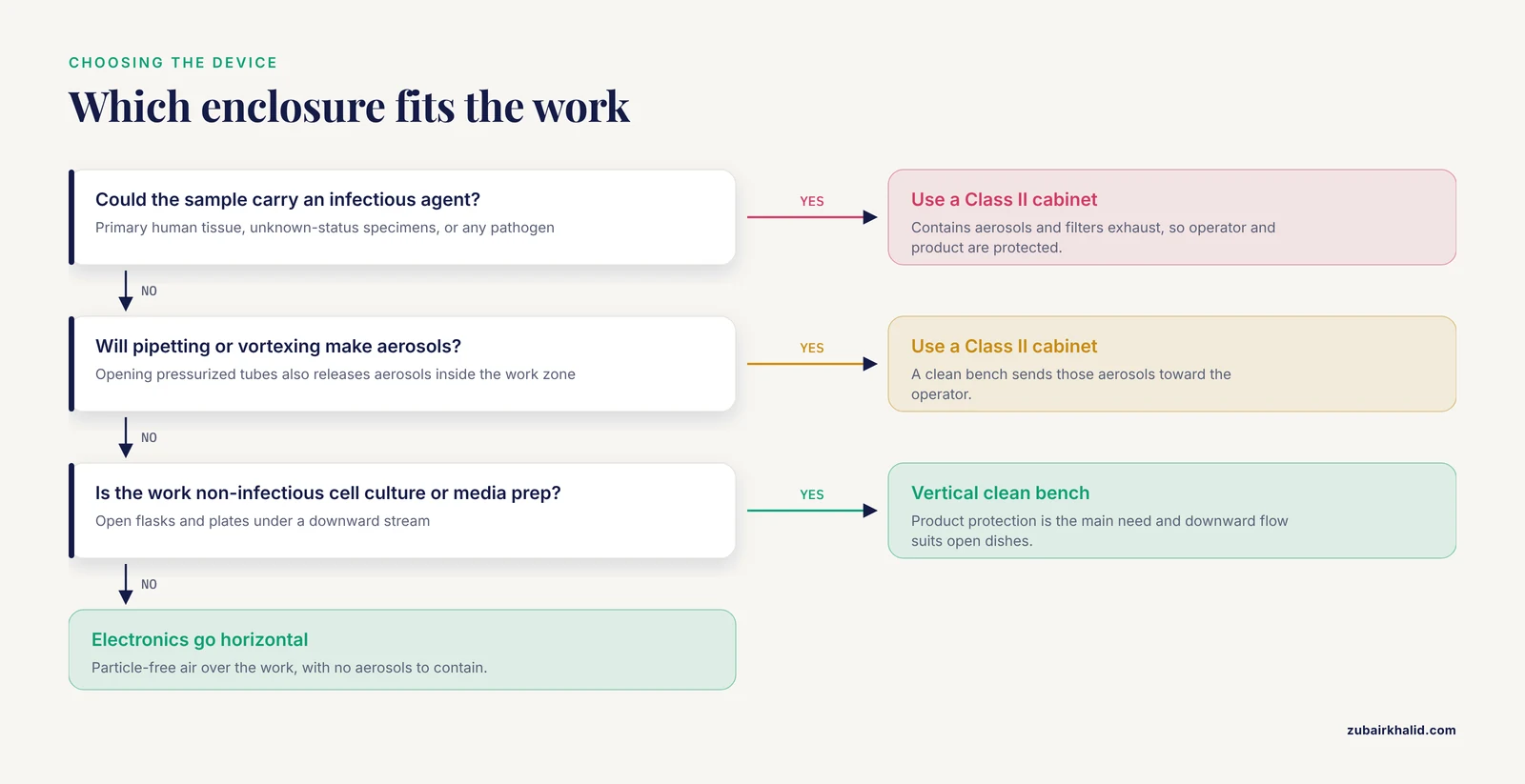
The decision is driven by the hazard of the agent, not by the value of the sample.
| Task | Recommended device | Reason |
|---|---|---|
| , - | , - | , - |
| Open manipulation of non-infectious cell lines | Vertical laminar flow hood or Class II BSC | Product protection is the main need |
| Embryo culture and IVF media handling | Vertical laminar flow hood or Class II BSC | Downward flow over open dishes [3] |
| PCR master mix preparation | Dedicated laminar flow hood or dead-air box | Amplicon-free workspace |
| PCR amplicon handling and sequencing cleanup | Separate room, never the master mix hood | Amplicons are the contamination source |
| Clinical cerebrospinal fluid or other diagnostic specimens | Class II BSC | Operator and product protection [4] |
| Human or animal infectious agents | Class II BSC | Aerosol containment |
| BSL-3 work | Class II BSC in a certified suite, or Class III | Containment [5] |
| Cytotoxic drug preparation | Containment cabinet, not a clean bench | Chemocontamination control [6] |
| Electronics assembly | Horizontal laminar flow hood | Particle-free air over the work |
The table gives the short answer. The rest of this guide explains the parameters behind it.
Laminar flow hood for tissue culture
A vertical laminar flow hood is the standard bench for open manipulation of non-infectious cell lines. The downward stream keeps particles out of open flasks and plates. The hood is not a sterile field. It is a filtered air field. The difference matters when a pipette tip touches the work surface, when a bottle cap is set down on its rim, and when the operator's sleeve passes over an open dish.
A five-year IVF program gives a useful calibration. The laboratory performed 570 passive air samplings under a laminar vertical flow hood and recovered at least 1 CFU of microorganisms on the tryptic soy agar (TSA) settle plate in 13 cases, a positivity rate of 2.28% [3]. No embryo culture showed detectable contamination under the microscope or visible turbidity or color change. There were no statistically significant differences in biochemical pregnancy, live birth rate, or abortion between the sampling-positive group and the negative group [3]. A positive settle plate is not proof that the culture is contaminated. It is a signal about the air and the handling at that moment.
Workflow design inside the hood matters as much as the filter. A multichamber perfusion platform for three-dimensional scaffolds was designed so that assembly and cell seeding could be performed under a laminar flow hood, with the explicit aim of minimizing contamination risk during handling [7]. The design used a small number of components, water-tight seals, and bayonet couplings to keep the assembly simple. That is the right instinct. Every joint, cap, and transfer step inside the hood is an opportunity for contamination.
Aerosol generation inside a clean bench is also real. A speech-aerosol study used a laminar flow hood as a low-particle background chamber and captured particles from 70 nanometers to 10 micrometers in diameter [8]. The hood reduced background particles. It did not eliminate particles produced inside the work zone. Pipetting, vortexing, and opening pressurized tubes generate aerosols that a clean bench sends toward the operator. If the sample is infectious, the clean bench is the wrong device.
For tissue culture with known non-infectious lines, a vertical clean bench is acceptable. For primary human tissue, unknown-status specimens, or any work with a pathogen, use a Class II biosafety cabinet. The cabinet gives the same product protection and adds operator protection.
The biosafety cabinet in molecular diagnostics and cell processing
In a molecular diagnostic laboratory, the biosafety cabinet is a contamination control device as much as a containment device. A retrospective study of the BIOFIRE FilmArray meningitis/encephalitis panel compared two point-of-care sites over two eight-week periods [4]. During period 1, cerebrospinal fluid was manipulated under a non-dedicated hood featuring laminar flow. During period 2, site A moved to a dedicated biosafety cabinet, while site B continued with its existing setup. False positives were detected in 3 of 114 cerebrospinal fluid samples (2.63%) at site A and 1 of 36 (2.77%) at site B during period 1. During period 2, site A had 0 false positives in 139 samples and site B had 1 in 38 (2.63%) [4]. All false positives were bacterial. The numbers are small and the reported P values were not significant, but the direction is consistent with the known behavior of pre-analytical contamination.
The lesson is not that a biosafety cabinet is a magic box. The lesson is that a dedicated cabinet, used only for clean reagents and never for amplicons, reduces the chance that a stray template or a bacterial contaminant reaches the reaction mix. The cabinet's airflow and its HEPA-filtered supply air help. The dedication and the workflow help more.
Containment performance is also measurable. In a BSL-2 plus laboratory, starting the biosafety cabinet reduced bioaerosol deposition on laboratory technician surfaces by 5 to 20 times [9]. The technician positioned downstream of the airflow still had an infection probability of up to 19.9% even with protective devices [9]. The cabinet is a control, not a guarantee. Room air currents, door openings, and the position of the operator relative to the airflow all change the dose.
In high-containment work, the cabinet can house the instrument itself. A flow cytometer was enclosed in a biosafety cabinet in a BSL-3 laboratory and characterized for temperature stability, optical performance, and aerosol generation [5]. The cabinet did not significantly affect instrument performance or stability. Low amounts of aerosol were detected from vulnerable points in the system, and a plate seal reduced aerosol generation 15-fold [5]. The enclosure added a containment layer around a process that would otherwise be open.
Laminar flow hood UV light: what it does and does not do
A ultraviolet (UV) lamp inside a laminar flow hood or biosafety cabinet is a surface disinfectant. Germicidal UV-C at 254 nm damages nucleic acids in microorganisms that are directly exposed to the light. It does not penetrate dust, liquid films, spills, or the shadowed seams where the work surface meets the wall. It does not sterilize the air that is already moving through the cabinet. It is an adjunct to cleaning, not a replacement.
The evidence supports that position. A cleaning study for biosafety cabinets evaluated UV irradiation at 200 mJ/cm² for 20 minutes alongside wiping with distilled water, benzalkonium chloride, and 70% ethanol for removing mycoplasma, feline calicivirus, and endotoxin from stainless steel plates [10]. The study is a reminder that UV belongs in a panel of methods. It is not a standalone changeover procedure.
A second study tested ethanol spraying alone, wiping alone, and combined spraying plus pressure-based wiping against Bacillus subtilis spores on stainless steel [11]. Only the combined treatment produced complete inhibition of bacterial growth. Chemical action alone and mechanical action alone were not enough. The practical rule is spray, wipe with pressure, and then use UV on the cleaned surface if the cabinet is so equipped.
Wiping itself can spread contamination. A quantitative study of wiping in biosafety cabinets tracked DNA, protein, and Bacillus subtilis endospores on stainless steel and polyethylene terephthalate surfaces [12]. Wiping redistributed contaminants across the work surface and transferred them to gloves. Reusing the same wipe for multiple passes made the problem worse. Replace the wipe after the source area, and change gloves after cleaning.
For chemical decontamination, the agent matters. A study of stainless steel surfaces inside a microbiological safety cabinet contaminated with antineoplastic drugs found that two quaternary ammonium-based solutions, Septalkan and Surfa'Safe, were more than 95% effective, while 70% ethanol was less effective [6]. Wet decontamination immediately after the spill was more effective than dry decontamination after one hour. That result is specific to cytotoxic drugs, but the principle generalizes: match the agent to the contaminant, and do not let a spill dry.
Ozone is another option for changeover. A biosafety cabinet fitted with an ozone generator reduced colony-forming units and endotoxin levels from Pseudomonas aeruginosa at 1.0 × 10^4 CFU, and it was tested against Bacillus subtilis spores and Aspergillus brasiliensis [13]. Ozone is a whole-cabinet treatment. It reaches surfaces that a wipe cannot, and it requires a validated cycle with a defined concentration and contact time. It is not a substitute for daily wiping.
A UV lamp has a finite life. Most cabinets log lamp hours and most lamp manufacturers publish a useful life. If the lamp has exceeded its rated hours, replace it. A UV lamp that still glows may no longer deliver the dose at the work surface.
Buying a laminar flow hood: what to specify
A search for a laminar flow hood for sale returns hundreds of units with similar photographs and very different specifications. The specification sheet is where the decision is made. Check these items before a purchase order is written.
- Cleanliness class at the work surface. Require ISO Class 5 or Grade A in operation, not only at rest.
- Airflow direction. Vertical for cell culture. Horizontal for electronics.
- Face velocity. A typical target is 0.45 m/s (about 90 feet per minute), with a tolerance of plus or minus 20%. The 0.45 m/s figure is the one reported for a laboratory-scale biosafety cabinet with homogeneous unidirectional airflow in a Grade A particle-counting study [14].
- HEPA filter access. The filter should be replaceable from the front or top without dismantling the cabinet.
- Work surface. 304 stainless steel with rounded corners and a dished or lipped edge to contain spills.
- Pressure gauge. A magnehelic gauge or a digital differential pressure display shows filter loading. A unit without one gives no warning before airflow falls out of specification.
- UV lamp with interlock. The interlock should prevent the lamp from operating while the sash or front access is open.
- Blower control. Variable speed allows the velocity to be restored as the filter loads.
- Electrical. In the United States, 120 V at 60 Hz is standard for bench-top units. Confirm the plug type and the circuit rating.
- Noise and heat load. A cabinet that is too loud or too warm will be switched off, and a switched-off cabinet protects nothing.
- Certification. A biosafety cabinet is certified to NSF/ANSI 49. A clean bench is tested to ISO 14644-1 and to the Institute of Environmental Sciences and Technology recommended practice for clean benches. Ask for the field certification report, not only the factory test sheet.
- Documentation. Demand the airflow diagram, the filter part number, the lamp part number, and the recommended spares list.
Do not accept a unit that cannot be field-certified by a qualified technician in your area. A cabinet with no local service support becomes a storage cabinet within a year.
Verification walkthrough: measuring airflow and checking the result
A laminar flow hood or biosafety cabinet is verified by measurement, not by the presence of a sticker. The walkthrough below uses a tape measure, a thermal anemometer, and a particle counter or settle plates. The calculations are worked examples. Substitute your own dimensions.
Step 1: Measure the work opening
Measure the width and height of the front opening in meters. For a hood with a 0.60 m wide by 0.50 m high opening, the open area is 0.30 m². Record the sash position if the cabinet has an adjustable sash.
Step 2: Compute the required airflow
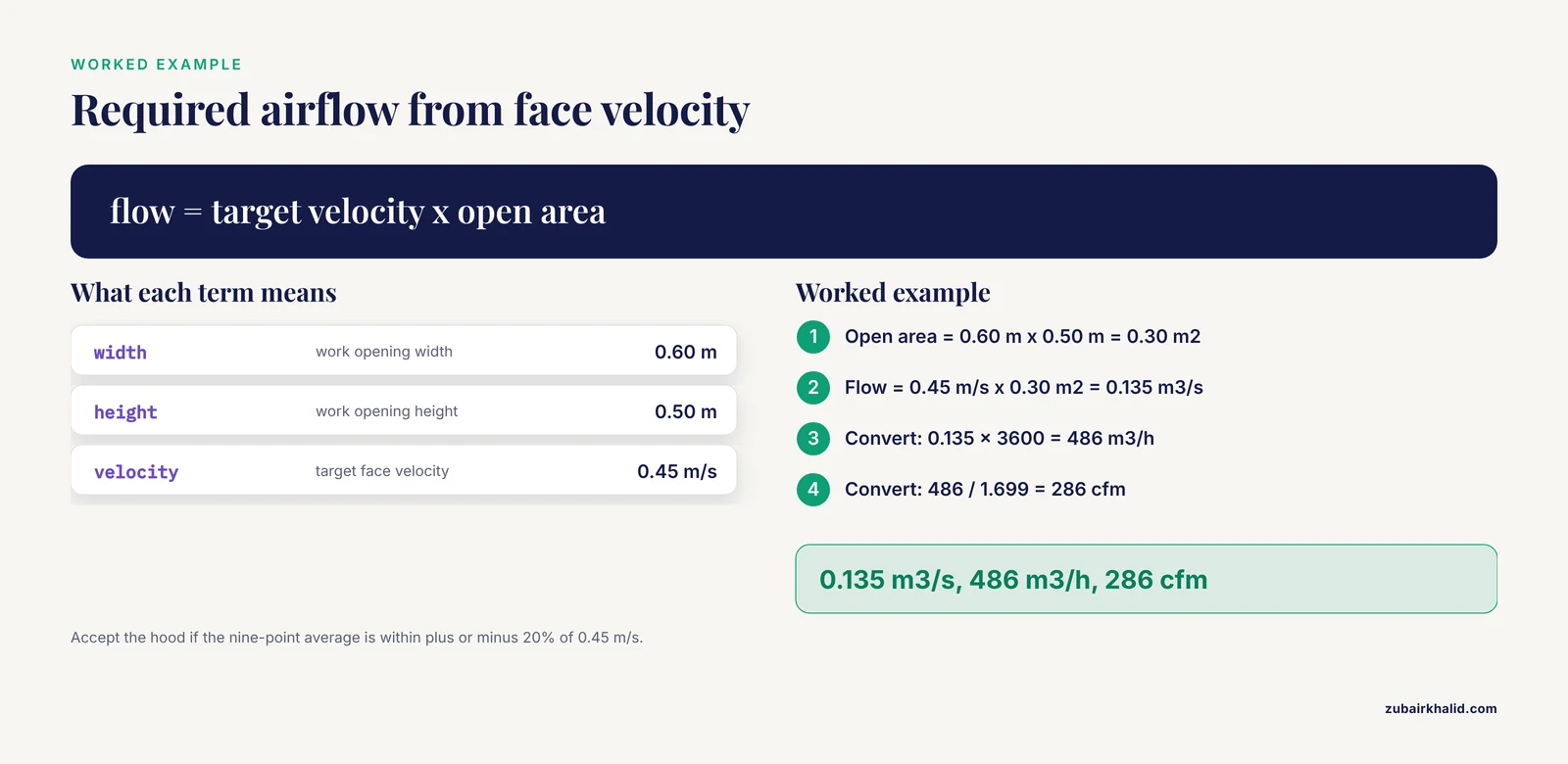
The required volumetric flow is the target face velocity multiplied by the open area. The script below converts the result to cubic meters per hour and cubic feet per minute.
width_m = 0.60
height_m = 0.50
target_velocity_m_s = 0.45

area_m2 = width_m * height_m
flow_m3_s = target_velocity_m_s * area_m2
flow_m3_h = flow_m3_s * 3600
flow_cfm = flow_m3_h / 1.699

print(f"open area: {area_m2:.2f} m2")
print(f"required flow: {flow_m3_s:.3f} m3/s")
print(f"required flow: {flow_m3_h:.0f} m3/h")
print(f"required flow: {flow_cfm:.0f} cfm")
Expected output:
open area: 0.30 m2
required flow: 0.135 m3/s
required flow: 486 m3/h
required flow: 286 cfm
Step 3: Measure face velocity at nine points
Divide the opening into a 3 by 3 grid. Take a reading at the center of each cell with the anemometer held perpendicular to the airflow. Do not stand between the hood and the room air supply. Average the nine readings.
Accept the hood if the average is within plus or minus 20% of the target and no single reading is more than 20% from the average. A reading of 0.45 m/s is 100% of target. A reading of 0.36 m/s is 80% of target, which is at the lower limit. A reading of 0.30 m/s is 67% of target, which is out of specification.
Common instrument messages and their fixes:
- "OL" or "out of range" on the anemometer: the range is set too low. Switch to the 0 to 5 m/s range.
- "Low flow" or "inflow alarm" on a biosafety cabinet: the sash is too high, a room door is open, or the exhaust duct is blocked. Lower the sash, close the door, and check the exhaust.
- "Filter load" on the magnehelic gauge: the HEPA filter is loading. Record the pressure and schedule a filter change if the velocity cannot be restored.
- "UV lamp fault": the lamp has failed or the interlock is open. Replace the lamp and test the interlock.
Step 4: Compute air changes per hour in the work zone
Air changes per hour (ACH) is the volumetric flow divided by the work-zone volume, multiplied by 3600. A high ACH means the air in the work zone is replaced quickly.
length_m = 1.20
depth_m = 0.80
height_m = 0.70
flow_m3_s = 0.135

volume_m3 = length_m * depth_m * height_m
ach = (flow_m3_s / volume_m3) * 3600

print(f"work zone volume: {volume_m3:.3f} m3")
print(f"air changes per hour: {ach:.0f}")
Expected output:
work zone volume: 0.672 m3
air changes per hour: 723
The number is a check on the airflow calculation, not a regulatory limit. If the ACH is far below the value expected for the cabinet model, the blower or the filter is not performing.
Step 5: Count particles and set settle plates
Use a particle counter at the standard rate of 28.3 L/min (1 cubic foot per minute) or at a lower rate that has been justified for unidirectional airflow sampling [14]. Sample at the work surface and at the back of the work zone. Record the counts for 0.5 µm and 5 µm particles.
For settle plates, place 90 mm tryptic soy agar plates open on the work surface for 30 to 60 minutes. Incubate at 30 to 35°C for 24 to 48 hours. Count colonies and report CFU per plate per hour. Trend the results. A single positive plate is an event. A rising trend is a problem.
A simple command-line check of a particle counter export looks like this:
awk -F, 'NR>1 {sum05+=$2; sum5+=$3; n++} END {printf "mean 0.5 um: %.1f particles/m3\nmean 5 um: %.1f particles/m3\n", sum05/n, sum5/n}' particle_log.csvExpected output:
mean 0.5 um: 12.4 particles/m3
mean 5 um: 0.8 particles/m3
Compare the means with the ISO Class 5 limit of 3,520 particles/m³ at 0.5 µm. A mean below the limit is necessary but not sufficient. Check the maximum value and the time trend as well.
Step 6: Confirm the certification and document the result
A qualified technician performs the field certification. For a biosafety cabinet, the test follows NSF/ANSI 49 and includes inflow velocity, downflow velocity, HEPA filter integrity, and containment. For a clean bench, the test follows ISO 14644-1 and the relevant clean bench recommended practice. File the report with the date, the technician, the instrument serial numbers, the measured values, and the pass or fail statement.
Step 7: Set the next actions
If the velocity is low and the filter pressure is high, schedule a filter change. If the velocity is low and the filter pressure is normal, check the blower and the duct. If the particle count is high but the velocity is normal, check the filter seal and the room air currents. If the settle plates are positive, review the cleaning log, the UV lamp hours, and the operator technique before assuming the cabinet is faulty.
Parameters that matter
| Parameter | Target or reference | How to measure | Action if out of range |
|---|---|---|---|
| , - | , - | , - | , - |
| Supply HEPA filter | 99.97% removal at 0.3 µm | Aerosol challenge by certifier | Replace filter, reseal |
| Face velocity | 0.45 m/s plus or minus 20% | Thermal anemometer, 9 points | Adjust blower, check filter load |
| Particle count | ISO Class 5, 3,520 particles/m³ at 0.5 µm | Particle counter | Check filter seal and room drafts |
| Settle plate | Trend, no fixed pass mark | 90 mm TSA, 30 to 60 minutes | Review cleaning and technique |
| UV lamp | 254 nm, within rated hours | Lamp hours, UV meter | Replace lamp |
| Work surface | 304 stainless steel, intact | Visual inspection | Repair or replace |
| Certification | Annual | Field test report | Remove from service if failed |
Common mistakes and limitations
Using a laminar flow hood for infectious agents. This is the most serious mistake. A clean bench exhausts into the room. Aerosols generated during pipetting, centrifugation, or opening tubes travel toward the operator. Use a Class II biosafety cabinet for any agent that requires containment.
Treating UV light as sterilization. UV reaches only the surfaces that the light touches. It does not penetrate dust, liquid, or seams. A cabinet that is switched to UV overnight without wiping is not clean in the morning.
Reusing a wipe across the work surface. Wiping redistributes DNA, protein, and spores and transfers them to gloves [12]. Use a fresh wipe for each section of the surface and change gloves after cleaning.
Spraying ethanol and wiping immediately. The combined chemical and mechanical action is what removes spores [11]. Spray, let the surface stay wet for the contact time stated on the label, and wipe with pressure.
Blocking the front grille or the filter face. A biosafety cabinet needs unobstructed inflow at the front grille and unobstructed supply air at the filter face. A stack of boxes at the back of the work zone changes the airflow and can defeat containment.
Placing a horizontal clean bench in a cell culture room. Horizontal flow blows toward the operator. It is the wrong direction for open vessels and for any aerosol-generating work.
Assuming the cabinet is certified because it is new. Field certification is required after installation, after a move, after a filter change, and annually. A factory test sheet does not cover the room, the duct, or the electrical supply.
Ignoring room air currents. A cabinet in a doorway or under a ceiling diffuser can have its inflow disturbed. The cabinet is tested in place for a reason.
Confusing clean bench classes with biosafety cabinet classes. A "Class II" clean bench does not exist in the same sense as a Class II biosafety cabinet. Specify ISO class and airflow direction for a clean bench, and Class I, II, or III for a biosafety cabinet.
Using a biosafety cabinet for amplicon work in the same room as reagent preparation. A dedicated cabinet helps only if it is dedicated [4]. Amplicons and reagents must be physically separated.
Limitations. The evidence summarized here comes from specific laboratory settings, including IVF, molecular diagnostics, high-containment flow cytometry, and surface cleaning studies. Your room, your workflow, and your agent list determine the final configuration. A biosafety officer or a qualified certifier should review the installation before the cabinet is used for diagnostic work.
Related Guides
- How to Set Up a Cell Culture Hood: Optimizing Your Biosafety Cabinet: Practical setup steps for cell culture work in a biosafety cabinet
- Biosafety Cabinet vs Fume Hood: Which One Do You Need: Clarifies difference between biosafety cabinets and fume hoods
- Biosafety Cabinet Principles: How They Work and How to Use Them Effectively: Explains how biosafety cabinets work and how to use them
- Biosafety Cabinet Selection for Risk Assessment: Guides cabinet selection using risk assessment principles
- Proper Use of a Biosafety Cabinet: Covers proper operating practices for biosafety cabinets
- Safe Handling of Microbial Cultures: A Biosafety Guide: Safe handling guidance for microbial cultures in the lab
- BSL-1 vs BSL-2: Key Differences: Explains key differences between BSL-1 and BSL-2 labs
- Biosafety Level 1 and 2 Labs: Common Mistakes in Safety Practices: Highlights common safety practice mistakes in BSL-1 and BSL-2 labs
Frequently Asked Questions
What is the difference between a laminar flow hood and a biosafety cabinet?
A laminar flow hood protects the product by blowing HEPA-filtered air across the work surface and exhausting it into the room. A biosafety cabinet contains aerosols and filters the exhaust, so it protects the operator and the environment as well as the product.
Does a laminar flow hood protect the operator?
No. A laminar flow hood exhausts into the laboratory, so aerosols generated inside the work zone can reach the operator. Use a Class II biosafety cabinet for any work that involves infectious agents or aerosol-generating procedures.
Can I use a laminar flow hood for tissue culture?
Yes, for non-infectious cell lines and for media preparation. A vertical laminar flow hood is the usual choice because the downward stream keeps particles out of open flasks. Use a biosafety cabinet when the cells or specimens may carry a pathogen.
Is UV light in a laminar flow hood enough to sterilize it?
No. UV is a surface adjunct that reaches only exposed surfaces. Cleaning with a fresh wipe and an appropriate disinfectant is required before UV treatment, and UV does not replace wiping.
What do laminar flow hood classes mean?
The phrase usually refers to the cleanliness class of the air at the work surface, such as ISO Class 5 or Grade A, or to the airflow direction, horizontal or vertical. Biosafety cabinets use a separate Class I, II, and III system.
How do I know my hood is working correctly?
Measure the face velocity at nine points, compute the airflow, count particles or set settle plates, and check the annual field certification report. A sticker alone is not evidence of performance.
Can a biosafety cabinet be used instead of a laminar flow hood?
Yes. A Class II biosafety cabinet provides product protection as well as containment, so it can replace a clean bench for cell culture. The trade-offs are higher cost, a more complex airflow pattern, and a greater space and ducting requirement.
What should I look for when buying a laminar flow hood?
Specify ISO Class 5 at the work surface, vertical or horizontal airflow to match the task, a face velocity near 0.45 m/s, front-access HEPA filtration, a pressure gauge, an interlocked UV lamp, and local field certification support.
Sources
- Laminar airflow versus turbulent airflow in simulated total hip arthroplasty: measurements of colony-forming units, particles, and energy consumption.
- A microbiological assessment of sterile surgical helmet systems using particle counts and culture plates: recommendations for safe use whilst scrubbing.
- IVF cycle safety when a positive passive air sampling occurs under laminar flow hood in absence of a detectable contamination in the embryo culture.
- Preventing contamination of PCR-based multiplex assays including the use of a dedicated biosafety cabinet.
- Assessment of Biocontainment Efficacy and Flow Cytometric Impact of a Novel Platform in High Containment Laboratories.
- Assessment of residual stainless steel surface contamination in an anticancer drug preparation microbiological safety cabinet after decontamination with four cleaning solutions.
- Design and functional testing of a multichamber perfusion platform for three-dimensional scaffolds.
- Aerosols, airflow, and more: examining the interaction of speech and the physical environment.
- Personnel exposure studies to multi-source diffusion of bioaerosols under biosafety laboratory - Level 2 plus operating conditions.
- Cleaning methods for biosafety cabinet to eliminate residual mycoplasmas, viruses, and endotoxins after changeover.
- Biosafety-cabinet wipe-cleaning assessment system: Integration of visual, thermal, and pressure sensing.
- Contamination spread within biosafety cabinets during wiping and its transfer to gloves: Quantitative assessment of cleaning risks.
- Changeover method for biosafety cabinets using ozone gas.
- Justification and Impact of Reduced Sampling Flow Rates for Total Particle Counting in Grade A Environments.