Biosafety Cabinet vs Fume Hood: Which One Do You Need
By Dr. Zubair Khalid, DVM, MS, PhD ·
A biosafety cabinet protects the worker, the sample, and the environment from biological aerosols using HEPA-filtered, directional airflow. A fume hood protects only the worker, by pulling chemical vapors away from the face and exhausting them, unfiltered, outside the building. That single sentence is the difference between a biosafety cabinet and a fume hood, and it drives every purchasing and protocol decision in the biosafety cabinet vs fume hood debate.
The rule of thumb is short. If the hazard is alive, or the sample must stay sterile, use a biosafety cabinet. If the hazard is a chemical vapor, gas, or dust, use a fume hood. Protocols that carry both hazards use both devices, at different steps.
Choosing wrong has consequences in both directions. Open cultures handled in a fume hood release unfiltered infectious air into building ductwork and expose the sample to contamination. Volatile solvents handled in a recirculating biosafety cabinet concentrate vapors in the air the operator breathes and can degrade the very filters that make the cabinet safe.
The confusion is not new. A review in the British Journal of Biomedical Science described substantial uncertainty among microbiologists and managers about the choice, installation, testing, and use of microbiological safety cabinets, and set out to clarify those issues against the standards of the time [1]. Two decades later, the same questions still reach biosafety offices, particularly during outbreaks. A team that built COVID-19 diagnostic laboratories reported that staff training surfaced repeated queries about cabinet functions and selection, and that detailed knowledge about choosing the right cabinet was scanty [2].
The Difference Between a Biosafety Cabinet and a Fume Hood
How a biosafety cabinet works
A biosafety cabinet (BSC) is a ventilated enclosure that uses high-efficiency particulate air (HEPA) filtration and directional airflow to contain biological hazards. A HEPA filter captures at least 99.97 percent of particles measuring 0.3 micrometers, the size that penetrates filters most efficiently, and it captures larger bacteria and smaller viruses even more effectively through other capture mechanisms. That filter is the reason a BSC can handle infectious aerosols and a fume hood cannot.
An aerosol is a suspension of tiny droplets or particles in air. In microbiology, aerosols form whenever liquid cultures are vortexed, plates are opened, loops are sterilized, specimens are decanted, or sealed centrifuge cups are opened after a spin. Aerosols are invisible, they ride on air currents, and they can stay suspended long enough to be inhaled or to settle on surfaces.
A Class II cabinet, the type found in most clinical and research microbiology laboratories, moves filtered air in three directions at once:
- Room air is drawn inward through the front opening. This inward flow, called inflow, protects the operator by pulling aerosols away from the face and into the cabinet.
- HEPA-filtered air flows downward over the work surface in a uniform, one-directional pattern called laminar downflow. Because this air is sterile, it protects the sample. This product protection is something no fume hood provides.
- Roughly 30 percent of that air is exhausted through a HEPA filter before it leaves the cabinet, which protects the environment. The remaining 70 percent is recirculated through the downflow filter.
At the standard working sash height, inflow at the front opening is maintained at a minimum of about 100 linear feet per minute (fpm), roughly 0.5 meters per second, under the NSF/ANSI 49 standard that governs Class II cabinets in the United States.
How a fume hood works
A chemical fume hood, also called a laboratory fume hood or chemical hood, is an enclosure open on one side that captures vapors, gases, fumes, and particulate dusts at their source and exhausts them outside the building. There is no HEPA filter and no recirculation. A fan pulls room air through the open sash at a controlled face velocity, the speed of air entering the hood, commonly specified between 80 and 120 fpm depending on the design and the institution's requirements. Baffles at the rear of the hood shape the airflow so that air is captured from both the work surface and the upper zone.
Protection is one-directional. The operator is protected because contaminated air moves away from the breathing zone and out the stack. The sample receives no protection, because the air moving over the work is unfiltered room air. The environment receives no microbial protection either, because the exhaust stream is not treated for biological agents. Fume hoods are engineered and maintained under the chemical hygiene plan, the written program required by the federal OSHA laboratory standard for laboratories that use hazardous chemicals.
Ductless hoods, which pass air through activated carbon or other chemical media and return it to the room, exist for specific low-volume chemical applications. They are not microbiology equipment, and they are not a substitute for either a ducted fume hood or a BSC.
Biosafety Cabinet vs Fume Hood: Side-by-Side Comparison
The table puts the two devices side by side on the criteria that decide real purchases and real protocols.
| Criterion | Biosafety cabinet (Class II) | Chemical fume hood |
|---|---|---|
| Hazard controlled | Biological aerosols and particulates | Chemical vapors, gases, fumes, and dusts |
| Who or what is protected | Operator, sample, and environment | Operator only |
| Air filtration | HEPA filters on recirculated and exhausted air, 99.97 percent efficient at 0.3 micrometers | No microbial filtration. Ducted hoods exhaust directly outside, ductless hoods use chemical media only |
| Air handling | Type A2 recirculates about 70 percent of the downflow and HEPA-exhausts about 30 percent | 100 percent of the air is exhausted outside, nothing recirculates |
| Sample (product) protection | Yes, sterile filtered downflow | No, unfiltered room air passes over the work |
| Chemical vapor capacity | Trace quantities only in Type A2, limited chemical work in Type B2 | Designed for continuous chemical work |
| Airflow at the opening | Minimum inflow of about 100 fpm at the sash | Face velocity commonly specified between 80 and 120 fpm |
| Typical microbiology tasks | Opening plates, inoculating, aliquoting specimens, vortexing, cell culture | Formalin fixation, solvent reagent preparation, phenol-containing stains, acid washes, powder weighing |
| Testing and certification | Field tested against NSF/ANSI 49, at least annually | Face velocity and containment checks under the chemical hygiene plan |
| Governing program | Biosafety program, biosafety levels, risk assessment | Chemical hygiene plan |
| Cannot be used for | Volatile toxic chemicals (Type A2), open chemical digestions | Infectious aerosols, sterility-critical work |
The two devices overlap on exactly one point. Both pull air away from the operator's face through the work opening. Every other line separates them. The biosafety cabinet filters the air and protects three things at once. The fume hood moves air and protects one thing. That asymmetry is why the answer to the biosafety cabinet vs fume hood question is almost never a single device for a working microbiology bench.
Start With a Biosafety Risk Assessment
A biosafety risk assessment is a structured judgment about what could go wrong, how likely it is, and how severe the outcome would be, followed by selection of controls that reduce the remaining risk to an acceptable level. In US practice it sits at the front of the CDC and NIH manual Biosafety in Microbiological and Biomedical Laboratories (BMBL), which assigns work with infectious agents to biosafety levels 1 through 4 (BSL-1 to BSL-4) based on the hazard the agent poses and the procedures performed with it.
A workable risk assessment for a microbiology protocol answers five questions.
- Agent. What is the organism or specimen, how is it transmitted, what is its infectious dose, and is treatment or vaccination available?
- Procedure. Which steps can generate aerosols? Vortexing, sonication, centrifugation, opening plates, decanting, and preparing standardized cell suspensions all rank high.
- Scale. How much material, at what concentration, over how many separate manipulations?
- People. What training and experience do staff have, and does anyone carry a condition that raises personal risk?
- Resources and rules. What containment exists, and what do institutional, local, and national guidelines require?
The published literature shows why the last two questions matter as much as the first three. Guidelines recommend handling Burkholderia pseudomallei, a Tier 1 select agent (a US designation for pathogens judged to pose the greatest risk of deliberate misuse) that has caused laboratory-acquired melioidosis, inside a Class II BSC in a BSL-3 facility. A field study in the Journal of Clinical Microbiology examined what happened when 30 laboratory scientists handled B. pseudomallei isolates on 1,267 occasions outside a biosafety cabinet in a low-resource setting. No infections occurred, every participant remained seronegative (no detectable antibodies on blood testing), and controlled environmental air sampling during 78 handling events, including plate opening, oxidase testing (a rapid biochemical test that requires opening the culture plate), and preparation of McFarland suspensions (standardized bacterial suspensions matched to a turbidity standard), detected no aerosolization of the organism. The authors still concluded that each laboratory must perform its own risk assessment, weighing melioidosis endemicity, the resources available for containment, the nature of the routine handling, and predisposing risk factors among staff, alongside region-specific guidelines [3].
The same humility applies in the other direction. The Biosafety Research Road Map project reviewed the evidence behind biosafety practices for two respiratory pathogens, avian influenza virus and Mycobacterium tuberculosis, and identified major gaps, including the absence of definitive data on M. tuberculosis sample aerosolization that would guide the selection of engineering controls for diagnostic procedures. It also found that guidance sources on BSC use for specific procedures with M. tuberculosis require clarification [4]. Some guideline recommendations rest on thinner evidence than their confident tone suggests, which is exactly why a documented, local risk assessment should carry the decision.
The World Health Organization adds the equipment side of the equation. It emphasizes the use of validated BSCs, so that the protection a cabinet promises on paper is demonstrated in the installed unit, and it directs laboratories to match the class of cabinet to the risk assessment of the pathogen in use [2].
When to Use a Biosafety Cabinet
Routine BSL-2 diagnostic work
BSL-2 is the working level for most clinical microbiology. It covers human blood, sputum, urine, tissue, cerebrospinal fluid, and cultures of moderate-risk agents such as Staphylococcus aureus, Salmonella species, and the pathogenic Escherichia coli groups. The Class II BSC is the primary engineering control for any manipulation that can create aerosols or splashes: opening primary containers, aliquoting specimens into tubes, inoculating and subculturing plates, harvesting colonies, and preparing smears before fixation.
The operating principle is one sentence. Any open manipulation of material reasonably expected to contain infectious agents belongs in a biosafety cabinet. That sentence covers most of the daily bench in a clinical microbiology laboratory.
Molecular and viral diagnostics
The COVID-19 pandemic made the stakes visible. Teams standing up SARS-CoV-2 testing laboratories were advised that the BSC is the most important single piece of equipment for protecting the user, the environment, and the integrity of results, and that the class of cabinet must match the pathogen's risk profile [2]. Respiratory specimen receipt, accessioning, aliquoting, and nucleic acid extraction setup are open manipulations of potentially infectious material, and they belong in a certified Class II cabinet.
High-consequence agents and BSL-3
Suspected or confirmed M. tuberculosis specimens are processed in a Class II BSC with respiratory protection, and propagating cultures requires BSL-3 containment. The default for B. pseudomallei isolates is likewise a Class II cabinet in a BSL-3 facility. The field study summarized in the risk assessment section shows how much evidence a laboratory would need to justify working differently, and why any such deviation must be a documented risk assessment decision rather than a preference [3].
Product protection and sterility-critical work
Cell culture, pouring and inoculating media, sterility testing, and work with primary cells all need an air stream that is not just moving but clean. A fume hood cannot perform any of these tasks, because its air is unfiltered room air and every open minute adds contamination risk. When the question is when to use a biosafety cabinet rather than whether, sterility is the second trigger after infectivity.
When a Fume Hood Is the Right Choice
Chemistry, not biology, sends work to the fume hood. The common chemical steps in and around a microbiology laboratory include:
- Tissue fixation with formalin, a buffered aqueous formaldehyde solution, and processing through alcohol and xylene series in histology.
- Acid-fast staining reagents. Carbol fuchsin contains phenol, a caustic compound whose vapor is irritating and harmful, and some protocols heat the stain, which drives vapor off aggressively. Heating phenolized stains belongs in a fume hood or a closed staining device, not over an open bench and not in a biosafety cabinet.
- Parasitology concentration procedures that use formalin with a volatile solvent such as ethyl acetate, where the solvent decanting and evaporation steps release flammable and irritating vapors.
- Acid washes and digestions, which release corrosive fumes.
- Solvent-based extraction and cleanup, glutaraldehyde disinfection of equipment, and dilution of concentrated bleach, which releases chlorine vapor.
- Weighing fine powders such as media components, salts, and dyes, where dust is the hazard.
None of these steps protects the sample, and none of them needs to. A fume hood is the right answer whenever the hazard is chemical and the work is neither sterility-critical nor aerosol-generating with infectious material.
When one protocol carries both hazards, split it. Do the biological manipulation in the biosafety cabinet, then move the fixed or chemically stabilized material to the fume hood for the chemical steps. If a protocol cannot be split, a total-exhaust Class II Type B2 cabinet, used under a biosafety program that explicitly permits chemical work in cabinets, is the engineered compromise.
Worked Scenarios: Biosafety Cabinet or Fume Hood
Scenario 1: Streaking a sputum culture for acid-fast bacilli
The specimen is sputum suspected of containing M. tuberculosis. Digestion and decontamination, smear preparation, and culture inoculation are all open manipulations of potentially infectious aerosol-generating material, so every open step runs in a Class II BSC with the respiratory protection your program requires, and culture manipulation proceeds at BSL-3. The fume hood has no role in the biological steps. Once smears are heat-fixed, they are handled at a ventilated staining area, because fixation renders the smear noninfectious while the staining reagents remain a chemical hazard.
Scenario 2: Formalin-ethyl acetate concentration for ova and parasite examination
This is the classic split protocol. Mixing stool with formalin is a splash and aerosol risk with infectious material, so it runs in the biosafety cabinet. Decanting and evaporating the volatile solvent is a chemical vapor risk, so it moves to the fume hood. Neither device substitutes for the other, and the sequence matters: the biological containment comes first, the chemical capture second.
Scenario 3: Preparing a McFarland suspension for antimicrobial susceptibility testing
Vortexing an overnight culture to match a turbidity standard is one of the most reliable aerosol generators on the bench. The mixing step belongs in a Class II BSC. If the laboratory's procedure requires visual matching against a card, the capped tube can be read outside the cabinet after aerosols have settled and the exterior has been disinfected.
Scenario 4: Weighing media components and preparing buffers
Weighing dehydrated media, salts, and dyes generates dust, which is a chemical and particulate hazard with no infectious component. This work belongs in a fume hood or a ventilated balance enclosure. The biosafety cabinet is the wrong tool here, because the powder can clog HEPA filters and the cabinet provides no capture advantage for dust.
Scenario 5: UV-C treatment of sealed urine containers before downstream testing
A diagnostic antidoping laboratory used UV-C exposure inside a Biosafety Level 2 cabinet to damage DNA and RNA in sealed human urine containers before analysis, including concern about SARS-CoV-2. After 15 minutes of UV-C irradiation, accredited analytical methods found no stability problems across 444 spiked and endogenous analytes, covering small molecules, Phase I and Phase II metabolites, peptides, pH, and specific gravity [5]. The result supports UV-C as a compatible decontamination step for sealed, nonliving specimen containers in that setting. It does not make UV-C a general substitute for surface disinfection, for reasons covered below.
Biosafety Cabinet Classes and Types
Class II is the default answer, but the class structure matters when you specify, purchase, or route work.
- Class I. Air is drawn inward past the work and exhausted through HEPA, with no downflow. It protects the operator and the environment but not the sample. Class I cabinets serve as containment enclosures for equipment and for work that does not need sterility.
- Class II Type A1 and A2. The A2 is the workhorse of clinical microbiology. About 70 percent of the air recirculates through the downflow HEPA filter and about 30 percent is exhausted. The exhaust can be released into the room or connected to building exhaust through a canopy (thimble) connection. A2 cabinets suit BSL-2 work and, with appropriate practices and facility approval, BSL-3 work, but only trace quantities of low-hazard chemicals.
- Class II Type B1. Roughly 70 percent of the air is exhausted and 30 percent recirculated, which allows limited work with small amounts of certain chemicals.
- Class II Type B2. Total exhaust, no recirculation. This is the cabinet for volatile toxic chemicals and radionuclides used inside the cabinet, and it requires dedicated ducted exhaust.
- Class III. A gas-tight, negatively pressurized enclosure with glove ports and HEPA-filtered supply and exhaust air, reserved for maximum containment work such as BSL-4.
Selection guidance follows two rules. Match the class to the risk assessment of the pathogen and the procedure, in line with the approach WHO emphasizes for validated cabinet use [2]. Then treat installation and testing as part of the selection rather than an afterthought, because a cabinet installed in a traffic path or exhausted incorrectly cannot deliver its rated performance no matter what its label says [1].
Work Practices and Microbiology Biosafety Training
Equipment does not contain aerosols on its own. Practice does. Structured microbiology biosafety training should cover, at minimum: how the airflow works and what disrupts it, the difference between the three protection targets, correct loading and unloading, surface disinfection and spill response inside the cabinet, what certification means and when it lapses, and the specific procedures the laboratory performs. Competency should be observed at the bench, not just recorded from a lecture.
Practices that keep a biosafety cabinet safe
- Run the blower for several minutes before work, per the manufacturer, to purge the cabinet.
- Wipe the interior with an appropriate disinfectant, such as 70 percent alcohol or the product your program specifies, and wipe each item as it enters and leaves.
- Bring in only what the procedure needs. Clutter blocks the perforated front and rear grilles and degrades both inflow and downflow.
- Work well inside the cabinet, behind the sash plane, and slow your arm movements. Rapid withdrawal pulls room air into the work zone.
- Use no open flames in a Class II A2 cabinet. Flames create turbulence, heat damages filters, and fire inside a recirculating cabinet is a real hazard. Use disposable loops or an electric incinerator.
- Keep a discard container inside the cabinet and disinfect it before removal.
- Decontaminate all interior surfaces at the end of work, including the walls and interior glass.
- Certify the cabinet at least annually, and again after any move, filter change, or repair, because certification is a field test of the installed unit rather than a property of the model [1].
A note on UV-C lamps
Many cabinets carry a germicidal UV-C lamp, which emits short-wavelength ultraviolet light around 254 nanometers. Treat it as an adjunct, never as the primary disinfectant. UV-C does not penetrate shadows, so racks, tube trays, and spill residues shield organisms from it, and lamp output fades with age and with film on the sleeve. Liquid surface disinfection remains the primary method. Where a workflow legitimately uses UV-C, the urine container study above shows that a 15-minute exposure inside the cabinet can be compatible with analyte integrity [5], which is a statement about the samples, not about microbial kill on shadowed surfaces.
Practices that keep a fume hood safe
- Confirm the hood is running and, where fitted, that the airflow monitor reads normal before starting.
- Keep the sash at or below the marked working height, and close it fully when the hood is unattended.
- Work at least 6 inches behind the sash plane.
- Keep your head outside the hood opening at all times.
- Store nothing inside the hood, and keep the rear baffle slots unobstructed.
- Report reduced face velocity, alarms, or unusual airflow immediately, and take the hood out of service until it is checked.
Common Mistakes and Limitations
- Doing open infectious work in a fume hood. The inward airflow feels protective, but the exhaust is unfiltered, the sample is exposed to contamination, and the ductwork becomes biologically loaded. Infectious aerosols belong behind HEPA filtration.
- Doing volatile chemical work in a recirculating Type A2 cabinet. About 70 percent of the air recirculates, so solvent vapor accumulates where you breathe, and organic vapors can degrade HEPA media and cabinet components. Use the fume hood, or a total-exhaust B2 cabinet under an approved program.
- Confusing a laminar flow clean bench with a biosafety cabinet. A clean bench blows sterile air across the work and out toward the operator. It protects the sample only, and it must never see infectious material.
- Treating the UV lamp as the disinfection step. Shadowed surfaces stay contaminated, and aged lamps lose output. Wipe surfaces down with a liquid disinfectant first.
- Skipping certification or assuming it survives a move. Relocation, filter changes, and repairs all reset the requirement, and an uncertified cabinet is an unverified claim [1].
- Overloading the cabinet. Racks, pipette boxes, and reagent bottles block grilles and distort the air curtain that provides containment.
- Chasing biosafety level with hardware alone. A BSL-3 sign on the door does not compensate for a crowded cabinet, untrained staff, or an aerosolizing protocol performed carelessly.
- Working without a documented risk assessment. The B. pseudomallei study showed that even a guideline default can be context-dependent, but the authors' condition was a formal assessment of agent, procedure, resources, and staff factors, not an informal decision [3].
- Reading face velocity as containment. A fume hood can meet a velocity number and still fail containment when doors open, people walk past, or the baffle is blocked. Containment is verified by testing, not by the gauge.
- Storing reagents inside either device. Storage blocks airflow in a cabinet, clutters the capture zone in a hood, and adds fuel and chemical inventory where spills are hardest to manage.
Two limitations deserve honesty. First, the published evidence for some pathogen and procedure combinations is incomplete, so every biosafety risk assessment blends literature with local judgment [4]. Second, no general guide substitutes for local review. Before new work begins, the protocol, the cabinet class, and the training plan need sign-off from the institution's biosafety officer or safety professional, and the equipment needs current certification.
Frequently Asked Questions
Can I do microbiology work in a chemical fume hood?
No. A fume hood exhausts unfiltered air, provides no product protection, and does not contain aerosolized infectious agents. Open cultures, primary specimens, and any aerosol-generating step with infectious material belong in a certified biosafety cabinet.
Can I use a biosafety cabinet for formalin, xylene, or other volatile chemicals?
Not in a recirculating cabinet. A Type A2 unit recirculates most of its air, so solvent vapor concentrates in your breathing zone and can damage the HEPA filters. Use a fume hood for chemical steps, or a total-exhaust Class II Type B2 cabinet if your biosafety program explicitly permits chemical work in it.
What is the difference between a biosafety cabinet and a laminar flow clean bench?
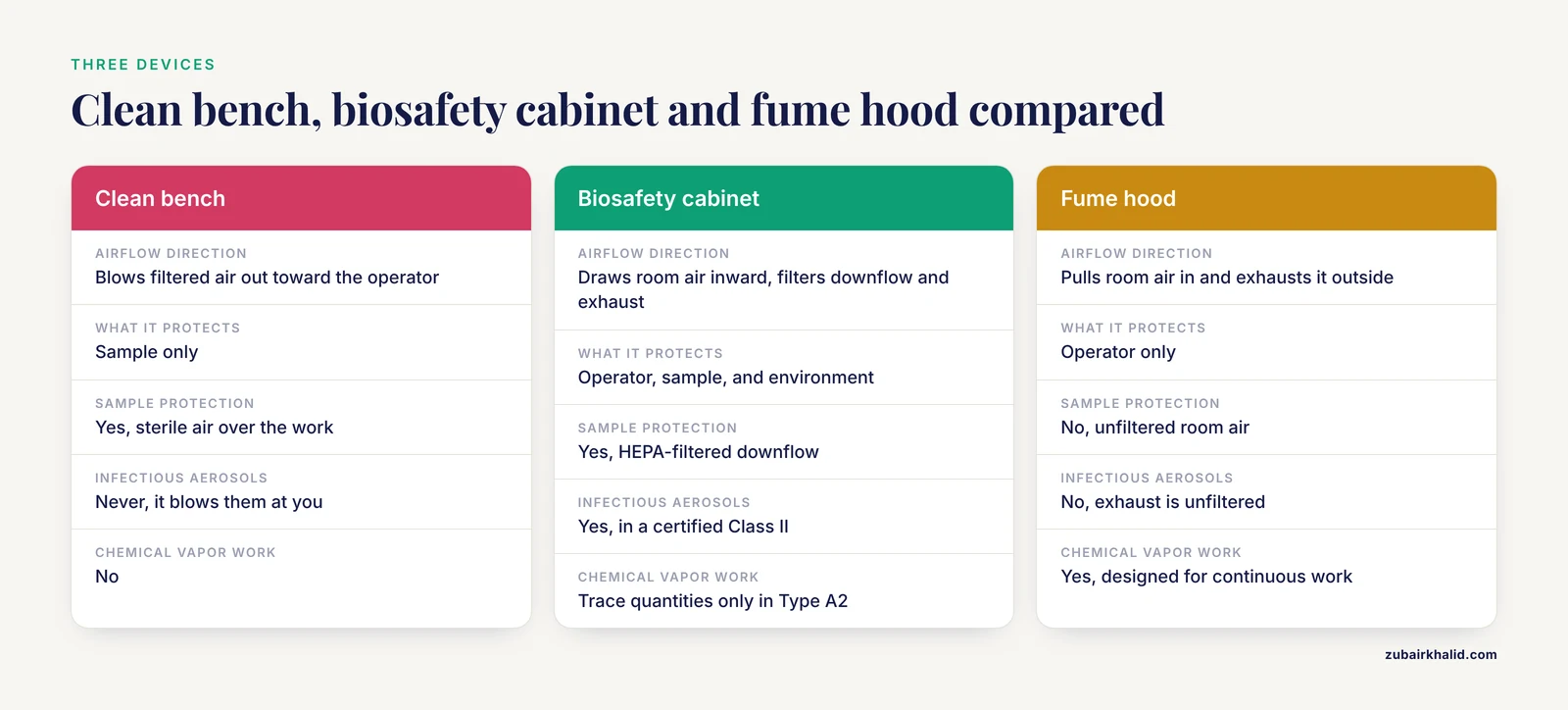
A clean bench pushes HEPA-filtered air across the work surface and out toward the operator, protecting the sample only. A biosafety cabinet pulls air inward, filters the downflow, and HEPA-filters the exhaust, protecting the operator, the sample, and the environment. Never use a clean bench for infectious material.
How often does a biosafety cabinet need to be certified?
At least once every year, and again after any relocation, filter change, or repair. Certification is a field test of the installed cabinet against performance standards, and it is the only verification that the cabinet in your room actually contains what it claims to contain.
Is the UV lamp inside a biosafety cabinet enough for decontamination?
No. Liquid surface disinfection is the primary method, because UV-C cannot reach shadowed surfaces and its output fades with age and lamp fouling. The lamp is a reasonable adjunct for some workflows, not a replacement for wiping down.
How do I decide between a biosafety cabinet or fume hood for a new protocol?
Run a biosafety risk assessment first. If any step can aerosolize infectious material or needs the sample to stay sterile, use a biosafety cabinet. If the hazard is chemical vapor or dust, use a fume hood. Protocols with both hazards get split across both devices, and the decision gets documented.
Sources
- Microbiological safety cabinets: selection, installation, testing and use.
- Selection and application of biological safety cabinets in diagnostic and research laboratories with special emphasis on COVID-19.
- Laboratory Safety: Handling Burkholderia pseudomallei Isolates without a Biosafety Cabinet.
- The Biosafety Research Road Map: The Search for Evidence to Support Practices in the Laboratory-Zoonotic Avian Influenza and Mycobacterium tuberculosis.
- Biosafety Level 2 cabinet UV-C light exposure of sports antidoping human urine samples does not affect the stability of selected prohibited substances.