Biosafety Cabinet Airflow Patterns
By Dr. Zubair Khalid, DVM, MS, PhD ·
A biosafety cabinet airflow pattern is the deliberate, engineered movement of air inside and around a biological safety cabinet that simultaneously draws room air away from the operator, bathes the work surface in filtered air, and strips contaminated air away from the laboratory. When the pattern is intact, HEPA-filtered air cascades down over the work area while unfiltered room air is pulled through the front opening, so that aerosols generated inside the cabinet never reach the operator and airborne contaminants never reach the work.
Why does this matter so much in a diagnostic or research microbiology laboratory? Because the cabinet is not a sealed box. It is a machine that manipulates moving air, and every protection claim it makes depends on that air moving in the right direction, at the right velocity, through the right filters. A cabinet whose airflow pattern is disturbed can look perfectly normal to an untrained eye while silently exposing the operator to aerosols, cross-contaminating cultures, or venting unfiltered air into the room. Confusion about cabinet types, installation, and correct use was widespread enough among microbiologists and laboratory managers in the late twentieth century that dedicated reviews were written to clarify which cabinets protect what, and how they should be tested and used [1]. Understanding airflow patterns is the practical core of that understanding, and it is a foundation of every credible microbiology biosafety training program.
What Does Biosafety Cabinet Airflow Pattern Mean
The phrase answers a simple question. Where is the air going, and why? In a biological safety cabinet, air moves along defined pathways. Filtered air falls downward inside the cabinet (the downflow). Room air is drawn into the cabinet through the open front window (the inflow). Some of that air passes under the work surface through front and rear grilles, some is drawn through the front sash opening, and all of it eventually passes through a HEPA (high-efficiency particulate air) filter before it is either recirculated inside the cabinet or exhausted from the building. The specific combination and proportion of these movements define the cabinet class and type.
A biosafety cabinet airflow pattern explained in one sentence: clean air moves down over the work, dirty air moves away from the operator, and everything is filtered before it leaves. Any practice that interrupts those three movements, whether it is sweeping an arm across the front opening, placing a centrifuge on the work surface, or leaving the sash at the wrong height, degrades one or more of the protections the cabinet was purchased to provide.
This is also why airflow patterns matter for a biosafety risk assessment. The risk assessment for any procedure with an infectious agent should ask whether the engineering controls in place actually contain the aerosols that procedure will generate. For respiratory pathogens such as SARS-CoV-2, the World Health Organization has emphasized the use of validated biological safety cabinets, and guidance on selecting the appropriate cabinet class rests directly on understanding how each class moves air [2]. Evidence-based assessment is not always straightforward. A systematic review of biosafety evidence for avian influenza virus and Mycobacterium tuberculosis found that guidance on which procedures with M. tuberculosis require a biosafety cabinet needs clarification, and that definitive data on how much aerosol diagnostic manipulations actually generate are lacking [3]. When the evidence base is incomplete, the airflow performance of the cabinet you have is one of the few things you can verify directly, which makes interpreting the pattern a bench-level skill rather than an abstract concept.
The Three Protection Goals
Every statement about airflow patterns traces back to three protection goals. Learning to name them makes airflow pattern interpretation far easier.
Personnel protection keeps aerosols generated inside the cabinet away from the person standing in front of it. This depends almost entirely on the inflow of room air through the front opening. If the inflow velocity is adequate, particles generated inside the cabinet are pulled back into the cabinet and through the filters rather than drifting out toward the operator's face.
Product protection keeps the cultures, cell lines, and specimens on the work surface free from room air contamination. This depends on the downflow. HEPA-filtered air descending over the work area dilutes and sweeps away any contaminants that might enter, provided the operator works deep inside the cabinet and does not break the downward air curtain.
Environmental protection keeps the agent out of the laboratory and, eventually, out of the community. This depends on the exhaust path. In a Class II Type A2 cabinet, exhaust passes through a HEPA filter and may be recirculated to the room or ducted outside. In hard-ducted cabinets (Types B1 and B2), all exhaust is carried outside the building.
These three goals exist in tension with each other. Increasing downflow velocity can improve product protection but, if it is too high, it creates turbulence at the front opening that pulls contaminated air outward and destroys personnel protection. Decreasing inflow to make the downflow more laminar does the opposite. The engineering compromise between these competing demands is what certification testing measures, and it is why a cabinet cannot simply be "turned up" for better performance [1].
How Air Moves Through a Class II Cabinet, Step by Step
The Class II cabinet is the workhorse of clinical microbiology, so the following walkthrough uses it as the reference design.
- Room air enters through the front opening. The operator's hands and arms pass through the open front window. Air from the room is drawn through this opening with a defined inward velocity, typically measured in feet per minute at the certified value for the model, and this inflow forms the primary barrier between the operator and the work.
- Inflow air splits at the front grille. Part of the air entering the opening is pulled immediately down through the front grille into the plenum beneath the work surface. This fraction sweeps away anything that might have spilled or splashed near the front edge.
- Air also enters through the rear grille and recirculates. Room air drawn through the sash opening joins the cabinet's internal circulation. All of this air is drawn up through the rear plenum toward the top of the cabinet.
- The blower drives air through the supply HEPA filter. The filtered air is distributed across the full width of the cabinet through a diffuser at the top, creating the uniform downward curtain of clean air that defines the downflow. This air is laminar in character, meaning it moves in parallel streams rather than tumbling, so particles on the work surface are swept toward the rear grilles instead of being stirred up.
- Roughly two thirds of the downflow air recirculates. In the common Class II Type A2 design, most of the air passing through the work zone re-enters the internal circulation loop. This is why the cabinet protects the product continuously even though only a fraction of its air volume is exhausted at any moment.
- The remaining air is exhausted through the exhaust HEPA filter. The balance of the air, which approximately equals the inflow entering through the front opening, is pushed through the exhaust HEPA filter. From there it either re-enters the room (canopy or thimble connection, or total recirculation) or is hard-ducted to the outside.
- The pattern repeats continuously. The cabinet is not a device that is turned on when work begins and off afterward. The air curtain and the filtration loop only protect when they are running, which is the reason UV lamps are often used in conjunction with cabinet downtime and why one study of UV-C exposure inside a Class II cabinet deliberately used a 15-minute exposure window to assess whether such treatment could inactivate nucleic acid contaminants in urine samples without damaging downstream analytical chemistry [4].
The same logic extends to other classes. A Class I cabinet has no downflow at all. It protects the operator by drawing a large inflow of room air across the open front, through the work zone, and out through an exhaust HEPA filter. It offers no product protection because room air passes directly over the work. A Class III cabinet is a completely sealed, gas-tight enclosure in which the operator works through attached gloves, and supply air is HEPA filtered while exhaust passes through two HEPA filters in series. Class III cabinets are reserved for the highest containment work, and the airflow pattern question almost disappears there because the operator never shares an air boundary with the agent.
Cabinet Classes and Types Compared
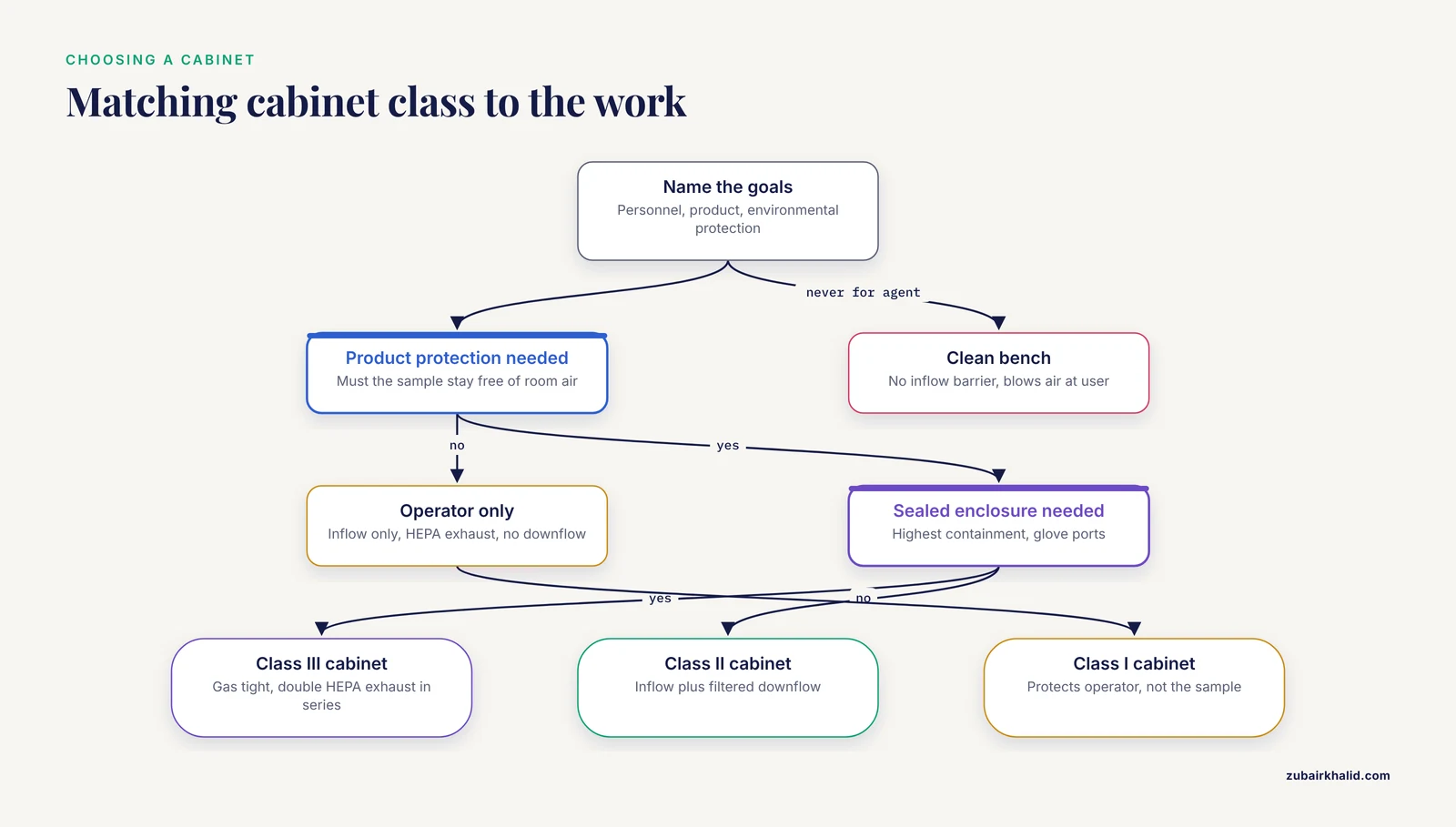
The table below contrasts the airflow patterns and protection profiles of the cabinet types a diagnostic laboratory is most likely to encounter, along with the term each is most often confused with.
| Cabinet type | Airflow pattern essentials | Personnel protection | Product protection | Common confusion |
|---|---|---|---|---|
| Class I | Inflow only through open front, HEPA exhaust, no downflow | Yes | No | Confused with Class II because both have open fronts |
| Class II Type A2 | Inflow through front sash, laminar downflow, about 70 percent recirculated, HEPA exhaust that may recirculate to room or be ducted out | Yes | Yes | Confused with a laminar flow clean bench, which blows filtered air at the operator and protects nothing |
| Class II Type B1 | Inflow plus downflow, most air exhausted once through dedicated ducting, recirculated portion is 30 percent or less | Yes | Yes | Confused with Type A2 because both look identical from outside |
| Class II Type B2 | Total exhaust, 100 percent of air ducted outside, no recirculation | Yes | Yes | Confused with other Class II types, often assumed to be the "best" when chemical work requires it but otherwise inefficient |
| Class III | Sealed glove box, HEPA supply, double HEPA exhaust in series | Highest | Yes | Confused with glove boxes used for inert chemistry, which have no biosafety filtration |
| Laminar flow clean bench | Filtered air blown horizontally or vertically toward the operator, no inflow barrier, no exhaust containment | No | Yes (only) | The single most dangerous confusion in the laboratory, because it looks like a cabinet and blows agent at the user's face |
Selection guidance published for COVID-19 diagnostic laboratories emphasized exactly these distinctions, noting that many laboratory staff trained during the pandemic had limited detailed knowledge of cabinet functions and that selecting the wrong type for the procedure is a recurring problem [2]. Earlier reviews reached the same conclusion for general microbiology, where confusion among cabinet types led to inappropriate purchases, poor installation, and inconsistent testing [1].
Reading the Airflow: What You Can See and Measure
Airflow pattern interpretation starts with the instruments and ends with trained eyes. Both matter.
Instrumented measurements
Certification field technicians measure two principal velocities. The inflow velocity is measured at the front opening, and it determines personnel protection. The downflow velocity is measured at a grid of points in the horizontal plane inside the cabinet, and it determines product protection and sweep-out of contaminants. Certification also includes leak testing of the HEPA filters, particle counts within the work zone, and aerosol challenge tests that verify the cabinet actually contains what it should contain.
For Class II Type A2 cabinets, NSF/ANSI Standard 49 is the reference standard for deriving cabinet airflow velocities, assessing particle contamination, and characterizing aerodynamic flow properties [5]. The standard matters because it turns an abstract pattern into pass or fail numbers on a certification report.
Visual observation
Instrumentation tells you whether the cabinet passes. Visual observation tells you whether the pattern is behaving on a given day, with a given operator, at a given work height. Technicians use smoke pencils or smoke tubes during certification to trace the air curtain at the front opening and confirm that smoke released inside the cabinet sweeps rearward and downward rather than spilling out toward the operator's face. During routine work, experienced staff learn to read indirect signs. A Kimwipe placed inside the cabinet that flutters outward toward the front edge is a warning. Condensation or drifting particles on the work surface suggest dead zones in the downflow.
What research on flow structure shows
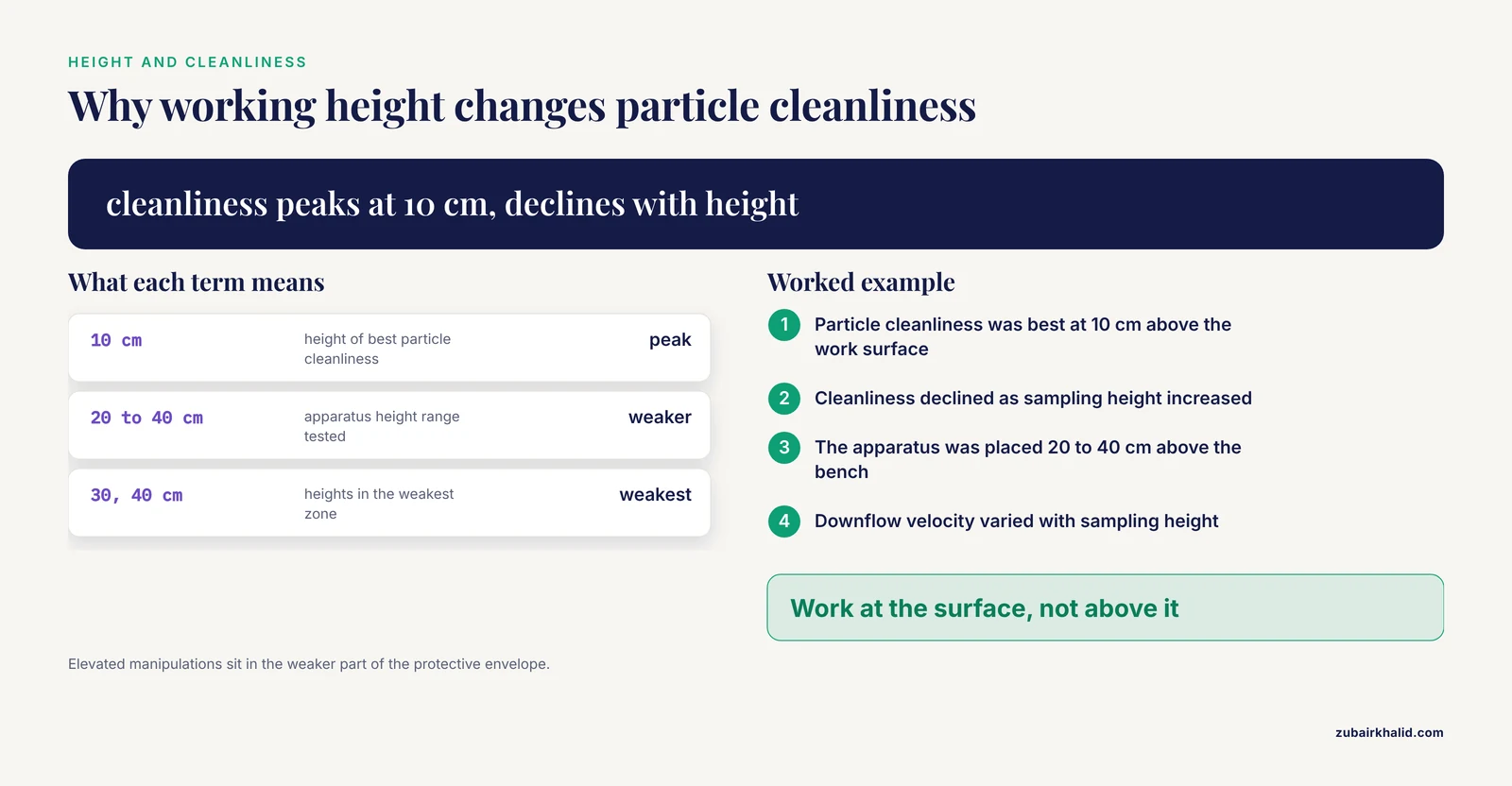
The internal flow is not uniform from top to bottom. A validation study of Class II Type A2 cabinets used particle image velocimetry, a laser-based technique that maps fluid motion, together with particle concentration measurements at different heights above the work surface [5]. The researchers compared three downflow air quantities while an operating apparatus was placed between 20 and 40 cm above the cabinet bench. Downflow velocity varied as a function of sampling height, and containment behaved differently depending on where in the cabinet the measurement was taken. Particle cleanliness was best near the bench, peaking at 10 cm above the work surface and declining with increasing height [5]. The practical lesson for bench microbiologists is that the air nearest the work surface, where your cultures actually sit, is the best-protected air in the cabinet, and that anything elevated above the work surface sits in a weaker part of the pattern.
Interpreting the Pattern During Routine Work
A correct biosafety cabinet airflow pattern looks like this in practice.
- The sash is at its certified working height. Raising it increases the open area, which drops the inflow velocity and weakens personnel protection.
- Work is performed at least several inches inside the front grille. Materials handled at the very front edge sit in the turbulent mixing zone where inflow and downflow collide, and the front zone is where cross-contamination risk is highest.
- The work surface is organized with a clean-to-dirty progression. Clean supplies on one side, the active manipulation in the middle, contaminated waste collection on the other side, so that filtered air sweeping rearward carries contamination away from clean materials rather than across them.
- Arms and hands move slowly and flat, entering and exiting straight back and forward. Fast or sweeping arm motions drag room air into the work zone on the in-stroke and drag contaminated air out toward the operator on the out-stroke.
- Nothing blocks the front or rear grilles. The grilles are the return path for the entire airflow loop. A pipette carton laid over the front grille starves the return airflow and pushes the internal balance out of specification.
- Equipment that generates air movement, such as a small centrifuge or a vacuum system, is understood as a disturbance. If it must be inside the cabinet, it is placed at the rear, and the operator accepts that the downflow around it is compromised.
A pattern that is failing looks like this. Smoke or tissue paper at the front opening drifts outward. Materials placed deep in the cabinet produce splashes that drift toward the front. Cultures inoculated near the front edge show contamination at rates that background plates do not explain. The certification alarm, on models that have one, sounds with the sash at the working height the operator prefers rather than the height the certifier tested.
Cross-contamination between samples is the classic downstream sign of a disturbed pattern. The validation work on A2 cabinets was designed precisely to quantify cross-contamination control, and it demonstrated that particle concentration gradients within the cabinet depend on both the downflow air quantity and the height of the obstruction, meaning that an oversized or poorly placed item inside the cabinet creates a measurable contamination shadow that can extend over neighboring samples [5].
What Breaks the Pattern
Airflow patterns fail in predictable ways. Each failure mode has a specific remedy, and recognizing them is a core competency in microbiology biosafety training.
Room air disturbances. Laboratory doors opening nearby, HVAC supply drafts, and even a colleague walking past the front of the cabinet create pressure pulses that push the air curtain outward. The remedy is siting and discipline. Cabinets belong away from doors, supply diffusers, and high-traffic lanes, and only one person works at the cabinet at a time.
Obstructions on the work surface. Every object in the cabinet deflects the downflow downstream of it. Large items, stacked plates, and equipment with vertical profiles create turbulent wakes where particles can accumulate and where aerosols generated during manipulation can linger instead of being swept to the grilles.
Elevated work. The particle gradient work showing best cleanliness at 10 cm above the bench, with degradation at greater heights, directly explains why holding a specimen or an inoculating tool high in the cabinet during manipulation is riskier than working at the surface [5]. Procedures performed at 30 or 40 cm, the very heights tested in that study, fall into the weakest part of the protective envelope.
Filter loading and blower drift. As supply HEPA filters load with particles over months of use, resistance rises and the downflow velocity profile shifts. The cabinet does not announce this. Certification on a scheduled interval is the only detection method.
Wrong sash height. Many modern cabinets have audible and visual alarms tied to sash position because the inflow velocity depends on the size of the opening. Working with the sash above the certified mark is one of the most common real-world violations.
Confusing the cabinet with a clean bench. A laminar flow clean bench delivers a stream of HEPA-filtered air directly at the operator and has no containment at all. Using one for infectious work means the airflow pattern is actively assisting every aerosol toward the operator's face. Reviews addressing cabinet selection during the COVID-19 response devoted explicit attention to this distinction because misidentification of clean benches as biosafety cabinets was a documented source of queries from newly trained staff [2].
Testing and Certification: How the Pattern Is Verified
Certification is the formal demonstration that the airflow pattern and all associated protections meet the standard. Reviews clarifying cabinet practice emphasized that testing at defined intervals, correct installation, and matching the cabinet type to the work are the three pillars of safe use [1]. The typical field certification includes several distinct tests.
HEPA filter leak testing. The certifier introduces a challenge aerosol upstream of the filter and scans the downstream face with a photometer or particle counter. Any penetration above threshold means the filter or its gasket seal leaks.
Downflow velocity and uniformity. Readings are taken across a defined grid in the work zone. Both the average and the spread matter. A downflow that averages to specification but swings wildly across the grid indicates turbulence that certification velocity numbers alone can hide.
Inflow velocity measurement. Depending on the model, this is measured directly at the sash opening or derived from the exhaust volume and opening area.
Airflow smoke patterns. Smoke is released at defined positions along the sash and work surface to verify that the visual pattern conforms to the expected lines of flow, with no spillage outward and no dead zones.
Personnel, product, and cross-contamination challenge tests. These are the tests that directly probe the airflow pattern with aerosols. Historically, this required generating a reproducible aerosol challenge, and the choice of nebulizer turned out to be critical. A study comparing nebulizer types for Class II cabinet certification found that common plastic and glass refluxing nebulizers gave inconsistent, unreproducible results, while the Collison 6-jet nebulizer produced little variation and held a constant spray volume even as the fluid level in its reservoir changed [6]. The same study optimized the geometry, finding that for the personnel protection test a Collison nebulizer with a 14 mm outlet diameter aimed so that the main aerosol stream struck the intersection of the test cylinder and the front opening gave the most reliable challenge, and that nebulizers with 12 to 16 mm outlets placed at the level of the lower edge of the front window delivered aerosols to the test point far more efficiently than when positioned 14 inches above the work surface [6]. For the product protection test, the 14 mm outlet again gave the best distribution around the test cylinder [6]. The takeaway for anyone reading a certification protocol is that the aerosol challenge itself is an engineered instrument, not a generic sprayer, and that the reproducibility of the entire containment test rests on the aerosol generator behaving identically every time.
Physical tests for sash integrity and structural leak testing complete the sequence on Class II and Class III units.
Certification frequency is commonly set at installation, after relocation or filter change, and at defined annual or more frequent intervals, following the manufacturer's requirements and institutional policy. The point worth retaining is that certification verifies a snapshot. The airflow pattern you rely on tomorrow is guaranteed by nothing except the pattern you observed and maintained since the last certification.
Airflow Patterns in the Context of Biosafety Risk Assessment
A biosafety risk assessment asks what could go wrong, how likely it is, and what controls reduce the risk. The airflow pattern of the cabinet is one of the engineering controls that the assessment either relies on or discovers to be absent.
The Burkholderia pseudomallei work illustrates how this plays out. B. pseudomallei is a tier 1 select agent associated with laboratory-acquired melioidosis, and international guidelines recommend handling isolates in a Class II biosafety cabinet within a biosafety level 3 facility. In settings where that is not practical, researchers assessed the actual risk of handling B. pseudomallei outside a cabinet. Thirty laboratory scientists handled the organism on 1,267 occasions without a cabinet, no infections were documented, and all participants remained seronegative. Controlled environmental air sampling during 78 handling events, including plate opening, oxidase testing, and preparation of McFarland suspensions, detected no aerosolization of the organism [7]. The authors were explicit that this does not abolish the recommendation. Instead, each laboratory must perform its own risk assessment weighing endemicity, available containment resources, the nature of the routine handling, and predisposing risk factors among staff, along with region-specific guidance [7]. For our purposes, the study demonstrates the correct logic. The default control is the cabinet with its intact airflow pattern, and any departure from that default is a deliberate, documented, risk-assessed decision, not an oversight.
The systematic review of biosafety evidence for avian influenza and M. tuberculosis pushed the same point in a different direction. It identified a significant evidence gap in definitive data on M. tuberculosis sample aerosolization to guide the selection of engineering controls, and found that existing guidance on which procedures with this organism require a biosafety cabinet needs clarification [3]. This means that for some of the most important respiratory pathogens a diagnostic laboratory handles, the risk assessment cannot lean on a complete evidence base. Prudent practice therefore errs toward containment, verifies that the containment actually works through certification and observation, and treats the airflow pattern as the tangible, testable surrogate for all the aerosol data that do not yet exist.
Selection guidance developed during the COVID-19 pandemic makes the same argument from the procurement side. Because WHO emphasized validated cabinets, and because laboratories stood up quickly, the authors documented that detailed information on cabinet selection and application was scanty among staff, and that matching cabinet type to risk assessment was a recurring stumbling block [2]. The airflow pattern is the property that determines whether a given class matches a given procedure, so the risk assessment and the airflow understanding are the same conversation.
Common Mistakes and Limitations
These are the errors seen most often on the bench, in training sessions, and during certification follow-ups.
- Working at the front edge. The front strip of the work surface is the turbulent meeting point of inflow and downflow. Manipulations performed there have the weakest product protection and the highest cross-contamination risk. Work deep in the cabinet, and if you cannot reach, move the rack rather than your technique.
- Treating the cabinet as storage. Reagents, plate stacks, and pipette boxes left inside between sessions obstruct the downflow and create contamination shadows. The work surface should be empty when the cabinet is not actively in use.
- Rapid arm movement. Pulling an arm straight out at speed creates a wake that carries cabinet air out through the sash. This is the single most reproducible way for one operator to defeat personnel protection without any equipment failure.
- Ignoring the alarm or bypassing the sash stop. The certified sash height is not a suggestion. It is the geometry at which the inflow velocity was measured and passed.
- Assuming certification lasts all year. Certification is a snapshot. Filter loading, blower wear, and room air changes all drift. Scheduled recertification plus daily visual checks are what keep the pattern honest between visits.
- Using a clean bench for infectious work. This bears repeating because the consequences are severe. The clean bench airflow pattern is designed for product protection only and directs filtered air straight at the user.
- Blocking grilles with equipment or tape. The front and rear grilles are the return air path. Blocking them changes the entire internal balance.
- Overreliance on UV. Ultraviolet lamps inside a cabinet are a supplementary decontamination tool, not a containment mechanism, and they have no effect on the airflow pattern. Their usefulness for specific applications, such as the UV-C treatment of urine samples studied for nucleic acid inactivation without compromising analytical chemistry, is a separate question from the cabinet's protective airflow [4].
- Assuming the highest class is always the answer. A Class III cabinet is unnecessary and impractical for routine bacteriology, while a Class I cabinet is inadequate for anything needing product protection. The choice comes from the risk assessment, not from maximal engineering.
As for limitations, the evidence base itself has gaps. As the systematic review on respiratory pathogens makes clear, definitive aerosolization data for some high-consequence agents remain absent, and guidance documents do not always agree on which procedures require cabinet containment [3]. Individual procedure decisions still require qualified biosafety professionals and institutional risk assessment, and this article is a teaching reference rather than a substitute for those assessments.
Microbiology Biosafety Training: Teaching the Airflow Pattern
Programs that teach microbiology biosafety training effectively share a few habits worth copying.
- Start with the air, not the box. Trainees who first learn that a cabinet is a machine for shaping airflow, and only then learn the classes, interpret everything afterward correctly. Trainees who memorize class names first tend to treat the cabinet as a magic box.
- Use smoke or a visual tracer during onboarding. Watching smoke roll rearward from the front opening teaches more in thirty seconds than an hour of slides. Certifiers do this during every annual visit, and trainees should watch.
- Demonstrate the failure modes deliberately. Have a trainer sweep an arm across the opening while a smoke pencil traces the curtain at the sash. The distortion is immediate and unforgettable.
- Connect the pattern to the risk assessment. Every procedure list in a laboratory's biosafety manual should reference which cabinet class each manipulation requires and why, in terms of the aerosols the manipulation generates. The COVID-19 selection guidance noted that staff questions clustered exactly at this junction between procedure and cabinet function [2].
- Drill the physical habits. Slow flat arm movements, deep working position, clean-to-dirty layout, unblocked grilles, correct sash height. These five behaviors are the operational expression of the airflow pattern and belong in every new worker's competency sign-off.
Quick Review
- A biosafety cabinet airflow pattern is the engineered movement of air providing personnel, product, and environmental protection simultaneously.
- Inflow through the front opening protects the operator. Downflow over the work surface protects the product. HEPA exhaust protects the environment.
- Class I has inflow only and no product protection. Class II has inflow plus filtered downflow. Class III is sealed with glove ports.
- A laminar flow clean bench is not a biosafety cabinet and blows filtered air at the operator.
- Containment is strongest near the work surface. Particle cleanliness was best at 10 cm above the bench and declined with height in validation studies [5].
- Certification verifies inflow velocity, downflow velocity and uniformity, HEPA integrity, and containment using standardized aerosol challenges, for which the Collison 6-jet nebulizer with a 14 mm outlet was the optimized generator [6].
- Slow arm movements, deep working position, unblocked grilles, correct sash height, and an empty work surface between sessions keep the pattern intact between certifications.
- Departures from cabinet use for any procedure are risk-assessed decisions, as the B. pseudomallei field study demonstrated [7], and for some pathogens the aerosol evidence base behind those assessments remains incomplete [3].
Frequently Asked Questions
What does biosafety cabinet airflow pattern mean?
It means the defined movement of air through and around the cabinet, with filtered air falling over the work surface, room air being drawn in through the front opening, and all air passing through HEPA filtration before exhaust. Those three movements deliver operator, product, and environmental protection respectively, and each one can be measured and tested.
How is a biosafety cabinet airflow pattern interpreted during certification?
The certifier measures inflow velocity at the sash and downflow velocity across a grid in the work zone, then releases smoke and test aerosols to confirm that flow lines conform to the design and that contamination stays contained. For Class II Type A2 cabinets the criteria come from NSF/ANSI Standard 49, which governs velocity derivation, particle contamination, and aerodynamic flow properties [5].
Why is airflow pattern different in each cabinet class?
Because each class balances the three protection goals differently. Class I draws air across an open work zone and filters only the exhaust, so it protects the operator but not the sample. Class II adds a filtered downflow curtain so both operator and sample are protected. Class III removes the shared air boundary entirely with a sealed enclosure and glove ports.
Can working habits really disrupt the cabinet airflow pattern?
Yes, and they are the most common cause of failed containment in an otherwise certified cabinet. Fast arm movements drag contaminated air outward, objects placed over the grilles starve the return flow, an elevated sash reduces inflow velocity, and large equipment on the work surface creates turbulence and contamination shadows downstream of it.
How often should a biosafety cabinet be certified?
At installation, after any relocation or filter change, and on a regular schedule thereafter, most commonly annually, following the manufacturer's requirements and institutional policy. Certification is a snapshot, so daily visual and behavioral checks by trained staff fill the gap between visits.
Do I need a biosafety cabinet for every procedure with an infectious agent?
That decision comes from a laboratory-specific biosafety risk assessment that considers the agent, the aerosols the procedure generates, the available containment, and staff risk factors. International guidelines generally recommend cabinet handling for high-consequence agents, but field research on B. pseudomallei showed that controlled departures can be justified by documented risk assessment when endemicity, resources, and procedure type support it [7], and reviews of respiratory pathogens note that the evidence base for some procedures still needs clarification [3].
Sources
- Microbiological safety cabinets: selection, installation, testing and use.
- Selection and application of biological safety cabinets in diagnostic and research laboratories with special emphasis on COVID-19.
- The Biosafety Research Road Map: The Search for Evidence to Support Practices in the Laboratory-Zoonotic Avian Influenza and Mycobacterium tuberculosis.
- Biosafety Level 2 cabinet UV-C light exposure of sports antidoping human urine samples does not affect the stability of selected prohibited substances.
- Validation of cross-contamination control in biological safety cabinet for biotech/pharmaceutical manufacturing process.
- Collison 6-jet nebulizer: choice for the certification test of the class II biological safety cabinet.
- Laboratory Safety: Handling Burkholderia pseudomallei Isolates without a Biosafety Cabinet.