Biosafety Cabinet Selection for Risk Assessment
By Dr. Zubair Khalid, DVM, MS, PhD ·
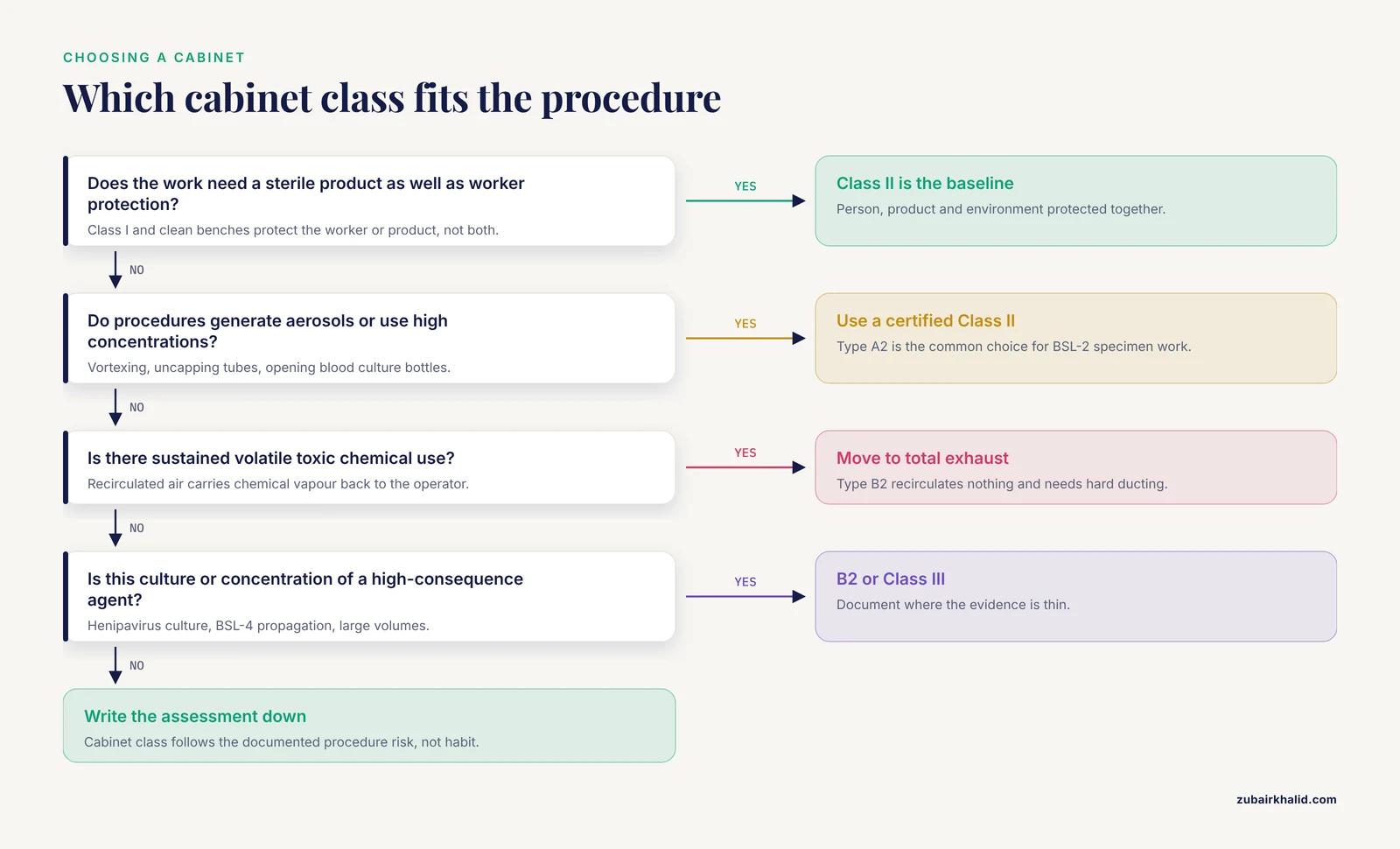
A biosafety cabinet is a ventilated, HEPA-filtered enclosure that protects the worker, the specimen, the environment, or some combination of the three, and the cabinet class your laboratory needs is determined by the highest-risk procedure you will actually perform inside it, not by the most dangerous agent listed in your specimen manual. The working rule of thumb is simple. For routine work with human or animal specimens and Risk Group 2 agents, a certified Class II cabinet is the default. For concentrated culture work with agents that transmit through the air, move toward total-exhaust Class II designs or Class III containment, and justify every step up or down with a documented biosafety risk assessment rather than habit.
This article walks through the risk assessment logic first, then the cabinet classes, then the practical criteria that decide a real purchase, with worked scenarios drawn from clinical microbiology.
Why Biosafety Risk Assessment Comes Before the Cabinet
A biosafety risk assessment is the structured process of identifying what can harm a worker, estimating how likely that harm is during a specific activity, and selecting controls that reduce the residual risk to an acceptable level. In the modern framework, controls include engineering measures such as the biosafety cabinet itself, administrative measures such as standard operating procedures, and practices such as personal protective equipment. The cabinet is one output of the assessment. It is not a substitute for doing the assessment.
Two developments in laboratory biosafety have reshaped how that assessment should be done.
First, the World Health Organization's Laboratory Biosafety Manual, fourth edition, moved the field away from fixed, one-to-one correspondence between an agent's risk group and a laboratory's biosafety level. Instead, it requires risk assessments tailored to the specific pathogen, the specific activity, and the specific operational setting, supported by evidence [1]. A team reviewing the evidence for Hendra and Nipah viruses, two highly pathogenic zoonotic henipaviruses, found that adequacy of the biosafety evidence behind risk-based containment decisions varies across pathogens and settings, which means laboratories must document their own reasoning rather than assume a published number settles the question [1].
Second, researchers have increasingly recognized that the procedure, not the taxonomy of the organism, drives exposure. A recent framework called Procedure-Specific Risk (PSR) presents an 8-step operational protocol in which the exposure generated by the procedure is the primary determinant of containment, integrating agent risk group classification, procedural exposure characterization, and modulating factor evaluation into a biosafety level assignment matrix [2]. The framework was built from a structured comparative analysis of ten national and international reference documents, including the WHO Laboratory Biosafety Manual fourth edition, the CDC-NIH publication Biosafety in Microbiological and Biomedical Laboratories (BMBL) sixth edition, and the CDC Biological Risk Assessment guidance from 2024, and it is supported by a structured template and a freely accessible digital tool [2].
The practical consequence for cabinet selection is direct. Two laboratories handling the same organism may need different cabinets if their procedures differ in aerosol generation, volume, concentration, and manipulation. This is not theoretical. Occupational exposure to airborne bacterial and fungal bioaerosols is measurable and quantifiable in real work environments, and hazard-based metrics such as the hazard quotient and hazard index are used to estimate non-carcinogenic inhalation risk from such exposures [3]. Inside a laboratory, the biosafety cabinet is the engineering control that interrupts the same exposure pathway at the source.
How a Biosafety Cabinet Actually Protects You
Three terms define everything that follows.
- HEPA filter: a high-efficiency particulate air filter that removes at least 99.97 percent of particles 0.3 micrometers in diameter, which captures bacteria, fungi, and, by aggregation, most virus-bearing droplets and droplet nuclei.
- Aerosol: particles small enough to remain suspended in air and be inhaled. Uncapping a centrifuge tube, snapping a swab shaft, vortexing, flaming a loop, and popping a microcapillary tube all generate aerosols.
- Inward airflow: air moving from the room into the cabinet front opening, which keeps contaminants from escaping toward the operator.
The World Health Organization has emphasized the use of validated biosafety cabinets to protect the person, the product, and the environment, and cabinet validation is part of quality assurance for diagnostic results [4]. Every class of cabinet delivers a different subset of those three protections, which is precisely why the class must come from the risk assessment rather than from a catalog photo.
One limitation applies across all classes. A biosafety cabinet is an aerosol control. It is not a chemical fume hood, and the amount of volatile, toxic chemistry a cabinet tolerates depends on how its air is handled, a distinction covered class by class below.
The Cabinet Classes Explained
Class I: personnel and environmental protection only
A Class I cabinet is an open-front, negative-pressure enclosure. Room air is drawn across the work surface at the front opening, passes over the material being handled, and exits through a HEPA filter to the room or, preferably, to ductwork leading outdoors. The operator is protected because air only moves inward. The environment is protected because exhaust is filtered. The product is not protected because unfiltered room air blows directly across the work.
Class I cabinets are the simplest of the three classes and find their niche for work that generates aerosols but does not require a sterile product, such as homogenizing environmental samples, grinding tissue for non-sterile downstream assays, or housing equipment such as plate shakers or centrifuges that need containment but not cleanliness.
Class II: the workhorse of clinical and research microbiology
A Class II cabinet protects the person, the product, and the environment simultaneously. Downflow air drawn through the cabinet's own HEPA filter creates a curtain of clean, laminar air over the work surface, while a separate inward flow at the front opening captures aerosols before they reach the operator. Mixed air is either recirculated through additional HEPA filtration or exhausted, depending on the type.
Class II cabinets are subdivided into types, and the type differences matter for facility planning and for any work involving chemicals.
- Class II Type A2 recirculates most of the cabinet air through HEPA filtration back into the work zone and exhausts a minority of the air, typically through a canopy connection to the building exhaust or even back into the room. Type A2 cabinets are the most common cabinet in clinical microbiology laboratories. They tolerate small amounts of hazardous chemistry, such as brief use of fixatives, but are not designed for sustained work with volatile toxic chemicals.
- Class II Type B1 exhausts most of its air to the outside and recirculates less, which lowers the chemical load inside the work zone and permits limited use of trace amounts of toxic or odorous chemicals.
- Class II Type B2, the total-exhaust design, recirculates nothing. Every cubic foot of air passes out of the cabinet and out of the building. This makes B2 cabinets the correct choice when procedures involve substantial volatile chemical use alongside infectious material, and it is also the design many institutions standardize on when a procedure-based risk assessment calls for eliminating recirculated air entirely.
All Class II types deliver the same nominal personnel, product, and environmental protection against particulate hazards. The type selection is driven by chemistry, facility ducting, and institutional policy layered on top of the microbiological risk assessment.
During the COVID-19 pandemic, when diagnostic laboratories were scaled up rapidly, authors reviewing biosafety cabinet selection noted that knowledge about the detailed selection and application of appropriate cabinet types was scanty among newly trained staff, even though the underlying principle remained that biosafety levels and cabinet types must be matched through risk assessment of the pathogen and the procedure [4]. That observation holds beyond SARS-CoV-2 and is the strongest argument for writing the assessment down rather than keeping it in someone's head.
Class III: maximum containment
A Class III cabinet, sometimes called a glove box, is a completely sealed, gas-tight enclosure maintained under negative pressure. All work is performed through attached gloves, supply air enters through HEPA filtration, and exhaust air passes through two HEPA filters in series or HEPA filtration plus incineration before release. The operator never has an open front, so the barrier does not depend on airflow velocity at a work access opening.
Class III cabinets serve laboratories performing the highest-risk activities, including propagation of agents handled at biosafety level 4, and specific high-consequence tasks at lower levels where the procedure concentrates or aerosolizes large volumes of agent.
Side-by-Side Comparison of Cabinet Classes
| Criterion | Class I | Class II Type A2 | Class II Type B1 | Class II Type B2 | Class III |
|---|---|---|---|---|---|
| Personnel protection (inward airflow) | Yes | Yes | Yes | Yes | Yes, via sealed enclosure |
| Product protection (HEPA downflow) | No | Yes | Yes | Yes | Yes |
| Environmental protection (filtered exhaust) | Yes | Yes | Yes | Yes | Yes, highest degree |
| Recirculated air | None (air passes once) | Most air recirculated inside cabinet | Minority recirculated | None | None |
| Front opening | Open | Open | Open | Open | Sealed, glove ports only |
| Volatile toxic chemical tolerance | Not designed for it | Trace amounts, brief | Limited, low concentration | Best among Class II | Possible with facility engineering |
| Ducting requirement | Can be ducted or recirculated after HEPA | Optional canopy or room exhaust | Hard-ducted to building exhaust | Hard-ducted to building exhaust | Dedicated exhaust system |
| Typical work | Aerosol-generating non-sterile manipulations, equipment housing | BSL-2 specimen processing, culture inoculation | Procedures needing reduced recirculation | Procedures with volatile chemicals plus infectious agents | BSL-4 level propagation, high-consequence agents |
| Operator technique dependency | High | High | High | High | Low |
The table is the core of biosafety cabinet selection for risk assessment because it separates two decisions that laboratories routinely merge. The first decision, protection profile, is dictated by the risk assessment. The second, type and ducting, is dictated by chemistry and facility infrastructure.
Matching Cabinet Class to Biosafety Level and Procedure
Biosafety levels (BSL) describe the sum of laboratory practices, containment equipment, and facility features applied to a given activity. The usual pairing, drawn from established practice under BMBL and WHO guidance, looks like this:
- BSL-1: well-characterized agents not known to consistently cause disease in healthy adults. Open bench work is acceptable. A biosafety cabinet is generally not required, though it may be used to protect the work from environmental contamination.
- BSL-2: agents of moderate hazard present in the community, handled with any potential for aerosol or splash generation. All manipulations that may create aerosols or involve high concentrations or large volumes are performed in a Class II biosafety cabinet or other physical containment. This is the default level for clinical microbiology specimen processing.
- BSL-3: agents with potential for respiratory transmission that can cause serious and potentially lethal infection. All manipulations are performed within a Class II Type B2 cabinet or Class III enclosure, and laboratory directors must consider additional containment for procedures with high aerosol potential.
- BSL-4: dangerous and exotic agents posing a high individual risk of life-threatening disease. Work is performed in a Class III cabinet or a Class II cabinet within a heavily engineered, pressurized suit laboratory.
The pairing is a starting point, not a verdict. The PSR framework exists precisely because linking risk group directly to biosafety level fails to capture how much exposure varies across procedures, and its 8-step protocol assigns the biosafety level from the exposure generated by the procedure with agent risk group as one input among several modulating factors [2]. Under such a procedure-based assessment, a laboratory might legitimately run an activity normally labeled BSL-3 at reduced containment because the specific steps performed, for example handling inactivated extracts, generate negligible exposure, or escalate containment for an activity normally labeled BSL-2 because a step concentrates the agent. Validation of the framework rests on content validity derived from the analyzed regulatory sources and on convergent validity of the biosafety level assignments it produces [2].
Biosafety Cabinet Selection Risk Assessment Options
There is no single mandated assessment format. Laboratories choose among three broad biosafety cabinet selection risk assessment options, each with distinct pros and cons. The best biosafety cabinet selection and risk assessment practice is to pick one approach, apply it consistently to every new procedure, and document the result where inspectors, certifiers, and new staff can find it.
Option 1: Agent-based assignment
The laboratory assigns containment by the risk group of the agent, following a published table.
Pros. Fast, easy to teach, easy to audit against a reference list. It works reasonably well when procedures are uniform and low exposure, for example streaking plated isolates for identification.
Cons. It ignores the procedure, which is the dominant driver of exposure in modern work involving genetically modified organisms, viral vectors, and multi-step protocols [2]. It also produces false comfort. A low-hazard agent manipulated in high concentration can generate more real exposure than a high-hazard agent handled in a sealed ampoule.
Option 2: Procedure-specific risk framework
The laboratory characterizes the exposure generated by each procedure and assigns containment from a structured matrix. The 8-step PSR protocol is a published example, integrating agent risk group, procedural exposure characterization, and modulating factors, supported by an assessment template and a bilingual digital implementation tool [2].
Pros. Reproducible, transparent, and traceable to the major reference documents including WHO LBM4, BMBL sixth edition, and the CDC Biological Risk Assessment guidance [2]. It handles viral vectors, genetically modified organisms, and multi-step protocols that defeat agent-based tables. It justifies both escalation and de-escalation with a written record.
Cons. It takes more effort per procedure. Staff need training to score exposure consistently, and small laboratories may find the full apparatus heavy unless they adopt the provided template.
Option 3: Semi-quantitative risk matrix
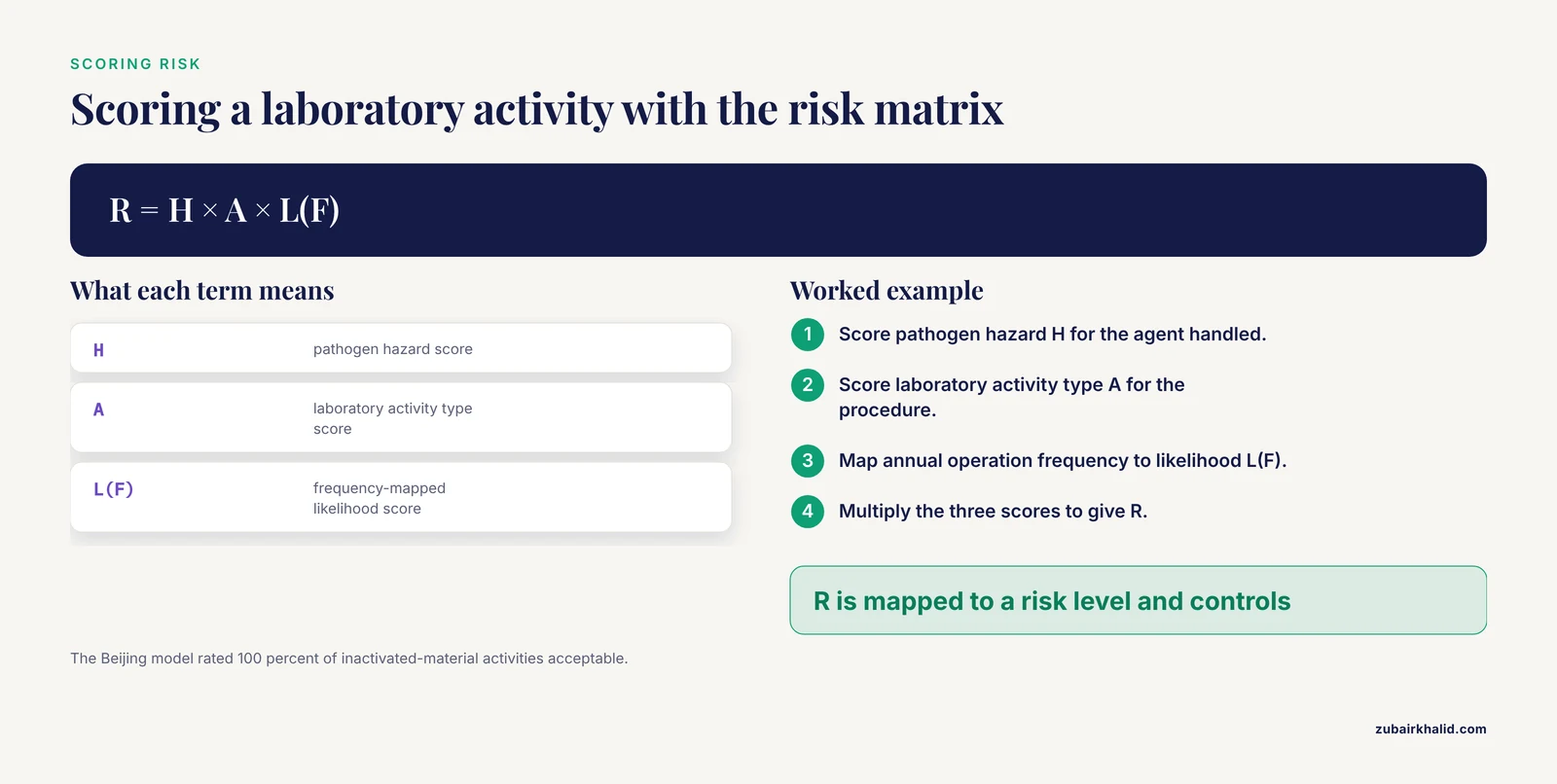
The laboratory scores risk numerically across defined dimensions and maps the product onto a risk matrix with preassigned control measures. One published model for primary-level public health laboratories uses three dimensions, pathogen hazard (H), laboratory activity type (A), and annual operation frequency mapped to likelihood of event occurrence (L), combined in the formula R = H × A × L(F), with a hierarchical risk matrix converting the calculated R value into a risk level and targeted controls [5]. The model was validated against actual 2024 laboratory activity data from 16 district Centers for Disease Prevention and Control in Beijing covering 130 pathogen tests, of which 88 percent involved Category III pathogens, and it identified one activity posing an unacceptable risk while rating 100 percent of activities with inactivated and non-infectious materials as acceptable [5].
Pros. Simple enough for primary-level laboratories, produces a number that supports prioritization and resource allocation, and validated with real workload data rather than expert opinion alone [5]. Workload intensity, such as how many tests run through a single BSL-2 room daily, becomes visible in the score, which matters because two district laboratories in that dataset reported daily workloads of at least 5 tests per BSL-2 room while most reported less [5].
Cons. The scale anchors are the model's own definitions, so a different laboratory choosing different anchors gets different numbers. Scores can create a false impression of precision. A matrix output guides cabinet selection and control allocation, but it does not replace the qualitative reasoning about a specific procedure's aerosol potential.
Pros and Cons Summary for Cabinet Choice Itself
The same risk assessment logic applies when choosing between cabinet designs, and the pros and cons there are worth stating plainly.
- Class I: lowest facility burden, but no product protection, so it is wrong for culture work where contamination ruins the result.
- Class II Type A2: flexible placement, no hard ducting required, but chemical tolerance is limited and building exhaust connections must not compromise cabinet airflow.
- Class II Type B1 and B2: better suited to chemical co-exposure and, in the B2 case, to procedure-based assessments that rule out recirculated air, but hard ducting ties the cabinet to the building, complicates relocation, and creates a dependency on exhaust system availability. A B2 cabinet stops protecting when the building exhaust stops, so laboratories using them need alarm and fail-safe interlocks.
- Class III: maximal containment, but the glove interface slows work dramatically, and it is disproportionate for routine diagnostic loads.
Worked Scenarios
Scenario 1: Routine BSL-2 clinical bacteriology
A hospital microbiology laboratory receives sputum, blood cultures, and wound swabs. The procedures include direct plating, Gram staining, biochemical identification, and antimicrobial susceptibility testing. A procedure-based assessment flags vortexing of sputum and opening of blood culture bottles as aerosol-generating steps, while streaking plates on an open bench with BSL-2 practices generates negligible aerosol. The assessment assigns a certified Class II Type A2 cabinet for the aerosol-generating steps and permits BSL-2 open-bench work for the remainder. This is the most common biosafety cabinet selection outcome in diagnostic microbiology and follows the standard pairing of BSL-2 work with Class II containment [4].
Scenario 2: Burkholderia pseudomallei in a low-resource laboratory
Burkholderia pseudomallei, the cause of melioidosis, is a tier 1 select agent, and international guidelines recommend handling isolates within a Class II biosafety cabinet in a biosafety level 3 facility [6]. In low-resource settings that standard may not be practical, so a team examined the actual risk of laboratory-acquired melioidosis during routine work performed outside a cabinet. Of 30 laboratory scientists who handled B. pseudomallei on 1,267 occasions outside a biosafety cabinet, no infections were documented and all participants remained seronegative on follow-up testing [6]. Controlled environmental air sampling during 78 laboratory handling events, including plate opening, oxidase testing, and McFarland suspension preparation, failed to detect aerosolization of the organism in any experiment [6].
The correct interpretation for cabinet selection is nuanced. The study suggests the risk of laboratory-acquired melioidosis during those specific routine manipulations is low, but the authors state that individual laboratories must undertake their own risk assessment covering melioidosis endemicity, resources available for containment, the nature of routine handling to be undertaken, and predisposing risk factors among staff, and must take region-specific guidelines into consideration [6]. For a laboratory in a non-endemic region performing only plate opening and spot identification on fully characterized isolates, a documented procedure-based assessment may support Class II A2 containment at BSL-2 with enhanced practices. For a laboratory identifying unknown isolates from endemic regions, the assessment should default to the guideline standard of Class II containment within BSL-3 conditions. The cabinet decision follows the assessment, not the other way around.
Scenario 3: Pandemic respiratory virus diagnostics
When laboratories stood up SARS-CoV-2 testing capacity, the commonest selection question was which cabinet class fit each workflow. Risk assessment of SARS-CoV-2 handling distinguishes specimen receipt and nucleic acid extraction, typically BSL-2 with Class II containment, from viral propagation, which requires higher containment and, at minimum, Class II cabinets within appropriately engineered space. Authors who trained staff during COVID-19 laboratory development found repeated questions about cabinet function and selection and wrote their review precisely because such detailed selection guidance was scarce, reinforcing that cabinets must be matched to procedure risk and validated for use [4]. The same workflow logic applies to any emerging respiratory pathogen: extraction in the A2 cabinet, confirmation and archiving of high-titer material in a higher-containment pathway, and propagation only in facilities assessed for that purpose.
Scenario 4: Henipavirus diagnostics and the evidence problem
Hendra and Nipah viruses are zoonotic henipaviruses with high case fatality rates and recurrent spillover from bat reservoirs through amplifying domestic animals, creating occupational exposure risks for veterinarians, healthcare workers, and laboratory personnel [1]. A structured narrative review organized around the LBM4 risk-based framework examined evidence for laboratory diagnostics, occupational exposure, and validated inactivation and decontamination practices for these agents [1]. The review illustrates the honest state of high-consequence risk assessment: the framework requires evidence-based, tailored decisions, but the evidence base behind containment choices for specific agents is uneven, so laboratories handling such agents must identify which containment decisions rest on solid experimental or outbreak evidence and which rest on prudent default. For cabinet selection, that prudence points toward Class II Type B2 or Class III containment for culture or concentration procedures, with the documented assessment noting where evidence is thin.
Scenario 5: Prioritizing cabinet upgrades across a network of laboratories
A regional public health network needs to decide which of its district laboratories gets the next cabinet and enhanced containment. A semi-quantitative matrix built on R = H × A × L(F), where H is pathogen hazard, A is laboratory activity type, and L(F) is frequency-mapped likelihood, can rank the network's activities consistently [5]. Applied across 16 district laboratories performing 130 pathogen tests in a year, the approach showed that laboratory utilization intensity varied widely, with only two laboratories reporting daily workloads of at least 5 tests per BSL-2 room, and it flagged a single activity as posing unacceptable risk requiring targeted control [5]. For an administrator, that single flagged activity is the cabinet selection decision with the highest return: the matrix identifies where engineering controls should go first.
Training and Competency
Cabinet selection fails if the people using the cabinet cannot maintain the airflow discipline that makes it work. Microbiology biosafety training should cover, at minimum, the correct work opening height, slow entry and exit of hands to avoid wake turbulence, placement of work at least several inches inside the front grille, avoidance of blocking perforated grilles, and the reasoning behind decontamination of cabinet surfaces before and after work. These points are established practice in biosafety teaching and are echoed in reviews written for laboratory staff who had to learn cabinet use rapidly during the COVID-19 response [4].
Clinical simulation is an emerging, evidence-supported training format. In a qualitative study of 26 nursing students, clinical simulation for biosafety learning helped participants integrate technical performance, emotional regulation, and communication, improved understanding of personal protective equipment use and risk perception, and strengthened self-assessment and recognition of technical limitations [7]. The same simulation logic translates to microbiology: rehearsing a spill inside the cabinet, a power failure during culture manipulation, or a glove tear, before those events happen with a real agent on the work surface, builds exactly the reflective competence that biosafety training aims for [7].
Training should also include the risk assessment itself. Staff who understand why a given procedure routes to the B2 cabinet instead of the A2 cabinet are far less likely to drift toward shortcuts, and training on structured frameworks makes assignments reproducible across shifts [2].
Common Mistakes and Limitations
Treating risk group as the answer. Assigning containment purely from the organism's risk group misses how strongly procedure drives exposure, which is the central finding motivating procedure-specific frameworks [2]. The same organism streaked on a plate and grown to high titer in a bioreactor are different risks that deserve different cabinets.
Using a clean bench for infectious work. A horizontal laminar flow clean bench blows unfiltered air from the work surface toward the operator. It protects the product and exposes the person. Substituting it for a biosafety cabinet to save money is one of the most dangerous errors in laboratory setup.
Ignoring the chemistry question. A Class II Type A2 cabinet recirculates most of its air. Sustained work with volatile toxic chemicals inside it exposes the operator through the recirculation loop. When the risk assessment identifies chemical co-exposure, the selection should move to a total-exhaust Type B2 design or add a chemical fume hood for that step.
Assuming the cabinet protects during bad technique. Rapid arm movement, working outside the access opening, blocking grilles with absorbent pads, and open flames that disrupt laminar flow all defeat the cabinet's design. Protection depends on technique as much as hardware, which is why training is part of the selection, not an afterthought [4].
Never revisiting the assessment. A risk assessment written at commissioning goes stale the first time the laboratory adds a centrifugation step, a new agent, or a new staff member with an immunity-altering condition. Structured frameworks are designed for reapplication, and re-running a semi-quantitative score annually is cheap insurance [2], [5].
Forgetting the facility behind a ducted cabinet. Type B1 and B2 cabinets and Class III enclosures depend on building exhaust systems. Building work, fan failure, or construction elsewhere in the facility can compromise containment without anything happening inside the cabinet. Alarms, interlocks, and a written response plan belong in the selection decision.
Skipping certification and repositioning checks. Cabinets are certified at installation, after relocation or filter replacement, and on a recurring schedule, with annual certification as the established minimum. A cabinet that passed certification five years ago in a different room is not a certified cabinet.
Over-reading low-exposure evidence. Studies showing that a specific set of manipulations did not produce detectable aerosols are valuable inputs, but they describe the tested procedures, organisms, and sampling methods. They do not license a laboratory to abandon cabinets for untested procedures, which is why even the authors of such work insist on laboratory-specific risk assessment [6].
One limitation applies to this article as it applies to the field: individual institutions must consult their institutional biosafety committee, applicable regulations, and local engineering constraints before finalizing any cabinet selection, because no general guide can substitute for assessment of your own facility and procedures.
Frequently Asked Questions
Which class of biosafety cabinet does a BSL-2 laboratory need?
A Class II cabinet, most commonly Type A2, is the standard choice for BSL-2 work, because manipulations that may generate aerosols or involve concentrated or high-volume material must be performed in a cabinet that protects the worker, the specimen, and the environment simultaneously. Class I cabinets lack product protection and clean benches protect only the product, so neither substitutes for a Class II cabinet at BSL-2.
Does buying the right cabinet replace doing a risk assessment?
No. The cabinet is an engineering control chosen as the output of the biosafety risk assessment. Modern frameworks, including the WHO Laboratory Biosafety Manual fourth edition and procedure-specific protocols, require the assessment of agent, procedure, and setting first, with the containment level and cabinet class following from that documented analysis [2], [1].
What is the difference between a Class II Type A2 and Type B2 cabinet?
A Type A2 cabinet recirculates most of its air through HEPA filtration inside the cabinet and tolerates only trace chemical use, while a Type B2 cabinet exhausts 100 percent of its air outside the building and recirculates nothing, making it the correct choice when procedures combine infectious material with significant volatile chemical use. Both deliver the same particulate protection profile, so the choice between them is driven by chemistry, facility ducting, and institutional policy.
Can I use a horizontal laminar flow clean bench instead of a biosafety cabinet?
No. A clean bench blows filtered air out across the work surface toward the operator, which protects the product from contamination but deliberately exposes the worker to anything aerosolized. It is appropriate for preparing sterile, non-hazardous media and never for handling infectious agents or human specimens.
How often does a biosafety cabinet need to be certified?
A biosafety cabinet should be certified at installation, after any relocation or filter change, and on a recurring schedule, with annual certification as the established minimum in laboratory practice. The World Health Organization emphasizes the use of validated cabinets, and certification verifies airflow velocities, filter integrity, and containment performance [4].
What training should staff complete before working in a biosafety cabinet?
Staff should complete microbiology biosafety training covering risk assessment principles, cabinet airflow mechanics, correct technique inside the work zone, spill and failure response, and certification basics, followed by supervised competency sign-off. Simulation-based formats improve integration of technical practice with risk perception and self-assessment, and structured training proved essential when large numbers of staff had to learn cabinet work rapidly during the COVID-19 response [4], [7].
Sources
- Hendra and Nipah viruses: Biosafety evidence for risk-based containment, inactivation practices, and one health preparedness.
- An 8-step procedure-specific risk framework enables reproducible biosafety level assignment beyond agent-based classification.
- Inhalation exposure and non-carcinogenic risk assessment of bacterial and fungal bioaerosols among wastewater treatment plants workers.
- Selection and application of biological safety cabinets in diagnostic and research laboratories with special emphasis on COVID-19.
- A semi-quantitative risk assessment of pathogenic microorganism laboratories in Beijing's CDCs based on a three-dimensional risk matrix model.
- Laboratory Safety: Handling Burkholderia pseudomallei Isolates without a Biosafety Cabinet.
- Nursing students' perceptions of the use of clinical simulation in biosafety education.