Biosafety Cabinet Class II B2: How to Choose
By Dr. Zubair Khalid, DVM, MS, PhD ·
A Class II B2 biosafety cabinet is a total-exhaust, hard-ducted cabinet that protects the worker, the product, and the environment by venting 100 percent of its filtered air outside the building, which makes it the only Class II type suitable for routine work with hazardous volatile chemicals and radionuclides alongside infectious agents. The rule of thumb is simple: if your protocol puts toxic vapors, chemical fixatives, or radioisotopes in the cabinet along with the microorganisms, choose a B2. If you work only with infectious agents in aqueous media and no volatile chemicals, a recirculating Class II A2 usually does the same microbiological job with far less building infrastructure.
This guide is written for laboratory managers, bench microbiologists, and biosafety officers who need to specify, purchase, install, and operate a Class II B2 cabinet correctly. It walks through how the B2 differs from the other Class II types, the pros and cons that actually decide a purchase, the installation and certification burden most buyers underestimate, and the biosafety risk assessment that should precede every cabinet decision.
What a Class II B2 Biosafety Cabinet Actually Is
A biosafety cabinet (BSC) is a ventilated enclosure that provides three simultaneous protections: personnel protection (filtered air barrier between worker and material), product protection (filtered air flowing over the work surface), and environmental protection (filtered exhaust). This distinguishes it from a chemical fume hood, which protects the worker only and offers no product protection, and from a laminar flow hood, which protects the product only and blows unfiltered air at the worker.
"Class II" refers to ventilated cabinets with an open front, an inward air curtain at the work opening, and HEPA-filtered (high-efficiency particulate air, capturing at least 99.97 percent of particles at 0.3 micrometers) supply and exhaust. Within Class II, the subtype letter describes the airflow and exhaust scheme:
- A2: roughly 30 percent of the air is exhausted and 70 percent recirculates through the work surface. Exhaust can be recirculated back into the room (thimble or canopy connected) because the air is HEPA filtered.
- B1: roughly 70 percent exhausted, 30 percent recirculated, hard-ducted, with internally recirculated air passing through a HEPA filter.
- B2: 100 percent of the air, both the room air drawn in at the front and the air rising through the work surface, is exhausted to the outside through HEPA filtration. Nothing recirculates within the cabinet.
The B2 design exists for one core reason: because no air recirculates, any chemical vapor or radionuclide aerosol generated on the work surface leaves the building on the first pass and never accumulates in the cabinet plenum or re-enters the room. A review of microbiological safety cabinet selection, installation, testing, and use documented decades of confusion among microbiologists and managers about which cabinet type suits which task, and the classification scheme exists precisely to remove that guesswork [1].
Historically, the B2 emerged for combined microbiological and chemical work, for example the staining, fixation, and extraction steps of clinical microbiology that use solvents, formaldehyde, or radioactive isotopes. In the modern diagnostic laboratory it remains the standard specification for molecular workups involving volatile reagents, for mycobacteriology and virology suites where total exhaust is specified by the facility, and for any laboratory where the biosafety officer has ruled out recirculating cabinets on risk grounds.
The Class II Family Side by Side
| Feature | Class II A2 | Class II B1 | Class II B2 |
|---|---|---|---|
| Air exhausted | About 30 percent | About 70 percent | 100 percent |
| Air recirculated inside cabinet | About 70 percent | About 30 percent | None |
| Ducting | Room recirculation or canopy to outside | Hard ducted to outside | Hard ducted to outside |
| Work with minute quantities of volatile toxic chemicals | Not appropriate | Limited, below the work surface grille area only | Appropriate |
| Work with radionuclides | Not appropriate | Limited, low energy, below the grille | Appropriate |
| Building impact (ductwork, exhaust fan, make-up air) | Minimal to moderate | High | Highest |
| Sensitivity to room airflow and volume | Moderate | High | Very high, the building exhaust system is part of the cabinet |
| Heat and energy load on HVAC | Low | Moderate to high | High, conditioned room air is continuously exhausted |
| Typical microbiology fit | Routine BSL-2 culture handling | Mycobacteriology, some chemical co-use | Chemical plus biological work, BSL-3 specified tasks, total-exhaust facilities |
Three points in this table drive most real decisions. First, the B2's hard-ducted total exhaust ties cabinet performance to the building mechanical system, so the exhaust fan, dampers, and room make-up air become part of the cabinet's safety envelope. Second, the ability to use volatile chemicals is the single clearest dividing line between the B2 and every other Class II type. Third, installation cost and building impact scale directly with exhaust volume, which is why many laboratories that would benefit from a B2 on paper choose an A2 after reviewing their HVAC capacity.
How the B2 Airflow System Works
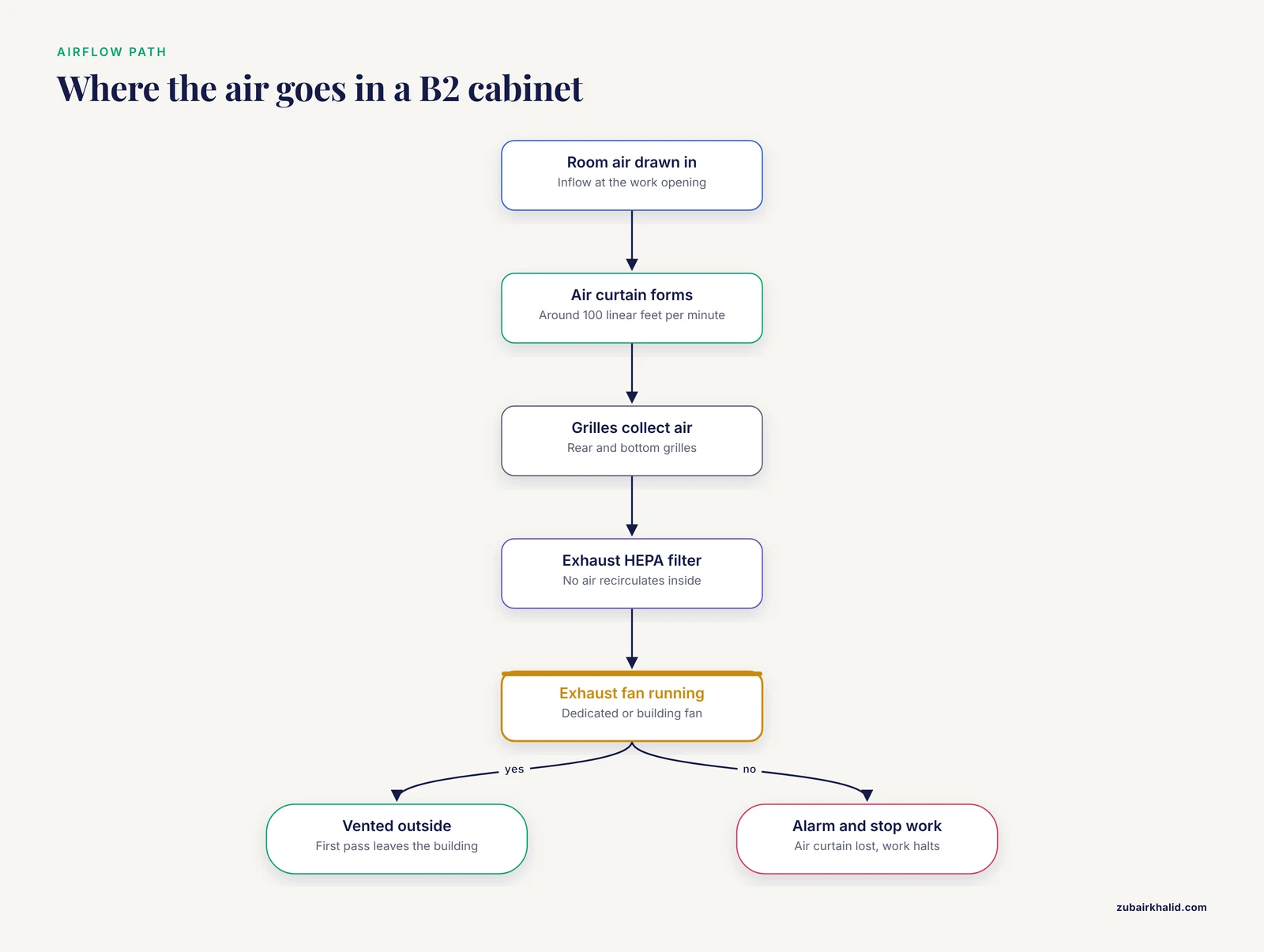
Understanding the airflow explains both the B2's strengths and its operational fragility. Room air is drawn through the open front at the design inflow velocity, typically around 100 linear feet per minute at the work opening. This inward air curtain is the worker's primary barrier. Below the work surface, the air joins air that has been drawn up through the perforated rear and bottom grilles, passes through the exhaust HEPA filter, and is discharged by a dedicated or building exhaust fan to the outside.
Because there is no downflow recirculation loop inside the cabinet in the way an A2 or B1 has, the B2 depends on an external exhaust system pulling air through the cabinet. Two consequences follow:
- The exhaust system must run whenever the cabinet is in use. Interruption of exhaust flow, whether from a fan failure, a closed damper, or a building interlock, removes the inward air curtain. Modern B2 cabinets therefore monitor downflow and inflow continuously and alarm on deviation.
- Room air balance matters. Every cubic foot exhausted by the B2 must be replaced by conditioned make-up air. A laboratory that adds a B2 without reviewing HVAC capacity will develop negative pressure problems, door drag, and, in cold climates, uncomfortable drafts at the work opening that cause operators to break the air curtain with their hands.
Certification testing directly probes these airflow behaviors. Aerosol challenge tests for personnel protection, product protection, and cross contamination were established using nebulizer-generated bacterial aerosols, and comparative testing showed that only certain nebulizer designs produce the reproducible aerosol distributions these tests require [2]. When a certifier runs the annual test on your B2, the airflow measurements and aerosol or photometric challenge protocols descend from that validation work.
Class II B2 Pros and Cons
Advantages
- Chemical compatibility. The B2 is the only Class II type appropriate for work with small amounts of hazardous volatile chemicals. In a recirculating cabinet, solvent vapors concentrate in the recirculated airstream and the HEPA filter, creating an exposure and fire risk.
- Radionuclide compatibility. Total exhaust permits low-level radionuclide work on the bench surface, something a recirculating cabinet cannot support.
- No contaminant accumulation in the cabinet. Spilled material or aerosols generated inside the cabinet exit the building on the first pass rather than recirculating across the work surface.
- Simplest contamination concept. For facilities that worry about cross contamination of cultures or molecular work, the absence of internal recirculation eliminates one contamination pathway.
- Facility flexibility for high-containment design. When a laboratory is built to BSL-3 or enhanced BSL-3 expectations, specifying total-exhaust cabinets simplifies the containment philosophy because nothing hazardous stays in the room loop.
Disadvantages
- Highest installation and operating cost of any Class II type. Hard ducting, an exhaust fan or connection to a building exhaust system, motorized dampers, interlocks, and the continuous conditioning of replacement air all add cost that recurs every year the cabinet runs.
- Dependence on building mechanics. Cabinet safety becomes hostage to fan uptime, damper function, and power reliability. A power outage in an A2 cabinet means the operator stops work. A power outage in a B2 without backup exhaust means the air curtain disappears entirely.
- Heat load and comfort problems. Continuously exhausting conditioned air can make the laboratory cold, dry, and expensive, and cold drafts at the work opening tempt operators to block the grille, which defeats the containment.
- Not movable. Once hard ducted, the cabinet is fixed. Relocation is a construction project.
- Alarms that stop work. Because the cabinet monitors exhaust dependence, airflow deviations halt work more often than in a self-balancing A2. This is a safety feature, but bench staff experience it as downtime.
The pros and cons resolve into one question: does your protocol require total exhaust? If yes, the B2's costs are simply the price of the work. If no, an A2 delivers equivalent microbiological protection with less infrastructure, and the international guidelines that recommend class II cabinets for handling agents such as Burkholderia pseudomallei specify cabinet class and containment level, not the B2 subtype specifically [3].
Class II B2 Options: Features and Configurations to Compare
Manufacturers offer the B2 subtype in several configurations, and the differences between the best biosafety cabinet class ii b2 options are mostly about installation, monitoring, and ergonomics rather than the containment principle.
Canopy versus hard duct
Some A2 cabinets can be thimble (canopy) connected, allowing a portion of exhaust to be pulled outside while the cabinet still balances itself. A true B2 is hard ducted with a sealed connection to a dedicated exhaust system, and the exhaust fan is typically sized and interlocked to the cabinet. Confirm with the manufacturer whether the B2 model's blower is inside the cabinet or remote, and who owns the responsibility for balancing the system at commissioning.
Exhaust interlock design
Ask how the cabinet behaves when exhaust flow fails. Well-designed systems close dampers, alarm locally, and in some facility designs trip the building exhaust to prevent pressurization of the room. The interlock logic should be tested at commissioning and at every certification.
Monitoring and alarms
Look for continuous monitoring of downflow velocity, inflow velocity, and exhaust flow, with audible and visual alarms. Sash height alarms matter because the air curtain design assumes a specific working sash opening, and raising the sash degrades both inflow and containment.
Size and ergonomics
Cabinets come in 4, 5, 6, and 8 foot widths. Interior height matters for incubators, microscopes, and tall equipment. Consider whether you need pass-through ports, an interior electrical outlet rated for the cabinet design, and service connections for equipment such as microincinerators. Note that an open flame inside any Class II cabinet is discouraged by manufacturers because the heat disturbs the airflow and can compromise filter integrity, and electric bead sterilizers create their own thermal plume.
UV lamps and their limits
Many cabinets are ordered with ultraviolet lamps for surface decontamination between uses. Buyers should understand what UV-C can and cannot do. In one controlled study, a 15-minute UV-C exposure inside a Class II cabinet did not affect the stability of hundreds of spiked analytes in urine samples stored in their original containers, which reassured that laboratory that UV decontamination cycles would not destroy their analytical targets [4]. The same study illustrates the correct use of UV, surface disinfection of exposed surfaces, not a substitute for wipedown or for gas or vapor decontamination before filter changes and certification. UV-C in a cabinet is also shielded by any shadow, and organic load dramatically reduces its activity, so it complements but never replaces manual disinfection.
Certification and service support
Before ordering, confirm that the manufacturer or its certified field service network can perform commissioning, annual certification, and HEPA filter replacement in your area, and that spare parts and qualified technicians are accessible. One long-standing review of cabinet practice concluded that proper maintenance throughout the cabinet's lifetime requires appropriate measuring equipment and trained technicians [1]. A cabinet you cannot get certified is not a safety device, it is a box with a fan.
Installation, Ducting, and Certification: The Part Buyers Underestimate
The purchase price of a B2 cabinet is often the smallest line item in the project. Budget and plan for the following.
Site preparation
- Dedicated exhaust run. The cabinet needs a sealed duct to the outside, ideally a dedicated exhaust fan with speed control matched to the cabinet's exhaust volume. Shared building exhaust requires careful review by the mechanical engineer and the biosafety officer.
- Make-up air. The room must supply conditioned replacement air. Under-sizing make-up air produces negative room pressure, door drag, and re-entrainment risk.
- Clearance and placement. Keep the cabinet away from doors, supply diffusers, and pedestrian traffic, all of which disturb the air curtain. A common siting rule is to avoid cross drafts from open doors and to leave access for certification at the sides and top.
- Power. Plan dedicated circuits and, for facilities where exhaust loss is intolerable, emergency power for the exhaust fan with automatic changeover.
Commissioning and certification
Every cabinet should be certified on installation, after any move or filter change, after a major repair, and at least annually. Certification includes airflow velocity measurements at the work opening and the downflow grid, HEPA filter leak testing by photometric challenge, leak testing of the cabinet itself, and functional tests of alarms and interlocks. The personnel protection, product protection, and cross contamination challenge tests that underpin these protocols were standardized with carefully characterized aerosol generation, and the comparative work that selected the reference nebulizer demonstrated why reproducible aerosol generation matters for a meaningful pass or fail result [2].
The historical record is instructive here. The review by Kennedy and Collins documented that confusion about cabinet choice, installation, testing, and use persisted among microbiologists and managers even late in the twentieth century, and attributed much of it to misunderstanding the differences between cabinet types and the testing each requires [1]. The lesson for a modern buyer is that the specification, the installation drawings, and the commissioning plan deserve the same scrutiny as the cabinet's advertised containment performance.
The Biosafety Risk Assessment That Should Come First
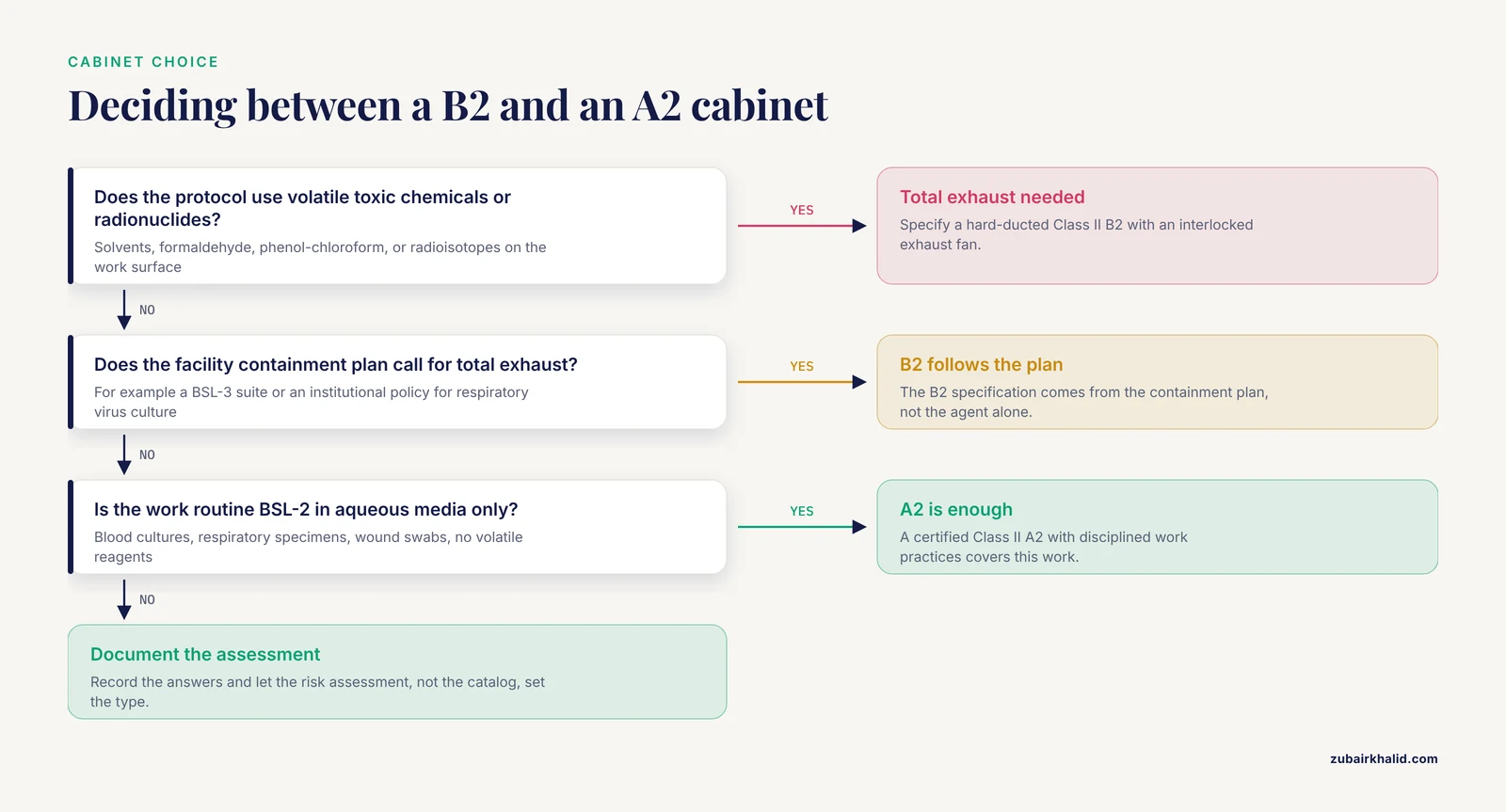
No cabinet purchase should start with the catalog. It should start with a documented biosafety risk assessment covering the agents you handle, the procedures you perform, and the people who perform them. The World Health Organization has emphasized the use of validated cabinets, and guidance on selecting cabinet class based on risk assessment of the pathogen and procedure was formalized during COVID-19 laboratory development, where the authors of a dedicated review on cabinet selection noted that detailed knowledge of appropriate cabinet type and function among laboratory staff was scanty and that training questions arose repeatedly during laboratory setup [5].
A practical risk assessment for cabinet selection answers four questions:
- What agent? Route of transmission, infectious dose, disease severity, and availability of treatment or prophylaxis. Tier 1 select agents, for example, carry the highest bar.
- What procedure? Manipulations that generate aerosols, such as vortexing, centrifugation, blending, and opening sealed plates, demand containment. Manipulations that generate chemical vapors demand exhaust.
- What resources? Can the facility actually build and maintain a BSL-3 suite and a total-exhaust cabinet, and can it sustain annual certification and trained staffing?
- Who is exposed? Staff training level, immune status, and predisposing risk factors.
The literature offers a useful worked example of this reasoning. Burkholderia pseudomallei, a tier 1 select agent and the cause of melioidosis, is handled in many guidelines only within a class II cabinet in a BSL-3 facility. Yet a prospective study of 30 laboratory scientists who handled B. pseudomallei isolates on 1,267 occasions outside a biosafety cabinet documented no infections and no seroconversions, and controlled air sampling during 78 handling events, including plate opening, oxidase testing, and McFarland suspension preparation, detected no aerosolization [3]. The authors concluded that the risk of laboratory-acquired melioidosis under those routine conditions was low but emphasized that each laboratory must still perform its own risk assessment weighing endemicity, containment resources, the nature of routine handling, and staff risk factors, along with region-specific guidelines [3]. The study does not mean the cabinet is unnecessary. It means the risk assessment, not reflexive containment, drives the specification, and that a well-documented assessment can legitimately justify a different working practice when resources are constrained.
The same evidence-based lens applies at the other end of the scale. The Biosafety Research Road Map project, which reviewed the literature underpinning biorisk assessments for avian influenza virus and Mycobacterium tuberculosis, identified a significant gap in definitive data on M. tuberculosis aerosolization during diagnostic procedures, data that would guide the selection of engineering controls, and noted that guidance on cabinet use for specific M. tuberculosis procedures requires clarification [6]. For a purchasing committee, the takeaway is that written guidance alone does not settle the airflow question. Your own assessment of the procedures, volumes, and aerosol potential in your laboratory does, and where the evidence base is thin, conservative choices are defensible and over-specification is cheaper than under-protection.
A note on laboratory tiers and cabinet choice: routine BSL-2 diagnostic work on well-characterized clinical specimens, processed with aerosol-generating steps inside the cabinet, is the bread and butter of Class II A2 cabinets worldwide. The B2 earns its place when chemical or radiological co-hazards exist or when facility design calls for total exhaust, not simply because the agent name on the requisition sounds frightening.
Microbiology Biosafety Training: The Cabinet Is the Least Important Safety Layer
Experienced biosafety professionals repeat one message about cabinets, and the literature supports it. In a review of biological safety in virology with specific attention to class II cabinets, the author concluded that the most critical element of biosafety is not sophisticated devices or facilities but the education of workers and their compliance with procedures, and that cabinets, being delicate safety equipment, must be adequately maintained throughout their lifetime by trained technicians using appropriate measuring equipment [7].
That framing should shape your purchase plan. A B2 cabinet purchased without a training budget is a liability. Your microbiology biosafety training program, before first use and refreshed regularly, should cover:
- Airflow principles. Why the front grille must never be blocked, why rapid arm movements break the air curtain, why the sash height is fixed at the certification position, and why the minimum work-in-cabinet dwell time after aerosol-generating actions lets cabinet airflow clear the work zone.
- The workflow discipline of deep-work layout. Clean to dirty movement, keeping work at least several inches inside the sash, minimizing the number of entry-exit arm sweeps, and never opening cabinets during room door swings.
- Chemical use rules specific to B2. Even a B2 cabinet is limited to minute quantities of volatile chemicals. It is not a chemical fume hood, and bulk solvent work has no place in it.
- Spill response inside the cabinet. Containment, disinfectant contact time, and the decision tree for when a spill mandates cabinet decontamination and recertification before further use.
- Certification awareness. Staff should know when the cabinet was last certified, what the current airflow readings are, and what the alarm states mean, so that a failing cabinet is recognized immediately rather than after the next incident.
- Decontamination before service. Formaldehyde or vaporized hydrogen peroxide decontamination before filter changes and before any internal service work, with documentation.
During the establishment of COVID-19 diagnostic laboratories, the team reviewing cabinet selection and application recorded repeated questions from staff about cabinet functions and correct selection, and built its training around those questions, which is exactly the model any laboratory should follow when it introduces a B2 [5].
Worked Scenarios
Scenario 1: A hospital clinical microbiology laboratory, routine bacteriology
The laboratory processes blood cultures, respiratory specimens, and wound swabs at BSL-2, with subculturing, staining, biochemical identification, and matrix-assisted laser desorption ionization identification on the open bench or in cabinets. Aerosol-generating steps (vortexing plates, flaming loops in the past era, decanting) are done inside the cabinet. No volatile toxic chemicals and no radionuclides are used on the microbiology bench. The biosafety risk assessment justifies a Class II A2, canopy or room-recirculating. Buying a B2 here adds ducting cost, heat load, and downtime without a containment benefit the risk assessment can justify.
Scenario 2: A reference mycobacteriology and molecular laboratory with chemical co-hazards
The laboratory performs specimen digestion and concentration with N-acetyl-L-cysteine and sodium hydroxide, extraction with phenol-chloroform and other volatile organic solvents for specific assays, and fluorescent microscopy. The biosafety officer rules that recirculating cabinets cannot accept the volatile reagent load and specifies total exhaust. Here a B2 is the correct choice, with hard ducting, an interlocked dedicated exhaust fan, make-up air calculations by the mechanical engineer, and a commissioning certification before any work begins. This is the classic B2 use case, and it illustrates why the decision belongs to the risk assessment and the facility engineer jointly, [5].
Scenario 3: A virology research group adding SARS-CoV-2 and other respiratory virus culture
The group plans virus propagation, which involves aerosol-generating steps (sonication, centrifugation, pipetting suspensions) with agents of elevated risk. Institutional containment policy specifies BSL-3 with total exhaust cabinets. The B2 specification follows from the facility containment plan, and the accompanying training program matters more than the cabinet itself, consistent with the principle that worker education and compliance, not device sophistication, anchor biosafety [7]. The group also plans its certification schedule around known evidence gaps, recognizing that for some respiratory pathogens the literature base for procedure-specific engineering control selection remains incomplete [6].
Common Mistakes and Limitations
- Buying a B2 when the protocol does not need it. The most common over-specification. An A2 with sound work practices protects personnel and product for routine BSL-2 microbiology. The B2's marginal benefit is chemical and radiological compatibility, not extra biological safety.
- Assuming a B2 eliminates the need for work practice discipline. Total exhaust does not compensate for blocked grilles, raised sashes, or frantic arm movements. The air curtain is the barrier, and it is trainable behavior, not hardware.
- Underestimating the mechanical scope. Buyers price the cabinet and forget the duct run, exhaust fan, dampers, interlocks, make-up air modifications, and the commissioning certification. On a hard-ducted cabinet, these routinely exceed the cabinet cost.
- Skipping commissioning certification or treating annual certification as optional. An unverified B2 is a hazard with a stainless-steel shell. Certification on installation, after moves and filter changes, and at least annually is the professional standard [1].
- Using the cabinet as a chemical fume hood. Minute quantities only. Large or bulk solvent work belongs in a chemical fume hood, full stop.
- Relying on the UV lamp as the decontamination method. UV-C is a surface adjunct. It does not penetrate organic load or shadows, and it is not a substitute for wipedown with an appropriate disinfectant or for a validated decontamination cycle before service.
- Letting certification lapse when staff or vendors change. Cabinet maintenance requires trained technicians with appropriate measuring equipment, and loss of that continuity is a documented failure mode in laboratory biosafety programs [7].
- Assuming guidance documents resolve every borderline case. As the B. pseudomallei field study and the biosafety evidence-mapping project both show, written guidance can be incomplete or require local interpretation, and the documented risk assessment is what makes either a conservative or a pragmatic choice defensible [3], [6].
- No electrical or exhaust contingency. If total-exhaust operation is critical to containment, plan what the laboratory does when the exhaust fan fails, and rehearse that response with staff rather than improvising it during the alarm.
Frequently Asked Questions
Does a Class II B2 cabinet have to be ducted to the outside?
Yes. The B2 subtype is defined by total exhaust with no recirculation, which requires a hard ducted connection to a dedicated or interlocked building exhaust system. A cabinet described as B2 but recirculating to the room is not a B2, and you should treat any such claim as disqualifying.
Can I use hazardous volatile chemicals in a Class II B2 cabinet?
Yes, in minute quantities. Total exhaust prevents vapor accumulation, which is the B2's defining advantage over A2 and B1 types. It is not a chemical fume hood, so bulk solvent handling, heated evaporation, and high-vapor-load procedures remain out of scope and belong in a fume hood.
Is a Class II B2 safer than an A2 for microbiology work?
For microbiological hazards alone, no. Both provide equivalent personnel, product, and environmental protection when properly certified and correctly used. The B2 adds protection against chemical vapors and radionuclides, not against microorganisms, and it introduces dependency on building exhaust that can itself become a failure point.
How often must a Class II B2 cabinet be certified?
On installation, after relocation or filter replacement, after any major repair, and at least annually. Certification should be performed by a qualified technician using calibrated airflow and photometric challenge equipment, and the resulting report belongs in the cabinet's permanent record.
Do I need a B2 cabinet for BSL-2 microbiology?
Usually no. BSL-2 work with infectious agents in aqueous media is well served by a Class II A2 with disciplined work practices. Choose a B2 only when your risk assessment identifies volatile chemical or radionuclide co-hazards, or when your facility containment plan specifies total exhaust.
What should staff training cover before anyone works at a Class II B2 cabinet?
Airflow principles and air curtain discipline, sash height rules, chemical quantity limits specific to the B2, clean-to-dirty workflow, in-cabinet spill response, alarm interpretation, and the decontamination procedure required before filter changes and service. Training and compliance matter more to biosafety outcomes than cabinet sophistication, so fund the training with the same seriousness as the cabinet purchase.
Sources
- Microbiological safety cabinets: selection, installation, testing and use.
- Collison 6-jet nebulizer: choice for the certification test of the class II biological safety cabinet.
- Laboratory Safety: Handling Burkholderia pseudomallei Isolates without a Biosafety Cabinet.
- Biosafety Level 2 cabinet UV-C light exposure of sports antidoping human urine samples does not affect the stability of selected prohibited substances.
- Selection and application of biological safety cabinets in diagnostic and research laboratories with special emphasis on COVID-19.
- The Biosafety Research Road Map: The Search for Evidence to Support Practices in the Laboratory-Zoonotic Avian Influenza and Mycobacterium tuberculosis.
- [[Biological safety in virological field with special considerations on class II biological safety cabinets].](https://pubmed.ncbi.nlm.nih.gov/17446668/)