Water Molecule: Structure, Polarity and Hydrogen Bonds
By Dr. Zubair Khalid, DVM, MS, PhD ·
A water molecule is a bent, three-atom unit with the formula H2O, in which one oxygen atom shares two pairs of electrons with two hydrogen atoms. The oxygen pulls the shared electrons toward itself, so the molecule carries a partial negative charge near the oxygen and partial positive charges near the hydrogens, and that uneven charge distribution lets water form hydrogen bonds with its neighbors.
That single arrangement explains most of what water does in a living system. Water is the medium for nearly every reaction in a cell, the coolant that carries heat away from a working muscle, and the solvent that keeps proteins, ions, and metabolites dissolved and mobile. A 2022 review of water chemistry describes how polarity, hydrogen bonding, and high heat capacity together support cellular processes, climate regulation, and biochemical reactions [1]. Change the bond angle by a few degrees or remove the polarity, and the chemistry of life as we know it would not run.
Key Facts at a Glance
| Property | Value or description | Why it matters |
|---|---|---|
| Chemical formula | H2O | Two hydrogen atoms, one oxygen atom |
| Molar mass | About 18.015 g/mol | Light enough to diffuse quickly, heavy enough to stay liquid at room temperature |
| O-H bond length | About 0.96 angstrom (96 picometers) | Short, strong covalent bond |
| H-O-H bond angle | About 104.5 degrees | Bent shape prevents bond dipoles from canceling |
| Electron-pair geometry | Roughly tetrahedral | Four electron domains around oxygen |
| Molecular geometry | Bent (angular) | The source of the net dipole |
| Dipole moment | About 1.85 debye | Makes water a polar solvent |
| Covalent O-H bond energy | Roughly 460 kJ/mol | Very strong, survives ordinary chemistry |
| Typical hydrogen bond energy in water | Roughly 10 to 40 kJ/mol, environment dependent | Weak enough to break and reform constantly |
| Hydrogen bond lifetime in liquid water | On the order of picoseconds | The network is dynamic, not fixed |
| Boiling point at 1 atm | 100 degrees Celsius | Abnormally high for such a small molecule |
| Temperature of maximum density | About 4 degrees Celsius | Ice floats, lakes stratify safely |
The Structure of a Water Molecule
Counting electrons
Oxygen has eight electrons, arranged as 1s² 2s² 2p⁴. Six of those are valence electrons, and the atom needs two more to complete its outer shell. Each hydrogen brings one electron. Two oxygen orbitals, each holding one unpaired electron, overlap with the 1s orbital of a hydrogen, and two covalent sigma bonds form. The remaining four valence electrons on oxygen sit in two nonbonding pairs, called lone pairs.
Why the molecule bends
The oxygen atom has four electron domains around it: two bonding pairs and two lone pairs. Electron domains repel each other and spread out into a roughly tetrahedral arrangement, which is the electron-pair geometry. The lone pairs occupy more space than bonding pairs, so they push the two O-H bonds closer together than a perfect tetrahedral angle of 109.5 degrees. The measured H-O-H angle in the gas phase is about 104.5 degrees, and the molecule is described as bent or angular rather than linear.
A labeled water molecule diagram usually shows the oxygen at the center, two small hydrogen atoms offset at roughly 104.5 degrees, two lone pairs drawn as small clouds or dots on the opposite side, and the partial charges marked as a delta-negative symbol near the oxygen and delta-positive symbols near each hydrogen. The lone pairs are not decoration. They are where a neighboring water molecule will eventually attach through a hydrogen bond.
The water molecule bonds
The O-H link is a polar covalent bond. Covalent means the atoms share electrons. Polar means the sharing is unequal because oxygen is far more electronegative than hydrogen. On the Pauling scale, oxygen scores about 3.44 and hydrogen about 2.20, a difference of roughly 1.24 units. That difference pulls the shared electron density toward oxygen.
A useful way to picture the charge separation is through partial charges. In many standard water models, the oxygen carries a partial charge near -0.8 of an elementary charge and each hydrogen near +0.4. The real electron distribution is more complex, but the model captures the essential physics: the oxygen end is negative, the hydrogen ends are positive, and the whole molecule acts like a tiny dipole.
Why the bend creates polarity
Imagine water were linear, with hydrogen-oxygen-hydrogen in a straight line. Each O-H bond would still be polar, but the two bond dipoles would point in opposite directions and cancel exactly. The net dipole moment would be zero, and water would behave like carbon dioxide, a nonpolar molecule with polar bonds.
Because water is bent, the two bond dipoles sit at about 104.5 degrees to each other. When you add them as vectors, they do not cancel. The molecule has a net dipole moment of about 1.85 debye, pointing along the axis that bisects the H-O-H angle, from the hydrogen side toward the oxygen side. This is water molecule polarity in one sentence: the geometry prevents cancellation of the bond dipoles.
Water Molecule Hydrogen Bonds
What a hydrogen bond is
A hydrogen bond is an attractive interaction between a hydrogen atom that is covalently bound to a highly electronegative atom and a lone pair of electrons on another electronegative atom nearby. The usual partners are oxygen, nitrogen, and fluorine. The hydrogen carries a partial positive charge, the acceptor carries a partial negative charge and a lone pair, and the two align.
In water, each molecule can donate two hydrogen bonds through its two hydrogens and accept two through its two oxygen lone pairs. In ordinary ice, this gives a tetrahedral lattice in which every molecule participates in four hydrogen bonds, with an oxygen-to-oxygen distance near 2.76 angstrom. Liquid water keeps the same basic building blocks but loses the long-range order. The network is distorted, continuously rearranging, and each molecule forms roughly three to four hydrogen bonds at any instant depending on temperature and local environment.
The energy scale is the key point. A hydrogen bond in water is worth roughly 10 to 40 kJ/mol, compared with about 460 kJ/mol for the covalent O-H bond. That is a difference of roughly an order of magnitude or more. Hydrogen bonds are strong enough to hold water molecules together in a structured liquid but weak enough to break and re-form within picoseconds at room temperature. This constant making and breaking is what gives liquid water its fluidity.
The network is not static
Students often picture the hydrogen-bond network as a fixed scaffold. It is not. In liquid water, individual hydrogen bonds break and re-form on picosecond timescales, and the network as a whole reorganizes through collective motions. A 2026 theoretical study mapped the potential energy surfaces of the water dimer and trimer and identified five candidate "roaming-like" pathways, each passing through a flat region near the O-H dissociation asymptote. These saddle points sustain a spin-polarized, broken-symmetry state with near-unity spin population on the migrating hydrogen, which is consistent with neutral radical character [2]. The authors' interpretable machine learning model reached 93.1 percent accuracy in buffered within-scan tests, though transfer to withheld scans was limited. The broader point is that hydrogen-bond rearrangement in water can follow exotic routes, not just simple rotation or exchange.
Why the network matters
Hydrogen bonding controls a surprising amount of chemistry at surfaces. A 2024 adsorption study of biodegradable water-soluble polymers found that hydrogen bonding, rather than electrostatics, controlled the attachment of noncharged polymers to sand and iron oxide-coated sand, while charged polymers were governed by electrostatics [3]. Water organizes around dissolved molecules and interfaces in ways that determine whether a substance sticks, dissolves, or gets transported.
Water Molecule Properties That Follow From Structure
The properties below are not separate facts to memorize. Each one traces back to the bent shape and the hydrogen-bond network.
High heat capacity
Water has a specific heat capacity of about 4.18 J/(g·K), which is high for a small molecule. Before water can warm up, the incoming energy must first disrupt hydrogen bonds, and that absorbs heat. The same reasoning explains water's high latent heat of vaporization, about 2260 J/g at 100 degrees Celsius. Sweating cools a mammal because each gram of water that evaporates removes that much heat from the skin.
High surface tension
Water molecules at a surface have fewer neighbors to bond with than molecules in the bulk, so the surface is energetically costly. This produces a surface tension of about 72 mN/m at 25 degrees Celsius, which is why water beads up on a waxy leaf and why small insects can walk on a pond. The same cohesive force drives capillary action in plant xylem.
Density anomaly
Most liquids become denser as they cool. Water reaches its maximum density near 4 degrees Celsius and becomes less dense as it freezes. The reason is that the hydrogen-bond network in ice is more open and tetrahedral than the disordered network in liquid water. Ice floats, lakes freeze from the top down, and aquatic life survives under an insulating layer of ice.
Solvent power
Because water is polar, it dissolves ions and polar molecules well. The partial negative oxygen surrounds cations, the partial positive hydrogens surround anions, and the resulting hydration shells stabilize dissolved species. A Raman spectroscopy study of hydration shells around closo-dodecaborate anions found a sharp band near 3600 cm-1 that was strongly blue-shifted relative to bulk water, representing weakly hydrogen-bonded, almost dangling OH groups at the solute interface [4]. Heating blue-shifted the hydration water resonance less than the bulk water resonance, so the two became more similar at high temperature. Hydration shells are real, measurable structures, and their hydrogen-bonding environment differs from bulk water.
Anomalous behavior
Water expands on freezing, becomes more fluid under pressure in some regimes, and has a viscosity that drops with temperature in ways that simpler liquids do not. The 2022 review ties these anomalies to hydrogen bonding and discusses their implications for biological systems and planetary habitability [1].
How Water Structure Is Observed and Modeled
Spectroscopy
Infrared and Raman spectroscopy probe the O-H stretch region, where the exact frequency depends on the local hydrogen-bond environment. Strongly hydrogen-bonded O-H groups absorb at lower wavenumbers than weakly bonded ones. The 2026 hydration-shell work used this shift to distinguish hydration water from bulk water [4]. Confined water shows similar effects: a molecular dynamics study of water in hexagonal boron nitride nanopores reported confinement and interface-induced shifts and broadening of vibrational features, reflecting altered hydrogen-bond environments and dynamic heterogeneity across pore sizes [5].
Microscopy at the atomic scale
Scanning tunneling microscopy can resolve hydrogen-bond networks directly. A 2026 experiment on monolayer ice grown on graphite showed that an external electric field drives a reversible transition from a mobile, physisorbed, non-wetting water phase to an ordered hexagonal monolayer, enabling deterministic nucleation, growth, and complete wetting on an otherwise inert surface [6]. Reversing the field polarity produced collective dipolar inversion, switching between symmetry-equivalent configurations without disrupting the lattice. The mechanism was field-induced modification of the interfacial electronic structure, not simple reorientation of intact molecules.
Contact angle measurements
Surface polarity is often measured by how a water droplet behaves on a solid. A lower contact angle means the surface is more polar and water spreads more. A 2018 study of plasma-treated P(VDF-TrFE) films tracked the water contact angle as a measure of surface polarity and found it increased from about 84 degrees to 111 degrees as plasma treatment time increased, indicating decreased surface polarity after treatment [7]. Contact angle is a practical, macroscopic readout of the same intermolecular forces that operate at the molecular scale.
Computer simulation
Molecular dynamics simulations fill the gap between single-molecule structure and bulk behavior. A 2012 review examined computational studies of how pressure, temperature, and surfaces affect the structure and thermodynamics of confined water [8]. A 2026 simulation using machine-learned potentials found that water confined in a 9-angstrom hexagonal boron nitride pore formed a distinct bilayer and showed the lowest diffusivity among the pore sizes studied, even though it had the weakest hydrogen-bond network. Water in 10-angstrom pores had the highest diffusion coefficient, and the authors identified a transition regime near 10 angstrom where relaxation of spatial constraints sharply increases mobility [5]. Geometry, not hydrogen-bond strength, dominated the dynamics in that system.
Water at Interfaces and in Confined Spaces
Water rarely exists as a pure bulk liquid in biology. It sits against membranes, fills narrow channels, coats proteins, and lines the inside of pores. Each of these settings changes the hydrogen-bond network.
At a hydrophobic surface, water molecules lose some hydrogen-bond partners and reorganize into a more ordered interfacial layer. At a hydrophilic surface, they hydrogen-bond directly to the surface groups. The 2026 nanodiamond review describes how surface termination changes zeta potential, hydration, and interfacial reactivity in aqueous environments, and notes that hydrogenated nanodiamonds show a strongly positive electrokinetic response combined with pronounced interfacial water structuring [9].
Inside a pore only a few molecular diameters wide, the available hydrogen-bond partners are limited. Simulation work shows that confinement can override the simple rule that stronger hydrogen bonding means slower water. In the 9-angstrom boron nitride pore, weaker hydrogen bonding coexisted with the slowest diffusion because the geometry restricted motion [5]. The general lesson from confined-water studies is that structure and dynamics depend on the balance between hydrogen-bond strength and geometric constraint, not on either factor alone [8].
Comparative and Biological Relevance
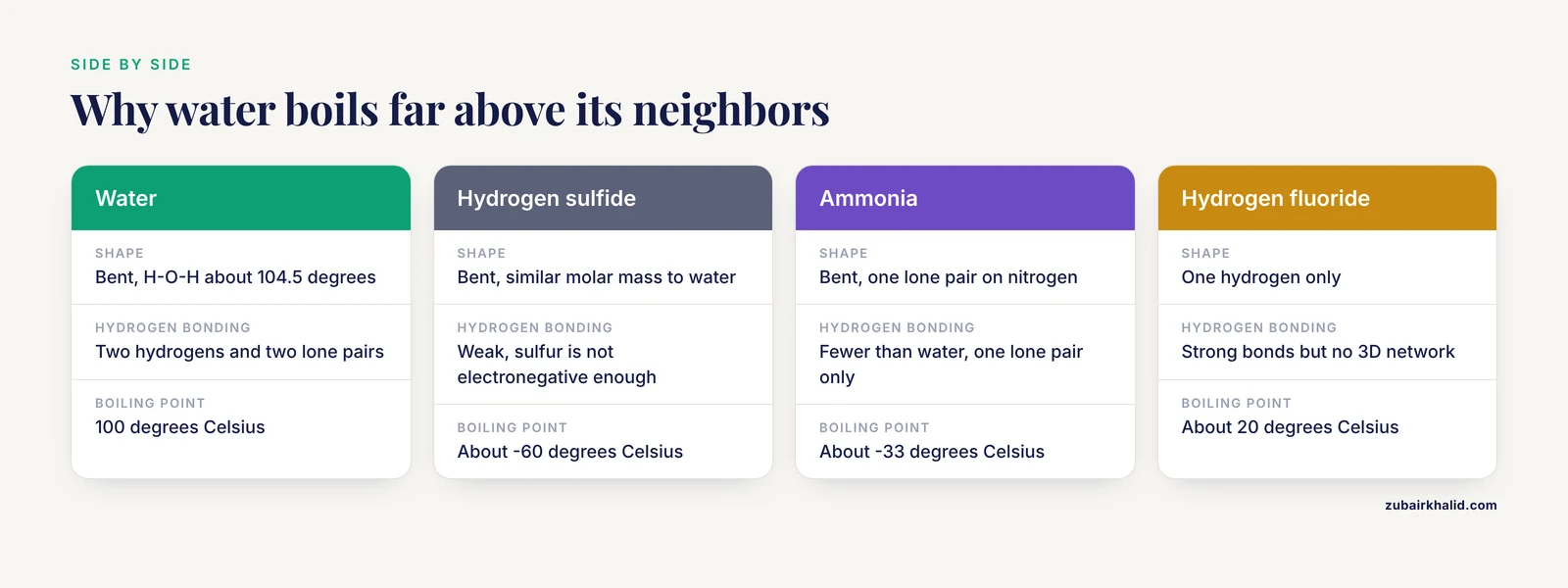
Water's properties look ordinary until you compare them with similar molecules. Hydrogen sulfide, H2S, has a similar bent shape and a molar mass close to water's, but it boils at about -60 degrees Celsius. The difference is hydrogen bonding. Oxygen is electronegative enough to make hydrogen bonds strong, and sulfur is not. Water is a liquid at room temperature, and hydrogen sulfide is a gas.
Ammonia, NH3, also forms hydrogen bonds and also has a bent shape, but each nitrogen has only one lone pair, so each ammonia molecule can donate and accept fewer hydrogen bonds than water can. Ammonia boils at about -33 degrees Celsius, far below water's 100 degrees Celsius.
Hydrogen fluoride, HF, forms strong hydrogen bonds, but each molecule has only one hydrogen, so it cannot build the same three-dimensional network. HF boils at about 20 degrees Celsius.
Within biology, water's polarity is what makes it such a good solvent for ions, sugars, amino acids, and nucleotides. Its high heat capacity buffers cells against temperature swings. Its high surface tension and cohesion allow capillary action in plant vascular tissue. Its density anomaly protects aquatic organisms in winter. Its ability to donate and accept hydrogen bonds lets it participate directly in enzyme catalysis, proton transfer, and the stabilization of protein and nucleic acid structure.
The same forces show up in materials science. Hydrogen bonding controls the adsorption of noncharged polymers to soil minerals [3]. It governs how water organizes around nanoparticles [9]. It can even be switched with an electric field at the atomic scale [6].
Misconceptions Students Hold
"Water is a linear molecule"
The most common error. Water is bent at about 104.5 degrees. A linear H-O-H geometry would give zero net dipole and none of water's characteristic properties. The bent shape is the direct result of the two lone pairs on oxygen.
"Hydrogen bonds are just like covalent bonds"
A hydrogen bond is roughly ten times weaker than a covalent O-H bond and does not share electrons in the same way. It is an electrostatic and partially orbital interaction between a polarized hydrogen and a lone pair. Its weakness is a feature, not a bug, because it allows the network to rearrange constantly.
"Water molecules are stationary in liquid water"
Liquid water is a dynamic system. Hydrogen bonds break and re-form on picosecond timescales, and molecules diffuse rapidly. Ice is the ordered state, not liquid water.
"Pure water conducts electricity well"
Pure water conducts very poorly. The current in tap water or seawater is carried by dissolved ions, not by intact water molecules. Water's polarity makes it a good solvent for ions, and dissolved ions are what conduct.
"All hydrogen bonds have the same strength"
Hydrogen bond strength depends on geometry, local environment, and the identity of the donor and acceptor. Hydration-shell water around a solute can have distinctly different hydrogen-bond energies from bulk water [4]. Confinement changes the network as well [5].
"Only oxygen can form hydrogen bonds"
Nitrogen and fluorine also act as hydrogen-bond partners. Ammonia, amines, amides, alcohols, and hydrogen fluoride all hydrogen-bond. The hydrogen bond concept is broader than water.
Quick Review
- A water molecule has one oxygen, two hydrogens, an O-H bond length near 0.96 angstrom, and an H-O-H angle near 104.5 degrees.
- The oxygen has four electron domains, two bonding pairs and two lone pairs, giving a roughly tetrahedral electron-pair geometry and a bent molecular geometry.
- The O-H bond is a polar covalent bond. Oxygen is much more electronegative than hydrogen, so the shared electrons sit closer to oxygen.
- Because the molecule is bent, the two bond dipoles do not cancel. The net dipole moment is about 1.85 debye.
- A hydrogen bond forms between a partially positive hydrogen on one molecule and a lone pair on another. Each water molecule can donate two and accept two.
- Hydrogen bonds in water are roughly 10 to 40 kJ/mol, far weaker than the covalent O-H bond but strong enough to shape the liquid.
- High heat capacity, high surface tension, the density anomaly, and strong solvent power all follow from the bent polar shape and the dynamic hydrogen-bond network.
Common Mistakes and Limitations
The first mistake is treating the 104.5-degree angle as a fixed number in every context. It is the gas-phase value. In liquid water, the angle varies slightly with hydrogen-bonding environment, and in ice it changes as the lattice forms. Models and simulations often fix the angle by design, which is a simplification rather than a measurement.
The second mistake is confusing the electron-pair geometry with the molecular geometry. The electron domains are roughly tetrahedral. The atoms themselves form a bent shape. Both statements are correct, and they describe different things.
The third mistake is assigning a single hydrogen-bond energy to water. In reality, the network contains a distribution of bond lengths, angles, and strengths. Hydration shells, interfaces, and confined pores each shift that distribution [4][5][8].
The fourth mistake is assuming that a water molecule model is the real molecule. Ball-and-stick models show bonds as rods and atoms as spheres, which misrepresents the continuous electron density. Space-filling models show relative atomic sizes more honestly but hide the bond axes. Electrostatic potential maps show charge distribution but not atomic positions. No single physical model shows everything, and a good answer often combines several representations.
The fifth mistake is overlooking timescale. A snapshot of a hydrogen-bond network is an average or an instant, not a permanent structure. Any claim that water "has" a fixed number of hydrogen bonds per molecule is a statement about a statistical average at a specific temperature and pressure.
The sixth mistake is overgeneralizing from one system. Confinement can reverse the usual relationship between hydrogen-bond strength and mobility [5]. Surface chemistry can change wetting behavior in ways that are easy to measure and hard to predict without knowing the surface groups [7]. Each new environment needs its own evidence.
Individual biological questions about water in a specific tissue, protein, or patient context require specialist judgment and, where health decisions are involved, a qualified clinician.
How to Calculate the Dipole Moment of Water: A Worked Example
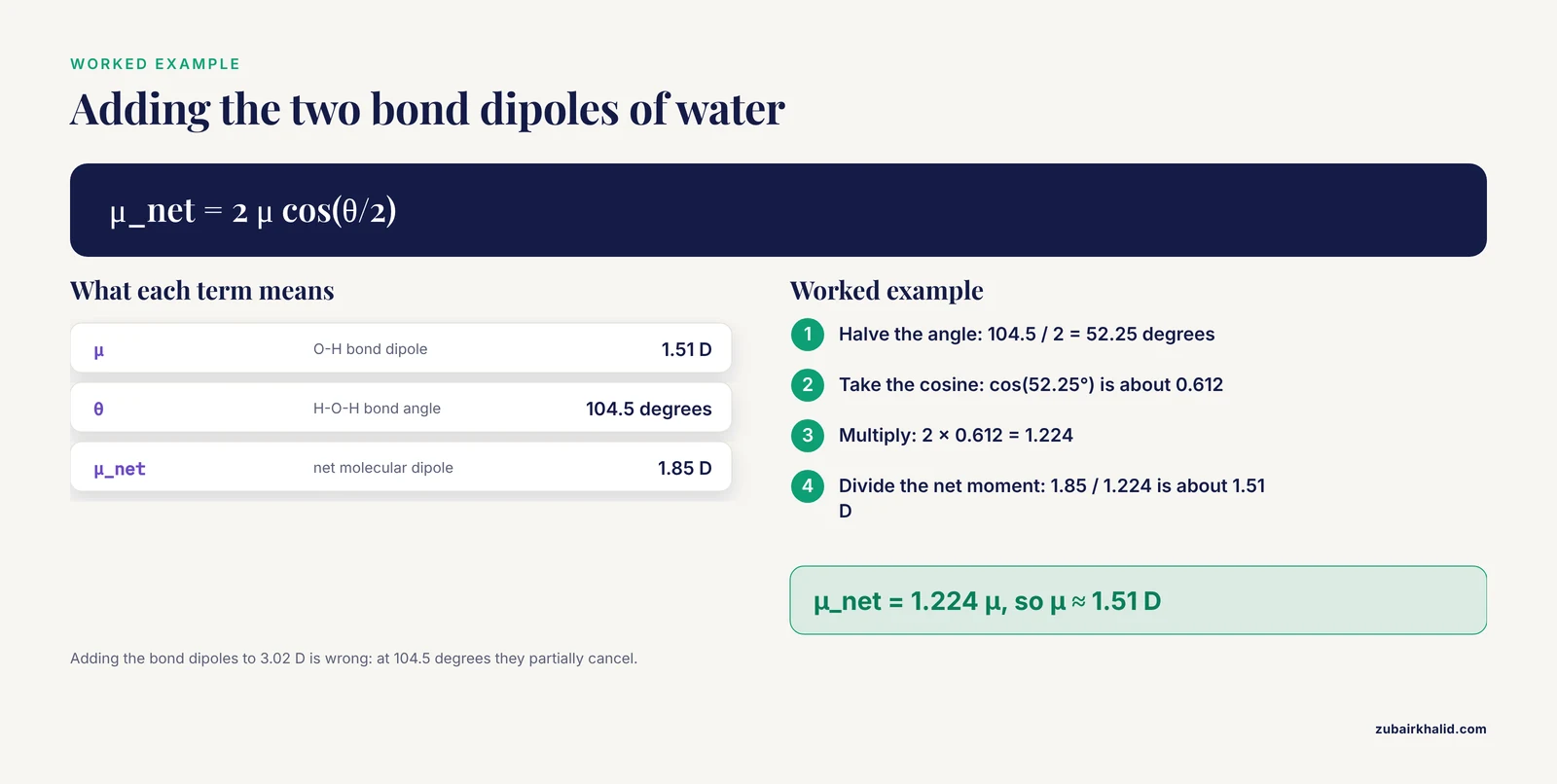
Treat each O-H bond as a vector. The vector's magnitude is the bond dipole moment, and its direction points from the hydrogen (positive end) toward the oxygen (negative end). The two vectors lie in the molecular plane and are separated by the H-O-H angle of 104.5 degrees.
For two equal vectors of magnitude μ at an angle θ, the resultant magnitude is:
μ_net = 2 μ cos(θ/2)
With θ = 104.5 degrees, θ/2 = 52.25 degrees and cos(52.25°) ≈ 0.612. So:
μ_net = 2 μ × 0.612 = 1.224 μ
Using the measured net dipole moment of 1.85 D, the implied O-H bond dipole is:
μ = 1.85 / 1.224 ≈ 1.51 D
The common mistake is to double the bond dipole: 1.51 + 1.51 = 3.02 D. That would be correct only if the two bond dipoles pointed in the same direction. Because they are at 104.5 degrees, the vectors partially cancel, and the resultant is much smaller.
The lone pairs on oxygen are not neutral bystanders. They carry negative charge on the oxygen side of the molecule, and their own dipole moments reinforce the net bond-dipole sum. The effective bond dipole of 1.51 D already reflects the strongly polarized electron distribution, so the simple vector addition reproduces the experimental 1.85 D moment.
Heating and Boiling Water: Worked Energy Calculations
Heating water to dry steam requires two energy inputs: warming the liquid to 100°C, then boiling it at constant temperature. The first step uses the specific heat capacity; the second uses the latent heat of vaporization.
Worked example: 250 mL of water from 20°C to dry steam
A 250 mL beaker of water has a mass of 250 g, since water's density is about 1 g/mL.
Step 1, warming: q = mcΔT = 250 g × 4.18 J/(g·K) × (100 - 20) K = 83,600 J = 83.6 kJ.
Step 2, boiling: q = mLv = 250 g × 2260 J/g = 565,000 J = 565 kJ.
Total energy: 83.6 kJ + 565 kJ = 648.6 kJ. Boiling consumes about 87% of the total, because the latent heat term is roughly seven times larger than the warming term. A hot plate must supply this energy to bring the beaker to dryness.
Common sign error: The same equations give negative q when water cools or steam condenses. For condensation, q = 250 g × (-2260 J/g) = -565 kJ; the negative sign means heat is released to the surroundings. Students often drop the sign. In warming, ΔT = +80 K; in cooling, ΔT = -80 K. The sign of q must always match the direction of energy flow.
Why Salt Dissolves in Water: A Step-by-Step Look at NaCl
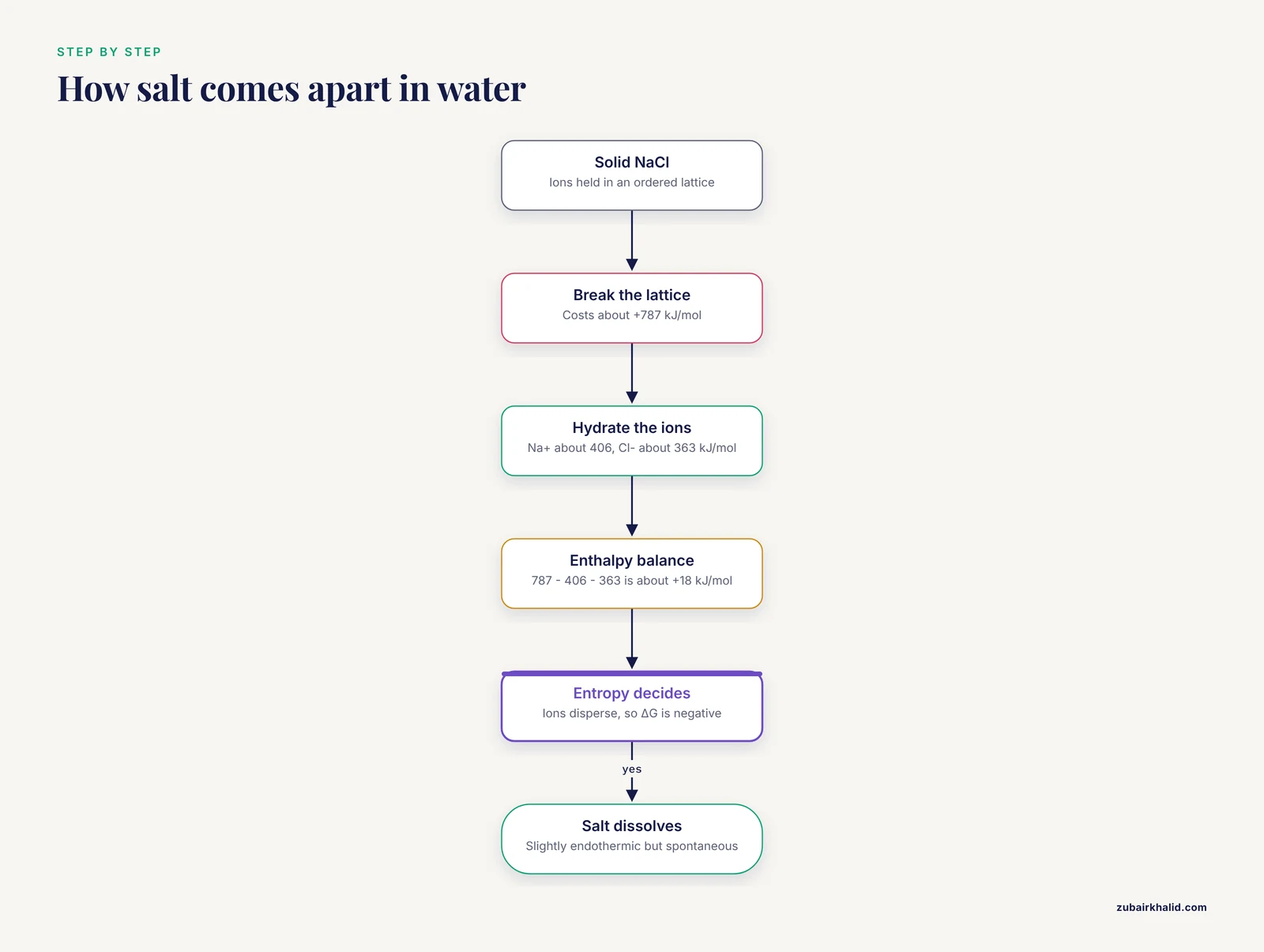
Separating solid NaCl into gas-phase ions costs energy. The lattice enthalpy is roughly +787 kJ/mol, an endothermic step. Hydrating those ions releases energy: about 406 kJ/mol for Na+ and 363 kJ/mol for Cl-. The balance is:
ΔH_solution ≈ 787 - 406 - 363 ≈ +18 kJ/mol
So dissolving NaCl is slightly endothermic, not strongly favored by enthalpy alone.
Entropy supplies the rest. Ions leave an ordered lattice and disperse through solution, and water molecules rearrange into hydration shells. The overall free energy change, ΔG = ΔH - TΔS, is negative at room temperature because the entropy term outweighs the small positive enthalpy.
This is where "like dissolves like" falls short. The phrase correctly predicts that polar water will interact with charged ions, but it does not explain the outcome by itself. NaCl dissolves because ion-dipole hydration nearly offsets the lattice energy and because dispersion of ions raises entropy. A nonpolar solvent cannot hydrate ions well, so its lattice balance stays unfavorable. "Like dissolves like" is a useful first guess, not a thermodynamic explanation.
Related Guides
- How to Identify Hydrogen Bonds in Protein-Ligand Complexes: A Step-by-Step Guide Using PyMOL and PLIP: Guide to identifying hydrogen bonds in protein-ligand complexes
- Nucleotide Molecule: Structure, Types, and Functions in DNA and RNA: Nucleotide molecule structure and functions in DNA and RNA
- Rna Molecule: RNA molecule structure and functions related to nucleic acids
- Dna Molecule: DNA molecule structure and biological role in nucleic acids
- Disulfide Bond: Formation, Structure and Function: Disulfide bond formation and protein structure compared with hydrogen bonds
- Helicase Break Hydrogen Bonds: Mechanism and Role in DNA Replication: Helicase mechanism shows hydrogen bonds breaking during DNA replication
- DNA Ligase Form Hydrogen Bonds: Mechanism and Role in Replication: DNA ligase mechanism shows hydrogen bond formation in replication
- RNA Polymerase Breaking Hydrogen Bonds: Mechanism and Role: RNA polymerase mechanism illustrates hydrogen bond breaking during transcription
Frequently Asked Questions
Why is a water molecule bent?
The two lone pairs on oxygen occupy more space than the bonding pairs, so they push the two O-H bonds closer together than a tetrahedral angle would allow. The result is an H-O-H angle of about 104.5 degrees instead of 109.5 degrees.
Why is water a polar molecule?
Oxygen is much more electronegative than hydrogen, so the shared electrons in each O-H bond sit closer to oxygen. Because the molecule is bent, the two bond dipoles do not cancel, and the molecule has a net dipole moment of about 1.85 debye.
How many hydrogen bonds can one water molecule form?
One water molecule can donate two hydrogen bonds through its hydrogens and accept two through its oxygen lone pairs. In ice it typically forms four. In liquid water the average is lower, roughly three to four, because the network is dynamic and distorted.
Are hydrogen bonds stronger or weaker than covalent bonds?
Hydrogen bonds are much weaker. A hydrogen bond in water is roughly 10 to 40 kJ/mol, while the covalent O-H bond is about 460 kJ/mol. That difference is why hydrogen bonds can break and re-form constantly while the water molecule itself stays intact.
Why does ice float on liquid water?
The hydrogen-bond network in ice is more open and tetrahedral than the disordered network in liquid water, so ice has a lower density. Water reaches its maximum density near 4 degrees Celsius and becomes less dense as it freezes.
Is the water molecule model the same as the real molecule?
No. A model is a representation that emphasizes selected features. Ball-and-stick models show bond directions, space-filling models show relative atomic volumes, and electrostatic potential maps show charge distribution. Each leaves something out, and none replaces the physical molecule.
Sources
- Understanding the Chemistry of Water: Implications for Life
- A Roaming-like Mechanism for Hydrogen Bond Network Rearrangements in Water Clusters.
- Molecular Structure and Conformation of Biodegradable Water-Soluble Polymers Control Adsorption and Transport in Model Soil Mineral Systems
- Hydration Shell Structure and Water-Mediated Binding of Closo-Dodecaborates Probed by Raman Hydration-Shell Spectroscopy.
- Balance between Geometric Confinement and Hydrogen Bond Strength Controls Water Dynamics in 2D hBN Nanopores.
- Electric-field control of hydrogen bonding via interfacial charge at atomic resolution
- Plasma surface modification of P(VDF-TrFE): Influence of surface chemistry and structure on electronic charge injection
- Computational studies of pressure, temperature, and surface effects on the structure and thermodynamics of confined water.
- Nanodiamonds in Filtration and Adsorption Systems: Structure-Property Relationships, Immobilization Strategies, and Emerging Applications.