Are Button Mushrooms Toxic to Cats?
By Dr. Zubair Khalid, DVM, MS, PhD ·
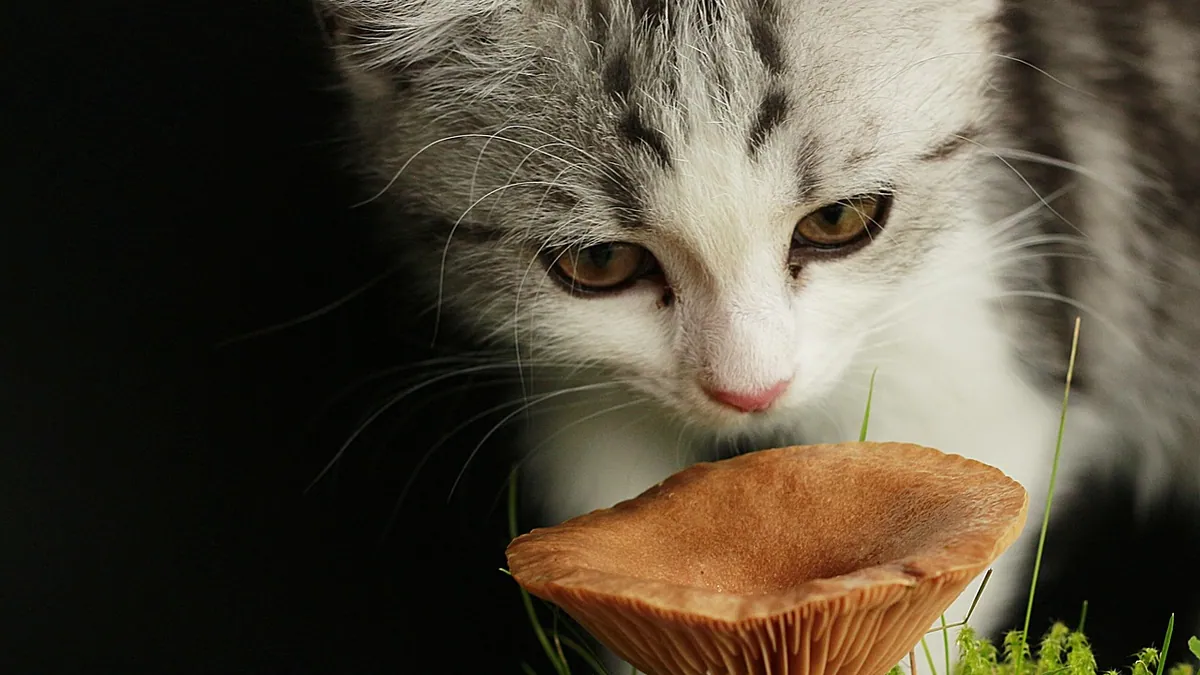
Are button mushrooms toxic to cats? Plain, store-bought button mushrooms (Agaricus bisporus) are not toxic to cats, and a small piece is unlikely to cause harm. The real danger comes from wild mushrooms that look similar, and from mushrooms cooked with garlic, onion, butter, or oil. If you are not certain what your cat ate, treat it as an emergency.
This article is educational and is not a substitute for veterinary diagnosis or treatment.
Quick Answer
- Plain white or brown button mushrooms from the grocery store are not poisonous to cats, but they are not a food your cat needs.
- Any mushroom growing outdoors should be treated as toxic, because many poisonous species look identical to safe ones [1][2].
- Mushrooms cooked with garlic, onion, shallots, or rich fats are a different and more serious problem than the mushroom itself.
- Signs of mushroom poisoning can start within 15 to 30 minutes, or take up to 24 hours to appear [1].
- If your cat ate any mushroom you did not buy at a store, call a veterinarian or a poison control line right away.
Are Button Mushrooms Toxic to Cats?
No. The common button mushroom sold in American grocery stores is not toxic to cats. The same is true for cremini and portobello mushrooms, which are the same species at different stages of growth.
That does not make mushrooms a good cat food. Cats are obligate carnivores, meaning they need nutrients from animal tissue. A mushroom offers little of value to them. A small nibble off your plate is not a poisoning emergency, but it is also not a treat you should offer on purpose.
The picture changes completely when the mushroom did not come from a store. North America has more than 100 poisonous mushroom species, and many of them look like the edible ones [2]. The species responsible for most confirmed poisonings are in the Amanita, Galerina, and Lepiota groups [1]. Because identification is so hard, the standard advice from veterinary toxicologists is simple. Assume every wild mushroom your cat encounters is poisonous [1][2].
Which Parts and Products Matter
The mushroom cap, stem, and gills all carry the same risk in a toxic species. Cooking does not destroy mushroom toxins. Drying does not either.
What you serve the mushroom with often matters more than the mushroom. Garlic and onion damage a cat's red blood cells and can cause anemia. These alliums are toxic to cats in any form, raw, cooked, powdered, or in broth. A mushroom sautéed in garlic butter is a double exposure.
There is also a rare allergy issue. A published case described a person who developed facial swelling, lip swelling, trouble breathing, and trouble swallowing within minutes of eating button mushrooms, confirmed by allergy testing to Agaricus bisporus proteins [3]. Food allergy to mushrooms in cats is not well established in veterinary research, but sudden swelling or breathing trouble after any food should be treated as an emergency.
The Toxic Principle and What It Does in the Body
Mushroom toxins are not one substance. Different species carry different poisons that attack different organs.
The Amanita, Galerina, and Lepiota groups are the ones veterinarians worry about most [1]. Some members of these groups contain amatoxins, which shut down the liver. Others cause severe gastrointestinal damage. Signs may be delayed for many hours, which is what makes these cases so dangerous. A cat can look fine at dinner and be critically ill by morning.
Cortinarius mushrooms carry a different toxin called orellanine. This compound is nephrotoxic, meaning it damages the kidneys [4]. Research on orellanine has compared its behavior in the body to paraquat and diquat, two well known chemical poisons, and found the toxicity comparable [4]. Kidney damage from Cortinarius can appear days after the meal, long after an owner has stopped worrying.
Other mushrooms cause milder problems. Some trigger vomiting and diarrhea within a couple of hours. Others affect the nervous system and cause wobbling, tremors, or strange behavior.
A large retrospective study of 421 mushroom ingestions in dogs found that about 45% of the mushrooms involved turned out to be non-poisonous [5]. The most common toxin groups were gastrointestinal mushrooms, then muscarinic mushrooms, then mushrooms containing isoxazoles [5]. About 64% of those cases were managed at home, 33% were hospitalized and treated, and 3% were observed by a veterinarian without treatment [5]. The survival rate was 98.6% [5]. Those numbers come from dogs, not cats, so they should be read as general context. Cats are smaller and often more sensitive to toxins, and a cat that eats a mushroom deserves the same caution.
One more point about cats specifically. Feline metabolism handles many chemicals differently from dogs and people. Laboratory work on feline cells has shown that cats can be more sensitive to certain naturally occurring compounds than dogs are [6], and models built to predict toxicity in cats confirm that this species has unique metabolic sensitivities [7]. This is a general principle, not a mushroom-specific finding, but it supports erring on the side of caution.
Signs of Mushroom Poisoning in Cats and Their Timeline
Signs depend on the mushroom and the toxin. Watch for any of these after a possible exposure.
- Vomiting, with or without food or mushroom pieces
- Diarrhea
- Drooling or excessive salivation
- Lethargy or weakness
- Loss of appetite
- Wobbling, stumbling, or trouble walking
- Tremors or muscle twitching
- Dilated pupils or changes in vision
- Yellow tint to the gums, skin, or whites of the eyes (a liver sign)
- Increased thirst and urination, or a sudden drop in urination (kidney signs)
- Collapse, seizures, or difficulty breathing
Timing varies widely. Some mushrooms cause signs within 15 to 30 minutes of ingestion, while others take up to 24 hours to show any effect [1]. Liver and kidney toxins often have the longest delay, which is exactly why a cat that seems fine right after eating a wild mushroom still needs veterinary attention.
If you see collapse, seizures, trouble breathing, or uncontrolled bleeding, go to an emergency clinic now. Do not wait for a callback.
What to Do Right Now If Your Cat Ate a Mushroom
Stay calm and act in order.
- Move your cat away from the mushroom source and remove any remaining pieces from reach.
- Look at what is left. Note the color, size, cap shape, gills, and where it was growing. Take a photo. Do not eat it or taste it yourself.
- Call your veterinarian, an emergency veterinary clinic, the ASPCA Animal Poison Control Center at (888) 426-4435, or Pet Poison Helpline at (855) 764-7661. Have your cat's weight, age, and health history ready.
- Follow their instructions exactly.
- Do not induce vomiting unless a veterinarian tells you to. Making a cat vomit at home can cause aspiration, choke injuries, or worse, and some toxins cause more damage coming back up.
- Do not give food, milk, oil, charcoal, or any home remedy unless a veterinarian directs it.
- Keep the mushroom sample in a paper bag or a sealed container if you can, and bring it with you.
If the mushroom came from a grocery store package and your cat ate a small plain piece with no garlic, onion, or seasoning, a call to your veterinarian is still the right first step. They can tell you whether monitoring at home is reasonable for your cat.
For other household exposures, our guide on what to do when a cat ate a cleaning product walks through the same call-first approach.
Veterinary Treatment for Mushroom Ingestion
Treatment depends on how much time has passed and what your cat is doing.
If your cat is seen quickly and is stable, the veterinarian may induce vomiting in the clinic under controlled conditions, then give activated charcoal to bind remaining toxin. They may also wash the stomach contents out in some cases.
If signs have already started, treatment turns to support. That often means intravenous fluids, medications to control vomiting, medications for tremors or seizures, and blood work to track liver and kidney values. Some cats need oxygen or a warm, quiet hospital setting.
There is no universal antidote for mushroom poisoning. For orellanine, the toxin in Cortinarius species, research on related compounds suggests that blood purification techniques such as haemoperfusion may be a reasonable treatment even several days after ingestion [4]. Your veterinarian will decide whether that kind of intervention is appropriate for your cat.
Doses of any medication are calculated by your veterinarian based on your cat's weight, kidney and liver function, and current signs. Never give a human medication to a cat without veterinary direction.
Outlook After a Cat Eats a Mushroom
The outlook is good for most cats that eat a plain button mushroom. A small piece of a grocery store mushroom with no seasoning rarely causes more than an upset stomach, and many cats show no signs at all.
The outlook is much less predictable when the mushroom was wild. The dog data showed a 98.6% survival rate overall, but that population included many non-poisonous mushrooms and many cases managed at home [5]. Deaths in that study were linked to specific toxic species [5]. Cats are smaller than most dogs, so the same amount of toxin represents a larger dose per pound of body weight.
The single biggest factor in outcome is time to treatment. Cats brought in early, before organ damage sets in, do far better than cats brought in after two or three days of vomiting and lethargy.
Prevention and Safer Alternatives
Prevention is straightforward.
- Keep your cat indoors, or supervise outdoor time closely. Pet Poison Helpline specifically recommends monitoring your cat's activity outdoors to prevent poisoning incidents [1].
- Walk your yard after rain and remove any mushrooms before your cat goes out.
- Never let your cat sample a wild mushroom, even one you think you recognize.
- Store mushrooms for cooking in a closed container, out of reach.
- Do not feed your cat mushrooms as a treat. There is no nutritional reason to do it.
- Keep garlic, onion, shallots, chives, and leeks away from your cat in all forms.
If you want to give your cat a small piece of something from your plate, choose a plain cooked meat with no seasoning. That fits a carnivore's biology and avoids the whole question.
If you are checking your home for other risks, our articles on plants toxic to cats and house plants toxic to cat cover the common indoor offenders. Two popular houseplants that are actually safe are covered in are orchids toxic to cats, while are snake plants toxic to cats explains a plant many owners assume is harmless.
Limitations and When to Contact a Veterinarian
Mushroom identification from a photo or a description is unreliable, even for experts. A veterinarian cannot tell you a wild mushroom is safe without a confirmed identification, and most clinics do not have that service on hand. That uncertainty is the reason the standard guidance is to treat every wild mushroom as poisonous [1][2].
Contact a veterinarian the same day if your cat ate a store-bought plain button mushroom and now has vomiting, diarrhea, drooling, or seems off. Contact a veterinarian the same day even if your cat seems fine but ate a wild mushroom, because delayed toxins can take up to 24 hours to show signs [1].
Go to an emergency clinic now if your cat is collapsing, having seizures, breathing with effort, bleeding from the gums or nose, or has a yellow tint to the eyes or gums.
Schedule a routine visit if your cat had a mild stomach upset days ago that resolved, but you want blood work to confirm liver and kidney values are normal.
Every case is different. Your cat's age, weight, other health conditions, and the amount eaten all change the plan. Only a veterinarian who examines your cat can decide what is right for your pet.
Frequently Asked Questions
Can my cat eat a piece of a raw button mushroom?
A small piece of a plain raw button mushroom is not toxic, but it offers your cat nothing nutritionally. Raw mushrooms can be tough to chew and may cause mild stomach upset. Skip it and offer a plain cooked meat instead.
What if my cat licked mushroom sauce with garlic in it?
Garlic is toxic to cats and can damage red blood cells, so this is a real exposure even if the mushroom itself was safe. Call your veterinarian or a poison control line and describe how much sauce was involved. Do not wait for signs to appear.
How long after eating a mushroom would my cat get sick?
It depends on the species. Some mushrooms cause signs within 15 to 30 minutes, while others take up to 24 hours to produce any visible effect. Because of that delay, a cat that looks normal right after eating a wild mushroom still needs a veterinary call.
Can I make my cat throw up at home?
No, not unless a veterinarian tells you to. Home induction can cause choking, aspiration into the lungs, and injury, and it is the wrong move for some toxins. Call your veterinarian or a poison control line first and let them direct you.
Are dried or cooked mushrooms safer than raw ones?
No. Cooking and drying do not remove mushroom toxins, so a poisonous mushroom stays poisonous after it is prepared. The only reliable safety step is knowing the mushroom came from a store package meant for human consumption, with no garlic or onion added.
Related Articles
- Are Orchids Toxic To Cats
- Plants Toxic To Cats
- Are Snake Plants Toxic To Cats
- House Plants Toxic To Cat
- Cat Ate a Cleaning Product: Immediate Steps and Toxicity Risks
- Flowers That Are Toxic To Cats
- Are Wild Mushrooms Toxic to Cats? What to Do
- Is Truffle Mushroom Toxic to Cats? What to Know
- Can Cats Eat Mushrooms? Raw, Cooked, and Pizza Risks
References
- Are Mushrooms Bad for Cats. Pet Poison Helpline.
- Can Cats Eat Mushrooms. Pet Poison Helpline.
- Anaphylaxis to Agaricus bisporus ingestion. Einstein (Sao Paulo, Brazil), 2020.
- Mushroom poisoning caused by species of the genus Cortinarius Fries. Archives of toxicology, 1983.
- A retrospective evaluation of mushroom ingestions in 421 dogs in Norway (2011-2022). Veterinary record open, 2023.
- In vitro immunotoxicity of important mycotoxins detected in commercial dry dog and cat food in relation to internal exposure. Mycotoxin research, 2026.
- Predictive q-RASAR modeling of intrinsic toxicity of pharmaceuticals and bioactive compounds in cats. Journal of hazardous materials, 2026.