Can Dogs Get FIV or FIP? Why These Cat Viruses Don't Affect Dogs
By Dr. Zubair Khalid, DVM, MS, PhD ·
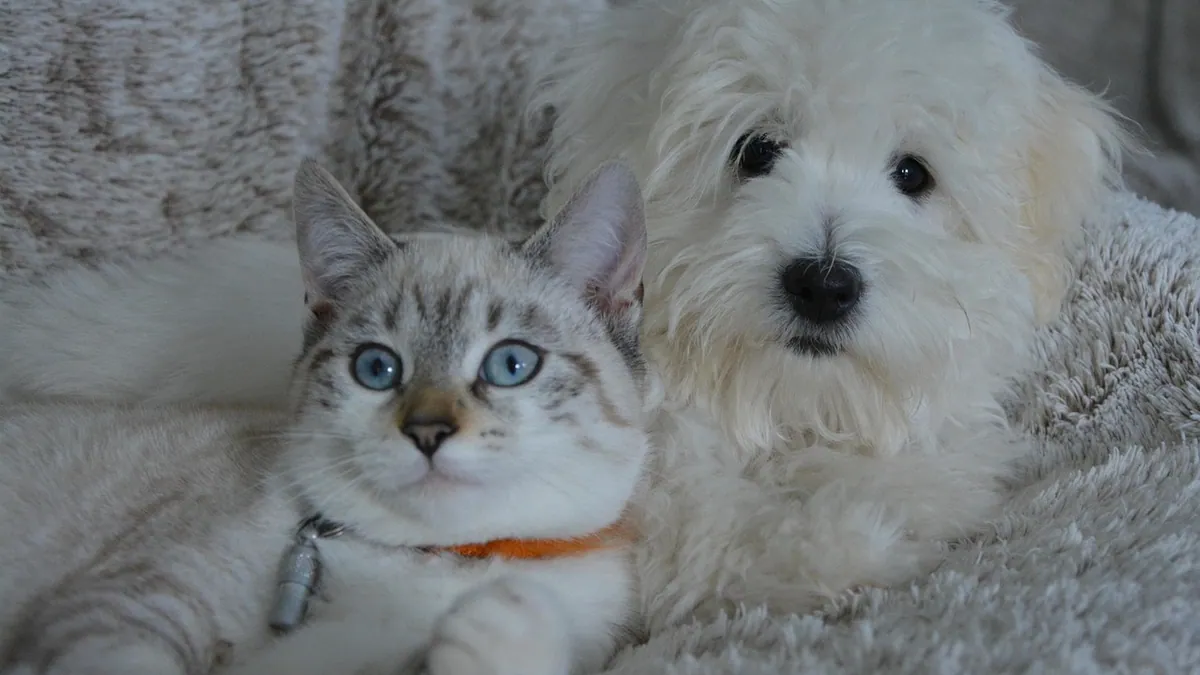
Can dogs get FIP? No. Feline infectious peritonitis (FIP) and feline immunodeficiency virus (FIV) are cat diseases caused by viruses that infect cats, not dogs. Your dog cannot catch either one from a cat in your home, even after a bite, a shared water bowl, or years of close contact.
This article is educational and is not a substitute for veterinary diagnosis or treatment.
Quick Answer
- Dogs cannot get FIP or FIV. These viruses are species-specific and only infect cats (and some wild felids) [1][2].
- FIP is caused by a mutated feline coronavirus. It does not infect dogs or people [3].
- FIV spreads mainly through deep bite wounds between cats, not through casual contact like grooming or sharing bowls [1].
- If your dog is sick after contact with a cat, the cause is something else. Dogs have their own versions of immune and infectious diseases.
- Keep the cat's litter box, food, and water separate from your dog's, and schedule routine vet visits for both species.
What Are FIP and FIV in Plain Words?
FIP stands for feline infectious peritonitis. It is a severe, usually fatal disease caused by a feline coronavirus [3]. Most cats that encounter feline coronavirus either fight it off or develop only mild intestinal signs. In a small number of cats, the virus mutates inside the body and triggers an intense immune reaction that causes inflammation throughout the body [3]. This is FIP.
FIV stands for feline immunodeficiency virus. It attacks the cat's immune system, leaving the cat vulnerable to other infections over time [1]. An FIV-positive cat may look completely normal for months or years before immune problems appear [2]. Once infected, a cat stays infected for life [2].
Neither virus is a dog virus. The "F" in both names stands for feline, and that is not a coincidence. These viruses evolved to attach to receptors found on cat cells. Dog cells do not offer the same docking sites.
Can Dogs Get FIP? The Species Barrier Explained
The short answer is no. Feline coronavirus, the virus that leads to FIP, infects cats. It does not infect dogs [3]. Even in households where a cat has confirmed FIP, the dog is not at risk of catching it.
The same is true for FIV. FIV is spread from cat to cat through saliva, primarily by biting [2]. A dog that lives with an FIV-positive cat will not develop FIV, even if the cat has bitten the dog during play or a scuffle.
This is why you will not find a diagnosis of "FIP in dogs" in veterinary medicine. There is no canine FIP. There is also no canine FIV. When owners search for an "FIV equivalent in dogs," the closest comparisons are different diseases entirely, such as canine distemper or canine parvovirus, which are caused by their own species-specific viruses.
If you are curious how this works with other cat viruses, the same principle applies to Can Dogs Get Cat Parvo. The parvovirus that affects cats is not the same virus that causes severe illness in dogs.
Signs Owners Notice in an Affected Cat
Since your dog cannot get these diseases, the signs you need to watch for are in your cat, not your dog. Knowing what to look for helps you get the cat to a veterinarian sooner.
FIP signs
FIP can appear in two main forms. The "wet" or effusive form causes fluid to build up in the belly or chest. You might notice a swollen abdomen, difficulty breathing, or lethargy. The "dry" or non-effusive form causes inflammation in organs such as the kidneys, liver, or eyes, and may cause weight loss, poor appetite, fever that comes and goes, or neurological signs.
FIP is most frequent in cats 6 months to 2 years old, though cats of any age can develop it [3]. Purebred cats, including Persian, Abyssinian, Bengal, Birman, Himalayan, Ragdoll, and Rex breeds, are more likely to be affected [3].
FIV signs
Early FIV infection may cause a brief fever and enlarged lymph nodes, but these signs often fade and the cat can look healthy for a long time [2]. Later, you may see chronic gum or mouth inflammation, digestive problems, urinary tract infections, skin infections, or weight loss [2]. FIV-infected cats also have a higher risk of certain blood cancers [2].
Causes and Risk Factors
How FIP develops
FIP starts with feline coronavirus. Many cats carry this virus without ever developing FIP. The severe form is thought to result from a mutation within the virus combined with an inappropriate immune response in that individual cat [3]. Kittens raised in infected colonies may pick up the virus from their mothers or from carrier cats when maternal immunity drops at 5 to 6 weeks of age [3].
Recent research has looked at specific mutations in the virus's spike protein, such as M1058L and S1060A, that may help the virus spread through the body [4]. Scientists still debate how much these mutations matter, since they have also been found in cats without FIP [4].
How FIV spreads
The primary route is bite wounds from an infected cat [1]. Casual, non-aggressive contact such as sharing water bowls or mutual grooming does not appear to spread the virus efficiently [1]. Cats in stable households where nobody fights are at little risk [1]. Sexual contact is not a significant means of spread among cats [1]. Outdoor cats, male cats, and older cats are more likely to become infected [2].
Risk factors for your dog
Your dog's risk is zero for these two viruses. The real risk in a multi-pet home is stress, competition for resources, and the chance that a cat with FIV passes the virus to another cat through fighting.
| Disease | Caused by | Species affected | Can a dog catch it? |
|---|---|---|---|
| FIP | Feline coronavirus (mutated form) | Cats, some wild felids | No [3] |
| FIV | Feline immunodeficiency virus | Cats, some wild felids | No [1][2] |
| Canine distemper | Canine distemper virus | Dogs, ferrets, wildlife | Not from cats |
| Canine parvovirus | Canine parvovirus | Dogs | Not from cats |
How FIP and FIV Are Diagnosed
Diagnosis happens in the cat, not the dog. If your cat has signs that worry you, your veterinarian will start with a physical exam and blood work.
For FIP, diagnosis is challenging because no single test confirms it. Veterinarians combine history, physical findings, blood tests, imaging, and sometimes fluid analysis. Newer research has explored serum exosomal miRNA signatures as a potential non-invasive diagnostic tool, with one combined model showing an area under the curve of 0.93, sensitivity of 88.6%, and specificity of 91.2% [5]. These tools are still developing and are not yet standard in every clinic.
For FIV, testing usually involves a blood test that detects antibodies to the virus. If you want to understand the difference between rapid in-clinic tests and laboratory PCR testing, this article explains it well: Feline Leukemia FeLV and FIV Testing: Snap Tests vs PCR Differences.
Your dog does not need testing for FIP or FIV. If your dog has symptoms, your veterinarian will look for canine diseases.
Treatment Options
FIP treatment in cats
FIP was once considered uniformly fatal, but antiviral treatments have changed that. In one study of 100 cats with FIP treated with oral GS-441524, the 42-day treatment success rate was 94% [6]. Another study of 17 cats that were positive for FeLV or FIV and had effusive FIP found a 94% twelve-week survival rate and an 82% one-year survival rate after GS-441524 treatment [7].
Researchers are also testing new antivirals. VV116 showed potent activity against FIP virus in laboratory cells and improved survival to 75% in experimentally infected cats [8]. CLEVir-X, another experimental antiviral, improved survival and stabilized clinical parameters in cats when given orally starting 5 days after infection [9].
Some cats with FIP develop kidney abnormalities during illness. A study of 80 cats treated with GS-441524 found that treatment reversed many of these renal abnormalities and reduced inflammation [10]. Your veterinarian will monitor organ function during treatment.
Doses for these medications are calculated by the veterinarian based on the cat's weight, the form of FIP, and response to treatment. Never adjust a dose on your own.
FIV treatment in cats
There is no cure for FIV [1]. Treatment focuses on managing secondary infections, supporting the immune system, and keeping the cat indoors to reduce exposure to other illnesses. Many FIV-positive cats live average life spans as long as they are not also infected with feline leukemia virus [1].
Treatment for dogs
There is nothing to treat because dogs do not get these diseases. If your dog is ill, your veterinarian will investigate canine causes.
Recovery, Outlook, and Long-Term Management
For cats with FIP, the outlook has improved dramatically with antiviral therapy. Some cats relapse and need longer or higher-dose treatment [7]. Regular follow-up blood work helps your veterinarian catch relapse early.
For cats with FIV, the goal is a stable, low-stress indoor life. Feed a balanced diet, keep up with parasite prevention, and treat dental disease promptly. Cats with FIV should see a veterinarian at least twice a year for early detection of problems.
For your dog, long-term management means routine wellness care. Keep vaccinations current, use flea, tick, and heartworm prevention, and watch for any changes in appetite, energy, or behavior.
If you have a multi-pet household, feed pets in separate areas and provide enough resources so nobody feels they have to compete. This reduces stress and the chance of fights.
Prevention
Protecting your cat from FIP
Feline coronavirus spreads easily among cats, especially in crowded or stressful environments. Keeping your cat indoors, cleaning litter boxes daily, and reducing crowding can lower exposure. There is no vaccine that reliably prevents FIP in the United States.
Protecting your cat from FIV
The best prevention is keeping your cat indoors and away from unknown cats that may bite. If you introduce a new cat, test for FIV and FeLV before mixing households. Spaying and neutering reduces roaming and fighting, which lowers bite-wound risk.
Protecting your dog
Your dog needs no special protection from FIP or FIV. Focus on canine-specific prevention: vaccinations, parasite control, and regular checkups. If your dog has contact with other dogs, ask your veterinarian about vaccines for canine respiratory diseases and other regional risks.
If you are also wondering about other cross-species viruses, these articles may help: Can Dog Get Herpes and Can Dogs Get Sexually Transmitted Diseases.
Limitations and When to Contact a Veterinarian
No article can replace an exam of your actual pet. Individual cases need a veterinarian who can see the animal, run tests, and tailor treatment.
Contact your veterinarian the same day if your cat has a swollen abdomen, trouble breathing, persistent fever, weight loss, or a sudden change in appetite or energy. These signs could point to FIP or another serious condition.
Go to an emergency clinic now if your cat is open-mouth breathing, collapsing, having seizures, or seems unable to get comfortable. Breathing difficulty in a cat with possible FIP can worsen quickly.
Schedule a routine visit if your cat has chronic bad breath, bleeding gums, recurrent skin infections, or lingering digestive issues. These can be signs of FIV-related immune problems [2].
For your dog, call your veterinarian if you notice vomiting, diarrhea, lethargy, coughing, or any change that lasts more than a day or two. Do not assume a dog illness is linked to the cat's diagnosis. It almost certainly is not.
Frequently Asked Questions
Can dogs get FIP from a cat?
No. FIP is caused by a feline coronavirus that infects cats, not dogs [3]. Even in a home with a cat that has confirmed FIP, your dog is not at risk of developing the disease.
Is FIP in cats contagious to dogs?
No. The virus that causes FIP does not infect dogs [3]. It spreads among cats, and even then, most cats exposed to feline coronavirus do not develop FIP.
Can FIV in cats spread to dogs?
No. FIV spreads from cat to cat through saliva, primarily by biting [2]. Dogs do not become infected, even if a cat bites them.
Is there an FIV equivalent in dogs?
Dogs have their own immune-suppressing and infectious diseases, but none are caused by FIV. Canine distemper and canine parvovirus are examples of serious dog viruses with no connection to FIV.
Do dogs get FIP?
No. There is no canine form of FIP. If your dog is sick, the cause is a dog disease, and your veterinarian should evaluate it.
Related Articles
- Can Dog Get Herpes
- Can Dogs Get Cat Parvo
- Can A Dog Have Herpes
- Feline Leukemia FeLV and FIV Testing: Snap Tests vs PCR Differences
- Can Dog Get Sexually Transmitted Diseases
- Why Is My Dog Pooping blood? HGE, Parvovirus & Emergency Protocol
- Can Dogs Get Feline Leukemia Virus? What Owners Should Know
- Can Cat Flu Spread to Dogs? What Owners Should Know
- Can Dogs Get Cat Herpes or Kennel Cough From Cats?
- Feline Coronavirus And Fip
References
- Feline Immunodeficiency Virus (FIV). Cornell University College of Veterinary Medicine.
- Feline Immunodeficiency Virus (FIV) - Cat Owners. Merck Veterinary Manual.
- Feline Infectious Peritonitis (FIP) - Cat Owners. Merck Veterinary Manual.
- Single-site mutation (M1058L) of feline infectious peritonitis virus (FIPV) spike protein in domestic cats of Northern Vietnam. Archives of virology, 2026.
- The value of serum exosomal miRNA signature profiles for the early diagnosis of feline infectious peritonitis. Experimental biology and medicine (Maywood, N.J.), 2026.
- Viral Coinfections Potentially Associated with Feline Chronic Gingivostomatitis in Cats with Feline Infectious Peritonitis. Viruses, 2025.
- Clinical Features and Outcomes of Treatment for Effusive Feline Infectious Peritonitis with GS-441524 in Seventeen Retrovirus-Positive Cats. Pathogens (Basel, Switzerland), 2026.
- VV116 exerts potent efficacy against feline infectious peritonitis. Veterinary microbiology, 2026.
- Antiviral efficacy and therapeutic potential of the novel nucleoside analog CLEVir-X against feline infectious peritonitis virus in vitro and in vivo. Microbial pathogenesis, 2026.
- EXPRESS: Renal Health in Cats with Feline Infectious Peritonitis treated with GS-441524: Baseline Findings and Longitudinal Effects. Journal of feline medicine and surgery, 2026.