Do Cockatiels and Parrots Pass the Mirror Test? Self-Awareness
By Dr. Zubair Khalid, DVM, MS, PhD ·
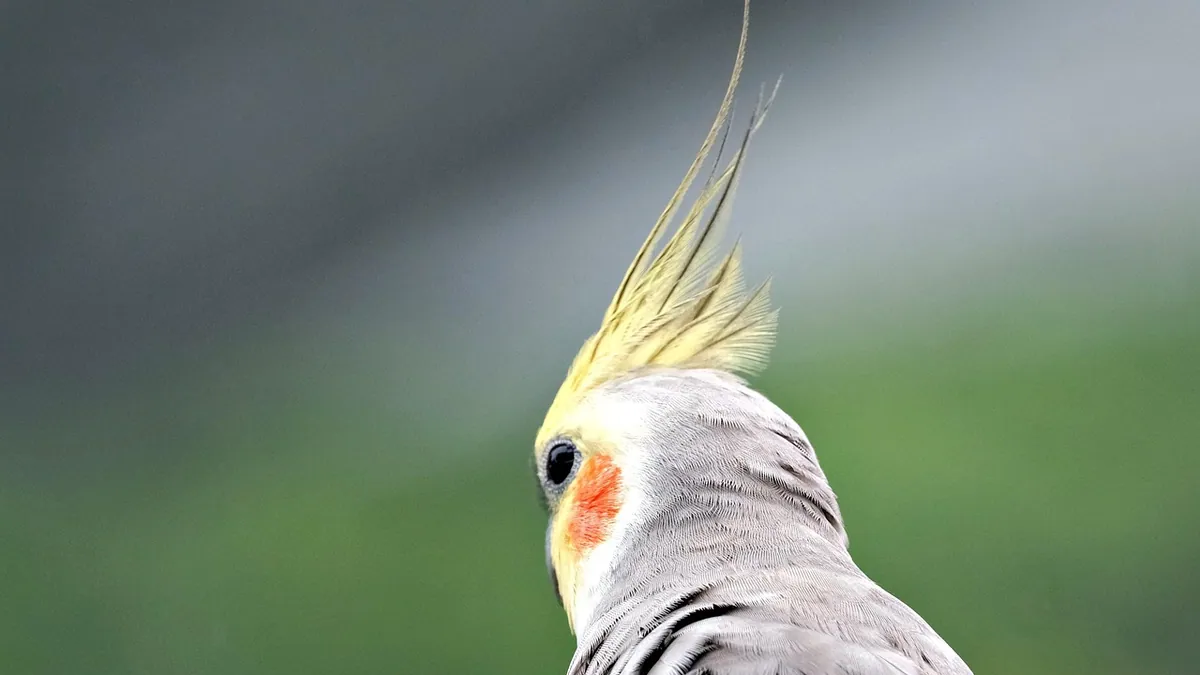
Do cockatiels pass the mirror test? No. Cockatiels and other parrots have not passed the standard mirror mark test, and the one parrot species studied in detail failed it too [1]. What your bird does at the mirror is still worth watching, because it tells you something about how birds explore and react to a strange image.
This article is educational and is not a substitute for veterinary diagnosis or treatment.
Quick Answer
- The mirror test checks whether an animal recognizes its own reflection, usually by secretly marking the animal and seeing if it touches the mark while looking in a mirror.
- African grey parrots and common hill mynas looked at mirrors longer than a clear plastic control and groomed more when a mirror was present, but neither species passed the mark test [1].
- Cockatiels have not passed the mirror test, and no published study has shown self-recognition in this species.
- A bird that sings to, attacks, or feeds its reflection is showing normal social or territorial behavior, not proof of self-awareness.
- Mirror time is not harmful by itself, but obsessive or aggressive mirror behavior is a reason to change your bird's setup and talk to your veterinarian.
What the Mirror Test Actually Measures
The classic mirror test works like this. An animal is allowed to get used to a mirror. Then a mark is placed somewhere the animal can only see in the reflection, such as on the forehead or throat. If the animal turns, reaches, or rubs at the mark while watching the mirror, researchers treat that as evidence the animal understands the reflection is its own body.
This test has limits. It was designed around what primates do, and it produces a yes or no result that may not fit every species [2]. Some researchers now argue for a more gradual view, where animals can show partial or intermediate understanding of mirrors instead of passing or failing outright [2]. That matters for birds, because a parrot may show real interest in a mirror without ever touching a mark.
Parrot cognition research also has a sample size problem. Many early parrot studies tested only one bird or a pair, and results vary a lot between individual parrots of the same species [3]. So a single bird's performance, good or bad, does not define the whole species.
Do Cockatiels Pass the Mirror Test?
No. There is no evidence that cockatiels pass the mirror test, and they are not among the bird species that have passed it. The species that have passed are certain songbirds, and even those results are still debated [1].
Cockatiels are small parrots with strong social instincts. In a home, a cockatiel that sees its reflection often treats the image as another cockatiel. It may call to it, sit beside it, or try to feed it. That is a social response, not self-recognition.
Do Parrots Pass the Mirror Test?
Most parrots have not been tested, and the parrots that have been tested have not passed. In one study, African grey parrots and common hill mynas spent significantly more time gazing into a mirror than into a clear plastic control, and they groomed significantly longer when the mirror was present [1]. The African grey parrots also approached the mirror more often than the mynas, which suggests the two species explore mirrors in different ways [1]. But every bird in that study failed the mark test, so the researchers found no evidence of mirror self-recognition [1].
That result fits the broader picture. Parrots are impressive in many cognitive tasks, including vocal learning and mimicry, and grey parrots have the largest mimicry repertoires among companion parrots in survey data [4]. Vocal skill and mirror self-recognition are different abilities, though. A parrot that talks up a storm may still see its reflection as a stranger.
Why Your Bird Reacts to a Mirror
Normal social and territorial responses
Most mirror reactions in pet birds fall into a few normal patterns.
- Singing, chattering, or calling to the reflection. Your bird is treating the image as another bird and trying to communicate.
- Sitting close and preening near the mirror. This is calm, companionable behavior.
- Feeding or regurgitating toward the mirror. Regurgitation can be courtship behavior aimed at a perceived mate.
- Head bobbing, wing flicking, or pacing in front of the mirror. These are excitement or display behaviors.
- Attacking, lunging, or screaming at the reflection. Your bird sees a rival in its space.
None of these prove self-awareness. They prove your bird is reacting to a visual stimulus the way its instincts tell it to.
Why birds are drawn to mirrors
Birds are visual animals, and a mirror gives constant, predictable motion and color. For a single pet bird, a mirror can look like company. That is exactly why mirrors are sometimes sold as cage accessories, and exactly why they can cause trouble. A bird that thinks it has a companion may spend hours trying to interact with an image that never responds properly.
Medical Causes to Rule Out Before You Blame the Mirror
Some behaviors that owners notice around mirrors have medical causes. If your bird suddenly becomes obsessed with its reflection, or if mirror time triggers repetitive behavior, a health check is reasonable.
- Feather picking or feather destructive behavior. This is one of the most common behavior problems in pet psittacine birds, and veterinarians most often see it alongside chronic egg laying, aggression, and screaming [5]. It can have skin, hormonal, nutritional, or infectious causes, so it needs a medical workup. See Feather Destructive Behavior in Birds: Medical Workup, Enrichment, and Behavior Management for how that evaluation is structured.
- Chronic egg laying. A mirror that your bird treats as a mate can drive hormonal laying behavior. Repeated egg laying is a medical concern, not just a nuisance. Our guide to Cockatiel Care: Chronic egg laying and hormonal management guide covers the hormonal side.
- Skin or feather problems. Over-preening near a mirror can be the first sign of an itchy bird. A veterinarian can examine the skin and feathers and decide whether testing is needed. If blood work is recommended, Diagnostic Sampling in Pet Birds explains what that involves.
- Respiratory or eye irritation. Any bird with discharge, sneezing, or squinting needs a veterinary visit, mirror or no mirror.
Your veterinarian calculates any medication dose from your bird's weight and health status. Do not use products or doses meant for other species.
When Mirror Behavior Becomes a Problem
A little mirror interest is fine. These patterns suggest the mirror is doing more harm than good.
- Your bird ignores food, toys, or you to stay at the mirror.
- Your bird attacks the mirror hard enough to damage feathers, beak, or feet.
- Your bird regurgitates to the mirror repeatedly, or starts laying eggs.
- Your bird screams or paces at the mirror for long stretches.
- Your bird preens or plucks more after mirror time.
- Your bird seems more anxious, not calmer, when the mirror is present.
Behavior problems in pet birds are common, and many owners look for advice somewhere other than their veterinarian first [5]. That delay matters. Aggression, screaming, and feather picking are the problems owners and veterinarians report most often, and they respond best to a plan that combines medical checks, diet, housing, and enrichment [5].
What to Do Step by Step
Step 1: Observe before you change anything
Watch your bird for a few days. Note when it uses the mirror, what it does, and how long it lasts. This record helps you and your veterinarian tell normal interest from a problem.
Step 2: Test a mirror-free setup
Remove the mirror for one to two weeks. Keep everything else the same. If your bird's behavior improves, the mirror was likely part of the problem. If nothing changes, the mirror was not the main issue.
Step 3: Replace the mirror with interactive enrichment
Birds need things to do. Rotate toys, offer foraging opportunities, and set up a perch near a window if your bird enjoys watching outside. Social play is linked to larger brain mass relative to body size in birds, and play behavior appears to matter more for brain development than tool use does [6]. Play is not a luxury for a parrot. It is part of normal life.
Step 4: Build a predictable routine
Parrots do well with sameness. Feed, clean, and handle your bird at similar times each day. A predictable schedule lowers the odds that your bird will fixate on a mirror for stimulation.
Step 5: Give real social contact
If your bird is alone most of the day, the mirror may be filling a gap. Spend focused time with your bird daily. If you cannot, consider whether a second bird is right for your household, and talk it through with your veterinarian first.
Step 6: Use training instead of removal alone
Target training and simple trick training give your bird a way to earn attention and treats. A bird that is busy learning is less likely to stare at a reflection. Keep sessions short and end on a success.
Step 7: Recheck the plan
If you removed the mirror and your bird still shows the behavior, the mirror was not the cause. That points toward a medical or environmental issue that needs professional evaluation.
What Not to Do
- Do not punish your bird for reacting to a mirror. Punishment does not teach a bird what you want, and it damages trust.
- Do not assume your bird is "smart" because it likes its reflection. Mirror interest is common and does not measure intelligence.
- Do not assume your bird is "stupid" because it fails to recognize itself. The mirror test is a narrow tool, and many capable animals do not pass it [2].
- Do not leave a mirror in the cage of a bird that is laying eggs, plucking, or attacking the reflection.
- Do not buy a mirror as a substitute for time with your bird.
- Do not treat regurgitation to a mirror as cute if it happens often. It can signal a hormonal pattern that needs management.
- Do not rely on internet claims that a specific parrot species passes the mirror test. The tested parrots did not pass [1].
When to Involve a Veterinarian or Behavior Professional
Call your avian veterinarian if your bird shows any of these signs.
- Feather loss, bare patches, broken feathers, or skin wounds. Book a visit within a few days.
- Repeated regurgitation, egg laying, or nesting behavior. Book a routine visit soon.
- Screaming that lasts for hours or disrupts your household. Book a routine visit.
- Aggression toward you or other pets. Book a routine visit, and keep everyone safe until then.
- Any bird that stops eating, sits fluffed at the bottom of the cage, has trouble breathing, or has discharge from the eyes or nostrils. This is an emergency. Go now.
- A bird that has not produced droppings, or whose droppings changed suddenly. Same-day call.
- A bird with a wound from attacking a mirror or toy. Same-day call.
Certified behavior professionals can help when the problem is behavioral instead of medical. Ask your veterinarian for a referral. Many bird behavior problems never reach a veterinarian because owners seek advice elsewhere first [5], so starting with your vet puts you ahead.
Limitations and When to Contact a Veterinarian
The mirror test is a research tool, not a diagnostic test. It cannot tell you how smart your bird is, and it cannot tell you whether your bird is happy. It only tells researchers whether an animal touches a mark it can see only in a mirror, and even that result is debated [2].
What you can act on is behavior you can see. A bird that plucks, screams, attacks its reflection, or lays eggs needs help. A bird that chirps at a mirror now and then is probably fine.
Individual cases need a veterinarian. No article can examine your bird, review its diet and housing, or run the tests that separate a behavior problem from a medical one. If you are unsure, make the call.
Frequently Asked Questions
Can a cockatiel recognize itself in a mirror?
There is no evidence that a cockatiel recognizes itself in a mirror. Cockatiels that interact with mirrors are almost certainly responding to the image as if it were another bird. That is normal bird behavior, not a sign of self-awareness.
Why does my parrot talk to its reflection?
Your parrot is treating the reflection as a social partner. Parrots are vocal learners, and many use mimicry in appropriate social contexts [4], so talking to a mirror fits that pattern. It does not mean your bird knows the image is itself.
Is it bad to keep a mirror in my bird's cage?
It depends on your bird. A mirror can be harmless for some birds and harmful for others, especially birds that pluck, lay eggs, or attack the reflection. If you see any of those behaviors, remove the mirror and talk to your veterinarian.
Do mirrors make birds hormonal?
A mirror can trigger hormonal behavior in some birds because it looks like a mate. Repeated regurgitation, nesting, and egg laying are signs of that pattern. Chronic egg laying is a medical concern, so have your bird examined instead of waiting to see if it stops.
Are parrots self-aware?
Parrots show advanced abilities in some cognitive areas, but the tested parrots failed the mirror mark test, so there is no evidence of mirror self-recognition in the species studied [1]. Self-awareness is hard to measure, and one test cannot settle the question for a whole group of animals [2].
Related Articles
- Cockatiel Care: Feather destructive behavior enrichment protocol
- Talking Parrots: How Parrots Learn to Mimic Speech
- Diagnostic Sampling in Pet Birds
- Cockatiel Care: Chronic egg laying and hormonal management guide
- Feather Destructive Behavior in Birds: Medical Workup, Enrichment, and Behavior Management
- Cockatiel Care: Pyramiding & Shell Health Management
- Do Parrots Understand What They Say? What Science Says
- Do Cockatiels Dream? Sleep and Night Behavior
- Can Cockatiels Talk? What to Expect and How to Encourage Speech
References
- Mirror responses in the common hill myna (Gracula religiosa) and the African grey parrot (Psittacus erithacus). Zoology (Jena, Germany), 2021.
- Fish, mirrors, and a gradualist perspective on self-awareness. PLoS biology, 2019.
- Psittacine cognition: Individual differences and sources of variation. Behavioural processes, 2017.
- A survey of vocal mimicry in companion parrots. Scientific reports, 2022.
- Surveys of avian practitioners and pet owners regarding common behavior problems in psittacine birds. Journal of avian medicine and surgery, 2011.
- Play behaviour, not tool using, relates to brain mass in a sample of birds. Scientific reports, 2020.