Deer Tick vs Dog Tick: How to Tell Them Apart
By Dr. Zubair Khalid, DVM, MS, PhD ·
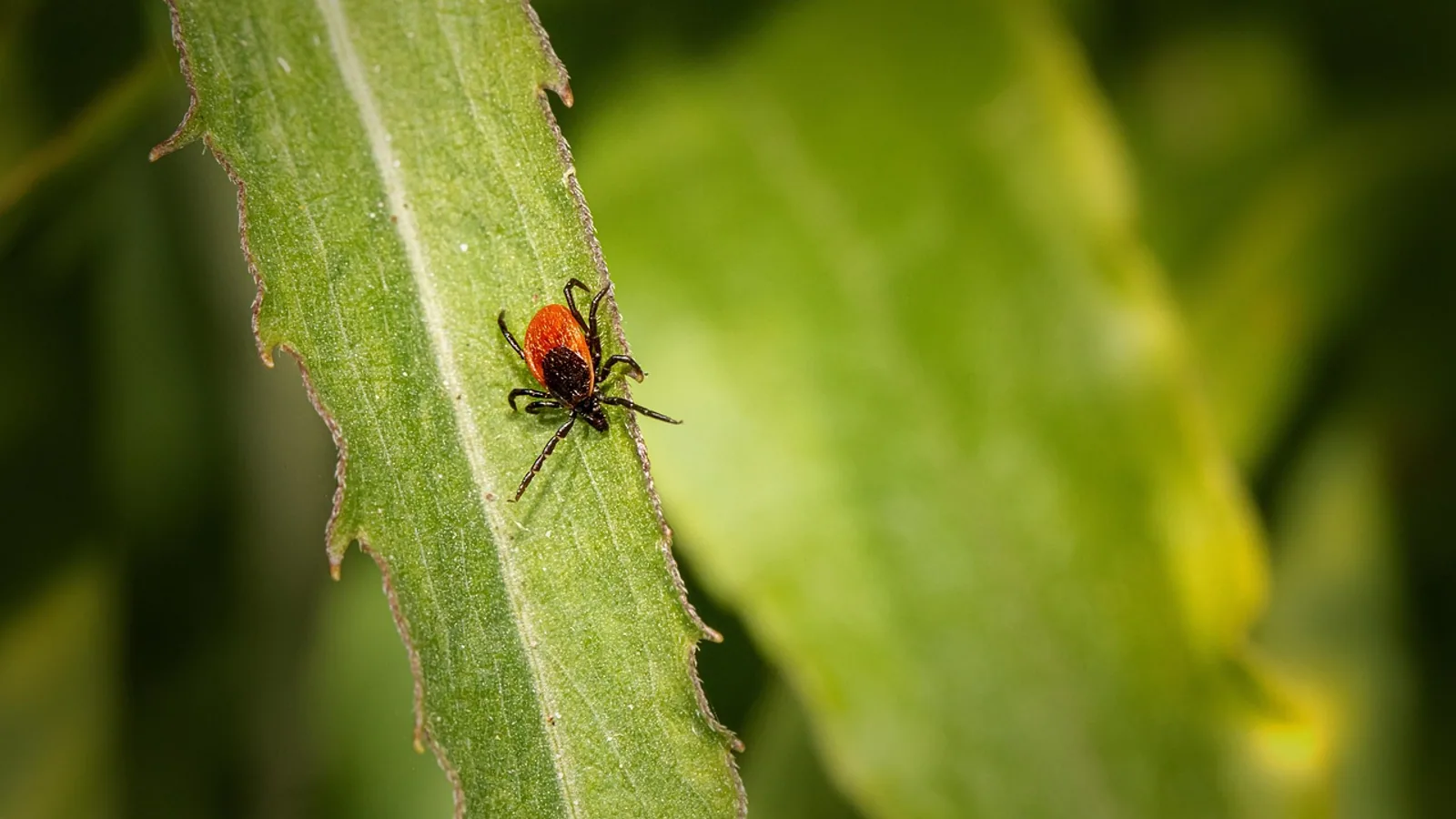
The single difference that matters most is this: a deer tick (blacklegged tick, Ixodes scapularis) is smaller, has black legs and no white markings, and transmits Lyme disease and other Ixodes-borne infections, while a dog tick (American dog tick, Dermacentor variabilis) is larger, brown with a white patterned shield, and transmits Rocky Mountain spotted fever and ehrlichiosis. The rule of thumb for choosing what to do next: identify the species first, then match the disease risk to that species, because the two ticks do not carry the same pathogens.
This article is educational and is not a substitute for veterinary diagnosis or treatment.
Tick identification is genuinely difficult, and owners get it wrong often. In a large photo-based surveillance program, users incorrectly identified their submitted tick 83% of the time, and American dog ticks were misidentified in 80.7% of submissions [1]. A separate crowdsourced photograph study found that expert review of images reached 96.7% accuracy to species, which shows that good photographs plus a structured checklist can close most of the gap [2]. The checklist below is built around the features that separate these two species reliably: size, color and markings, mouthpart length, and preferred host.
Why Species Identification Changes the Plan
Different ticks carry different pathogens, and the pathogen determines the disease risk for the pet and the household. Ixodes scapularis is the primary vector for Borrelia burgdorferi, the spirochete that causes Lyme disease, and it is expanding in numbers and geographic range across central and eastern North America [3]. Dermacentor variabilis is a common tick of dogs in the United States and is repeatedly recovered from pets in national surveillance [4]. The two species also differ in how they behave on a host and how they look at each life stage, which is why a single trait is rarely enough for a confident call.
One practical consequence is that the same tick found on the same dog can mean two different conversations with a veterinarian. A blacklegged tick raises the question of Lyme disease and co-infections such as anaplasmosis and babesiosis. An American dog tick raises the question of spotted fever group rickettsiosis and ehrlichiosis. Getting the species right is the first step in that conversation.
Side-by-Side Comparison Table
| Feature | Deer tick (Ixodes scapularis) | Dog tick (Dermacentor variabilis) |
|---|---|---|
| Unfed adult size | 2 to 3 mm | Larger, roughly 4 to 5 mm |
| Engorged female size | Up to about 10 mm | Larger and more oval when fully fed |
| Body color | Reddish-brown to dark brown | Brown |
| Leg color | Black | Brown |
| White markings | None | White or silvery pattern on the scutum (the shield behind the head) |
| Mouthparts | Long, visible from above | Short, not prominent from above |
| Preferred hosts | White-footed mice as juveniles, deer as adults, plus dogs and people | Dogs and other medium to large mammals, plus people |
| Key pathogens | Borrelia burgdorferi, Anaplasma species, Babesia species | Rickettsia rickettsii, Ehrlichia species |
| Hardest to identify | Engorged females and nymphs | Engorged females |
This table is the core reference for the rest of the article. Everything below explains how to apply it in practice, where it breaks down, and what to do when the tick does not fit neatly into either column.
How to Identify a Deer Tick
Size and shape
An unfed adult deer tick is small, roughly 2 to 3 mm, about the size of a sesame seed. A fully engorged female can swell to about 10 mm, roughly the size of a small grape, and at that point the body becomes a smooth gray-brown oval that hides most of the features used for identification. Nymphs are smaller still and are the stage most often missed on pets. In passive surveillance collections from the Canadian Maritimes, adult females made up 90.2% of recovered I. scapularis, with far fewer males, nymphs, and larvae, which reflects how much easier adult females are to find on a host [3].
Color and markings
The unfed adult has a reddish-brown to dark brown body with distinctly black legs and no white markings anywhere on the body. The absence of white is the single most useful feature when comparing an unfed deer tick against an unfed dog tick. Males are darker and smaller than females and can look almost uniformly dark brown to black.
Mouthpart length
Deer ticks have long mouthparts that project forward and are visible when the tick is viewed from above. This long mouthpart is one reason the tick can remain attached and feed for extended periods. It also means that when an attached deer tick is removed, a longer section of the feeding apparatus is involved than with a dog tick.
Preferred host and where you find them
Ixodes scapularis uses white-footed mice and other small rodents as larval and nymphal hosts and deer as the adult reproductive host, which is why the species is tied to wooded and brushy habitat with wildlife present. Dogs and people are incidental hosts. In a national survey of ticks submitted from veterinary practices, I. scapularis accounted for 27.4% of dog infestations and 46.4% of cat infestations, making it the most common tick on cats in that dataset [4]. Blacklegged tick encounters in community science data cluster heavily in the Midwest and Northeast regions of the United States [5].
Disease risk
Ixodes scapularis is the principal vector for Borrelia burgdorferi in central and eastern North America, and its range and population numbers are increasing [3]. The same species is associated with Anaplasma and Babesia infections in dogs. B. burgdorferi has also been isolated from Dermacentor variabilis larvae collected from infected wild rodents, which shows that dog ticks can acquire spirochetes from a host even though they are not the primary maintenance vector [6]. This is a useful reminder that finding a spirochete in a tick does not by itself prove that the tick transmitted it.
How to Identify a Dog Tick
Size and shape
The American dog tick is larger than the deer tick at every comparable stage. An unfed adult is roughly 4 to 5 mm, and an engorged female becomes a large, gray, bean-shaped oval. The size difference is most obvious when both species are placed side by side on a white surface.
Color and markings
The body is brown, and the defining feature is a white or silvery pattern on the scutum, the hard shield on the back just behind the head. On males the scutum covers most of the back, so the white pattern is extensive. On females the scutum is smaller and the white pattern is confined to the shield, while the rest of the body remains brown. The legs are brown, not black.
Mouthpart length
Dog ticks have short mouthparts that are not prominent when the tick is viewed from above. This is one of the quickest ways to separate the two species under a hand lens or a close-up phone photo. If the mouthparts are clearly long and projecting, the tick is more likely an Ixodes species.
Preferred host and where you find them
Dermacentor variabilis is a common tick of dogs across the United States, and in a 12-month national survey it was the most frequently submitted species from dogs, accounting for 35.6% of dog infestations [4]. It also feeds on cats and people. It is a habitat generalist compared with the blacklegged tick and can be found in grassy and shrubby areas as well as woodland edges.
Disease risk
Dermacentor variabilis is a vector for Rickettsia rickettsii, the agent of Rocky Mountain spotted fever, and for Ehrlichia species. Ehrlichia chaffeensis and E. ewingii have been detected in tick pools collected from urban and suburban greenspaces in the U.S. Great Plains, alongside Rickettsia species [7]. The species also carries its own microbial community, including Rickettsia montanensis, which has been studied in the context of tick-rickettsia interactions [8]. In addition, D. variabilis has been used experimentally to propagate Ehrlichia canis, the cause of canine monocytic ehrlichiosis, although the brown dog tick Rhipicephalus sanguineus is the acknowledged natural vector of that pathogen [9].
Species, Size, Markings, and Vector Role Table
| Species | Common name | Unfed adult size | Markings | Primary vector role |
|---|---|---|---|---|
| Ixodes scapularis | Blacklegged tick (deer tick) | 2 to 3 mm | Reddish-brown body, black legs, no white markings | Borrelia burgdorferi, Anaplasma species, Babesia species |
| Dermacentor variabilis | American dog tick | 4 to 5 mm | Brown body, brown legs, white patterned scutum | Rickettsia rickettsii, Ehrlichia species |
| Amblyomma americanum | Lone star tick | Intermediate | Reddish-brown with a white spot or streak on the scutum of females | Ehrlichia species, Rickettsia species, and alpha-gal sensitization |
The lone star tick is included because it is one of the three most common human-biting ticks in the United States and is frequently confused with the other two [10][11]. It is also the species most strongly associated with alpha-gal in salivary glands, the carbohydrate linked to red meat allergy after tick bites [12]. If a tick has a single white spot on the back, it is more likely a lone star tick than either a deer tick or a dog tick.
The Hard Cases: Engorged Females and Nymphs
Engorged females are the hardest ticks to identify, and this is where most owner identifications fail. Once a female has fed for several days, the body expands and the color and markings that normally separate the species are stretched or obscured. A fully engorged deer tick and a fully engorged dog tick can both look like smooth gray-brown ovals. The remaining clues are the mouthpart length and the overall shape. Deer ticks keep long mouthparts and a more teardrop outline, while dog ticks keep short mouthparts and a broader, more bean-shaped body.
Timing matters here. More than a quarter of participants in a photo-based surveillance study submitted ticks that had been feeding for at least 2.5 days, which is the point at which engorgement starts to blur the identifying features [1]. Nymphs are the other hard case. They are small, and participants in the same study were significantly more likely to misidentify nymph-stage ticks than adult ticks [1]. Nymphs are also the stage most likely to be missed during a routine pet check, which is why a full-body search matters more than a quick glance.
Geography Matters as Much as Appearance
The same tick species does not occur everywhere, and location is one of the strongest pieces of evidence for identification. Ixodes scapularis populations are concentrated in the Northeast and upper Midwest of the United States and are expanding in central and eastern Canada [5][3]. Dermacentor variabilis is broadly distributed across the United States and is the most common tick submitted from dogs in national veterinary surveillance [4]. A tick found on a dog in a region where blacklegged ticks are not established is far more likely to be a dog tick or a lone star tick.
Travel history adds a layer of complexity. In a smartphone-app study of tick encounters, about 75% of users from large metropolitan and rural counties had traveled outside their county of residence in the four days before finding a tick, compared with 50 to 60% of users from smaller metropolitan areas [5]. A tick can therefore be acquired somewhere other than where it is found, and the location where the pet was walked or boarded may be more informative than the home address.
Worked Scenarios
Scenario 1: A small dark tick with black legs on a dog in Connecticut. The size, black legs, and lack of white markings point to Ixodes scapularis. The region is within the established range of blacklegged ticks [3]. The relevant disease concerns are Lyme disease, anaplasmosis, and babesiosis. The tick should be saved in alcohol and the dog's veterinarian contacted about testing and prevention.
Scenario 2: A larger brown tick with a white patterned shield on a dog in Oklahoma. The white scutum pattern and brown legs point to Dermacentor variabilis. The region is within the range where this species is commonly collected, including in urban greenspaces [7]. The relevant disease concerns are spotted fever group rickettsiosis and ehrlichiosis.
Scenario 3: A fully engorged gray oval with no visible markings. This is the hardest case. Check the mouthparts. Long projecting mouthparts favor a deer tick, short mouthparts favor a dog tick. If the mouthparts cannot be seen, save the tick and have it identified by a veterinarian or a public health laboratory rather than guessing.
Scenario 4: A tick with a single white spot on the back. This is more consistent with a lone star tick than with either a deer tick or a dog tick. Lone star ticks are among the three most common human-biting ticks in the United States and are readily identified by that marking [10][11].
Common Mix-Ups
The most common mix-up is calling every small tick a deer tick. Size alone is not reliable, because an unfed dog tick is small enough to be mistaken for a deer tick if there is no side-by-side reference. The second most common mix-up is calling every brown tick a dog tick, which ignores the reddish-brown body and black legs of an unfed deer tick. The third is confusing a lone star tick with either species because of the white marking, which on a lone star tick is a single spot or streak rather than the broad patterned scutum of a dog tick.
A fourth mix-up involves the assumption that any tick carrying Borrelia must be a deer tick. B. burgdorferi has been isolated from D. variabilis larvae collected from infected rodents, so a positive pathogen test on a dog tick does not automatically mean the tick is a deer tick [6]. Species identification and pathogen testing answer different questions.
What to Do With a Tick You Have Found
Save the tick in a small container with a little rubbing alcohol and label it with the date and the location where it was found. Take a clear, well-lit photograph from directly above, because dorsal images are what identification keys and image-based tools rely on. A convolutional neural network trained on a molecularly verified dataset of A. americanum, D. variabilis, and I. scapularis reached 99.5% accuracy on its test set, and a separate model trained on more than 12,000 user-submitted images reached 87.8% accuracy across the same three species [10][11]. These tools are useful for a first pass, but expert review of photographs still outperforms them in real-world conditions [2].
Contact the pet's veterinarian with the photograph and the location. The veterinarian can combine the tick identification with the pet's vaccination status, preventive product history, and any clinical signs to decide whether testing or monitoring is appropriate. The Companion Animal Parasite Council and the American Veterinary Medical Association both maintain owner-facing resources on tick prevention that can guide the choice of a year-round tick control product.
Limitations and When to Contact a Veterinarian
Individual cases need a veterinarian. Contact a veterinarian promptly if the pet develops fever, lethargy, loss of appetite, joint swelling or lameness, unexplained bruising or bleeding, or neurologic signs after a tick bite. Contact a veterinarian if the tick was attached for more than 24 hours, if multiple ticks were found, or if the pet is on a tick preventive product but ticks are still attaching. Contact a veterinarian if you cannot identify the tick and the pet lives in or has traveled to an area where Lyme disease or Rocky Mountain spotted fever is common. Contact a veterinarian if the pet is very young, very old, pregnant, or immunocompromised, because those animals may need a different monitoring plan. Save the tick and bring it to the appointment whenever possible.
Frequently Asked Questions
Is a deer tick the same as a blacklegged tick?
Yes. Deer tick and blacklegged tick both refer to Ixodes scapularis in North America. The name deer tick comes from the adult tick's use of deer as a reproductive host.
How can I tell a deer tick from a dog tick without a microscope?
Check the legs and the back. Black legs and no white markings point to a deer tick. Brown legs and a white patterned shield point to a dog tick. Mouthpart length is the tiebreaker, with long mouthparts favoring a deer tick.
Why are engorged ticks so hard to identify?
Engorgement stretches the body and obscures the color and markings used for identification. Mouthpart length and overall body shape are the features that remain most useful once a female has fed for several days.
Does a dog tick carry Lyme disease?
The American dog tick is not the primary vector for Lyme disease. Borrelia burgdorferi has been isolated from Dermacentor variabilis larvae taken from infected rodents, but the blacklegged tick is the main maintenance vector [6][3].
Do I need to identify the tick to protect my dog?
Identification helps because the two species carry different pathogens, but it does not replace year-round tick prevention. A veterinarian can recommend a product appropriate for the pet's risk and lifestyle.
What should I do if I find a tick on my dog?
Save the tick, photograph it from above, note the date and location, and contact the pet's veterinarian. Bring the tick to the appointment so the species can be confirmed.
Related Articles
- Observational vs. Experimental Studies: How to Tell Them Apart
- Frog or Toad? How to Tell Them Apart and Why It Matters for Pet Care
- Sea Lion Vs Seal A Simple Guide To Telling Them Apart
- Tick-Borne Parasites in White-Tailed Deer: Babesia and Theileria Prevalence, PCR-Based Surveillance, and Impact on Livestock Interface
- Deer Farming in Pakistan: Opportunities and Challenges
- Deer Farming in Texas: Regulations, Species, and Management
- Minipreps: How They Work and When to Use Them
- Bluetick Coonhound: Traits, Health, and Care Needs
- How to Tell If an Egg Is Still Good: 4 Safe Tests
Sources
- Assessing Public Tick Identification Ability and Tick Bite Riskiness Using Passive Photograph-Based Crowdsourced Tick Surveillance.
- Crowdsourced Photographs as an Effective Method for Large-Scale Passive Tick Surveillance.
- Monitoring Risk: Tick and Borrelia burgdorferi Public Participatory Surveillance in the Canadian Maritimes, 2012-2020.
- Show us your ticks: a survey of ticks infesting dogs and cats across the USA.
- Evaluating spatial and temporal patterns of tick exposure in the United States using community science data submitted through a smartphone application.
- Identification of endemic foci of Lyme disease: isolation of Borrelia burgdorferi from feral rodents and ticks (Dermacentor variabilis).
- Risk of encountering ticks and tick-borne pathogens in a rapidly growing metropolitan area in the U.S. Great Plains.
- Molecular and functional characterization of vacuolar-ATPase from the American dog tick Dermacentor variabilis.
- Growth of Ehrlichia canis, the causative agent of canine monocytic ehrlichiosis, in vector and non-vector ixodid tick cell lines.
- A Computer Vision-Based Approach for Tick Identification Using Deep Learning Models.
- Identification of public submitted tick images: A neural network approach.
- Discovery of Alpha-Gal-Containing Antigens in North American Tick Species Believed to Induce Red Meat Allergy.