Raising Bottle Calves: Feeding Schedule, Housing and Health
By Dr. Zubair Khalid, DVM, MS, PhD ·
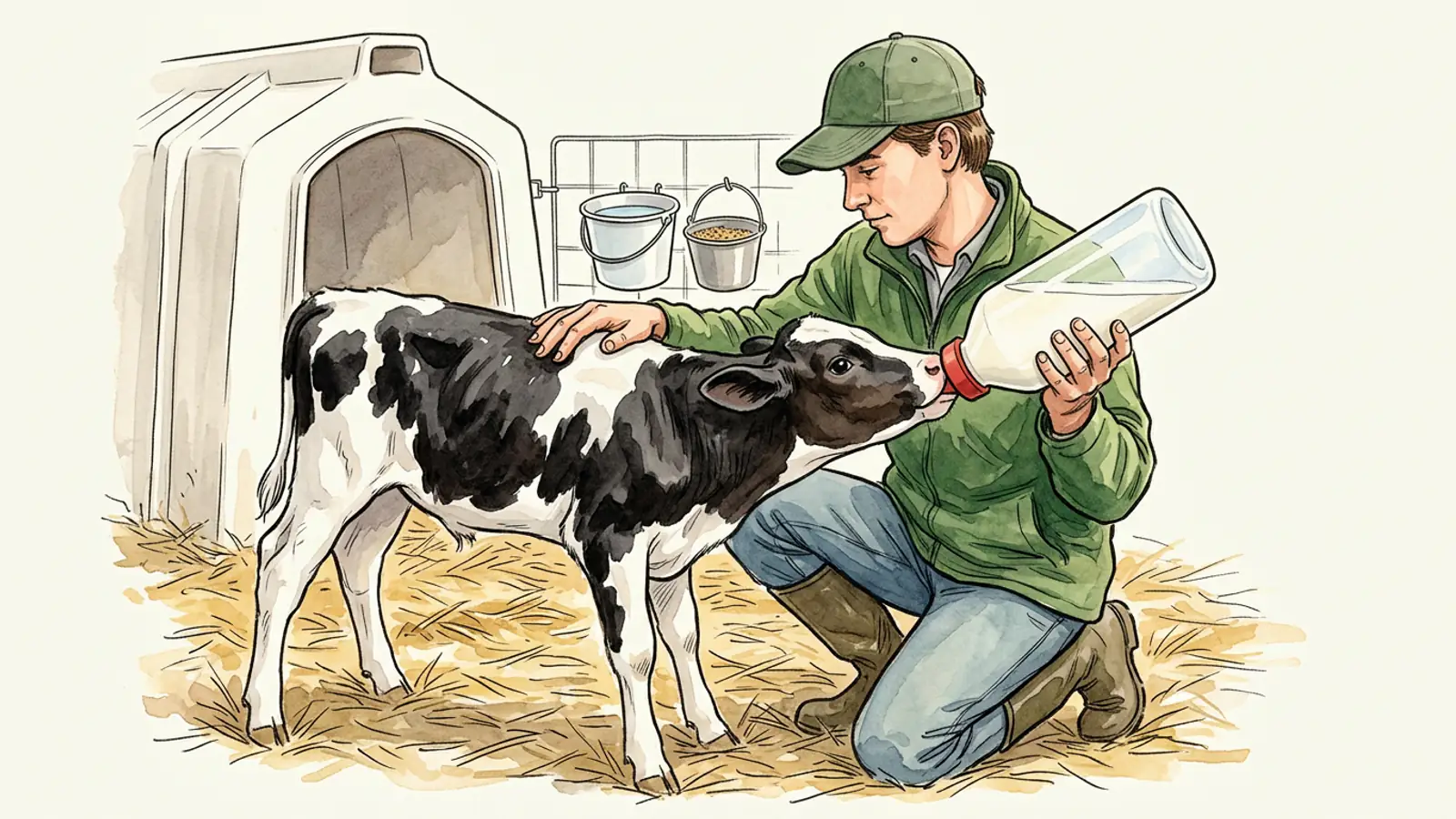
Raising bottle calves succeeds or fails in the first 24 hours and then in the daily details. A newborn calf needs colostrum within the first hours of life, a clean and dry pen, and a consistent liquid feeding routine built around a quality milk replacer or whole milk. Feed a calf roughly 10 to 12 percent of its body weight in liquid per day, split into two feedings, at a consistent temperature near 101 to 105 F. Offer fresh water and calf starter from the first week so the rumen develops. Wean when the calf eats about 2 pounds of starter per day for several consecutive days, usually around 6 to 8 weeks of age. Get the colostrum step right first, because passive immunity drives everything that follows [1].
This guide is for small farms and first-time owners. It covers the bottle calf feeding schedule week by week, how to choose and mix calf milk replacer, housing and hygiene, and the health problems that most often kill bottle calves. It also explains when a veterinarian needs to see the calf.
This article is educational and is not a substitute for veterinary diagnosis or treatment.
Key Takeaways
- Raising bottle calves requires colostrum within the first 1 to 2 hours of birth, then again by 12 hours, because milk replacer contains very little immunoglobulin and cannot replace it.
- Feed a bottle calf roughly 10 to 12 percent of its body weight in liquid per day, split into two feedings, at a consistent temperature near 101 to 105 F.
- Calves fed a 24 percent protein and 24 percent fat milk replacer gained 23.6 percent more weight per day than calves fed a 20 percent protein and 20 percent fat replacer from day 1 to day 56.
- Wean a bottle calf when it eats about 2 pounds of starter per day for several consecutive days, usually around 6 to 8 weeks of age.
- Mixing errors cause nutritional scours, so weigh milk replacer powder on a scale, add powder to clean warm water, and never microwave it because hot spots can burn the calf.
At a Glance: The Bottle Calf Action Checklist
| Step | What to do | Timing |
|---|---|---|
| Colostrum | Feed 3 to 4 quarts of high-quality colostrum or a colostrum replacer | Within the first 1 to 2 hours, and again by 12 hours |
| First liquid feed | Begin milk replacer or whole milk after colostrum | Day 1 to 2 |
| Daily volume | About 10 to 12 percent of body weight per day, split into two feedings | Day 2 onward |
| Feeding temperature | Warm to about 101 to 105 F | Every feeding |
| Water and starter | Offer fresh water and a small handful of calf starter | From the first week |
| Weaning | Wean when starter intake reaches about 2 lb per day for several days | About 6 to 8 weeks |
| Housing | Dry, draft-free, deeply bedded hutch or pen | From arrival |
| Navel | Dip the navel in iodine and watch for swelling | First day |
| Health watch | Check manure, breathing, attitude, and temperature daily | Every day |
Start With Colostrum, Not Milk Replacer
Colostrum is the single most important management factor determining calf health and survival. Calves that achieve successful passive transfer of colostral immunoglobulins, defined as serum IgG above 10.0 mg/mL, have improved preweaning health and survival, improved growth rate and feed efficiency, reduced age at onset of puberty, reduced age at first calving, and improved first and second lactation milk production [1].
The four factors that determine whether a colostrum program works are the quality of the colostrum fed, the quantity fed, how quickly the first feeding is given, and how clean the colostrum is [1]. A bottle calf that did not nurse its dam needs colostrum by bottle or esophageal feeder as soon as possible after birth. Commercial colostrum replacement products offer consistent quality, convenience, and cleanliness, and they can achieve passive transfer when used correctly [1]. For the full protocol on volumes, timing, testing, and storage, see our companion article on colostrum management for newborn calves.
Do not substitute milk replacer for colostrum. Milk replacer contains very little immunoglobulin. A calf that gets milk replacer instead of colostrum in the first hours of life is set up for scours, pneumonia, and poor growth for the entire preweaning period.
Choosing What Goes in the Bottle
You have two realistic options for the liquid portion of the diet: calf milk replacer or whole milk. Both can raise a healthy calf. They differ in cost, convenience, consistency, and growth performance.
Milk Replacer Protein and Fat Content
Milk replacer is described by its crude protein (CP) and fat percentages. A conventional product sits near 20 percent protein and 20 percent fat. A higher-specification product sits near 24 percent protein and 24 percent fat or higher.
In a study of Angus × Holstein crossbred calves fed either a 20 percent CP and 20 percent fat milk replacer (MR20) or a 24 percent CP and 24 percent fat milk replacer (MR24), calves fed MR24 gained 23.6 percent more weight per day and 9.8 percent more gain per pound of feed from day 1 to day 56. Feeding MR24 also tended to increase starter intake and total feed intake [2]. The authors concluded that feeding a milk replacer of higher nutritive value is a simple and effective strategy to increase weight gain and feed efficiency in beef × dairy calves [2].
A separate study of Holstein heifers used a 26 percent CP and 20 percent fat milk replacer and compared an enhanced program of 9 liters per day against a control program of 4 liters per day. Calves were fed equal amounts of milk replacer three times daily until 42 days of age, then tapered [3]. This shows that both concentration and total volume are levers you can adjust.
Protein source matters too. Whey and skim milk are both considered valuable protein sources in calf milk replacer, and a study comparing 0, 25, and 50 percent skim milk inclusion in whey-based milk replacer found no difference in cumulative milk replacer intake, starter intake, final body weight, average daily gain, or feed efficiency among groups [4]. In practical terms, a whey-based replacer and a skim-based replacer of similar nutrient content performed similarly in that trial.
Medicated Versus Non-Medicated Milk Replacer
Medicated milk replacers contain an approved drug. Many contain a coccidiostat such as decoquinate or lasalocid to help control coccidiosis. Products containing medically important antibiotics such as neomycin and oxytetracycline have required a veterinary feed directive (VFD) in the United States since 2017. Non-medicated replacers contain no drug.
The decision belongs with your veterinarian. Medicated milk replacer is a preventive antimicrobial use, and antimicrobial stewardship guidance from the AVMA and other veterinary bodies favors treating sick calves rather than medicating all calves. If you use a medicated product, follow the label exactly and observe the withdrawal period. Never add extra medication to milk replacer on your own.
Whole Milk Versus Milk Replacer
Whole milk generally supports faster growth than milk replacer of similar volume. In a study of Fleckvieh dairy calves fed either whole milk or milk replacer from birth to weaning at 60 days, calves fed whole milk had greater body weight and greater average daily gain (0.85 versus 0.77 kg per day for whole milk and milk replacer, respectively) despite similar total dry matter intake [5]. The whole milk in that study analyzed at 29.1 percent protein, 27.3 percent fat, and 37.3 percent lactose on a dry matter basis, while the milk replacer analyzed at 22.9 percent protein, 19.1 percent fat, and 51.73 percent lactose [5].
In a study of organic-certified Jersey calves fed either raw whole milk or an organic milk replacer (22.1 percent crude fat, 21.3 percent CP) at 4 liters per day until weaning at 8 weeks, whole milk calves had higher final body weight (54.7 versus 49.3 kg), higher average daily gain (483 versus 411 g per day), and larger heart girth, withers height, hip height, and body length at 8 weeks. Milk replacer calves ate more starter (329 versus 178 g per day), particularly from week 4 to 8 [6]. This is the classic trade-off: whole milk grows the calf faster, while milk replacer pushes the calf onto starter sooner.
A review of calf nutrition notes that higher planes of whole milk or milk replacer feeding improve growth, welfare, and gastrointestinal development, but that milk replacer formulations often diverge from whole milk in fat, protein, and carbohydrate profiles, which raises concerns about metabolic imbalances and morbidity risk [7].
Practical guidance: if you have a steady supply of clean, pasteurized whole milk or saleable milk, it is an excellent liquid feed. If you do not, choose a milk replacer with at least 22 percent protein and 20 percent fat, and preferably 24 percent protein and 24 percent fat for faster growth [2].
Mixing Milk Replacer Correctly
Mixing errors are a common cause of nutritional scours. Too concentrated and the calf gets osmotic diarrhea. Too dilute and the calf is underfed.
Follow the label. The label specifies grams or ounces of powder per volume of water. Two common concentrations appear in the research literature. One is 12.5 percent dry matter, which is about 6 liters per day when delivering 750 grams of powder [8]. Another is 16.7 percent dry matter, which is about 4.5 liters per day for the same 750 grams of powder [8]. A third common mixing rate is 130 grams of powder per liter, used to match the solids content of whole milk [5]. A higher concentration of 140 grams per liter has also been used in research settings [9].
The study comparing 12.5 percent and 16.7 percent dry matter found no difference in nutrient intake, growth performance, or mean glucose and insulin concentrations between the two approaches, and postprandial glycemia was equivalent between groups [8]. In other words, you can deliver the same total nutrients in a larger volume of more dilute milk or a smaller volume of more concentrated milk, and the calf performs similarly. Choose the approach that matches your equipment and your calf's appetite, then stay consistent.
Weigh the powder. Do not scoop by eye. Use a kitchen scale accurate to a few grams.
Mix with clean warm water. Add powder to water, not water to powder, and whisk until fully dissolved. Feed immediately. Do not mix a batch in the morning and feed it at night.
Never mix milk replacer with cold water and then feed it cold. Never mix it with hot water and feed it hot.
Feeding Temperature
Feed milk replacer or whole milk at approximately 101 to 105 F, which is close to the calf's body temperature. Calves drink warm milk more readily, and day-to-day swings in milk temperature can upset digestion. Milk that is too hot can scald the mouth and esophagus.
Use a thermometer every time until you can judge temperature by feel reliably. A simple approach is to mix with water that is warmer than the target and let it cool to the target, stirring. Never microwave milk replacer, because hot spots form and burn the calf.
How Much to Feed: Volume as a Percentage of Body Weight
The traditional rule for bottle calves is 10 to 12 percent of body weight in liquid per day, split into two feedings. For a 90-pound calf, that is roughly 9 to 11 pounds of liquid per day, or about 4 to 5 quarts. For a 100-pound calf, that is about 10 to 12 pounds, or about 4.5 to 5.5 quarts.
Research programs have fed considerably more. One study fed 5.68 liters per day (2.84 liters twice daily) to calves weighing 34.0 to 47.6 kg [2]. Another fed 9 liters per day in an enhanced program versus 4 liters per day in a control program [3]. A third fed 7.5 liters daily in three feedings of 2.5 liters each, delivering 1200 grams of milk replacer powder per day [4]. A fourth fed 12 liters per day of either transition milk or milk replacer [9].
Higher feeding levels are supported by a meta-analysis of 43 studies, which found that increased milk allowance affects growth, digestibility, blood parameters, and future production performance [10]. The review of calf nutrition also concludes that higher planes of feeding improve growth, welfare, and gastrointestinal development [7].
For a first-time owner, start at 10 to 12 percent of body weight per day and increase gradually as the calf grows and as you gain confidence. The table below uses source-supported numbers.
Week-by-Week Bottle Calf Feeding Schedule
| Age | Liquid feed | Volume per day | Feedings per day | Starter and water | Notes |
|---|---|---|---|---|---|
| Day 1 | Colostrum | 3 to 4 quarts total in the first 12 hours | 2 to 3 | None | Feed first colostrum within 1 to 2 hours of birth [1] |
| Day 2 to 3 | Milk replacer or whole milk | About 10 percent of body weight | 2 | Fresh water offered | Transition from colostrum |
| Week 1 | Milk replacer or whole milk | About 10 to 12 percent of body weight | 2 | Fresh water plus a small handful of starter | Starter intake is usually minimal |
| Week 2 | Milk replacer or whole milk | About 10 to 12 percent of body weight | 2 | Fresh water plus starter | Starter intake begins to climb |
| Week 3 to 4 | Milk replacer or whole milk | About 10 to 12 percent of body weight, increase as the calf grows | 2 | Fresh water plus starter | Starter intake climbs steadily |
| Week 5 to 6 | Milk replacer or whole milk | Hold steady or increase slightly | 2 | Fresh water plus starter | Watch starter intake closely |
| Week 6 to 8 | Milk replacer or whole milk | Taper as starter intake rises | 2, then 1 | Fresh water plus starter | Wean when starter intake reaches about 2 lb per day for several days [11] |
Two feedings a day is the standard for bottle calves. Research protocols also use three feedings per day in some programs, particularly with higher daily volumes [3][4]. Two feedings is practical for most small farms and is fully compatible with the volumes above.
Consistency Beats Optimization
Calves thrive on routine. Feed at the same times each day, at the same temperature, at the same concentration, from the same bottles. Sudden changes in any of these variables cause scours. If you need to change milk replacer brands or mixing rates, transition over several days by blending the old and new.
Bottle and Nipple Hygiene
Clean equipment prevents disease. Milk residue in a nipple is an ideal growth medium for bacteria that cause scours.
Wash bottles and nipples after every feeding with hot water and a dairy detergent, then rinse thoroughly. Sanitize at least daily. Use a bottle brush that reaches the bottom and the shoulders of the bottle. Nipples wear out and crack, and cracks harbor bacteria, so replace them regularly.
Do not share nipples between calves without sanitizing between uses. Do not leave mixed milk sitting in a warm bottle.
The same hygiene rules apply to esophageal feeders. Clean and sanitize after every use.
Water and Calf Starter From the First Week
The rumen is not functional at birth. It develops in response to the physical and chemical presence of solid feed, water, and the fermentation products that follow. Calves that only receive milk have underdeveloped rumens and will not wean successfully.
Offer fresh, clean water free choice from the first week. Water intake drives starter intake, and starter intake drives rumen development.
Offer a highly palatable calf starter from the first week. A 25 percent CP mini-pellet starter has been used successfully in research settings [12]. Start with a small handful and refresh it daily. Do not let starter sit and mold.
Starter intake in the first weeks is small. In one study, milk replacer calves ate 329 g per day of starter versus 178 g per day for whole milk calves, with the difference concentrated in weeks 4 to 8 [6]. Expect starter intake to climb sharply after week 3 or 4.
The review of calf nutrition emphasizes that weaning outcomes depend not only on the timing and amount of milk but also on the quality and formulation of the entire diet, including starter feed, across the preweaning, weaning, and postweaning phases [7]. Starter composition, including starch source, effective fiber, protein-to-energy balance, and the rumen undegradable protein fraction, plays a central role in sustaining growth [7].
Weaning Criteria
Wean on starter intake, not on the calendar. The standard benchmark is about 2 pounds of starter per day for several consecutive days. A calf eating that much starter has a functioning rumen and can maintain growth without liquid feed.
The typical weaning window is 6 to 8 weeks of age. Research programs have weaned at 49 days [13], 50 days [14], 60 days [15][5], and 8 weeks [6]. Some programs wean later. One study gradually weaned calves starting in week 8 until week 14 [9][16].
The weaning method matters. Step down the liquid feed over one to two weeks rather than stopping abruptly. A common approach is to drop from two feedings per day to one feeding per day for several days, then stop. In one protocol, calves were fed twice daily from day 1 to 42 and once daily from day 43 to 49, then weaned at 49 days [13]. Another fed twice daily through day 35, once daily through day 42, then weaned [12].
Keep starter and water in front of the calf throughout weaning and after. Do not reduce starter when you reduce milk.
Housing: Dry, Draft-Free, Clean, and Bedded
A bottle calf has limited fat reserves and a limited ability to regulate body temperature. Housing is not a background detail. It is a primary determinant of whether the calf gets sick.
Hutches and Individual Pens
Individual outdoor hutches under shade are a standard housing system. In one study, Holstein heifers were housed outdoors in individual wire hutches under shade cloth blocking 80 percent of solar radiation until 70 days of age, then managed on pasture until 180 days [3]. This design provides separation between calves, which limits the spread of scours and respiratory disease, and it provides ventilation.
If you use a hutch, place it on a well-drained site. Orient the opening away from prevailing wind and rain. Provide shade in summer and wind protection in winter.
Bedding
Use deep, dry bedding. Straw is the traditional choice. The goal is a dry lying surface that insulates the calf from cold ground and absorbs urine and manure. Wet bedding chills the calf and harbors bacteria.
Add bedding daily. Remove wet bedding completely and replace it. Do not simply top-dress a wet spot.
Draft-Free Does Not Mean Air-Tight
Calves need ventilation to clear moisture, ammonia, and airborne pathogens. They do not need drafts at calf level. The distinction matters: a draft is air moving across the calf's body, while ventilation is air exchange above the calf. Seal gaps at calf height and keep the ridge or upper openings clear.
Cold Stress
Young calves are more susceptible to cold than older animals because of their limited ability to regulate body temperature and their lack of fat reserves, and they may struggle to consume enough energy to maintain body temperature and meet metabolic needs, especially when fed constant levels of waste milk with lower solids content [17]. One management response is to increase the solids content of the milk to the existing volume using milk replacer powder or transition milk [17]. In practical terms, cold weather calls for more energy, not less.
Heat Stress
Heat also matters. In a subtropical summer study, heifers were housed under shade cloth blocking 80 percent of solar radiation, and heat abatement was applied through a positive pressure tube ventilation system with daytime misting [3]. Shade is the minimum. Ventilation and misting help in extreme heat.
Health: The Problems That Kill Bottle Calves
Three problems account for most bottle calf losses: failure of passive transfer, scours with dehydration, and pneumonia. A fourth category, navel infection, is common and preventable.
Navel Care
Dip the navel in iodine shortly after birth. The navel is an open path from the environment into the calf's body, and bacteria that enter through it can cause joint infections, liver abscesses, and generalized infection. Check the navel daily for the first week. A normal navel dries and shrinks. A swollen, hot, painful, or malodorous navel needs veterinary attention.
Scours and Dehydration
Scours is the leading cause of death in young calves. The danger is not the manure itself but the fluid and electrolyte loss that follows.
Signs of dehydration include sunken eyes, a skin tent that stays up when pinched, dry gums, weakness, and reluctance to stand. A calf that is still strong and nursing can often be managed with oral electrolyte solution. A calf that is down, cold, or unable to suckle needs a veterinarian immediately.
Scours has many causes, including nutritional errors, bacterial infection, viral infection, and parasitic infection. The treatment depends on the cause. Do not reach for antibiotics without a diagnosis. Do not stop feeding milk entirely unless your veterinarian directs it, because a scouring calf still needs energy.
Milk replacer composition affects scouring frequency. In the study comparing MR20 and MR24, scouring frequency was one of the measured outcomes [2]. In a study of lactoferrin supplementation in milk replacer, scouring incidence was one of the primary endpoints [13]. These studies show that the formulation of the liquid feed influences gut health.
Pneumonia
Pneumonia is the second major killer. Signs include rapid or labored breathing, coughing, nasal discharge, fever, droopy ears, and a calf that hangs its head or lags behind. Early treatment is far more effective than late treatment. Call a veterinarian at the first sign of respiratory difficulty.
Housing affects pneumonia risk. Poor ventilation, ammonia buildup, and overcrowding all increase risk. Dry bedding and good air exchange reduce it.
Failure of Passive Transfer
A calf that did not receive adequate colostrum has a compromised immune system for the first weeks of life. Serum IgG above 10.0 mg/mL defines successful passive transfer, and calves that achieve it have better health, survival, growth, feed efficiency, and future production [1]. If you do not know whether your calf got enough colostrum, ask your veterinarian about testing.
Vaccination
Vaccination programs for calves vary by region, by herd, and by the diseases present on your farm. In one study of beef × dairy calves at a calf-raising facility, all calves were vaccinated against Salmonella on arrival, and a booster dose given 15 days later minimally affected feeding behavior [18]. This is an example of a farm-specific program, not a universal recommendation.
Work with your veterinarian to design a vaccination program for your calves. The program should reflect the diseases that actually occur on your farm and in your area.
Disbudding and Castration
Disbudding and castration are routine procedures on many farms, and both require pain control. The AVMA and other veterinary bodies recognize that these procedures cause pain and that pain mitigation is part of responsible care.
Timing matters. Disbudding is easier and less stressful when done early, before the horn bud attaches to the skull. Castration method and timing depend on the calf's age and the facilities available.
Do not perform either procedure without discussing pain control with your veterinarian. Local anesthesia and analgesia are available and appropriate. Your veterinarian can also perform the procedures and advise on the optimal age for your operation.
Common Mistakes in Raising Bottle Calves
Feeding milk replacer instead of colostrum in the first hours. This is the single most damaging mistake. Colostrum is not optional [1].
Mixing milk replacer by eye instead of by weight. Concentration errors cause scours.
Feeding cold or inconsistently warmed milk. Calves drink cold milk poorly, and temperature swings can upset digestion.
Changing feed abruptly. Switch brands or mixing rates over several days.
Skipping water and starter in the first weeks. Rumen development depends on them.
Weaning by the calendar instead of by starter intake. A calf that is not eating starter is not ready.
Letting bedding get wet. Wet bedding chills the calf and harbors bacteria.
Ignoring early signs of scours or pneumonia. Both are far easier to treat early.
Troubleshooting
The calf will not drink from the bottle. Check the nipple hole size. A newborn may need a smaller hole. Check the temperature. Cold milk is less appealing. If the calf is weak, it may need an esophageal feeder, which your veterinarian can show you how to use.
The calf has loose manure but is still strong and nursing. Review your mixing rate, temperature, and feeding schedule. Check for recent feed changes. Offer oral electrolyte solution between feedings. If the calf worsens, call your veterinarian.
The calf is bloated. Bloat in a bottle calf can follow overfeeding or a feeding error. It can also indicate a serious problem. Call your veterinarian.
The calf is coughing. Coughing is an early sign of pneumonia. Check temperature and breathing rate. Call your veterinarian.
The calf is not eating starter at 6 weeks. Review starter freshness and palatability. Make sure water is clean and available. Check the calf's overall health. Do not wean a calf that is not eating starter.
The navel is swollen at 1 week. This is a navel infection until proven otherwise. Call your veterinarian.
Welfare and Safety Points
Clean colostrum, clean equipment, dry bedding, and prompt treatment of illness are the basics of calf welfare. Pain control for disbudding and castration is part of that standard. So is working with a veterinarian rather than guessing.
Handle calves calmly and quietly. Move them with their herd mates when possible. Avoid overcrowding. Provide shade in summer and wind protection in winter.
Keep records. Record colostrum intake, daily milk volume, starter intake, manure scores, and any treatments. Records turn guesswork into management.
Limitations and When to Contact a Veterinarian
This article covers general principles for raising bottle calves. Individual calves differ, and a calf that is sick needs a veterinarian who can examine it, take its temperature, run diagnostics if needed, and prescribe treatment.
Call a veterinarian immediately if:
- The calf is down and cannot stand.
- The calf will not suckle.
- The calf has sunken eyes, a persistent skin tent, or dry gums (signs of dehydration).
- The calf has a fever, rapid breathing, or a deep cough.
- The calf has a swollen, hot, or malodorous navel.
- The calf has bloody manure or manure with a foul odor.
- The calf has been scouring for more than 24 hours.
- The calf is not eating starter by 6 to 8 weeks.
- You are unsure whether the calf received adequate colostrum.
Call a veterinarian before performing disbudding or castration if you have not been trained and do not have a pain control protocol.
Frequently Asked Questions
How much milk replacer should a bottle calf get per day?
Feed about 10 to 12 percent of body weight per day, split into two feedings. Research programs have fed higher volumes, including 5.68 liters per day and 9 liters per day, with good results [2][3].
What temperature should milk replacer be fed at?
Feed at approximately 101 to 105 F, close to the calf's body temperature. Use a thermometer until you can judge temperature reliably.
Can I feed a bottle calf whole milk instead of milk replacer?
Yes. Whole milk supports faster growth than milk replacer in head-to-head studies, but milk replacer calves tend to eat more starter earlier [6][5]. Either option works if the milk is clean and the volume is adequate.
When can I wean my bottle calf?
Wean when the calf eats about 2 pounds of starter per day for several consecutive days, usually around 6 to 8 weeks of age. Step the liquid feed down over one to two weeks rather than stopping abruptly.
Should I use medicated or non-medicated milk replacer?
Discuss this with your veterinarian. Medicated milk replacer is a preventive antimicrobial use, and current stewardship guidance favors treating sick calves rather than medicating all calves.
Why does my bottle calf have diarrhea?
Diarrhea has many causes, including mixing errors, cold milk, abrupt feed changes, bacterial infection, viral infection, and parasites. Review your mixing and feeding routine first, then call your veterinarian if the calf is weak or the diarrhea persists.
How do I know if my bottle calf is dehydrated?
Sunken eyes, a skin tent that stays up when pinched, dry gums, weakness, and reluctance to stand are signs of dehydration. A calf with these signs needs a veterinarian.
Do bottle calves need water and hay in the first weeks?
They need fresh water and calf starter from the first week. Water drives starter intake, and starter intake drives rumen development, which is what allows weaning [3][7].
Related Articles
- Calf Milk Replacer Mixing and Feeding: Temperature and Hygiene
- Calf Milk Replacer Selection: Ingredients, Quality, and Cost
- Calf Feeding Area Design: Bottle, Bucket, and Group Feeding Stations
- Calf Barn Safety: Preventing Injuries to Calves and Workers
- Creep Feeding Calves: Benefits and Management
- Dairy Calf Housing and Ventilation
- Calf Barn Cleaning Schedule: Daily, Weekly, and Deep Cleaning Tasks
- Jersey Cows: Milk, Size, Temperament and Care
- How to Pasteurize Milk at Home Safely
- How Much Milk Does a Cow Produce a Day?
Sources
- Effect of Feeding One or Two Doses of a Colostrum-Derived Commercial Colostrum Replacer on Passive Transfer of Immunoglobulin Gin Newborn Dairy Calves
- Impacts of feeding milk replacer containing 20% or 24% protein and fat on growth and feed efficiency of beef × dairy crossbred calves.
- Impact of heat stress abatement and milk replacer feeding programs on thermoregulation, health, and growth performance of dairy heifers during a subtropical summer.
- Effect of inclusion of skim milk in milk replacer on growth performance of newborn dairy calves.
- Growth performance, metabolic, and hematological markers in Fleckvieh dairy calves fed milk replacer or whole milk.
- Effects of feeding an organic-certified milk replacer to preweaning Jersey dairy calves on growth performance, blood metabolites, and economic efficiency.
- Review: The paradigm shift in calf nutrition: Redefining energy and protein nutrition in the dairy calf.
- Liquid feeding strategies to provide equal nutrient intake to dairy calves: increased liquid volume versus diet concentration.
- Long-term effects of transition milk feeding on feed intake, growth performance, feeding behavior, and oxidative status of Holstein calves.
- Effects of increased milk allowance through within-study comparisons on dairy calf growth and future performance.
- Rumen Development, Don't Wean Calves Without It! (extension.psu.edu)
- Male Holstein calves fed a milk replacer and pelleted calf starter containing a botanical extract or a direct-fed microbial alone or in combination.
- Assessment of lactoferrin supplementation in milk replacer on calf growth, feed efficiency and scouring incidence preweaning and postweaning.
- Reconstituted versus dry alfalfa hay in starter feed diets of Holstein dairy calves: Effects on feed intake, feeding and chewing behavior, feed preference, and health criteria.
- Effects of milk replacer powder added to pasteurized whole milk over different durations on dairy calves fed ground starter diet with alfalfa hay.
- Longitudinal characterization of plasma and fecal bile acids in dairy heifers from birth to first calving in response to transition milk feeding.
- Transition milk or milk replacer powder as waste milk supplements to cold-stressed neonatal Holstein dairy calves: Effects on performance, feeding behavior, and health.
- A booster vaccination for Salmonella spp. minimally affects feeding behavior in beef × dairy calves fed with automated milk feeders.