Hog Feeding Guide: Rations, Stages, and Feed Conversion
By Dr. Zubair Khalid, DVM, MS, PhD ·
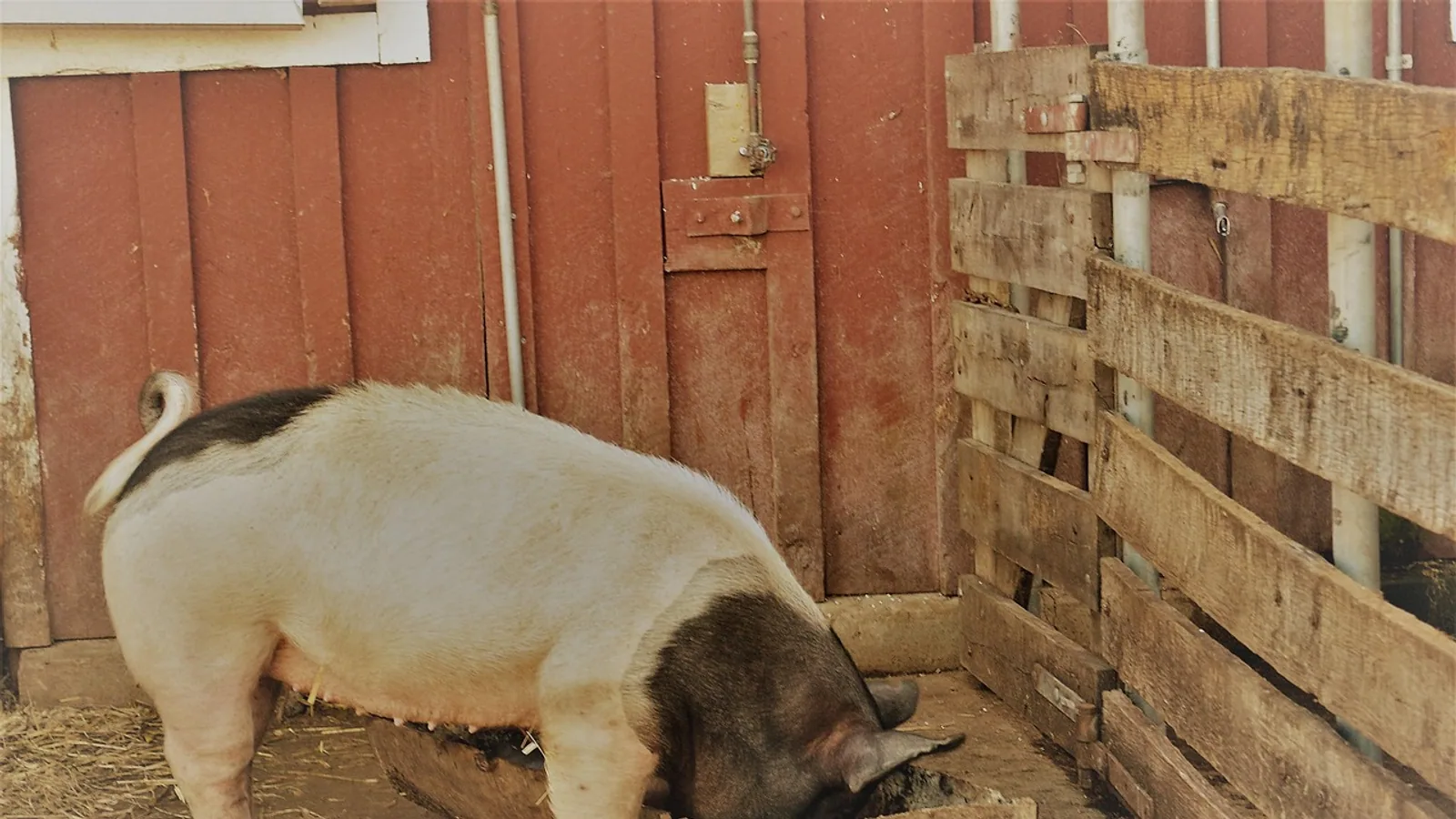
Hog feeding works best when you match the ration to the pig's body weight, not to a calendar date. A 10 kg nursery pig, a 35 kg grower, and a 90 kg finisher have very different nutrient needs, and the single most useful number for each stage is not crude protein. It is standardized ileal digestible (SID) lysine, paired with an energy target. Get the lysine-to-energy balance right, feed in phases, and track feed conversion ratio (FCR), and you will control cost, growth, and carcass quality at the same time.
This guide gives you the feeding table by weight band, the FCR math with a worked example, and the ration mistakes that quietly cost producers the most money. It covers nursery pigs from 5 to 20 kg, growers from 20 to 50 kg, and finishers from 50 to 120 kg. It is written for students, technicians, and producers who want the reasoning behind the numbers.
This article is educational and is not a substitute for veterinary diagnosis or treatment.
At a Glance: The Hog Feeding Framework
| Stage | Body weight | Primary nutrient driver | Energy focus | Expected FCR |
|---|---|---|---|---|
| Nursery | 5 to 20 kg | SID lysine, highly digestible protein | High density, small meals | 1.2 to 1.6 |
| Grower | 20 to 50 kg | SID lysine for lean gain | Moderate density | 1.8 to 2.3 |
| Finisher | 50 to 120 kg | SID lysine declining with weight | Lower density, limit waste | 2.5 to 3.2 |
Five steps that make this table work in practice:
- Weigh pigs, not pens. Body weight, not age, sets the diet.
- Formulate to SID lysine and energy, then let crude protein follow.
- Split the growth curve into phases so the diet tracks the pig's declining lysine need per unit of feed.
- Measure feed intake and weight gain to calculate FCR for each phase.
- Check water flow, feed quality, and mycotoxin risk before blaming the ration.
Why Body Weight Beats Crude Protein
Crude protein is a crude number. It measures nitrogen, not usable amino acids. Two diets with identical crude protein can deliver very different amounts of lysine, and lysine is the first limiting amino acid in almost every practical corn and soybean meal hog diet. When lysine is short, the pig cannot build muscle protein no matter how much total protein is in the feed. The excess nitrogen is excreted, which wastes money and increases environmental load.
Modern formulation therefore targets standardized ileal digestible lysine, expressed as a percentage of the diet or as grams per megajoule of metabolizable energy. The SID value corrects for what the pig actually absorbs by the end of the small intestine, which is far more predictive of growth than total lysine. A systems evaluation of grower-finisher programs showed that diets built around low-protein corn and soybean meal supplemented with crystalline amino acids can match growth performance while improving nitrogen utilization efficiency compared with conventional higher-protein programs [1]. That is the practical case for amino acid formulation: same gain, less wasted nitrogen.
Energy sets the ceiling on intake. Pigs eat to meet an energy need, so a high-energy diet is eaten in smaller amounts and a low-energy diet in larger amounts. If you change energy density without adjusting lysine, you change lysine intake even though the diet label looks the same. This is why lysine and energy must be formulated together, as a ratio.
Growth itself is not a straight line. Modeling work using the principles of the 2012 Swine National Research Council equations shows that body weight gain, feed intake, protein deposition, and lipid deposition interact continuously, and that barrows deposit more lipid while boars accrete more daily protein and have higher dietary SID lysine requirements [2]. The practical lesson is that sex and genetics shift the target, so a single fixed ration for all pigs in a barn will always be a compromise.
The Feeding Table by Stage and Weight Band
The table below is a formulation framework. Exact values depend on genetics, sex, health status, and environment, so treat the ranges as targets to refine with your nutritionist and your own records. Lysine is expressed as SID lysine as a percentage of the as-fed diet.
Nursery Pigs, 5 to 20 kg
| Weight band | SID lysine target | Energy target | Feed form | Notes |
|---|---|---|---|---|
| 5 to 7 kg | 1.30 to 1.45% | High density | Pelleted crumble | Highly digestible protein sources |
| 7 to 11 kg | 1.20 to 1.35% | High density | Pelleted crumble | Transition from milk-based to plant protein |
| 11 to 20 kg | 1.00 to 1.20% | Moderate to high | Pellet | Introduce simple corn and soybean meal |
Nursery pigs have immature digestive systems and a high surface-area-to-body-weight ratio, so they lose heat quickly and need dense, digestible feed. The goal is to keep them eating through the weaning transition. A commercial farm study compared a complex nursery diet using highly digestible protein sources including animal proteins against a simple corn and soybean meal diet fed over three phases. The nursery feeding program did not influence body weight, weight gain, or serum haptoglobin at any stage of production, and the simple diet reduced feed cost by $2.82 per pig during the nursery period without harming growth performance or carcass value [3]. Complex does not automatically mean better. Match diet complexity to pig health status and ingredient quality.
Grower Pigs, 20 to 50 kg
| Weight band | SID lysine target | Energy target | Expected FCR |
|---|---|---|---|
| 20 to 30 kg | 0.95 to 1.10% | Moderate | 1.8 to 2.1 |
| 30 to 40 kg | 0.85 to 0.95% | Moderate | 2.0 to 2.2 |
| 40 to 50 kg | 0.75 to 0.90% | Moderate | 2.1 to 2.3 |
The grower phase is where lean tissue deposition peaks. Protein deposition in growing pigs reached a maximum of about 170 g per day when pigs were fed 100% of their estimated individual SID lysine requirement in a controlled study, and average daily gain peaked at 0.98 kg per day at that same level [4]. Feeding below that level limits lean gain. Feeding far above it does not add muscle, it adds cost and nitrogen excretion.
Finisher Pigs, 50 to 120 kg
| Weight band | SID lysine target | Energy target | Expected FCR |
|---|---|---|---|
| 50 to 70 kg | 0.70 to 0.85% | Moderate | 2.4 to 2.7 |
| 70 to 90 kg | 0.60 to 0.75% | Moderate | 2.6 to 2.9 |
| 90 to 120 kg | 0.50 to 0.65% | Lower | 2.8 to 3.2 |
Lysine requirement per unit of feed falls steadily through the finisher phase because the pig is depositing more lipid and less protein relative to its total body mass. If you keep feeding a grower-level lysine concentration to a 100 kg pig, you oversupply amino acids and pay for nitrogen the pig cannot use. If you cut lysine too early, you reduce loin muscle area and carcass value.
A finishing study with pigs starting at 68.9 kg body weight found that increasing medium-oil dried distillers grains with solubles from 0 to 45% decreased average daily gain and gain-to-feed ratio linearly, with average daily gain falling about 2.3% for every 15% added DDGS and gain-to-feed falling about 1.3% for every 15% added [5]. Diets in that study were not balanced for energy, which is a key point. When you swap ingredients, you change energy density and amino acid profile at the same time.
Phase Feeding: Why More Phases Usually Pay
Phase feeding means changing the diet as the pig grows instead of feeding one ration from 20 to 120 kg. The logic is simple. A pig's lysine requirement per kilogram of feed declines as it gets heavier. A single diet must either oversupply lysine early or undersupply it late. Splitting the growth period into three, four, or more phases lets the diet track the requirement more closely.
A four-phase grower-finisher program is a standard research design in this field, and studies comparing corn and soybean meal, low-protein diets supplemented with crystalline amino acids, and DDGS-based diets have all been run within that structure [1]. The number of phases is a cost-benefit decision. Each additional phase adds feed mill complexity and ingredient storage, but reduces nutrient oversupply.
Precision feeding takes this further. A simulation study compared conventional phase feeding against a daily fit model that anticipates a proportional percentage of the next phase diet into the current diet. The simplified daily adjustment did not impair growth performance and showed potential to reduce crude protein, lysine, and digestible phosphorus intake by up to 5.58%, 7.11%, and 9.13% respectively [6]. That is a meaningful reduction in nutrient intake with no loss of gain.
Real-time models exist to estimate individual amino acid requirements. One model estimates daily feed intake, body weight, and daily gain from individual pig data, then uses factorial equations to calculate the optimal amino acid concentration for that pig [7]. Another validated method estimates real-time individual SID lysine requirements and showed that the best gain-to-feed ratio was obtained at 85% or more of the estimated requirement, while maximum protein deposition and weight gain in the 25 to 50 kg range were achieved at 115% of the estimate [8]. The gap between those two numbers is the practical uncertainty in any requirement estimate. Formulate slightly above the requirement for lean growth, not far above it.
Feeding patterns also matter. A study of sequential feeding with diets varying in amino acid concentration across the first and last 12 hours of the day found that pigs on the sequential program had higher lysine intake, protein gain, and phosphorus efficiency during the 25 to 50 kg phase compared with a daily program [9]. Pigs do not eat uniformly across the day, and nutrient supply can be matched to that rhythm.
Feed Conversion Ratio: The Math
Feed conversion ratio is feed intake divided by weight gain. It answers one question: how many kilograms of feed did the pig eat for each kilogram of body weight it added?
FCR = total feed consumed (kg) / total weight gained (kg)
Worked example. A pen of finisher pigs consumes 240 kg of feed over a period and gains 100 kg of total body weight.
FCR = 240 kg feed / 100 kg gain = 2.4
That means 2.4 kg of feed produced 1 kg of gain. Lower is better. An FCR of 2.4 is a solid finisher result. An FCR of 3.0 means the same gain cost 300 kg of feed.
You can also express efficiency as gain-to-feed ratio, which is the inverse.
G:F = weight gained / feed consumed = 100 kg / 240 kg = 0.42
Both numbers describe the same performance. Use one consistently within a farm so records stay comparable.
Why FCR Worsens With Age
FCR gets worse as pigs get heavier. This is normal and expected. Young pigs are building lean tissue efficiently, and lean tissue is mostly water and protein, which is cheap to deposit. Older pigs deposit more fat, and fat requires far more dietary energy per kilogram of gain. The maintenance cost also rises because a heavier pig has more body mass to maintain.
The practical consequence is that you should not compare a nursery FCR to a finisher FCR. Compare each phase to its own benchmark. Nursery pigs can convert at 1.2 to 1.6. Growers typically run 1.8 to 2.3. Finishers commonly run 2.5 to 3.2. A finisher FCR of 2.6 is not worse management than a nursery FCR of 1.4. It is the same pig at a different point on its growth curve.
Growth is also not linear within a phase. A study of four Chinese indigenous pig breeds during the fattening stage from roughly 50 to 90 kg found significant non-linear changes in FCR and feeding rate across growth stages, with breed-specific windows where the breeds diverged [10]. Even within a single weight band, FCR moves.
Why FCR Improves With Phase Feeding
Phase feeding improves FCR by reducing nutrient oversupply. When lysine and energy match the pig's actual requirement, more of the feed goes into gain and less into excretion or fat deposition beyond the target. The daily fit model study quantified part of this effect, showing reduced crude protein, lysine, and digestible phosphorus intake without impaired growth [6]. Less wasted nutrient per kilogram of gain is exactly what a better FCR looks like.
Genetics also move FCR. Feed efficiency is an economically important but costly trait to measure in pig breeding, and breeding programs use genomic prediction to estimate breeding values for FCR in animals that lack individual feed intake records [11]. If you buy breeding stock selected for feed efficiency, you are buying a better FCR baseline.
Tracking FCR Correctly
Three rules keep FCR records honest:
- Use the same weight basis. Live weight gain and carcass weight gain give different FCR values. Do not mix them.
- Account for feed disappearance, not feed delivered. Feed that is spilled, spoiled, or stolen by rodents is not eaten by pigs.
- Measure over a defined period with a known starting and ending weight. Short windows amplify weighing error.
Water: The Nutrient Nobody Formulates
Water intake drives feed intake. A pig that cannot drink will not eat, and a pig that is mildly dehydrated will eat less and convert worse. Water flow rate, nipple height, and drinker cleanliness matter as much as the diet.
Pigs drink roughly two to three times their dry feed intake by weight under normal conditions, and more in heat. If feed intake drops suddenly, check water before you change the ration. A partially blocked drinker line or a nipple set too high for small nursery pigs is a common cause of poor nursery performance that gets misdiagnosed as a feed problem.
Water quality matters too. High mineral content, bacterial contamination, and biofilm in lines can reduce intake. Clean and sanitize drinker lines between groups.
Feed Ingredients and Processing
Corn and soybean meal remain the backbone of US hog diets. Dried distillers grains with solubles (DDGS) is a common byproduct inclusion, and its energy and amino acid profile vary by source. The medium-oil DDGS study showed that increasing inclusion reduced average daily gain and gain-to-feed when diets were not balanced for energy [5]. Know your ingredient spec before you build a ration around it.
Feed processing changes nutritional value. A study of low-temperature two-stage probiotic fermentation of complete pig feed found that soybean antigenic protein and crude fiber were significantly degraded, crude protein and acid-soluble protein content increased, and biogenic amine accumulation was inhibited, while antioxidant and enzymatic activity improved [12]. Fermentation and similar processing methods can reduce antinutritional factors and improve nutrient utilization.
Former food products from the food industry are another option. A study testing 20% and 40% inclusion of sugary former food products in grower, finisher 1, and finisher 2 phases found that daily feed intake and daily gain decreased with increasing inclusion during the grower period, with tendencies in later phases [13]. Novel ingredients need to be validated on your farm before wide use.
Mycotoxin Risk
Mycotoxins are toxic compounds produced by molds that grow on feed grains, and they are a real and recurring hazard in hog feeding. They reduce feed intake, damage the gut and liver, and depress growth. The pigs most at risk are young nursery pigs and breeding animals.
Risk management steps:
- Buy grain and byproducts from suppliers who test for mycotoxins and provide certificates of analysis.
- Store feed and ingredients dry and cool. Moisture and heat drive mold growth.
- Inspect deliveries for caking, discoloration, and musty odor.
- Use a mycotoxin binder in the diet when risk is elevated, chosen with your nutritionist.
- Investigate any sudden drop in feed intake across a pen as a possible feed quality event.
Common Ration Mistakes
Overfeeding Finishers
The most expensive mistake in hog feeding is keeping a high-lysine, high-energy grower ration in front of heavy finishers. The pig deposits fat, FCR worsens, and feed cost per kilogram of gain climbs. Step the lysine concentration down as body weight rises, and consider restricting energy density in the final phase. Do not restrict feed intake itself unless a specific program calls for it, because limit feeding finishers can reduce gain and create aggression at the feeder.
Ignoring Water Intake
Covered above, and worth repeating as a mistake category. Poor water access mimics a bad ration. Check water first.
Abrupt Diet Changes
Switching diets suddenly causes a drop in intake and digestive upset. Pigs are creatures of habit and their gut microbiota adapts to the diet. Transition over several days by blending the old and new diets, especially at weaning and at each phase change. The gut microbiota composition of pigs changes between growth stages, with different microbial populations at 60 kg and 120 kg body weight [14]. A sudden diet change disrupts that adapted population.
Formulating to Crude Protein Only
Already covered, but it belongs on the mistake list because it is still common. Crude protein tells you nothing about lysine availability. Formulate to SID lysine and energy.
Ignoring Sex and Genetics
Barrows deposit more lipid and boars have higher SID lysine requirements [2]. If you feed both sexes the same ration to the same weight, one group is being overfed or underfed. Split-sex feeding is a low-cost improvement where facilities allow.
Forgetting the Nursery Transition
Nursery pigs need dense, digestible feed, but the simple versus complex diet comparison showed that a simple corn and soybean meal nursery program can reduce feed cost without harming growth or carcass value on commercial farms [3]. Do not assume the most expensive nursery diet is the best one. Match complexity to health status.
How to Build a Feeding Program Step by Step
- Set your weight bands. Use 5 to 20 kg for nursery, 20 to 50 kg for grower, and 50 to 120 kg for finisher as a starting framework, then split each band further if your records support it.
- Set the SID lysine target for each band based on genetics, sex, and target lean gain.
- Set the energy target for each band. Higher energy for young pigs, lower for heavy finishers.
- Balance the remaining amino acids to lysine using the ideal protein concept, so methionine, threonine, tryptophan, and the branched-chain amino acids stay in proportion.
- Check calcium and phosphorus against the expected bone and lean deposition.
- Add vitamins, trace minerals, and any feed additives per your nutritionist's specification.
- Verify water supply and quality.
- Confirm ingredient quality and mycotoxin status.
- Feed in phases and record intake and weight at each phase change.
- Calculate FCR per phase and compare to your own historical benchmarks, not to other farms.
Decision Path for a Feeding Problem
The flowchart below shows the order to check when growth or feed conversion is below target.
flowchart TD
    [Poor growth or high FCR]
    [Check water supply]
    [Check feed intake records]
    [Check ingredient quality]
    [Check mycotoxin risk]
    [Check body weight and stage]
    [Check lysine and energy targets]
    [Check health status]
    [Adjust ration or treat cause]
    [Recheck FCR next phase]
    [Poor growth or high FCR] --> [Check water supply]
    [Check water supply] --> [Check feed intake records]
    [Check feed intake records] --> [Check ingredient quality]
    [Check ingredient quality] --> [Check mycotoxin risk]
    [Check mycotoxin risk] --> [Check body weight and stage]
    [Check body weight and stage] --> [Check lysine and energy targets]
    [Check lysine and energy targets] --> [Check health status]
    [Check health status] --> [Adjust ration or treat cause]
    [Adjust ration or treat cause] --> [Recheck FCR next phase]
Welfare and Safety Points
Feed and water are welfare issues, not just production inputs. A pig that cannot reach feed or water is in distress. Check feeder adjustment so that feed is not wasted and every pig can eat, and check drinker flow at the nipple, not at the source.
Feed safety covers mycotoxins, microbial contamination, and unwanted residues. Antibiotic residues in feed and feces are a documented concern in intensive swine operations, with tetracyclines found at much higher concentrations than sulfonamides in both feed and fecal samples, and some excretion ratios above one indicating additional administration routes beyond feed [15]. Follow withdrawal requirements and keep medication records accurate.
Do not feed moldy, wet, or spoiled feed. Do not use feed that has been contaminated by rodents or chemicals. Store feed in clean, dry bins and rotate stock.
Clinical Relevance, Limitations and Common Mistakes
The feeding table and FCR benchmarks here are a framework, not a prescription. Individual pigs and individual barns vary with genetics, health, environment, and management. A ration that performs well in one facility may underperform in another because of water quality, stocking density, or disease pressure. Use these numbers to start a conversation with your nutritionist and your veterinarian, then refine with your own records.
The most common mistakes in hog feeding are overfeeding finishers with grower-level lysine, ignoring water intake when growth drops, changing diets abruptly, formulating to crude protein instead of SID lysine, and failing to account for mycotoxin risk. Each of these has a clear fix and each shows up in FCR records before it shows up anywhere else.
Individual cases need a veterinarian. If pigs are off feed, losing weight, or showing signs of disease, the ration is not the first thing to adjust. Diagnose the health problem first.
Frequently Asked Questions
What is a good feed conversion ratio for pigs?
A good FCR depends on the stage. Nursery pigs commonly convert at 1.2 to 1.6, growers at 1.8 to 2.3, and finishers at 2.5 to 3.2. Compare each pig to the benchmark for its own weight band, not across stages.
Why does feed conversion get worse as pigs grow?
Heavier pigs deposit more fat and less lean tissue, and fat costs more dietary energy per kilogram of gain. Maintenance cost also rises with body mass. Worsening FCR with age is normal.
Should I formulate to crude protein or lysine?
Formulate to standardized ileal digestible lysine and energy. Crude protein measures total nitrogen, not usable amino acids, and it does not predict growth as well.
How many feeding phases should I use?
Most grower-finisher programs use three to four phases. More phases track the pig's declining lysine requirement more closely but add feed mill complexity. Precision feeding with daily adjustments can reduce nutrient intake further without hurting growth.
Can I feed the same ration from 20 to 120 kg?
You can, but it will oversupply lysine early and undersupply it late, which wastes money and can reduce lean gain. Phase feeding improves both cost and FCR.
How do I calculate FCR?
Divide total feed consumed by total weight gained. For example, 240 kg of feed for 100 kg of gain gives an FCR of 2.4.
What causes a sudden drop in feed intake?
Check water supply first, then feed quality and mycotoxin risk, then health status. Abrupt diet changes and spoiled feed are common causes.
Do barrows and gilts need different rations?
Yes, barrows deposit more lipid and boars have higher SID lysine requirements. Split-sex feeding improves efficiency where facilities allow it.
Related Articles
- Pig Feed Rations: Formulation for Grower, Finisher, and Sow Stages
- Feed Conversion Ratio in Aquaculture: Calculation and Improvement
- Feed Conversion Ratio in Livestock: Measuring Efficiency
- Dairy Cow Feed Efficiency: Measuring and Improving Conversion
- Evaluating Dairy Cow Feed Efficiency and Feed Conversion Ratios
- Sheep Feed Conversion: Improving Efficiency and Reducing Costs
- What to Feed Ducklings: Age-Based Feeding Chart
Sources
- A systems approach to evaluate nitrogen utilization efficiency and environmental impacts of swine growing-finishing feeding programs in U.S. pork production systems.
- ASAS-NANP symposium: mathematical modeling in animal nutrition: agent-based modeling of nutrient requirements and growth performance in growing-finishing pigs for sustainable production systems.
- Effect of nursery feeding program on serum haptoglobin, growth performance, and carcass characteristics of pigs reared on commercial farms.
- Improving the estimation of amino acid requirements to maximize nitrogen retention in precision feeding for growing-finishing pigs.
- The effects of medium-oil dried distillers grains with solubles on growth performance, carcass traits, and nutrient digestibility in growing-finishing pigs.
- A Simplified Daily Fit Model to Reduce Costs and Nutrient Intake in Growing-Finishing Pigs.
- Development of sustainable precision farming systems for swine: estimating real-time individual amino acid requirements in growing-finishing pigs.
- Evaluation of a method estimating real-time individual lysine requirements in two lines of growing-finishing pigs.
- Effects of sequential feeding with adjustments to dietary amino acid concentration according to the circadian rhythm on the performance, body composition, and nutrient balance of growing-finishing pigs.
- Comparative Analysis of Growth and Feeding Behavior in Four Chinese Indigenous Pig Breeds.
- Modest contribution of metabolomic data to genomic prediction of breeding values for feed conversion ratio in pigs.
- Low-temperature two-stage probiotic fermentation enhances nutrition and safety of pig liquid feed.
- Evaluating 20% and 40% Inclusion of Sugary Former Foods in Pig Diets: Effects on Growth Performance, Feeding Behaviour, Carcass and Meat Quality Traits.
- Gut Microbiota Composition and Diversity in Different Commercial Swine Breeds in Early and Finishing Growth Stages.
- The presence of tetracyclines and sulfonamides in swine feeds and feces: dependence on the antibiotic type and swine growth stages.