Buckskin Horse: Color Genetics, Buckskin vs Dun, and Breeds
By Dr. Zubair Khalid, DVM, MS, PhD ·
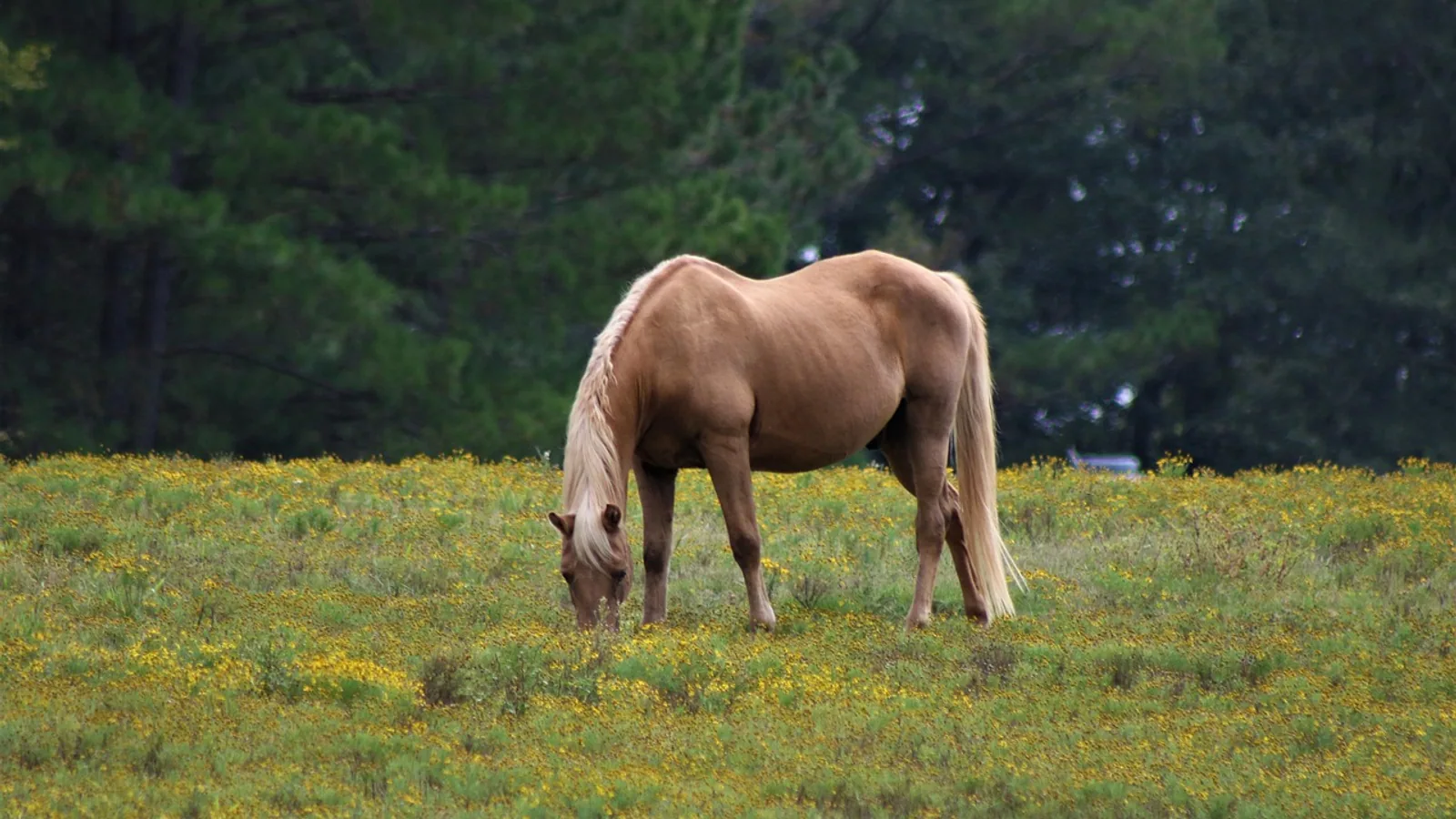
A buckskin horse is a bay horse that carries exactly one copy of the cream dilution allele. The cream allele lightens the red (phaeomelanin) pigment in the coat to a golden, tan, or butterscotch shade while leaving the black (eumelanin) points, mane, tail, and lower legs, largely intact [1][2].
That single sentence answers most of what people search for, but the details matter. The cream allele behaves differently depending on how many copies a horse inherits and what base color sits underneath. Buckskin is also routinely confused with dun, a completely separate dilution with its own gene, its own markings, and its own inheritance pattern. This guide covers the biology, the visual differences, foal coat changes, breeding probabilities, the breeds where buckskin appears, and the health question owners ask most often.
This article is educational and is not a substitute for veterinary diagnosis or treatment.
What Makes a Horse Buckskin
The bay base coat
Every horse color starts with one of two base pigments. Eumelanin produces black and dark brown. Phaeomelanin produces red and yellow. The interaction of two genes, Extension (MC1R) and Agouti (ASIP), determines which pigment lands where.
A bay horse has a black base with the Agouti gene restricting that black pigment to the points: mane, tail, lower legs, and ear edges. The body is red or reddish brown. Genetically, a bay horse is E\_ at Extension (at least one functional black allele) and A\_ at Agouti (at least one dominant bay-restricting allele) [3][4].
What the cream allele does
The cream allele is a variant in the SLC45A2 gene, historically mapped to equine chromosome 21 and identified as a G to A transition in exon 2 that substitutes asparagine for aspartic acid in the encoded protein [1][2]. This same gene family influences pigmentation across mammals, including dogs and donkeys, which tells you how conserved this pathway is [5][6].
Cream is inherited in an incomplete dominant pattern [7]. That means the number of copies changes the visible result:
- One cream allele (Ccr/C): dilutes only red pigment. Black stays black. On a bay base, this produces buckskin.
- Two cream alleles (Ccr/Ccr): dilutes both red and black pigment. On a bay base, this produces perlino, a much paler horse with cream or white body hair, pale mane and tail, and often blue eyes.
A buckskin horse, therefore, is always heterozygous for cream. It has one cream allele and one non-cream allele, sitting on a bay base [1][7].
Why buckskin is not a breed
Buckskin describes a color, not a breed. Any breed with access to a bay base and the cream allele can produce buckskin foals. The Kiso horse study from Japan documented buckskin among 149 horses at a low frequency, with the cream allele present at only 0.02 in that population [3]. Thoroughbreds carry the cream allele rarely, and the allele frequency data from that population show why buckskin is uncommon in the breed [4]. In stock horse populations, buckskin is far more common because the allele has been selected for deliberately.
Buckskin vs Dun: The Critical Difference
This is the single most common point of confusion in equine color. Buckskin and dun can look similar at a glance, especially in photographs. They are genetically unrelated.
Different genes, different mechanisms
Buckskin comes from cream (SLC45A2) acting on a bay base [1][2]. Dun comes from regulatory mutations in the TBX3 gene [8]. These are separate loci on separate chromosomes. A horse can carry cream, dun, both, or neither.
The dun mutation works by changing how pigment is deposited inside individual hairs. In dun horses, TBX3 expression in the hair follicle causes radially asymmetric pigment deposition, meaning the pigment granules cluster on one side of the hair shaft rather than wrapping evenly around it [8]. That asymmetry is what produces the washed-out, diluted body color while leaving certain areas dark. In non-dun horses, regulatory mutations impair TBX3 expression in the hair follicle, so melanocytes and pigment granules distribute more evenly around the hair, producing a more intensely pigmented coat [8].
The markings that separate them
Primitive markings are the practical field test. Dun horses show:
- A dorsal stripe running down the spine
- Horizontal stripes on the upper legs (zebraring)
- A transverse stripe over the shoulders (sometimes called a cross or Bider marking)
- Dark ear tips and a dark-edged mane
- Cobwebbing or frosting on the forehead in some individuals
Buckskin horses do not have these markings as part of the color. A buckskin may have a dorsal stripe for unrelated reasons, including countershading or sooty modifiers, but the stripe is not produced by the cream allele.
Recent research on Mongolian dun horses examined the Bider marking, a symmetrical dark-mottled pattern on the shoulder blades also seen in Przewalski's horses. TBX3 expression differed between Bider-marked and non-Bider dun horses, with higher expression in the shoulder of non-Bider horses and higher expression elsewhere in Bider horses [9][10]. TBX3 is clearly implicated in these markings, though the upstream regulation is still under study [9].
The dun allele is not fully penetrant
One of the most useful findings for owners is that dun does not always express the way textbooks describe. In the Polish Primitive Horse (Konik), researchers found a significant association between the TBX3 1.6 kb insertion/deletion genotype and the degree of dun dilution, and they demonstrated that the dominant action of the dun mutation is not fully penetrant [11]. They also identified a high frequency (35%) of genetically bay dun horses that were officially recorded as blue (black base) duns, meaning even experienced registries misclassify these horses [11].
The Hucul horse study found disagreement between genotype-predicted color and recorded color in 157 of 462 horses (34%). The most common error was misclassification of horses with the nd1/nd1 and nd1/nd2 genotypes, which may relate to intermediate dilution phenotypes [12]. The authors also found the dominant dun allele at a frequency of 0.30, higher than studbooks predicted, and suggested the dun dilution effect may not be as strongly epistatic in Hucul horses as in other breeds, possibly due to an additional genetic modifier suppressing the D allele's visible effect [12].
The practical takeaway: visual identification of dun is unreliable in some horses. If the color matters for registration, breeding, or sale, genetic testing is the only definitive answer.
Quick comparison
| Feature | Buckskin | Dun |
|---|---|---|
| Gene involved | Cream (SLC45A2) | Dun (TBX3 regulatory mutation) |
| Base coat required | Bay (E\_ A\_) | Any base color (bay, black, chestnut, etc.) |
| Inheritance | Incomplete dominant, one copy needed | Dominant, but not fully penetrant [11] |
| Body color | Golden, tan, butterscotch | Diluted, washed-out version of base color |
| Mane and tail | Black | Usually dark, may be diluted |
| Dorsal stripe | Not part of the color | Characteristic |
| Leg barring | Absent | Common |
| Shoulder cross or Bider mark | Absent | Common in some lines [9][10] |
| Eye color | Dark | Dark |
| Skin color | Dark | Dark |
Shades of Buckskin
Buckskin is not one color. The cream allele dilutes red pigment to varying degrees, and the underlying bay shade modifies the result. Owners and registries describe several shades.
Classic golden buckskin. A rich golden body with jet black points. This is the shade most people picture.
Buttercream or pale buckskin. A lighter, softer body color. The points may appear less starkly black, though they are still black genetically.
Sooty buckskin. Darker hairs mixed through the coat, often along the topline, giving a deeper, more muted appearance. Sooty is a separate modifier, not part of the cream effect.
Dunskin. A horse carrying both cream and dun. These horses show the golden body of buckskin plus primitive markings. Dunskin is a color description, not a separate genetic category, and it is worth testing if you need certainty.
The cream allele's effect on red pigment is dose-dependent, which is why one copy gives buckskin and two copies give perlino [7]. There is no genetic category between them, though visual overlap with pearl and champagne dilutions exists. Pearl is a recessive dilution in SLC45A2 that produces a phenotype similar to homozygous cream when paired with a cream allele, sometimes called a false double dilute [13][7]. Champagne is a separate dominant gene, SLC36A1, that produces a different dilution pattern and is often confused with cream-based colors [14]. If a horse's color does not match its pedigree expectations, testing multiple loci is the answer.
Foal Coat Changes
Buckskin foals do not always look buckskin at birth.
Foals are born with a foal coat that is often lighter, fluffier, and less defined than the adult coat. A buckskin foal may appear pale cream or washed out for the first weeks to months. The black points may be faint or absent at birth and darken as the foal coat sheds.
The first significant change comes with the foal shed, typically within the first few months. The adult coat begins to emerge, and the golden body color and black points become clearer. A second change often occurs at the yearling shed, when the coat matures further.
Some buckskin foals are born with a dorsal stripe or countershading that fades with age. This is normal and does not indicate dun. Conversely, a dun foal may show primitive markings from birth or develop them over the first year.
The practical point for breeders: do not register or advertise a foal's color with certainty based on the newborn coat. Wait for the first or second shed, and use genetic testing if the color is contractually or financially important.
Breeding Outcomes
Buckskin breeding is predictable once you know the genotypes of both parents. The cream allele is inherited in a simple Mendelian pattern, so the outcomes follow directly from whether each parent carries zero, one, or two copies.
The table below assumes the non-cream parent is bay and does not carry cream. It also assumes the cream-carrying parent is buckskin (one cream allele on a bay base).
| Sire | Dam | Foal outcomes |
|---|---|---|
| Buckskin (Ccr/C) | Bay (C/C) | 50% buckskin (Ccr/C), 50% bay (C/C) |
| Buckskin (Ccr/C) | Buckskin (Ccr/C) | 25% bay (C/C), 50% buckskin (Ccr/C), 25% perlino (Ccr/Ccr) |
| Buckskin (Ccr/C) | Palomino (Ccr/C on chestnut base) | 25% bay, 25% buckskin, 25% palomino, 25% cremello |
| Buckskin (Ccr/C) | Chestnut (C/C) | 50% buckskin, 50% palomino (base color depends on Agouti inheritance) |
| Perlino (Ccr/Ccr) | Bay (C/C) | 100% buckskin (all foals inherit one cream allele) |
| Perlino (Ccr/Ccr) | Buckskin (Ccr/C) | 50% buckskin, 50% perlino |
Two important caveats.
First, the base color outcome depends on the Extension and Agouti genotypes of both parents, not just the cream status. A buckskin bred to a chestnut can produce palomino if the foal inherits the chestnut base from both sides. The table simplifies this by holding base color constant, but real matings vary.
Second, breeding two cream-carrying horses together risks producing a double dilute foal (perlino, cremello, or smoky cream). Double dilutes are healthy horses, but they have pale skin and light eyes, and they require thoughtful management of sun exposure. This is a management consideration, not a genetic defect.
If you are planning a breeding and the color outcome matters, test both parents for Extension, Agouti, and Cream at minimum. Adding Dun, Pearl, and Champagne testing gives a complete picture.
Breeds and Registries
Buckskin appears wherever a bay base and the cream allele meet. Some breeds and registries actively select for it.
Quarter Horse and stock horse lines
The buckskin Quarter Horse is one of the most recognizable and sought-after color variants in the stock horse world. The American Quarter Horse Association registers buckskin horses and they compete across all disciplines. The cream allele is well established in Quarter Horse lines, and buckskin Quarter Horses are frequently marketed for their color.
The Palomino Horse Breeders of America pedigree study traced 460 randomly sampled horses from ten years of World Show entries and identified six foundation sires contributing to the modern stock-type horse, with 58% tracing back to a sire named Old Fred [15]. Two of the identified sires carried cream-influenced color inheritance [15]. DELETE (or replace with a neutral statement about cream allele frequency in stock horses, if sourced).
Color registries
The International Buckskin Horse Association registers buckskin, dun, grullo, and related colors [16]. Color registries exist because the market values these coats, and they provide a registration pathway for horses that may not qualify for breed registries based on pedigree alone.
Other breeds
Buckskin appears in many breeds at varying frequencies. The Kiso horse, a Japanese native breed, included 6 buckskin horses among 149 documented, with a cream allele frequency of 0.02 [3]. The Hispano-Arabian horse study documented dilution genes entering the population through Spanish Purebred contributions, since many dilution genes present in the Hispano-Arabian are absent from the Arabian Purebred [17]. That study also noted that crossbred breeding may increase the likelihood of double dilute combinations and that pearl coats appeared at higher numbers in Hispano-Arabian horses than in either parent breed [17].
Dun, by contrast, is the wild-type color in horses and appears across many breeds and landraces. The Konik, Hucul, and Mongolian horse populations all carry dun at meaningful frequencies [11][10][12]. Dun is also the ancestral phenotype in donkeys, where wild asses show diluted gray pigmentation and domestic donkeys display non-diluted black or chestnut coats, a shift caused by a 1 bp deletion downstream of TBX3 that reduces the gene's expression [18].
Health and the Color Itself
Buckskin is a coat color. It is not a disease, and it carries no known health problem.
The cream allele affects pigment production in the hair and skin. It does not affect the immune system, the musculoskeletal system, the respiratory system, or any internal organ. A buckskin horse has the same health profile as any other horse of the same breed, age, and management.
Two points deserve attention because they are frequently misunderstood.
First, double dilutes (perlino, cremello, smoky cream) have pale skin and light-colored eyes. These horses can be more sensitive to sunlight and may require management of sun exposure. This is a consequence of having two cream alleles, not of being buckskin. A buckskin horse has dark skin and dark eyes and does not share this consideration.
Second, some color patterns are associated with health conditions in specific breeds. Lethal white syndrome in overo Paint Horses is the classic example. Buckskin is not one of these patterns. The cream allele has no known association with any congenital condition.
If a buckskin horse develops a health problem, the problem is the health problem, not the color. Work with your veterinarian on diagnosis and treatment as you would for any horse.
Practical Implications for Owners
Buying and selling
DELETE or replace with 'Color can affect market demand in some disciplines.' DELETE or replace with 'Some buyers show a preference for buckskin in certain disciplines' without price claim. DELETE.
If you are buying a horse advertised as buckskin, verify the color if it matters to you. The Hucul and Konik studies both documented substantial misclassification rates between genotype and recorded color [11][12]. A horse sold as buckskin could be a dunskin, a sooty bay, or a light bay. DELETE or replace with 'Genetic testing resolves the question definitively.'
Registration
If you plan to register a foal with a color registry, check the registry's requirements before breeding. Some registries require parentage verification, and some require specific color documentation. The International Buckskin Horse Association registers buckskin and related colors [16]. Breed registries like the American Quarter Horse Association have their own color and pedigree requirements.
Management
Buckskin horses need the same care as any horse. Nutrition, hoof care, dental care, parasite control, vaccination, and exercise are determined by the individual horse's needs, not its color. DELETE (or move to a general equine wellness article with proper citation). Color does not change any of these recommendations.
Breeding decisions
If you are breeding for color, understand the probabilities before you commit. The table above gives the basic outcomes. Two cream-carrying parents can produce a double dilute foal, which is a healthy horse but a different management proposition. Test your breeding stock so you know what you are working with.
Common Myths About Buckskin Horses
Myth: Buckskin and dun are the same color. They are produced by different genes with different inheritance patterns and different markings [1][8]. The confusion is understandable because both dilute the body color while leaving dark points, but the genetics are distinct.
Myth: A dorsal stripe means the horse is dun. Not necessarily. Countershading and sooty modifiers can produce a dorsal stripe on a non-dun horse. The full set of primitive markings, combined with genetic testing, is the reliable way to distinguish them.
Myth: Buckskin horses are a breed. Buckskin is a color. It appears in many breeds, including the Quarter Horse, and color registries exist to record it [16].
Myth: Buckskin horses have health problems. The color carries no known health problem. Double dilutes have management considerations related to sun exposure, but buckskin horses have dark skin and dark eyes and do not share those considerations.
Myth: Two buckskins always produce a buckskin. Two buckskins produce buckskin 50% of the time, bay 25% of the time, and perlino 25% of the time. The actual outcome depends on the base color genetics as well.
Myth: You can tell a foal's adult color at birth. Foal coats change significantly through the first and second sheds. Waiting is more reliable than guessing.
What Is Still Uncertain
Dun genetics are more complex than the simple dominant model suggests. The Konik study showed the dun mutation is not fully penetrant, and the authors proposed an additional allele at the TBX3 locus contributing to coat color variability [11]. The Hucul study proposed a genetic modifier suppressing the D allele's effect in that breed [12]. The Mongolian Bider studies localized TBX3 to the epidermis and hair follicle bulbs but noted that upstream regulation requires further study [9].
Pearl and cream interactions continue to be characterized. The pearl variant in SLC45A2 produces a phenotype similar to homozygous cream when paired with a cream allele, which is why some horses test as single cream carriers but appear double dilute [13][7]. This has practical implications for breeders who test only for cream and assume the result explains the phenotype.
For owners, the uncertainty is mostly academic. The color of your horse does not change its care. If you are breeding for color or registering a horse where color matters, genetic testing across multiple loci gives you the clearest picture.
Limitations and When to Contact a Veterinarian
This article covers coat color genetics and general care context. It does not replace an examination by a veterinarian who can see your horse.
Contact a veterinarian if your horse shows any of the following:
- Sudden coat color change, hair loss, or skin lesions, which may indicate a medical condition rather than a genetic color trait
- Eye discharge, squinting, or cloudiness, particularly in double dilute horses with light eyes
- Sunburn, blistering, or skin crusting on light-pigmented areas
- Lameness, swelling, or reluctance to move
- Fever, nasal discharge, cough, or changes in appetite or water intake
- Any wound, colic signs, or behavior change that concerns you
For routine preventive care, follow the schedule your veterinarian recommends based on your horse's age, use, and environment. DELETE (or cite properly and relocate to a general care article). DELETE.
Color genetics is not a diagnostic tool. If your horse is unwell, the color is irrelevant to the workup.
Frequently Asked Questions
What is a buckskin horse?
A buckskin horse is a bay horse with one copy of the cream dilution allele. The cream allele lightens the red body pigment to gold or tan while leaving the black mane, tail, and lower legs intact [1][2]. Buckskin is a color, not a breed.
How do you tell a buckskin from a dun?
Look for primitive markings. Dun horses have a dorsal stripe, leg barring, and often a shoulder cross or Bider mark, produced by TBX3 regulatory mutations [8]. Buckskin horses do not have these markings as part of the color. Because dun is not fully penetrant and misclassification is common, genetic testing is the definitive answer [11][12].
Can two buckskin horses produce a perlino foal?
Yes. Two buckskins each carry one cream allele, so 25% of their foals inherit two cream alleles and are perlino [7]. The other outcomes are 50% buckskin and 25% bay, assuming both parents are bay at the base.
Is buckskin the same as palomino?
No. Buckskin is cream on a bay base, so the horse has black points. Palomino is cream on a chestnut base, so the horse has no black points and a flaxen or white mane and tail. Both involve one cream allele, but the base color differs [1][7].
What breeds can be buckskin?
Any breed with a bay base and the cream allele can produce buckskin. It is common in Quarter Horses and stock horse lines, appears in color registry populations [16], and occurs at low frequency in breeds like the Kiso horse [3]. The buckskin Quarter Horse is one of the most recognized examples.
Does buckskin cause any health problems?
No. Buckskin is a coat color with no known associated health problem. Double dilutes like perlino and cremello have pale skin and light eyes and may need sun exposure management, but buckskin horses have dark skin and dark eyes.
What color will a buckskin foal be?
A buckskin foal may look pale or washed out at birth and darken through the first and second sheds. Do not assume the adult color from the newborn coat. Genetic testing gives a definitive answer if the color matters for registration or sale.
Can a buckskin horse have a dorsal stripe?
A buckskin horse can have a dorsal stripe from countershading or sooty modifiers, but the stripe is not produced by the cream allele. A true dun dorsal stripe comes from TBX3 and is accompanied by other primitive markings [8]. If you need certainty, test for dun.
Related Articles
- Palomino Horse: Genetics, Color, and Health Considerations
- Quarter Horse Health: Common Conditions and Preventive Care
- Horse Breeds: A Comparative Guide for Veterinary Professionals
- Selecting the Right Horse Breed for Your Riding Goals
- Horse Breeds for Beginner Riders: A Safer Way to Choose a First Horse
- Miniature Horse Care Guide
- Horse Coat Colors: Bay, Chestnut, Dun, Roan, and the Genetics
- Roan Horse: Red, Blue, and Bay Roan Color and Genetics
- Norwegian Fjord Horse: Size, Temperament, Color, and Care
Sources
- A mutation in the MATP gene causes the cream coat colour in the horse.
- The cream dilution gene, responsible for the palomino and buckskin coat colours, maps to horse chromosome 21.
- Variation in the MC1R, ASIP, and MATP genes responsible for coat color in Kiso horse as determined by SNaPshot™ genotyping.
- Development of a method for simultaneously genotyping multiple horse coat colour loci and genetic investigation of basic colour variation in Thoroughbred and Misaki horses in Japan.
- Identification of a Missense Variant in MFSD12 Involved in Dilution of Phaeomelanin Leading to White or Cream Coat Color in Dogs.
- A SLC45A2 mutation is strongly associated with the cream dilution in Baroque donkeys.
- A candidate gene approach identifies variants in SLC45A2 that explain dilute phenotypes, pearl and sunshine, in compound heterozygote horses.
- Regulatory mutations in TBX3 disrupt asymmetric hair pigmentation that underlies Dun camouflage color in horses.
- Differential Expression and Analysis of TBX3 Gene in Skin Tissues of Dun Mongolian Horses with and Without Bider Markings.
- Expression and Analysis of TBX3 Gene in the Skin from Three Locations on Dun Mongolian Bider Horse.
- Genetic Background of the Polish Primitive Horse (Konik) Coat Color Variation-New Insight into Dun Dilution Phenotypic Effect.
- TBX3 and ASIP genotypes reveal discrepancies in officially recorded coat colors of Hucul horses.
- Explicit evidence for a missense mutation in exon 4 of SLC45A2 gene causing the pearl coat dilution in horses.
- Missense mutation in exon 2 of SLC36A1 responsible for champagne dilution in horses.
- Pedigree tracing to determine the origins of the modern Palomino Horse Breeders of America stock-type horse.
- International Buckskin Horse Association (madbarn.com)
- One Hundred Years of Coat Colour Influences on Genetic Diversity in the Process of Development of a Composite Horse Breed.
- Donkey genomes provide new insights into domestication and selection for coat color.