Shih Tzu Bichon Mix: Zuchon Breed Traits and Care
By Dr. Zubair Khalid, DVM, MS, PhD ·

The Shih Tzu Bichon mix, often called a Zuchon, is a deliberate cross between a Shih Tzu and a Bichon Frise. It is not a recognized pure breed, so two Zuchons can differ in size, coat, face shape, and temperament. Care should be built around the individual dog and the health risks that come from both parent lines. A sensible plan combines a careful breeder search, an early veterinary wellness visit, lifelong skin and ear checks, dental care, weight control, and prompt attention to breathing, eye, and kidney changes [3][4].
This article is educational and is not a substitute for veterinary diagnosis or treatment.
At a Glance: Zuchon Care Checklist
| Action | Why it matters | When to start |
|---|---|---|
| See the puppy and at least one parent in person before purchase | Designer crossbreed puppies are more often bought without an in-person visit [2] | Before purchase |
| Ask for parent health records and written health information | Crossbreed status does not guarantee freedom from inherited disorders [1] | Before purchase |
| Schedule a full veterinary exam | Establishes baseline weight, skin, ears, eyes, breathing, and dental health | Within the first few days after purchase |
| Inspect the skin during grooming | Shih Tzus have a higher reported prevalence of atopic dermatitis in at least one breed survey [3] | At every grooming session |
| Watch breathing, exercise tolerance, and heat tolerance | Flat-faced conformation can affect the airway [5] | Daily |
| Plan dental and ear care with your veterinarian | Small companion dogs need routine preventive care | At every wellness visit |
| Track thirst, urination, appetite, and weight | Bichon Frise case reports describe skin and kidney disease [4][6] | Daily and at senior exams |
| Use positive, consistent training and gradual socialization | Designer crossbreed behavior is variable [7] | From puppyhood |
What Is a Shih Tzu Bichon Mix?
A Zuchon is a cross between two small companion breeds. It is sold under several names, including Shih Tzu Bichon mix, Shih Tzu Bichon Frise cross, and Zuchon. It belongs to the wider group of deliberate designer crossbreeds, which are produced by breeding two established purebreds [1][2]. It is not a breed with a recognized standard, so there is no predictable adult size, coat type, or temperament. A litter can contain puppies that strongly favor one parent or the other.
Both parent breeds are small. A Korean study of small-to-medium breeds included Shih Tzus and Bichon Frises among the nine breeds that made up 77% of dogs with canine atopic dermatitis [3]. That study supports a practical point for owners: skin allergy is a relevant concern in these lines, and small size does not mean low maintenance.
Health claims around designer crossbreeds deserve scrutiny. A large UK study compared three common Poodle crosses with their purebred parent breeds and found no statistically significant difference in 86.6% of 342 health comparisons [1]. The crosses had higher odds for some disorders and lower odds for others. That result does not mean every crossbreed is unhealthy. It means the label “crossbreed” is not a health guarantee. A Zuchon can inherit a disorder from the Shih Tzu side, the Bichon Frise side, or both.
Because no breed standard exists, the most reliable way to understand an individual Zuchon is to review the parents, their health records, and the puppy’s own development. That is more useful than relying on coat color, size at birth, or online descriptions.
Zuchon Traits: What Varies and What to Expect
Size, Coat, and Appearance
Adult size falls somewhere between the parent breeds, but exact ranges vary. A Zuchon may have a shorter muzzle from the Shih Tzu side or a longer muzzle from the Bichon Frise side. Coat texture can range from soft and wavy to denser and straighter. Shedding and grooming needs vary with the individual coat.
There is no standard that allows a Zuchon to be classified as “hypoallergenic” or “low-shedding.” Those labels are marketing terms, not medical diagnoses. In a UK survey, 47.1% of designer crossbreed owners cited hypoallergenicity as a reason for their choice, compared with 7.86% of purebred owners [2]. The perception is common. The guarantee is not.
Ask the breeder for photos of the parents and, if possible, meet them. Ask what the puppy’s coat looks like now and how it is expected to change. Plan for regular grooming regardless of coat type. Grooming sessions are also the best time to inspect the skin, ears, eyes, and nails.
Temperament and Behavior
Temperament is individual. A Zuchon may be outgoing, reserved, playful, or sensitive. Early training and consistent routines matter more than the crossbreed name. A study of Poodle-cross designer dogs found that designer crossbreeds showed more undesirable behaviors than a progenitor breed in 44.4% of 72 behavioral comparisons and fewer undesirable behaviors in 9.7% [7]. The remaining comparisons showed no difference. That study was not about Zuchons, but it supports a practical point: a crossbreed label does not guarantee easy training or a specific temperament.
Use positive reinforcement, short sessions, and gradual exposure to new people, dogs, sounds, and handling. Teach handling for grooming, nail trims, ear checks, and tooth brushing. If fear, aggression, separation distress, or house-soiling appears, ask your veterinarian for a behavior referral. Do not wait for the dog to “outgrow” a serious behavior problem.
Health Inheritance
Health inheritance is a mix. Shih Tzu lines carry a higher reported prevalence of atopic dermatitis in at least one breed survey [3]. Bichon Frise lines have rare published reports of skin and kidney conditions, including nodular dermatofibrosis with renal cysts in a dog with a BRCA2 mutation [4] and uremic pneumonitis in a 15-year-old spayed female [6]. The Shih Tzu parent is a flat-faced breed, so airway conformation is a relevant concern. Research on Pug crosses found that less extreme facial conformation was associated with fewer respiratory, ocular, dermatological, and musculoskeletal disorders than purebred Pugs [5]. That finding is specific to Pug crosses and cannot be applied directly to Zuchons, but it supports careful breathing checks in any flat-faced cross.
Ask the breeder about health testing of the parents. A negative test does not guarantee that a puppy will never develop a disorder, but it adds useful information. A veterinarian can review the records and decide what screening is appropriate.
Health Priorities for a Shih Tzu Bichon Mix
Skin and Allergies
Canine atopic dermatitis is a common itchy skin disease. In the Korean study, Shih Tzus had a higher prevalence of atopic dermatitis than their share of the registered dog population. Among affected Shih Tzus, ventral lesions were most common in 51% [3]. This does not mean every Zuchon will develop allergies. It does mean owners should watch the belly, groin, armpits, paws, and face for redness, saliva staining, hair loss, and odor.
Bichon Frise ancestry adds a second reason to check the skin. A case report described multiple firm skin nodules on all four limbs of a 10-year-old Bichon Frise. Histopathology confirmed nodular dermatofibrosis, and ultrasound found multiple kidney cysts [4]. This is a rare report, not a common risk. The practical lesson is to palpate the skin and limbs during grooming and report new lumps promptly.
Do not assume that a Zuchon is hypoallergenic. If the dog scratches, licks, rubs the face, or develops recurrent ear or skin infections, schedule a veterinary exam. Treatment may include flea control, skin cytology, ear cytology, medicated shampoo, or an elimination diet trial. The exact plan depends on the diagnosis. Do not start steroid or antibiotic treatment without veterinary guidance.
Eyes, Breathing, and Heat
The Shih Tzu side can contribute a shorter muzzle and shallow eye sockets. Flat-faced conformation can narrow the airways. Signs to watch include noisy breathing at rest, snoring, snorting, reverse sneezing, exercise intolerance, and difficulty eating or swallowing. The Pug cross study found that Jugs and Puggles had longer relative muzzle length and less stenotic nostrils than purebred Pugs, and purebred Pugs had a higher prevalence of respiratory, ocular, dermatological, and musculoskeletal disorders [5]. A Zuchon may inherit a more moderate face, but owners should not assume the airway is normal.
Keep the dog cool. Avoid strenuous exercise in hot weather. If the dog has blue gums, collapses, makes loud rasping sounds, or cannot settle after activity, seek emergency care. These signs can indicate airway compromise or heat illness.
Eye discharge, squinting, cloudiness, or redness should be examined promptly. Do not use human eye drops or leftover medications.
Dental and Ear Care
Small companion dogs need routine dental care. Ask your veterinarian at each wellness visit about plaque, gum health, and whether a dental cleaning is needed. Start home tooth brushing when the puppy is young. Ask your veterinarian to demonstrate brushing and recommend a safe pet toothpaste. Human toothpaste is not appropriate for dogs.
Ear checks should be part of grooming. Lift the ear flap, look for redness, discharge, odor, and swelling, and ask the veterinarian before using any cleaner or medication. A dog with a painful ear may snap, so handle gently.
Kidneys and Senior Monitoring
Bichon Frise ancestry means senior monitoring should include kidney and skin checks. The case report of nodular dermatofibrosis and renal cysts in a Bichon Frise [4] and the report of uremic pneumonitis in an older Bichon Frise [6] are rare events, but they show why routine senior bloodwork and urinalysis matter. Ask your veterinarian when to start annual or twice-yearly senior screening. Signs of kidney trouble include increased thirst, increased urination, weight loss, poor appetite, vomiting, and lethargy. Breathing changes in an older dog with kidney disease need urgent assessment.
Orthopedic and Weight Concerns
Keep the dog lean. Excess weight adds strain to joints and can worsen breathing. Feed a complete and balanced diet, measure portions, and account for treats. Ask your veterinarian for a body condition score at every visit. Do not free-feed if the dog gains weight. Exercise should be regular and adjusted to the dog’s fitness and breathing.
Preventive Care Plan by Life Stage
Puppy and Young Adult
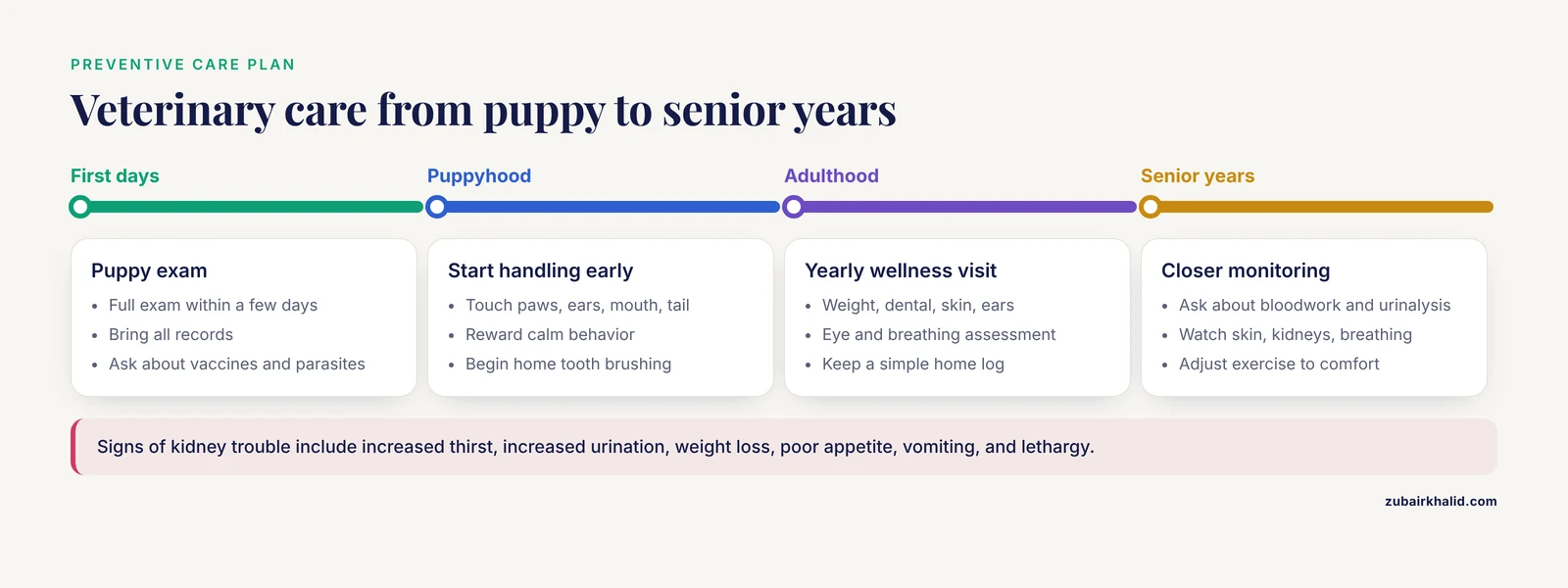
Bring the puppy to a veterinarian within a few days of purchase. The exam should include weight, body condition, mouth, ears, eyes, skin, breathing, heart, lungs, abdomen, and limbs. Bring all records. Ask about vaccination, parasite prevention, microchip, and a spay or neuter plan. The veterinarian may recommend a fecal exam and screening for common parasites based on the puppy’s history.
Start grooming and handling early. Touch the paws, ears, mouth, and tail. Reward calm behavior. Enroll in a puppy training class if the dog is healthy and the class uses positive methods.
Adult
Adult Zuchons need a wellness exam at least once a year. The visit should include a weight check, dental assessment, skin and ear exam, eye exam, and breathing assessment. Ask about behavior changes. Owners often miss subtle signs such as reduced activity, reluctance to jump, or increased scratching.
At home, monitor appetite, water intake, urination, stool, scratching, lumps, and breathing. Keep a simple log. Bring it to the appointment. This helps the veterinarian decide whether further testing is needed.
Senior
Senior exams may need to be more frequent. Ask your veterinarian about bloodwork, urinalysis, blood pressure, and chest imaging. The Bichon Frise case reports [4][6] support close monitoring of skin, kidneys, and breathing in older dogs with Bichon ancestry. Dental disease and arthritis also become more common with age. Adjust exercise to the dog’s comfort.
Bringing Home a Zuchon: Acquisition Checklist
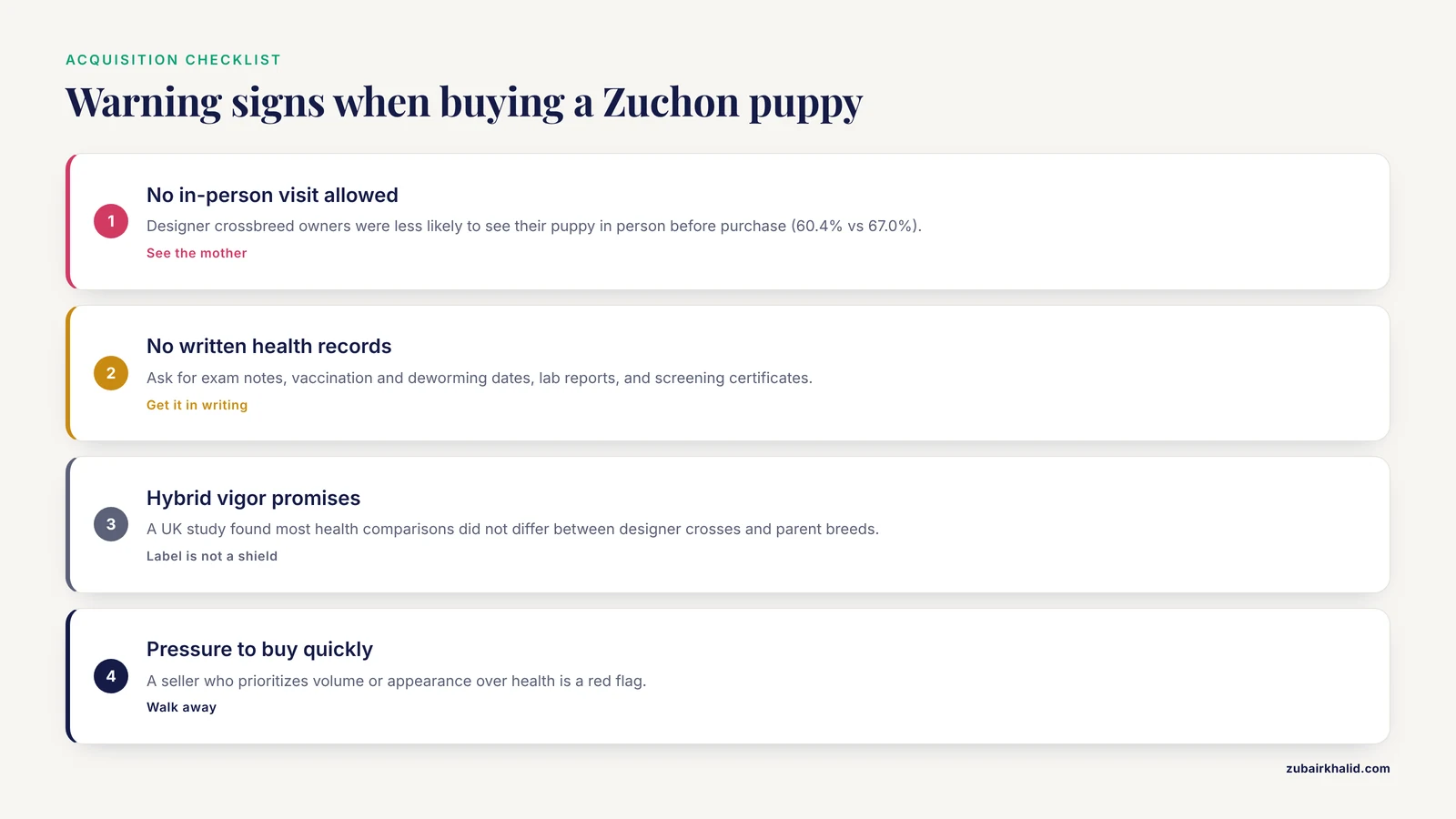
See the puppy in person. Meet the mother. Ask to see the father if he is on site. Ask for veterinary records, vaccination dates, deworming dates, and any parent health testing. Ask about the puppy’s diet, stool, and behavior. Ask why the litter was bred.
Be cautious of a seller who will not allow an in-person visit, cannot provide records, or pressures you to buy quickly. The UK survey found that designer crossbreed puppies were more likely to be acquired through general selling websites (13.8%) than purebred puppies (7.67%) and through animal-specific selling websites (55.7% vs 37.4%). Designer crossbreed owners were less likely to see their puppy in person before purchase (60.4% vs 67.0%) [2]. Those patterns increase the risk of buying a puppy without enough information.
Ask specifically about skin, eyes, breathing, and kidneys. A breeder who knows the parent lines should be able to discuss health history. Do not accept a verbal guarantee alone. Get the guarantee in writing.
Be skeptical of “hybrid vigor” claims. The UK study of three designer crossbreeds found that most health comparisons did not differ significantly from the parent breeds, and some disorders were more common in the crosses [1]. A Zuchon may be healthy. The cross itself is not a shield.
The Advisory Council on the Welfare Issues of Dog Breeding noted that irresponsible production, purchase, and ownership can create welfare problems, and that breeding strategies for designer dog hybrids need scrutiny [8]. A responsible breeder screens parents, raises puppies in a home, provides records, and matches puppies with suitable homes. A seller who prioritizes volume or appearance over health is a red flag.
Grooming, Skin, and Home Care
Grooming is a health task. Use it to check the whole body. Look for redness, rash, odor, discharge, lumps, scabs, fleas, and ticks. Check the ears. Check the eyes for discharge or cloudiness. Check the paws for mats, cuts, and swelling. Check the nails. Check the skin folds around the face and under the tail.
Coat type varies. Ask the breeder or groomer what the individual puppy needs. Some Zuchons may need daily brushing, others less. Bathing frequency depends on the coat and skin. Use a pet-safe shampoo. Rinse well and dry thoroughly, especially around the ears and skin folds. Do not use human shampoo. Do not shave the coat without grooming advice because the coat can change.
Start grooming early. Use treats and breaks. If the dog becomes fearful, stop and seek help. A groomer and veterinarian can work together on a plan.
Nutrition, Exercise, and Weight
Feed a complete and balanced diet for the dog’s life stage. Choose a food that meets a recognized nutrient profile. Measure portions. Limit treats. Avoid table scraps. If you change food, do it gradually. Ask your veterinarian for a diet recommendation if the dog has skin or kidney disease.
Fresh water should be available at all times. Track water intake if the dog is older or has kidney concerns. Changes in thirst can be a sign of disease.
Daily walks and play help maintain weight, muscle, and behavior. Adjust intensity to the dog’s breathing and fitness. Avoid hot pavement and midday heat. Puppies need short, frequent play sessions. Adult dogs need regular activity. Senior dogs need gentle exercise and may need shorter walks.
Behavior, Training, and Welfare
Training should be positive and consistent. Socialization should be gradual. Avoid punishment. If the dog shows fear, aggression, or anxiety, ask your veterinarian for a behavior referral. A qualified trainer or veterinary behaviorist can help.
Crossbreeding can be done responsibly or irresponsibly. Public attitudes toward crossbreeding are mixed. Some people see crossbreeding as a way to improve conformation and genetic diversity, while others worry about unpredictable health and unregulated breeding [9]. For a Zuchon, the practical response is the same: judge the individual dog and the breeder, not the label.
Common Mistakes and Troubleshooting
Avoid these common errors:
- Buying for the name. A Zuchon is not a standardized breed. The name does not predict size, coat, or health.
- Accepting hypoallergenic claims. Designer crossbreed owners commonly cite hypoallergenicity as a motivator, but the term is not a guarantee [2].
- Skipping the in-person visit. The UK survey found designer crossbreed owners were less likely to see their puppy in person before purchase [2].
- Assuming hybrid vigor. A large study found most health comparisons did not differ between designer crosses and parent breeds [1].
- Ignoring the skin. Shih Tzu lines have a higher reported prevalence of atopic dermatitis [3]. Check the belly and paws.
- Ignoring breathing. Flat-faced conformation can affect the airway. Do not exercise in heat.
- Skipping dental care. Small dogs need routine dental checks. Ask the veterinarian.
- Overfeeding. Obesity worsens breathing and joint strain.
- Waiting on lumps. Bichon case reports show that skin and kidney disease can appear in older dogs [4]. Report new lumps or thirst.
Troubleshooting guide:
| Problem | What to do |
|---|---|
| Itchy, red, or smelly skin | Book a veterinary exam. Do not start steroids or antibiotics without guidance. |
| Noisy breathing or exercise intolerance | Stop activity, cool the dog, and seek emergency care if gums are blue, the dog collapses, or breathing is labored. |
| New lump or swelling | Note the location and size. Have it examined promptly. |
| Increased thirst or urination | Book an exam and urinalysis. |
| Bad breath or drooling | Ask for a dental exam. |
| Eye discharge or squinting | Seek a veterinary exam the same day. |
Limitations and When to Contact a Veterinarian
Zuchons are not a standardized breed. Most health data come from parent breeds or other designer crosses. The studies cited here include Poodle crosses, Pug crosses, Shih Tzus, and Bichon Frises, not Zuchons specifically. Individual dogs can differ. A veterinarian who examines your dog is the only one who can diagnose or treat a medical condition.
Contact a veterinarian promptly for:
- Labored breathing, blue gums, collapse, or heat exposure
- Seizures or sudden weakness
- Repeated vomiting or diarrhea
- Not eating for more than 24 hours
- Severe itching with skin infection, odor, or pain
- Eye discharge, squinting, cloudiness, or redness
- New lumps or rapidly growing masses
- Increased thirst or urination
- Weight loss or poor appetite
- Behavior change such as aggression or extreme fear
Reading Zuchon Parent Health Records: DNA Tests, Screening, and Limits
Ask for the actual documents, not a summary: veterinary exam notes, vaccination and deworming dates, laboratory reports, and screening certificates. Confirm each parent's identity is on the record. For every DNA test, note the condition, laboratory, result (clear, carrier, or affected), and date. Ask for raw laboratory reports when possible, not a breeder-created chart. Breed-specific DNA tests are not interchangeable with a general health check. They identify specific mutations, often recessive, and a normal result says nothing about hips, eyes, patellas, skin, or airway.
Eye screening is an examination, usually by a veterinary ophthalmologist, looking for eyelid, eyelash, corneal, and retinal disease. Patella screening is palpation by a veterinarian, often graded. These exams describe the parent on the day of examination. A single normal exam is a snapshot, not a lifetime clearance. They do not prove the puppy will never develop eye or knee problems.
Written guarantees should state what is covered, for how long, required documentation, and whether the remedy is reimbursement, replacement, or return. A guarantee that requires giving up the dog may not fit your plans. Verbal promises are not enough. Read the fine print before signing. A one-year guarantee on an inherited condition may expire before signs appear. Ask whether patella luxation, skin allergy, eye disease, and kidney disease are included or excluded.
Normal results reduce risk but do not eliminate it. A crossbreed label is not a health guarantee; a UK study found most health comparisons between designer crosses and parent breeds did not differ significantly [1]. Have your veterinarian review the records before you pay. They can flag missing tests, inconsistent dates, and results that need follow-up. A veterinarian can also advise which additional tests are worth doing. Bring the puppy for an exam soon after purchase.
Professional Grooming for a Zuchon: Choosing a Groomer and Preventing Matting
Select a groomer who works with small companion breeds and understands the Zuchon's variable coat. Ask how they handle wavy or dense coats, whether they use force-dryers on the face, and how they restrain a dog. A groomer should never sedate a dog without veterinary approval. Ask for a trial session and watch how the groomer handles the dog's face and ears. If the dog has a short muzzle, the groomer must avoid pressure on the neck and allow rest breaks. Flat-faced conformation can affect the airway [5], so a dog that pants heavily, turns blue, or collapses during grooming needs immediate veterinary attention.
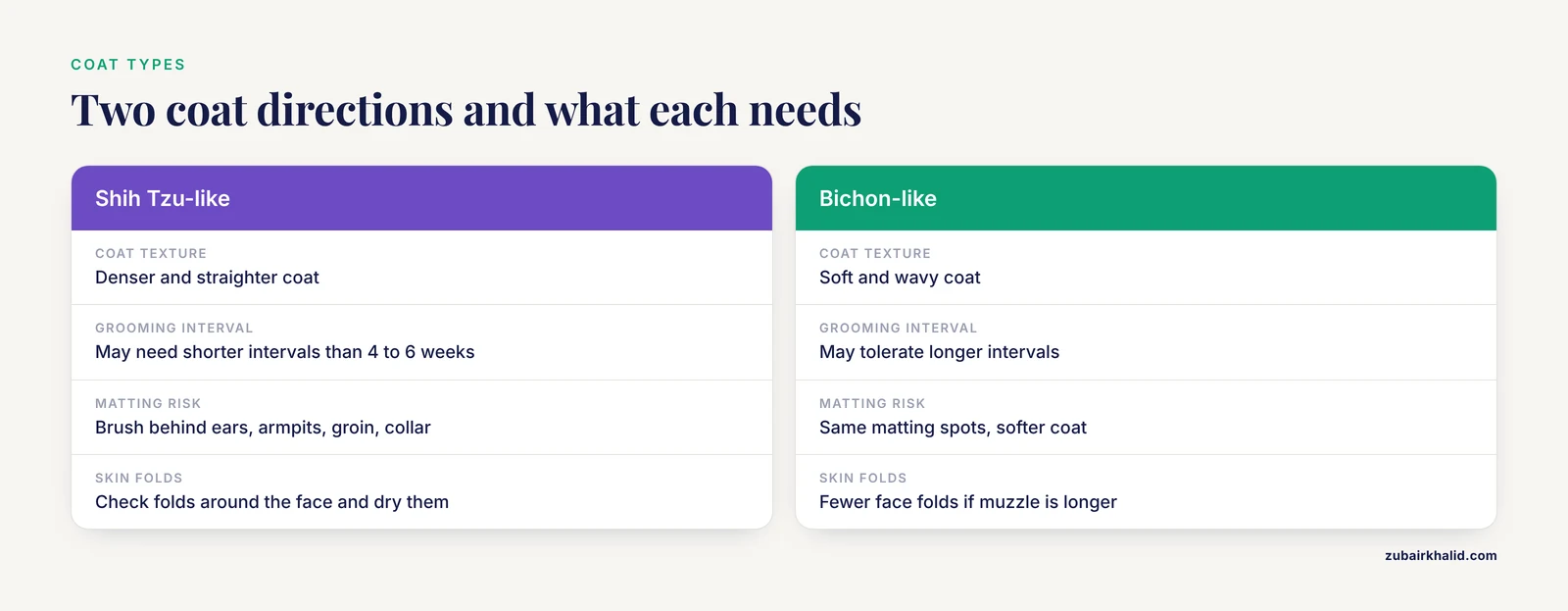
Schedule professional grooming every 4 to 6 weeks for most Zuchons, but adjust for coat and skin. A denser, Shih Tzu-like coat may need shorter intervals; a softer, Bichon-like coat may tolerate longer ones. If the dog has atopic dermatitis, the veterinarian may recommend medicated baths at a specific frequency. Do not over-bathe, as that can dry the skin.
Prevent matting by brushing at home between professional sessions. Mats form behind the ears, in the armpits, in the groin, and around the collar. Use a slicker brush and metal comb. If a mat is tight against the skin, do not pull it; a groomer can clip it out safely. Matting can hide redness, parasites, or infection.
Check skin folds, especially around the face if the Zuchon has a Shih Tzu-like muzzle. Wipe folds with a veterinarian-approved cleanser and dry them completely. Inspect folds at every grooming visit; a groomer who notices moisture or odor should flag it. Redness, odor, or discharge in a fold is a reason for a veterinary visit, not just a grooming fix.
Watch for signs that require veterinary care. A dog that cries or flinches when an ear is touched may have an ear infection. Do not clean a painful ear at home; a veterinary exam is needed. Have new lumps examined before they are clipped or brushed. Labored breathing or distress during handling means stop and seek emergency care.
Emergency and Travel Planning for a Flat-Faced Crossbreed
A Zuchon may inherit a shorter muzzle from the Shih Tzu side. Flat-faced conformation can narrow the airway and reduce heat tolerance. Travel and boarding plans should account for that risk.
Car and Heat Safety
- Secure the dog in a crash-tested crate or harness. Do not let it ride loose or in the front seat.
- Never leave a dog in a parked car, even in mild weather.
- Walk early or late, test pavement with your hand, and carry water. Stop if breathing becomes noisy or the dog lags.
- Use air conditioning and shade. A cooling mat or damp towel helps, but do not rely on them in a hot car.
Airline and Boarding Policies
Ask the airline in writing about carrier size, cabin limits, and flat-faced breed restrictions. Cabin travel is usually safer than cargo for a dog with airway risk, but rules vary. A health certificate and vaccination records are often required.
For boarding, inspect the facility. Ask about climate control, exercise limits, and staff experience with flat-faced dogs. Confirm who handles emergencies and whether staff can give your dog's medication. Provide written instructions, food, medication, vaccination records, microchip number, your veterinarian's contact, and an emergency contact. Carry a recent medication list and your veterinarian's phone number in the travel bag.
Emergency Plan
Know the nearest 24-hour emergency clinic and call before you arrive. For noisy breathing, stop activity, keep the dog calm, and cool it if overheated. If gums are blue, the dog collapses, or breathing is labored or rasping, seek emergency care now. For collapse or heat exposure, move to shade or air conditioning, apply cool water, and call a veterinarian. Do not wait for improvement.
Call your veterinarian before travel if the dog has known breathing, heart, or kidney disease. Ask about sedation only with veterinary advice.
Related Guides
- Shih Tzu Lifespan Diet and Preventive Care Guide: Shih Tzu lifespan, diet, and preventive care details for the parent breed
- Shih Tzu Feeding Guide: Calorie Targets & Sensitive Stomach Food: Feeding targets and sensitive stomach advice for Shih Tzu parent lines
- Bichon Frise Feeding Guide: Calorie Targets and Sensitive Stomach Diet Plans: Bichon Frise feeding guide with calorie and diet plan support
- Cavapoochon Dog: Breed Traits and Care Guide: Similar small companion cross with Bichon Frise and Poodle heritage
- Poodle Mixes: Doodle Breeds, Traits, and Care Needs: Broader poodle-mix and doodle care context for designer crossbreeds
Frequently Asked Questions
Is a Shih Tzu Bichon mix a purebred?
No. A Shih Tzu Bichon mix is a cross between a Shih Tzu and a Bichon Frise. It is not a recognized pure breed and has no breed standard.
Are Zuchons hypoallergenic?
No guarantee. The term “hypoallergenic” is not a medical diagnosis. Allergy risk depends on the individual dog, and designer crossbreed owners often cite hypoallergenicity without a guarantee [2].
Do Zuchons have breathing problems?
Some may. The Shih Tzu side can contribute a shorter muzzle, and flat-faced conformation can affect the airway [5]. Watch for noisy breathing, exercise intolerance, and heat sensitivity.
What skin problems should I watch for?
Watch for itching, redness, hair loss, odor, recurrent ear infections, and new lumps. Shih Tzu lines have a higher reported prevalence of atopic dermatitis [3]. Bichon Frise lines have rare reports of skin nodules and kidney cysts [4].
How often should a Zuchon visit the veterinarian?
Puppies need visits based on their vaccination and parasite plan. Healthy adults need at least a yearly wellness exam. Seniors may need exams and bloodwork more often. Ask your veterinarian for a schedule that fits your dog.
Are Zuchons easy to train?
Training depends on the individual dog. Designer crossbreed behavior is variable [7]. Use positive reinforcement, short sessions, and gradual socialization.
What should I feed a Zuchon?
Feed a complete and balanced diet for the dog’s life stage. Measure portions and limit treats. Ask your veterinarian for advice if the dog has skin, kidney, or weight problems.
When should I call the vet?
Call for labored breathing, collapse, blue gums, heat exposure, seizures, repeated vomiting, diarrhea, not eating, severe skin pain, eye changes, new lumps, increased thirst, or sudden behavior changes.
Sources
- The doodle dilemma: How the physical health of 'Designer-crossbreed' Cockapoo, Labradoodle and Cavapoo dogs' compares to their purebred progenitor breeds.
- How much is that doodle in the window? Exploring motivations and behaviours of UK owners acquiring designer crossbreed dogs (2019-2020).
- Prevalence and lesion distribution of atopic dermatitis in small-to-medium breed dogs in Korea.
- Case Report: Atypical Nodular Dermatofibrosis and Renal Cysts in a Bichon Frise with a BRCA2 Mutation and No FLCN Mutation.
- A solution right under our nose? Crossbreeding extreme brachycephalic dogs results in better health outcomes while preserving behavioural profiles and dog-owner relationship quality.
- Uraemic pneumonitis in a 15-year-old spayed female bichon frise.
- Comparing undesirable behaviours between 'designer' Poodle-cross dogs and their purebred progenitor breeds.
- The Advisory Council on the Welfare Issues of Dog Breeding.
- "You could get the best of both breeds or the worst of both": UK public attitudes towards crossbreeding in dogs - with a specific focus on brachycephalic dogs.