Why Does My Cat Nibble Me? Causes and What to Do
By Dr. Zubair Khalid, DVM, MS, PhD ·
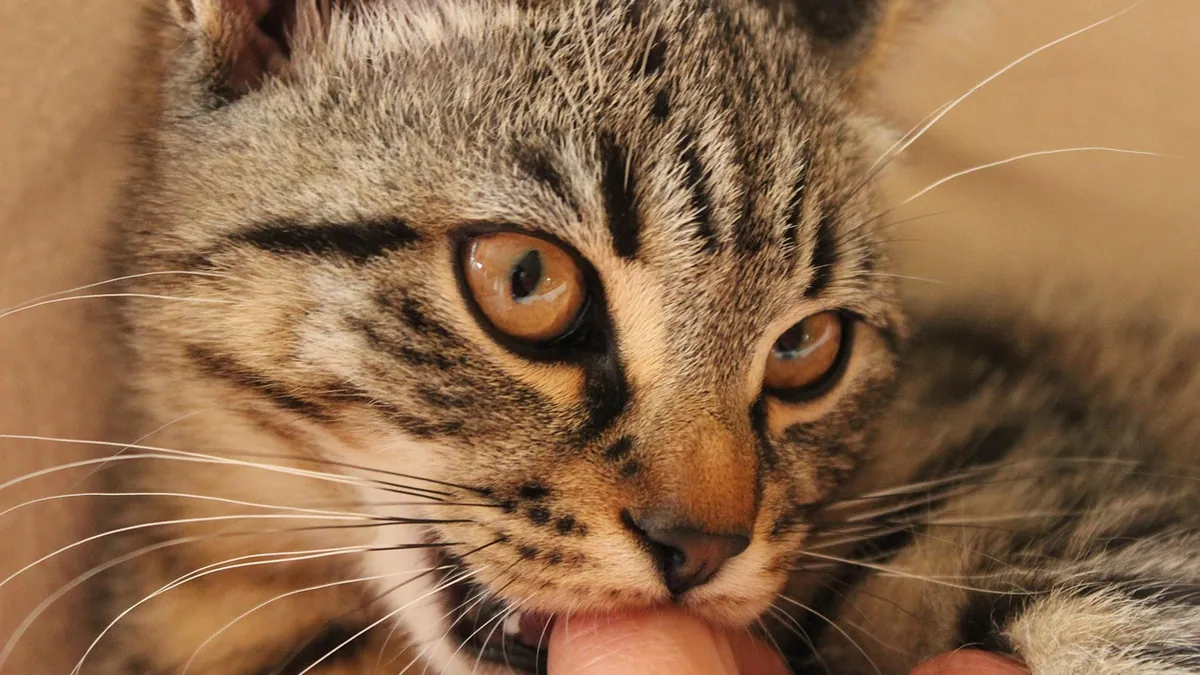
Why does my cat nibble me? Most of the time, a gentle nibble is a normal cat behavior. It can be affection, a request for attention, or the first sign that your cat is getting overstimulated. This article is educational and is not a substitute for veterinary diagnosis or treatment.
Quick Answer
- A soft, brief nibble with relaxed body language usually means affection or grooming, not aggression.
- A nibble that comes with a twitching tail, flattened ears, or dilated pupils means "stop petting me now."
- Play biting is different. It is usually harder, directed at hands and ankles, and often happens in kittens and young cats with too much energy.
- The fix is to stop the interaction at the first nibble, redirect your cat to a toy, and add daily play and enrichment.
- Never hit, yell at, or scruff your cat. Punishment raises fear and can turn a gentle nibble into a real bite.
Why Does My Cat Nibble Me? Normal Reasons First
Nibbling sits on a spectrum. At one end is affection. At the other end is a warning. Your cat's body language tells you which one you are getting.
Affection and social grooming
Cats groom each other as a bonding behavior. When your cat nibbles your fingers or your hand lightly, it may be treating you like a member of its social group. The nibble is soft, brief, and often paired with slow blinking, purring, or kneading. Your cat may also lick you before or after the nibble.
Attention seeking
Some cats learn that a nibble gets a reaction. If you stop what you are doing, talk to your cat, or push it away, the nibble worked. This is especially common in cats that are bored or that want food, play, or a door opened.
Overstimulation during petting
This is the most common reason a cat nibbles when you pet it. Cats have a threshold for touch. Once that threshold is crossed, the same hand that felt good a second ago feels irritating. The nibble is a polite first warning. If you keep petting, the next step is often a swat or a real bite.
Watch for these early signs:
- Tail starts twitching or thumping
- Skin ripples along the back
- Ears rotate sideways or flatten
- Pupils get wide
- Head turns toward your hand
- Body stiffens instead of staying soft
Play and predatory behavior
Kittens and young cats have a strong drive to practice hunting. Hands and ankles move like prey. A kitten that nibbles on you during play is learning that biting skin is a game. If that lesson sticks, the bites get harder as the cat grows. Human-directed aggression in cats can be classified as misplaced play or predatory behavior, and it can appear as daily episodes of jumping at, scratching, and biting owners' hands and legs [1].
Why does my cat nibble my nose?
Nose nibbling usually happens during close contact, often in the morning or when you are lying down. Your face is at your cat's level, and your breath and movement draw attention. In most cases this is affectionate or attention seeking. Some cats also nibble noses because the nose is warm and moves slightly, which triggers a mild predatory interest. If the nibble is soft and your cat is relaxed, it is rarely a concern. If it comes with a hard bite or a pounce, treat it as play biting.
Why does my kitten nibble on me?
Kittens nibble for the same reasons adult cats do, but the behavior is more intense because they are still learning bite inhibition. Kittens who were separated from their littermates early may have had less chance to learn that bites hurt. The answer is not punishment. It is redirection to toys and consistent ending of play when teeth touch skin.
Medical Causes to Rule Out Before Assuming It Is Behavioral
Behavior problems are diagnosed only after medical causes have been excluded [2]. A cat that suddenly starts nibbling or biting more may be in pain or uncomfortable.
Common medical triggers include:
- Dental disease, including broken teeth, resorptive lesions, and gum inflammation
- Oral pain that makes a cat pull away or nip when the face is touched
- Arthritis or back pain that makes petting uncomfortable
- Skin parasites or allergies that cause itching and chewing
- Hyperthyroidism, which can raise irritability and activity
- Cognitive changes in older cats
- Hunger from a medical condition or a diet change
If your cat's nibbling is new, if it started suddenly, or if it comes with other changes like weight loss, poor appetite, vomiting, or scratching, a veterinary visit is the right first step. Two related guides may help you sort out other symptoms: Why Is My Cat So Itchy? and Why Is My Cat Vomiting? Common Causes and Red Flags.
When Nibbling Becomes a Problem
Nibbling is a problem when any of these are true:
- It breaks skin or leaves bruises
- It happens every time you pet your cat
- It is directed at guests or children
- It is getting harder over time
- Your cat seems tense, fearful, or on edge most of the day
- You have started avoiding your cat
Aggression is one of the most common behavior problems in cats, and it often has more than one trigger [3]. A cat that nibbles when petted and also bites ankles during play has two separate patterns that each need a plan.
Fear-based aggression is a different pattern. It happens when a cat feels trapped or threatened. If your cat nibbles and then hides, hisses, or swats when approached, the goal is safety first. Fearful cats should be kept away from whatever causes their fear, at least in the short term, and that often means housing the cat in its own room with litter, toys, bedding, and food until it is calm [3].
What to Do Step by Step
Step 1: Read the moment
Before you change anything, watch your cat for a week. Note when the nibble happens. Is it during petting, during play, at feeding time, or when you are on your phone? Note the body language right before it. Most owners find a clear pattern within a few days.
Step 2: Stop at the first nibble
The single most effective response is to end the interaction the instant teeth touch skin. Pull your hand away slowly, stand up or turn away, and give your cat 30 to 60 seconds of no attention. This teaches your cat that nibbling ends the fun. It also prevents the nibble from being rewarded with a reaction.
Step 3: Change how you pet
Many cats do better with short petting sessions. Pet for 5 to 10 seconds, then pause. If your cat leans in for more, continue. If your cat looks away or its tail moves, stop. Stick to areas most cats tolerate well, such as the cheeks, chin, and base of the ears. Avoid the belly, tail base, and paws unless you know your cat enjoys them.
Step 4: Build a play routine
Play is the main outlet for predatory energy. Use a wand toy and move it like prey, away from your body. Two or three sessions of 10 to 15 minutes a day is a reasonable target for most healthy adult cats. End each session with a successful catch, then give a small treat or meal. This mimics the natural hunt-eat-groom-sleep cycle.
Step 5: Add enrichment to the environment
Cats need things to do when you are not available. Elevated structures matter to cats, and they use vertical space more during busy periods [4]. Provide cat trees, shelves, window perches, and scratching posts. Rotate toys so they stay interesting. Puzzle feeders and food-dispensing toys give cats a job.
Step 6: Train an alternative behavior
Teaching an alternative desirable behavior, called response substitution, can help if your cat is reward trained with food or favored toys [3]. Pick one simple behavior, such as "sit" or "come," and reward it with a treat. Then ask for that behavior when your cat starts to get wound up. A leash and harness can also be used as a training aid and to prevent undesirable behavior [3].
Step 7: Manage the environment
If your cat targets ankles, keep a toy nearby to toss as a distraction. If your cat nibbles during lap time, use a blanket as a barrier. If visitors trigger the behavior, put your cat in a quiet room with its resources before guests arrive. This is not punishment. It is setting your cat up to succeed.
Step 8: Track progress
Give any plan at least 4 to 6 weeks. Behavior change is slow. If the bites are getting harder or more frequent, or if you are not seeing any improvement, get professional help.
What Not to Do
- Do not hit, slap, or scruff your cat. These responses raise fear and can turn a warning nibble into a defensive bite.
- Do not yell. Cats do not connect yelling to the bite. They connect it to you being unpredictable.
- Do not use your hands as toys, even with kittens. It teaches the exact behavior you are trying to stop.
- Do not hold your cat still to make it accept petting. Forced interactions raise stress hormones, while passive interactions are linked to higher oxytocin and lower cortisol in cats [5].
- Do not assume a cat that bites is "mean." Most biting is communication, fear, or play.
- Do not ignore a sudden change in behavior. New biting in an adult cat deserves a veterinary exam.
When to Involve a Veterinarian or Behavior Professional
Start with your veterinarian for any new or worsening biting. They can rule out pain, dental disease, and other medical causes. If your cat is healthy, your vet can refer you to a board-certified veterinary behaviorist or a certified applied animal behaviorist.
Medication is sometimes part of the plan. In one reported case, a young cat with human-directed aggression and pica improved significantly after 6 weeks of fluoxetine, prescribed by a veterinarian [1]. Medication is not a first step for most cats, and it is never a substitute for behavior work. It is a tool a veterinarian may consider when the behavior is severe or when a cat cannot learn while stressed.
If your cat is aggressive toward visitors or other cats, confinement away from those triggers is an essential first step for safety and to keep the problem from getting worse [3]. When your cat is calm and comfortable, a gradual reintroduction using desensitization and counterconditioning may be possible [3].
Limitations and When to Contact a Veterinarian
This article covers general patterns. Every cat is an individual, and your cat's case needs a veterinarian who can examine it, ask about its history, and rule out medical causes.
Contact a veterinarian the same day if:
- A bite broke your skin. Cat bites can become infected quickly, and you may need medical care for yourself.
- Your cat is biting hard enough to bruise or draw blood.
- Your cat is biting while eating, being picked up, or being handled in ways it used to accept.
- Your cat is also not eating, hiding more, or acting painful.
Go to an emergency veterinary clinic now if:
- Your cat is biting and cannot be safely handled or contained.
- Your cat is showing sudden aggression with confusion, wobbling, or collapse.
- Your cat has a wound, swelling, or a suspected injury that may be causing pain.
Schedule a routine visit if:
- The nibbling is new and there are no other symptoms.
- The nibbling is getting more frequent over weeks.
- You have tried the steps above for 4 to 6 weeks with no improvement.
- You want help designing a training and enrichment plan.
If your cat is also showing other changes, such as sneezing or coughing, these guides may help you decide how urgent things are: Why Is My Cat Sneezing? and Why Was My Cat Choking. If your cat has become unusually clingy along with the nibbling, see Why Is My Cat Suddenly Clingy?.
Frequently Asked Questions
Should I be worried if my cat nibbles me gently?
No, a gentle nibble with relaxed body language is usually normal. It often means affection, grooming, or a request for attention. The behavior only needs a plan if it is getting harder, happening more often, or coming with signs of stress.
Does nibbling mean my cat is angry?
Not usually. Anger is not the best way to describe most cat biting. A nibble is more often a warning that your cat is overstimulated or a sign of play drive. True fear-based aggression looks different, with hiding, hissing, flattened ears, and attempts to escape.
Can I train my cat to stop nibbling?
Yes. Cats respond well to consistent, reward-based training. End the interaction at the first nibble, reward calm behavior with treats or toys, and teach one simple alternative behavior such as "sit." Punishment makes biting worse, so keep the plan positive.
Is it normal for a kitten to nibble on me?
Yes, it is common. Kittens explore with their mouths and practice hunting on whatever moves. The goal is to teach bite inhibition early by redirecting to toys and ending play when teeth touch skin. Never use your hands as toys.
Could a medical problem cause my cat to nibble?
Yes. Dental pain, arthritis, skin problems, and other illnesses can make a cat more likely to nip when touched. Any sudden change in biting behavior in an adult cat should be checked by a veterinarian before you assume it is purely behavioral [2].
Related Articles
- Why Is My Cat Sneezing?
- Why Was My Cat Choking
- Why Is My Cat Vomiting? Common Causes and Red Flags
- Why Is My Cat Suddenly Clingy?
- Why Is My Cat So Itchy?
- Why Is My Cat Shaking Her Head And Ears
- Why Does My Cat Bite Me? Causes and How to Stop It
- Why Does My Cat Nip Me When I Pet Him?
- Why Is My Cat Kneading Me? Understanding This Behavior
References
- Human-directed aggression and pica in a 1-year-old cat, which worsened following international relocation. JFMS open reports, 2023.
- Behavior Problems of Cats - Behavior. Merck Veterinary Manual.
- Behavior Problems in Cats - Cat Owners. Merck Veterinary Manual.
- Cats in a Cat Café: Individual Cat Behavior and Interactions with Humans. Animals : an open access journal from MDPI, 2025.
- EXPRESS: The hormonal effects of owner-cat interactions on pet cats of different potential attachment styles. Journal of feline medicine and surgery, 2026.