Is It Normal for Kittens to Wrestle? Play vs. Fighting
By Dr. Zubair Khalid, DVM, MS, PhD ·
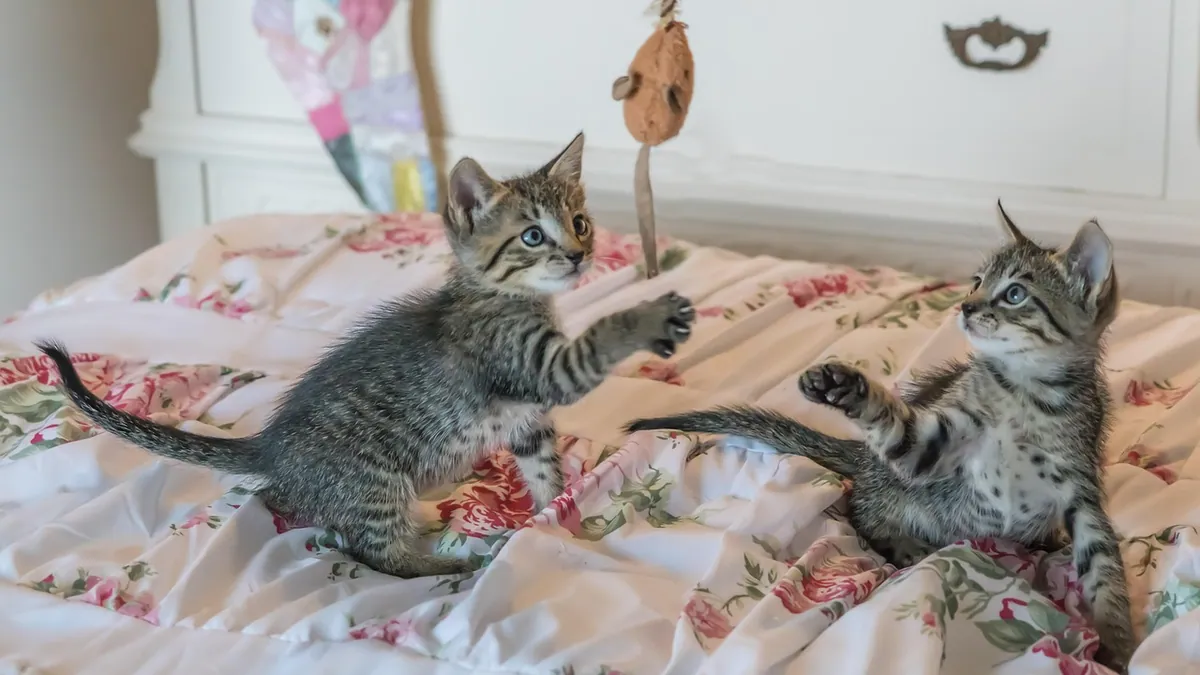
Yes, it is normal for kittens to wrestle. Wrestling is one of the main ways kittens learn social skills, practice hunting moves, and burn off energy. Most of what you see, the pouncing, rolling, biting, and chasing, is healthy play. The tricky part is knowing when normal play tips into something that needs your help.
This article is educational and is not a substitute for veterinary diagnosis or treatment.
Quick Answer
- Wrestling between kittens is normal and expected, especially between littermates or kittens close in age.
- Real play has loose body language, pauses, and role swapping. A kitten who pins and then gets pinned is usually playing.
- Watch for the "off switch." If one kitten keeps trying to leave and the other keeps chasing, the interaction is no longer mutual play [1].
- Never punish wrestling with hitting, yelling, or scruffing. It teaches fear and can make aggression worse.
- Call your veterinarian if you see injury, hiding, litter box avoidance, or one kitten who seems afraid of the other.
Why Do Kittens Wrestle Each Other?
Kittens wrestle because it is how they learn to be cats. The basic feline social unit is the mother cat and her kittens, and kittens stay close to that group for a long stretch of their early life [2]. During that time, play with littermates teaches bite inhibition, balance, and the difference between a friendly swipe and a real one.
Play also serves as practice for hunting. A kitten who stalks, pounces, and wrestles a sibling is rehearsing the same sequence used on prey. This is why a well-fed indoor kitten still "attacks" a toy mouse with full commitment.
Play as social development
Social play peaks in young cats and tends to decline as they mature. Owners who raise two kittens often notice the wrestling gets calmer by the time the cats are a year or two old. That shift is normal.
Play is also a form of communication. Kittens who grow up with siblings tend to read other cats' signals better as adults. A 2025 survey of US cat owners found that most had never heard of formal kitten socialization programs, yet about half said they would be interested in one [3]. That interest makes sense, because early social experience shapes adult behavior.
Play aggression in single kittens
A kitten raised alone often directs that same energy at hands, feet, or ankles. This is called kitten play aggression, and it is not a sign of a bad cat. It is a sign of a kitten with no outlet. The fix is usually more appropriate play, not punishment.
If your kitten is hissing at a new arrival, that is a different problem. See Cat Hissing at New Kitten: How Long Will It Last? for a step-by-step introduction plan.
Is It Normal for Cats to Wrestle, or Is This a Fight?
This is the question that worries most owners, and it is a fair one. Even experts have trouble sorting rough play from real conflict. A 2023 study of 105 pairs of interacting cats found that public and professional assessments often struggle to tell rough-and-tumble play from true aggression, partly because play and agonism can mix within a single bout [4].
That matters for you at home. You do not need a perfect label. You need to know whether both cats are still having a good time.
Signs of healthy play
- Both cats take turns being on top.
- Bodies stay loose, with tails up or gently swishing.
- Claws are usually sheathed, and bites are soft.
- There are pauses. One kitten walks away, shakes off, and comes back.
- Ears stay forward or neutral, not flattened.
- No blood, no urine, no screaming.
Signs of a real fight
- One cat is pinned and cannot get up.
- Loud yowling, hissing, or growling that does not stop.
- Fur flying, blood, or a cat urinating or defecating in fear.
- One cat hides after every interaction.
- Ears flat, pupils wide, tail puffed, body stiff.
- One cat blocks the other from food, litter, or the owner.
The clearest signal is consent. If one cat wants to stop and the other will not let it, the exchange should not be treated as play [1]. That is your cue to separate them calmly.
Medical Causes to Rule Out First
Sometimes what looks like aggression has a physical cause. Pain, illness, and stress all lower a cat's patience.
- Dental pain or oral disease can make a cat snap when another cat bumps its face.
- Arthritis or injury makes a cat defensive about being touched or jumped on.
- Hyperthyroidism, cognitive changes, and skin conditions can all increase irritability.
- Vision or hearing loss can cause a cat to startle and react defensively.
A sudden change in behavior in an adult cat deserves a veterinary exam before you assume it is behavioral. Cats are good at hiding pain, and a cat who was always tolerant may only show discomfort through irritability.
There is also a link between clinic behavior and home behavior. In a 2024 survey of US cat owners, aggression at the veterinary clinic was reported in 42.6% of cats, and it was positively associated with behavior problems at home, including aggression toward familiar cats [5]. That does not mean clinic fear causes home aggression. It means a cat who struggles in one stressful setting may struggle in others, and both are worth discussing with your vet.
When Kitten Wrestling Becomes a Problem
Wrestling is a problem when someone is getting hurt or when a cat's quality of life drops. Watch for these patterns.
One-sided play
If one kitten is always the aggressor and the other is always the target, the balance is off. This often happens when kittens are different ages or when one is much larger.
Play that never stops
Some kittens get over-aroused and cannot self-calm. They escalate from wrestling to hard biting and do not respond to the other cat's signals.
Fear and avoidance
A cat who hides under the bed, stops using the litter box, or avoids shared spaces is telling you the situation is not working. Behavior problems like house-soiling and separation-related behaviors often travel together with aggression issues in the same household [5].
Redirected aggression
A cat who cannot reach the target (an outdoor cat at the window, for example) may turn and attack the nearest cat or person. This is a distinct pattern and needs a different plan.
If your adult cat has suddenly turned on a housemate, read Why Is My Cat Suddenly Aggressive Towards Other Cats? before you try anything else.
What to Do Step by Step
1. Let normal play run
If both kittens are loose, taking turns, and pausing, leave them alone. Interrupting healthy play too often can increase frustration.
2. Break up real fights safely
Do not reach in with bare hands. Make a loud noise, toss a blanket or pillow between them, or use a piece of cardboard as a barrier. Then separate them into different rooms for a cool-down period of at least 20 to 30 minutes.
3. Give each cat its own resources
Food, water, litter boxes, beds, and scratching posts should be available in separate locations. The general rule is one litter box per cat plus one extra. Cats who feel they must compete for basics are more likely to squabble.
4. Add vertical space
Cat trees, shelves, and window perches let cats get out of each other's way. Vertical territory reduces face-to-face conflict and gives a nervous cat an escape route.
5. Schedule real play sessions
Two or three focused play sessions a day with a wand toy can drain the energy that would otherwise go into pouncing on a sibling. For ideas, see Best Interactive Cat Toys: Keep Your Feline Active and Engaged. End each session with a treat or a meal so the hunt has a finish.
6. Use food puzzles and foraging
Scattering kibble or using puzzle feeders slows eating and gives cats something to do. Boredom is a common driver of over-the-top play.
7. Reintroduce slowly if needed
If the cats have had real fights, treat them like a new introduction. Keep them separated, swap bedding for scent, feed them on opposite sides of a closed door, then move to a baby gate, then supervised time together. Go at the pace of the more nervous cat.
8. Track what you see
Note the time of day, who started it, and how it ended. Patterns help your veterinarian or behavior consultant give you a targeted plan.
What Not to Do
- Do not hit, yell at, or spray a cat. Punishment increases fear and can make aggression worse.
- Do not scruff a cat to break up a fight. It risks injury to you and the cat.
- Do not assume it is "just play" if one cat is hiding or bleeding.
- Do not separate cats permanently without a plan. Isolation without a reintroduction strategy rarely fixes the underlying issue.
- Do not rely on the myth that cats "work it out." Some do, but repeated serious fights damage the relationship and can cause lasting anxiety.
- Do not use your hands as toys, even with a tiny kitten. It teaches that hands are fair targets.
If you are worried about a cat who may have swallowed part of a broken toy during a wrestling match, see How To Know If Your Cats Choking.
When to Get Professional Help
Call your veterinarian if:
- Any cat has a wound, limp, or swelling.
- A cat stops eating, hides constantly, or avoids the litter box.
- Fights are happening daily or drawing blood.
- One cat is being bullied away from food or the box.
- An adult cat's behavior changed suddenly.
Your veterinarian can check for pain, dental disease, thyroid problems, and other medical causes. If the exam is normal, ask for a referral to a veterinary behaviorist or a certified applied animal behaviorist. Behavior problems in cats are treatable, and the earlier you start, the better the outcome.
If medication is part of the plan, your veterinarian will calculate the dose from your cat's weight and health status. Never give a cat any human medication without veterinary guidance.
Limitations and When to Contact a Veterinarian
This article covers general patterns, not your specific cats. Individual cases need a veterinarian who can examine the animals and see the home setup.
Contact your veterinarian the same day if a cat has a bite wound, is limping, is not eating, or is hiding and refusing to come out. Bite wounds from cats are puncture injuries, and the small surface wound can hide deeper damage and infection.
Go to an emergency clinic now if there is heavy bleeding, a cat who cannot bear weight, breathing trouble, collapse, or a cat who has not urinated in more than 24 hours (especially a male cat).
Schedule a routine visit if the wrestling is escalating but no one is injured yet. Early help is easier than repairing a damaged relationship between two cats who share your home.
Frequently Asked Questions
Do kittens wrestle for fun?
Yes, most kitten wrestling is play. Kittens use it to practice hunting skills, learn bite inhibition, and build social skills with littermates. Loose bodies, soft bites, and taking turns are all signs it is fun for both kittens.
At what age do kittens stop wrestling?
Wrestling usually peaks in the first year and gradually declines as cats mature. Many cats still enjoy short play bouts as adults, especially with a familiar housemate. A sudden increase in wrestling in an older cat is worth a vet visit.
Should I separate kittens when they wrestle?
Only if the play turns one-sided or someone gets hurt. Healthy wrestling with pauses and role swapping should be left alone. If one kitten is pinned, screaming, or trying to escape, separate them calmly and give both a break.
Can wrestling cause behavior problems later?
Occasional rough play does not cause lasting problems. Repeated serious fights can lead to fear, hiding, and house-soiling in the cat who is losing. Getting help early prevents those patterns from becoming habits.
Is my kitten's biting during play a sign of aggression?
Soft biting during wrestling is normal kitten behavior. Hard biting that breaks skin, or biting that continues after the other kitten signals stop, is a sign of play aggression that needs a plan. More interactive play and a veterinary behavior consult can help.
Related Articles
- Cat Hissing at New Kitten: How Long Will It Last?
- Best Interactive Cat Toys: Keep Your Feline Active and Engaged
- How To Know If Your Cats Choking
- Cat Peeing on the Bed: Medical or Behavioral?
- Why Is My Cat Suddenly Aggressive Towards Other Cats?
- Cat Limping After a Jump: Is It a Sprain or a Break?
- Is It Normal for Kittens to Play Rough With Each Other?
- Is It Normal for Cats to Fight? Play vs Real Fights
- How Do Cats Play? Reading Feline Play Behavior
References
- Are These Cats Playing? A Closer Look at Social Play in Cats and Proposal for a Psychobiological Approach and Standard Terminology. Frontiers in veterinary science, 2021.
- Normal Social Behavior in Cats - Cat Owners. Merck Veterinary Manual.
- Socialising kitties: A quantitative survey of US cat owner attitudes towards kitten and adult cat socialisation programmes. Animal welfare (South Mimms, England), 2025.
- An ethological analysis of close-contact inter-cat interactions determining if cats are playing, fighting, or something in between. Scientific reports, 2023.
- Correlation between aggression at the veterinary clinic and problem behaviors at home for cats in the USA. Journal of feline medicine and surgery, 2024.