How Dogs Know Owner Love: Science Explained
By Dr. Zubair Khalid, DVM, MS, PhD ·
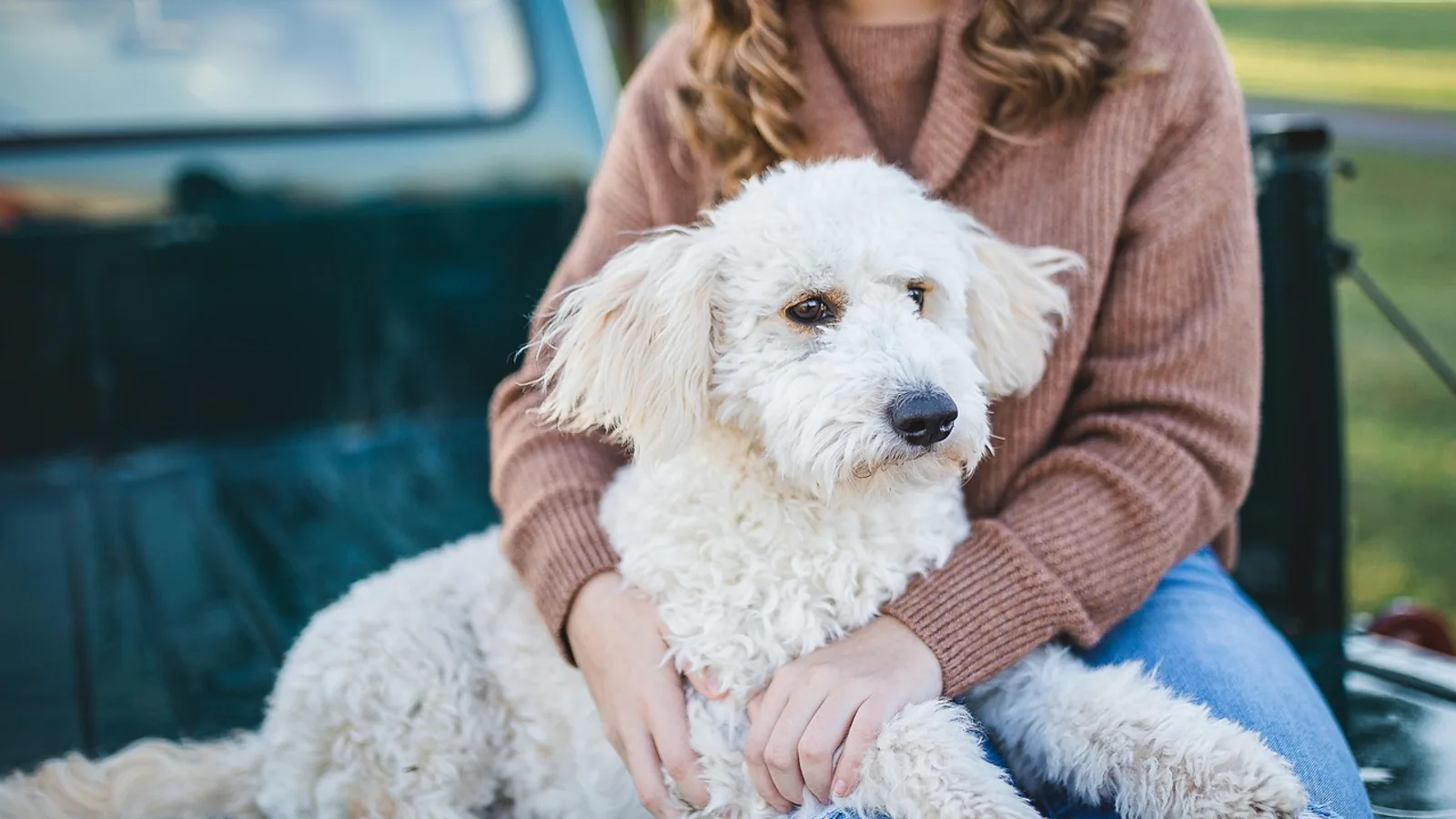
Dogs identify their owners through overlapping sensory and social systems: a unique scent signature processed in the olfactory bulb, a familiar voice processed in the temporal lobe, and a learned pattern of gaze, proximity, and touch that triggers measurable hormonal responses in both species. The strongest scientific evidence points to an interspecies oxytocin loop in which mutual gazing raises oxytocin in dogs and owners, but that loop is correlational, not proof that a dog experiences love the way a human does.
This article is educational and is not a substitute for veterinary diagnosis or treatment.
The Short Answer
A dog does not need to understand the word "love" to respond to it. What the research actually shows is that dogs build a mental model of a specific person using smell, sound, sight, and routine. When that person appears, the dog's brain and body respond in ways that look like attachment: approach, gaze, contact seeking, and stress reduction.
Three systems do most of the work:
- Olfaction. The dog's olfactory bulb is tuned to individual chemical signatures, including the owner's.
- Audition. The temporal lobe processes familiar voices differently from unfamiliar ones.
- Social bonding physiology. Oxytocin and related hormones rise during affiliative contact, especially mutual gaze.
Attachment research modeled on human infant-caregiver studies adds a fourth layer. Dogs show organized attachment behavior toward owners, and the quality of that attachment tracks with stress physiology.
The Oxytocin Loop: Mutual Gaze and Mutual Hormone Release
Oxytocin is a hormone and neurotransmitter involved in social bonding, parental care, and trust. In dogs and humans, it can be measured in urine, saliva, and blood, though each method has limits.
The best-known finding in this field is the oxytocin-gaze positive loop. In a landmark study, gazing behavior from dogs, but not from wolves, increased urinary oxytocin concentrations in owners [1]. That rise in owner oxytocin then facilitated affiliative behavior toward the dog, which in turn raised oxytocin in the dog. When researchers gave dogs intranasal oxytocin, the dogs gazed at their owners more, and owner oxytocin rose in response [1].
A separate study found the same pattern in ancient Japanese breeds, which are genetically closer to wolves than most European breeds. Oxytocin treatment enhanced gazing behavior in those dogs and increased their owners' urinary oxytocin levels [2]. The dogs showed relatively low skin contact and proximity to owners, so gaze did the bonding work even when physical closeness was minimal.
An earlier study divided owners into groups based on how long their dogs gazed at them. Owners who received longer gazes had higher urinary oxytocin after a normal 30-minute interaction, and the frequency of gaze-initiated exchanges correlated with the size of the oxytocin increase [3]. When owners were instructed not to look directly at their dogs, that effect disappeared.
Why This Is Not Proof of Love
The oxytocin loop is real and reproducible, but it is correlational. A hormone rise during gaze does not tell us what a dog feels. Oxytocin is also released during stress, novelty, and physical activity, and it is not a "love molecule" in any exclusive sense.
The mixed results in the literature reinforce caution. One study measured canine urinary oxytocin after owner-led dog walking and after affiliative human-dog interaction. Neither condition produced a significant change in canine oxytocin, and the owner-reported strength of the bond did not moderate the response [4]. Another study compared dogs interacting with their owner versus a familiar but non-bonded person. Neither familiarity nor interaction type affected oxytocin reactivity in dogs or owners [5]. The authors of that paper called for greater standardization of methods and attention to publication bias.
Intranasal oxytocin studies also produce inconsistent behavioral results. In one experiment, dogs given oxytocin were slower and less likely to open a box to "rescue" a stressed owner than dogs given saline [6]. In another, oxytocin reduced friendly first reactions when the owner approached in a threatening posture, while increasing looking back at the human behind them [7]. A third found that oxytocin decreased physical contact seeking with an experimenter, and that a polymorphism in the oxytocin receptor gene changed how dogs sought contact with their owner [8].
The honest summary: oxytocin is part of the machinery of dog-human bonding, and mutual gaze is one reliable trigger. It is not a readout of love.
Scent Recognition: The Olfactory Bulb as an Identity System
Dogs live in a chemical world. Their olfactory system is far more sensitive than ours, and the olfactory bulb is the first relay station for that information.
Every person carries a personal odor signature built from skin oils, sweat, hormones, diet, cosmetics, and the bacteria that live on skin. Dogs learn this signature and can recognize it after long absences and in different contexts. This is why a dog may react to a worn shirt or a pillow before the person walks through the door.
Scent recognition is not the same as emotional recognition. A dog recognizing your smell tells you the dog has stored a specific identity. It does not, by itself, prove an emotional bond. What it does provide is a stable anchor: the owner is a known individual, not just a generic human.
Scent also interacts with the oxytocin system. Affiliative physical contact, including petting and closeness, is one of the contexts in which hormonal responses are studied in dogs [4][5]. The chemical and hormonal systems are not separate. They feed the same social machinery.
Voice Recognition: The Temporal Lobe and Familiar Sounds
Dogs process human voices in the temporal lobe, the same broad region humans use for voice and language processing. Research using brain imaging shows that dogs respond differently to familiar versus unfamiliar voices, and that they integrate voice content with the speaker's identity.
In practical terms, this means your dog is not just hearing noise. Your dog is hearing you. The pitch, rhythm, and emotional tone of your voice are part of how your dog identifies you and predicts what happens next.
Voice and gaze work together. Dogs are unusually skilled at following human pointing, eye direction, and gaze. That skill is thought to have been shaped during domestication, and it is one reason dogs and humans can coordinate so smoothly [9]. When you speak to your dog and look at your dog at the same time, you are combining two identity signals into one event.
Attachment: Borrowed From Infant-Caregiver Research
Attachment theory was developed to describe how human infants use a caregiver as a secure base. The Strange Situation Test was designed for that purpose. Researchers adapted it for dogs, and the results have been consistent enough to support the idea that dogs form attachment bonds with owners.
A large study of 222 family dogs used the Strange Situation Test across three age groups. Puppies under 6 months already showed attachment behavior toward their owners. In adult dogs, age was positively associated with acceptance of a friendly stranger. In senior dogs, attachment scores increased with age [10]. Training experience influenced adult behavior, with more trained dogs showing lower attachment scores, higher acceptance scores, and lower anxiety scores. The authors suggested this reflected underactivation of the attachment system in the test rather than a weaker bond.
Attachment quality also tracks with stress physiology. In one study, dogs with anxious attachment patterns showed stronger acute stress responses, including elevated heart rate, rectal temperature, and salivary cortisol. Dogs that maintained more contact with their caregiver had lower heart rate and lower hair cortisol, suggesting a protective effect of secure attachment against chronic stress [11].
A newer framework proposes assessing attachment structure without separating the dog from the caregiver at all. Instead of inducing separation, it looks at exploration-return organization, distance regulation, emotional stabilization after return, and caregiver responsiveness during everyday interaction [12]. This matters because separation-based tests can conflate behaviors that look similar but come from different relational structures.
What Attachment Research Does and Does Not Show
Attachment research shows that dogs use owners as a regulatory anchor. It shows that the quality of that relationship affects stress hormones and heart rate. It does not show that dogs love owners in the human sense of the word. Attachment is a behavioral and physiological system. Love is a human interpretation layered on top of it.
Dogs Are Not Wolves With Collars
The comparison with wolves is one of the most useful controls in this research. Wolves do not show the same gaze-mediated oxytocin response to humans that dogs do [1]. Dogs acquired human-directed gazing and other communicative skills during domestication, and those skills appear to be part of what makes the dog-human bond possible [9].
This distinction matters because it rules out a simple explanation. Dogs are not just tame wolves responding to a food provider. They have specific social adaptations for living with humans, and those adaptations show up in their physiology and behavior.
The comparison also warns against overreading. Domestication shaped dogs to be sensitive to human signals. That sensitivity can look like love, and it may feel like love, but it is a product of selection for cooperation and communication as much as affection.
Table: Evidence Type and Strength of Claim
| Evidence type | What it measures | Example finding | Strength of claim |
|---|---|---|---|
| Hormonal (oxytocin) | Urinary, salivary, or blood oxytocin | Mutual gaze raises oxytocin in dogs and owners [1][3] | Moderate for gaze effect, weak for general bonding claims |
| Hormonal (oxytocin) | Oxytocin reactivity to interaction type | No significant change after walking or affiliative interaction [4] | Weak, results inconsistent across studies |
| Hormonal (oxytocin) | Oxytocin plus bond strength | Bond strength did not moderate oxytocin response [4][5] | Weak, does not support simple bond-to-hormone link |
| Behavioral (attachment) | Strange Situation Test scores | Puppies show attachment before 6 months, senior dogs show higher attachment scores [10] | Strong for attachment behavior, not for internal emotion |
| Behavioral (attachment) | Non-separation observation | Attachment structure visible without separation [12] | Emerging, promising but newer framework |
| Physiological (stress) | Heart rate, cortisol, temperature | Secure attachment linked to lower chronic stress markers [11] | Moderate, supports regulatory role of attachment |
| Neuroimaging | Brain response to voices and faces | Temporal lobe processes familiar voices | Moderate, supports recognition, not emotion |
| Behavioral (oxytocin administration) | Rescue, contact seeking, threat response | Mixed results across tasks [6][8][7] | Weak to moderate, context dependent |
What Dogs Actually Use to Identify You
Put the systems together and a practical picture emerges. A dog identifies an owner through a combination of:
- Smell. A stable chemical signature processed by the olfactory bulb.
- Sound. A familiar voice processed in the temporal lobe.
- Sight. A familiar face and body, plus gaze patterns dogs are unusually good at reading.
- Routine and context. Predictable patterns of when and how you appear.
- Touch and proximity. Physical contact that feeds the same social bonding systems studied in oxytocin research.
No single channel is "the" answer. Dogs combine them. That is why a dog can recognize you by scent alone, by voice alone, or by sight alone, and why the response is strongest when all the signals arrive together.
Common Myths and Related Questions
"Dogs love us because we feed them."
Food matters, but it does not explain the gaze-oxytocin loop, the attachment behavior in the Strange Situation Test, or the stress buffering effect of a caregiver's presence [1][10][11]. A food provider model predicts that any consistent feeder would produce the same response. Attachment research shows the specific caregiver matters.
"Dogs do not really feel anything. They just respond to cues."
This is the opposite error. Dogs clearly have emotional systems. What is uncertain is whether their internal experience maps onto the human word "love." The science supports strong social bonding. It does not support a claim about the exact subjective quality of that bond.
"If my dog does not gaze at me, my dog does not love me."
Gaze is one channel, not the only one. Ancient Japanese breeds showed strong oxytocin responses to gaze while maintaining low physical proximity [2]. Dogs vary in how much they gaze, and breed, individual temperament, and context all matter. A dog that stays close, seeks contact, or shows stress reduction when you return is showing attachment through other channels.
"Oxytocin proves love."
Oxytocin is involved in many social and non-social processes. It rises during bonding, but it also rises in other contexts. It is a useful marker of social engagement, not a love meter.
"My dog rescues me because of love."
In one study, dogs did open a box to reach a "stressed" owner more often than in a control condition [6]. But oxytocin administration made them slower and less likely to do it, which complicates the simple story. Rescue behavior is real and interesting. Its emotional meaning is not settled.
Practical Implications for Owners
You do not need to run experiments to strengthen the relationship. The research points to a few things that matter.
Gaze matters. Mutual gaze is the most studied trigger of the oxytocin loop in dogs and owners [1][3]. Looking at your dog during calm, positive moments is not sentimental. It is one of the signals the bonding system responds to.
Contact matters. Affiliative physical contact is part of the interaction contexts studied in this field [4][5]. Petting, closeness, and calm presence are the raw material of social bonding.
Consistency matters. Attachment research depends on a specific caregiver, not a generic human [10][11]. Being the predictable person in your dog's daily life is the foundation.
Stress regulation matters. Secure attachment is linked to lower chronic stress markers in dogs [11]. A relationship that helps a dog stay calm is not just emotionally satisfying. It has measurable physiological effects.
Avoid overinterpreting single behaviors. A wagging tail, a gaze, or a greeting at the door are all consistent with attachment. None of them alone proves an internal emotional state. Look at the pattern over time.
Limitations and When to Contact a Veterinarian
The science of dog-human bonding has real limitations. Oxytocin measurement methods vary, results are inconsistent across studies, and publication bias is a recognized concern [5]. Attachment tests were designed for human infants and adapted for dogs, which raises questions about what they actually measure. Neuroimaging in awake dogs is technically difficult and samples are often small.
Individual dogs also vary. Age, training history, temperament, and prior experience all shape attachment behavior [10]. A dog that seems distant may be securely attached in a different behavioral style, and a dog that seems clingy may be showing anxious attachment rather than stronger affection [11][12].
Contact a veterinarian if you notice:
- Sudden changes in attachment behavior, such as a previously social dog becoming withdrawn or avoidant.
- Destructive behavior, vocalization, or house soiling when left alone, which can indicate separation-related distress.
- Signs of chronic stress such as persistent pacing, excessive grooming, or appetite changes.
- Aggression or fear responses toward family members that are new or worsening.
- Any behavior change that appears alongside physical symptoms such as vomiting, diarrhea, weight loss, or lethargy.
Behavior changes can have medical causes. A veterinarian can help separate a physical problem from a behavioral one and recommend the right next step.
Frequently Asked Questions
Do dogs actually know their owners love them?
Dogs respond to signals associated with affection, including gaze, voice, scent, and touch. Whether they experience a human-like feeling of being loved is not something current science can confirm.
What does the oxytocin loop prove?
It proves that mutual gaze can raise oxytocin in both dogs and owners. It does not prove that dogs feel love, because oxytocin is involved in many social processes and results across studies are mixed.
Can dogs recognize their owners by smell alone?
Yes. Dogs have a highly sensitive olfactory system and can learn an individual's chemical signature. Scent recognition gives a dog a stable identity anchor for the owner.
Do dogs recognize their owner's voice?
Yes. Dogs process human voices in the temporal lobe and respond differently to familiar and unfamiliar voices. Voice is one of several channels dogs use to identify a specific person.
Do dogs form real attachment bonds with owners?
Research using adapted infant-caregiver tests shows organized attachment behavior toward owners, including in puppies under 6 months. Attachment quality also tracks with stress physiology.
Are dogs just responding to food?
No. Attachment research shows that the specific caregiver matters, and gaze-mediated oxytocin responses are not explained by feeding alone.
Why does my dog stare at me?
Gaze is a social signal in dogs and is one of the best-studied triggers of the oxytocin loop. Staring during calm moments is consistent with affiliative bonding.
Is it bad to anthropomorphize my dog's feelings?
Some interpretation is natural and harmless. Problems arise when human labels replace observation. Describing what your dog does is more reliable than assuming what your dog feels.
Related Articles
- Hedgehog Quilling: What Owners Need to Know
- Reptile Brumation: What Owners Need to Know
- Pet Dental Cleaning: What Should Owners Know?
- Xylitol Poisoning in Dogs: What Owners Need To Know
- Microchips for Dogs and Cats: What Owners Should Know
- Axolotl Teeth and Biting: What Owners Should Know
- Rat Tail Anatomy and Health: What Owners Should Know
- Pot Belly Pigs: Care Guide for Owners
Sources
- Social evolution. Oxytocin-gaze positive loop and the coevolution of human-dog bonds.
- Intranasal Oxytocin Treatment Increases Eye-Gaze Behavior toward the Owner in Ancient Japanese Dog Breeds.
- Dog's gaze at its owner increases owner's urinary oxytocin during social interaction.
- Canine Endogenous Oxytocin Responses to Dog-Walking and Affiliative Human⁻Dog Interactions.
- The Role of Oxytocin in the Dog-Owner Relationship.
- Effects of oxytocin administration and the dog-owner bond on dogs' rescue behavior.
- Intranasally administered oxytocin affects how dogs (Canis familiaris) react to the threatening approach of their owner and an unfamiliar experimenter.
- Intranasal oxytocin and a polymorphism in the oxytocin receptor gene are associated with human-directed social behavior in golden retriever dogs.
- After all, how valuable is the dog model for examining human socio-cognitive abilities?
- Human-analogue age-related dynamics of dog-human attachment.
- Attachment patterns toward the caregiver modulate canine physiological indicators of acute and chronic stress.
- A non-separation diagnostic framework for assessing canine attachment structure.