Cat Not Adjusting to a New Home: How to Help
By Dr. Zubair Khalid, DVM, MS, PhD ·
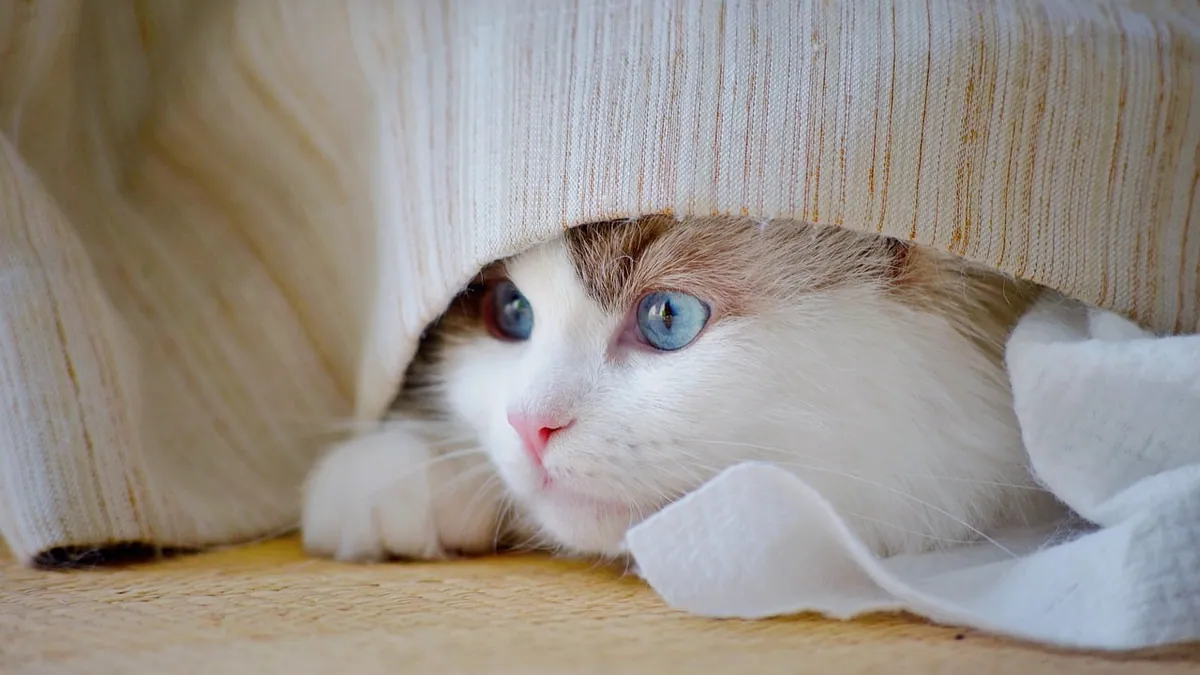
Most cats need a few days or more to settle into a new home, and hiding, cautious exploring, or eating less at first is normal [1]. The fix is usually a small quiet room, patience, and letting your cat set the pace. If your cat stops eating or hides for more than a day or two, that changes from a settling issue into a medical one.
This article is educational and is not a substitute for veterinary diagnosis or treatment.
Quick Answer
- Set your cat up in one small, quiet room with the door closed, and keep food, water, bedding, a hiding spot, toys, a scratcher, and a litter box in that room [1].
- Expect most cats to need a few days or more to settle in, though some adjust within hours [1].
- Let your cat approach you. Sit a few feet away and wait for contact instead of picking your cat up [1].
- Move your cat into the rest of the house only after they move around the first room confidently [1].
- Call a veterinarian if your cat has not eaten for 24 hours, especially a kitten, or if hiding, isolation, or excessive vocalization continues or worsens [2].
Why Your Cat Acts This Way
New spaces are overwhelming
Cats are territorial and rely on familiar smells, routes, and hiding spots. A new home removes all of that at once. The ASPCA recommends starting your cat in a small quiet room with the door closed precisely because open, unfamiliar space can overwhelm them [1]. That is not a sign your cat is broken or unfriendly. It is a normal response to a big change.
Hiding is a coping strategy, not a personality flaw
Cats in group settings use avoidance to reduce conflict, and they seek elevated or cat-only spaces when activity around them increases [3]. Your new home is full of unfamiliar sounds, smells, and traffic. Hiding is how your cat manages that load until the environment feels predictable. For more on this pattern, see Cat Hiding After Moving: How to Help Your Cat Adjust.
Some cats settle fast, most do not
The range is wide. Some cats settle in within a few hours, but most need a few days or more [1]. A kitten not adjusting to a new home often follows the same pattern, with the added factor that kittens are curious and energetic but also small and easily startled [4]. Give the process time before you decide something is wrong.
Your behavior matters to your cat's stress hormones
How you interact with your cat affects their physiology. In one study, passive interactions (being near your cat without forcing contact) were linked to higher oxytocin and lower cortisol, while forced interactions showed the opposite pattern [5]. Cats with secure attachment styles had more positive hormonal responses to human interaction than insecure cats, who showed higher cortisol or limited hormonal response [5]. In plain terms, sitting quietly near your cat does more good than grabbing them for a cuddle.
Medical Causes to Rule Out First
Behavior is often the whole story, but not always. A cat that hides and refuses food can be sick, in pain, or both. Cats in pain tend to withdraw, and cats with nausea or dental disease often stop eating before they show any other sign.
Two things make this harder to sort out on your own. First, cats hide illness well. Second, a move can trigger both stress and a flare of an existing problem at the same time. A cat with arthritis may struggle with a new home layout, and stress can make litter box habits worse. If your cat is older or has known mobility problems, see How to Help Your Cat with Mobility Issues at Home: Safe Adjustments.
Cats showing isolation and excessive vocalization have been found to have higher cortisol levels, a marker of chronic stress [2]. That does not tell you whether the cause is medical or behavioral, but it does tell you the behavior is worth taking seriously.
When It Becomes a Problem
Not eating
This is the line that matters most. A cat who skips a meal or two during a move is common. A cat who refuses food for a full day is not something to wait out. Cats can develop serious liver problems quickly when they stop eating, and kittens deteriorate even faster because they have less reserve. If your cat has not eaten for 24 hours, call your veterinarian.
Hiding that does not ease
A cat who hides for the first day or two and then starts exploring is on track. A cat who is still hiding in a closet a week later, or who comes out only at night when the house is silent, needs help. Watch for progress, even slow progress.
Other body signs
Vomiting, diarrhea, straining in the litter box, limping, breathing changes, or a cat who sits hunched and tense are all reasons to call a vet. These are not settling behaviors.
Litter box changes
Stress from a move commonly shows up in litter box habits. If your cat is going outside the box, see Cat Not Using Litter Box After Moving: How to Help and Cat Litter Box Problems After Moving: How to Help Your Cat Adjust. Rule out medical causes with your vet before assuming it is behavioral.
How to Help Your Cat Adjust to a New Home
Step 1: Set up the base room
Pick one small, quiet room. A bathroom or spare bedroom works well. Close the door. The room should contain comfy bedding, at least one hiding spot, toys, food, water, a scratcher, and a litter box [1]. Put the litter box away from the food and water. If the room is small, a covered box or a box placed in a corner gives your cat privacy.
Make the hiding spot easy to reach. A cardboard box on its side, a cat bed under a chair, or a blanket draped over a low table all work. Your cat needs a place to retreat that you will not pull them out of.
Step 2: Let your cat come to you
Sit a few feet away and let your cat approach you for petting or attention [1]. Do not reach into the hiding spot. Do not pick your cat up. Bring a book or your phone and just be present for 10 to 15 minutes at a time, a few times a day. Passive presence is the interaction type linked to lower cortisol in cats [5].
Talk softly. Offer a treat by placing it on the floor between you and your cat, then let your cat decide. If your cat takes the treat and retreats, that counts as progress.
Step 3: Keep the routine boring and predictable
Feed at the same times each day. Scoop the litter box daily. Keep the lights and noise level steady. Predictability is what lets a cat relax, and it is the main thing you can control in those first days.
Step 4: Expand the territory slowly
When your cat moves around the base room confidently, you can begin to slowly introduce them to the rest of your home [1]. Do this in stages. Open the door and let your cat explore the hallway on their own. Add one room at a time. Keep the base room available as a safe zone for as long as your cat wants it.
If you have other pets, do not skip introductions. See How To Introduce New Cat To Home for a structured approach.
Step 5: Build an enriched environment
Indoor cats do well when their space has resources to use. Indoor cats in enriched environments have litter boxes, hiding places, vertical spaces, and predatory play opportunities, and these features support low stress levels [2]. You do not need to buy much. You need to place what you have well.
Vertical space matters. Cats prefer elevated structures, especially when activity in the home is high [3]. A cat tree, a shelf cleared for your cat, or the top of a sturdy bookcase gives your cat a place to watch in published veterinary research. This is often the single fastest change that helps a hiding cat start coming out.
Scratching is a need, not a behavior problem. Provide plenty of cat-friendly scratching surfaces. Most cats enjoy both horizontal cardboard scratchers and posts, and posts should be sturdy and tall enough for your cat to get a good stretch [1]. Put a scratcher near the base room door and another near where your cat likes to rest. Reward your cat with treats and praise when they use them [1].
Play is medicine here. A few short play sessions a day with a wand toy help your cat burn off nervous energy and build confidence in the new space.
Step 6: Make the carrier a normal object
Leave the carrier out all the time in a spot your cat likes. Prop the door open, put comfy bedding inside, and feed a treat in the carrier at least once a day. You can also use play to get your cat running in and out of it [1]. A cat who rests in the carrier regularly is comfortable with it, and that makes future vet visits far easier [1].
What Not to Do
Do not punish hiding or refusal to eat
Punishment does not teach a cat to feel safe. It teaches a cat that people are unpredictable. Forced interactions, which include pulling a cat out of hiding or holding them when they want to leave, are linked to higher cortisol and lower oxytocin in cats [5]. That is the opposite of what you want during a move.
Do not force contact
Let your cat approach you [1]. If your cat walks away, let them go. You will get more contact over the next week by backing off today.
Do not flood your cat with the whole house
Opening every door on day one does not speed up adjustment. It removes the safe zone your cat needs. The ASPCA guidance is a small room first, then a slow introduction to the rest of the home once your cat is confident in that room [1].
Do not assume a quiet cat is a fine cat
A cat who hides silently and eats nothing may look calm. Guardians do not reliably judge their cat's stress level, and perceived stress reported by owners does not match hormonal measures [2]. Trust the observable facts: is your cat eating, drinking, using the litter box, and coming out at all?
Do not skip the vet because "it's just the move"
Stress and illness look alike in cats. If your cat is not eating or is showing body signs, a veterinary exam is the fastest way to know which one you are dealing with.
When to Involve a Veterinarian or Behavior Professional
Call your veterinarian the same day if your cat has not eaten for 24 hours, if a kitten has not eaten for 12 hours, if your cat is vomiting or has diarrhea, or if your cat is straining in the litter box. These need prompt evaluation.
Call right away, as an emergency, if your cat is having trouble breathing, is open-mouth breathing, is collapsed or unresponsive, is crying out in pain, or cannot walk normally.
Schedule a routine visit if your cat is eating and using the litter box but remains withdrawn after a week or two, if hiding is getting worse instead of better, or if your cat is showing new aggression toward people or other pets. A veterinarian can check for pain, dental disease, and other medical causes, and can discuss whether anxiety treatment is appropriate. Any medication dose is calculated by your veterinarian from your cat's weight and health, so do not use anything left over from another pet.
If your cat has been cleared medically and is still struggling, ask your veterinarian for a referral to a certified behavior professional. Behavior work is most effective once pain and illness are off the table.
Limitations and When to Contact a Veterinarian
This article covers common patterns, not your specific cat. Individual cases need a veterinarian who can examine your cat, ask about the move, and check for medical causes.
Contact your veterinarian the same day if your cat has not eaten for 24 hours, if a kitten has not eaten for 12 hours, or if you see vomiting, diarrhea, or litter box straining.
Go to an emergency clinic now if your cat is breathing with an open mouth, struggling to breathe, collapsed, unresponsive, crying out in pain, or unable to walk.
Schedule a routine visit if your cat is eating and using the litter box but is still hiding heavily after one to two weeks, if the behavior is getting worse, or if you are unsure whether the problem is medical or behavioral.
Frequently Asked Questions
How long does it take for a cat to adjust to a new home?
Most cats need a few days or more, though some settle within hours [1]. Progress is usually gradual, with short explorations followed by retreats. If your cat is still hiding heavily after a week or two and not eating well, call your veterinarian.
Why is my cat not eating after moving?
Stress suppresses appetite in many cats, and a new home is a major stressor. The concern is duration. A cat who skips a meal or two is common, but a cat who has not eaten for a full day needs veterinary attention because cats can develop liver problems quickly when they stop eating.
Is it normal for a kitten not adjusting to a new home to hide?
Yes, hiding is common for kittens in a new space, and kittens are easily overwhelmed by new environments [1]. Kittens have less body reserve than adults, so a kitten who refuses food for 12 hours should be seen by a veterinarian instead of watched at home.
Should I force my cat out of hiding?
No. Forced interactions raise cortisol and lower oxytocin in cats, while passive interactions do the opposite [5]. Sit a few feet away and let your cat approach you [1]. Provide a hiding spot you never reach into, and let your cat use it as a base while they build confidence.
Will my cat adjust faster if I give them the whole house right away?
No. A small quiet room with the door closed is the recommended starting point, and you should expand access only once your cat moves around that room confidently [1]. Full access on day one removes the safe zone and usually slows the process down.
Related Articles
- Cat Hiding After Moving: How to Help Your Cat Adjust
- How to Help Your Cat with Mobility Issues at Home: Safe Adjustments
- How To Introduce New Cat To Home
- Cat Not Using Litter Box After Moving: How to Help
- Cat Litter Box Problems After Moving: How to Help Your Cat Adjust
- How To Introduce New Cat To Cat
- Cat's First Day Home: Helping a New Cat Settle In
- Cat Moving House Stress: Symptoms and How to Reduce It
- Kitten Not Eating in a New Home: Normal or Worrying?
References
- Tips for a New Cat. ASPCA Animal Poison Control Center.
- Stress in Indoor and Outdoor Cats: Association between Hair Cortisol Levels, Housing Style, and Guardians' Perceptions of Behavior. Journal of applied animal welfare science : JAAWS, 2026.
- Cats in a Cat Café: Individual Cat Behavior and Interactions with Humans. Animals : an open access journal from MDPI, 2025.
- Choosing and Caring for Your New Cat. Cornell University College of Veterinary Medicine.
- EXPRESS: The hormonal effects of owner-cat interactions on pet cats of different potential attachment styles. Journal of feline medicine and surgery, 2026.