Is It Normal for Cats to Hiss While Playing?
By Dr. Zubair Khalid, DVM, MS, PhD ·
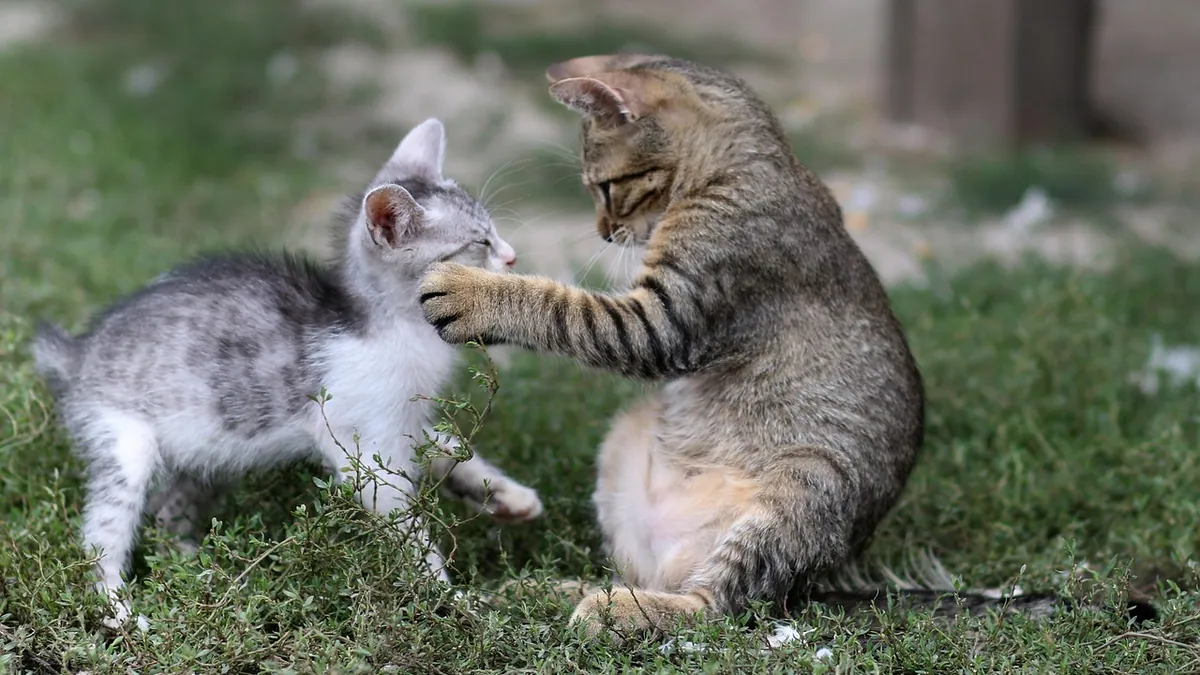
Yes, it can be normal for a cat to hiss while playing, especially during intense wrestling or chase games. Hissing is a warning sound, so it usually means your cat is excited, overstimulated, or setting a boundary with a playmate. The key question is whether the hiss comes with loose, bouncy body language or with tense, defensive posture.
This article is educational and is not a substitute for veterinary diagnosis or treatment.
Quick Answer
- A single hiss during a wild play session is often normal, particularly in kittens and young cats still learning bite and claw control [1].
- Hissing paired with a play bow, sideways hop, or pouncing is usually part of the game.
- Hissing paired with flattened ears, a puffed tail, hiding, or freezing means your cat is scared or defensive, not playing [1].
- Kittens hiss more often than adults because they are still learning social rules, and hissing is a normal warning signal across many species [2].
- If hissing turns into yowling, growling, spitting, or staring, treat it as aggression and separate the cats [1].
Why Cats Hiss During Play
Hissing is a warning signal. It is a non-vocal sound made by forcing air out, and it shows up across a wide range of animals as a way to say "back off" or "I am not comfortable" [2]. In cats, hissing during play usually means one of a few things.
Overstimulation and excitement
Play fighting can get intense fast. A cat may hiss when the action crosses a line, even briefly. This is common in kittens who are still learning how hard is too hard. Cats learn bite inhibition and claw sheathing when they are young, but how well each cat learns this varies [1].
Boundary setting between cats
When two cats play, one may hiss to say "that was too much." If the other cat backs off and play resumes with loose body language, the hiss did its job. Normal social play includes these small corrections.
Frustration during solo play
Some cats hiss at a toy when they cannot catch it, or when play stops suddenly. This is usually frustration, not fear. It tends to fade when you keep the toy moving and let your cat "win" at the end of the session [1].
Kittens hissing
Do kittens hiss? Yes, and it is often normal. Kittens hiss during play when they are startled, overwhelmed, or practicing communication. A kitten hiss during a wrestling match with a littermate is usually a normal warning, not a sign of a serious problem [2].
Medical Causes to Rule Out
Hissing that appears suddenly in a cat who never used to hiss can have a medical trigger. Pain is the most common one. A cat with dental disease, arthritis, an injured paw, or abdominal pain may hiss when touched or approached, even during what looks like play.
Other health issues can change behavior too. Cats with chronic stress may show more isolation and excessive vocalization, and those behaviors have been linked to higher hair cortisol levels, a marker of long-term stress [3]. If your cat's hissing is new, frequent, or paired with hiding, appetite changes, or litter box changes, a veterinary exam is the right first step.
Hissing at nothing, or hissing at a spot on the wall, is a different problem. That pattern deserves its own evaluation, and you can read more about it in Cat Hissing at Nothing: When to Worry About Hallucinations or Medical Issues.
Is It Normal for Cats to Hiss at Each Other?
Sometimes yes, sometimes no. The answer depends on what happens next.
Normal play between cats includes chasing, wrestling, batting, and pausing. A hiss can be part of that exchange as long as both cats stay relaxed between rounds. Watch for these signs that the interaction is still play:
- Ears forward or slightly sideways, not pinned flat
- Claws sheathed most of the time
- Roles switching, so each cat gets a turn to chase
- Short pauses, then play restarts
- No hiding, no avoidance after the session
Signs that it has shifted to aggression include hissing with yowling, growling, or spitting, plus intense staring [1]. If one cat hides, stops eating, or avoids the other cat's favorite rooms, the relationship needs management. This is especially common when a new cat or kitten joins the home, and the timeline for that adjustment is covered in Cat Hissing at New Kitten: How Long Will It Last?.
Is cat hissing always bad? No. Hissing is communication. It becomes a problem when it is frequent, when it escalates, or when it is paired with fear and avoidance.
When Hissing During Play Becomes a Problem
Use these markers to decide whether you are watching play or conflict.
Play that is fine
- Both cats return for more
- Bodies look loose and bouncy
- Hissing is rare and brief
- No one hides, flattens, or screams
Play that needs intervention
- One cat is always the target
- Hissing comes with growling, yowling, or spitting [1]
- Fur flies, claws come out, or someone gets scratched
- One cat hides, stops eating, or avoids shared spaces
- The hissing gets louder or more frequent over weeks
Rough play can lead to real aggression over time, and the patterns set in kittenhood can be hard to change later [1]. That is why early management matters.
What to Do Step by Step
Step 1: Separate calmly if things escalate
If a session turns into a real fight, do not reach in with your hands. Make a loud noise or toss a blanket between the cats, then separate them into different rooms. Give both cats 20 to 30 minutes to settle.
Step 2: Build a daily play routine
Make play part of your daily routine. Twice a day, set aside 10 to 15 minutes to play with your cat, ideally before meals [1]. End each session by letting your cat catch the toy one last time, then give a few treats [1].
Step 3: Make the toys move like prey
Wand toys should jump, fly, or skitter across the ground. Alternate fast and slow movement. Toys should move away from your cat, since prey does not walk up to a cat [1]. Some cats love flying toys and others prefer ground skitters, so experiment to find your cat's preference [1].
Step 4: Rotate toys and put them away
Use different toys each day so they stay interesting, and put interactive toys away when playtime ends [1]. This keeps the wand toy special and prevents your cat from treating it as a constant target.
Step 5: Manage multi-cat homes
Give each cat separate feeding stations, water, litter boxes, and resting spots. Add vertical space like cat trees and shelves so cats can choose distance. If hissing between cats is frequent, separate play sessions so each cat gets one-on-one attention.
Step 6: Reduce household stress
Cats showing isolation and excessive vocalization tend to have higher stress markers, so enrichment matters [3]. Indoor cats do well with litter boxes, hiding places, vertical spaces, and predatory play opportunities [3]. A predictable routine helps too.
Step 7: Track what you see
Keep a simple log of when hissing happens, who is involved, and what happened right before. Patterns become clear fast, and this record helps your veterinarian or behavior professional.
What Not to Do
Do not punish hissing
Never yell at, spray, or swat a hissing cat. Hissing is a warning, and punishing it can remove the warning without removing the fear. A cat who stops hissing may skip straight to scratching or biting.
Do not use your hands as toys
Playing with hands and feet teaches kittens to chase and attack people. It seems cute when they are small, but as the cat gets older and stronger, the bites and scratches really hurt, and by then the habit is hard to change [1].
Do not force interaction
Do not hold two cats together, put them in a carrier to "work it out," or push a scared cat toward the other cat. That raises fear and makes future meetings worse.
Do not assume hissing is always aggression
Hissing during a fast, bouncy play session is often normal. Assuming the worst can lead you to break up healthy play, which leaves cats under-exercised and more likely to act out later.
Do not ignore a sudden change
A cat who never hissed and suddenly hisses during gentle play needs a health check. Pain and stress both change behavior, and stress shows up in measurable ways [3].
When to Call a Veterinarian or Behavior Professional
Contact your veterinarian if hissing is new, if it comes with hiding or appetite changes, or if you cannot tell whether your cat is in pain. Your veterinarian can examine your cat, rule out medical causes, and discuss whether a referral to a veterinary behaviorist makes sense.
If the hissing is between cats and one cat is hiding, losing weight, or avoiding resources, ask for help early. Behavior problems that involve fear and conflict are easier to improve before the pattern is years old [1].
If your cat hisses and scratches when you try to give medication, that is a handling problem with its own solutions. See How to Give Your Cat a Pill When They Hiss and Scratch.
Limitations and When to Contact a Veterinarian
This article cannot tell you what is happening with your specific cat. Only a veterinarian who examines your cat can do that.
Call your veterinarian the same day if your cat:
- Hisses and then hides for hours
- Stops eating or drinking
- Hisses when you touch a specific body area
- Shows new hissing after a fall, fight, or injury
Go to an emergency clinic now if your cat:
- Hisses with labored breathing, open-mouth breathing, or collapse
- Has a wound, heavy bleeding, or a swollen painful limb
- Cannot urinate or is straining in the litter box
- Shows sudden weakness, wobbling, or seizures
Schedule a routine visit if hissing is new, gradually increasing, or paired with any behavior change. Your cat's individual case needs a veterinarian's assessment.
Frequently Asked Questions
Do kittens hiss while playing?
Yes, kittens often hiss during play, and it is usually normal. Hissing is a warning signal used across many species, and kittens are still learning how to use it [2]. Watch the body language. If the kitten keeps playing with loose posture, the hiss was just a quick correction.
Is it normal for cats to hiss at each other during play?
It can be normal when the hiss is brief and both cats keep playing. Hissing becomes a concern when it comes with yowling, growling, spitting, or intense staring [1]. If one cat hides or avoids the other afterward, treat it as conflict and manage the environment.
Is cat hissing always bad?
No. Hissing is communication, not a diagnosis. It becomes a problem when it is frequent, escalates, or pairs with fear and avoidance. A single hiss during a wild play session is very different from a cat who hisses every time another cat enters the room.
Should I stop play when my cat hisses?
Pause and watch. If your cat shakes it off and comes back for more with loose body language, you can continue. If your cat freezes, flattens its ears, or hides, end the session and give it space.
Can stress make a cat hiss more?
Yes. Cats with signs of chronic stress, such as isolation and excessive vocalization, tend to have higher hair cortisol levels [3]. More enrichment, predictable routines, and daily play can help lower that stress load. Talk to your veterinarian if the behavior does not improve.
Related Articles
- Cat Hissing at New Kitten: How Long Will It Last?
- Cat Hissing at Nothing: When to Worry About Hallucinations or Medical Issues
- Cat Hissing and Growling at New Baby: How to Manage
- How to Give Your Cat a Pill When They Hiss and Scratch
- Cat Coughing Once in a While: Hairball or Something More?
- Cat Having Trouble Coughing Up Hairball
- Is It Normal for Cats to Fight? Play vs Real Fights
- Is It Normal for Kittens to Play Rough With Each Other?
- Why Is My Cat Hissing? What It Means and How to Respond
References
- Cats Who Play Rough. ASPCA Animal Poison Control Center.
- Avian hissing sounds: occurrence, mechanism, ontogeny, function and phylogeny. Royal Society open science, 2025.
- Stress in Indoor and Outdoor Cats: Association between Hair Cortisol Levels, Housing Style, and Guardians' Perceptions of Behavior. Journal of applied animal welfare science : JAAWS, 2026.