Turkey Colors: Plumage Varieties Explained
By Dr. Zubair Khalid, DVM, MS, PhD ·
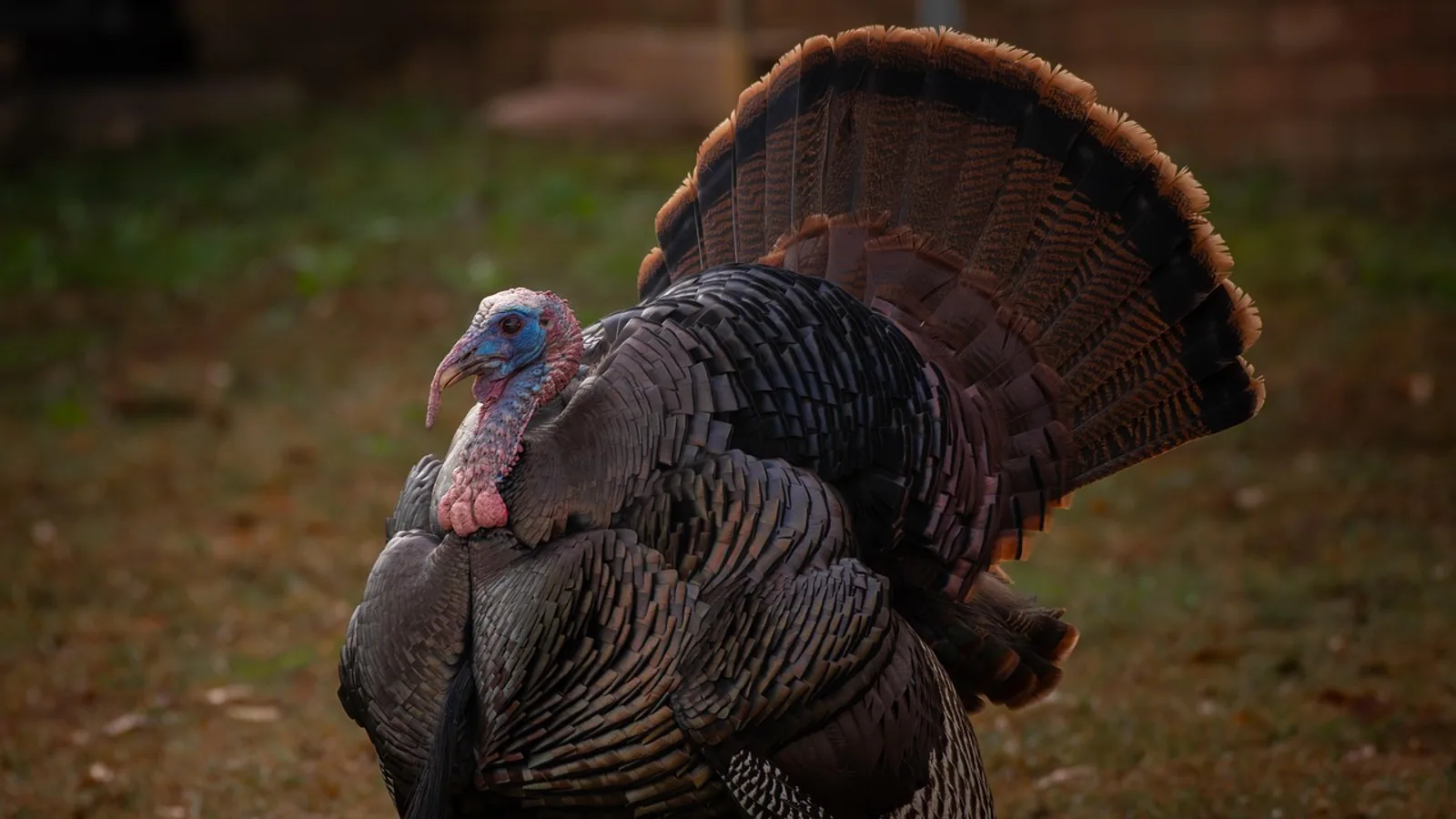
Turkey plumage color is controlled by a small number of genes that switch pigment production on or off and then redistribute that pigment across the feather. The wild-type color is Bronze, produced by the recessive allele b+ at the bronze locus, and nearly every named variety is a variation on that baseline: dominant black (B), recessive red (r), recessive slate (sl), and dominant or recessive white (W or w).
This article explains how those alleles interact, why two Bronze parents can produce a Slate poult, and how heritage color varieties differ from the commercial Broad-Breasted White. It covers the eight varieties most often kept in backyard flocks and gives a genotype table you can use when planning a breeding pen.
The Genetic Switchboard Behind Turkey Color
Feather color in birds comes from melanin pigments deposited into the developing feather by pigment cells called melanocytes. Two pigment families matter here: eumelanin, which produces black and dark brown, and pheomelanin, which produces red, tan, and buff tones. The genes that control turkey color decide how much of each pigment is made, where it is deposited, and whether it is deposited at all.
The master regulator is the melanocortin 1 receptor gene, usually abbreviated MC1R. This gene codes for a receptor protein on the surface of melanocytes. When the receptor is active, the cell makes dark eumelanin. When it is switched off, the cell defaults toward lighter or red pigment, or toward no pigment.
A 2010 study in Poultry Science sequenced the full coding region of the turkey MC1R gene and found four mutations arranged into five haplotypes. Those haplotypes lined up perfectly with the three known alleles at the bronze locus: B (dominant black), b+ (bronze, the wild type), and b1 (black-winged bronze). The researchers proposed that the dominant black phenotype comes from constitutive activation of the receptor, meaning the receptor stays switched on without needing a signal, and that this effect is probably caused by a specific missense mutation (c.364A>T, p.Ile122Phe). The recessive black-winged bronze phenotype, by contrast, appears to result from two deleterious mutations in the same gene [1].
That finding matters because it shows the bronze locus is not a separate mystery gene. It is the MC1R gene itself. When breeders talk about "the bronze gene," they are talking about MC1R.
A later study of Nigerian indigenous turkeys and British United Turkeys (a commercial line) examined selection signatures in MC1R across birds with different feather colors. It found evidence of purifying selection in the gene across all color types, which supports the conclusion that MC1R plays a central role in producing turkey feather color. The highest genetic differentiation in that study was between white commercial turkeys and black indigenous turkeys, and the lowest was between lavender and white indigenous birds [2].
Why "Recessive" Does Not Mean "Rare"
A recessive allele only shows up in the phenotype when an animal carries two copies. A bird with one copy of a recessive allele and one copy of the dominant allele looks like the dominant type but can pass the recessive allele to offspring. This is why two birds that both look Bronze can produce a Slate poult if both carry the slate allele.
Dominant alleles show up with just one copy. That is why Black spreads so quickly through a flock once a black bird is introduced.
Sex-Linked Barring and Dilution
Some turkey patterns are tied to the sex chromosomes rather than to the autosomes. Sex-linked barring produces the alternating light and dark bands seen on the wings and tail of some varieties. Because the gene sits on the sex chromosome, a hen needs only one copy to show the pattern while a rooster needs two, and breeders can use this to predict the sex of poults from certain crosses.
Dilution genes lighten whatever base color is present. Slate is the classic dilution in turkeys: it takes a black base and turns it into a soft blue-gray. The same dilution acting on a red base produces a lighter, washed-out red. Dilutes are recessive, so a bird must inherit two copies to show the diluted color.
The Eight Main Turkey Color Varieties
Bronze
Bronze is the wild-type color and the reference point for every other variety. The base color is black or very dark brown with a metallic sheen, and each feather carries a distinct coppery or bronze band near the tip. The tail feathers show broad black bands with white or buff tips, and the wing feathers carry bold white bars.
Genetically, Bronze birds are b+/b+ at the bronze locus. They produce normal eumelanin and deposit it in the standard pattern. The bright end seams of the dark pennaceous feathers and the bright banding of the primary and secondary flight feathers reflect ultraviolet light, which a 2017 study in Poultry Science confirmed using UV photography on bronze-feathered fattening turkeys. That same study found that the down feathers of slightly melanized plumage areas on bronze poults showed UVA fluorescence [3].
Bronze is the most common heritage color in the United States and the foundation of several standardized varieties. It is also the color most likely to be confused with wild Eastern turkeys, though domestic Bronze birds are heavier and less wary.
Narragansett
Narragansett looks like a Bronze bird that has been washed with gray. The base is black, but a dilution gene softens the black to a slate-gray or steel-gray tone, and the bronze banding is muted. The tail feathers show black bands with a distinct white or pale gray tip, and the wings carry gray and white barring.
Narragansett is a heritage variety from the northeastern United States. Genetically it combines the bronze base with a dilution allele, which is why the black pigment reads as gray rather than jet black. The pattern is essentially the same as Bronze, just lighter.
Because the dilution is recessive, Narragansett birds breed true only when both parents carry the dilution. A Narragansett crossed with a Bronze typically produces Bronze-looking offspring that carry the dilution allele.
Bourbon Red
Bourbon Red is a deep, rich chestnut-red bird with black primary and secondary wing feathers, a black band near the tail tip, and white underparts and tail coverts. The contrast between the red body and the black and white flight feathers is the variety's signature.
The red color comes from the recessive r allele, which shifts pigment production away from eumelanin and toward pheomelanin. The black wing feathers persist because the r allele does not eliminate black pigment everywhere, only in the body plumage. Bourbon Red is a heritage breed developed in Kentucky and named for Bourbon County.
Genetically, Bourbon Red birds are r/r at the red locus. They can also carry bronze, black, or dilution alleles in the background, which is why some Bourbon Red flocks show more or less black in the wings than others.
Royal Palm
Royal Palm is a patterned variety rather than a solid color. The base is white, and each feather carries a black or dark metallic band, usually near the tip. The result is a bird that looks white with a black-edged or black-tipped pattern across the body, wings, and tail. The contrast is high and the pattern is regular.
Royal Palm is a relatively small heritage variety and is popular in backyard flocks for its appearance. Genetically it combines a white base with a pattern gene that deposits dark pigment in bands. The white base can come from either the dominant white allele (W) or the recessive white allele (w), and the pattern gene sits on top of that base.
Because Royal Palm involves both a white base and a pattern gene, breeding two Royal Palms together does not always produce uniformly patterned poults. Some offspring come out mostly white, some come out with heavier dark markings, and some show an intermediate pattern.
White Holland
White Holland is a solid white turkey with a black beard, dark eyes, and pinkish-white shanks. It is a heritage variety, distinct from the commercial Broad-Breasted White, and it was historically kept for both meat and exhibition.
The white color in White Holland is generally attributed to the recessive white allele (w), which blocks pigment deposition in the feathers while leaving other tissues unaffected. That is why White Holland birds still have dark eyes and a black beard. A bird with the dominant white allele (W) tends to be white more completely, and the two alleles behave differently in crosses.
White Holland is a good example of why "white turkey" is not a single genetic category. Two white birds can carry different white alleles, and crossing them can produce colored offspring if the white alleles are recessive and the parents carry hidden color genes.
Black
Black is a solid black turkey with a metallic green or bronze sheen in good light. The beak, eyes, and shanks are dark, and the beard is black. The variety is sometimes called Spanish Black or Norfolk Black depending on the line.
The black color comes from the dominant B allele at the bronze locus. One copy of B is enough to produce a black bird, which is why Black spreads quickly in a breeding flock. The 2010 MC1R study linked the dominant black phenotype to constitutive activation of the receptor, likely caused by the c.364A>T mutation [1].
Black turkeys are not always uniformly black. Some birds show a bronze or greenish sheen that shifts with the angle of light, and some show a few lighter feathers in the wings or tail. These variations come from the background genetics of the individual bird, not from a different color allele.
Slate
Slate is a soft blue-gray turkey with a black beard, dark eyes, and slate-gray shanks. The body color ranges from a light powder blue to a deeper charcoal gray depending on the line and the lighting. The tail feathers are usually darker than the body.
Slate is produced by a recessive dilution allele, sl, acting on a black base. A bird must inherit two copies of sl to show the slate color. One copy produces a black bird that carries slate. This is why Slate can appear unexpectedly in a flock of Black turkeys if both parents carry the dilution.
The dilution does not change the pattern of pigment deposition, only the intensity. A Slate bird has the same feather pattern as a Black bird, just with the black pigment lightened to gray.
Beltsville Small White
Beltsville Small White is a small, solid white turkey developed by the United States Department of Agriculture in the mid-twentieth century for small households. It was bred to be a compact bird with a broad breast and a white plumage, and it was the precursor to the commercial Broad-Breasted White.
The white color is the same recessive white that appears in White Holland. The difference is body type and size, not color genetics. Beltsville Small White birds are much smaller than commercial broad-breasted turkeys and are kept today mainly by heritage breeders and small-flock owners.
Beltsville Small White is a good reminder that "white" is a color category, not a breed category. Several distinct turkey populations are white, and they differ in size, body shape, and background genetics.
Comparison Table: Turkey Color Varieties
| Variety | Base Color | Pattern | Genotype at Bronze Locus | Key Notes |
|---|---|---|---|---|
| Bronze | Black with bronze banding | Banded, wild type | b+/b+ | Reference color, UV-reflective feather tips [3] |
| Narragansett | Gray with muted bronze | Banded, diluted | b+/b+ plus dilution | Recessive dilution softens black to gray |
| Bourbon Red | Chestnut red | Solid body, black wings | r/r | Recessive red, black flight feathers retained |
| Royal Palm | White with black bands | Banded over white | White base plus pattern gene | Pattern variable in offspring |
| White Holland | White | Solid | w/w (recessive white) | Dark eyes and black beard retained |
| Black | Black with metallic sheen | Solid | B/B or B/b+ | Dominant black, spreads quickly [1] |
| Slate | Blue-gray | Solid, diluted | sl/sl on black base | Recessive dilution of black |
| Beltsville Small White | White | Solid | w/w (recessive white) | Small body type, heritage line |
The table lists the primary genotype for each variety. Real birds often carry additional alleles in the background, which is why color can vary within a variety.
Heritage Colors Versus Commercial Broad-Breasted White
The commercial turkey industry is built almost entirely on one color: white. Broad-Breasted White turkeys dominate because white feathers leave no dark pigment in the skin, which produces a cleaner-looking carcass after plucking. This is a processing advantage, not a health or welfare advantage.
Broad-Breasted White turkeys are not a heritage breed in the usual sense. They are a commercial hybrid line selected for rapid growth and heavy breast muscle. They are typically produced by crossing parent lines, so offspring do not breed true. A backyard owner who hatches eggs from a Broad-Breasted White flock will get birds that vary in growth rate and body shape.
Heritage color varieties are different. Bronze, Narragansett, Bourbon Red, Royal Palm, White Holland, Black, Slate, and Beltsville Small White are all recognized populations that breed true for color when mated appropriately. They grow more slowly, forage better, and are more likely to reproduce naturally. They are also the varieties most likely to show the color genetics described in this article.
The 2022 study of Nigerian indigenous turkeys and British United Turkeys found that the highest genetic differentiation in MC1R was between white commercial birds and black indigenous birds [2]. That result reflects the different selection histories of commercial and heritage populations. Commercial white lines have been selected for uniform white plumage for decades, while indigenous and heritage flocks retain a wider range of color alleles.
The choice between a commercial white turkey and a heritage color variety is a management decision. Commercial birds reach processing weight faster. Heritage birds live longer, forage more, and produce offspring with predictable colors.
How Color Genes Interact in a Breeding Pen
Color genetics becomes practical when you plan a mating. The following examples show how the main alleles combine.
A Bronze hen (b+/b+) mated to a Black tom (B/B) produces all B/b+ offspring. Every poult looks Black because B is dominant, but every poult carries bronze.
A Black tom that carries bronze (B/b+) mated to a Bronze hen (b+/b+) produces roughly half Black (B/b+) and half Bronze (b+/b+) poults. This is the classic test cross for detecting a hidden bronze allele in a black bird.
Two Slate birds (sl/sl) mated together produce all Slate offspring, because both parents contribute the recessive dilution. A Slate bird mated to a Black bird that does not carry slate produces all Black offspring that carry slate.
Two Bourbon Red birds (r/r) mated together produce all red offspring. A Bourbon Red mated to a Black bird produces offspring that depend on the background genetics of both parents, because red and black sit at different loci and interact.
Two recessive white birds (w/w) mated together produce all white offspring, but those offspring can carry hidden color alleles. If both parents carry bronze, some offspring may show color if the white allele is not fully epistatic in that genetic background.
The key point is that color is not a single gene. It is a set of alleles at several loci that interact. A breeder who wants to fix a color needs to know which alleles are present and which are hidden.
What Still Is Not Fully Understood
The MC1R gene explains the bronze locus and the dominant black phenotype, but it does not explain every turkey color. The red allele, the slate dilution, and the white alleles sit at other loci, and the genes responsible for some of them have not been identified with the same precision.
The 2010 study identified five MC1R haplotypes that correlate with three bronze locus alleles [1]. Other color loci in turkeys have not been sequenced to the same level. The genetic basis of the pattern gene in Royal Palm, for example, is not fully characterized.
The 2022 study of Nigerian indigenous turkeys found evidence of purifying selection on MC1R across color types, which suggests the gene is under functional constraint [2]. That is consistent with MC1R doing something important beyond color, but the full range of its functions in turkeys is not known.
The 2017 UV photography study found that white turkey down feathers fluoresce yellowish-green under UVA light and that white vaned feathers reflect UVA radiation, while bronze feathers reflect UVA mainly at the bright end seams and wing bars [3]. The biological significance of these UV properties is not established. They may relate to mate choice, flock recognition, or something else.
Practical Implications for Backyard Keepers
Color is mostly cosmetic in a backyard flock, but it has practical consequences.
White birds show dirt and injuries more readily than dark birds. A small wound or a patch of feather loss is easier to spot on a White Holland than on a Black turkey. That can be an advantage for early detection of problems.
Dark birds absorb more solar heat than white birds. In hot climates, a Black or Bronze bird may be more prone to heat stress than a White Holland. The 2022 quail study found that heat stress affected oxidative stress markers differently across plumage colors in Japanese quail, with the highest MDA level in the recessive white variety, though the differences were not statistically significant [4]. That study was in quail, not turkeys, so it should not be extrapolated directly, but it illustrates that plumage color can interact with thermal biology.
Color does not determine meat quality, egg production, or disease resistance in any way that has been demonstrated in turkeys. A Bourbon Red and a Broad-Breasted White raised under the same conditions will differ in growth rate and body shape, but those differences come from breed selection, not from the color alleles themselves.
If you are choosing a variety for a small flock, pick the color you like and the body type that fits your management. Then learn the genotype of your breeding birds so you can predict the colors of the next generation.
Limitations and When to Contact a Veterinarian
This article is educational and is not a substitute for veterinary diagnosis or treatment.
Color genetics is a breeding topic, not a health topic. If a bird's plumage changes color, loses pigment, or develops patchy or abnormal feathers, that is a clinical sign and not a genetic variety. Contact a veterinarian if you see any of the following:
- Sudden loss of pigment in feathers that were previously colored
- Patchy feather loss, broken feathers, or bare skin that was not there before
- Feathers that are misshapen, curled, or fail to grow back after a molt
- Skin lesions, crusting, or redness under the feathers
- A bird that is lethargic, off feed, or losing weight alongside a plumage change
- Any color change in a bird that is also showing respiratory, digestive, or neurological signs
A veterinarian can examine the bird, check for parasites, infection, nutritional deficiencies, or systemic disease, and determine whether the plumage change is genetic, environmental, or medical. Do not assume a color change is harmless just because the bird looks otherwise normal.
Frequently Asked Questions
What is the wild-type color in turkeys?
Bronze is the wild-type color, produced by the b+ allele at the bronze locus. It is the reference point against which all other turkey colors are described.
Why do two Bronze turkeys sometimes produce a Slate poult?
Both parents can carry a hidden recessive dilution allele. If each parent passes the slate allele to the poult, the poult shows the diluted gray color even though both parents look Bronze.
Is Black dominant or recessive in turkeys?
Black is dominant. A single copy of the B allele produces a black bird, which is why Black spreads quickly in a breeding flock.
What makes a Bourbon Red turkey red?
The recessive r allele shifts pigment production toward red pheomelanin and away from black eumelanin in the body plumage. The black wing feathers remain because the allele does not eliminate black pigment everywhere.
Are White Holland and Broad-Breasted White the same thing?
No. Both are white, but White Holland is a heritage variety that breeds true, while Broad-Breasted White is a commercial hybrid line selected for rapid growth and heavy breast muscle.
Can a turkey change color as it grows?
Yes. Poults have down feathers that differ in color from adult plumage, and the adult color develops through successive molts. A poult's down color is not always a reliable predictor of its adult color.
What is the difference between dominant white and recessive white?
Dominant white (W) produces a white bird with one copy of the allele. Recessive white (w) requires two copies. The two alleles behave differently in crosses and can produce different results when combined with color genes.
Do turkey colors affect health or meat quality?
No demonstrated effect on meat quality or disease resistance has been shown in turkeys. Color is a plumage trait. Body type and growth rate come from breed selection, not from color alleles.
Related Articles
- Goldfish Types and Varieties Guide
- Sexual Selection In Birds From Plumage To Song
- Pigeon Breeds: A Guide to Popular Varieties
- Budgie Cere Color Meaning
- Dog Eye Goop Color
- Dog Vomit Yellowish Color
- Goose Types: Breeds Compared for Eggs and Meat
- Funky Chicken Breeds: 12 Unusual Varieties to Know
- Bourbon Red Turkey: Breed Profile and Care
Further Reading
- A Triple-Allele Series and Plumage Color in Turkeys.
- Traditional sexing methods and external egg characteristics combination allow highly accurate early sex determination in an endangered native turkey breed.
Sources
- Variability of the melanocortin 1 receptor (MC1R) gene explains the segregation of the bronze locus in turkey (Meleagris gallopavo).
- Selection signatures in melanocortin-1 receptor gene of turkeys (Meleagris gallopavo) raised in hot humid tropics.
- UV reflection properties of plumage and skin of domesticated turkeys (Meleagris gallopavo f. dom.) as revealed by UV photography.
- Effects of heat stress on fattening performance, carcass traits, oxidant/antioxidant status, and hepatic heat shock protein 70 levels in different plumage colors of Japanese quail (Coturnix coturnix japonica).